← The GaryVee Audio Experience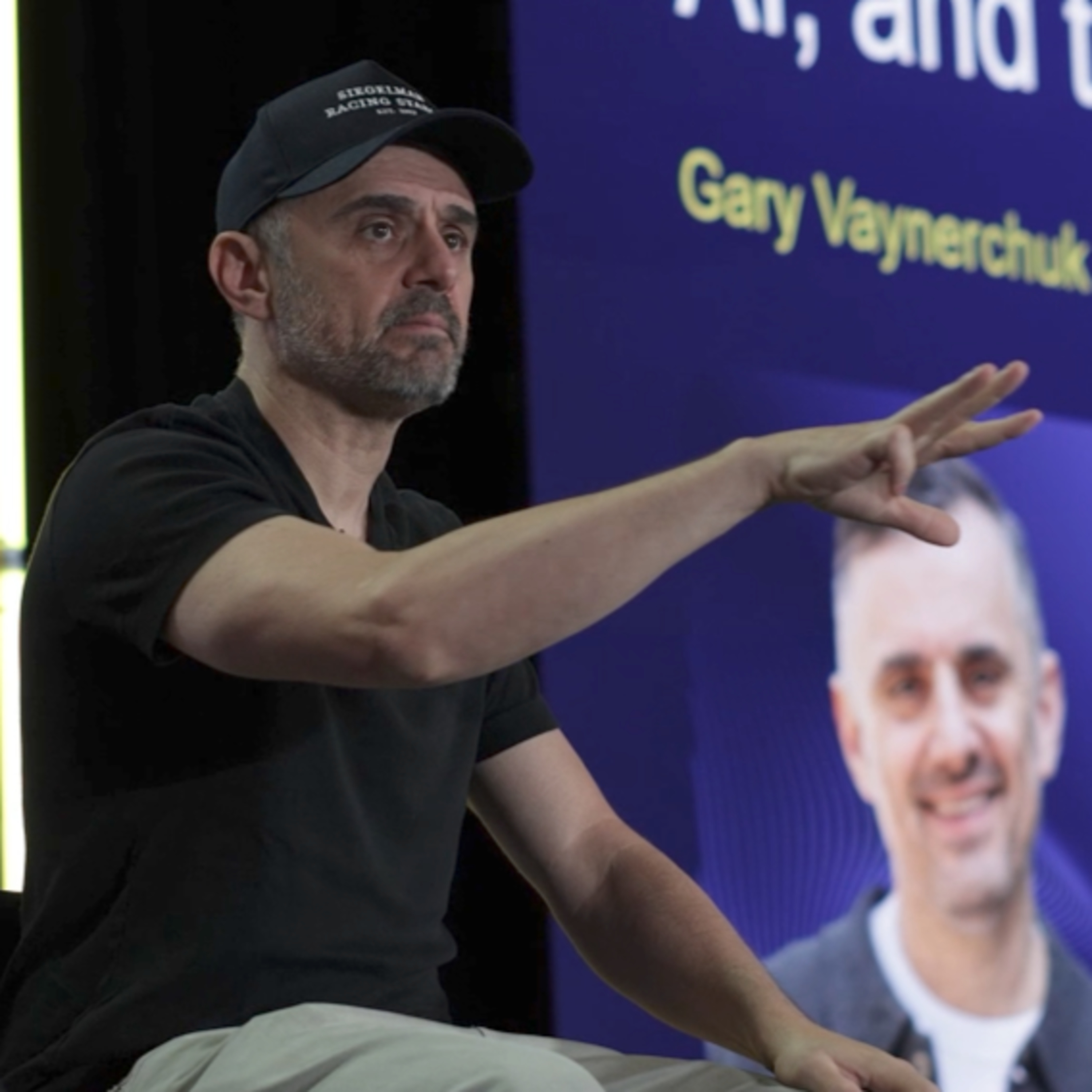
The GaryVee Audio Experience
The Entrepreneur’s Edge in the AI & Social Media Era | RightNOW 2025 Keynote PART 1
00:38:51
Loading summary
Transcript39 lines
- [00:00]
A
Morning.
- [00:02]
B
Great to be here. So, fun fact. I've known gary for about 15 years. I saw him speak in New York City and went up to talk to him afterwards because I was blown away. And we kept in touch and I was able to bring him to Tahoe to participate in a snowshoe event that we had when I was at Caesars Entertainment. He did a wine and food pairing and social talking was just amazing. So, Gary, I'm so thrilled to have you here.
- [00:27]
A
Thank you for having me. It's a pleasure. Good morning, everyone.
- [00:31]
B
All right, you'd like to get into it. I know he's got a lot to share with us, so I want to start talking about brand building and content. Before I do, I just want to share a little bit of who's in the audience. So you have everybody from solopreneurs to large piggybacked organizations. There are people who are doing books for construction companies. So across the accounting profession, we also have a wide range of services. So some are doing tax services and audit bookkeeping, but a lot of advisory services. And that takes many forms. So some are doing fractional cfo, trying to get in front of their customers on a monthly basis to share their knowledge and help them, help them grow and help the business succeed. Just being ready for the future. And so one of the things that I've heard is that not all of them, but not all their clients know their whole range of services. And so how can we be using content in an authentic way across social, but in other ways to tell their whole story and make sure their audience knows everything that they're doing and that their whole range of offerings.
- [01:35]
A
So what's interesting about being in this room is, and you might have saw quickly in the video, I grew up in a small family business, and for the last 15 years, I've been running a service business that started with me and my brother in a conference room in another company's company because we had no money and went from zero revenue in year one to we're in year 15 this year, and we'll do 350 million in revenue, all service. And. And then also I've had my career that I have, right? I've written predominantly marketing and business and leadership books, really ultimately for SMBs, but all the way up to private equity Firm and Fortune 500s. And what, what that context for this room means is what I'm about to say is not philosophy for me. It's not know teaching in a college what marketing is this morning. I can tell you that for 95% of this room. If this room was making one or two videos a day on their phone in their hotel room right now about insights or thoughts they have that impact their customers, whether it's through tax law or opportunities. If they just made a video and said, I'm Carl, I live in the outskirts of Columbus, Ohio, I'm a cpa, I do this. Here's the fun fact of the day or the thing that is top of mind or the biggest mistake people just made during this last tax season or where most of you just left money on the table. XYZ. XYZ. XYZ. And Carl upstairs posted that video organically on LinkedIn, on Facebook and then took $50 and ran ads in the five mile radius of his office for that video. $50 the five mile radius of his office. There is a stunning percentage likelihood that Carl would pick up a customer today. Do you know what else I know? None of those people in this audience did that today. So what do I think? I think that there is a naivete in the world and definitely in this room on how powerful social media marketing is. It's now been around long enough that it's not the shiny new thing. Many of you actually watch this. This will be fun for you, man. How many people here have tried social media marketing but it's not really worked for your business the way you've liked? Raise your hand. I'm sure it's plenty. Just raise your hand, please. Raise it high. Don't be shy. Right? All right. So the seven or eight people that raised their hand, which is a whole nother fucking problem, you're a psyche. But for the 10 to 12 people that raised their hand, you have to understand, because it didn't work doesn't mean that social media doesn't work. It means that they didn't do a good job at it. This is important to understand. I don't know if you know this, but if you play professional basketball, you make an extraordinary amount of money. I would really like to do that. I don't have the skill set to do that. Thus I don't get the results. I am going to spend the next hour here desperately trying to motivate, encourage, eliminate excuses of the collective group in here around contemporary marketing and technology. Because the history of business is completely easy to understand, which is the following. Whoever takes advantage of the opportunities, both in the technologies that are available to them at that moment and the marketing arbitrage that sits of the moment, win. When the radio was invented, many businesses exploded because we went from Just print to a radio device and some of the most iconic brands. Coca Cola leveraged a new medium called radio. Proctor and Gamble is one of the biggest consumer brand companies in the world because they were the leading advertiser on television in the 50s and 60s while their competitors were still figuring it out. Social media is disproportionately the most important opportunity for this room, and yet we continue to underestimate it. That is what I want to get everyone to understand in this room, that it will lead to new customers. And too many people here are relying on. On the word of mouth, of their reputation, of being in the business in their area for a long period of time, and they will get outflanked by people that use these platforms. And I think that's a mistake.
- [07:16]
B
Talk a little bit about, you know, the sort of range of people on social. A lot of people in this room, you know, have challenged getting staff when staffing was a giant issue for this profession. How can we be authentic with their social media posting and still live into who they are, but also attract and get in front of people who might be interested in working there, as well as just making sure their clients feel connected and engaged? Is this something that people do have a different way?
- [07:48]
A
Yeah. I mean, I think at the end of the day, I think a lot of you have built your careers through your people skills, right? It's not super complicated. I think people struggle to be authentic on camera because people are insecure and people change in front of a camera because they're worried about judgment. On the other side, humans buy from humans, and some people overthink variables. I think a lot of us in this room are not gen Alpha, and we remember where a suit and tie and the way you presented yourself was an imperative variable. I think we can all agree the world has become dramatically more casual. I'm wearing a baseball cap. Things have changed. And I think that the authenticity is an incredibly easy game once you understand what's actually happening here, which is humans will always buy from humans when they trust in. It's very hard to trust someone when you can feel it's not fully them. They're holding back. So all I would do is encourage people to not overthink what they're saying on video or in the written word or the copy that supports a picture they put out on these mediums, because that's what's hurting people. But I'll be honest with you, Monica, I'm not worried about that. I'm worried that I believe that every business in this room should be posting two times a day, minimally on these platforms to get employees and to get customers. And I think we're millions of miles away from that in this room.
- [09:32]
B
It sounds like your mistake is not making mistakes, it's not doing well at all.
- [09:37]
A
That's right. I think people have done a ton of different things with social media that's hurting you. I think a lot of you don't post on an ideology of what you think about social media. You know, there's a lot of people here who don't post on social media because they have a philosophical point of view about what social media means to society. I want the kids to go outside and play too. But your political views or your ideologies of how the world should be should be left at the door when we're talking about making money. So I think people haven't put in the work to figure out how to be good at it. What platforms do what? What does the first three seconds have to look like in a video to get people to actually watch it? What's the copy that it puts it? So there's just a lot of 101 hurdles that I want to get through. But you know, as far as employee acquisition it again, it is disproportionately the way things are working right now. This same 15, 10 mile radius advertising that I'm telling you about to get a customer is exactly how you're going to find those needles in the rough that you're looking for for employees. Because it is not lost on me the friction of this industry is now finding with the expectation of compensation that the youth they used to drive so much of the scale is looking for in comparison to what you can actually pay them. But good news, AI is going to replace them all and so you'll be fine.
- [11:12]
B
So I'm embarrassed to say that I spend more time on Facebook than other channels at my age and gender. Do they have to be in Instagram, TikTok and LinkedIn and Facebook if they want money?
- [11:28]
A
Like, what are we talking about here? You don't have to do anything. You're more than allowed to slowly go out of business. You know, man, I'm being serious with this. Like, look, what can I tell you? Like, I didn't want to wake up this morning and go to the gym. I really didn't. Like, I just think that this is we're talking about business and work. I didn't make up the rules. I'm not happy that marketing changes every minute. I wish it was the 1950s I would be Don Draper. I'd be in midtown Manhattan right now having a cocktail and doing business. I don't like that. This stuff changes. You've seen my career for 20 years. I've been on top of everything. Do you know what it feels like to be at the top of the game and then see TikTok come along and be like, damn it, now I have to learn all this too? Like, I'm not thrilled. I like easy too. I'm a human. Do they have to be? They don't have to do anything. But you're missing opportunity for customers and employees. If you're not on these channels, you're allowed to decide. But the world's changing. How many people here get business from Google AdWords? Raise your hand. Raise it high, please. I'm just trying to get a sense. Great. So for the seven or eight people that just raised their hands, again, a problem. We'll get to that in a minute. It. I mean, Google's in trouble. We are right now, as we all sit here, AI. How many people now use Chat, GBT or Perplexity to do search instead of just Google? Raise your hands. Look at. Raise it high. Actually stand up. If you don't mind, Please don't be lazy on me. I want your fellow teammates to see this.
- [13:06]
B
This is a good showing this.
- [13:08]
A
A. Please, please keep standing up. If this is you, this is important. This is a room that barely raised its hands for social media, marketing and search, and yet more than half the room. And again, this is not the Silicon Valley elite we're looking at right now. More than half the room right now is now using ChatGPT versus Google. This is a profound indication that I want you to see. What do you think's happening to Google adwords if all these people are no longer even seeing it? You can sit. Thank you. So things are changing. Google AdWords is going to look like the yellow pages in seven years. That's crazy. So for that gentleman in the white shirt and others that raised their hand, they're going to start losing those customers from that channel. We have to continue to adjust. That's. I just don't know anything else than adapt or die. I prefer not to die in business. It's a bowed outcome.
- [14:06]
B
Makes sense. All right, well, let's. Let's talk a little bit more about AI.
- [14:10]
A
Okay.
- [14:10]
B
Obviously it's here to say it's scary in some cases, but it can create efficiencies. What should this room be thinking about for AI in their day to day? I mean, you Just talked about Geny, but what else, you know, can offer?
- [14:24]
A
Well, I think, you know, it all depends on how you want to look at it. Like, the reality is this is the biggest technology shift that we've faced since the Internet itself. This is big, big. Let there be no confusion. This is the biggest opportunity to people in this room, and this is the single thing that's going to put people out of business in this room. It's black and white. I think, first and foremost, actually, this is a good question for this room. How many people in this room are retiring in the next five years? And I don't mean you're going to crush it and like, dominate the next five years and buy an island. I mean, you're old and you're finished. O2 me. Four, five, six. All right, so for this. Oh, seven. So for the seven people that just raised their hands, I have some good news. You'll probably be able to use one of my least favorite business strategies, which is this, on this issue, and probably see yourself out for the rest of the people in this room. And I could speak for five hours on why I think social media, videos and advertising will change your life. For as much passion as I have on that, I'd be willing for you to never do social media marketing in exchange for you spending one hour a day going forward learning about AI and using AI. This is big, big man. This is big, big, big, big, big. Nothing scares me, given who I am as a businessman and entrepreneur. This has eaten up an enormous amount of my time in the last year to protect myself from having my companies exist. Here's why. This technology will be better at doing my taxes for me than anybody in this room. And it won't even be close. That's it. I don't know what else to say. And it will take one second, and that's real. And I don't know how you don't focus on what does that mean? This leads to why I want so many people to build personal brand in here. I believe one of the few things that will be defensible in the next decade or two is people wanting to do things with you. And I think the way people want to do things with you is they discover you and see you every day on the Internet. But the task at hand is profound. The AI is able to do all the work, and that's that. And I don't know how to sugarcoat it. So there's a couple things in the next five years, 10 years before consumers fully go to a place where they are using these tools at scale for a lot of people in the next two or three tax seasons, if they listen to me and learn how to use AI over the next year, next year's tax season, it will be them and AI doing all the work. And they will never worry about the issues they're having with employees or outsourcing to the Philippines or anything else ever again.
- [17:45]
B
I think that's great news. I mean, this is a relationship business. Trust is paramount. If they can take away some of the menial tasks and focus on the relationships and the consulting, the it is.
- [17:58]
A
Where they make that second part. That second part. I think this is not lost on any of you. I know a lot of you are moving in this direction, getting into the consulting, you know, being the right hand, it's just, it's going to become imperative. Trust is going to become so uncomfortably important. Trust over task should sit as a sign about everybody's, you know, computer screen. You know, it should be your wallpaper on your iPhone right now. Trust over task, getting paid for just the blocking and tackling of what you've done historically is going to get harder and harder. Getting more integrated and becoming a considier to these businesses, I think has incredible merit and would be 100% what I would be doing if I was sitting out there.
- [18:51]
B
So this group would not say that they're bleeding edge.
- [18:55]
A
Leading edge, you don't say.
- [18:59]
B
But they want to be in the mix. They know that they need to be in the game. How can they be on trend related to AI and not bleeding edge?
- [19:13]
A
And by the way, when I say, you don't say I. I go to every one of these events with zero prejudgment or what have you. My answer is based on the fact that so few people are doing the social media marketing and the Google adwords. But I have good news. What's amazing about technology is you could have missed every trend of the last decade. And if you actually decide to get serious and do the homework an hour a day, what does AI mean? How do I use AI? And AI is crazy itself. You can use AI to get smart about AI. You can literally go into ChatGPT and be like, literally, this is what you type in. All right. This morning I was at a keynote with Gary Vaynerchuk and he made me feel some sort of way you could literally tuck these kind of things in. I am an accountant. I am a fractional cfo, whatever it might be. You can literally, literally talk to it on like literally for seven minutes. Seven minutes. The biggest issue right now for a lot of you using AI is you don't know how to be good at using AI yet. Remember, when we first started using search engines, we didn't know what we were doing either. The first time I used a search engine, I just typed in wine enter. I didn't know you got better at it. You're going to get better at using ChatGPT and things of that nature. But you can literally talk out and say, what are the 13 apps I should be using if I'm an accountant, to. To save myself 10 to 15 hours a week on tasks that I might be doing in Excel? I mean, it's incredible. Like, literally talk to it like you're talking to a therapist or a strategist. It's profound. I don't even type. I literally audio it, so I get every nuance of what I want in there. So I think what I'm excited about, what motivates me to continue to do what I'm doing right in this nanosecond, is I'm desperate for one person in this audience to hear me and say, you know what? I have an hour a day. Yeah. Like, I'm doing this for another 20 years. I don't want to fall behind. This is real stuff. Gary's not wrong. Let me put in the hour a day. And you can literally go from someone who's been not on the bleeding edge to being the most bleeding edge because you put in the work. I genuinely think about it like health and wellness. This will not be lost on this crew. I'm sure you're aware. Maybe you've lived this in your life or you've seen it in someone that, you know, some people do not live healthy for 20 years. Eating, drinking, staying up, like, no exercise, and then they just start. And it's a little ugly at first. It's hard. But a year later, it's a lot better. And that's exactly how I feel about this technology thing. You might have been the person that, like, passed on learning how to do Cousseur and you kept doing direct mail instead. You decided social media was stupid. You could have now apps like, you could be that person. And yet tomorrow you can decide that this keynote this morning motivated you and you agree, and now you spend an hour a day researching and you could be cutting edge in a year. And I could not recommend that more because I believe that this AI thing is big, big. And some of you are old enough looking around here to remember we underestimated the Internet and a lot of the Internet companies have been a problem for our business too. And this is bigger than that.
- [22:39]
B
All right, so not just in your business, you spend time with a lot of companies all year round as well. What's an example? And it doesn't have to be AI, specifically other kinds of automation, but how it. What's a great example of a company that used automation or AI to sell their strategic services or build another business, like, do something drastically different?
- [23:01]
A
Well, I mean, you know, what's. That is just, I would argue that's the plight of everything. Let me give you an example. When the iPhone was invented, it changed the landscape, right? And so when, when I, I basically think of that as the watershed moment that we all live in today. I mean, when I think about companies that have built things, I think about things like Uber, like completely transferred, like Waymo. I mean, self driving. Like, like, what about the way people order from restaurants? Do you remember, again, this is what's fun, not talking to a high school crowd. Like, you remember that we used to like, have to go into our kitchen drawer and find a menu and call the restaurant and stay on hold and place the order. And like, my answer to your question is everything. Like, every business has transformed. People have taken market share, People have evolved. Look what's happened to retail. Like, everybody in this room now has the expectations that they can order a blender and it should be at their house in a couple hours, not wait to Saturday to go to, you know, like, I mean, it's funny how that question formed in my head, man. Like, I don't think anything's the same. Look at dating.
- [24:31]
B
Again, that's actually worse in some ways. I mean, not, I mean, just like the apps instead of the personal connection. I don't know. Like dating, that's a hard.
- [24:41]
A
Yeah, but, but it's, but remember, like, the app is just a gateway drug to get you there, right? It's just a technology to get you to the date. I, I do not think like, randomly going to bars with the hope of finding your spouse 30 years ago is some ideologically better thing than using an app to find someone you're attracted to or have a conversation with to then create a date later. Right. I think that what we do is society and business people are very good about being romantic about yesterday and demonizing tomorrow. I remember a couple years ago when people were like, you should send people letters. That's good. I'm like, why, why did we put like writing on a piece of paper and sending it in the mail on this ideological Pedestal versus sending a text. I understand why we did it. We decided that that was more effort and meant more. But so is like walking instead of driving. So is a million things. I think we are incredibly scared of being left behind. But I want to remind everybody here, you're only left behind if you choose to be lazy. Exactly. All right. But I want to say something that's important to me. This room is full of judgment. You're business owners and executives. You've judged Gen Z workers for the last five years. You love to say, in my day, during tax season, I would have worked 800 hours a week and got paid a dollar. These fucking kids are full of. Right, Right. This crew has judged the living crap out of. A lot of people in this room have been successful. You've judged. You have so much pride in how hard you've worked. I know this crew. I am this crew. Here's my problem. Why are you being lazy now? You judge people being lazy and things that come easy to you. I'm not interested in what comes easy. I'm interested in what comes hard. I get that you didn't grow up with AI and social media. News alert. I'm 49. I didn't either, but I put in the work. Well, it got quiet in here.
- [27:20]
B
Mon, I want to talk about something that I saw this week from you that spoke to me.
- [27:26]
A
Okay.
- [27:26]
B
And it's about how we feel as. Oops, sorry. How we feel as humans. There was a post that got into.
- [27:35]
A
What you give out, you get back.
- [27:38]
B
And it's about our narrative. And if you think about what you post or actually a conversation in your kitchen, you're talking about a ski trip, and all of a sudden, we all know 30 minutes later we're seeing destinations and ski sales in our fees. But you talked about if you're trying to feel better and be more positive, what you put out there is what you get back. Can you talk about that? Because I thought that was amazing.
- [28:04]
A
What I was referring to in this piece of content that went viral this last week is people think the algorithm is changing you. A lot of you have demonized social media because you think it's bad, and it's trying to pump certain things. What I don't think any of you realize is your news feed, your algorithm, is actually exposing who you actually are, not changing who you are. And in the video, I said, you want me to prove this to you? I've got a way to do it. And by the way, I hope some of you do this. What I'm about to say if you want to go into Facebook right now or Instagram or whatever app you use, TikTok, if you go into the search at the top and you type in motivation, positivity, good news, good vibes, happiness, joy, you type that in and you get results. In those results, you go to all the videos, 20, 50 in the video. I said 200 of them. And you like 200 of them. And you leave 25 comments on the posts. The next morning when you wake up, your entire algorithm will look different. The end. The end. And so I think that humans have become incredibly good at not being accountable. We have become the generation, including our generation, of pointing fingers, not thumbs. It's this president's fault, it's that president's fault, it's my mom's fault, it's my dad's fault, it's my boss's fault, it's China's fault, it's everyone's fault but ourselves. Because I'm such an advocate for marketing on social media, I'll be at an airport, it's happened several times in the last year. And a parent will come up to me like, gary Vee, big fan. But I gotta tell you, I really don't like that you push social media. It's really bad. And I don't like my 14 year old being on TikTok. And I look at these people and I'm like, so take it off their phone. The hell do you want from me? I'm literally talking about these things from a business lens. I'm not telling people that it's good for their health or they should do it. If you don't like it on your child's phone, be a goddamn parent and delete it off the phone. Amen is right. In the same way that I'm concerned that a lot of people have ideologies or political views about these things right now and not using it for their business. I, if, if I didn't like, you know, you know this about me. I'm inherently incredibly private. I've posted more than any human in the last 20 years. But none of my family, no pictures of my kids, none of my personal beings. I'm private. I don't want to share that. I view these things as business tools. This is marketing and sales and recurring revenue and real life that you need to pay your income and your taxes on and your, your life is dependent on your business. These tools are incredible for that. But yes, I think that a lot of people in this room, if you don't like what you're getting in your feeds and you're feeling depressed, it's because you got sucked into fear. My friends, mainstream media pushes fear both sides. It's all fear based. And then humans on social media amplify that stuff. It's just fear. And I don't believe in that fear. The data is very, very black and white, my friends. Let me say this nice and slow to everybody. I really want you to leave with this. This morning. As we sit in this room this morning, this is the greatest moment to be alive as a human being for life expectancy, for civility, for all the things that you think are happening bad in the world. People are. Mom, it's so crazy. People are like, gary, the kids especially are really sucked into this bullshit. They're like, gary, it's never been worse. First I'm like, bro, do you know what the Holocaust was? Do you. Have you ever. Did you have history class? Do you know what the black plague was? You know, Hiroshima is like. Like, people are like, you know that everybody used to die of heart attack. Our grandparents generation all died of heart attacks. We, we didn't have that figured out yet. Remember when people, like when most of this crew was kids, when somebody lived to 60, we're like, oh, not bad. And so I think people are delusional and have bought into the wrong narrative. And so to answer your question fully, you don't like what your feed looks like, you can change it today, in two hours. The end. Love it.
- [32:34]
B
All right, let's talk a little bit about making the shift. So again, we want to move toward an advisory mindset. How does this group, this room, become more entrepreneurial and innovative?
- [32:49]
A
Look, I think I always think about the path that has least financial, you know, because I was born in the Soviet Union, so I grew up very, very poor. Immigrant life. Like my family business had no money. So everything I think about is how do you use the least amount of money to make the most amount of stuff to happen? And that's why I'm obsessed with social. I don't know if you know this. It's free. Like, you know that's crazy, right? Like, I'm a marketer. Like direct mail, newspaper, ads, radio, television, billboards. I did all that stuff for my family business that all cost money. When you send direct mail, like, hey, use me for taxi, that costs money. Social media is free. Free. So I believe the. And I'm just going to be very prescriptive about this. I believe people in this room taking a phone to their face every day and Giving advice as if they were giving advice to a client in front of them. Things to think about. You know what's amazing about this group is that it has incredible amounts of experience and pattern recognition of what common problems are, mistakes people make, issues. If you put that out there, it will come back to you. I believe that is the entrepreneurial spirit that people need here. Which is the biggest opportunity in marketing history to get new customers is sitting in front of them right now. And most of us are not taking advantage of it. And I hate to be a dead horse, but I also hate making up stuff that isn't true. There's not a lot of things I can think of that are going to crush for this room with very little cost. That is the thing. Daily videos on Facebook, especially Facebook, because after you post a video organically on your page, this little move that I keep telling you about, to spend $50, $100 to amplify the video locally is the best tactic for businesses in this room right now.
- [34:48]
B
All right, so I mentioned earlier the staffing challenge.
- [34:52]
A
Yeah.
- [34:52]
B
And potentially for the younger people, but it goes beyond that. So what about culture? I mean, you talk a lot about culture. Talk about how this room can build a culture of innovation, A culture that they can attract not just younger people, but also engage with their audience.
- [35:11]
A
How many people here have more than 5 employees? Raise your hand. Love it. So let's start with that part. I could not recommend more until I had 150 employees in my company. I met with every employee one on one multiple times a year. Dinners, group dinners, one on one dinners, 15 minute meeting, check ins. The way you build culture is by giving a crap. There are people in this room who have 10 employees who've not had a one on one for an hour with two of their employees in the last three years. Because we get caught up in other things. I get it. But I could not recommend more the thesis that has built every one of my businesses, which is I work for them, they don't work for me. The second you actually believe that, and I'm not saying that up here as like a cheerleader, rah, rah, rah. I'm saying it because I believe the number one vulnerability a lot of you have is lack of retention. Right. That's what you don't want to happen. I know, I know your business well enough to know, right. You'd like to have the same crew. It's easier. I really believe the way you retain people is by caring about them and realizing that they all have different wants. And needs. I think the thing that was really eye opening to me growing up, you know, my father spent the first 23 years of his life in the Soviet Union. And so when I started working for my dad, he was the scariest, meanest boss I had ever seen. He was really tough on his employees. And it was just Soviet stuff, you know, it was just. Because in the Soviet Union, I know you guys are a bunch of Americans. Let me educate you on what goes on over there. It was all black market. Everybody stole from every thing because it was all communism and it was just yucky. So literally when I was 14, this is a funny story real quick for one second. The first day I ever worked in my dad's business, I was 14 years old. We lived 40 minutes from the store. My dad wakes me up at 7am I'm like devastated. This sucks, you know, like he's dragging me to the store. My dad is the opposite of me. The dude does not talk. So we literally, literally drive 40 minutes and my father does not say one word to me. We pull up into the parking lot, he turns to me and in a heavy Ivan Drago accent, looked at me and said, keep an eye on the employees. They steal. That was the culture I was brought up in. And every essence of my body thought it was wrong because my mother was a complete angel and saw the world completely different. And I was raised by that woman at that point. I promised myself at 15 that I would be the best boss of all time. The biggest thing that I learned in this quest to be that good is that employees have different wants and needs and it changes every year. The reason I want you to meet with your employees all the time is because this year Johnny wants a $5,000 raise. Maybe you don't want to give it to him, but that's what he wants. And maybe in three years, because he just had his first child, he wants a little more work life balance during tax season, which you may not want to give, but by talking to your employees constantly, you will have a better pulse of what makes them tick. And it will give you the optionality to be able to feed that appetite at the time, which creates a higher propensity for you to create the retention that you're looking for. I believe in culture over everything. Absolutely over everything.