Loading summary
Transcript56 lines
- [00:03]
A
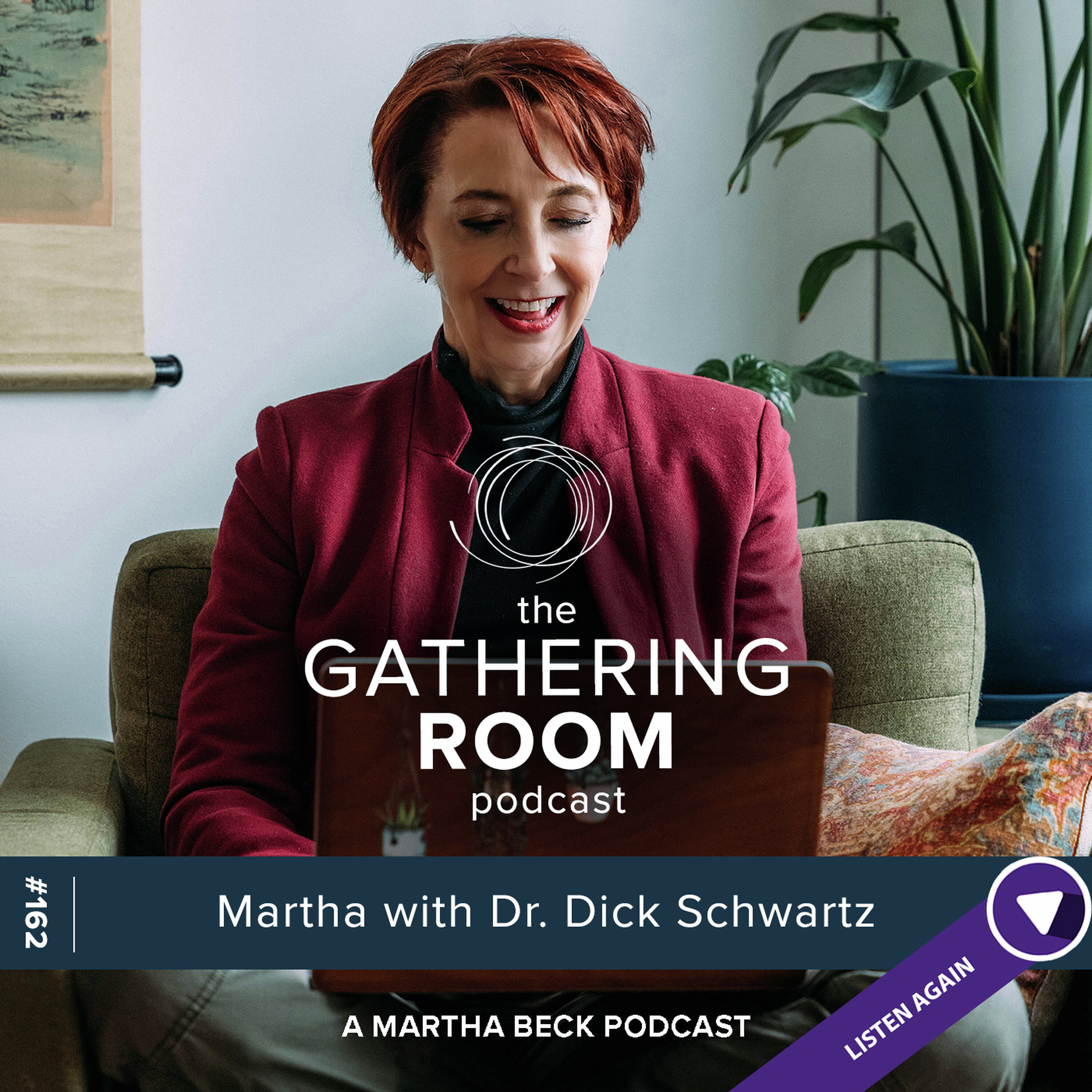
Welcome to the Gathering Pod, the audio version of my weekly gathering room broadcast. I'm Martha Beck. Hi, everyone. I am here today with one of my heroes. There are not many scientists, therapists, psychologists, who not only create powerful strides forward in theory and in practice, but also somehow become rock stars of their profession, and especially when they don't have any egoic investment in. In being that Dick Schwartz started out in the 80s, and I'll let him talk more about it, but he began to create and. And teach a form of therapy called internal family systems therapy that has revolutionized the way therapy is done. I heard about it maybe 10 years ago. By five years ago, I said, I gotta get me some of that. Signed myself up with an IFS therapist. Still doing it. She's amazing. And I started reading more and more. And here's the thing, Vic. People don't just talk about how brilliantly IFS works, and they don't just talk about how amazing you are. They love you. Like, I've never seen anything like it. In. In the forwards to these very academic books or papers online, people say I've got to acknowledge Dick Schwartz. And it feels like they step out of their academic or scientific Persona and just say, oh, my God, this man. I love this man. So, I mean, I feel the same way. And I'm. I'm here to. To praise loudly your latest book, you are the one you've been waiting for, which is about relationships, and I do want to talk about it, but I also, before we started recording, was just talking to Dick about how he kind of slogged along out there in the world with these incredible ideas for decades before suddenly it just went absolutely supersonic. So for those of us who are out in the world plugging away and, you know, grinding toward what we hope, what we feel is most true, but it hasn't worked yet or hasn't kicked in yet. I'd love to hear a little bit of your story about how you went from a therapy maverick on the fringes to this godfather of a new way of doing therapy whom everybody adores.
- [02:48]
B
I have to say that's probably the loveliest intro I've had in one of these. So it's always great to be with you, Martha. Yeah, it's been quite a journey. And as I was saying before, we got on, because there were many, many lonely years where I would beg people to come to the trainings and we were losing money. And so this is all very. I wouldn't say uncomfortable, but unfamiliar, this territory, the last six, seven, eight years so, and, and welcome. But yeah, back in those days I was kind of insecure about it. I mean I, I saw the big vision of it and I really kind of believed it. But I, there are parts of me that could this be real? And, and so I think I was also quite defensive about it because of that, because I wasn't really secure. And so I probably came across that way at times. And so the degree to which people say I'm, I'm a good person now, they didn't say back in those days a lot of the time in the early days because I, I was cranky and kind of, you know, to bring something like this to the world, you have to have a reasonable amount of ego. And I had a lot to counter the worthlessness that I felt coming out of my family. So, so part of, you know, as we were saying earlier, I think part of why it's taking off is because over the years not only did I keep teaching it, but I kept working on myself so that I could heal a lot of the parts that were driving these protectors to get in my way. And so yeah, to degree that people say I'm humble now, that's a huge compliment. I, I, that's very hard earned. In other words, so, and it's true, I mean I don't feel like I've got to get accolades all the time that I, in the way I did back then.
- [04:54]
A
The other thing that differentiates you to me, and this is again a tribute to the parts work that you do on yourself and that to everyone and that's affected my life as well. And that is that so many people are like grasping and proprietary about their new ideas, like don't take that, that's mine. You are the opposite. You are so generous. You're like take, you know, learn from anything, take it out there. There is such, there is such a consistent exhibition of the true intent to alleviate human suffering as the driving force behind your whole life. I may be reading too much into it, but I've been following, you know,
- [05:37]
B
not many people have said that to me. So it really is moving to hear that because that has been a big goal of mine and, and you know, a value to not try and control it and own it. The only time that we get a little bit hard ass about it is around training programs and oh yeah, that's mainly for quality control because our trainings are very expensive to run. We have a 3 to 1 ratio with assistance to students. And so there are others who are trying to say if you do this three day thing, you're certified in ifs, so we have to do something about that. But otherwise. Yeah, I, you know, it feels like it was a gift given to me. And it's not mine. It's something to, to spread.
- [06:26]
A
So this is, I call this the gathering room. And I do it once a week just because I have a side of my personality or I have a part that. Many parts, actually, that are very spiritual. I, I just finished reading a psychologist named Lisa Miller. Two books that she's written about the biological underpinnings of spirituality and how there's a neurological capacity for a spiritual life that's born into us and that our culture, it denigrates it, it dismisses it even. And you actually make space. I also think this is one of the great powerful things about your system. And certainly this book, which I will talk about that there is space in ifs for the part of humanity that has a spiritual inclination. And you, you. I know people have been pilloried in your profession for even suggesting that there might be something real in our experience of spirituality. But you said, just before we started, you said you're, you're sort of coming out of the closet with that a little bit. Yeah, just a word or two about that.
- [07:39]
B
Yeah. You know, I, I started out, I come from a very scientific family and medical science. And so. And I had a kind of atheistic to agnostic position myself. And then I ran into what I call self with a capital S in people. Even people who'd been horribly abused.
- [07:59]
A
Yeah.
- [07:59]
B
So there was no way to account for it in traditional psychological thinking. And so over time and just seeing this over and over, I had to say there's got to be some other explanation for this. Because I, I searched through science to find it. And it wasn't until some students started saying, well, maybe it's like Buddha nature, or maybe it's like, you know, Atman in Hinduism, or maybe it's, you know, and, and I would look into that. And indeed they were describing the same thing that I was finding as an essence in people. It's just that what I had found was it's just covered over by these parts such that if they open space, it comes out spontaneously and undamaged and knows how to heal. So as I was getting all of that, I really had to shift toward the data, which is that there is something beyond, you know, our bodies that, that is in there. And yeah, so for me now, what I call self with a capital S is, you know, in quantum physics, they talk about Light being both a photons being both a particle and a wave. So there's this particalized state in us of a bigger wave that, you know, you can access if you meditate in certain ways or you can access through psychedelics and, and where you don't really feel. You just feel fully connected to everything and you, you're not even aware of your body. And then, then as you come back in, you particleize and you now, oh yeah, there, there is a me that's different from other people, unfortunately, because it's a kind of blissful state.
- [09:45]
A
Yeah.
- [09:45]
B
And you know, we have work to do here, so we do need to have this drop of that ocean in us to be able to do that work. But yeah, so for me it's, that's that, you know, there are many spiritual traditions that would share that view of the, of human nature.
- [10:03]
A
Yeah. And that's at really at the core of ifs and the core of this book. I don't have a copy. I read, I've been reading mine on, on Kindle and I got the audio book and they're both brilliant. The book is called you were the one you've been waiting for. And it's about relationships from the perspective of a. A view of the mind where that self that Dick is talking about, the, the in inherent and I believe divine self, whatever you want to call divine, is actually the part that of you that is there to heal you and that you have multiple other aspects of yourself, like little parts that have been split off for one reason or another. I'm vastly oversimplifying this. Dick does a brilliant job of it. But the, the point is if you can access this part of you, it can fix the other parts of your. Integrate them. And that this way of hand, your own inner life is the best hope you have for a really, really wonderful romantic relationship or any other relationships as far as I can see. So it's. This is one of the best books on relationship you will ever hear about. Go get it.
- [11:18]
B
Thank you. Yeah. You know, we all come out of our families with what I call these exiled parts that were, in my case, given the message that I wasn't valuable. So they carry the burden of worthlessness or parts that carry terror or, or a lot of emotional pain. And when you have those kinds of exiles that didn't get what they needed is these inner children that didn't get what they needed from parents, then they start looking and other protective parts of you start looking to get that from an intimate partner.
- [11:56]
A
Right.
- [11:56]
B
And so you Recruit you. You kind of search around to find this sort of savior person who. What. What we call infatuation is that feeling of, oh, my God, there's somebody who resembles my parent who actually loves me and shows me that I'm valuable. So it's. They're a redeemer. That kind of help you let go of the curse of worthlessness.
- [12:24]
A
Right.
- [12:24]
B
And that's very intoxicating. The problem is that at some point, because they do resemble that parent, they act like that parent, they hurt you in the same way. And when that happens, your protective parts go into what I call one of. I think it's four projects. Either they focus on getting that person to change. And so you start to badger them about, you know, stop yelling at me or stop or. Or whatever it takes to get them be different. Yeah, be. Be the. Be the loving person you were when I first hooked up with you. And usually that doesn't work. And so then you start to change, try to change yourself and maybe lose weight because you think that's the issue. Or. Or you stop yelling so much or so all your protectors are criticizing you and aspects of you. And you know, sometimes that doesn't work. And so at some point your protectors start looking around because they think this person wasn't the right redeemer out there. And ultimately, when that doesn't work, some people then just kind of give up on getting it from a person and look to some other activity or something else to distract them or. And just, you know, kind of write off people.
- [13:58]
A
Y.
- [13:59]
B
That's pretty much what I was finding in the couples that I was working with. That one partner would come in one. In one project, the other would be in another project and.
- [14:09]
A
Fascinating.
- [14:10]
B
Well, go ahead.
- [14:12]
A
You have such an incredible way of using simple story, like images that. That carry the meaning so concisely. There are two things that I especially loved. One is the way you contextualize this in sociological terms, because I was trained as a sociologist. So when you started talking about how we are trained to look for a redeemer in our romantic partner and we are trained to believe that they have to look exactly. They have to be like this. And there's a way that men are supposed to be, and there's a way that women are supposed to be, and we're supposed to save each other and the whole sociological, along with the pressure of, like, just earning a living, you describe it as a virtually undoable task to be each other's redeemer in that way. And so it's nice that you step back and looked at the. At the society. And the other thing is, I love the story of the magical kitchen that originally came from Miguel. What was Ruiz was the last name of the author. I was wondering if you could recount the story of the magical kitchen just briefly, because it's one of the ways in which you made it come to life really vividly in my mind with so few words.
- [15:38]
B
Well, I have a terrible memory, so I. I kind of have the gist of it, but I. It'd be easier if you recounted it.
- [15:45]
A
Okay, you tell me where I'm wrong. I like that.
- [15:47]
B
Okay.
- [15:48]
A
What he says is, imagine that you grow up in a. In a house where the kitchen is overflowing with good food and people are cooking and they're having a good time and everyone is totally fed. And then somebody comes to the door selling beer and pizza and ice cream, and all the children go, no, we're good. We really like our family's cooking. So he goes off, and maybe then you meet another family. Say that your mother meets the father of another family, and they both cook beautifully, and they join the families, and now they have even more food. And it's a. It's wonderful. And the siblings aren't competitive. They're just, you know, thrilled by the abundance. And then you said, actually, it's more like most people's lives are more like this. You're born with parents who cannot always feed every part of you, and they disapprove of parts of you, so you kick those parts of you down into the basement where they starve, and. And there's a little food coming from the kitchen. It might not be great. And nobody is really fully fed. And then the pizza and beer man comes, and there people are like, oh, my God, you're here to save us. And then you go addicted to pizza and beer, and. And then people meet each other and try to combine those things. And there's competition and there's rivalry, and there's. There's scarcity, of all things. And then you say, look, the food is love. And the household. We're talking about the whole house with all its occupants is all you. You have to find the source of the delicious food within your own household and keep all those little children out of the basement and well fed, or you'll fall for an addiction or you'll fall into conflict. It was just a really vivid description. And that. That thought of becoming the house with the kitchen that is always creating abundance, that is access to self. Yeah.
- [17:49]
B
That's total. It's what a wonderful. I'm so glad I asked you to
- [17:53]
A
recount it because I'm so glad you wrote it.
- [17:56]
B
Such a wonderful rendition. Yeah. And that's the solution. The solution. Turns out that there is this person inside what I call the self, who instead of your partner becoming that caretaker of your exile parts, you do that. So you become the primary caretaker attachment figure, the primary parent almost to these young parts. And you get them out of the basement and you have them come and see the light and you feed them and you help them unburden. You help them out of where they're stuck in the past. And as you do all that, then your partner can become the secondary caretaker.
- [18:43]
A
Yeah. Yeah.
- [18:44]
B
Most of us have that reversed. We want our partner to be the primary caretaker attachment for your. For these very vulnerable parts of us. And when they don't. And. And they can't really. They can't do a perfect job of it. So anytime they don't, then there's this huge explosion and. And. And then my protectors set off yours and we're off to the races and. Yeah, and that's the way most couples come in to my office. Not back when I was doing a lot of couples therapy. So. And so a lot of the work was to get each of them to do what I call a U turn in their focus.
- [19:26]
A
I love that phrase. Talk more about that.
- [19:28]
B
Yeah. So again, most of us come in focused on getting the other person either by changing ourselves or. Or ch. Directing our change attempts at them, getting the other person back into the redeemer role. And they want the therapist to do that too.
- [19:47]
A
Ah, yes.
- [19:49]
B
And so it's. It's kind of jarring to clients when I'll say, no, let's both. I want both of you to take a second and just notice what's happening inside yourself as you have this fight. Notice the parts of you that are doing the talking and then notice what they're protecting inside. Notice these very vulnerable, starving parts of you that. That really are driving the whole thing. And most people can do that. It's sometimes hard for them to do it in the presence of their partner because. Feels a little dangerous. So I'll. I might do it individually and then with each partner and then have them come back. So not only do I have them notice all that, but I have them begin to shift and get to know these protectors and. And help them see there is this other person inside of them who can handle their partner, can handle life, and can also feed these exiled parts the way that they can. And so. And if. If the other partner is witnessing this, it's very powerful to watch your partner doing this work and. And see what's driving all of that and see them actually starting to change all that themselves.
- [21:11]
A
So that really is like. I'm thinking there are probably people out there watching this going, okay, I accept that I have to be my own source of love, but I'm exhausted and I don't have infinite food inside me. You're just asking. You're trying to get blood from a stone here. And I remember feeling that way many years ago when I was trying to deal with a marriage that would end and raise kids and everything. That path to self, that is access to the magical kitchen. Like, what I want people to hear and what you do so brilliantly is you don't ask a part that feels overwhelmed or exhausted to be self, but somehow your help and the way. Maybe it's because you've done this work so deeply yourself. There are certain people, in my experience, when you talk about a field versus a particle versus a wave, I think people exist in morphogenic fields. And some people who are in touch with self within them seem to be able to help people who haven't connected yet make that connection.
- [22:24]
B
That's right.
- [22:25]
A
That, to me, is like the absolute core of this whole process. So we. We don't have much time left. What would you say to people who feel like, yeah, I want to get to the part of me self with a capital S. I believe you that it has infinite love and can heal all my parts. How do I find it? How do I get there?
- [22:49]
B
Yeah, you know, it turns out in most people, it's much easier than most spiritual traditions would tell you, because all it takes is convincing these protective parts to open space. And now if you're. If you have a history of being really burned by many, many people, that can take some convincing. But it turns out once they open a little space inside, self is right there and it pops right out. It's. It's not like you got to build up the muscle of compassion or. Or whatever. It's just all right there. So a lot of my job is to create in my relationship and also my office a sense of a high level of safety and lack of. Of judgment and all that. So if I can be himself, if I can, you know, as I was itself was popping out of lots of people, I began to try and categorize the qualities that would show up. And so we have what we call the eight C's of Self love. So, you know, if I can check and see, am I. Am I purely curious? And do I. Am I calm and. And do I have a lot of confidence and compassion? So those are half of them. And then it's harder to tell if I'm feeling creative or not. But creative creativity is one courage. Do I have the courage to really stop them when they're. They're fighting?
- [24:20]
A
Yeah.
- [24:20]
B
And do I have clarity? Can I see them clearly? Am I. Or am I distorting their image from parts of me? And then do I feel connected to each of them? So if I can check on that and make sure that I'm in that state, and if I'm not, I simply ask certain parts to open more space.
- [24:43]
A
That's. I just got to note that I can go a few minutes long if you can. Good, because I want to talk about this, but finish what you were going to say.
- [24:52]
B
If I can come in in that state as a therapist, then each client senses the safety of my presence, and that helps their protectors relax, and then they access more self. So self is contagious. Yeah, One person can hold a lot of self. It's sort of like the tuning fork, you know, that they resonate in each person, and you get a lot more self in the room. And once you have more self in the room, healing just starts to happen. I don't even have to work. Yeah.
- [25:26]
A
Fascinating. Sometimes I talk about. I've lived in Asia for a while. I talk about the Asian concept of awakening. And at one point I started to think maybe it's like a virus. You catch it and you start to awaken, and at a certain point, you become highly symptomatic. And when you become symptomatic enough, it becomes much more contagious. So there you were out working on your theory and on yourself. And then at a certain point, you got highly symptomatic of being self almost all the time. And I think, like it immediately, the power with which the theory went out to so many people, medical people, people in all different fields of social work therapy. I read widely in these fields and the impact it made so suddenly, almost. I really think it's because of this transmissible tendency in the brain to awaken. And I think you've been doing that. And. And at this stage, you are extremely contagious. So y' all who are watching you are now infected with awakening by Dr. Dick Schwartz. But the interesting thing when you said open space. So there's this Asian story about a scholar who goes to a Zen master and he says, I. I have been studying my whole life, but I don't know enough to be enlightened. I. Something must be missing, and please teach me. And the Zen master says, have some tea, because he's a Zen master. So he hold. The guy holds up this teacup and the guy pours the scalding water. And when the cup is full, he keeps pouring and it goes all over his hand and burns his hand. And he screams, what did you do that for? And that's the end of the story. And because that's Zen. But the point is that the one thing he's missing is emptiness. The one thing he's missing is spaciousness. And when I heard that as an American, I was like, emptiness means eternal loneliness. I've got to fill myself. And Asian philosophy says different. It says that emptiness is alive and spaciousness is what's lacking when you feel like there's not enough. So you like that. This is another hinge of your theory. You found a way to help people open space within their psychological systems and then self steps forward into the space. So it's a not doing instead of an addition. It's like a subtraction. Can you just. You described me once before the. When you first realized that you could ask parts of yourself to step out the way you would ask different people to step out of a room. If we can get everybody watching this today, I usually do a meditation in the gathering room that is on spa, where you just focus on the space inside your physical body, which is almost 100% empty space. So this is another version of that meditation, folks. This is like, very simply, if I'm sitting around going, oh, I'm so depressed, and everybody hates me, and I hate my partner and I want him to change or her to change or whatever. And your goal was to help me open up space. What would. What would you have me do?
- [28:56]
B
Well, the first thing I would have you do would be to find the part that was saying that in your body or around your body, people can do pretty readily. And then I would ask you how you felt toward that part of you, and you might hate it because. Right. Yeah. So for me, that's a polarization between this part that's unhappy all the time and then the part of you that wants to get rid of it and wants you to be strong and so on. And so to start out, I would ask the one who hates it to give us a little space so we can just get to know the other one. And in the. And most of the time, I You know, I have to do some convincing sometimes, but much of the time, you would sense this shift in energy out of this place in your body, and there would be a lot more space, and then you would feel more self. And I would ask now, how do you feel toward this one? And you would say some version of, I'm sorry, it feels so bad, I want to help it, or curious about why it feels so bad, what it needs from me, or something like that. And then I would know, because not just the words, but the tone of voice and your face, now we've got the critical mass of self, and it's just that simple a lot of the time.
- [30:15]
A
I love that. That is a beautiful, elegant experiment that I would like everyone out there to try for yourself today and enlightene, just experience the power of the simplicity of this theory. I read a, A something online the other day that said the polarization in our culture right now, it's mirroring the polarization of an ego that has divided in two. And that's what Dick was just saying that you, you'll get like, there's a part of me that like, oh, everybody hates me. And there's another part that goes, stop it, you whiny. And if I can ask the whiny, okay, I'll go over here. Okay, whiny, what do you need from me? I just want to lie down. Okay, we'll do that. And then those two polarizations subside, and where in the space they have left, the self does not grow, but is revealed.
- [31:15]
B
Okay.
- [31:16]
A
And this Instagram post said maybe the polarization in our culture with such ferocious antipathy everywhere is the screaming of an ego that is always loudest just before it dies. And her idea was that there's another part of all of us and each of us that is ready to awaken at a level we've never seen before.
- [31:40]
B
That's what keeps me going. That's. You know, I've. I've worked with so many individuals who had horrible backgrounds and horrible polarizations when we started and all kinds of symptoms. And, you know, when I started, I thought, how is this ever going to change? But as soon as we access a little bit of self, everything does start to change. It really kind of magically things very quickly. And so I have. That's what keeps me going is the idea. Because as she was, I guess she was saying, our culture is like that now. Our culture has so many exiles and then so many extreme protectors that are so polarized. There's not much self to be found Anywhere. But if we can all bring some, like you said, it's contagious. If we can all start to bring some, things can change pretty quickly.
- [32:40]
A
I think that's. We saw during the pandemic how it went upward so quickly. And. And I've always believed in something since I was a small child. I felt something, and later came to call it by the. With the phrase. Label it with the phrase, the transformation of consciousness and human consciousness. That's what keeps me going too. And I think Dick Schwartz right here in front of us is one of the first. He's. He's an icebreaker for a transformation of human consciousness. And at first it was a long, cold, lonely road, but because you've continued not only to practice, but to practice what you preach, but to share it so generously with people like us who are watching you right now. I have hope for the whole catastrophe. I have hope for the whole human species, because I do think that self is stepping forward by the. By the billions, I hope.
- [33:46]
B
Absolutely.
- [33:47]
A
And you've shown us such a simple and beautiful path to making that happen.
- [33:52]
B
Yeah. And I. I strongly feel like you're doing the same kind of work. And, you know, it's. There's a number of us that are trying to bring this. And it's so great to connect with you and have company on the journey this way.
- [34:06]
A
I feel so much gratitude and, and just the. The depth of my admiration and. And gratitude toward you is absolutely inexpressible. Those of you who haven't read Dick's work, please go and get it. All his books are brilliant. This last one, you are. The one you've been waiting for, is the best book I've ever read on relationships. If you want your. Your consciousness to transform in a way that will leave you much happier, this. This guy can really help and has helped. So, Nick, thank you again for being with us.
- [34:41]
B
You're always, always great to be with you, Martha. Yeah. Thank you for having me again.
- [34:47]
A
Okay, Take care. I wish I didn't have to say goodbye, but I've kept you too long already. Thank you again for everything.
- [34:54]
B
Is very, very welcome.