Loading summary
Transcript123 lines
- [00:00]
A
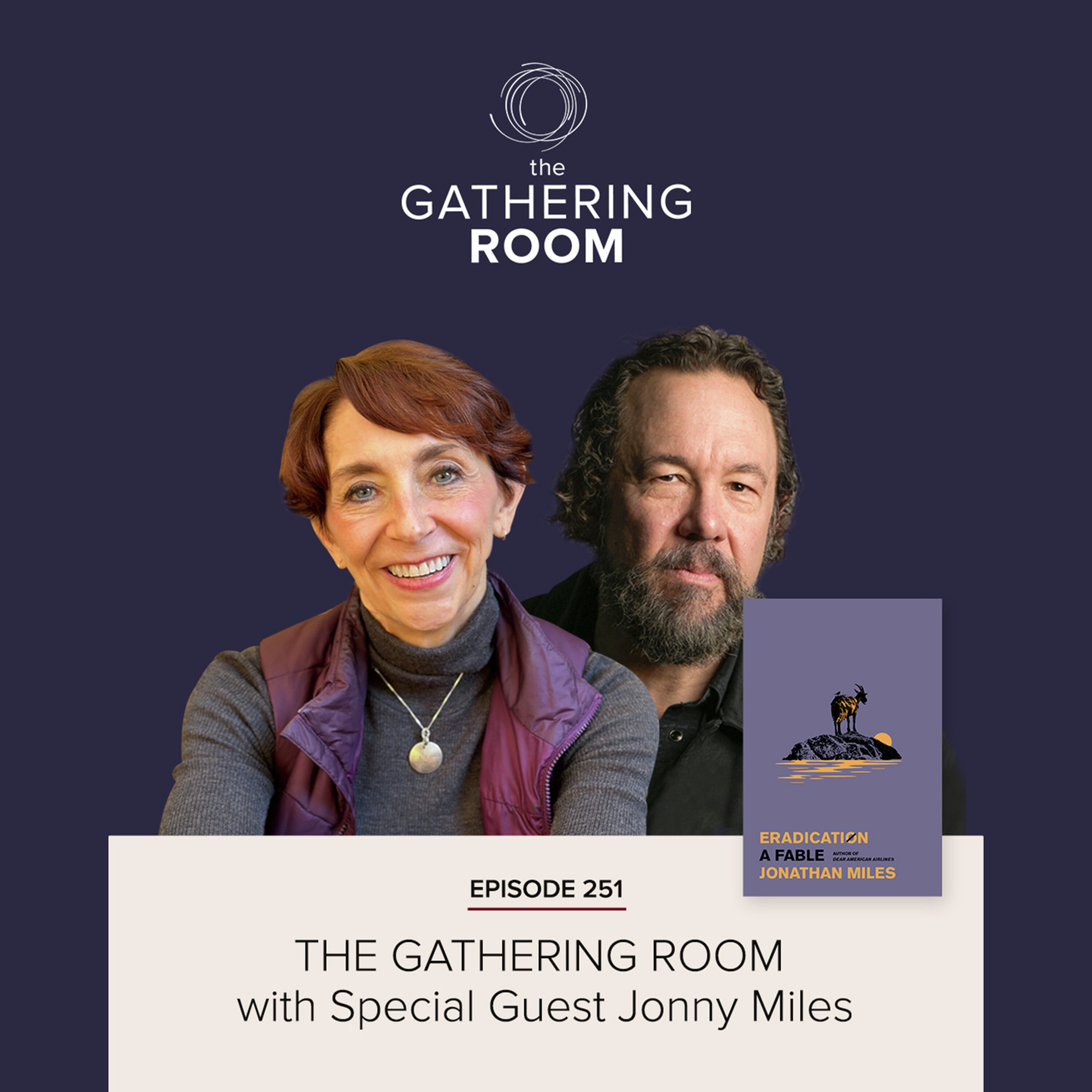
People are always asking me, how did you get into training life coaches? And the answer is backwards. I did it backwards. That is, I didn't set up a program and then look for people to fill it. It's just that so many people were coming to me for coaching that I realized in order to serve the market, I was going to have to train other people in my methods. That was decades ago. And now the Wayfinder program contains all my very best wisdom and tools for living, boiled down to their savory essence. Now, if that sounds interesting to you, head on over to MarthaBeck.com and find your way. Welcome to the Gathering Room Podcast, the audio version of my weekly Gathering Room broadcast. Hello, all you Gathering Room listeners. Today I have an incredibly special, special guest. Jonathan Miles is one of the best authors I have met in my life, and I didn't even know he was an author when I met him. I met him first, thought he was a wonderful person, then read this book, Eradication, a fable. Go buy this book or stay home and order it. Just get it one way or another. This is one of the most brilliant pieces of literature, and look how little and easy to read it is. Deceptively, I must say. I'm going to save my comments for our conversation. So do you go by Johnny or Jonathan here in Literate World?
- [01:32]
B
Johnny? Yeah. Nobody. Yeah, nobody calls me Jonathan. Yeah.
- [01:35]
A
Okay. So welcome. Welcome, Johnny. Thank you for coming on the show. Show. Oh, podcast.
- [01:42]
B
I'm absolutely. I'm honored to be here and. And honored by your. Your. Your words about the book. Thank you.
- [01:47]
A
Okay, so let me tell a story about how I came to read it. I have a friend who is my editor at Oprah Magazine. When I was writing there. I'm the editor in chief, actually, and she gets special permission to read books before they're actually released to the public. She has some sort of an app that only editors can get. And she called me and she said, oh, my God, there's this book that is not like any book I've ever read. You've got to read this book. And she tried to get me to download the program that she was on, and I couldn't do it. So she actually physically gave me her Kindle that had the book on it so that I could read it right away without any delay. So I did, and here it is again. So I was not disappointed. Before I start asking you questions, Johnny, I just have. I have to give you my feedback. My feedback is, first of all, I thought, if this doesn't get a Pulitzer Prize, there is no justice in publishing. There has never been justice in publishing. But I still think it deserves a Pulitzer and any other prizes it can get. Your writing style is like nothing I've encountered anywhere. It is so unusual to get a voice in that is incredibly fresh, like nothing you've read, and yet better than anything you've read. It's so succinct. Jonny's prose is incredibly lean, and it has that delicious quality of feeding you a story that is a whole universe with galaxies and stuff. And it's all in a simple little line. It's extraordinary. And also, then there's the message of the book, which I think is a deep, profound, necessary thing that actually, like, physiologically changed things in me without any effort on my part. I mean, this is. This is truly how I define great literature. And it's fun to read. It's not a choice. It's not Finnegan's Wake. It's a little bit like Hemingway, but better, in my opinion. Um. So. Yeah. So, Johnny, I liked your book.
- [04:09]
B
Yes, thank you. I don't know what to say to all that, except. But thank you. Thank you.
- [04:15]
A
You're welcome. Now, I met you, I think, at a Halloween party in New Jersey, and I knew you as a musician.
- [04:23]
B
Yeah.
- [04:24]
A
When my editor gave me your book, I thought, jonathan Miles. Jonathan Miles. Could that be the same person? No, he's a musician. So I don't know that much about you, despite having met you a couple of times. Could you. You seem to be living the life of a naturalist, artist, mystic, or something like, very much in keeping with the audience of the gathering room. So could you just tell us a little about yourself and how you came to be such an extraordinary creator?
- [04:55]
B
Yeah. So I am also a musician. And those, I guess, we have to track back to childhood when those two things I almost said braided, but they didn't really braid for me until later. I started writing early and then switched my energy over to music with adolescence, sort of more natural outlet. Right. For a teenager, and made my living, or something like a living as a musician for some time in Mississippi and. And then returned to writing, and I have been writing novels ever since. And then about two, three or four years ago, I. I started, you know, playing music professionally again with John Batiste and went on his first tour, the Uneasy Tour, as part of the band with him. And it wasn't until then that I understood the connection between those two endeavors, those two enterprises. Right. I always thought of them as. As existing in separate containers inside myself. There was. There was the Writing and there was the music. And maybe they were distantly related, like cousins, by the fact that they're both creative enterprises, but I didn't see any connection to them. And it's not until recently that I've made that connection that they're both manifestations of the very same impulse, which is that. Well, you know, I think that, that, that, that storytelling and, and music emerged from the very same place around the very same time. That place being, you know, a campfire thousands and thousands of years ago when people realized and began using rhythm and, and narrative and melody in order to find some sort of spiritual order in from the chaos of survival. Right. To, to, to find a way to sort of metabolize everything that had happened to them and everything they'd felt. And so with that in mind, I think that whether you're, you're making music or whether you're writing novels, you're. Your objective is the same. It is to, it's to make people, is to make people feel right, to move them, to make them think, to make them remember, to make them wonder and maybe to make them dance, but. But ultimately most of all to make them feel right.
- [07:39]
A
Yeah.
- [07:40]
B
To nudge them maybe even just slightly in a different direction towards some kind of fresh intensity is what you hope for. So I think they are related. Yeah.
- [07:54]
A
Oh, very. That's a really, really beautiful analysis. And I love the, the image of the campfire because you're also very much a naturalist. Right. Like, I, I know you through our mutual friend Liz Gilbert mostly. And she's described your family to me as living in a very sort of authentic way.
- [08:16]
B
I think the word I've heard her use on occasion, it's the word feral.
- [08:19]
A
But yeah, it's okay. Yeah. And I've met your. Your kids. They're amazing. Your wife. The whole family is amazing now. Exactly. So are you, like, off the grid or. Well, obviously we're, we're zooming. So you're not completely off.
- [08:38]
B
Yeah, no, yeah. This is proof.
- [08:42]
A
This is proof.
- [08:42]
B
I'm undergrad. I did live off the grid.
- [08:46]
A
Did you?
- [08:46]
B
Many years ago. In a 12 by. Yeah, in a 12 by 30 cabin in the woods in Mississippi.
- [08:53]
A
Wow.
- [08:54]
B
For years.
- [08:55]
A
How many years?
- [08:56]
B
No phone. I did have electricity. Oh, gosh. Seven. Wow. It was blissful. But it's very difficult to. To do nowadays.
- [09:09]
A
Now, were you raising a family then or were you by yourself?
- [09:13]
B
No, no, no, no, no. That was. I was by myself then. So no. But we. Now we live in rural New Jersey. Top of a hill. We have a Little. I wouldn't call it a farm. Maybe a farmette. Farmellini, small farm. Raise chickens and ducks and vegetables and try to spend as much time as possible outside.
- [09:38]
A
Okay, so you are.
- [09:42]
B
Yeah, I think I've always been drawn to natural spaces because they make sense to me in a way that human spaces don't always. So. And you know, I've tried to raise my kids to, to have that, you know, that same sense.
- [09:59]
A
Yeah. And your children are also brilliantly talented and fabulous in every way. You're actually. I'm going to go from the sublime to the ridiculous for just a second because I. They call me a life coach and I train life coaches, but that is actually not what we're doing at all. What I'm actually doing is trying to live my own nature, which happens to follow the archetype that might be a medicine person in a traditional society. And at a certain point in my, in my own life of researching and writing, I became very focused on this after an encounter with a shaman in Africa where I was told, go, go. I dreamed about the ancestors and then I told my friends there in the Shangan tribe about it and they rushed to get a shaman because you have to have a shaman if you've had that dream. Anyway, she said, go find the people who would be the medicine people, the Sangoma, the shamans of other cultures. And after a few years of research, I realized that there is a personality cluster in certain individuals that are not usually clumped by our culture. So they're the, the storytellers, the dancers, the musicians, the naturalists, the. The healers, the psychologists, the mystics. They're basically the medicine people. Yeah. And they existed in every pre modern human civilization. So this cluster of characteristics, I believe it's genetic and that some people just have it. So as you're describing your entire life, going out to the woods for seven years, getting off the grid, writing music, fire, campfires, it's like right exactly down the center of the lane for this archetype. And I want to talk a little bit more about, well, a lot more about this, but this book, it's about Earth and what we have done to the earth and what we might still do to the earth. My personal woo woo belief is that those of us who fit the archetype of the healer are drawn to healing the planet itself right now because the ecosystems on which we depend have been so despoiled. And this book is about an ecosystem that has been despoiled by human interference. And the main character, it's so brilliant. The main character is given an assignment that he believes is a conservationist assignment to go heal an ecosystem. And he goes to try to do it, and lo and behold, it turns out that the human calculations about how an ecosystem can be refurbished aren't exactly correct. And he undergoes. I don't want to give too much away, but he undergoes this shift of perspective and paradigm that is, as I said, it really shifted me because I've been obsessed with this stuff since I was born, right? I mean, literally since I can remember. And this book is about a deep investigation of these attempts to. All the talk there is about conservation, restoration, healing the planet. It's a little darker and yet a little brighter, I think, than most analyses of it. And it's not an analysis. It's a fabulous story, and it has that rhythm and that energy that gets you moving. Can you tell us a little bit about how you came up with this idea? What motivated you to write it? What gave you all the ideas? Like the character is a whole. The whole character's backstory comes out in this incredible, economical way. Yes, Tell us everything, please, about how this fits in.
- [13:51]
B
Yeah, I mean, first, I just want to. I want to say I love the framework that you just laid out about healing. You know, that Adi, this is the main character, believes he's been sent as a kind of healer to this island. But what he finds is, you know, as we humans, what we are healing, are trying to heal are wounds that we inflicted ourselves. You know, it's. It's the arsonist showing up with the bucket of water. Right? The. The story itself, the idea of it. The seeds of that go back 25 years to when I was. I've also been a journalist, and I was down in the Galapagos Islands embedded with the Ecuadorian Navy who were patrolling against illegal shark poachers. And while I was there, I happened to hear about government efforts to eradicate feral goats on some of the islands of the Galapagos, because the goats had been left there by whalers, you know, hundreds of years ago, or. And, yeah, there's one. And sort of stashed there as. As. As protein. But of course, the whalers went away, but the goats didn't. And it did, as goats continue to do. But what happened is they had decimated the habitat for native tortoises. So the government's plan was to send in men with rifles to. To shoot and kill every last goat. And I found myself immediately seized by the moral friction of that. Yeah, you know, this ostensibly noble and righteous ecological Aim chafing against the wholesale slaughter species.
- [15:49]
A
Right.
- [15:50]
B
And I just wondered. And I guess that's the novelist in me. Right. That's sort of the abstract. And you just wonder how that feels for a human being. In this case, how would that feel for a human being who has been given a rifle and told to do that? You know, what would that sound like? What would that feel like? But the. The idea, as they sometimes do, just marinated, you know, for 25 or 20 some years.
- [16:15]
A
Wow.
- [16:16]
B
Until, you know, it finally came back. Sometimes it takes that long.
- [16:21]
A
Yeah, well, it was a very, very fruitful gestation then. I don't think I've mentioned the title of this book. It's called Eradication. A fable. Yes, I did. I said it once before, but I'm going to say it many times. Eradication. A very loaded word. And it is. I mean, the irony is immediately apparent as you start the book that the problem is, we've killed so much, and the solution is, let's kill a more. And it makes sense to the character, kind of. Then he gets to the island and he's by himself. I just saw something, a documentary. A documentary where there was a cult and they arrested some of the cult members and they were always together, and some of them were children, and they separated them and sent them to different foster homes. And I thought, oh, how cruel. And then they interviewed some of them and. And they said, yeah, until we were separated from each other, until we were alone, we didn't start thinking. It was like there was a hypnosis in the cult. And I was watching that, thinking there's a hypnosis in the cult of our entire vast global society that is saying, well, we've killed a lot. Let's kill some more. Like the movie the Matrix, where he finds out he can literally do anything with his imagination. And his imagination coughs up the phrase, going to need a lot more guns. Really? That's. That's the best you can do? So you kind of show how that falls short. Again, people are always telling me, I give spoilers. It falls short for him, morally and emotionally, psychologically. And then he has other experiences that sort of open his eyes. Did that experience of living by yourself in the forest for seven years, was it anything like this kind of gradual awakening that Audie has in Eradication?
- [18:20]
B
It must have been. You know, what you're describing is that sense of the way we human beings think. It's almost like we're, you know, to use a metaphor for nature. We're in the current of A river. And we're just impelled into. Into that. That mainstream of thought. And it's only sometimes if you, you know, if you find your own pool, that. Your own puddle, that you can actually pause and, and look at that current, wonder where that current is going. And if you want to go with it, you know, solitude. I, I don't. It's necessary for me as a writer, of course, but I think it's necessary for me as a human being because solitude is. Is where focus happens, right? And. And it's where. It's where ideas fall apart in very beneficial ways, you know, received ideas. Because when we're around other people, the ideas we, you know, with the notions, we tend to take them for granted. They're just part of the atmosphere, they're in the molecules. But when you're by yourself, you know, you can. You can actually break them down, understand them better. And one of the things that. That dismays me about just contemporary life, not to sound too ancient here, but you know, that. That we. That alone time is now so deeply rare. And you know that. Yes, these devices, you know, you know, even the, The. The old boredom of waiting in a line where your thoughts can unspool, where you're forced to just think, you know, we've lost these very precious moments. And in those moments, I think, are when we are our most. At our most selves. You know, I'm phrasing that clumsily, but. But, you know, most ourselves.
- [20:37]
A
Yes, yes. I love that you just said everybody has to be in their own pool because the author photo on the back, you're underwater, which. Lovely. And. And then this image of. Of ideas falling apart rather than coming together. It's. This was so beautifully evoked in this book, and it rang so true to me because I also. I ran to the forest for six years. On my 50th birthday, I just went out to live as far from people as I could. I had a small family, but I was out there for six years, not doing much except meditating in the woods. And that's exactly what happened. I didn't have any new ideas. I didn't have any bolt from the blue. I felt strongly compelled to go by myself and meditate. So just stop thinking. And what happens is not a consolidation of ideas, but a dissolution. And there's a. There's a. You said ourself, and at that moment you said. I don't like the phrasing, but there's not a good phrase for the. No thingness that remains conscious and aware after the ideas dissolve. And in eradication you depict that. I've read so many things, you know, Buddhist tracts and Christian mystics and whatever. I've read a lot about that process of the dissolving of ideas. But eradication shows it happening and allows the reader to go with it in such a deft and masterful way that you can actually feel your own received ideas starting to fall apart with the characters. I don't know how you did that. How long did this take to write? It's short, but it takes a long time to write a short book.
- [22:19]
B
It does, yeah. It probably, I mean, I could say it took me, you know, 25 years from the idea to the completion. I'm being, you know, glib with that. The actual writing probably took a year and a half. Yeah, it is hard to write that lean. I think you used that word earlier.
- [22:42]
A
Oh my gosh, it's so economical.
- [22:44]
B
Well, yeah. And the problem with economy is that, you know, there's, there's just no superfluousness that you can, you know. Yeah, you have to keep it tight, you have to keep it controlled. But, you know, it's amazing to the point of, you know, the, the size of the book. I wanted to tell, I wanted to write a short novel because I find myself attracted more and more to short novels. And I do think it's partly. I think you're asking a lot of contemporary readers nowadays to, to put a cinder block sized novel in their hands. And I say this is someone cinder block size. But you know, when, by the time, let's say you read at night and you know, you put your bookmark in at page 130 and then by the time you pick it up the next night, you have been bombarded by just untold terabytes of information. And I think it is asking a lot of a reader to, okay, reorient myself, find myself again, get back into the story. Well, you know, while life is still tapping us on the shoulder at every minute. So what I wanted to do was write something that can conceivably be read in a single sitting, you know, and
- [24:01]
A
which is how I read it. Yes. For the first time.
- [24:04]
B
Yeah. That makes me happy. Yeah. Every, every. There were no leftovers.
- [24:08]
A
Yeah, that's right. I know there are a lot of people who watch this who love writing and love to write. And I have to say that it's incredibly hard. It's true. When I set out to write these days, I always remember how easy it is to put down a book and how much I think maybe the culture is just keeping all our received ideas alive and amplifying them continuously so that spareness, that openness, is almost impossible to find. But also, if you're going to get people to read a book at all, however short, it has to be so grabby. So those of you out there who write, I mean, this book is a study in how to grab a reader's attention and like it. Ironically, he's supposed to shoot everything because it goes like a bullet. The narrative does. And there are so many things that are. That delight and cause questions and mystery. You don't really know what's happened to this guy. You know that big things have happened to him, but you don't know it right away. The questions are seeded in so early and so well that you're. You're dying to read on. And then there's so much quirkiness and humor when he gets to the island. And the character, the other characters that you. The first ones you meet, aside from the woman who sends him out, are the goats. And when my friend gave me the book, she was laughing out loud. She said, these goats, you're gonna fall in love with these goats. They're amazing. They're different characters. And I read it. I did. I did laugh out loud a lot of the goat interactions. Have you had a lot of goats?
- [26:00]
B
No, I.
- [26:01]
A
How did you.
- [26:01]
B
Yeah, I. You know, it's funny because my wife has been lobbying for us to raise goats for years, and I've always resisted because they can be. They can be a bit of a chore, let's say, as you see in
- [26:19]
A
the book, you don't whitewash that.
- [26:20]
B
Yeah. Yeah. So, no, I. I don't have a terrible amount of. Of experience with goats, so I relied on two friends of mine who both made slightly unusual midlife changes and decided to become goat herders. And so I spent a lot of texts and phone calls asking them about goat behavior. So.
- [26:48]
A
Yeah, well, they told you, well, I know nothing about goats, but I loved those goats. So back. Back to solemn topics. Yeah, the book goes to a place. As I said, I used to be very rah rah as a tiny kid, I was a rah rah conservationist, like, panicking over the disappearance of the rainforests and stuff by the age of three, and really was a true believer up through my 20s, 30s, and 40s. In my 50s, when I went to the woods, I sort of. I had sort of given up on the idea that we could roll it back. And I just read something online, of course, because that's where we read things these days with an ecologist saying, none of us alive are going to see the temperatures go down. We're never going to see a cooler summer, which I think. I mean, there is fluctuation, but. And he said, we're never going to see the restoration of anything, and maybe our children will never see even if we take every measure. So that was very despairing.
- [27:57]
B
Yeah.
- [27:57]
A
I don't quite land there, but I was wondering, because the book leaves the question open, which it is. Right. You don't know for sure, but how do you feel? And what gives you the courage to, like, plant your feet in the topic of the destruction of the ecosystems and write a story that has at least some hope in it? Like, where are you with that whole nightmare we're living through?
- [28:23]
B
Oh, gosh. I mean, I think the best summation. That is a line from the poet Pablo Neruda, who says, I know the Earth and I am sad. You know, there it is on the. You know, one of the things that I wrestled with in the novel, and you know that there's two characters that you mentioned. One of them says, nature doesn't give a. Is.
- [28:48]
A
You can say all the words.
- [28:50]
B
Yeah. Is the fact that. That nature itself is a human construction.
- [28:55]
A
Yes.
- [28:56]
B
Nature doesn't know it's nature. Nature is an idea that, that we invented to. To apply to something that we see as separate. Right, right. There's the human world and the natural world. You find that framework so often. And of course, that's a false distinction, you know.
- [29:18]
A
Yeah.
- [29:20]
B
We are all living in nature, in the natural world. And so all the time. Yes. And, and, and we are always changing it by a presence. We are always altering it. And, and we're not going to stop. You know what I think the best we can hope for is. Is to. Is to reduce, you know, our, Our altering is to preserve some areas, not as. As museum pieces, but simply for what we call nature itself, for the planet itself, for the other species that we share this giant sphere with. But it, it. It is, you know, difficult and despairing to think that even in my lifetime and I'm, you know, not that old, that so, so much has been lost.
- [30:25]
A
Yeah.
- [30:26]
B
And still, still being steadily, steadily lost every day it can be. The problem is, then how do you wake up every day? How do you look outside? What do you find? How do you go on? The one consolation for me is that nature is going to win this fight, you know?
- [30:52]
A
Yes. Done deal.
- [30:53]
B
Yeah, exactly. Yeah. The ending has been written. Nature is going to outlast Us. So you know the metaphor of the dandelion coming through between the cracks on a city sidewalk. Yeah.
- [31:12]
A
Right.
- [31:13]
B
Nature's gonna win. So I, I very often when we're talking about, you know, the planet, we're talking about our experience with it.
- [31:22]
A
Sure.
- [31:22]
B
You know, our, again, our construct of it.
- [31:29]
A
And yes, for sure, nature is going to win. So, yeah, that is, that is pretty dejecting. Do you have. Given that and you have children? Yeah. Do you hope they have children? Yeah, I have children. You know, they'll be. There is a kind of, I have to say, as I get older, there's this kind of relief, like, whew. And the younger people listening to this, this is just my own diabolical self centeredness. Like, it's like, good luck, kids, I'm out. You know, there's. There's kind of this feeling of, ooh, nature's gonna beat me faster than it beats anything else. So there's a kind of existential resignation that I've reached. But I also have, I also have the unknown. And that is one thing I did encounter during all that meditation that I have no idea what's going to happen, how fast anything could happen. I have. There are, there are left turns that have happened in our lifetime that were so unforeseen. I mean, I grew up thinking everybody thought we were going to be living on the moon and we would all have spaceships and weightless coffee or whatever. Nobody foresaw the Internet that I knew of. Nobody saw the type of society we're living now. So there's a piece of me that stays open and I have to say, and it may just be a weed of hope that will not quite die. So I don't quite despair, but I don't think that anything in our known liturgy of things is going to fix what we call nature. Where do you land in a kind of the meaning of life, the meaning of human life, like the deeper existential questions in the book and in yourself.
- [33:23]
B
So I think this is why I write fiction. It's certainly why I read fiction.
- [33:29]
A
Yeah.
- [33:30]
B
To, to, to dig as best I can into that very question. I don't know that I've ever gotten answers, but I've found that it's the questioning that is more important than the answering for me. You know, when it comes to, when it comes to writing novels, they always, they always start with a question. This one or, or multiple questions. This one probably was, you know, when is killing righteous? And who gets to decide? It's a great painter, Terry Allen, who Once said, the shortest distance between two questions is art.
- [34:11]
A
Beautiful.
- [34:13]
B
But, you know, when I'm writing, it is. I have these questions, but it is. My goal isn't to answer them because if I wanted to do that, I could write an essay. Right, right. I think to write a novel, you're taking. You're taking these questions and you're. You're deepening them, you're broadening them, you're multiplying them. You are giving them a voice and a face. But ultimately the story is the answer, you know?
- [34:43]
A
So did you know? Sorry, go ahead.
- [34:45]
B
Yeah, no, no, go ahead.
- [34:48]
A
Did you know the end of the. The novel? Did you know? It didn't. Doesn't exactly answer any questions, but it definitely goes to a place of very satisfying sort of consolidation of the things that have happened in the book and of the characters in her life. I found the ending. It's so incredibly hard to write beginnings and endings. Even harder, I think, to write endings than beginnings and to make it so satisfying and so brief. Like, the last page was just like, wow. Wow. Did you know where it would land when you started?
- [35:23]
B
I did. That was the one thing I know. And I always know my endings before I begin. I always know the actual endings.
- [35:29]
A
How do you do that?
- [35:30]
B
The last line.
- [35:31]
A
Come on.
- [35:31]
B
Procedurally, yeah. It's a bit strange. I've heard it likened to throwing a pebble into a pond. And so the writing process, you're just swimming around trying to find that pebble.
- [35:43]
A
I love that.
- [35:44]
B
But it's. It's just. It's simply the way, you know, that I have found that. That I need. I need the destination. How I get there, I don't know. But what I wanted out of that ending, to go back to what we were talking about with questions, is for that ending to just detonate a hundred more questions, you know?
- [36:03]
A
Yeah.
- [36:03]
B
And to sort of. What I hope happens is that, you know, when the reader comes to that ending. Yeah. I mean, they are bombarded with, you know, questions of their own.
- [36:15]
A
Yeah. I loved it. Reminded. It's funny because the Overstory is one of the longest books I've read recently, not longest novels. And it had that same last page pow. That this book does. But he has, like, 93 characters and basically six novellas. And you managed to make this one character, Audie, sort of represent. Embody all the. The scarring, the pain, the questions, the hope, the love in his sort of battered psyche when he goes into the story and it's very obvious, or I don't know if you meant it this way, but it seems very obvious that his internal life is a reflection of what's happened to the ecosystem and to the earth in general. And he does have. I think it's very redemptive for him in a way. I guess you could say it's not. But he changes in a way that, to me, felt very satisfying. And to use that word again, healing. I don't know if that was your intention. If you got there accidentally, did it reflect anything that you've experienced? And does that arc from really, really obliterating pain to healing and peace? It may not be rejoicing, but it's peace. Do you find that in the circumstances we see here, all of us listening to this, like, can you show us a way to a kind of healing even if we don't know the answers to the questions?
- [37:59]
B
I. I don't know. Possibly. And I say not this book, but the storytellers in general sometimes give you a kind of rough map, you know, Adi's. It's strange the way fiction writing sometimes manifests, because Adi's grief, which you're alluding to, because he has suffered a tremendous tragedy in his life, was almost an engineering way. I had to get him to the island. And that's a very radical move, you know, to take. To give up your life in the city and go to a remote island when you have never really been out of the. The capital of the country, never been out of the main city in your life. And so, you know, it started as. As just a kind of architectural or engineering thing. But then, of course, it. In the magical way of. Of writing fiction, it deepened and I can't imagine it any other way. And, yeah, it became a mirror, you know, Adi's own grief, his own passage and his own way of, you know, trying what Tennessee Williams called, you know, running toward the light. Yeah, yeah. Became. Became a kind of mirror to the islands. Its own grief, you know, don't rabbit.
- [39:33]
A
Yes, it's so beautifully interwoven. And that is a real tribute to your craft and to your mastery of the writing craft. I'm also wondering, as you're talking about your friend and mine, Liz Gilbert's theory. In Big Magic, her book on creativity, she states the belief. I haven't talked to her to ask her if she still holds this recently, but that a story will go looking for an author and a song will go looking for a songwriter. I know you. You write songs as well, right? You do.
- [40:07]
B
I don't write songs. I'm an instrumentalist. I have. Yeah, I know your Daughter writes awesome songs. She writes songs, yeah. But she did not get that skill from me. No.
- [40:19]
A
Wow. Oh, good. There's. There's one or two things you still haven't done. But. But Liz says, you know, there's this famous example where she's writing a book with a very detailed plot. She puts it aside and she goes to have lunch with Ann Patchett. And Ann Patchett is writing a book with exactly the plot, and it's very involved. And these two things do not seem to be coincidental. They're too close to be statistically random. When you say it was a feat of engineering to get Audie off the mainland, into the island, it almost felt to me like there was a teleological aspect to the story itself. Like your muse was whispering in your ear, put a big tragedy in there. It'll get him, you know, get into the island. And then it turned out to be this incredible illustration and harmony with the other themes in the book. Do you ever feel what Liz says, that something is the daemon in the wall is coming into your mind and saying, hey, try this?
- [41:22]
B
Absolutely. No. Absolutely.
- [41:23]
A
Really?
- [41:24]
B
Right. I'm also. Yeah. You know, I'm also reminded, I can't remember if it was Michael Jackson or Prince in the story, but one of them, you know, called their band. We'll say it's Prince, and I'm not sure I'm getting that right. Called the band at three in the morning and said, everybody needs to come to the studio right away. And I said, everybody gets up, goes to studio and had to record a song. And the, you know, the reason for it was if, if. If I don't get this down now, God's going to give it to Michael Jackson.
- [41:55]
A
That's true.
- [41:56]
B
Which illustrates that, yes, we are always. And Liz's point, we're on the receiving end of. Of these ideas. And, you know, I tell my students at teacher, I'm like, you know, when you have a viable idea, when it won't leave you alone, and wow. When it comes to you unbidden, when it's. When it's something that, you know that comes into your head as you're drifting off to sleep or when you're driving, those are the ideas that are alive, those are the ones that are electric, and those are often the ones that you don't understand
- [42:32]
A
and what gives you the courage to say, okay, this idea keeps coming up. I know the pebble. I've got the final sentence. Other than that, I just have to jump into the water. Did you write this book on Proposal, like, were you paid for it ahead of time? Did you have to sell it once it was finished?
- [42:50]
B
Yeah, after finished and because I, you know, I abandoned six novels between my third novel and this one, you know, one of them I was, you know, about 200 pages in. So in some sense this was almost in my head, this sort of last chance. And I knew this idea was deeply weird, but it wasn't letting me go. And I thought, well, let's try this. And no, I didn't, you know, I didn't try to, as is very common in publishing, you know, to sell it. What they say is on a partial, you know, out of a few chapters, I knew that I needed to finish it to see if I could even do it. That's the kind of. And that's what I'm talking about with these ideas that frighten you, you know, because you're not sure a, if there's value in this idea or that you can, or that you can pull it off. But those are the ones, the ones that frighten you, you know, those are the ones that are most alive. Yeah.
- [43:52]
A
So I think, you know, the sort of materialist culture has it completely backwards because the idea is, well, I'm a good writer, I therefore can make money doing it. Or I have a good idea. I know there's money in this. It always comes down to money, right? Or maybe fame, status as well, but that people are always asking me if I'm sure I'll succeed. You know, if I'm sure I can make money, I will sit down and write every day. But writing a book is just too large a proposition to take with an uncertain outcome. And they don't say it in a, in a, a greedy way. They just are afraid. They're afraid to take that amount of time and devote it to something that they can't hold up to the world as a money making project. Do you have a, like you've lived off the grid. Clearly you don't think about exchange and money quite the way most people do in the culture. How do you like say to your family and friends, I'm going to shut the door and write. And I have no idea if it'll make any money. And it's a weird idea. I'm just going to see, like, how do you justify that with the people around you?
- [45:03]
B
Oh, what a great question. I. So I will, I will say I'm very fortunate to be married to a wonderful woman who has always, you know, knew from the beginning that she was marrying a novelist. And even at Best. You know, a creative person's income is never steady. Right. I mean, if you sell a book every five years or so, you, you get a paycheck every five years or so. So as far as, as justifying it, I, I, it's almost impossible to justify art, making art. But also, you know, because, you know, just to the scenario that you described. Yes. You're working on, on something, you know, strange and mysterious to you. Even if you know how it's going to end, you don't know how you're going to get there. And, and if you, if you start thinking about the marketplace or money or any of that, that can be crippling. So I guess I have, I guess my answer to your question is, how do I justify it? Is, is by ignoring it, by not, you know, and, and I, you know, for all these years, you know, I've, I've always had to find some other income stream, you know, whether that means, you know, playing, playing music or doing journalism or, you know, whatever it is. But it is always to support the making of the art, to always, you know, provide the cushion for that.
- [46:53]
A
Yeah.
- [46:53]
B
And of course, to keep the lights on and that sort of thing. And my children fed. But, you know, I think an artist makes art regardless. It's the making that is the beautiful part. I actually don't, I don't like publishing part. I really, in a perfect alternate universe, I would write these books and give them to a few people and then be done with it and then start writing another one.
- [47:21]
A
That was my plan to.
- [47:23]
B
Yeah, I know. But. Yeah, yeah, that's, that's, it's a bad economic model, but it's really the, you know, the old saw about the destination is the journey kind of thing. It is, it is the making of it that is the satisfying part. And then. Well, two satisfying parts. The making of it and then seeing your story affect other people and to hear their take. Because another thing I've learned is that the story that I write is not the story that you receive.
- [47:57]
A
Yeah.
- [47:57]
B
That was frustrating when I was younger because I didn't understand it. And now I think it is absolutely beautiful and magical. Nobody.
- [48:05]
A
Once you've.
- [48:05]
B
Same book.
- [48:06]
A
Yeah. Once you've got a book in your hands, it's yours, you know, bounce off what I wrote. But that is your. You are writing that book now. Postmodernism. Yay.
- [48:16]
B
Yeah.
- [48:16]
A
So I love that. And I, I also think it almost comes full circle back to that shaman in Africa. It was a very weird experience. There was a flickering fire and it Was a cold night, and there were lions roaring close by. And this little tiny woman from Mozambique, this old lady, was huddled on this mat, throwing the bones for me. She had a little pouch of, like, bones and chicken feet and whatever. I don't. I don't know, but it's a form of divination. They throw them on the mat. And then she would read the patterns and she would. She would look up from the bones and she. Only. I don't know what she spoke, but she didn't speak English. There was somebody interpreting. But when she looked at me, I was trying to be all very anthropological. Oh, I'm going to participant observe this. But when she looked at me, it felt as though two very intense icy needles were going in all the way up and down like a machine. I felt like I was in some sort of mri. It was very physical. Scared me to death because I really hadn't expected it. But she was saying, you have to go tell people. You have to go tell people what's being forgotten. You have to go tell people what's been lost. And I. So I went back and tried to write about shamanism and try. And that got me to the whole idea of a global healing that's trying to happen. And it took me to some very weird and mystical places where the questions cracked wide open. And I don't have any answers yet, not at all. But it almost feels like this book. I mean, if something grabs me this hard. Eradication A Fable. Read it. By Jonathan Miles. Buy it. Read it. Buy it for your friends. Tell them to read it. When you say that it picked you up and carried you like a river.
- [50:14]
B
Yeah.
- [50:15]
A
That experience for me was like being picked up and, like, thrown forward, like, into rapids, to take all the crap that I was gonna get from intellectuals about even addressing this topic. But I have to say, there's a vein of the mystery in this book that catches you like a fish hook and drags you along. Very much the way I felt that old woman's presence dragging me into something that. That I didn't understand. You've lived this long life of art and pondering and, like, deep thought, deep solitude, communion with ecosystems. Do you feel that fish hook in you? Do you feel that the river is still flowing for you? Because looking at it on the surface, you know, what we call nature is pretty much doomed. Let's get some sanctuaries and keep it alive for the kids. But is there something you don't yet understand that is going to pull you into writing more books and making more Music and.
- [51:26]
B
Absolutely. Because I feel that I know 2% at best of what is noble about this mystery of life that we're living. I mean, the physical life, the spiritual life, just existence. Right. Writing for me is a way of. Of delving into that mystery and again, not, you know, not to solve it, but. But brushing myself up against these mysteries. It's how, you know, these novels start from questions, they start from mysteries. And. And each one is very different and each one just represents a. For me, a mystery that wouldn't let me go. That. And each time. And now, you know, I'm 250 pages into a new one. It's completely different, but it's still. There's just another mystery that I need to get my head around, so to speak.
- [52:31]
A
Can you give us a little taste? Like, what's the topic?
- [52:33]
B
Yeah, I find that. That for me writing novels is. Is how I interact with life. It is. Oh, I don't want to say too much of it now because I almost don't want to jinx it, but it's. It's decades worth of letters back and forth between two people.
- [52:58]
A
I love it.
- [52:59]
B
Both of them trying to figure out life and its attendant mysteries.
- [53:04]
A
It sounds absolutely delightful. And anything that comes from your pen or your word process or your mind. I have to go. I. I'm ashamed to say I haven't read your backlist yet, but I'm going to go and read everything you've ever written and everything you ever write from now on till the end of my days. So those of you out there watching the gathering room, whom I know identify with these same themes of mystery and the healing of the planet and, and the love of art you are in for. Absolutely. Once in a lifetime treat with Eradication, a fable by Jonathan Miles. Thank you so much for being here, for living the life you've lived and for writing this delicious book.
- [53:49]
B
Martha, thank you so much for the time. Thank you for the conversation. It's been a pleasure.
- [53:53]
A
It was. The pleasure is all mine. So, yes, let's. Let's get this out there just for the fun of it.
- [54:01]
B
Thank you.
- [54:02]
A
All right, take care.
- [54:04]
B
All right. Thank you so much.
- [54:13]
A
Hello, the lovely peoples. This is Marty, Martha, inviting you to a free masterclass that I have made called five paths to your purpose. Probably the most common question I get from people is, how do I find my purpose? Why don't I feel that I'm on purpose? Well, it turns out there are certain things you have to do to find your purpose. And I broke them down into five and I made a little masterclass about it. So if you'd like to see it, just go to marthabeck.compurpose and you will be able to to watch it without any charge at all.