
Podcast
The Good Steward Law and Wealth Podcast
Hosted by Ledly Jennings · EN
Are you ready to secure your financial future and protect your legacy? Welcome to 'The Good Steward Law and Wealth Podcast,' where Attorney Ledly Jennings shares his extensive knowledge and experience in estate planning, elder law, probate, and business planning. This podcast is designed for high-net-worth individuals, family business owners, and anyone committed to effective wealth management and preservation.
In each episode, you'll master the latest tools and strategies in estate planning to secure your assets and provide for your heirs. Understand the intricacies of wills, trusts, and power of attorney to make informed decisions about your legacy. Discover best practices for business succession planning, whether you're passing the baton to the next generation or preparing for a sale, with expert discussions guiding you through the process.
Navigate the complexities of elder law with confidence, from long-term care planning to guardianship issues, gaining the knowledge to protect your elderly loved ones. Demystify the probate process and learn how to efficiently manage the settlement of estates with step-by-step guidance for a smooth and stress-free experience. Benefit from the wisdom of guest experts in law, finance, and business, with each episode featuring interviews with professionals who share their insights and real-world experiences.
Ledly Jennings brings a unique combination of qualifications and experience to the podcast. With a J.D. and an MBA, and valuable experience at Stephens, Inc., Arkansas’s largest investment bank, Ledly is uniquely positioned to address the challenges faced by high-net-worth clients and family businesses. His practical advice and innovative solutions are designed to help you manage and protect your wealth effectively.
About the Host:
Attorney Ledly Jennings, founder of L. Jennings Law, specializes in protecting legacies and ensuring smooth transitions of personal and business assets. With offices in Arkansas, his firm offers expertise in estate planning, elder law, probate, and business planning. With a J.D. and MBA, plus valuable experience at Stephens, Inc., the state's largest investment bank, Ledly serves high-net-worth clients and family businesses statewide.
14episodes
Episodes
Newest firstAll episodes
Dynasty Trusts - How the Rockefellers Did It
Jun 2300:13:45Tap to summarizeThe Good Steward Law and Wealth Podcast Generational Wealth: How to Actually Pass It OnIn this episode, we break down the real strategies behind building and transferring generational wealth — and why the "Rockefeller method" you see online is often missing the most important parts.What we cover:Why avoiding probate matters — It's time-consuming (6 months minimum in Arkansas, often longer), expensive (1–6% statutory fees), public record, and can lead to unintended outcomes for your familyRevocable trusts — How they work, why they're the foundation of a good estate plan, and the critical second step most people skip: funding the trustDynasty (generational) trusts — How assets can pass to your children in a protected sub-trust, shielding them from divorce, creditors, and bankruptcy — while they still maintain full control as their own trusteeHow the Rockefellers actually did it — Setting up structures designed to pass wealth down through generations, not just one-time transfersTax planning — Why your attorney and financial advisor need to be working together, and how capital gains planning (including step-up in basis, tax loss harvesting, and direct indexing) can save your heirs significantlyKey takeaway: Leaving assets to your kids outright and leaving them in a protected generational trust are very different things. The right structure protects wealth from outside forces while giving the next generation full flexibility and control.Questions or want to discuss your specific situation? Visit ljenningslaw.com to book a consultation.
Transcribe →Dynasty Trusts - How The Rockefeller's Did It
Jun 2200:17:27Tap to summarizeGood Steward Law and Wealth Podcast Episode: How to Pass Wealth Generationally — The Dynasty Trust StructureEpisode Summary: Host and attorney breaks down how wealthy families like the Rockefellers actually build and protect generational wealth — and why it's not just about buying life insurance. He walks through the exact estate planning structure he uses for his own clients, parents, and himself.Topics Covered:Why you need to avoid probate — It's time-consuming (6 months to years in Arkansas), expensive (1–6% of estate), public record, and can produce unintended outcomes for your familyHow trusts avoid probate — Assets held in a revocable trust pass directly to heirs outside of court, quickly and privatelyThe two-step trust process — You must both (1) create the trust and (2) fund it by retitling assets (real estate, brokerage accounts, life insurance, IRAs/401Ks)What a dynasty trust is — A revocable trust that becomes irrevocable at death, creating sub-trusts for each child that pass generationallyAsset protection benefits — Inheritance held in trust is protected from divorce, creditors, and bankruptcy — while children retain full control as their own trusteesTax planning opportunities — Capital gains tax strategy, including the step-up in basis at death, tax loss harvesting, and direct indexingWhy your attorney and financial advisor must work together — Someone needs to quarterback your full picture: assets, titling, estate plan, and tax returnKey Takeaway: A properly drafted dynasty trust lets you leave wealth to your children in a protected, tax-efficient, and generationally enduring way — with full flexibility and control retained by your heirs.Resources Mentioned:Website: ljenningslaw.comPrevious episodes on probate and inherited IRAs/401Ks referencedBook a consultation at ljenningslaw.com
Transcribe →Estate Planning Case Study for a $1.2M Retirement Account and Family Land
Apr 600:16:50Tap to summarizeEpisode Summary: In this episode, estate planning attorney Ledly Jennings walks through a real-world client case study from start to finish — showing exactly how he analyzes a new client's situation, identifies risks, and designs a custom estate plan. If you have a large retirement account or family land, this episode was made for you.What You'll Learn:How Ledly's client intake process works (the "Decision Vault" form)What he looks for when reviewing a client's financial pictureWhy having no beneficiary on your savings account is a serious problemWhy leaving $1.2M in retirement accounts directly to your kids can go wrongHow a revocable trust protects your family farm from your kids' divorceHow to protect a child who can't manage money using a supplemental needs trustWhy everyone over 18 needs a power of attorney — financial AND healthcareHow to keep everything out of probate and pass wealth in a protected mannerThe Client Scenario:John (70) & Kim (65) Smith — married, 3 adult children (ages 37–45)Assets: ~$1.3M in 401k/403b, personal residence, rental property, 80-acre family farm, life insuranceNet worth: ~$3MKey concerns: protecting the family farm from divorce, one child who can't manage money, avoiding probateThe Plan Designed:Revocable Living Trust — holds all assets, avoids probate, protects at incapacitySub-trusts for each child — protected from divorce, creditors, and bankruptcySupplemental Needs Trust for Eric — bank-managed, preserves Medicaid/disability eligibilityBeneficiary deed and beneficiary designations on all accountsFinancial Power of Attorney — covers assets outside the trustHealthcare Power of Attorney — all three kids named as decision makersKey Takeaway: If you have a million-dollar retirement account and family land, you need more than a will. Come see us and we'll build a plan that protects what you've worked for.Connect with Ledly Jennings: 📍 L. Jennings Law — Arkansas Estate Planning 🌐 ljenningslaw.com 📞 501-501-9455Subscribe & Leave a Review — if this episode helped you think differently about your estate plan, share it with someone who needs to hear it!
Transcribe →How to Protect Your Family's Wealth from Nursing Home Costs | Medicaid Secrets
Mar 1300:30:02Tap to summarizeMost families don't think about Medicaid until they're in crisis — and by then, it's often too late. In this episode of The Good Steward Law and Wealth Podcast, elder law attorney Ledly Jennings sits down with Tzivya Murrin, owner of Sensible Senior Planning, to break down everything you need to know about Medicaid planning and the application process. Whether you're planning ahead for a loved one or already navigating long-term care, this conversation could save your family thousands. Don't wait until it's an emergency.
Transcribe →Ep. 30 – Comprehensive Estate Planning Guide – Part 2
Jun 28, 202500:16:53Tap to summarizeAvoiding Probate: Essential Estate Planning StrategiesWelcome back to the Good Steward Law and Wealth Podcast, hosted by Ledley Jennings. In this episode, Jennings continues the estate planning series by diving into how to avoid probate. He starts by clarifying what probate is and why it's often best to avoid it, outlining the time-consuming, tedious, public, and costly nature of the probate process. Jennings then explores effective strategies to bypass probate, including joint ownership, beneficiary designations, gifting, and setting up a trust. He highlights the risks and benefits of each approach, emphasizing the importance of comprehensive planning to ensure efficient and private asset distribution. Tune in to learn how to set up your estate to minimize hassles for your loved ones and maintain control over your legacy.00:00 Introduction to the Good Steward Law and Wealth Podcast00:33 Recap of Previous Episodes on Estate Planning01:37 Understanding Probate and Its Misconceptions03:19 The Drawbacks of Probate07:40 Strategies to Avoid Probate12:31 The Role of Trusts in Estate Planning15:26 Conclusion and Next Episode Preview
Transcribe →
Ep. 29 - Comprehensive Estate Planning Guide - Part 1: A
May 29, 202500:16:43Tap to summarizeAre you prepared to secure your future with a robust estate and financial plan for long-term care? Tune in to discover how to protect your wealth and navigate these critical decisions. Welcome to The Good Steward Law and Wealth Podcast, where host Ledly Jennings delivers expert guidance on crafting an estate plan and financial plan for long-term care. In this continuation episode, Part 1-A, we dive deeper into strategies for funding long-term care, ensuring your estate plan aligns seamlessly with your financial plan.IN THIS EPISODE:(01:25) Prepare for long–term care costs ahead of time in your estate plan (04:14) Paying for long-term care with private pay(08:28) Paying for long-term care using Medicaid: Qualify for Medicaid using legal strategies, not loopholes, to best support your financial plan(15:54) Check back for parts 2 and 3 of the series on estate planning and preparing for long-term careKEY TAKEAWAYS: An effective estate plan addresses long-term care costs through options like private pay, insurance, or Medicaid. A strategic financial plan, such as using tax-deductible IRA withdrawals, optimizes payments for long-term care while preserving the estate plan’s goals.Medicaid within an estate plan involves managing assets to meet eligibility, such as reducing them to under $2,000, while protecting assets like a house. A financial plan ensures legal strategies align with government programs to support the estate plan without exploiting loopholes.A holistic estate plan, developed with attorneys and advisors, ensures long-term care needs are met through coordinated asset protection. Integrating a financial plan with the estate plan efficiently secures resources for long-term care and future inheritance.RESOURCES:L. Jennings Law - WebsiteL. Jennings Law - FacebookLedly Jennings - LinkedInL. Jennings - InstagramL. Jennings Law - YouTubeInfo@ljenningslaw.com - Email Ep. 12 - Long-Term Care Planning: All You Need to KnowABOUT THE HOST: Attorney Ledly Jennings, founder of L. Jennings Law, specializes in protecting legacies and ensuring smooth transitions of personal and business assets. With offices in Arkansas, his firm offers expertise in estate planning, elder law, probate, and business planning. With a J.D. and MBA, plus valuable experience at Stephens, Inc., the state's largest investment bank, Ledly serves high-net-worth clients and family businesses statewide.KEYWORDS: Estate Planning, Long-Term Care, Financial Plan, Medicare, Insurance, Incapacity, Power of Attorney, Living Will, HIPAA Authorization, Financial Decisions, Nursing Home Costs, Medicaid, Private Pay, IRA, Asset Protection, Estate Recovery Program, Good Steward Law and Wealth Podcast, L. Jennings Law, U.S. Law, Tax Deductions, Medicaid Qualifications, Long-Term Care Support, Long-Term Care Funding, Pension, Finances, funding long-term care, tax-deductible IRA withdrawals, Medicaid Eligibility, holistic estate plan, Attorneys, Advisors, asset protection, Living trust vs will, How to set up a trust fund, Medicaid planning strategies, IRA rollover rules, Estate tax strategies, Revocable vs irrevocable trust, Best retirement accounts, Power of attorney financial, Beneficiary planning, End-of-life financial planning, Living trust vs will How to set up a trust fund Medicaid planning strategies IRA rollover rules Estate tax strategies Revocable vs irrevocable trust Best retirement accounts Power of attorney financial Beneficiary planning End-of-life financial planning
Transcribe →
Ep. 28 - Comprehensive Estate Planning Guide - Part 1
May 27, 202500:14:38Tap to summarizeHave you considered how to protect your legacy if you’re suddenly unable to make healthcare or financial decisions? Welcome to this episode of the Good Steward Law and Wealth Podcast, where host Ledly Jennings dives into estate planning essentials to help you safeguard your future. In this opening segment of a comprehensive three-part series, we focus on preparing for incapacity, exploring indispensable tools like financial power of attorney, healthcare power of attorney, and the living will. Join us to gain expert insights and practical strategies to ensure your financial security and personal wishes are honored, no matter what life brings.IN THIS EPISODE:(03:00) Estate planning for incapacity, emphasizing its inevitability(03:50) Four key documents: Financial Power of Attorney, Healthcare Power of Attorney, Living Will and a HIPAA Authorization(04:14) A Financial Power of Attorney, enables trusted financial decisions during Incapacity(08:39) Various powers within the Power of Attorney(12:17) Healthcare Power of Attorney, the HIPAA Authorization and the Living Will for medical decisions during incapacity(13:32) The Living Will is the document for end-of-life decisions in estate planningKEY TAKEAWAYS: Estate planning is a critical process that prepares for incapacity. It ensures that your financial and medical wishes are documented and followed when you can no longer decide for yourself.A Financial Power of Attorney is a key document in estate planning. It allows a trusted individual to manage your financial affairs effectively during incapacity, protecting your assets and obligations.Healthcare Power of Attorney and a Living Will are vital components of estate planning. They enable designated individuals to make informed medical and end-of-life decisions on your behalf during your incapacity.RESOURCES:L. Jennings Law - WebsiteL. Jennings Law - FacebookLedly Jennings - LinkedInL. Jennings - InstagramL. Jennings Law - YouTubeInfo@ljenningslaw.com - Email Ep. 7 Understanding a Power of Attorney: Protecting Your FinancesABOUT THE HOST: Attorney Ledly Jennings, founder of L. Jennings Law, specializes in protecting legacies and ensuring smooth transitions of personal and business assets. With offices in Arkansas, his firm offers expertise in estate planning, elder law, probate, and business planning. With a J.D. and MBA, plus valuable experience at Stephens, Inc., the state's largest investment bank, Ledly serves high-net-worth clients and family businesses statewide.Estate Planning, Incapacity, Power of Attorney, Springing Power of Attorney, Financial Power of Attorney, Healthcare Power of Attorney, Living Will, HIPAA Authorization, Wealth Management, Rule Against Perpetuities, Financial Decisions, Healthcare Decisions, Asset Protection, End-of-Life Decisions, Trusts, Ledly Jennings, L. Jennings Law, Safeguard, Legacy, Protect Your Legacy, expert insights, Financial Insights, Financial Strategies
Transcribe →
Ep. 27 - Tax Advantaged Gifting to Minors
Apr 22, 202500:14:46Tap to summarizeWant to maximize your wealth while securing your children’s future? Tune in to this episode of the Good Steward Law and Wealth Podcast with host Ledly Jennings to explore innovative wealth management strategies for a secure financial future gifting to minors through your estate plan. Discover how tools like UTMA accounts, 529 accounts, and trusts can help you provide for future generations while maximizing tax benefits. Whether you're planning for education or long-term security, this episode offers practical advice on how to make every dollar count.IN THIS EPISODE:(00:30) Ways of gifting to minor children with a UTMA through your estate plan(05:25) Setting up a 529 Account to use for education - a no-risk account(08:59) Set up a trust in combination with a 529 Account(11:31) Different ways to have income tax benefits KEY TAKEAWAYS: One of the most effective ways of gifting money to minors is through accounts like a UTMA Account (Uniform Transfers to Minors Act). These accounts allow you to gift money to children but retain control until they reach a certain age (typically 18-25, depending on the state). This method helps avoid potential gift tax consequences and provides some tax benefits as the money grows.A 529 account is a highly beneficial tax-advantaged way to save for a child's education. Contributions to these accounts are tax-deductible in many states, and the money grows tax-free. Additionally, if the child doesn't need the money for education, it can be rolled over into a Roth IRA, providing future retirement benefits.Setting up a trust in your estate plan can be a great way to protect and manage assets for children, ensuring that money is distributed responsibly and protected from creditors, divorce, and other risks. Combining a trust with a 529 plan can offer flexibility and security, with the trust managing the 529 account and ensuring generational succession for education funds.RESOURCES:L. Jennings Law - WebsiteL. Jennings Law - FacebookLedly Jennings - LinkedInL. Jennings - InstagramL. Jennings Law - YouTubeInfo@ljenningslaw.com - Email Ep. 17 Transfer and Death TaxABOUT THE HOST: Attorney Ledly Jennings, founder of L. Jennings Law, specializes in protecting legacies and ensuring smooth transitions of personal and business assets. With offices in Arkansas, his firm offers expertise in estate planning, elder law, probate, and business planning. With a J.D. and MBA, plus valuable experience at Stephens, Inc., the state's largest investment bank, Ledly serves high-net-worth clients and family businesses statewide.
Transcribe →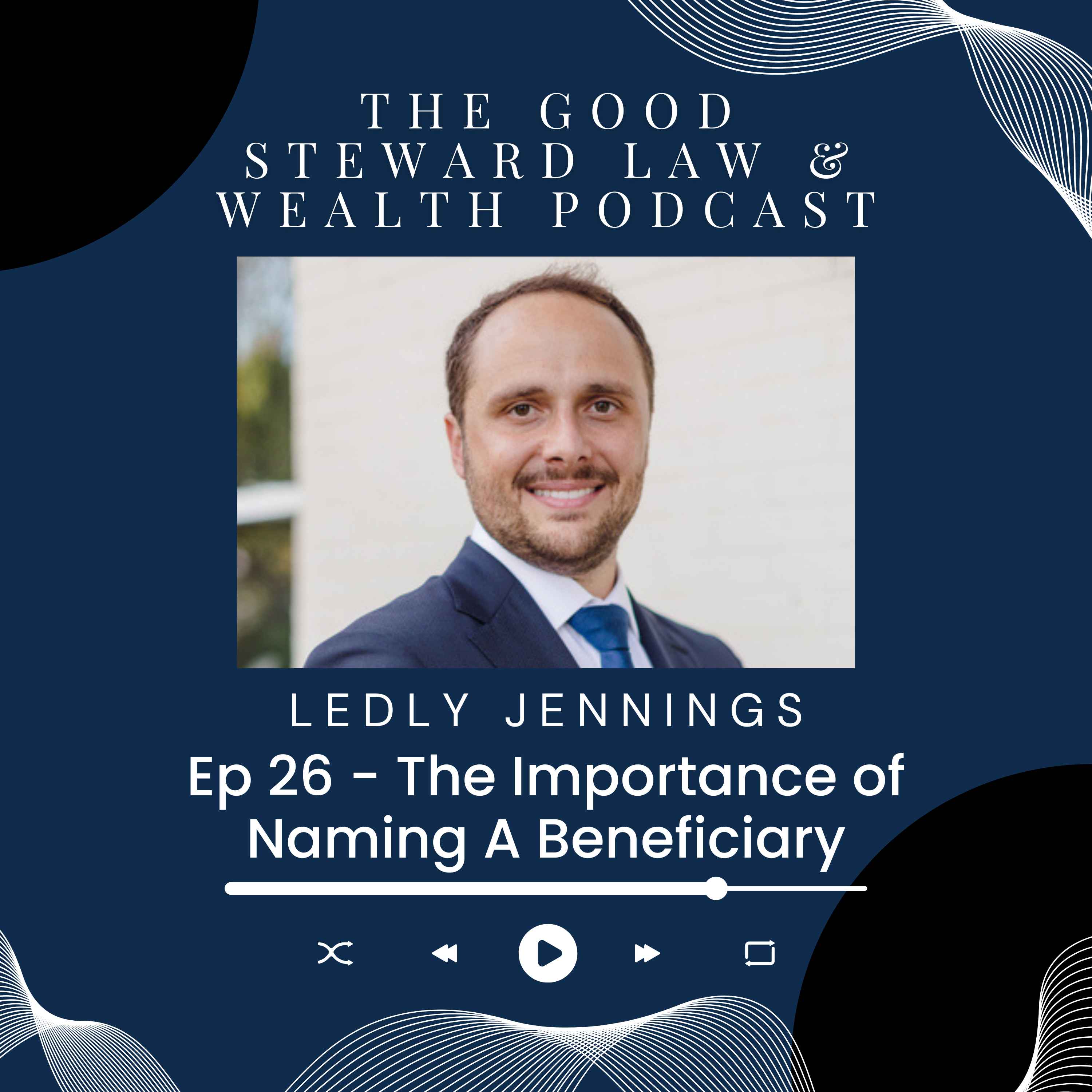
Ep. 26 - The Importance of Naming A Beneficiary
Apr 15, 202500:14:15Tap to summarizeAre your beneficiary designations working in your favor—or putting your estate at risk? Learn the difference between a smooth transfer of assets and a probate headache. On this episode of the Good Steward Law and Wealth Podcast, host Ledly Jennings breaks down why beneficiary designations matter more than most people realize. From POD (Payable on Death) and TOD (Transfer on Death) designations to the risks of naming a minor as a beneficiary, Ledly explains how small mistakes can lead to big problems. You'll also learn how using a revocable trust can offer asset protection and peace of mind—and why simply creating a trust isn’t enough if you don’t fund it properly. Whether you’re setting up your estate plan for the first time or reviewing it after a significant life change, this episode is packed with practical tips to help you stay a good steward of your legacy.IN THIS EPISODE:(00:00) The importance of updating a beneficiary designation on your estate plan(01:45) Naming a beneficiary and examples of problems when not done correctly(08:06) Don’t list a minor child as a beneficiary(10:10) Discussion on asset protection(12:15) Make sure you fund the trust you’ve createdKEY TAKEAWAYS: If you don’t update your beneficiary designations after major life events—like getting married or having children—your assets may go to someone who you no longer wish to receive them. Failing to name a beneficiary (or naming your estate) can lead to probate, which delays the process and may not follow your final wishes. Naming a child as a direct beneficiary can lead to unintended consequences, such as receiving a large sum of money at age 18 with no restrictions. A better option is to use a revocable trust, which can control when and how the funds are distributed and offer protection from creditors, divorce, and other legal risks.RESOURCES:L. Jennings Law - WebsiteL. Jennings Law - FacebookLedly Jennings - LinkedInL. Jennings - InstagramL. Jennings Law - YouTubeInfo@ljenningslaw.com - Email LedlyEp. 22 - The Best Account to InheritEp. 24 - The Will - The Least Important DocumentABOUT THE HOST: Attorney Ledly Jennings, founder of L. Jennings Law, specializes in protecting legacies and ensuring smooth transitions of personal and business assets. With offices in Arkansas, his firm offers expertise in estate planning, elder law, probate, and business planning. With a J.D. and MBA, plus valuable experience at Stephens, Inc., the state's largest investment bank, Ledly serves high-net-worth clients and family businesses statewide.
Transcribe →
Ep. 25 - AMA - Ask Me Anything About Estate Planning
Mar 25, 202500:19:26Tap to summarizeAre you prepared for the unexpected? In this special AMA (Ask Me Anything) episode of the Good Steward Law and Wealth Podcast, host Ledly Jennings answers real questions submitted by listeners about estate planning. From when to start thinking about an estate plan to whether a will or trust is right for you, Ledly breaks down essential topics like protecting assets, avoiding probate, and ensuring your wishes are honored. He also discusses the importance of powers of attorney, healthcare directives, and whether high-profile individuals like Matthew Stafford use Trust and Will for estate planning. Don’t miss this insightful episode packed with practical advice to help you take control of your financial future!IN THIS EPISODE:(00:30) “AMA” (ask me anything). Ledly answers at what age should I start to think about estate planning(02:46) Do I need an estate plan if I have a house, car and a 401K(04:27) What if I die without a will? Why is it different from trust? Can I disinherit a family member, and can my assets pass on protected(08:46) Discussion of the two types of trusts, whether they protect from nursing home care and funding the trust(13:06) Power of Attorney and Health Care Directives and ramifications of not having these directives and how often should I update my estate plan(16:49) Does Matthew Stafford use Trust and Will for his estate planningKEY TAKEAWAYS: Once people turn 18, they need healthcare and financial power of attorney since parents no longer have automatic legal authority over their decisions.Dying without an estate plan leads to intestacy probate, where the state determines asset distribution. A will alone does not bypass probate, while a trust provides privacy and control.Estate planning isn’t just for the wealthy—it’s essential for everyone. Whether you're 18 and need powers of attorney, a homeowner wondering if a will is enough, or looking to protect assets from probate and nursing home costs, having a plan ensures your wishes are honored and your loved ones are safeguarded.RESOURCES:L. Jennings Law - WebsiteL. Jennings Law - FacebookLedly Jennings - LinkedInL. Jennings - InstagramL. Jennings Law - YouTubeEp. 24 - The Will - Least Important Document In An Estate PlanEp. 12 - Long-Term Care Planning - All You Need to Know!Ep. 18 - The HSA Triple Play: The Most Powerful Retirement Account and Long-Term Care StrategyInfo@ljenningslaw.com - Email ABOUT THE HOST: Attorney Ledly Jennings, founder of L. Jennings Law, specializes in protecting legacies and ensuring smooth transitions of personal and business assets. With offices in Arkansas, his firm offers expertise in estate planning, elder law, probate, and business planning. With a J.D. and MBA, plus valuable experience at Stephens, Inc., the state's largest investment bank, Ledly serves high-net-worth clients and family businesses statewide.
Transcribe →