
Podcast
The Gradient: Perspectives on AI
Hosted by Daniel Bashir · EN
Deeply researched, technical interviews with experts thinking about AI and technology.
thegradientpub.substack.com
thegradientpub.substack.com
13episodes
Episodes
Newest firstAll episodes

Judy Fan: Reverse Engineering the Human Cognitive Toolkit
Aug 22, 202401:32:39Tap to summarizeEpisode 136I spoke with Judy Fan about:* Our use of physical artifacts for sensemaking* Why cognitive tools can be a double-edged sword* Her approach to scientific inquiry and how that approach has developedEnjoy—and let me know what you think!Judy is Assistant Professor of Psychology at Stanford and director of the Cognitive Tools Lab. Her lab employs converging approaches from cognitive science, computational neuroscience, and artificial intelligence to reverse engineer the human cognitive toolkit, especially how people use physical representations of thought — such as sketches and prototypes — to learn, communicate, and solve problems.Find me on Twitter for updates on new episodes, and reach me at editor@thegradient.pub for feedback, ideas, guest suggestions. I spend a lot of time on this podcast—if you like my work, you can support me on Patreon :) You can also support upkeep for the full Gradient team/project through a paid subscription on Substack!Subscribe to The Gradient Podcast: Apple Podcasts | Spotify | Pocket Casts | RSSFollow The Gradient on TwitterOutline:* (00:00) Intro* (00:49) Throughlines and discontinuities in Judy’s research* (06:26) “Meaning” in Judy’s research* (08:05) Production and consumption of artifacts* (13:03) Explanatory questions, why we develop visual artifacts, science as a social enterprise* (15:46) Unifying principles* (17:45) “Hard limits” to knowledge and optimism* (21:47) Tensions in different fields’ forms of sensemaking and establishing truth claims* (30:55) Dichotomies and carving up the space of possible hypotheses, conceptual tools* (33:22) Cognitive tools and projectivism, simplified models vs. nature* (40:28) Scientific training and science as process and habit* (45:51) Developing mental clarity about hypotheses* (51:45) Clarifying and expressing ideas* (1:03:21) Cognitive tools as double-edged* (1:14:21) Historical and social embeddedness of tools* (1:18:34) How cognitive tools impact our imagination* (1:23:30) Normative commitments and the role of cognitive science outside the academy* (1:32:31) OutroLinks:* Judy’s Twitter and lab page* Selected papers (there are lots!)* Overviews* Drawing as a versatile cognitive tool (2023)* Using games to understand the mind (2024)* Socially intelligent machines that learn from humans and help humans learn (2024)* Research papers * Communicating design intent using drawing and text (2024)* Creating ad hoc graphical representations of number (2024)* Visual resemblance and interaction history jointly constrain pictorial meaning (2023)* Explanatory drawings prioritize functional properties at the expense of visual fidelity (2023)* SEVA: Leveraging sketches to evaluate alignment between human and machine visual abstraction (2023)* Parallel developmental changes in children’s production and recognition of line drawings of visual concepts (2023)* Learning to communicate about shared procedural abstractions (2021)* Visual communication of object concepts at different levels of abstraction (2021)* Relating visual production and recognition of objects in the human visual cortex (2020)* Collabdraw: an environment for collaborative sketching with an artificial agent (2019)* Pragmatic inference and visual abstraction enable contextual flexibility in visual communication (2019)* Common object representations for visual production and recognition (2018) Get full access to The Gradient at thegradientpub.substack.com/subscribe
Transcribe →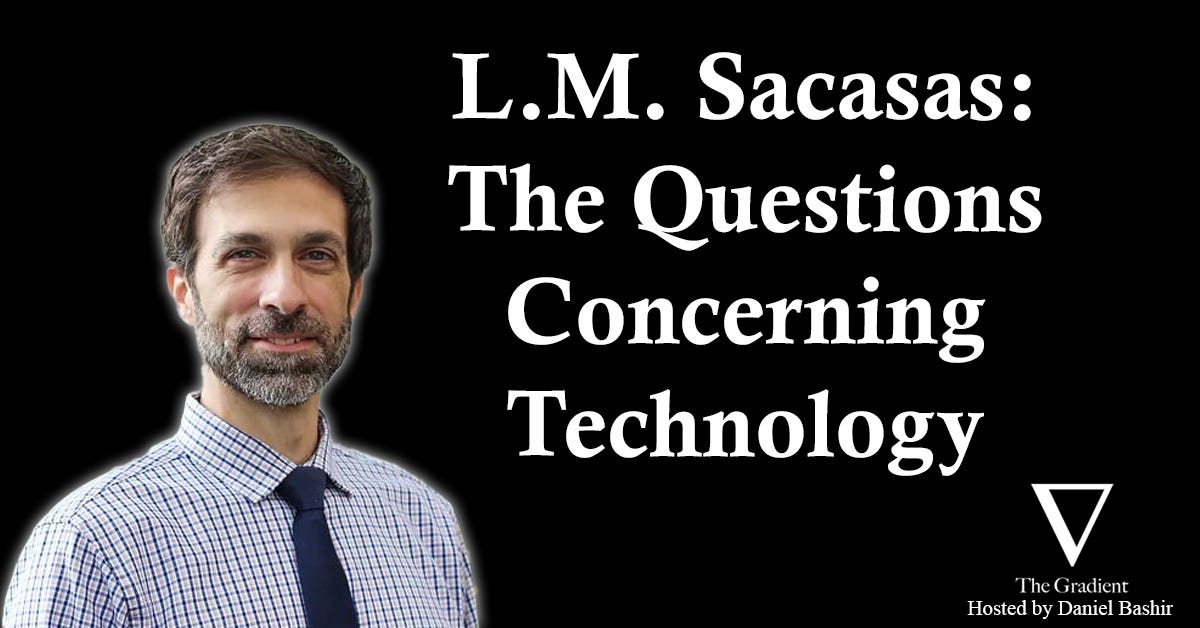
L.M. Sacasas: The Questions Concerning Technology
Aug 15, 202401:47:20Tap to summarizeEpisode 135I spoke with L. M. Sacasas about:* His writing and intellectual influences* The value of asking hard questions about technology and our relationship to it* What happens when we decide to outsource skills and competency* Evolving notions of what it means to be human and questions about how to live a good lifeEnjoy—and let me know what you think!Michael is Executive Director of the Christian Study Center of Gainesville, Florida and author of The Convivial Society, a newsletter about technology and society. He does some of the best writing on technology I’ve had the pleasure to read, and I highly recommend his newsletter.Find me on Twitter for updates on new episodes, and reach me at editor@thegradient.pub for feedback, ideas, guest suggestions. I spend a lot of time on this podcast—if you like my work, you can support me on Patreon :) You can also support upkeep for the full Gradient team/project through a paid subscription on Substack!Subscribe to The Gradient Podcast: Apple Podcasts | Spotify | Pocket Casts | RSSFollow The Gradient on TwitterOutline:* (00:00) Intro* (01:12) On podcasts as a medium* (06:12) Michael’s writing* (12:38) Michael’s intellectual influences, contingency* (18:48) Moral seriousness* (22:00) Michael’s ambitions for his work* (26:17) The value of asking the right questions (about technology)* (34:18) Technology use and the “natural” pace of human life* (46:40) Outsourcing of skills and competency, engagement with others* (55:33) Inevitability narratives and technological determinism, the “Borg Complex”* (1:05:10) Notions of what it is to be human, embodiment* (1:12:37) Higher cognition vs. the body, dichotomies* (1:22:10) The body as a starting point for philosophy, questions about the adoption of new technologies* (1:30:01) Enthusiasm about technology and the cultural milieu* (1:35:30) Projectivism, desire for knowledge about and control of the world* (1:41:22) Positive visions for the future* (1:47:11) OutroLinks:* Michael’s Substack: The Convivial Society and his book, The Frailest Thing: Ten Years of Thinking about the Meaning of Technology* Michael’s Twitter* Essays* Humanist Technology Criticism* What Does the Critic Love?* The Ambling Mind* Waste Your Time, Your Life May Depend On It* The Work of Art* The Stuff of (a Well-Lived) Life Get full access to The Gradient at thegradientpub.substack.com/subscribe
Transcribe →
Lukas Biewald: Crowdsourcing at CrowdFlower and ML Tooling at Weights & Biases
Jul 7, 2022Tap to summarizeIn episode 33 of The Gradient Podcast, Andrey Kurenkov speaks to Lukas Biewald.Lukas Biewald is a co-founder of Weights and Biases, a company that creates developer tools for machine learning. Prior to that he was a co-founder and CEO of Figure Eight Inc. (formerly CrowdFlower) — an Internet company that collects training data for machine learning, which was sold for 300 million dollars.Subscribe to The Gradient Podcast: Apple Podcasts | Spotify | Pocket Casts | RSSFollow The Gradient on TwitterOutline:* (00:00) Intro* (01:18) Start in AI* (06:17) CrowdFlower / Crowdsourcing* (21:06) Discovering Deep Learning * (25:10) Learning Deep Learning* (32:50) Weights and Biases* (37:30) State of Tooling for ML * (41:20) Exciting AI Trends* (44:42) Interests outside of AI* (45:40) OutroLinks:* Lukas’s website* Lukas’s GitHub* Starting a Second Machine Learning Tools Company, Ten Years Later* Confession of a so-called AI expert* What I learned from looking at 200 machine learning tools* CS 329S: Machine Learning Systems Design* Designing Machine Learning SystemsOpportunity at Weights & Biases: Get full access to The Gradient at thegradientpub.substack.com/subscribe
Transcribe →