← The HC Commodities Podcast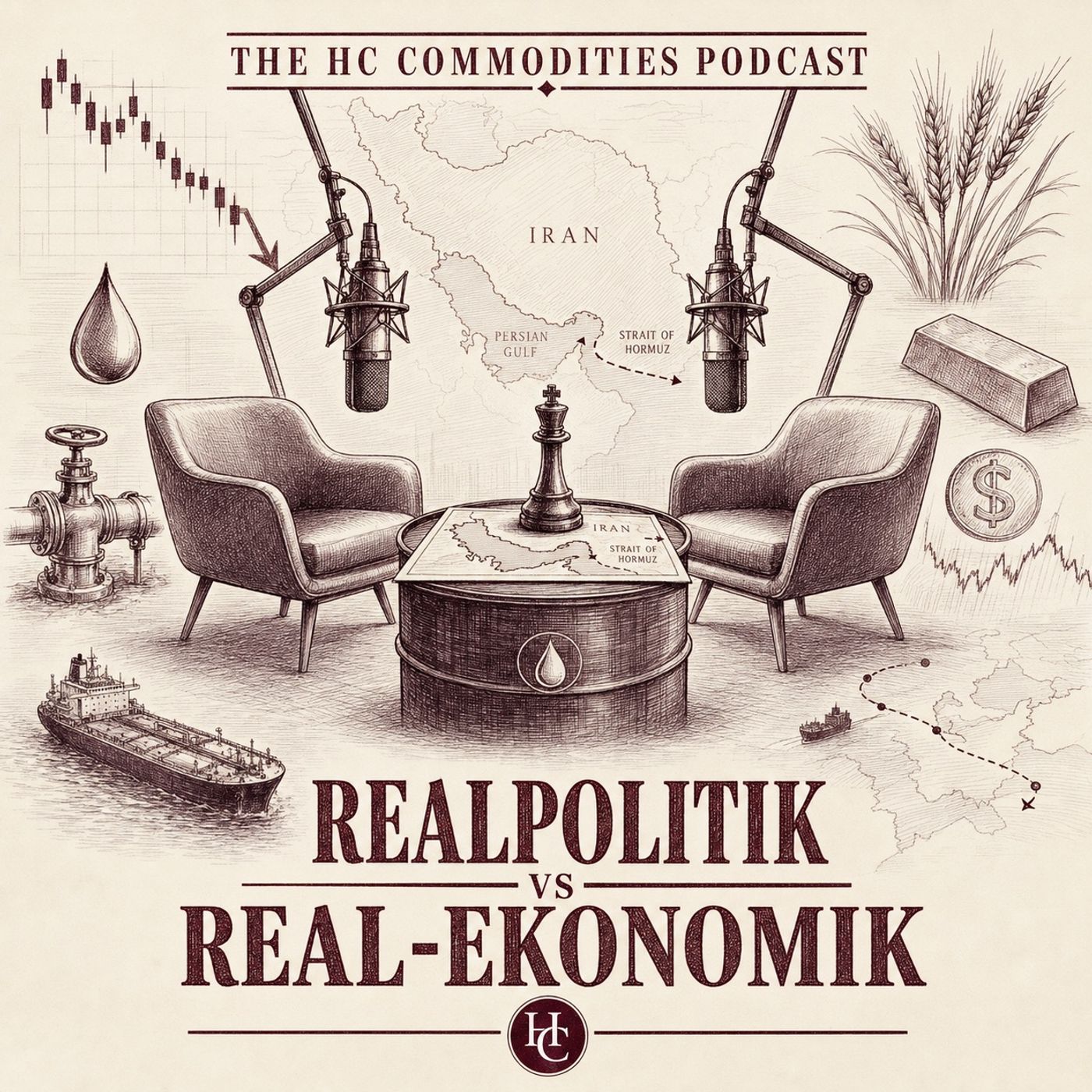
The HC Commodities Podcast
Real-Ekonomik: The Iran War's Longevity with Nick Kumleben
00:57:30
We return in a special episode to the Iranian-US war to discuss how "Real-Ekonomik" is shaping realpolitik. Nick Kumleben, Director at Greenmantle, the geopolitical risk and strategy consultancy, where Nick handles the energy and commodities portfolio, joins us to discuss the status of the war and its potential future track. We use commodities and more broadly economics to try and understand the strategies and positioning of the various participants and their allies. Who wants peace, who wants all-out war, if any and who is OK with the status quo for now.
Loading summary
Transcript97 lines
- [00:00]
A
Foreign. Welcome to the HC Commodities Podcast, a podcast dedicated to the commodities sector and the people within it. I'm your host Paul Chapman. This podcast is produced by HC Group, a global search firm dedicated to the commodities sector. Foreign. Today we return to the subject of the Iranian US War and joined by Nick Kumleben, director at Greenmantle, the geopolitical risk and strategy consultancy where Nick handles the energy and commodities portfolio. We're using commodities and more broadly economics to try and understand the positioning of the various participants as well as broader proxies as to whether we can see peace in the future, a continuing of the status quo or an outbreak of an all out war and what might be some of the tail risks that could upend all of these calculations. As always, you can really support the show by leaving us a positive review on the platform you're listening on. We will be getting back to a regular schedule in the next week or two after taking some time out for the summer and releasing some of our greatest hits. And as always I hope you enjoy the episode. Nick, welcome to the show.
- [01:27]
B
Thank you Paul. Pleasure to be back.
- [01:29]
A
Yeah, I should say welcome back and I'm avid listeners might recognize that I've had a bit of a bit of a summer off so far and released some of our greatest hits just to pause given so much business travel actually and then some obviously personal vacation over the summer. But we will be getting back to a normal schedule very soon. However we couldn't so much has gone on that we thought you and I should check in and just try and use commodities as a lens through which to understand the ongoing protracted, uncertain and ever changing and also at the same time not changing conflict between the US Israel and Iran and both. So check into where we are since we last spoke, you in my office in I guess very early May and get your take and Greenmantle's take on the risk cascading out of these events and then try and as I said, look at the different participants, protagonists and see we can use commodities to divine where this may end up or where we might be at the beginning of next year, which now is not so far away. So with all that said Nick, welcome back. We've been using you throughout this ongoing conflict to get the geopolitical risk view and some intelligence on what's going on. Let's start with that MOU that was signed in mid June and then let's talk about what's happened since.
- [03:04]
B
Yeah, that's great Paul. Mou signed June 17, Islamabad and a lot of the Reaction early on was that this is a really bad deal for the us. I hold a slightly contrarian view in that I think to call the deal gives it a little too much credit. It was more of a meeting agenda, if you will. In the yad, you had 14 points. Only four of them required immediate action relating to the end of the US blockade on Iran. Iran committing to 60 days of free transit through the Strait of Hormuz, the lifting of US sanctions on Iran and the release of frozen assets. And the other points were left for future discussions, which any historian of US Iran relations means that there would be many, many meetings, some in Vienna, some in Pakistan, elsewhere, and little would actually get agreed. So calling the MOU is a long way from a binding document or representing major diplomatic progress as a result of the war. And I think we've seen how weak a foundation it's been over the last few weeks in terms of how easily it's been broken by both the US and Iran. So I think both parties understood how far away they were from each other. What the MOU really accomplished in the two, three weeks after its signature is to get a flood of oil out of the Strait of Hormuz. Both Iranian oil and oil from the rest of the region. Bring prices down, let inventories rebuild a little bit, and as a result of that, economic pressure lessen, less lessening both on Iran and on the rest of the world. Both the US and Iran have become a little more maximalist in their discussions. And we've gone back to war.
- [05:11]
A
Yeah, we're going to talk about some of the sort of surprises and non surprises that have happened in this period from then June 17 until July 28, just on that MOU. So a few questions. Firstly, do we think, Are we to take the cynical view that this was. Everyone kind of knew exactly what they were doing. A pause was needed. Us needed it for, for, for economic reasons. Iran was happy to have it for a breather and rebuild weapon stocks and so forth. It was essentially a repositioning. Or was this an honest. Do you think this was an honest attempt at peace that was so, you know, bungled, perhaps inevitably.
- [06:00]
B
I think it's fair to describe it as, as an honest attempt. I mean, if we look at where, if we look at where prices were on signing day, obviously the signing had been foreshadowed to the market with some, with some intentionality around that. WTI was in the mid-70s, so, so the administration has done a really good job of talking down the oil price and there wasn't an immediate need to, to sign the mou. If you recall, it got signed in and around, in, in around a number of other events, but it showed that there was a clear way out of this, out of the closure of the strait and, and help markets bring, bring the price down quite significantly. But in the long term, you're right that it's basically a placeholder document. It's a signal that good faith negotiations are about to begin rather than a signal that they're actually going to accomplish anything. And that's what leads to a much longer timeline on this war than might have been expected from the signing of a nominal deal.
- [07:09]
A
Yeah, and a couple more questions. Firstly, who out of interest is that deal being pinned on? Is this a J.D. vance or is this Witkoff and Kushner? And then I'd like to get your take the sort of the, the cold eyed appraisal of. There's a lot of talk about, well, it was poorly worded. It was sort of inevitable that being so poorly worded inevitably led to conflict and, and so forth and everyone walking away with what they thought, you know, what they wanted to perceive in it. And the other narrative out there is kind of, this is Iran has been sort of reneging on the deal. There's a, certainly a case to be made that the US is the one that reneged on the deal. So can you just, hey, who is it getting pinned on politically? Does it even matter? And secondly, the Mechanics of that MoU breaking down, where do we, where do we lie the blame equally or one side or the other?
- [08:02]
B
Look, two good questions. Let's start with the, with the personnel side. I think Vance drove this to be a, perhaps a more expansive deal and a deal with a lot more room for negotiation, given his desire to get the deal done. But Woff and Kushner were fairly, fairly involved throughout the process and certainly in many of the key negotiating rooms executing the President strategy. So it's hard. There hasn't been as much of a blame game as one might think. And frankly, I'd also argue the MOU from an American perspective served its purpose fairly well in terms of putting the brakes on for a few weeks, keeping prices down until the war restarted. And so while given what we've seen the last few weeks show that the MOU hasn't really committed the US to do all that much, it's not necessarily a failure as a negotiating document. It certainly staunched some of the flow out of inventories in the US and elsewhere.
- [09:10]
A
Yeah, but what I mean, okay, so, so there's this Sort of. We can take one view that this was a bit of a master class in. Let's just. We needed a pause, the President saying he wants us to stop. Let's just get something in place that does that. On the other hand, they are unfreezing assets. How significant was that unfreezing? How many billions flowed into Iran both from being able to sell oil and from unfreezing these assets, if any? And isn't that a bit of a Pyrrhic victory if you're arming your enemy at the same time?
- [09:36]
B
Yeah. I think what's interesting here, Paul, is that the unfreezing of the assets is probably the provision of the document the US has failed to comply with that's been tied up in technical negotiations from day1 post MoU, whereas the US had ended the blockade and released sanctions on Iran. So Iran hasn't actually received the frozen assets back yet. What it has done is been able to sell a lot more oil in the weeks after the MOU and able to sell them at international prices to willing buyers. So the US has, to a degree, given Iran a lot more room to work with. And if you play out a model of the blockade, it certainly extends the timeline on which Iran can survive a blockade. And it gave Iran some time, given the ceasefire, to harden its minister inflation, to move more assets underground or into bunkers. But it's also given the US some a longer timeline. Given the relevance of all the economic
- [10:41]
A
variables we've discussed, it's worth noting that none of those four now therefore in action. Right. The strait is indeed blockaded and closed. There's no free transit, the US Sanctions are back on and assets frozen.
- [10:55]
B
Yeah. And if we look at the language in the MoU, that was always a risk in that, you know, Iran clearly interpreted the MOU to say, well, we'll open the strait, but it's got to be on our terms, hugging our coastline. And the US saw that very differently.
- [11:08]
A
So, yeah, and this is. This again is sort of some of the issue of wording or perhaps the facility of wording to enable everyone to get an agreement, which is the other way of looking at it. Right. Okay. We don't want to go and discuss and back and sort of rehash the oil price. And I think, you know, I would argue that essentially we've sort of now fallen into this kind of war at the weekend and peace during the. When the markets are open. But anyway, what are a couple of surprises. One has obviously been how actually controlled the oil price has been. And we've Got Jeff Curry coming back on in a week and a half or so to sort of give us his update on this and tank bottom and where we actually are. But certainly the markets have been far more sanguine both in general on mass, but also in particular with regards to oil than anyone would ever expected. And a lot of that, as David Veck pointed out on the podcast a few weeks back, is obviously China is now sort of the, the, the hinge of this. Instead of having sort of the balanced supplier, this is the sort of the balanced demander. Can you talk about that and your take on that piece?
- [12:18]
B
Yeah, well, it's fascinating Paul, that at a time when OPEC is, is losing a bit of its primacy on the supply side of the market, certainly in market share terms but also in membership terms, China's kind of built this demand side OPEC in terms of its ability to be the swing consumer and that's really been what saved the world from call it $150 oil or higher. I mean the numbers are simply incredible. And David did a really good job walking through this. But you look at June crude imports down 40 to 45% relative to February, 40% year on year relative to June 2025. It's remarkable. And I think what's interesting about, about the Chinese demand destruction story, unlike the rest of Asia where we saw work From Home Mandate 4 day weeks and so on and so forth, in China we're not seeing as as much of an impact on, on the mobility side. I think what we're seeing is a little bit of inventory work down but, but also fuel switching in petrochemicals and in road transport. So this has been accomplished with a relatively limited impact on economic activity which is remarkably impressive. And I think you have to look at the price elasticity of demand as much, much higher in the world's largest oil importer going forward it's a really impressive achievement and I think it's, yeah, it stands the world in good stead for future crises if this is the playbook going forward.
- [13:50]
A
Yeah, not so much for oil prices.
- [13:53]
B
No, no, it does cap the upside to some degree.
- [13:56]
A
But yeah, China is unique in terms of the penetration of renewables, obviously the buckets of coal and reserve coal fired power stations they have and all the rest of it. Right. And obviously centralized economic control. That means you can ask your populace to suck it up a bit more. To be flippant, where are we at in terms of the rest of Asia? Are we still on those four day weeks? And it feels a very long Way away from kind of, you know, here in the US and you know, people worried about $4 gas.
- [14:27]
B
Okay, it depends. It depends where you look. I think we've seen less aggressive rationing across the rest of Asia as some of the steams come out of the market. But the inventories still look relatively stretched. And so there are still some restrictions, although much less than we saw in March when oil prices were much higher. I mean, prices peaked at roughly the end of March and restrictions have kind of tracked that downward trajectory. And the prices themselves peaked.
- [14:56]
A
For now, I would say.
- [14:58]
B
Fair point, fair point.
- [14:59]
A
I mean, there's a lot of refineries being taken out around the world as well. So, you know, people don't use crude, they use gasoline. But anyway, we'll come back to that in a minute. Don't derail myself, the other one. And sorry for stealing your thunder on this, but this sort of, the other sort of big surprise. Well, let you say it. What is, what did, what did you find the other big surprise of this sort of intervening period?
- [15:20]
B
I think what's interesting, Paul, is that you'd think the markets would have stopped listening to what traders and analysts are calling the jawboning. So bring the price down through announcements that a deal is very close or that the US is undertaking escorts of ship through the strait, or essentially announcements designed to bring down the price without necessarily reflecting the reality on the ground. And what we saw, we saw that very effectively carried out in April and May. So in that period between the price peaking and the MOU actually getting signed, and then the MOU putting a degree of credibility on that rhetoric and those announcements from D.C. and then we've come back to a world in which the President says we're going to bomb Iran very aggressively and then six hours later says there's a deal at hand because he doesn't like the market's response. We're back to a world where truth socials are driving the market as much as the fiscal reality.
- [16:28]
A
Well, hence he's going to start pre selling it, um, extraordinarily. Why, why is that so? You know, is that because you just cannot afford to ignore those statements? Is that because you've got algorithmic trading that's just driving the swings? It's, you know, the computers are hooked up to true social and man not intervening and it just is moving markets, or is it. I mean, I don't want to be cynical either, but. And is it also. It's quite good fun and expedient for everyone to trade along with, with the, with the true socials and you know, it's generating a lot of volatility. I mean like why it's fascinating to me that people aren't sort of barrel counting and just sort of keeping their power. I don't know, I'm a bit of a naive on this stuff, but it would. Do we have any sense of why is it that you just cannot afford to ignore it or is it actually that, you know, it is driving just this momentum trading, this sentiment trading and therefore you had to participate?
- [17:28]
B
Yeah, certain. Certainly a big part of it. If you look at, kind of, if you look at the market structure and I think the difficulty is that, you know, if, if you do believe these statements and, and expect them to say, you know, statement that a deal is coming and we'll get another few weeks of, of higher flows that's, that's justified from a barrel counting. Level 2. The problem is distinguishing between fact and fiction, which is difficult to do if you're for say momentum trading or running a quant. But the market structure certainly impacts there.
- [18:04]
A
Yeah, it's extraordinary, isn't it? Yes, but a lot of jawboning and has been relatively expedient and we are reminded daily that as I pumped$5.60 gas in, in Houston, which was a bit eye watering, you know, that prices are ticking back up. Okay, so let's, I'll sort of, you know, thanks for that. Our next bit is to kind of state where, where things are today and then kind of, and then work through the participants to get to where we might, you know, is anything going to change? Who's going to be a driver, an actor that might change the status quo as we head towards the end of the year. If I can, I'll start us off on where I think we are today and then you can add the sort of sensible and data led aspects of it. But it seems to me at the moment, obviously things have heated back up. We're in a declared, we're in various levels of us declaring a ceasefire in Iran saying they have no such interest. Likewise on diplomacy and again I think somewhat reflective of different factions with Iran who you're talking to on whether there's discussions going on or not. But certainly the strait is closed. The war seems to be metastasizing. When we wake up in the morning over here, there's new attacks being done by Iranian proxies. You've got attacks from Saudi going onto Saudi, Saudi onto Shia militias in Iraq. I mean the whole thing, you've got Ukraine attacking Iranian shipping in the Caspian Sea. Supposedly moving arms to Russia. I mean, it certainly is expanding beyond borders and you know, it is a low grade hot war or a pretty, pretty failed sort of detent or something, but it's, you know, it's definitely heating up. What's your sort of analysis of where we are today?
- [19:58]
B
Yeah, I think that's right, Paul. And I'd add in the Houthis and the strikes on ships and the Red Sea and the Bab El Mandeb, which is obviously one of the key rerouting options for, for Middle Eastern crude and Saudi crude as a really, really important expansion of the war. That's the one we've been watching since early March in terms of growing the, the, the actual scale of disruption to oil markets from the war. If Saudi can't do 4 or 5 million barrels a day out of Yanbu, then, then the world has a big problem. So that's, that's concerning. And then you have the Ukrainian angle, as you've discussed.
- [20:37]
A
Did the Saudis, sorry, did the Saudis start that? The Saudis bombed the Yemeni airport where the Houthi delegation were landing. Right. Did that then trigger this as a Houthi response or am I getting my timelines mixed up?
- [20:52]
B
Not really. The question was always going to be when the Iranians and the Houthis decided together that this was the right time to, to come back in. It reflects Saudi Arabia being drawn closer into the war. It reflects the breakdown of the Houthi Saudi deal that's been, that's been fairly effective over, over the last few, few months and years. But if, if we look at the timing of the Houthis coming back in, it's got more to do with the escalation between the US and Iran than it does specifically Saudi Houthi relations.
- [21:34]
A
Yeah. And then one final question just on that piece before we talk about Ukraine for a moment. Notably, everyone is getting attacked. Jordan, Kuwait, Iraq, you know, except the uae. What, what is going on there? Is the UAE done a separate deal? Are they, you know, are they seen in a different camp to Qatar, Bahrain, etc.
- [21:59]
B
Look, I think what the UAE's done is very impressively navigated the diplomatic landscape to get closer to Iran without antagonizing either its regional allies or the US and we can see this, for instance, in its attitude towards Hormuz and Tolling, where I think it's moved a little bit. And then I think we can also see this in, as you say, in the strikes that have taken place. So the UAE has been able to navigate this quite Impressively on a diplomatic basis in a way that I think other countries in the region will look at and see to emulate.
- [22:45]
A
Yeah. And then obviously it is very notable indeed that Ukraine attacks shipping in the Caspian Sea. You know, I don't think it's wrong to see this as a, an escalation and a, some centrifugal forces going on that are bringing in other actors, which is about what we're going to start talking about. But certainly that to me seemed a major step of this becoming a broader kind of China, Russia, Iran versus, you know, the US and certainly kind of the. Again, future historians could start divining this as the start of that great power war type business.
- [23:26]
B
Yeah, absolutely. And I mean, you look at, we were just talking about, about the Houthis. So, you know, the Chinese have said that they're negotiating the Houthis on a ship by ship basis to get Chinese tankers through Russia. Ukraine is another great example in which Ukrainian strikes on Russian infrastructure and as you say, on water have led to Russia's inability to export refined products and sending out a lot more crude, which is all well and good if you have the refining capacity, but is otherwise a bit of a problem. And it does start to look more and more global.
- [24:07]
A
Yeah. Okay, well, that's what we're going to talk about. Just one final question. Is the Bab El Mandeb actually fully closed or just. Okay, you just don't, you might not want to risk it? Basically, yeah.
- [24:18]
B
And there's two reasons for that. Well, one is the Houthis are just not as effective as the Iranians have been historically at hitting ships. Secondly is that.
- [24:27]
A
It's not really, not really reassuring, is it?
- [24:30]
B
No, it's. No, it's not. The second reason is, is that as has been said, they're letting Chinese tankers through on a case by case basis, as they did in prior attacks on shipping. Right. So for instance, what we saw in 2023, Chinese and Russian cargoes were allowed through and they would focus on hitting Western shipping. Their targeting isn't perfect. They did hit a ship that they thought was Western was actually a Russian ship to ship transfer, which is very embarrassing for all parties involved. But the Babel Mandeb is not fully closed.
- [25:05]
A
No, no. But another, another shoe that could drop.
- [25:07]
B
Okay, yeah, it's a shoe that could drop and you can reroute some of that north. But it's very logistically difficult. Yeah.
- [25:14]
A
Okay. We are now going to work our way through. So the major protagonists thus far and try and as best as possible confine ourselves to a very sort of real economic argument and a commodities argument as to, you know, whether they are interested in peace, you know, the status quo or all out war. So taking the U.S. iran, Israel, China, Ukraine, Russia and Saudi and so forth. Again it's going to be rather hard keeping ourselves just to an economic and commodities angle, but let's try it. Okay, so, okay, firstly the US where, where you know, and obviously one of the, one of the two key players here from a, an economics and a commodities standpoint. You know, where, where should they, or where are they leaning?
- [26:10]
B
Well look, it's clear that the, the war is making the Fed Chairman and the Treasury Secretary's life harder and thus the President's life harder. If we look at where oil price than the 10 year R, it is a more difficult place to be for the US than would be the case without the war. The ability to talk down the price and all of the bearish factors we've discussed have helped a lot. I think it's also worth mentioning on the US side. Obviously this is wonderful for LNG exporters who have, who have done really well out of, out of this. But if we look at the supply response on the oil side specifically, it's not been nearly as impressive as you might have expected. We're roughly 20 weeks into the war. US production has increased by around 100,000 barrels a day per the EIA data. If you look at say Russia, Ukraine, which is a roughly similar price move, similar circumstances, US production was up by 400,000, 500,000 barrels a day 20 weeks into that war. So we've seen this, this muted supply response on the commodity side in the US although certainly on the gas side it's been been more of a positive.
- [27:30]
A
Yeah, I mean there's a lot more going on than just the economics here. But it would seem to me that the economics are kind of why we've got the bit of a schizophrenic approach here. Right. It seems the economics are from a political standpoint. You know, gas prices is where all of the gas prices will determine the midterms. They probably already have determined the midterms. After the midterms does that equation change?
- [27:58]
B
I think it probably doesn't fall in terms of the direction, in terms of the function of the equation. I think how much consumer perceptions of the economy and the President's approval rating matter after the midterm fizz is a more interesting question. After the midterms the President is going to be a fully lame duck as all Second term presidents are after the midterms and there are no further elections in a very, very narrow sense that determine his political career. And to that extent he's got a freer hand for this kind of legacy defining foreign policy initiative. But on the other hand, any president's going to care who their successor is and they're going to want to come out of the same party, especially given the noises Democrats are making about the current administration. It various in invest some of the public investment, some of the gifts given to the President, some of his family businesses. So I think he'll still be pretty invested in having a Republican in office after 2028.
- [29:06]
A
Yeah. So essentially it's kind of, I mean, and the signals are they want peace or at least freeze. An all out war would just be, unless I'm misreading you, sort of the least likely, you know, is not in the US's interest.
- [29:21]
B
No, it's still militarily possible, but it's, it's unlikely to be in, in the U.S. interest in economic terms. And as the U.S. has kind of played this, this role where U.S. inventories have worked down in U.S. exports, have surged the scope to, to launch an all out war, take the pain for say 6 weeks, 2 months and try and fill stocks around the world. US exports get smaller and smaller.
- [29:49]
A
Yeah. Out of interest, what's the sort of analysis of Lindsey Graham's passing? Is that a, how significant do you think that is, as you know, a factor pushing for all out war?
- [30:02]
B
Well, certainly Israel's lost a great friend in Washington, as has, as has Ukraine. But there are certainly enough hawks around around the present to keep arguing for that. I mean, you look at the Secretary of State as a good example of someone who was brought in a similar place to Lindsey Graham on most issues. And Graham's role as an advisor is more relevant than his role as a legislator here. I mean, if you look at for instance the sanctions bill Graham and Blumenthal had, that's been, that's had immense bipartisan support in Congress for quite a long time and yet the President hasn't signed it because it would reduce his negotiating ability if he were locked in by legislation. So Congress is not particularly important in the setting of foreign policy unless there's a direct line to the President.
- [30:49]
A
Yeah. Okay. So on balance we're saying sort of peace freeze for the us. From an economics and commodity standpoint, there's some freeze is all right for some of the LNG exports and all the rest of it, but it's all out war would Be deleterious for sure. And we've got midterms coming up. What about Iran?
- [31:12]
B
Well, Iran's obviously in a difficult place given the amount of damage it's taken. There's talk of immense reconstruction funding being needed. But this is an incredibly resilient regime, Paul. Not, you know, this is a regime that's been dealing with aggressive US sanctions for near on a decade and sanctions as a whole for longer than that. So this is a regime skilled in the art of making do. It's similar, not dissimilar to Cuba in that way. We were more skeptical than most of the blockades ability to affect change in the near term. We thought there was somewhere between six and 18 months the regime could survive under a blockade getting in goods imports overland smuggling oil out, given its storage capacity both onshore and floating. And if you look at, if you look at the amount of oil Iran got out in the two, three weeks after the MOU was signed. So during the ceasefire and thought full opening of the straight, it's given Iran a lot more breathing room both in terms of dollars and in terms of inventory to fill. So this is an, this is an unqualified negative for Iran. But it doesn't have any near term deadlines at which point it's got to choose between. It's not going to, we're not going to face a sort of Germany 1945 scenario in which the economy completely collapses and limits its ability to prosecute a war.
- [32:43]
A
Yeah. Is it able to, this might be naive. Is it able to sell oil over land, albeit in limited amounts with the street? Yeah, it's good at smuggling, right? Yeah.
- [32:53]
B
And there's a railway on which you can run rail cars to, to China full of crude. Now not a huge amount. There's, there's some good work on this. Gabe Collins at Baker for instance has done great work looking at this. But you can also look at some of the smuggling in small boats, some of the ship to ship transfers that in theory goes out as Iraq, as Omani. There's certainly some overland fuel smuggling going on to Pakistan. So there are ways and means to get around this. Even if the US blockade in the Indian Ocean is airtight.
- [33:30]
A
Yeah, in some ways.
- [33:31]
B
Or watertight I should say.
- [33:33]
A
Yeah, in some ways. Sort of. The US well let's, let's just finish the thought first. Iran other wants peace but is probably less afraid of all out war than the US is. I don't know we can divide it that easily.
- [33:48]
B
I think it's hard to know. I think what you've got is, is an Iranian economy that is more damaged than that of the United States but that lives within a much, much less responsive political system.
- [33:58]
A
Yeah, fair enough. Okay. In some ways actually the more interesting pieces are the other proxies and other participants here. Right. Thinking you know, because when we'll come on to China but you know China the economics might not apply if as the same exactly the mirrored with Ukraine. If you're, if some chap's having a war on your behalf so to speak to degrade your enemy. Let's talk Israel. Is there an Israeli economic impact here or have they just been living with that for a long time? They're not, they're not commodity exporters, et cetera, et cetera. I mean there's lots of political, you know certainly political support in Washington has declined dramatically. But is, you know, where is this while Bibi is in power, Netanyahu is in power. This is. They want all out war.
- [34:48]
B
Look, I think that's broadly correct and there's still consensus within the security state in Israel around, around the prosecution of the war. I'd just say the cost of living is a major issue in this Israeli election. And that's not all energy. There are issues around housing and wages and other topic but the energy price spikes of the last five months don't help that. Especially when those are energy price increases that can be traced back to the Prime Minister.
- [35:24]
A
Yeah.
- [35:24]
B
So from a, from an economics perspective as a as you say Israel's not an exporter, it's a major importer that becomes a problem.
- [35:31]
A
Yeah. But again kind of non economic factors are probably weighing that decision more than economic factors at least right now.
- [35:40]
B
Correct, Correct.
- [35:42]
A
Okay so then we get to the really interesting one which of course is China. And between that you know, peace status quo and all out war and again it's. I know this is very simplistic. What does China start thinking about?
- [36:00]
B
China's pretty happy with the status quo especially. Well as long as it can get oil in through, through the and other means China's in a pretty good place. If we look at, if we look as we've talked about the huge fall in Chinese imports but if you look at inventories they have declined a little bit over the last few months. But you can look at the data and make the argument Chinese infantries have actually grown since February which is remarkable. And China's extremely well stocked in both commercial and strategic reserves, far more so than than any other country. So China's in a pretty good place to watch and wait. We've seen it release both oil and LNG cargoes when prices have gone a bit higher, which tells you it's not too worried. And then if we look at the broader economics of it for China to a world in which crude prices in China stay low but refined products globally are very, very high, is a pretty good place to be for the world's largest electric vehicle importer exporter and for
- [37:19]
A
some of their refineries that they've built as well. The. So the status quo works well for them at least at the moment for other. For military and geopolitical reasons. Right. It's fantastic to watch the other superpower embarrass itself and use up all its stockpiles, especially when everyone keeps passing around 2027 as the year that, you know, Taiwan has invaded all the UFO's land. But anyway, I've got a couple of questions here. Firstly, how much military support, economic support is China providing Iran? As best as we can tell today.
- [38:01]
B
Look, I think there's been quite a bit of support, not just in the hardware and the goods coming in, but also in on the software side. It's difficult to imagine the Iranian war machine working without Chinese and Russian assistance. So that plays into your global point. The US has pushed back on this to a degree both publicly and in private meetings, but there's certainly assistance and there's still assistance going on.
- [38:37]
A
Well, the precedence has been set in Ukraine. Right. So I'm assuming China can just say, well, you know, they're an ally and we're supporting them and they're paying for it through whatever funky economics they want to use. I imagine. Is the, is the pushback there? Does that mean certainly this China is a sort of status quo. Would they mind all out war?
- [39:02]
B
All out war does run a risk of escalation. That isn't great from a Chinese perspective. So if Iran fully took the Houthis off the leash, it would become difficult for China to get the oil that it does need. I mean it's still importing a huge amount of oil. China's still importing around 7 million, 6, 7 million barrels a day. So that, that's got to come from somewhere and that's after demand destruction. So I think, I think the status quo is quite, is probably where China's happy.
- [39:39]
A
Yeah.
- [39:40]
B
Rather than all out regional war which would imperil energy supply that it really does need.
- [39:48]
A
Yeah, it's interesting, isn't it? Because in some ways, counterintuitively and paradoxically, the US might benefit from a short, sharp closure of the Bab El Mandeb Strait. Right. It would suddenly put, it would push China into a situation where it might have to exert more control on Iran and get a peace solution.
- [40:14]
B
Yeah, exactly right. The current status quo of Chinese ships getting through on a case by case basis seems doable, but that can break down in the fog of war. And not all the oil that comes into China comes in on Chinese ships or flows into Asia comes in on Chinese ships. So there is certainly a risk there. And I think China probably quite happy with the war and wouldn't have minded the ceasefire ending, but doesn't want the water to spiral out of control here.
- [40:45]
A
Yeah, okay, let's be philistines and, and count Europe as one block and throw the UK in it. And roughly speaking we're talking commodity importers, you know, lots of ongoing challenges. They've lost Russian gas, you know, already. I mean expensive US LNG coming in. Where is Europe? I mean this is, this presumably is peace at any cost as soon as possible.
- [41:14]
B
Yeah, I think that's right. And just on your generalization of Europe as a bloc, I'm not sure the new Prime Minister would mind that. So maybe we've got to get used to it on the, on, on the,
- [41:27]
A
just throw a little pro Brexit jab there from our friends at Green Mantle.
- [41:33]
B
No, it was a comment about the Prime Minister rather than any, any, any comments for or against Brexit. But I should say on back on the main topic on, on European energy security. This is pretty scary and a little scarier than, than the markets seems to be pricing in from our perspective. You look at where European inventories are even relative to 2021 and 2022 and it doesn't look great. And this time around know one of the factors that really helped in winter 2223 was, was Asia Asian cargoes getting released because of a warm winter in Asia and well stocked and, and China being relatively well stocked. So that's, that seems unlikely to happen this time around given where, where Middle east and LNG flows from. Although with that, you know you, you're basically betting that, that Europe can snap up spot cargoes throughout the winter and, and, and be all right. It certainly it has put a bit of a pause on, on some of the discussions around phasing out the last Russian molecules into Europe which is, you know, beneficial for Russia. But, but yeah, we're a little concerned about Europe. And then you look at some of the other things happening, low river levels in Germany and so on and so forth and the tail risky material yeah,
- [43:06]
A
just sorry on that. So natural gas exports or the totality of the ones meant to stop this year. Right. Has that now been extended?
- [43:18]
B
That comes into effect January 1st of next year. So until through 26 there can still be purchases. Yeah, yeah, you're exactly right, yeah. The UK's got what, two destroyers? The French have not two destroyers, but
- [43:35]
A
56 admirals, I think is the, is the current count.
- [43:38]
B
But the French and other military powers in Europe have not really been able to have a material impact on this war and it's hard to see them doing so, especially given their focus on events nearer home.
- [43:52]
A
Yeah, well, the focus of those events and the material support and materiel support has been Ukraine. Is this. So, so Europe's, Europe's on the peace side. You know, everyone else seems somewhat between status quo and peace with China and Iran, a little bit more comfortable on the sort of the war edge. Where does Ukraine sit on this? Is this, again, this is hard to talk of it from a commodities lens unless you start counting drones as commodities, where exporting them is good news. But generally speaking is, you know, is, is this, this bolsters Ukraine's point about, you know, we are the start of a big, broader, you know, broader hot war. And, and we can stop it all here or we can allow it to metastasize. I mean, some of the stuff Zelensky has been saying sounds quite prescient.
- [44:40]
B
Yeah, absolutely, I think that's right. Strategically, I think in the near term, though, this is a major negative for Ukraine in that it drags away US attention to a lesser degree, European attention. Suddenly you start competing for material in terms of interceptors and other assets. And it also gives Russia, until Ukraine started hitting the refinery. Seriously. It gave Russia both a new sanctions license to sell oil at, on, on the free market, but also Russia will have benefited from, from the run up in crude prices we saw in March. I've got to give the Ukrainians some credit though. Ukrainian drones are not, not yet commodities. They're still best in class. And the same is true for, true for air defenses, which is why we saw Zelensky in the Middle east in, in, in late March.
- [45:38]
A
Well, those air defenses are drones as well, right? They've mastered.
- [45:41]
B
Exactly. Yeah, yeah, yeah, exactly. And, and so you're seeing actually a nice, nice little export market open up in the Gulf for air defenses against shahed drones and the like, which is something the Ukrainians have become extremely good at over the last few years.
- [45:56]
A
And stopping therefore sort of our final party to talk about before we talk about some big tail risks Russia, because you know, on paper at the start of this, this was like, oh my God, you know, this is just a shot in the arm. The Russians, the economy needed to get, you know, to, to, to maintain and prosecute the war. And actually Ukraine through long range sanctions has done a pretty good job of taking out refineries. And I know we've had Doomberg on saying that this is a disaster for the world, disaster for Europe, destroying its own infrastructure. But certainly in the short term, this has created an extraordinary amount of commodity based pain for the Russian economy and a significant political pressure on Putin. Does he need this war to stop so that Iran and China can start getting back to supporting the Russian regime?
- [46:46]
B
Not yet, Paul. You know, there's probably still enough support and, and certainly a little more, a little more movement on, on the positive side in the Russian economy such that Putin doesn't, doesn't need this war to end immediately. And obviously he'll be seeing the same negative dynamics for Ukraine as we've discussed. I think one of the surprises here has been the degree to which Ukraine's been able to prosecute the strategy of hitting refineries while refined product prices have been very, very high. I think it speaks to both Ukraine's willingness to take risks strategically and the fact that despite popular, popular sentiment, Ukraine is acting with a lot of free will here and not being explicitly, explicitly told what to do by, by the US or Europe. And even some of the American commentators like Laura Loomer, who were previously fairly skeptical, the Ukrainians have, have changed their tune.
- [47:50]
A
So I mean, it's extraordinarily impressive. We're on year, this is almost, has gone on as long as the Second World War. They have, you know, taken the complete. Well, their strategy has been, you know, machines not men. Right. Which is kind of the US approach in the Second World War, in contrast to Russia. And now, as you say, in some ways because the US did stop supply, you know, had a crash course in self sufficiency, you know, and now, I mean, I mean, again, it's incredibly not, not to say I didn't, I don't think we're at the point where Ukraine is winning the war, but certainly we're in a different world from where we were a year ago and you know, have now created a, a capacity, a capability that the west cannot ignore. Right. I mean, if, if, you know, I know there's already a lot of worry in the world about essentially post war, you've got a lot of very, very highly trained soldiers with skill sets around drone warfare, who might be, you know, ready for hire, which causes a lot of people some angst, you know, as we head into the 2000 and 30s. Okay, so, but generally, I mean, when you sum that all up, I mean, it's not like every different protagonist is screaming for peace. Right. I mean, it seems like there's a lot of potential interest in. We have not yet seen sufficient pain from a commodities and an economic angle that the status quo isn't acceptable to continue for some time yet.
- [49:22]
B
That's exactly right, Paul. Yeah, exactly right. And it's a fairly depressing statement to make, but there isn't a forcing mechanism here that anyone with a major say in this is affected by.
- [49:38]
A
Yeah, and so when you're overlapping the economic and the political, you've got status quo on the, you know, stretching out. Right. I think is a reasonable expectation. Let's talk therefore then. You know, actually how, how deleterious this might be because I think this is all quite. At the moment, it's all quite sanguine and everyone's saying we've got loads of oil and all the rest of it. You know, there is still the, you know, Jeff Curry's warnings in the background about tank bottom as big tail risks. And, and can you define actually what that is? Because that's, that's not just running out of oil. That's actually the tank's not working anymore. I mean, it's pretty. Can you tell us about that as a real tail risk and, and perhaps a big shock that might come?
- [50:20]
B
Yeah, well, look, as a concept, what that means is that you hit what you might call operational tank bottom, which is when you have, say 10 or 20% left in the tank. But it's either sludge that is functionally unusable or the way the tank's designed from a logistical or pressure perspective means that you can't actually get anything out of the tank. Just to give an example that I know fairly well, if you look at the US SPR, views on where the tank bottom is range from 250 million barrels to 70 million barrels. So predicting tank bottoms is an inexact science unless you designed the tank yourself, pretty much. But it is a major risk because then you start to see physical shortages and the logistical systems break down. I think Jeff will have a really interesting view on, on where that goes. That is, that that is concerning. And if you play out the current dynamics, towards the end of the year, things get a little bit scary. That tank bottoms obviously become quite a bit more real. If if the Babel Mandeb gets closed, the, the scenario we talked about earlier in which the war spirals out of control, maybe China can get a ship or two through but, but suddenly those 4 or 5 million barrels a day that Saudi Arabia was sending out through the Red Sea come off the market, then that timeline towards a real crisis in, in the oil market gets a lot shorter. A cold winter in Europe or Asia and the stress that would put on LNG markets given, given the loss of Qatari send out and where European inventories are, is, is a tail risk that, that scares me. And then, and then to add I think two more if we look at the strength of El Nino coming in and I know you've got episode that has either just come out or will be released shortly with a real expert on this topic, there's a tail risk that towards the end of this year you've got capacity limitations on the Panama Canal, the Strait of Hormuz closed and the Barbell Mandeb semi closed, shall we say. And all of that makes me, that makes me grateful to be in geopolitical risk rather than shipping, put it that way.
- [52:40]
A
Yeah, yeah.
- [52:43]
B
How the other point, Paul, sorry, just worth adding is, is one you touched upon that I think is a tail risk in the medium term. One thing we've learned from both Ukraine and Gulf War 3 is the cost of war, both in hardware costs and in the number of humans required to prosecute a war in the era of drone warfare and UAVs is much, much lower. And if the economic and human cost of war is much lower to prosecute, that's probably not a good thing for the world. And there are a lot of conflicts where, which may have been deterred by those costs in past years that we could see flare up again in coming years around the world. Some of them linked to this global dynamic we've discussed and some of them simply matters of local importance. But that does keep us up at night.
- [53:39]
A
Yeah, again that comes back to that point about if Ukraine doesn't find a meaningful peace and a home in Europe and an economic resurgence, there are going to be a lot of very highly trained. Well, same for Russia as well. Right. Highly trained drone builders and utilizers that might be available for, for hire. And you've got a very again, as exactly the point you made when you add all that up. So you say sort of okay, we status quo continues. You've got a bit of, you know, the markets are reacting to signals that aren't pure sort of fundamentals and are sort of a president that wants to portray good news. I mean, I think that's a very fair statement to say right, pieces around the corner, we're getting it done. And if, if they don't do what we say, we're going to bomb to high hell. And you know, here's a meme of aliens and all the rest of it just to be a bit sort of jaundiced on what's going on. The, you know, there's, there's. So the market's sanguine. You've got the status quo continuing. You do have these tail risks. You've got El Nino, as you pointed out. You've got the, the Babel Mandeb now under a threat. You've got potential. You know, Europe's had two nice, three basically since the Ukrainian war started. It's had decent enough winters that have actually surprised to the warm side. Right. Probably maybe due a cold winter at some point and perhaps isn't filling tanks as fast as they should do, you know, come, come the autumn, you, you kind of do have that sense of sort of the Hemingway bankruptcy, you know, slowly and then all of a sudden feeling to this is, you know, and, and how, how much are people paying attention to that and putting on sort of their, that, that risk management trays to manage it?
- [55:35]
B
Well, I think it depends who you speak to, Paul. There are certainly some market participants who are very concerned about this and there are others who might have a bit of recency bias and will make the point that, look, the market sold for itself. I would rather be in the former camp, put it that way.
- [55:58]
A
Yeah, yeah. Well, Nick, it's been great to put the old headphones on and get back behind the mic after a couple of weeks off. It's been great to catch up with you. And obviously the watchword for all of this is uncertainty. And probably closely followed by volatility, which is why the physical commodities world exists to manage these risks in time, form and space and are having a great whale of a time doing it. But I think it was a bit of a useful and timely touching base and recognizing that, you know, a lot of these risks, whilst they haven't materialized right now, are very much still out there and no one can afford to be complacent. And yeah, it's. The world is. Is, you know, is in a, is, is in a scary place. And if you look back to some of the predictions made by some of the people we mentioned, Zelensky and others, you know, a lot of it started to come true, which is worrisome.
- [56:56]
B
Yes, extremely concerning.
- [56:59]
A
Awesome. Well, we look forward to having you back on. And God forbid the news is much worse.
- [57:07]
B
Exactly.
- [57:14]
A
Thank you for listening. To find out more about HC Group, our global offices and our expertise in search within the commodities sector, please visit www.hcgroup global.