← The High Performance Podcast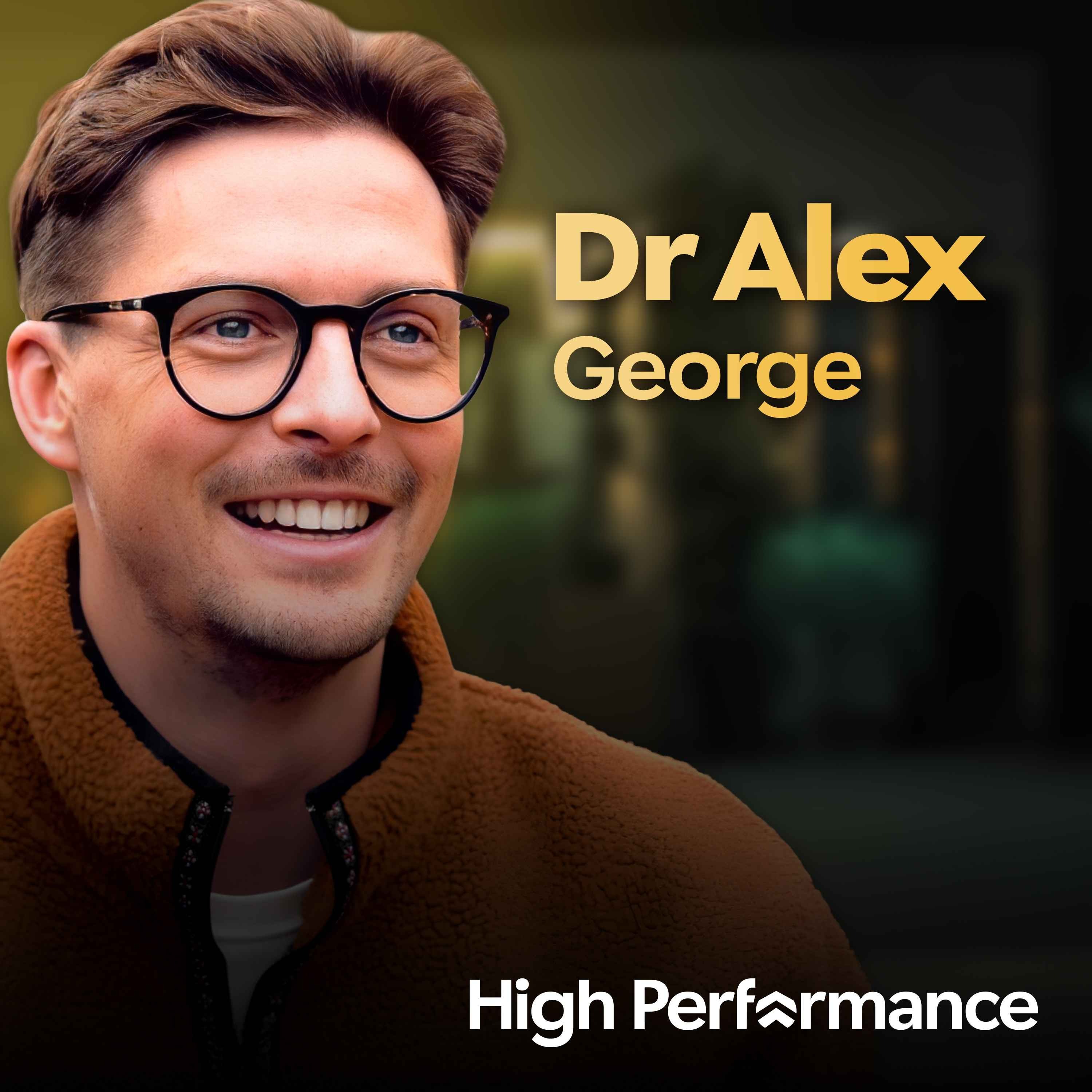
The High Performance Podcast
How Giving Up Alcohol Transformed Everything, with Dr Alex George
00:48:07
Loading summary
Transcript123 lines
- [00:04]
Dr. Alex George
Me deciding to stop drinking was the single best decision I've ever made. Bar nothing. There is nothing in my life that has come close. No career decision, no path. That is the single best decision I've ever made. Everything else that follows on was because of it. I suspect it will be for a long time.
- [00:22]
Host (possibly Damien or Sam)
That was the voice of Dr. Alex.
- [00:24]
Narrator/Producer
George, an A and E doctor, a reality star turned mental health advocate, a podcaster, a youth mental health ambassador, and now an author. But behind all of those campaigns and all of that incredible work, behind his public face was for so long a man medicating his life with alcohol. So December 4, 2022, sitting in a hairdresser's chair, Alex was at rock bottom, 20 stone drinking to suppress the grief of losing his brother to suicide. And it was at that moment that he took an honest look in the mirror and it was the catalyst for transformation. He gave up alcohol and as you've just heard at the start of this episode, it changed everything for him.
- [01:02]
Host (possibly Damien or Sam)
It.
- [01:03]
Narrator/Producer
And we're about to explore why so many of us are auto enrolled into drinking. Why it's the only drug you have to explain that you don't take. And the three groups of people that Alex believes should never drink at all. Please make sure you hit subscribe and share this live recording with Dr. Alex George with someone that you think may well benefit from the amazing wisdom that he's got to share as we welcome Alex to high performance.
- [01:30]
Host (possibly Damien or Sam)
Alex, thank you so much for coming.
- [01:32]
Dr. Alex George
And talking to us.
- [01:33]
Host (possibly Damien or Sam)
It's really nice to see you again. Before we sort of get on with the structure of the conversation, I just think the way that your, your journey and your career has gone since Love island has been absolutely fascinating to watch from the outside. What's it been like to actually be in the middle of it because you seem to be doing a different project and a new thing every single time.
- [01:50]
Dr. Alex George
I talk to you, maybe I'll say adhd, I don't know. I think it's been an interesting experience that's been. There's many kind of lows and highs and everything in between, to be honest. I think, you know, people often ask me the question, like, has it made your life better? Are you happier? And I couldn't honestly say I think my life is better off because of everything that has happened. I think I've experienced so much and I think I've probably contributed more. Yeah. And I think I've done more because of it. But actually, when I look at it, in many ways, so I used to work with, we Were obviously recording this in central and I used to work at King's College London, which not far away. And then I eventually went over to Lewisham to work and I loved that, loved the hospital. I worked in A and E. It was a dopamine heaven with adhd kind of running around this, you know, you've got a stabbing here and something else going on there. It was chaos, but I loved it. And I used to cycle to work every day. I'd do my job, had a good group of friends, life was kind of good. And then I got persuaded to go on the show. Literally dragged on the show actually. Mostly thought it was a two week holiday which was perfectly aligned. My contract was ending at the hospital and turned out things went very differently. But you know, I'm very grateful. I managed to do lots of different things in my life, but I don't think that doing lots or being externally successful actually makes you happy necessarily. It's always going to be within.
- [03:07]
Host (possibly Damien or Sam)
It's interesting, isn't it, as you get older. There was a period where I thought like happiness is the goal, right? But actually the more that you live, the more that you do things, the more success or failures that you have along the way, the more you realize that happiness is one of the most transient things that a human being can experience and that you. Just because you're not always happy doesn't mean you're always on the wrong path. And I think so often in life, as soon as people think, well, I'm not very happy doing this, they have to chop and change. But it's. It's a dangerous game, the chase of happiness, isn't it?
- [03:36]
Dr. Alex George
I think so. I think, I think a lot of people probably get really stuck because they're chasing this feeling, which is actually one of many deflections from a baseline. I guess happiness is, is that, you know, floaty feeling of sat in the park, the sun shining with your friends. That's kind of like a feeling of warm, like happiness. But that is just a deflection. You know, the purpose of sadness is important, of grief, of anger, frustration, all the kind of other emotions are really important. But I think we kind of put happiness on a pedestal and demonize lots of other feelings. And I think therefore when you do feel angry or upset or like anxious at times, I think you then think that you are kind of failing. What we don't want to do, obviously is get stuck in an emotion. And that's where the challenge really starts. Like if you're happy all the time, you might be Suffering from mania. And that's a problem if you. That could be a real problem.
- [04:26]
Host (possibly Damien or Sam)
That's what's wrong with me.
- [04:29]
Dr. Alex George
But it's kind of like every emotion has its job and I think it's trying to find a time where you can apply the right ones at the right times. And that's what I guess we're all trying to figure out.
- [04:37]
Host (possibly Damien or Sam)
Absolutely. Well, can you take us to what the emotion was like on December 4, 2022, sitting in a chair at the hairdresser's?
- [04:46]
Dr. Alex George
Yeah, that was a, that was an interesting time. Which now as we record this is like coming up to three years ago. I was in a very difficult place at that, you know, and it's odd sometimes that you're the last person to see how bad things are. And the kind of backstory to that was I kind of sat down on that day in the kind of hairdresser's chair and I kind of. You get asked and you're like, what we're going to do for you today. And I looked in the mirror and I was like, Christ, I don't know where you're going to start. I'm bloody lost here. Hell. And I think it was a realization that I was like, it wasn't just the physical appearance, being like 20 stone overweight, puffy faced, dark eyed, all these different things. It was like looking within into my eyes. I was like, I don't actually. It's a very frightening experience, but I don't recognize. I'm completely lost here. And I think what had happened really, I think probably, I don't think Love island was like a starting point for, for the badness, if you like, but I guess you put into the public space. I was then kind of like, what am I going to do with this? I went back to A and E, started working, talking about how things started becoming clear on my path. I guess the pandemic hit and I was like, I feel a real calling. I want to do something positive here. And then something happened which often, sometimes the worst things that happen in your life is not expected. I think we often think we can worry and predict and if we worry loads, you can control the outcome. And actually the truth is often, as my mum put, actually after, after this happened, the worst things in life are often the things you hadn't even imagined. Like, my mum was what she called herself a warrior all of her life. And she said, I worried about everything. And the worst thing that actually happened, I hadn't even had a moment's thought that it could and so I'm referring to the phone call I got from my dad one day on a summer sunny evening, sat with my friends to say that my brother just died and that he died by suicide. And that kind of moment, I'll never forget it. When you're sat there with, almost sat at the dinner table, sat at the table here, you put your phone on the side, don't you? You're kind of chatting with your friends, looking at the starters. And we had a kind of an agreement in our family that if something is wrong, ring through twice. Because often I'm doing stuff like this. And if you ring once, like it stops ringing, it's just ringing for chat, ringing twice, important. So obviously he did that. And I picked up the phone and as soon as I heard his voice, I said immediately before he spoke, who has died? And I never in my wildest dreams imagined that would be my brother. And I assumed it was a car accident or a heart attack. But when I found out it was suicide, obviously that was life changing. So what did I do? I worked hard afterwards, started campaigning, doing all this stuff, and drank loads of booze. So it wasn't working. I was drinking. So fast forward what happens, you end up sat in a chair, completely lost, thinking, shit, what am I going to do now? And that was that day. I was like, I can't continue like this anymore. It's a mess.
- [07:36]
Host (possibly Damien or Sam)
So that was the rock bottom moment for you?
- [07:38]
Dr. Alex George
Yeah, and I think it was. And you don't have to get to rock bottom to stop drinking. There's many people that option out, or many people who moderate well before and drink mindfully, I guess people like to say. But for me, it had to be that, that point and that moment. And really I look back on my life and think that I'd been medicating with alcohol for probably most of my life. Really taking the edge off things. Yeah, I think so. Without realizing. I mean, if you look at. I was, I was diagnosed with ADHD actually not long before I stopped drinking. And I think almost I wasn't ready to stop at the time I was diagnosed. I kind of carried on for a few months because I just wasn't ready to kind of fully accept what, what I was told. But I think all my life, when I look back, alcohol is just a way of taking the edge off things, making yourself feel normal. I mean, many of us use it anyway for things like anxiety or like, you go to a social situation, you have a quick drink before it calms you down. If you celebrate something, you have a drink. If something goes wrong, you have a drink. It's just used. But I was really medicating myself and what happened? I think what changed is suddenly it wasn't just to kind of round the edges. It was like to suppress. And I think that change in that relationship was significant for me.
- [08:50]
Herobred Advertiser
Fall is all about cozy comforts. But when you're prioritizing your health, it's easy to feel like you're missing out. With Herobred, you can enjoy all your fall favorites because they're made with herobread, sliced bread loaves, tortillas, bagels, dinner rolls and more. Try their all new hero noodles. With 12 grams of protein and just 80 calories, you won't believe. HeroBred's options have 0 to 5 grams net carbs and are high fiber from the taste and texture. They've even got small batch drops of indulgent favorites like the popular Hero croissant. And right now, Herobred is offering 10% off your order. Go to Hero Co and use code fall25 at checkout. That's fall25EROCO. All figures are per serving of HeroBread. Contains 2 to 18 grams of fat per serving. See the product nutrition panels on Hero Co for more information.
- [09:38]
Land Rover Advertiser
Are you a trailblazer, a risk taker? Maybe someone with countless tales of epic adventure? Well, I'm not quite there yet, but I'm working on it. Even the boldest among us started off small, right? Daring themselves to reach greater goals every day. And if you're looking to take on a challenge like that, the Defender is too. Now, I've driven a Defender for a few years. It's the best car I've ever owned. It's a vehicle built for drivers capable of great things, whether they're heading towards uncharted territory or just fancy a weekend getaway. Defender was engineered to meet challenges head on so you can explore with confidence. It's the legendary icon of adventure reimagined through modern design, fit for a new generation of explorers. My kids love it as much as me. It also has a tough, rigid body tested to the extreme, a modern functional interior built for comfort. It's a vehicle that, like you, is capable of great things. And with next gen technology, from 3D surround cameras to clear site ground view, it will help you embrace the impossible. Explore the full Defender lineup@land roverusa.com.
- [10:40]
Host (possibly Damien or Sam)
A lot of people, I think when it comes to drinking, they don't realize there's a problem because they can't pinpoint a specific moment of trauma that Might have led to this. Right, but you did have a moment of trauma. You know, the death of your brother by suicide was a moment that a lot of people to deal with, would have gone to therapy. They would have gone and seen a counselor. Did you do that as well? Or did you. Did you actually not deal with the grief at the time?
- [11:05]
Dr. Alex George
I tried, but I think it's very difficult. I mean, I thought I was in shock for, like a couple of weeks, but in reality, I think the shock lasted a year and a half, maybe even two years. I kind of. You lose almost insight. And my reaction was actually the very next day, I mean, I rung Harry. I think you're probably the second person I called. Harry's my manager, sat here now, who I called at the time, saying, look, my brother's died. Clearly, I was not speaking like that. It was quite a different kind of phone call, but I think it was like a day or so later. I was trying to carry on work, working, wasn't that. I was like, no, let's carry on working. I need to carry on. And this wasn't in a sense of, like, not caring. It was a sense of clinging on to, like, I was falling into this hole and I was kind of cling on to any sense of normality, of, like, what previous life would be like. And. And part of that was then working really hard. And, yeah, when I was, like, not working, I was like, I just need to not feel. And I wasn't drinking, like, every night. I was drinking like three nights a week, but just a lot. And that cumulative effect of the time, plus not exercising, not looking after myself, not eating well, just was a compounding effect. And it's very easy to happen. It's so easy. You don't have to have a big trauma to get yourself in a difficult state. But I had to get to rock bottom to learn. I think a lot of the stuff that I've learned on the other side, which has undoubtedly. I look back now, me deciding to stop drinking was the single best decision I've ever made, bar nothing. There was nothing in my life that has come close into a decision. No career decision, no path. That is the single best decision I've ever made. I. I suspect it might well, because everything else that follows on was because of it. Yeah, I suspect it will be for a long time.
- [12:39]
Host (possibly Damien or Sam)
Well, it wasn't the answer the hairdresser was expecting then, was it? When they said, what are we doing today?
- [12:43]
Dr. Alex George
I said, like, well, it's going to be quite the dream. Yeah, more Than a trim. Let's talk for a more than a.
- [12:48]
Host (possibly Damien or Sam)
Trim today, obviously, you did get your hair cut, right?
- [12:51]
Dr. Alex George
Yes.
- [12:51]
Host (possibly Damien or Sam)
Yeah. After looking in the mirror and thinking, this isn't like this. Something has to change. I think a lot of people, maybe some people in this room have had that moment where they're just like, I'm just not happy, I need to change something. But then you go and have a drink, or you go and have a meal, or you go and see your friends, or you go to work, and that. That moment's quite fleeting. And maybe it comes back in a few months or a few weeks for you. Was it quite fleeting and you carry on as you were, or was that literally you left the hairdressers and things had changed? And if so, immediately, what had changed?
- [13:19]
Dr. Alex George
Well, I was at a point where I could not continue. Yeah. I was really at a point where this was now in a desperate state.
- [13:25]
Host (possibly Damien or Sam)
How much were you drinking?
- [13:27]
Dr. Alex George
I was kind of. I was drinking like three nights a week and I was drinking, like. I mean, when I was really going for, like eight pints, nine pints or something like that.
- [13:34]
Narrator/Producer
You're, like, pissed a lot of the time.
- [13:36]
Dr. Alex George
Well, certainly when I was drinking on the weekends. Yeah. I mean, when I was working, I was working. And actually, to be perfectly honest with you, the mountains I was drinking was probably not so different to a lot of people that live in London and just do it under the guise of fun. But I think the reason had changed. I think the effect. Clearly, that amount is a significant amount of alcohol. That's a lot. But I think it wasn't just the quantity. I think the why was very much tied in. Does that make sense? It's like, it's important. The reason, I think. I think it's very different having, you know. Look, I personally, I will talk about a little bit, some of the reasons. I think that some people shouldn't drink, but I think probably for me, I shouldn't have ever drunk, but I think some people can just, like, moderate and then do it for social reasons and enjoy. That's fine. But I think when the reason becomes very different and then it starts to run away, you have to. But yes, I mean, that day for me was like, this has to change. I mean, you know, it sounds very dark, but when my brother passed away the night after, me and my brother Elliot, who's, you know, here, and my parents, we all made a promise that none of us would ever leave. That what has happened is so bad that no matter how much we kind of suffered because of it, we would always stay. And so I was like, well, if I'm staying, I better change. And I need more than the haircut. So, you know, from that day onwards, like, the two promises I made that day was, I'm not drinking anymore, and I'm going to walk every morning. And I say, this sounds ridiculous, but I was like, I need to just feel grounded and outdoors. And my childhood was kind of running around, playing the field, being in nature. And I was like, I just need to go back to that. And funny if that's kind of where the Stomp cast came from, was like, I need to just walk every morning to ground myself and walk for hours to get this stuff out of my head. And it became, like, the basis of, like, everything else changed. That changed because a lot of people say, well, you know, you've run London marathon this year. You know, you're fit, you're strong, you've changed so much stuff. You've lost all this weight you've done. I didn't start with that. And I think when you're trying to make a big change, I think a lot of the reasons people, quote, fail or don't do it on that occasion is because they try and do too much. I literally was like, I'm not drinking and I'm going for a walk every day. And then after a few weeks, I was, like, kind of enjoying this. Walking is helping. I'm now going to, like, I used to enjoy lifting weights. I'm going to go to the gym, lift weights. I was way too overweight to run. I was too heavy to run because it would have hurt my knees and things. But I was, I'll start with weights. And then eventually I was like, I kind of probably should eat a bit better if I'm going to lift weights. I want to feel my body and you can see how things. And. And I built upon that. And then, you know, that turned into, I'm probably slim enough now I can go for a run for a couple of K2K or 1K or whatever. And then you follow that on for a couple of years and you run a marathon or whatever. You don't have to, but, you know, that's. That's how I get there, step by step.
- [16:11]
Host (possibly Damien or Sam)
And did you also address the underlying trauma that was the reason for the drinks?
- [16:14]
Dr. Alex George
It's the hardest thing. I mean, putting down the bottle is the easiest bit. Dealing with the problems. Now, I didn't have an addiction, which. And addiction is a difficult concept because it depends on how people look at it. Because I guess a habit is something you turn to without conscious choice or that you're driven to repeat. So, you know, people are largely addicted to their phones. It's a conversation I think people don't want to have, particularly. But it is one of the most common addictions there is. You can't compare the consequences necessarily, other forms, but it is a habit. That's an impulse. So in some sense, you could say it was habitual. But I very much felt like I could stop and I didn't have to do it. I was doing it deliberately for a reason. And when I stopped, I chose to.
- [16:54]
Host (possibly Damien or Sam)
And this sounds great, and it sounds very positive, and doing the exercise and eating less and stopping drinking.
- [17:00]
Dr. Alex George
Fantastic.
- [17:01]
Host (possibly Damien or Sam)
But there is obviously one other element that you would have brought back into your life that would have been really difficult, is that when you're not drinking, you have to feel emotion.
- [17:09]
Dr. Alex George
Yeah.
- [17:09]
Host (possibly Damien or Sam)
And you'd already said you were drinking to sort of numb the pain of what happened.
- [17:13]
Dr. Alex George
What was.
- [17:14]
Host (possibly Damien or Sam)
So what was that like when for the first time, probably in a long time, you actually had to sit with your own feelings?
- [17:19]
Dr. Alex George
The most difficult part of it was as I. Putting down the bottle was like, allowing everything to come up and you had to deal with your emotions. And that is a very difficult thing. I think that first year was the hardest year of my life. Not necessarily the year my brother passed away, but the year I kind of had to face that stuff because, you know, I was quite traumatized by what happened. There's lots of other stuff that's happened in my life that's very difficult. Even the anger and frustration around being diagnosed at 31 with ADHD, having a life of many challenges that could very much been avoided. All of that stuff was just there, and you have to deal with it. And, yes, I brought in therapy, and actually I managed to persuade my therapist, which is quite new at the time, to do my therapy walking, because I don't like sitting still too long. And I was like, I feel like when you sat still, it's very hard to, like, talk in the same way. And so we walked and did all. I did most of my therapy, hours and hours and hours of it, just walking.
- [18:14]
Host (possibly Damien or Sam)
And are you still in therapy?
- [18:16]
Dr. Alex George
Yes, I am. It's funny because I think, you know, I'm going through an assessment for autistic spectrum at the moment, and I think in reality, the older I get, the more I'm actually looking back and realizing how much was already there. Since I was very young, I'm dealing with OCD as well. At the moment, I think OCD's probably there since it's been a very young age. I find it very fascinating, actually, if you look at neurodevelopmental disorders, ocd, autism, adhd, it's all very, quite closely linked and the prevalence and coexistence of all of those is very high in certain people. And I think probably that has. All of that has played a huge picture in my life. And to be honest, I look at my. My dad, to me, is certainly autistic and has adhd. Elliot, my brother, I believe, firmly does as well. He's going to go through assessment and I think probably Theo did, you know, because it's so strong within us, we can see it within one side of the family pretty strongly. And I think the shame is. And there's questions around, well, if that had been picked up at a younger age, could it have been different for all of us? I think certainly for my life, my life would have been very difficult had I different. Had things have been picked up, I wouldn't have drunk. You know, I say, I often say to people, I do talks now, I genuinely believe that there are three groups of people that shouldn't drink. For many people, I go to pub with my friends and they can drink mindfully and whatever, fine. But there's three groups of people, I think, that really shouldn't drink. And I think the first group is anyone with adhd. Because ADHD is a dopamine deficit disorder. The name is rather stupid, doesn't really explain a lot of what people experience. But at its core, we have a lack of dopamine in certain parts of the brain, particularly the prefrontal cortex. And the job of the prefrontal cortex is to regulate your decisions. It's like a man or a woman sat in a control room pulling levers and fundamentally that person's had a few too many beers and pulling the wrong levers a lot of the time, which means that emotional reaction isn't great. Executive functioning can be quite poor, impulsivity can be high, inhibition can be poor as well as. Obviously, there's lots of parts of it that can be great outside the box thinking. But at the core of the problems of adhd, it's executive functioning, it's making those controls. So when you pour alcohol in to already disinhibited brain, that's impulsive, that probably doesn't always make the best decisions. It's a recipe for disaster. That's why 40% of ADHDers have alcohol misuse disorder. Significant number go on to have significant addictions and so on. So I think ADHD is definitely one to avoid alcohol in my opinion. The second group, I think is anyone who's stuck in life. I wonder in the room, how many people have felt stuck and be like, oh, why can't I not get where I want to be? I can't get to my dream job or I've really been meant to be consistent in the gym and I always fall out of the gym. Ask yourself the question, is alcohol getting in the way? Because I think for a lot of people it's like that lead ball around your ankle. I had Tony Adams on the Stompcast recently, England footballer. And he was saying how Arsene Wenger said to him when he'd quit drinking, like, God, it's amazing because you've been playing all these years at 70% capacity while he's drinking and now you've got 100% and he's like, everything's so much easier and you're. And he was amazing after that and won the double and did all this stuff. And I genuinely believe that's true. It can be the weight on your ankle. And the third group, and I think this is very important, is that anyone struggling with any sort of mood issue, if you're low and you're depressed or you're anxious, look at alcohol like it is a depressant, it is a anxiety inducing drug. And I think often we just like because of how society sells this thing, alcohol should be there, you know, you're happy, have drink, you know it's bad thing, have a drink. Really look at that. Because that in itself can make you depressed. And for so many people, if you're trying to get better, look at the booze. I mean, it's not lost on me the fact that I was taking antidepressants for a year while I was drinking and I look back now and think probably didn't make much sense.
- [22:09]
Host (possibly Damien or Sam)
So you were removing the depression with one drug and then adding it back with another.
- [22:13]
Dr. Alex George
But it's so common and so many people.
- [22:15]
Host (possibly Damien or Sam)
Well, it's so common because like we're auto enrolled into drinking in this society, right? So like you've already said, if someone dies or you have a drink at the wake when someone's born, or you have a glass of champagne at the Christine when someone gets married, you have a glass of champagne. Something when they get divorced might have a glass of champagne. It's like every moment in life we celebrate with drink. And then I say this fully, well, that we were serving spicy Margaritas arriving, but they were bloody good, right? And it's. It's really interesting, isn't it, that, like, it's about the only drug where you have to explain why you don't take that drug. And when you do, people take the.
- [22:49]
Narrator/Producer
Piss and you're like, oh, my God, are you boring?
- [22:52]
Host (possibly Damien or Sam)
I mean, no one's going to have a line of coke or you're dull. Well, some people are. I mean, we're in London, right, and we work in the media, so that does happen. But it's like, it's just so common.
- [23:01]
Dr. Alex George
I think it's just being able to make a choice. And, like, it's kind of like I say, I sound like I'm really anti alcohol, and for me in my life, I am. But I go to the pub and my mates have a beer and like, I'm so comfortable with that because for them, they don't sit in those three groups, or at least they. But yeah, they don't sit in one of those three groups. And they make a choice. They go, I choose to drink, but I don't drink eight pints. And then in a difficult situation, I don't booze three nights a week. They're kind of doing it in it with a consciousness. And I think what the point around auto enrollment is exactly that. How many people make a conscious choice to drink? I'm pretty sure most people just do it because that's what happens. So if you choose to do something, then that's great. It's a choice. You've weighed things up. But I don't think I ever made that choice. It's like, I was 15, he was like, here's a pint. Or he started playing rugby. It's like necklace, beer, whatever it is. And then you went to med school, and drinking was just as part of med school as learning is. It was just part of what you do. And I just think that it's just being able to make a choice for so many people. They can drink and be happy, and that's great. But I do think we should probably give people more of a choice at a younger age.
- [24:05]
Host (possibly Damien or Sam)
So what would you say to anyone in the room who's thinking about giving up alcohol or drinking less alcohol? I saw a study recently. It said only about 7% of people want to fully give up alcohol, but about 80% of people wish they could drink a bit less alcohol.
- [24:17]
Dr. Alex George
Most people say that they wish they'd either drink a bit less or that they do it in a way that was more controlled, but, like, more Cognitive, like more of a choice I think just give it, I think it's a great experiment just to go like for a period of time and try. I mean a lot of people do dry January but I think the first 30 days is kind of like learning how do I kind of do this. And I think the next 60 days when you feel the real benefits, if you can do 90 days, it's a good challenge. You save a lot of money, put the money aside and go on holiday. It's amazing how bloody expensive it is to buy. Lucky. There's probably three of those margaritas. Right? How much do they cost you down the road? How much they be down the road? Yeah, 20 quid for one or 15 quid. So go for your life. Yeah, yeah. So make load up, make the most of it tonight. I think, yeah, I think is that the right messaging? I think it's, I think it's something to worth giving a try. And I think like for example people go what's the point doing dry January? All the studies show that for the vast majority of people do go back to drinking after dry January, they drink more mindfully and they have a better relationship with alcohol. It does actually benefit their health. So give it a try, you know, why not?
- [25:16]
Host (possibly Damien or Sam)
I also, and as you know, I, I, I'm not teetota but I drink.
- [25:19]
Land Rover Advertiser
A lot, like very, very rarely.
- [25:21]
Host (possibly Damien or Sam)
If I've got a friend that only buys like 300 pound bottles of red wine, I will drink when I'm with him just to try that red wine.
- [25:26]
Dr. Alex George
Only with him.
- [25:27]
Host (possibly Damien or Sam)
Of course, only with him. But I don't drink. And I'll tell you, I think a lot of it is to do with hosting, you know, high performance. For the last six years, the number of times that we've had conversations with people and they've said the biggest barrier to, to success is people are unable to do the hard thing. If you can do things that are hard, it sets you on a path to success. And I actually really like the fact that not drinking is hard and I think it's a great thing to be able to say no, let's see how much strength we have as human beings.
- [25:53]
Dr. Alex George
You know, I think it's really important. It's easy to talk about the other side of it. I guess that's how we start the conversation. But I'm much more in control of my emotions. I'm more productive than I have ever been. Like I run like six or seven different projects, I'm starting another business. I'm a calmer person, I'M better to be around most of the time. I get to do a lot more life. I started riding motorbikes. Okay, you could argue one vice for another, I don't know. But I ride motorbikes carefully. I've traveled so much this year and I think I was able to plan and do those things and carry them out and enjoy them. When I go on holiday now, I remember all the holiday. I never sleep till midday hungover. I do the fun activities. You're the ones you plan. You go to a city and think, oh, I can do those really cool activities. But then you end up drinking. You don't see any of the city. I get to do that stuff. And also I kind of think there's that thing. Like I did enjoy certain parts of my drinking. For sure I had some great times. But if you're gonna spend 15 years of your life doing something, it's kind of fun to do a while of your life doing something else. Like is it, does it. I had to remember this one time actually not before I'd stopped drinking, but I remember before. I think a lot of people have this, right. It's like midnight, isn't it? You're in the pub, you've had six or six or seven pints and you look around and think like, what the hell are we all doing here? Like, why am I not in bed? You just have this moment of odd clarity, don't you? It's like drunk clarity of like, what is. The floor's sticky, the music's bloody annoying. This person's telling the same story the third time. It's kind of funny. You're just like, what? You know, what am I doing? So I think there's some element of try something different. Yeah.
- [27:18]
Host (possibly Damien or Sam)
Have you ever met anyone that's regretted giving up drinking? I haven't.
- [27:21]
Dr. Alex George
Never my life. Never. Never in my life. I haven't. I genuinely haven't. And I think that's probably why a lot of people are doing different. But look at the stats for kind of like 18 to 21 year olds, 18, 23 year olds. It's kind of nearly half of them just don't, don't drink at all. I think probably because people want to be, want to have different aspirations and goals to what I guess we were told was fun. I think the idea of fun is changing. It's more experience, health based traveling, doing things rather than going to a club, etc.
- [27:50]
Host (possibly Damien or Sam)
Totally right. I mean I remember when I went to university or the age I never went because I failed my A Levels but the age I could have gone to university, nobody went to the gym, my mum and dad, it was not a thing. Now universities are just full of people in the gym all the time. I think we've definitely moved away from drinking and definitely towards doing more exercise. One thing you said at the beginning.
- [28:10]
Narrator/Producer
That I thought was really interesting, you.
- [28:11]
Host (possibly Damien or Sam)
Said going on Love island was kind of the start of the bad stuff. Maybe it wasn't linked but it felt like that most people would go, well, you went away, you're on a TV show, you're on a lovely island with a load of good looking people having a great time. What were the challenges of going on a show like that? And why did it, why did it sort of signal the start of this tough period?
- [28:30]
Dr. Alex George
Everything was. I don't think the show was kind of irrelevant to the rest of it afterwards. I just think that that change I. My life changed a lot afterwards. What the show was kind of was almost irrelevant. I think change is a. Is something that like can be amazing but unsettling as well. I think. You know when I'm for example, I moved to London from being like in Exeter and I'm from West Wales, like sleepy area, go to Exeter, still quite sleepy. You come to London, it's like this was my dream job. I had a post my wall studying at uni of King's College London. I watched 24 Hours in A E. I was like, I want to work in a hospital. When I moved here and got my dream job, I was like, oh my God, like petrified and scared and in many ways it's unsettled. But this was the dream. So I think change can be a big thing and I think I had just such an overhaul. Like I had 200 followers going on that show. I had no agent. I had no idea that I, when I say people go, oh, I had no idea. I was looking for love. I wasn't necessarily looking for love. I thought it was a sunny holiday, but I wasn't looking for a career. I can say that hon, honestly. I was going to be two weeks back to A E. That was the plan of action. It didn't go to plan. But yeah, I mean look, it's. It did change my life and a lot of things that followed have allowed me to do things that I'm very proud of and I have to be grateful for that. And you can't change the past. All you can do is learn from things and you learn from your mistakes, learn from things, you do well and you move forward. I think Being stuck in the past is a. Is not a helpful thing.
- [29:53]
Host (possibly Damien or Sam)
We've got some questions from you all, which I'm looking forward to hearing. So I look forward to seeing who the first person is brave enough to put their hand up. Before we do that, though, I just want to mention your new book, Am I Normal? It's out on January 15th. And he's such a lovely, humble bloke.
- [30:05]
Narrator/Producer
He's like, oh, please, I don't really.
- [30:07]
Host (possibly Damien or Sam)
Want to talk about the book.
- [30:07]
Land Rover Advertiser
I don't want to make this a.
- [30:08]
Host (possibly Damien or Sam)
Sale thing about my book. But before we take some questions, I think it's a really interesting book because we're in this space now where someone getting an ADHD diagnosis.
- [30:17]
Narrator/Producer
Right.
- [30:17]
Host (possibly Damien or Sam)
It's not a rare thing now. It's suddenly is a big topic of conversation, but it's been a really, really important period for you. And you, I think, learned a lot about yourself and about the world, having been through that process of a diagnosis.
- [30:28]
Dr. Alex George
Yeah. I mean, and actually, I must be honest, and people often say, books hard. I've written a couple of books now. This is probably the hardest things I've ever done. I think it's so hard because it's not written as an autobiography. But I really, like, dug through, like, a lot of difficult things in my life. And the way I did it is that I basically, like, wrote down the questions that I was asked, like, how was childhood? How do you deal with this? What was your relationship with, like, drugs and alcohol? What was university like? You know, really digging into, like, personal stories. What were your relationships like? And so I use these as chapter titles and just, like, try to work out, like, is it me or is it the world? And I did it while trying to, like, figure this stuff out. And it's really interesting. I learned a lot of stuff about myself that I hope other people will resonate with and might help them on their kind of looking into these things. But also, I actually looked at the world and thought, screw you quite a lot. Like you, you know, the world itself and the way we set society up. Not just. It's not. This book's not really just about neurodiversions for anyone because society works against you a lot of the time. A lot of the stuff we blame ourselves for and that we're really hard on ourselves and that we measure ourselves to fail. All these difficult things and experiences. It's society, not you. And I think so much of the time, we just. We always think it's our fault that we're like, this is going wrong. Or this is happening in our lives. Actually, society is really set up against you quite a lot of the time.
- [31:49]
Land Rover Advertiser
Are you a trailblazer, a risk taker? Maybe someone with countless tales of epic adventure? Well, I'm not quite there yet, but I'm working on it. Even the boldest among us started off small, right? Daring themselves to reach greater goals every day. And if you're looking to take on a challenge like that, the Defender is too. Now, I've driven a Defender for a few years. It's the best car I've ever owned. It's a vehicle built for drivers capable of great things, whether they're heading towards uncharted territory or just fancy a weekend getaway. Defender was engineered to meet challenges head on, so you can explore with confidence. It's the legendary icon of adventure, reimagined through modern design, fit for a new generation of explorers. My kids love it as much as me. It also has a tough, rigid body, tested to the extreme, a modern functional interior built for comfort. It's a vehicle that, like you, is capable of great things. And with next gen technology, from 3D surround cameras to clear sight ground view, it will help you embrace the impossible. Explore the full Defender lineup@land roverusa.com.
- [32:51]
Dr. Alex George
Tonight's meal, tilapia surprise with boiled cabbage. Begin cooking steps 1 through 50 now.
- [32:56]
Blue Apron Advertiser
Are you kidding me? Making dinner shouldn't feel like doing a thousand piece puzzle. With Blue Apron's new one pan assemble and bake meals. The hard part's already done. Pre chopped ingredients, zero stress. Just assemble, bake and enjoy. No complicated steps, no mountain of dishes. Try assemble and Bake today. Get 20% off your first two orders with code APRON20. Terms and conditions apply. Visit BlueApron.com terms for more.
- [33:27]
Host (possibly Damien or Sam)
Right, time for some questions.
- [33:28]
Dr. Alex George
Who would like to go first?
- [33:32]
Host (possibly Damien or Sam)
Hiya. What's your name?
- [33:34]
Audience Member Olivia
Olivia. Very inspiring insights.
- [33:37]
Dr. Alex George
Thank you.
- [33:38]
Audience Member Olivia
So I lived in Germany before and yes, drinking culture there is heavy as well. But in England I feel like it's really like pint after pint or drink after drink every Thursday, every weekend. And people can be quite patient about it. So how did you handle that social pressure, especially at the beginning? I think that's the beginning, you know, and would you say to push back against it?
- [34:00]
Dr. Alex George
So there's lots of different approaches and people do it in different ways. But I really, I think fundamentally the most important thing if you try alcohol free living is that removing alcohol shouldn't take away from life, should add to it. And I think a lot of time in January, people stop drinking Stay inside, don't do anything, don't leave, don't talk to anyone. And then they're miserable and they wonder why. I think when you take the alcohol out, it's serving something. Fundamentally, if you drink alcohol, you drink it for a reason. You would not consume it if it didn't do something for you. Whether that's taking the edge off, having fun, numbing, like I was doing, doing something. So you have to replace it with something. So that's, that's really important. And I think remembering why you're doing that is at its core almost when you are pushing back on people. It's like, I'm doing this because I want to like, travel more or live more, be fitter, do more in my life. So remembering that for yourself, when people are pushing you, but for them it's all about like, how much do you want to say, like, people say to me, like, oh, you're not drinking. How come? It's like, well, alcohol didn't suit me that well. I'm. Sometimes I just be like, you know, I'm trying a different way of life. Or you could say I'm training for a run. You can tell them a white light, whatever you like. But I think just remembering, it's not for them to dictate, you know, why you don't, whether you should or shouldn't drink. But I just don't think it leave it too open. Just be like, I've decided to stop drinking for a while and I'm enjoying it. And I think that it's worth though saying that there's a lot of people you'll find that actually ask out of curiosity. I have a lot of people asking me. Obviously, I guess some people know that I don't drink, but in the first instances. Oh, how come? That's really interesting. And that's a very different question. Because then you can have a really nice conversation sometimes about it and sometimes that might inspire them. But you're right, people can be pushy. And there is no doubt, I would say there is no doubt there are certain people in your life that you will lose. I think where people, when people struggle, when after a while, when they quit drinking and the times like it can be difficult is when you're not willing to let go of a former version of yourself. Do you know who talks about this? Sometimes you hear dads talk about it. So if you have a. If you have. My friend has got two young children. He said, when you have children, you've got to let go of the life of going out on the Friday night and all that kind of stuff and realize your new chapter is beautiful. Your old chapter was fun, but you got something new. And that's how I see it. It's like I can remember the nostalgia and some of the memories, some of the fun nights I had, some of the bad ones as well. But I just think you've got to embrace this new way of being. So if someone pushes you, you've got to accept that most your friends will accept you. And if they don't, they're not really your friends and they never were your friends is the truth. They weren't ever your friends. You're not losing something. But I've gained so many friends. You know, you meet new people in different ways and it's fine.
- [36:28]
Host (possibly Damien or Sam)
Do you ever drink?
- [36:30]
Dr. Alex George
Well, alcohol, never. I'm not a driver, I've never had. I've not drunk anything since. But I didn't stop planning to quit forever. I stopped trying to fix myself and then actually discovered I actually really like this life. I genuinely can tell you. I mean, why would anyone quit drinking if it wasn't better? Yeah, I, I genuinely, I genuinely can say, hand on heart, I enjoy life more. It's better. I enjoy it. It's better for me in my life.
- [36:55]
Host (possibly Damien or Sam)
Another question at the back there.
- [36:56]
Dr. Alex George
What's your name?
- [36:57]
Host (possibly Damien or Sam)
Rolf. Hi, Rolf. Good evening.
- [36:59]
Audience Member Rolf
If you look at HDHD assessments, NHS even closed the waiting list. Now, if you were lucky enough to get on the waiting list, you still have to wait eight years, I believe.
- [37:13]
Dr. Alex George
Yeah, It's a eight years average wait list per adult in the uk, in England. Yeah.
- [37:18]
Audience Member Rolf
And a lot of people wait for the confirmation to get the diagnosis and then try to change anything. Do you have any other tips for people to forget about the diagnosis but just drink less, exercise more and what else can you.
- [37:34]
Dr. Alex George
It's absolutely right and I think the sad fact of it, it's completely wrong, really just might address this. And it sounds like I'm being really negative tonight. But people, sometimes people go, oh, you know, everyone's got ADHD these days and it's just a fad and so on. I think, I think it's really important to realize how much ADHD impacts people's lives. So a meta analysis, a really big study, 35,000 people released very recently, and they looked at longevity, and they looked at longevity of adults, neurotypical adults versus those with ADHD but not treated. So they're untreated people with ADHD and women on average lived eight years shorter lives and six years shorter for Men. Really interesting question about why there's disparity between men and women. I think lots of typical barriers probably are in place that we can talk about. But the point is it really does affect people's lives. It's not just longevity, it's quality of life. So the likelihood of mental illness and all these things are higher. So the point around does it matter that we do something is absolutely. And I think that's why it's such a criminal injustice that the government doesn't do something about it. I mean regularly ADHD medications just run out in this country and like for months people go without them. If you run out of diabetics medications, quite rightly people be like, what the hell's going on? So that needs to change. But unfortunately because of that situation we have to. A lot of people have to kind of self diagnose or recognize these things themselves and do something about it. I would say some of the best advice is on the ADHD foundation website. They give a lot of advice actually specifically for those undiagnosed, as does Autism uk I think it is for those with autism around, like what do you do if you are not diagnosed? And like what are the steps that you can take? And there's some great, there's some great content creators and actually podcasts out there. One of the best ones, ADHD chatter. And he has, Alex has amazing guests on experts who are giving advice like what to do. So I think it's looking at that. For me though fundamentally exercise has been massive. I think understanding like the what happens to ADHD brain, the lever stuff has been really important. Recognizing impulses and so on and just trying to build a bit of a life that makes sense. With adhd I'm very fortunate. I build my own time and things. So I kind of work. I fell into a job in A E which actually makes a lot of sense for someone with adhd. So I think it's trying to build your life as best you can around that, you know, it's not easy though.
- [39:57]
Host (possibly Damien or Sam)
Brilliant answer. Time for a couple more questions, I think. Hi there.
- [40:01]
Audience Member
Loving this. Thank you so much to both of you. Just the question is about. There seems to be so much diagnosis on neurodiversity spectrum, whether it's ADHD or dyslexia, et cetera. But there seems to be almost like a comfort amongst Gen Z about it. But the stigma around severe mental illness like bipolar disorder or schizophrenia, it seems to be really being pushed down. And I'm just, I've got a question around your thoughts around it.
- [40:33]
Dr. Alex George
Yeah. I think there are certain mental conditions that people are not ready, that still see that are not palatable. And I think that's the truth. We are. We've done a lot of good work, and I think it is. I genuinely think we've done the positive stuff is really good work around some of the stigma around, lots of the common, yes, neurodevelopmental conditions, but things like anxiety and depression, even eating disorders. Some good work there. Lots of work to be done on the treatment side, but some positive work in that space. But I think, yeah, things like bipolar disorder, disorder, mania, schizophrenia and these things, people still have a lot of stigma and fear around. And a lot of that fear is actually because of, like, stereotypes they've seen in movies and films and stuff. In reality, working in A and E, I can tell you these people that are, you know, that are really struggling are very rarely a danger to anyone except themselves. Obviously, there are examples where that isn't always, always the case, but I can tell you 99% of the time, it's themselves that they unfortunately, are the most danger to. So I think we do need to continue to do work around that. And we need to talk not just about the stuff like depression and anxiety, which is kind of really severe, but more palatable in an odd way. We need to talk about the more. What's seen as more difficult topics as well, I guess. And I think that only comes through education. All ignorance, in my opinion, is combated through education majorly. I think it's a great question.
- [41:50]
Host (possibly Damien or Sam)
I mean, how many of us have met someone who's bipolar? Hardly any of us. Doesn't mean they're not there. It just means they've not been diagnosed.
- [41:56]
Dr. Alex George
People don't. People don't want to say. The number of times I've met people after talks and say that they have one of, say, those conditions, or even people who say, look, I've got autism. They would. They said, I can't tell my workplace because I'd be. I couldn't tell them. And there's a real fear in the medical profession, actually huge issue, the medical profession, that people will not say anything because. Yeah, but if I tell them, it'll be fine with it, but I won't get the surgeon's job. You know, I won't get that. I won't get that training program. The fear is real. I think so.
- [42:20]
Host (possibly Damien or Sam)
Interesting, because, you know, six years of high performance, I would say 80% of the people that have sat opposite Damien and myself as guests on high performance are Neurodiverse in some. In some way.
- [42:30]
Dr. Alex George
Because self selecting group, I'm afraid. Well, I would throw ourselves into the thing.
- [42:34]
Host (possibly Damien or Sam)
I think you're right. And it's, you know, it's that desire to keep pushing and do a million things or a million miles an hour and constantly chase success and never be satisfied. You know, that comes at a price.
- [42:43]
Dr. Alex George
Would I be like, screw it, all right, then I'll go on the show? No, probably not. If I had any sense at the time. Probably not.
- [42:48]
Host (possibly Damien or Sam)
Exactly right. I think we've got one time for one last question. Hi there. We'll do use one with you tomorrow. Yeah, I'm.
- [42:55]
Audience Member Olivia
You said that like looking back into your childhood, you probably have had ADHD and OCD for a long time. What do you think would have been different if you'd have known about it then as opposed to getting to your 30s before finding out?
- [43:08]
Dr. Alex George
I think so. I think it's almost. Where do you even start? I think the way that I viewed myself and I understand the most powerful thing that happens when you understand who you are and how you behave and how you move through the world is that I think you treat yourself a lot more compassion, you provide yourself the care that you deserve. And I think you can advocate better for what you need both internally and to others. And often I think the question of people say, well, you know, getting label, what's the point? If someone doesn't have a label of ADHD given to them, doesn't mean they don't have it. And they end up with other labels like alcoholic, depressed, suicidal, in jail, a problem, the naughty kid, the angry person, there's all sorts of other labels they collect instead. Whereas if at a young age we address what is going on and you realize you within yourself can develop in that way, but also, you know, adaptations should be made for people. It may well be medication in the sense of adhd, but also it's. It's just being able to move to the world differently. I would never have drunk if I'd have known. If I know what I knew now, I would never have drunk alcohol. And there's so much pain and things that have happened in my life that wouldn't happen, not just with alcohol, but in, in general, I'd have managed it so much better.
- [44:19]
Narrator/Producer
Final question.
- [44:20]
Dr. Alex George
Thank you.
- [44:21]
Audience Member
Thank you both for sharing as well. I'll try to definitely empathize with some of the things you've said.
- [44:26]
Dr. Alex George
Thank you.
- [44:26]
Audience Member
Things that I'm still going through myself. But did you sort of find any of the. Is there five Stages of grief, I.
- [44:34]
Dr. Alex George
Think that's what you talked about.
- [44:36]
Audience Member
So did you sort of resonate with any of those? And then also probably like in the darkest times, or whilst you're trying to make sense of what was going on after the news of your brother, was there anyone you could reach out to? Or we sort of just left to your own thoughts and your, your own feelings. And if so, how did you get through that?
- [44:54]
Dr. Alex George
You know, the, the five. Do you know where the five stages of grief model came from?
- [44:58]
Audience Member
Not entirely, no. It's been pointed out to me and I think there was a couple websites on the marriage Mariki website.
- [45:06]
Dr. Alex George
So it was designed and it was, it was designed to describe the stages of grief someone goes through when they're dying. And it's been taken and popularized to be how we would approach grief of someone else dying. But the stages you go through in your own palliative experience is very different to the experience of what you see in others. And I think largely the five stages of grief model has been by a lot of, like, modern experts, so it's said there's not that you want to see that useful. There's no such linear experience. And most people experience grief would describe that. Adam, someone called Dr. Chloe on my, on my podcast, and she's an expert in grief. That's what she dedicates her life to. And I think she brilliantly describes this, that it's much more what realizing that you kind of go in Almost this figure 8 of 8 into different emotions of grief. You, you sit in acceptance sometimes, then you're triggered and you're upset and you're angry, and then you go through all these different, different feelings. And it's much more important that you're able to continue the figure eight of eight and flow. Almost like I said at the start, it's not being stuck. You don't want to be stuck in the center of like the hot sad angle, angry grief for six months. You want to be sad for an hour or so and then move back into a state of the middle bit. Being stuck is the issue. And so I think when you start to realize that it's not an end goal, there's no end point. There is no end point. And you allow yourself the fluidity and you focus rather on going, okay, I'm feel sad for an hour or so, but then I'm going to like, laugh, get on with it, and move, move with my life as well. You accept that that's okay, and suddenly you lose a lot of the weight and it's just a strange thing that happens when you stop trying to do the impossible. Sudden, suddenly everything feels better. Because trying to be accepting of someone dying is largely impossible, I think. I don't know when you wake up, I'm like, when I'm 80, I don't want to wake up and be like, you know, I'm cool that Cleo killed himself at 19. And I just think that would be a strange place to try and get to almost. So I think that really helps. What's the second part of your question about trying to.
- [46:59]
Audience Member
It was just like, when you were, like, at a low point dealing with the depression and the grief, were the people you could reach out to? Obviously we have our support networks, family and friends, but sometimes, especially as a mayor, as you pointed out, you don't necessarily voice how you're feeling. So I'm just wondering, were you able to do that? And if so, know how. But if you were dealing with those feelings yourself, what ultimately enabled you to overcome them or deal with them better?
- [47:25]
Dr. Alex George
I think everyone needs that. Like. Like one friend that you can call. I don't know about you, but, like, I've got, like, my friend Adam, who I said about the two children. Like, I. I call one thing one. Things are good. I call him both. So things are really bad. I call him. And you have to have that person. I think that's kind of your lifeline. But, like, I think generally trying to focus on three groups. Groups is important. You need someone within your profile, within a professional setting. You need your therapist or someone that's there to like to actually look in and help you. I think you need someone in your friendship or family group. And then I think you need someone in your workspace as well. I think very difficult when you're trying to show up at work and pretend to be okay all the time. Like, masking is exhausting. So I think it's very important to be able to be transparent work. And actually that's why it's so important in the workspaces that people aren't afraid to say, hey, do you know what? I'm actually miserably depressed at the moment because I've gone through this shit thing you don't know about. But actually, I've got to show up at work, you know, And I think a lot of that is very tiring for people. So I think trying to have someone at least in those settings is important. And also for yourself, just remembering, as the tattoo says on my wrist, this too shall pass. It's kind of that there's a feeling that the pain of sadness and depression and things is very clever because it gives a feeling of permanence. But of course, no feeling is permanent. And for depression, it's a deliberate trick of the disease. If you catch a virus, for example, if you catch the flu, what do you feel like? You feel tired, you want to be on your own, you want to withdraw, lie in your bed, stay away from everyone. That's deliberate, partly because your body wants to fight the illness, but also it is a protective mechanism for the herd. So by withdrawing yourself from the group, you're less likely to infect others. It's. It's a design of the human race. Depression is very clever because it does the same thing. Because what do you do when you're depressed? You want to stay away from people. You don't want to speak, you don't want to do fun things, you want to laugh, you don't exercise. What's the cure? What's the opposite of depression? If you ask someone, often people say, what do I do when I'm depressed? Say, what do you do when you're happy? What do you do when you're happy? Because that's what you should be doing. I think it's very important to remember that it's not permanent and I'm not gonna do what the depression tells me to do, because that's what it wants you to do, is keep you depressed. What a depressing note to finish on. Go and have margaritas.
- [49:41]
Host (possibly Damien or Sam)
Look, thank you for your question, sorry for what you've gone through and sending you lots of love and thank you.
- [49:45]
Narrator/Producer
All so much for being here.
- [49:46]
Host (possibly Damien or Sam)
But the biggest thanks goes to Alex for opening up, sharing so much and please get your hands on his book. It's out on the 15th of January. Listen to the Stomp cast. There are so many amazing episodes from.
- [49:57]
Dr. Alex George
Over the last few years, including the one that we went on.
- [49:59]
Host (possibly Damien or Sam)
I didn't want to make a big deal of that, but it was bloody good episodes and we really appreciate all of you coming out this evening. And thanks to Fora for making this happen. Alex, George, everyone.
- [50:08]
Dr. Alex George
Thank you so much. Thank you.
- [50:10]
Host (possibly Damien or Sam)
Well done, mate. Thank you. Well done.
- [50:15]
Narrator/Producer
What a powerful conversation. So Alex's three groups, who shouldn't drink, anyone with adhd, anyone who feels stuck in life and anyone struggling with their mental health. And I wonder how many of you thought, wow, that that is a category that I'm in. Well, I guess here's the hope. Alex hasn't met a single person who regrets giving up drinking. Not a single one. And as someone who drinks an awful lot less than he did before, I absolutely understand that. And if you've been thinking for a long time that maybe you want to drink less or actually even drink not at all. Maybe this episode is the catalyst for you. Alex's new book, Am I Understanding? Your place in a complex world is a deep dive into ADHD neurodiversity. And whether it's you that's broken or it's actually society working against you. And please, if you're struggling right now, remember Alex's tattoo that he talked about. This too shall pass. Please hit subscribe. Please share this episode with someone that needs to hear it, and we'll see you next time for another conversation on high performance.
- [51:18]
Host (possibly Damien or Sam)
Sam.