← The High Performance Podcast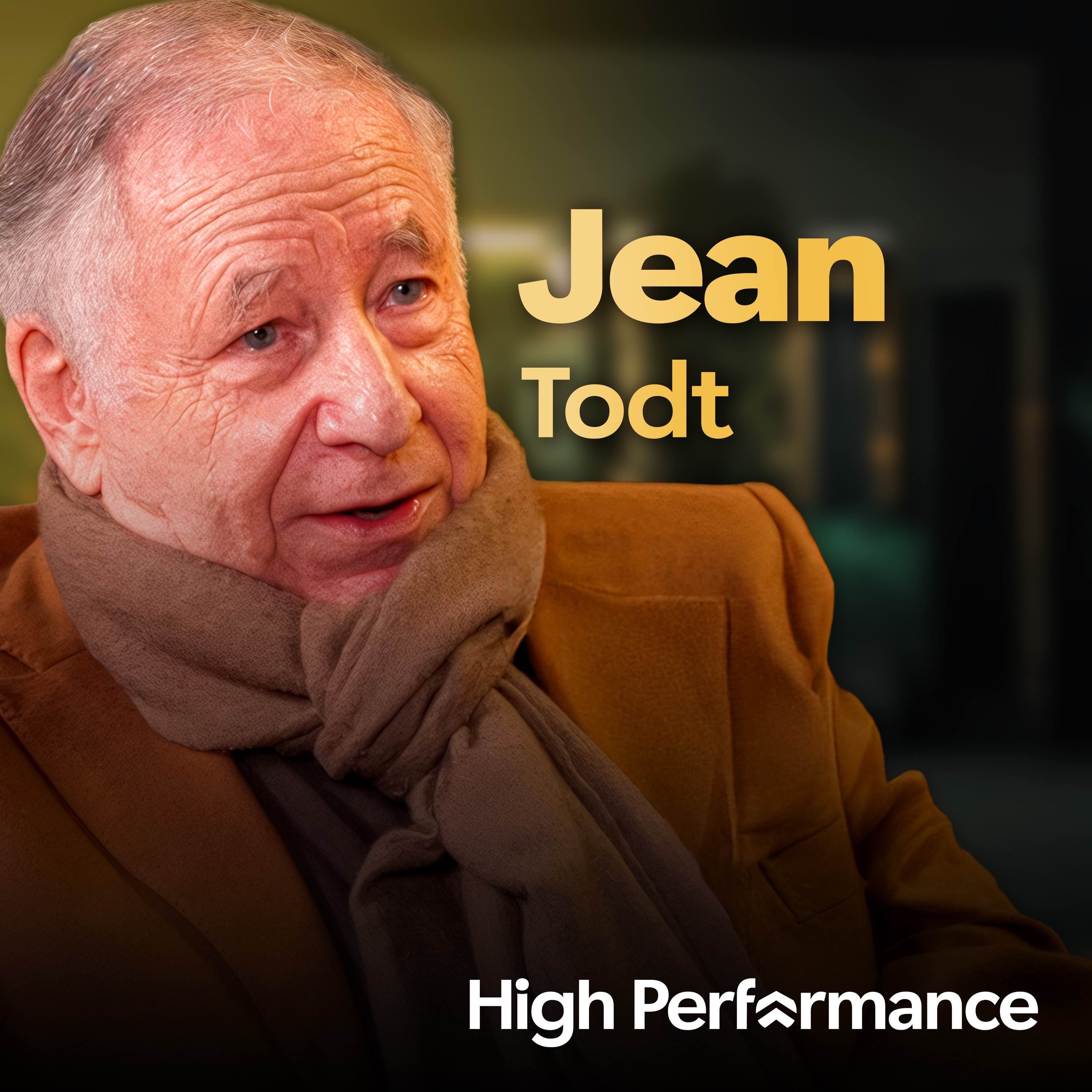
The High Performance Podcast
Jean Todt: The Mastermind Behind Ferrari and Schumacher’s Dominant Era (E403)
00:48:00
Loading summary
Transcript140 lines
- [00:00]
Interviewer
So people who have the idea that Michael Schumacher was overconfident, they've got him completely wrong.
- [00:05]
Jean Todt
Completely. Michael is a kind of shy, generous guy and he hides his shyness by looking arrogant.
- [00:14]
Interviewer
To win the World Championship for the
- [00:16]
Jean Todt
first time in the history a driver was world champion. In the middle of the season before starting the new season, he said, could you give me half a day to do some testing to make sure I'm still good?
- [00:30]
Co-Interviewer
Never fear a storm.
- [00:31]
Applebee's Advertiser
Be ready to adapt.
- [00:32]
Interviewer
The skill is staying true to ourselves.
- [00:39]
Verizon Advertiser
Think Verizon is expensive? Think again. Anyone can bring their AT and T or T Mobile bill to a Verizon store today and we'll give you a better deal. So bring us your bill. Walk in running, pogo sticking, teleport. If you can ride on the back of a rollerblading yak or fly in on the wings of a majestic falcon. Any way you can bring your AT&T or T mobile bill to a Verizon store today and we'll give you a better deal on the best network based on root metrics Best Overall mobile network performance US second half 2025 all rights preserved must provide a very recent postpaid consumer mobile bill in the name of the person redeeming the deal. Additional terms, conditions and restrictions apply.
- [01:09]
Walmart Business Advertiser
Hi friends, Grace from the Working Hard podcast here. When you're stretching every dollar, a little goes a long way and Walmart Business is here to help. They make it easy to order what you need, from tech and cleaning supplies to everyday essentials, all at low prices and with helpful tools like spend tracking and tax exempt purchasing for eligible organizations. Because when your operations are smooth, your impact can be bigger. Visit business.walmart.com to get started.
- [01:33]
Interviewer
I don't know about you, but I love keeping my money where I can actually see it. Unfortunately, big wireless companies seem to like keeping my money too. And after years of overpaying for wireless, I finally got tired of those high wireless bills, the extra fees, the so
- [01:47]
Podcast Host
called free perks that actually cost more in the long run.
- [01:50]
Interviewer
So I decided to switch to Mint Mobile. Mint helps you save money on your phone bill. Plans start at just 15 bucks a month and you'll get high speed data and unlimited talk and text or on the nation's largest 5G network. Honestly, the wireless service is just as good as the traditional big carriers. So keep your own phone and number, activate with ESIM in minutes and start saving immediately. No long term contracts, no hassle. If you like your money, Mint Mobile is for you. Shop plans@mintmobile.com HPP that's mintmobile.com HPP upfront payment of $45 for three months. Five gigabyte plan required equivalent to $15 a month. New customer offer for first three months only. Then full options available. Taxes and fees. Extra siement Mobile for details. Well, Jean, welcome to high performance. So many people will see you and instantly be transported back to your glory days as the leader of Ferrari in Formula One. Can I take you back to 1993 when the decision was made to sign Michael Schumacher?
- [02:53]
Jean Todt
Ferrari was not successful at all. And they were dying to try to find somebody who could take the job. When my name was proposed, until I met them, it was a long time before. I mean, we both agreed because I felt it's going to be a very difficult challenge. Everybody was telling me, don't go there. You will not last more than two years. And for them, for them to take somebody who had no experience of Formula one and to take somebody who was not Italian, you know. So it was a kind of big change. But finally, after long discussions, I think the discussion started in August 92 and we finalized in March 93. The first really dream driver I discussed was Ayrton Sinner. It was during Monza Grand Prix in 94. Sorry, 93.
- [03:52]
Interviewer
93.
- [03:52]
Jean Todt
Yeah, 93. I remember he came to my room in Villa d'. Este. We were staying in the same hotel and we spent part of the night together to speak about him joining Ferrari. And he wanted to come. He wanted to come, but he wanted to come in 94. And in 94 we had already a contract with Gerald Berger and Charlesi. And I said to him, 94 will not be possible. First, we will not be ready yet. And then we have a contract. And he answered to me, in Formula one, contracts are not important. I said, for me, a contract is important.
- [04:31]
Interviewer
So when did you want Senna to come to Ferrari?
- [04:34]
Jean Todt
In 94.
- [04:35]
Interviewer
You wanted to come in and.
- [04:38]
Jean Todt
No, in 95.
- [04:39]
Interviewer
You wanted him in 95. And he wanted to come and he
- [04:41]
Jean Todt
wanted to come in 94. That's why he wanted to drive Ferrari.
- [04:45]
Interviewer
Ayrton Senna wanted to drive for Ferrari
- [04:48]
Jean Todt
and I heard he wanted. There were some contacts before me, but I cannot talk about. I don't know, you know, But I mean, with me as the head of the Formula team, it was a discussion in September 93 for him arriving in 95, and he wanted to arrive in 94. That's why he went to Williams. So after that, 94, we still had the same drivers, but we were rebuilding the team. 95, still rebuilding the team. And then we knew that 96 was the year really to try to have. And you know, very often also amongst engineers, some were saying, the chassis people, we don't have a good engine. The engine people, we don't have a good chassis. And then above all, we don't have good drivers. So I said, okay, let's. To make sure nobody will be able to say, having Michael, we miss the driver. So Andy was the best driver we had to convince to take him. So we discussed mid early 95. And then we spent one day in Monte Carlo. A lawyer, Henri Peter and myself with Michael and Willie Weber. And after one day, we signed the contract.
- [06:19]
Interviewer
One day. So why were you able to sign Michael Schumacher from a team where he had been successful in one day?
- [06:31]
Jean Todt
I think he thought driving for Ferrari would be different. You know, he liked the challenge. And he, of course, he was very curious, you know, very professional. He did not want to commit without having some guarantees. And I contacted simultaneously, without them knowing, Rose Braun to propose him the position of technical director, and Rory Byrne to propose him the role of chief designer. And both of them had worked with Michael in the Benetton team. And of course, Michael knew about that. And so that's how slowly and slowly we rebuilt the team. In 96, we won finally three Grand Prix. 97, we lost the driver's championship at the last race with this controversial overtaking to Vilna, where Michael unfortunately did a mistake. But probably, you know, the mistake demonstrated a very strong solidarity, you know, because why? You see the strength of a group of people when things don't go well, you know, when all goes well, everybody's friends.
- [08:00]
Interviewer
What mistake are you talking about there?
- [08:02]
Jean Todt
I mean, the last race in Spain
- [08:05]
Interviewer
with Villeneuve, you think that was a mistake? It wasn't when Michael crashed into Jacques.
- [08:12]
Jean Todt
I mean, he crashed him purposely, but he did it badly. In fact, you know, Michael with amazing guy. Every time he lost control, he paid it very expensive. So it cost him championship. As incidentally, in 2006, Monte Carlo qualifying with Alonso, where he stopped, he purposely spun. He had to live in the back of the grid. It cost him the championship as well. So the two mistakes he did cost him the championship and some others, you know, I mean, it was so. 97, we lost at the last race. 98, we lost at the last race when he stole at the car. And earlier, you know, when it was when he was lapping Coulter in Spa under the rain, you know, well, obviously the car in front him slowed down unnecessarily. He could not see and he damaged his car and so lost at the last race. 99 mechanic mistakes made that during the formation lap he lost his brakes. Incidentally, never complained about a mistake which was done by the team. He came back in Malaysia at the time we had Eddie Irvine who took the lead and incidentally he finished the championship at equal points than Aikinen, but less victories. But 99, finally we won the manufacturers world championship. And we Knew that in 2000 that was the last year, because if we would not have won in 2000, clearly the team would have exploded. And we won. But we won. It was not obvious because midway mid season, I mean, I remember in the debriefing where I said, we need to win the last four races, otherwise team is gone. And we won them. And then it was a kind of dream period because winning both championship 2001, 2, 3, 4.
- [10:44]
Interviewer
Would you give us an example? A story of a time where you saw a behavior from Michael Schumacher that you think best explains to people watching this why he behaved in the way he did, why his behavior was so important, his personality was so vital.
- [11:00]
Jean Todt
But you know, Michael, in fact is a quite a fragile human being. He's not the kind of, you know, typical hard voice or somebody who in German we say best service, who knows better than the others. And I will give you an example, which for me was amazing, you know, and significant of what is Michael, you know, after he was world champion, before starting the new season, he asked me, I'm going back to a private track in Fiorano. He said, could you give me half a day where I'm going to do some testing to make sure I'm still good. So I mean, and I think it's a big strength not to be sure to be good, you know, So I think none of us thought we were good. We are always scared not being good enough. That's why in a way bit painful because we never probably enjoyed as much as we should have done the result. But I remember, I think it was in 2004 where for the first time in the history a driver was world champion in the middle of the season. In many corps, Michael was world champion in many corps present Grand Prix. And then one race after we were manufacturers world champion in Budapest. And then next race was a Spa where incidentally he did not win. And next race was Monza. We had two card on pole. And I remember myself torturing my head by saying, are we going to do well? Are we going to do well? And then I speak to myself and I said, but you are crazy. What will we do? Why do I care? You have already watched championship, you know, but we forgot very easily. I mean, all that because we are thinking, how can we do good next? How can we do better? How can we improve? We never felt it's done. You know, we always felt we need to do more. And I think this spirit, you know, was shared by most of the people in the team.
- [13:24]
Interviewer
So people who have the idea that Michael Schumacher was overconfident and almost arrogant, they've got him completely wrong.
- [13:32]
Jean Todt
Completely. But, you know, Michael is a kind of shy, generous guy, and he hide his shyness by looking arrogant.
- [13:44]
Interviewer
Right. Why does that help him?
- [13:47]
Jean Todt
I don't think it's. You don't do that to help you. I think it's in your character, in your gene. You are like that.
- [13:53]
Co-Interviewer
And when did you see behind the mask then to see the real.
- [13:57]
Jean Todt
I mean, very quickly, because, you know, then, I mean, the problem. We had to fight going back 97, you know, all the protection, he realized that he was protected. He realized he was loved. So he goes both. It goes both ways, you know, so clearly, one after the other, from kind of professional relationship, it became friend and family relationship.
- [14:29]
Interviewer
You've just described all of those seasons. 97, 96, 97, 98, 99. And you still remember the moments that cost you the title in those seasons.
- [14:40]
Jean Todt
Because, you know, sometime people say, what is your best memory? In a way, my worst memory is when we lost the title at the last race. And it happened in 97, 98, 99, 2006 and 2008, five times.
- [15:00]
Interviewer
And as that was happening, was there ever a moment when Michael. Michael's behavior changed because he was having to be patient. He was having to wait. Like, was he getting angry? Was he getting frustrated? Was he ever saying, maybe I need to leave Ferrari to win?
- [15:15]
Jean Todt
I think probably had some thoughts because he got very good offers from certain teams. And so he probably was thinking of it. But I think it was at the second or third renewal, he knew he was going to stay for Ferrari.
- [15:40]
Co-Interviewer
When we interviewed Toto Wolff, he told us a. An anecdote about coffee cups that paying attention to detail in his world, he would look for whether there was dirty coffee cups in the reception area, because that gave him a clue as to whether the culture was aligned all the way through. Can you give us any examples of when you've got the right people within your team, how you would ensure that
- [16:07]
Jean Todt
that alignment was, you know, for me, I mean, it. I'm a detailed maniac. Okay, so all has to be clinical. I remember randomly, every week, I was taking the security people and I said, we are going to go through all the factory, you better make sure I don't find one cigarette on the floor. You know, So, I mean, for me,
- [16:31]
Interviewer
why does that matter so much?
- [16:33]
Jean Todt
Because all I have to, you know, it's a mentality, you know, if you want to have things perfect, I mean, to be competitive in Formula one, which is Pinnacle or motorsport, I mean, the bar is high. So you must be very, very focused on making sure that things are perfect. And it demonstrates the mentality. If people accept to see a burn cigarette on the floor, it doesn't work.
- [17:04]
Interviewer
I love this insight into the management of Ferrari and I fully understand the paying attention to detail, having stability, if you've got good people working with Ross and Rory, protecting each other. But I think a really interesting part of your management is actually when things aren't so good, when you've got to deal with challenges. And going back to the incident with v nerve in 1997, I'm fascinated how you dealt personally with Michael after that moment.
- [17:31]
Jean Todt
I mean, first, you know, if Michael. Michael did not know how to cheat. He did it from my knowing twice, but he did it badly, you know, I mean, it would have been easy. I mean, he was in first line with Villeneuve at the start, you know, I mean, we have examples two years in a row between Senna and Prost, you know, so he just had to break a bit late or something that he could have done at the start. He chose to do that 10 times behind the lap, 10 laps behind the end was the wrong choice.
- [18:07]
Interviewer
When he did that with Villeneuve, was that like instinct? It was in the moment, it wasn't. Or was it premeditated?
- [18:13]
Jean Todt
No, I mean, it was just, you know, in emotion. That's why you must be. When you judge somebody in action, you know, you must be very indulgent. It's easy around the table. You should do that, you should do that. But when you are in the action, you must understand that your brain is reacting differently. And when he thought that he was going to lose the championship because he had to be in front of Villeneuve, he tried to avoid that and he tried wrongly to do it and he needed support. It was a bad move, it was unnecessary.
- [19:00]
Interviewer
Yeah. What did you say to him privately?
- [19:03]
Jean Todt
I mean, honestly, we are going to protect you. We are together, you know, I mean, human, Human mistake. I mean, you must accept human error.
- [19:12]
Interviewer
Did you also say, michael, come on, you can't do that that's not good enough.
- [19:17]
Jean Todt
I mean, honestly, when we always think, if it will happen again, what you will do, you should not do that. But again, it's very difficult, I mean, to blame emotion. You need to understand. You need to understand emotion. And then he did so many amazing things. So, I mean, you have plus and minus. So you have some minus, but you have so much plus, you know, And I remember before a race, I went. Just before the start of a race, I went in his room in the motorhome, and I said, look, Michael, we have this idea. We don't have money. Will you help? And he said to me, you know, I'm very cautious on all my engagement and all that, but if you tell me to do, I will do it. Of course I trust you, you know, But Michael was emotional. Look, you know, when it was this earthquake in. I don't remember, in Asia, in Indonesia or some. I mean, where he had this one or two guy of his security was around there at the time. He decided to give without knowing, I mean, what will be the use of this money? He decided to give 6 or 7 million, you know, so in a way, it was generous, but in an emotion manner.
- [20:39]
Interviewer
And do you think that the. The flawed moments that he had. You said 97 and 2006. Do you think that those are the same part of Michael that's also the genius? The guy that drove in Barcelona. 96, Hungary, 98, you know, if you're gonna have genius, there's also gonna be a flawed element to that same.
- [20:59]
Jean Todt
I didn't know he said it earlier. I mean, it started when he was very competitive. I remember first time, I really realized that he was a quick driver. Was in, I think, with Mount Fuji in sports car. At the time, I was running the Peugeot team, and he was driving for Mercedes, Mercedes, Sauber. And I realized he was really good because watching on the screen, the lap time on the rain and all that, and then I crossed him at the airport, and well done. He was a young guy, you know. And then first race he did with Jordan, we could see he was special and he had the best car. And 92, 93 here, he was like a machine, you know, lap after lap, very consistent, very quick, and he developed that. But saying that, as I said earlier, he needed to have the good package, because in 96, he did not have the good package, but he was still as talented as he was before.
- [22:12]
Co-Interviewer
And what did you learn then about being able to control emotions, to then become like a machine and be so consistent?
- [22:22]
Jean Todt
I must say, it's never a question I raise myself, you know, but, I mean, try to. I think it is very important not to. Not to lose a sense of reality. Not to. Not to lose your nerves, you know, being stable, whatever the condition, the situations. That is very important.
- [22:43]
Interviewer
What do you think was Michael's greatest ever race?
- [22:46]
Jean Todt
I mean, if you tell me what was the. The one which for me was the most memorable is Suzuka in 2004. Because after all this suffering, this emotion and all that, finally we got the trophy, you know, and we all were hired for that. And I remember going, taking him to the podium. I said to him, michael, our life will never be the same because we got it home.
- [23:16]
Interviewer
And how did he change when the success came?
- [23:19]
Jean Todt
He never really changed, which was a good thing. You know, Michael, he knew he was a star, but he wanted to be able to live normally, incidentally. That's why he wanted to live in Switzerland. He wanted to be able to go in a place without being. He wanted to be able to pick up the kids at school. He wanted to be a normal citizen, which was very difficult.
- [23:52]
Co-Interviewer
So can we talk about your decision then to bring Ross and Rory into the team? I'm interested in the dynamics between you and how that eventually led to success.
- [24:03]
Jean Todt
You know, it was easy decisions. You know, I mean, we knew that to have a winning team, we needed to take best mechanics, best engineers, best partners. So for me, I mean, I remember we had some thoughts about Adrian Newey, some discussion with him. He did not want to come to Italy. I remember I had always a lot of respect for Rory Byrne, because when I was running the Peugeot sports cars program, I tried to hire him, but he did not want to come because he wanted to stay in Formula one. And Rose Braun was a reference as a technical director. So clearly, incidentally, it happened that they were in the same team, but for me, it wasn't belonging to the team. It was, I mean, the personality of. Of Ross on one side and of Rory on the other side. Incidentally, they did not know I was talking to them. And I remember after I signed both of them, I said, look, now you can mention to each other that you have signed. And they said, remember, Rose? Okay, I will invite him for a beer tomorrow. But they did not know. So it was not kind of hiring a package. It was individual discussions and decisions.
- [25:26]
Co-Interviewer
But what do you tell us about the first meeting when you all get together? Like, how. How do you get people to buy into the team as opposed to people bringing their own egos or their own agendas?
- [25:40]
Jean Todt
Michael arrived in 96, Ross arrived early 97, a few months before Rory. But I mean, if it was, I mean, nothing magic, nothing historic, just get the job done.
- [26:00]
Interviewer
And did you, did you keep the signing of Michael secret from Bernie Ecclestone?
- [26:07]
Jean Todt
So. Yes. I mean, Bernie, you know, Bernie I know very well. I mean, Benny likes always so that he is the one behind. So I never spoke about that until the day before the announcement. I told him and Bernie after said I knew it since a long time or even I contributed, which is not true.
- [26:39]
Interviewer
Explain again why you didn't want Bernie to know.
- [26:41]
Jean Todt
No, it's no point. But honestly, it was not Bernie's business. Yeah, it was up to us to. We wanted to have Michael to deal with, with Michael and, and, and that's it. But honestly, I don't care if somebody wants to, to say something, even if it doesn't correspond to the reality at the end of the day. But what important is of Michael. Yeah.
- [27:05]
Interviewer
One of the phrases we use often here is evidence, leaves clues. And there was some brilliant moments like Barcelona 96, where Michael won by almost a minute in bad conditions. I wonder the impact on the team when you're fighting and fighting and fighting and sometimes you just get an amazing result. What did that do for you? What did it do for Ferrari?
- [27:26]
Jean Todt
I mean, it's, you know, it's a refreshment.
- [27:29]
Interviewer
Yeah.
- [27:30]
Jean Todt
You know, it gives, it puts the pressure for two weeks. And I remember also, you know, enjoying a race, success, enjoyment was between the podium and Monday morning. After that it was forgotten. So, you know, no time to celebration, no time for. Just be focused. Because we know that it's very fragile. You know, success is never given for granted, will never last. It can only last if you put effort to make sure that you made weight again.
- [28:14]
Interviewer
And of course, as soon as things do go even slightly wrong, there will always be many people waiting to criticize.
- [28:21]
Jean Todt
You know that. I mean, if you have some understanding of life, you know that things are never given for granted and will not last. You know, sometimes the mistake is when somebody give you the key, you need to know that you will have to give back the keys and that's finished. You know, the key will not remain for you all the time and it will be a mistake to think that it is your belonging. So you must be prepared, I mean, to be involved with the responsibility. And, you know, I mean, you take FIA, FIA. I left FIA. And I think it was 17 or 19, December 2021. I never heard about Fia thing then, you know, so I Just chapter closed. It's okay.
- [29:14]
Co-Interviewer
So when you start a role, like, because when you talk about you will hand the keys back one day, it reminds me of. We've met members of the New Zealand rugby team that talk about leave the shirt in a better place than you find it. How would you like to be remembered? When you think back in Ferrari, from when you came into the day you left, it was obviously in a better place, but how would you like people to.
- [29:40]
Jean Todt
Honestly, I don't have a special wish how I want to be remembered. I mean, I always said, I mean, probably my asset is my credibility and my integrity. That's, for me, the most important. You know, nobody can come and tell me you remember.
- [30:03]
Co-Interviewer
Can you give us an example in Formula one where your integrity was tested?
- [30:12]
Jean Todt
I don't think I can, but maybe you have something in mind.
- [30:16]
Co-Interviewer
No. I was taken by the conversation that you recounted when with Senna, and you said, no, contracts are important. And that's what resonated. And I was wondering if there was ever any other situations or occasions where you felt you acting with integrity was questioned or challenged.
- [30:38]
Interviewer
I mean, I would offer 2002, when you asked Michael and Rubens to swap on track, it wasn't against the rules of Formula one, but people felt it was against the spirit of Formula one.
- [30:50]
Jean Todt
I like this question.
- [30:52]
Interviewer
Yeah. So we'll be right back after a quick word from our partner.
- [30:57]
Podcast Host
This episode is brought to you in association with Claude. AI now, if there's one thing that I'm proud of here on High Performance, it's that our conversations are real, they're honest, they're impactful. You can trust them. But that doesn't mean that we can't use AI. And I've actually really enjoyed creating a template for an interview and then asking AI some pretty complex questions, like, how can I hone this? How can I make it better? How can the things that I want to talk about be even more impactful? Because I think that AI isn't just about making your workflow more seen, seamless, or more easy. It's also about increasing the amount of impact that you have in the world. And Claude is the AI for minds that don't stop at good enough. It's the collaborator that actually understands your entire workflow and thinks with you. Whether you're debugging code at midnight or strategizing your next business move, Claude extends your thinking to tackle the problems that matter. I also love the fact that Claude
- [31:46]
Interviewer
can do some really deep research.
- [31:47]
Podcast Host
For me, I'm talking about research for guests on this show that would have taken hours, maybe even days can be done in seconds. And also Cowork brings Claude Code's agentic power to your desktop. There's no terminal required, so anyone can use and have Claude do real work. Point it to a folder on your computer, or add connectors like Google Drive and Gmail. Describe what you need and it just handles the rest, like organizing files, building spreadsheets, drafting reports or scattered notes. Queue up tasks and come back to finished work. Are you ready to tackle bigger problems? Get started with Claude today at Claude AI Performance. That's Claude AI Performance. Oh, and check out Claude Pro, which includes access to all the features mentioned in today's episode. Claude AI Performance Are you a trailblazer, a risk taker?
- [32:34]
Interviewer
Maybe someone with countless tales of epic adventure? Well, I'm not quite there yet, but I'm working on it. Even the boldest among us started off small, right? Daring themselves to reach greater goals every day. And if you're looking to take on a challenge like that, the Defender is too. Now, I've driven a Defender for a few years. It's the best car I've ever owned. It's a vehicle built for drivers capable of great things, whether they're heading towards uncharted territory or just fancy a weekend getaway. Defender was engineered to meet challenges head on so you can explore with confidence. It's the legendary icon of adventure reimagined through modern design, fit for a new generation of Explorers. My kids love it as much as me. It also has a tough rigid body tested to the extreme, a modern functional interior built for comfort. It's a vehicle that, like you, is capable of great things. And with next gen technology from 3D surround cameras to clear sight ground view, it will help you embrace the impossible. Explore the full Defender lineup@land roverusa.com I don't know about you, but I love keeping my money where I can actually see it. Unfortunately, big wireless companies seem to like keeping my money too. And after years of overpaying for wireless, I finally got tired of those high wireless bills, the extra fees, the so
- [33:44]
Podcast Host
called free perks that actually cost more in the long run.
- [33:47]
Interviewer
So I decided to switch to Mint Mobile. Mint helps you save money on your phone bill. Plans start at just 15 bucks a month and you'll get high speed data and unlimited talk and text on the nation's largest 5G network. Honestly, the wireless service is just as good as the traditional big carriers. So keep your own phone and number, activate with ESIM in minutes and start saving Immediately, no long term contracts, no hassle. If you like your money. Mint Mobile is for you. Shop plans at mintmobile.com/hpp. That's mintmobile.com hpp upfront payment of $45 for three months. Five gigabyte plan required equivalent to $15 a month. New customer offer for first three months only. Then full price plan options available, taxes and fees, extra cement Mobile for details.
- [34:34]
Jean Todt
I mean, for me, it has always been the terror to lose, you know, because we lost so much at the last race. So probably in certain years we should have been less cautious, you know. But I mean, let's say the team discipline was after a certain amount of races, it will be a priority to one driver, you know. So in 22,002, in 2002, I mean, we started the race in Austria, debriefing with Tim Hodder, you know, and it was, if you are in front of Michael before the last pit stop, you must let Michael go. And it was agreed. Wrongly or rightly, but it was agreed
- [35:34]
Interviewer
before and accepted because Michael was leading the world championship.
- [35:38]
Jean Todt
Because Michael and again because we did not want to take the chance to lose at the last race. Probably wrongly today, you know, it's easy to say at the end of the season, but it could not have been wrongly. So anyway, and it was accepted. And when we were to the end of the race, where an agreement was taken and. And accepted, I mean, Rubens did not leave, did not like to commit to what was decided, which created a big embarrassment. So normally I would not go on the radio, you know, that was engineers Ross working on the race development. So I had to go on the radio and remind what was agreed. And I must say, Ruben did not do it nicely and he put the team in a big controversial situation, even Michael. But it was agreed. And then, you know, I remember, I think it was the same year in Indianapolis. Indianapolis, they were first and second. And Michael waited for Rubens. He was leading the race. Michael waited for Rubens to arrive at the finishing line together. And Rubens passed him. Yes. So when, you know, you think in a way, the candidity, you say candid.
- [37:16]
Interviewer
Yep. Being candid.
- [37:17]
Jean Todt
Yeah. Of Michael waiting for his teammate to go to the finishing line and he did not. We never spoke about that. And Michael never complained.
- [37:25]
Interviewer
So in that moment in Indy or in the moment in Austria, what's your approach to management and leading the team after that race? Like, how did you approach Rubens?
- [37:36]
Jean Todt
I must say it was very embarrassing because then Michael was very embarrassed. And in fact, we got penalized Simply for wrong procedure on the podium, which is true, because Michael was so embarrassed that he gave his position and to Rubens. So that was the thing, you know. But honestly, it's little. It's little to do on that.
- [37:59]
Interviewer
But you must have had something to say to Rubens.
- [38:01]
Jean Todt
Of course I did. But, you know, if you're in a bad face, I mean, you will make your own story. But I mean, at the time, everybody will remember because at the team meeting before the start of the race, you have the technical director, you have the two race engineers, and you have the two drivers. So everybody knew about it.
- [38:25]
Interviewer
Difficult for you.
- [38:26]
Jean Todt
But, you know, that human being, that's very. I mean, anyway, again, that's emotion. You know, we were talking earlier about emotion. So I should accept the emotion of Reben said accept the emotion of Michael. What are the consequences? Emotion of Michael had some consequences. Emotion of Reben have had some consequences. Yeah, but that's the price to pay.
- [38:54]
Interviewer
Yeah, well, that's exactly the price to pay for being the leader of the biggest Formula one team in the world. Was the embarrassing thing for you that you had to be the person to come over the team radio and deliver the news?
- [39:06]
Jean Todt
No, it's my job. You know, I mean, I'm. I mean, being a team leader is also being a fireman. You know, if there's fire, you need to extinguish it. You don't leave the fire going on.
- [39:18]
Interviewer
And how did you protect the team after the backlash and the criticism that followed?
- [39:23]
Jean Todt
You know, in a way, it's a smoke, you know, the team, but, you know, it's better to be attacked being first and second than being attacked because you don't finish the race. So it was. It did not hurt me.
- [39:40]
Co-Interviewer
So, you know, you spoke earlier when you came into Ferrari and you were constantly asking, how can we get better? How can we improve? When you come towards the end of a chapter, what are the questions you're asking yourself then?
- [39:54]
Jean Todt
But, you know, then, you know, I was saying also, it's a life with going from place A to place B, you know, and you don't know what is going to be valid for all of us, you know, and going on place B, you find different things on the road. So I found fia. During fia. I found un. Before that, I found Brain Institute. Something is sure. I decided in 2008 that it was time to give something back, you know, so for me, my interest is to give something back. I still have the. I could have done. Incidentally, I remember something when I left Ferrari, Dietrich Mateschitz wanted me to join, so he came to have lunch at home in Paris with me twice.
- [40:52]
Interviewer
To join Red Bull?
- [40:53]
Jean Todt
Yeah.
- [40:53]
Interviewer
Oh, really?
- [40:54]
Jean Todt
And he really wanted. He was keen, you know, and he did not like to travel, so he came twice at home.
- [41:00]
Interviewer
In what job? To do what job for Red Bull?
- [41:02]
Jean Todt
I mean, to run the team and to run motorsport activities of Red Bull. And I say no, because for me this chapter is over. You know, I was running kind of iconic Brown with success. So in a way I could not do better and I wanted to do other things. So it was time for me to give something back. It was a period of my life and it's still the period of my life where I want to give something back. In some world where there is even competitivity, people forget that. That's why for me, it is important to travel, to see poverty, to see people who don't have access to medical care, people who not have access to public transportation, and to try to give a little hand. Little. It will be very presumptuous to say that we are changing the world, but even giving little, you know, see eyes of people who are in the need, who smile, make people smiling. It's a win, it's a different win, you know, But I think it is very important.
- [42:18]
Interviewer
When you were the president of the Fiat, sadly, Formula one lost Gil Bianchi in an accident in Japan and he later died. How did that change the way that you saw the world?
- [42:33]
Jean Todt
I mean, you know, we started discussion by saying motorsport is dangerous, so a lot of effort, you know, and incidentally, we're talking Max Maudslay, a lot of people who were in charge have been putting priority on improving safety. You see that in motor racing, you see that in motorbike racing. And incidentally, that's one of the reason I consider motor racing at the laboratory and we must do something, you know, I will cover that in a while, but. So between 94, when Ayrton Senna and Ratzenberger died the same weekend, you know, it had been even more priority on safety, governing body teams, drivers. And unfortunately it was the accident of Jul Bianchi, which was devastating. Devastating. I mean, for the family, for the sport in a way, for my son, who was his manager, who loved him like his brother. And. We only sort of putting even more effort. And then in 2009 it was Felipe Massa, you know, Felipe Massa got in the in lap, he got the shock absorber of Rubens Barrichello, which almost destroyed his head. So I really said we need to do something. So I asked engineers what is the most vulnerable part now after all the progress which have been done and the head cockpit, but we need to find something.
- [44:40]
Co-Interviewer
So
- [44:42]
Jean Todt
I got proposal about the allo and say okay, let's work on it. And incidentally, at the time the one who was in charge of this program was Laurent Mikies, now running Red Bull. And I asked him to work on the project and he made a proposal. And when the proposal was presented to the teams, certain teams, certain rivals a lot were against, they said it's not Formula one. So my question was towards ingenious. Is it going to protect the red better? The answer was yes. So we do it. And I remember Romain Grosjean commenting the day of the announcement of the decision saying it's a sad day for Formula one. And a few months after he lost his car the first lap in Baron and he went through the barrier and the barrier was like a knife. Without alo he would have lost his head, which he admitted, you know, so that was probably the best answer, that it was right to do it.
- [45:57]
Interviewer
But the work that you're doing now, although linked to sport and movement and cars and travel, is very important. It's very different to Formula one. What gives you the thrill for the work that you're doing now with the
- [46:09]
Jean Todt
U.N. i mean simply because first of all I consider that life is a book, you know, it's a movie. So with chapters, I was blessed enough to have a few chapters in what was still is incidentally my passion. But then I thought I've been quite successful. I was in a way quite comfortable in my life. And on the other side, I think it's very important never to lose sight of what is happening globally in the world. You know, and something which is hurting me quite a lot is discrepancy between wealth and poverty. So I thought I would put my kind of reputation for something different which could help those who are not as fortunate as we are. So clearly, I mean it started in around 2003, four by doing something around the medical institute, which is called brain institute. And it's something, you know, I've always been, I mean, very scared by being hurt in motor racing. And we know that motorsport is dangerous and it has improved significantly over the decades. But unfortunately during my career as a co driver, as running a rally team, cross country team, endurance team, I was facing accident. So I thought it was time to give back. After I left Ferrari early 2009 and very quickly I was elected president of the FIA. And FIA we have two different responsibilities. One around motorsport as a regulator and legislator of motorsport, and the other one by being the umbrella of automobile association, you know, which is facilitating life for road users. And I realized the number of victims on the road at the time, 1.3 million people were dying on the roads every year and about 50 million people were injured with full time disability. And it's number one cause of death and injuries for young generation from 5 to 29. I said, I think it's something which has to change. Incidentally, I gave you this book, a Silent Pandemic, you know, because everybody, everybody is under the threat of having a road crash. Of course, depending on the countries, it's different. Incidentally, UK is one of the best countries, so you should be proud of that. But 90% of those figures are occurring in low and middle income countries. So as the President of the fia, I had some contact with international organization and I thought it's something we need to address. With un. I was fortunate to be able to be introduced to Ban Ki Moon and his team and we had a very good discussion, very good contact until he decided on 1st April 2015 to appoint me for the first time as Secretary General, Special Envoy for Road Safety. And I was passionate about that. I thought it was a great responsibility, but it was always going back to chapter. It was also a way to give something back. And since then, you know, it's a kind of renewal agreement. I'm appointed, reappointed until end of this year, then we will see because it will be a new election for the Secretary General of United nations and all that. But still at the moment it's something which takes quite a lot of my time and where I feel passionate, even if, I mean, I must confess that a lot needs still to be done to address properly this silent pandemic.
- [50:42]
Interviewer
Look, the fact that you're 79 and can talk so passionately for so long about that is a good reminder to people that keeping passion at the heart of what you do in life is so vitally important. Time for some quick fire questions. Jean, from your amazing career. What are the three non negotiable behaviors that you think are most important in life?
- [51:02]
Jean Todt
I mean, I said integrity.
- [51:04]
Interviewer
Yep,
- [51:08]
Jean Todt
honesty and humility.
- [51:12]
Co-Interviewer
What's the single best piece of advice you've ever received and why?
- [51:17]
Jean Todt
You know, for me, advice is to learn by example. I don't think somebody really told me you should do that or not do that, but I mean, you learn from yourself, you see, and you learn by behavior. I always said for me the most fascinating things is human being. You know, population of the planet is 8 billion people. We all have the same specifications. And you have 8 billion prototypes on Earth. And it's fascinating and you don't know how it works.
- [51:54]
Interviewer
What is your biggest strength?
- [51:58]
Jean Todt
Hard worker, never give up.
- [52:01]
Co-Interviewer
And your greatest weakness?
- [52:08]
Jean Todt
Maybe a bit impatient, a bit not very tolerant and to have a too big memory.
- [52:21]
Interviewer
And finally, your advice to people that have listened to this conversation about how they can live their own high performance life.
- [52:30]
Jean Todt
I think you. But you know, I mean you can see, you know, very often I think people are getting lazy in certain parts of the world, you know. And you know, why Asian people developing so much? Because I mean the commitment, you know, I think high commitment is very important. And the tendency in the developed countries is people are less committed, they are more with, you know, maybe I will make a. I will be unpopular, but I hate teleworking. You know, for me the best way to, I mean to have success, to communicate is to be together, you know, eyes in hive, working together, collaborating together. Not through a video. Yeah.
- [53:21]
Interviewer
Jean, thank you very much for your time. Absolutely fascinating.
- [53:24]
Jean Todt
Thank you.
- [53:25]
Co-Interviewer
Fabulous. Thank you.
- [53:36]
Verizon Advertiser
Think Verizon is expensive? Think again. Anyone can bring their AT&T or T mobile bill to a Verizon store today and we'll give you a better deal. So bring us your bill, walk in, run in, pogo sticking, teleport if you can ride on the back of a rollerblading yak or fly in on the wings of a majestic falcon. Any way, you can bring your 8th AT&T or T mobile bill to a Verizon store today and we'll give you a better deal on the best network based on Routemetric's best overall mobile network performance. US second half 2025. All rights reserved. Must provide very recent postpaid consumer mobile bill in the name of the person redeeming the deal. Additional terms, conditions and restrictions apply.
- [54:07]
Applebee's Advertiser
More cheese, say less. The Applebee's OM Cheeseburger is back with even more cheese. So now you can get our juicy bacon cheeseburger served on a sizzling skillet of even more cheesy deliciousness. Dip your fries in more cheese, dip your burger in more cheese and dip your cheese in more cheese. Applebee's even cheesier om cheeseburger for 11.99. Also on our 2 for 25 menu.
- [54:32]
Verizon Advertiser
Dine in only for a limited time price and participation.
- [54:34]
Interviewer
Berries.
- [54:34]
Jean Todt
No substitutions offer.
- [54:35]
Verizon Advertiser
Valid per person, per order.
- [54:37]
Strayer University Advertiser
At Strayer University, we help students like you go from. Is it possible to anything is possible by offering access to up to 10 no cost gen Ed courses so you can reach your goals affordably and fast. Visit Strayer. Edu to learn more. No cost Gen EDS Provided by Strayer University Affiliate sofia. Eligibility rules apply. Connect with us for details. Strayer University is certified to operate in Virginia by Shep and has many campuses, including at 2121 15th Street north in Arlington, Virginia.