← The High Performance Podcast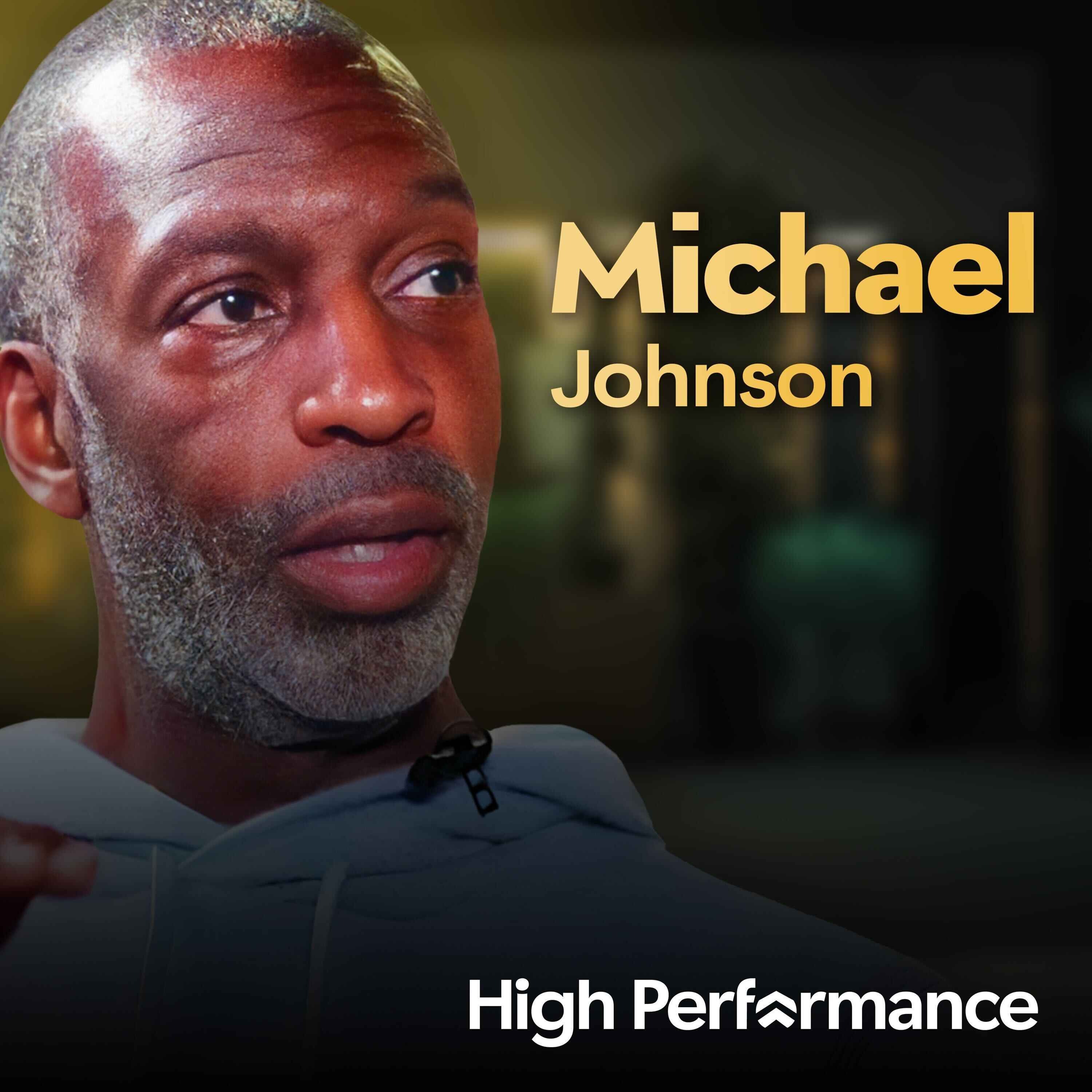
Loading summary
Transcript558 lines
- [00:03]
Michael Johnson
I got more speed in my little
- [00:04]
finger than most people have in their whole body.
- [00:06]
And I was just born that way. It's not easy to become Olympic champion. It's not easy to become the best in the world. It's not easy to even become a professional. Not everybody can have it.
- [00:16]
When I had my stroke, it was a crazy experience.
- [00:19]
Left side, arm, fingers, leg, barely can move them. I'm scared to death.
- [00:25]
We are just like, what is happening?
- [00:31]
Podcast Host / Narrator
That is the voice of the Olympic legend Michael Johnson. And even now, that clarity and that confidence stops you in your tracks, doesn't it? I wasn't there for this conversation that was done with Jake, but I watched it and I wish that I was. Because Michael Johnson didn't just run differently to everyone else, he thought differently as well. He understood himself on a level that most of us spend our entire lives trying to reach. In my experience, that is always where greatness begins. Four Olympic gold medals, world records. The only man in history to win gold in both the 2 and 400 metres at the same games. And yet what you're about to hear isn't really a conversation about sprinting. It's a masterclass in the mindset that made all of it possible. You can listen to Jake and Michael talk about the loneliness of chasing a dream before anyone ever really believes in you. The moment Michael finally confronted the one thing he'd been quietly avoiding and how he learned to control his nerves rather than let them control him. And also listen now to what happened when his body and his identity were taken from him by a stroke. I think you're going to find that this one is an episode that stays with you long after you stop listening. Certainly did for me. This is high performance and this is Michael Johnson.
- [01:56]
Michael Johnson
High performance for me is all about sustained excellence and consistency around performance as
- [02:05]
opposed to, you know, sort of the spike, you know, or, you know, the
- [02:10]
one time great performance. When I was an athlete, for me it was all about just sustained performance, consistency. Once I established a level of, of
- [02:23]
high performance and a race, then my expectation was that I'm going to always sort of hit that point consistently again and again and again or better. But there was no tolerance for sort of dips in performance that are dramatic. That was not acceptable for me.
- [02:44]
So I look for that in everything.
- [02:46]
It's all about consistent, sustained, high performance.
- [02:49]
Interviewer / Jake
So should we talk about how you get to the peak first or should we talk about how you sustain it? Where should we begin?
- [02:56]
Michael Johnson
I think the common mistake is, you know, people think that, you know, yeah, Getting to the top is hard, is
- [03:02]
the hardest, and it is.
- [03:04]
It's really hard. There's no doubt about it. But once you get to the top, you know, you have the benefit at that point of knowing that, okay, I can do this.
- [03:14]
Now, I've accomplished a significant, you know,
- [03:16]
feat in getting to the top. Staying there is a whole different set of challenges. You know, when I was. When I, When I first started in my career and Carl Lewis and those sort of folks, you know, the big names, I had to knock them off
- [03:31]
in order for me to be on
- [03:33]
top, and that was extremely difficult. But no one knew who I was.
- [03:37]
No one was scrutinizing my performances. No one was, you know, questioning my
- [03:41]
choices of how I train and where
- [03:43]
I race and how I race.
- [03:45]
If I made a mistake, I was given the benefit of the doubt. That was on the journey to get to the top. There's positives and negatives around that. Once you get to the top, now
- [03:58]
you gotta stay there. Everybody's scrutinizing you, everyone knows you, everybody's watching your every move. Everybody's got an opinion. Fortunately, when I was competing, there was
- [04:07]
no social media, so they could make
- [04:09]
their opinion about me known to their friend, but they couldn't just post it to the world.
- [04:14]
Now they can. That's very difficult. But you're going to have injuries, you're
- [04:18]
going to have some.
- [04:19]
Some losses, you're going to have some setbacks, and. But then you have the benefit of, well, I've already been on top. I know what it's like to be there. I have that confidence to fall back on. So those are the sort of positives and sort of negatives of being on top. But when you're there, you can't do the same things that got you to
- [04:38]
the top to just stay there. You have to do something different. You have to figure out now, okay,
- [04:43]
I spent years trying to get to the top, figuring out what it takes for me to get there.
- [04:48]
Now I gotta spend years figuring out what I have to do to stay here, because just doing the same things that got me here aren't gonna keep me here.
- [04:55]
Interviewer / Jake
So we know what you did. You got there and you stayed there. How you did it is fascinating. So what were the behaviors that you think got you to the top in the first place?
- [05:04]
Michael Johnson
Yeah, I think it, you know, it absolutely goes beyond just, you know, sort of the cliche, you know, just, you know, believe in yourself. You know, when you getting your ass handed to you, it's hard to believe in yourself.
- [05:17]
Right.
- [05:18]
And you're not gonna believe in yourself every day. So what do you, the question is, what do you do? You know, to your point, it's the how. So what do you do when you know you're not believing anymore? And that's having good people around you
- [05:30]
who can pick up the slack and
- [05:31]
say, you know what, I do believe in you and you should continue to believe in yourself. And then it's the, you know, for me it was always about the why, why, why should I believe in myself? There are some significant proof points that
- [05:45]
I should believe in myself.
- [05:46]
I'm running the same sort of times that the people who are winning the medals are running. I need to do it now against them. I need to do it in those races. It's having proven to yourself that you are capable and having evidence to back that up. If all of the evidence points to that, you not going to get there because you haven't actually delivered those performances to, then it's really gonna be difficult for you to believe in yourself if
- [06:13]
the evidence shows otherwise.
- [06:16]
Interviewer / Jake
And before you had the first gold medal hanging around your neck, what was the why at this point? Because I think that. And you'll correct me if I'm wrong. Cause I've not done it. And you have. But you go through almost a lonely period where you haven't got the success and the accolades, but you also haven't got the nights out with your mates and the relationships that other people have got because you have this single minded desire to be the fastest man on the planet. What's that period like and what keeps you going in that, in that lonely period?
- [06:45]
Michael Johnson
There's a lonely period. There certainly was for me, but it was, you know, I was going out with my mates, I was having, you know, I, I had that balance from the very beginning which I always felt was very important. And I was fortunate to have a coach who believed that as well. Like, you know, you got to get out and just go and have some fun, you know, and just, you know, have that balance. I did throughout my entire career. So, you know, that's not to say
- [07:09]
that there weren't sacrifices. There certainly were.
- [07:11]
It's funny because I was writing my
- [07:14]
book Gold Rush, I interviewed all of
- [07:17]
these serial champions and I interviewed Daley,
- [07:20]
who's a good friend of mine, Daley Thompson, who's a good friend of mine.
- [07:22]
And we were talking and we were talking about sacrifice. We talk about this sort of stuff all the time.
- [07:28]
And so we were talking about. Everybody always says, you know, about sacrifice. And he's Like, I don't feel like I sacrificed anything to you.
- [07:33]
And I was like, no. And so we keep talking, and next
- [07:36]
thing you know, we're talking about birthday
- [07:38]
parties that we missed, we talked about. And both of us are like, it just didn't feel like a sacrifice because I'd rather be there training, pursuing my goals than doing these other things.
- [07:48]
Right. So it just didn't feel like a sacrifice.
- [07:50]
But there were sacrifices, so I had that balance. So that's not where the loneliness came from. For me, the loneliness comes from, you know, when you're sort of alone with yourself, dreaming about that success, thinking about that success, and you're not there yet. Like you said, you haven't won the gold medals yet, won any medals yet, and you're wondering, you know, if you're
- [08:12]
ever going to get there.
- [08:13]
No one else. Regardless of how many people you have around you that are supportive, they're not you. They're not the one with this talent and this belief in the talent and also knowing that everyone else believes in me as well, but I have to be the one to go out there and do it. And that is a bit lonely. When you have people around you who get that and understand that so that they're there to sort of try to fill in those gaps in those moments and be that support for you in those moments, that helps a lot.
- [08:41]
Interviewer / Jake
And what have you learned about the people around you? How to pick the right people.
- [08:45]
Michael Johnson
For me, I was really fortunate having parents.
- [08:50]
And I come from a large family. There's five of us, and I'm the youngest.
- [08:54]
And so I always had the support
- [08:57]
of my brother and my sisters and my parents. And so I look for people. You know, it was just kind of automatic for me to look for people like them. So my coach and my dad are very similar people. In what way?
- [09:11]
You know, high standards around excellence, but also very understanding, you know, and also they both have that ability to sort of allow you to go out there
- [09:23]
and make the mistakes. Like, my dad was very much a, you know, sort of disciplinarian from a sort of military background, but at the same time, it's always like, you know,
- [09:33]
I'm going to give you the ability
- [09:36]
to go out there, make your own mistakes. I'm going to trust you until you show me that you can't be trusted.
- [09:43]
And that was, for me, as a
- [09:45]
young kid growing up was very sort of liberating. And like, oh, he trusts me. You know, give us an example of
- [09:53]
when he would do that. Like, I didn't have like when I
- [09:54]
was growing up and like other kids had, you know, like, and I curfew,
- [09:58]
I didn't have one.
- [09:58]
My dad was like, you know, you know what to do, you know, when you should be here, you know, and
- [10:02]
gave me just all sorts of freedoms
- [10:04]
of, you know, you know, who I wanted to hang out with and trusted that I could, you know, take care of myself and that I would, you
- [10:10]
know, he knew, he set the standard. Absolutely.
- [10:12]
Like, this is what I expect and if you disappoint me, there's going to be a little bit of hell to pay.
- [10:17]
It was a very effective, effective strategy. I didn't want to suffer that wrath for one thing and, but I think he was very sort of crafty in the way of, you know, I'm gonna
- [10:27]
set this standard where you don't wanna disappoint me and I didn't wanna disappoint my dad.
- [10:36]
Workday Advertiser
Could AI help you do more of what you love? Workday is the next gen ERP powered by AI that actually knows your business. We help you handle the have to dos so you can focus on the can't wait to dos. It's a new workday.
- [10:51]
Sleep Number Advertiser
Why choose a sleep number? Smart bed. Can I make my sight softer?
- [10:54]
Healthy Choice Advertiser
Can I make my sight firmer?
- [10:56]
Michael Johnson
Can we sleep cooler?
- [10:58]
Sleep Number Advertiser
Sleep number does that cools up to eight times faster and lets you choose your ideal comfort on either side. Your sleep number setting. Enjoy personalized comfort for better sleep night after night. And now during our president's day sale, take 50% off our limited edition bed plus an extra $100 off all mattresses and Saturday only at a sleep number store or sleepnumber.com.
- [11:21]
Healthy Choice Advertiser
eating healthy doesn't mean you have to eat out at a pricey restaurant. Healthy choice simply steamers grilled chicken and broccoli Alfredo is an easy high protein meal with nothing artificial. The steam tray keeps the sauce separate so you get crisp broccoli, creamy Alfredo sauce and tender grilled chicken. That's delicious every time. And it's a satisfying meal. With 28 grams of protein, you can find it in the frozen aisle. Healthy choice what having it all tastes like.
- [11:52]
Interviewer / Jake
So you've got a coach that you also don't want to disappoint because he has similar attributes to your dad. What was your coach like if you ever missed a training session or something?
- [12:01]
Michael Johnson
I never missed a training session. Never missed a training session?
- [12:05]
Interviewer / Jake
Come on, man. What in your life?
- [12:06]
Michael Johnson
No.
- [12:07]
Never missed a training session.
- [12:08]
There was no reason to miss a training session. There was literally no reason to Miss
- [12:12]
Interviewer / Jake
a training session, you could have been tired, you could have not fancied it that day, you could have put it down or not interested.
- [12:17]
Michael Johnson
I wanted it.
- [12:18]
Too bad. There was never a reason I missed
- [12:20]
a training session, what I did do. So I had two training sessions every day.
- [12:27]
Training on the track for our running
- [12:29]
sessions and then training in the weight
- [12:31]
room for our strength training.
- [12:33]
And I was always in the weight room, never missed any of those either. But I wasn't really there. I didn't like it, so I wasn't really into it. And of course, as a sprinter, the running session is the bulk of the training.
- [12:45]
That's the most important part.
- [12:47]
And I was really good at it.
- [12:48]
And I loved running. Loved running. You didn't have.
- [12:50]
That's another reason why I never missed a training session.
- [12:52]
I loved to run ever since I was a kid.
- [12:54]
So you're not going to miss what
- [12:55]
you love, you know, you're not going to just.
- [12:57]
There is no such thing as tired, you know, because this is fun. I love it.
- [13:01]
Love running.
- [13:02]
I mean, the training sessions are hard, but I love that. That part about it as well. But I didn't like.
- [13:07]
Didn't like the strength training.
- [13:08]
Never liked it. So I was there, but I wasn't really, you know, committed to it. And my coach, you know, similar to my dad, you know, he would tell
- [13:17]
me, you know, you know, if you
- [13:19]
really want this, you know, you need
- [13:20]
to get in that weight room, you know, and really give it, give it, you know, everything. Jack. Coach.
- [13:25]
And so I was. I had a lot of injuries in
- [13:29]
my four years at university and college
- [13:32]
when I was competing to a point where every year, when it came to championship time and I had the potential to be NCAA champion, and I was
- [13:42]
injured at the end of every year.
- [13:44]
So my final year and in the US Collegiate system, it's kind of like, you know, you got really four years
- [13:49]
to prove yourself, and you got the best of training, the best of support.
- [13:52]
You can't prove yourself then and then have that, you know, sort of catapult
- [13:56]
you into a professional career. You're not worth it.
- [13:59]
You don't have it. So going into my final year, I was sort of in jeopardy of actually
- [14:05]
not having a professional or Olympic career
- [14:08]
because of all of the injuries. I had shown the potential, absolutely had the potential, but the injuries were holding me back. So I go to my coach and I said, look, you know, we got
- [14:19]
to do something about these injuries. And he said, yeah, I know.
- [14:22]
And he says, I believe in you. I believe in your talent. I'll do whatever I can to help you. And he said, let me give it some thought.
- [14:28]
Give me a few days, figure out what we can do to try to eliminate this injury problem.
- [14:33]
I said, okay. And he says, you give it some thought to.
- [14:35]
I said, all right, I will do. Come back in a couple of days. I said, okay.
- [14:39]
Just as I'm walking out of his office, he says, oh, and Michael, let's think about anything that we haven't been
- [14:44]
doing that maybe we can start doing to try to, you know, mitigate or eliminate this injury ish problem. I said, okay.
- [14:52]
I'm walking out of his office, walk into my car, and it just dawned on me.
- [14:56]
I know exactly what he's talking about.
- [14:58]
What am I not doing that I could be doing better?
- [15:01]
And it's strength training.
- [15:04]
I always knew that, you know, every world class sprinter is in the weight room getting strong. And I realized that, yeah, I have been trying very hard to avoid the thing that I don't like because I'd
- [15:16]
rather just do the thing I do like. And trying to make this, you know,
- [15:19]
sort of excuse and trying really hard
- [15:21]
to become the first world class sprinter ever to do so without weights.
- [15:28]
And I committed to it and finished that year without any injuries.
- [15:31]
And end of that year, the first person ever in the world to be ranked number one in the world in the 200 and 400 meters.
- [15:38]
And it was a, it was a
- [15:39]
tremendous lesson that, you know, the fundamentals matter. It takes what it takes.
- [15:42]
This illusion of, you know, that there's choices. When you want to be world class,
- [15:47]
there are very few choices that you can make.
- [15:48]
You have to just do what you
- [15:50]
got to do, takes what it takes.
- [15:52]
Interviewer / Jake
I love that there's very few choices.
- [15:54]
Michael Johnson
The fundamentals matter and there are no
- [15:56]
choices around the fundamentals now. There are choices in terms of, you
- [15:59]
know, how you might actually, you know, start to push boundaries and do things maybe a little bit different than everyone else has done in order to actually excel and go beyond.
- [16:09]
And of course I did that. And that's how I was able to make history multiple times in my career.
- [16:14]
But the fundamentals come first and you
- [16:17]
cannot, you absolutely have no choice there. Those are, those are critical.
- [16:21]
And you'd be surprised just in life how many times people try to avoid the fundamentals.
- [16:26]
When that part is hard or that
- [16:28]
part, they don't, they're not, you know, necessarily as good at.
- [16:31]
And we want to do the things we're good at, we want to do the things we like and we'll sort of Try to create and weave a path that avoids the hard things sometimes.
- [16:40]
Interviewer / Jake
And perhaps a great lesson as well as it was for you, that the one thing that you want most is often on the other side of the thing that you're not doing.
- [16:47]
Michael Johnson
Exactly.
- [16:48]
Yeah, yeah, no, no doubt.
- [16:49]
Interviewer / Jake
So we talk often about the difference between the mental and the physical aspects of sport. You know, Dame Kelly Holmes has sat where you're sitting and said her success was 80% mental, 20% physical. Where would you put that? Because, you know, when you weren't in the weight room, you were still there mentally, but it was the physical element that was letting you down and that was stopping you from achieving the thing you really wanted. So where do you put the balance?
- [17:16]
Michael Johnson
100% and 100%.
- [17:18]
My perspective is that everything. I'm not going to spend time trying to figure out, you know, what percent is mental and what percent is physical,
- [17:26]
because then I've got to be focused on, you know, I'm going to disperse my energy or focus on those things
- [17:32]
in that way and other things, recovery,
- [17:36]
that balance that I was talking about, you know, the mental aspect of racing,
- [17:41]
the physical aspect, the emotional state that I need to be in to go out there and deliver my best, all of those things impact on performance. Anything that impacts on performance, I want to be 100% proficient and as good
- [17:55]
as I can be in that particular area.
- [17:57]
If this impacts performance, how good can
- [17:59]
I be in this area?
- [18:01]
My focus is not about the split, but how good am I, what percentage of 100% am I at, and how
- [18:09]
much more can I improve?
- [18:10]
And I was at, you know, much, much closer to 100% in terms of
- [18:18]
my physical preparation for races way before I was. I got to that point mentally.
- [18:25]
And so I was focused at the
- [18:27]
very beginning of my career, my professional career, on trying to level up that
- [18:31]
mental part because the pressure is there. You know, I know that physically I'm ready. Training wise, I've done everything that I could possibly do to be ready physically to go out here and deliver a great performance. But in the moment, dealing with the pressure, I hadn't figured out yet. You know, how do I actually navigate this particular part of racing, being in that space where I'm, you know, able to control the nerves and I'm able to, you know, sort of deal with the pressure of the moment in a way where I can go out here and deliver my best performance as opposed
- [19:07]
to being, you know, a nervous wreck.
- [19:09]
And now unfocused and going out here
- [19:11]
and, you know, and.
- [19:12]
And executing the Race in a way that is extremely poor, riddled with mistakes, and then coming out of it and not knowing what the hell happened. I had to really work on that part of it, and I did. At the very beginning of my career, I recognized that, you know, as opposed
- [19:27]
to, you know, yeah.
- [19:28]
Being this percentage of physical, this percentage of mental. I knew that physically I'm there, I got to get there mentally. And I knew that mentally I'm not anywhere close to 100% where I need to be.
- [19:41]
So what do I.
- [19:42]
So I worked on that from that perspective.
- [19:44]
Interviewer / Jake
What did you do?
- [19:45]
Michael Johnson
I visualized a lot. I studied a lot, you know, of. You know, why. In a lot of sort of self awareness of. Okay, what is it about this moment that has actually got me so nervous? I knew even then, when I didn't feel like I was as masterful around the mental part and dealing with the
- [20:05]
pressures I wanted to be that.
- [20:07]
That I actually enjoyed being nervous. I knew that I enjoyed it, but I hadn't figured out yet how to control it. I liked the feeling. To this day, that's the one part that I miss most about racing, is that moment before the race begins. And I know that I can win, but I don't know if I'm gonna win. I know that everybody out here is world class and all of us are at our best.
- [20:29]
And it's an Olympic final, and I
- [20:30]
want this really bad. That feeling of just that nervous energy. I love it. I miss that. I loved it then. But I hadn't figured out, and I knew I hadn't figured out yet how to actually control those nerves. So I worked on it and figured
- [20:46]
out what works for me.
- [20:48]
And what works for me was just being absolutely focused, no distractions, and focusing only in those moments, focusing only on and thinking only about the things that
- [20:58]
I can control, which is how I'm going to run this race.
- [21:01]
So I spent that entire time visualizing how I'm gonna run this race, what might happen, and how I'm gonna react
- [21:08]
to those things during the race, and
- [21:11]
getting really, really skilled at recognizing when my thoughts may actually drift off to something that actually I can't control. So, for example, what one of my
- [21:22]
competitors is doing, we're all in the same warmup area. Prior to going out onto the track
- [21:27]
for the race, I might see that athlete and he looks really good in warmup, and I start thinking about, oh, yeah, I know he ran last week and wherever, a really fast time. If you say to yourself, I don't need to be thinking about that, you're going to think about that. So the process for me was, you know, once I recognize that I'm starting to think about that, I immediately start
- [21:47]
visualizing the race again.
- [21:48]
It was just almost like automatically, bang, gun goes off and I'm think I'm running the race.
- [21:54]
That's.
- [21:55]
And that, that was, that was the process for me.
- [21:57]
Interviewer / Jake
When you visualized the race, what did you see? Was it the perfect race?
- [22:01]
Michael Johnson
No, not the perfect race. It was how I think this race is going to unfold, given who's in it and how they typically run. And, and maybe sometimes it's even a variation because I'd probably run that race just in the, you know, 20 minutes or so from the time I finish
- [22:17]
my warmup to when we actually get on the track and race.
- [22:20]
I probably run that race 10 times.
- [22:22]
So sometimes there may be a variation
- [22:24]
where, you know, an athlete that I'm
- [22:26]
running against, that I've run against many times, is in that race.
- [22:29]
And maybe I'm visualizing them doing something now that I didn't really expect and now how would I react to that if they're doing that? So that I'm just prepared for all of the different things that may happen in that race and how I need to react. Because the thing is, Even in a 43 second, 400 meter race, you're constantly taking in all of this information about your own performance as well as the competitors, and you're making decisions in real time. You don't have time to sort of ruminate on that decision. Should I make an adjustment or should I mean, the race is going to be over. You have to make that decision right now. And it may be the right decision, it may be the wrong decision. The wrong decision can be a chain of wrong decisions that then causes you to lose the race. So visualizing it and being able to react quickly, you know, because you visualized it and you're now not surprised by
- [23:24]
those things, is a tremendous help.
- [23:26]
Interviewer / Jake
That is so interesting for me because as you know, I grew up watching you in your prime. And did you wear a chain when you ran? I, I have this image of, you know, the camera that's at the end watching you come down the back straight, right? And you're upright as you were. Your face is so relaxed. Like your jaw is, like your lips are going up and down, your jaw is going up and down, the chain is bouncing around. I remember watching that as a teenager thinking, that guy's so in flow, he's not even thinking about anything else other than running. But what You've just explained is that over that 20 odd seconds a million thoughts are coming into your head. You're reacting constantly.
- [24:07]
Michael Johnson
Yeah, I don't think we do a very good job in our sport of explaining to people the intricacies of racing. And that's another thing, we don't call it racing, we call it running. Well, everybody runs. And what do people do when they run? It's sort of mindless. Right. But you're not running, you're actually racing and you're having to balance in the
- [24:31]
race between producing the fastest performance you
- [24:34]
can, but also racing against the other
- [24:36]
people and making adjustments based on what they do.
- [24:39]
You'd be surprised that just even over 100 meter race, less than 10 seconds,
- [24:44]
you're executing a strategy and you're racing against other people and making decisions and
- [24:48]
taking in a tremendous amount of information and executing based on that.
- [24:53]
Interviewer / Jake
How would you be mentally walking to the blocks for something that's going to last 20 or 40 seconds? That's taken four years of preparation. What's the final thing that you're thinking about in that moment that so much work is determined in such a minuscule amount of time?
- [25:10]
Michael Johnson
Well, first I'm thinking if this race
- [25:12]
takes 20 seconds, I'm going to be.
- [25:13]
I'm last.
- [25:14]
Interviewer / Jake
Okay.
- [25:14]
Michael Johnson
Yeah.
- [25:14]
Interviewer / Jake
All right.
- [25:17]
Michael Johnson
There are people in the race that did finish it in 20 seconds, but it wasn't me.
- [25:23]
Interviewer / Jake
No, ever the competitor.
- [25:27]
Michael Johnson
So yeah, going to the blocks, I'm thinking about, I'm thinking only about the race, nothing else. Only about the race. So the weakest part of my race
- [25:36]
was always my start. My start was not great, never was great.
- [25:40]
And as a 200 meter sprinter, I was typically in the 200 meters competing
- [25:45]
against 100 meter sprinters who are 100 meter specialists. 100, 200, I was 200, 400.
- [25:51]
They are amazing starters. So that was always going to be my weak part. I was never going to be the fastest out of the blocks, but I couldn't give up too much ground. I was always focused at that point as I'm walking to the blocks, thinking
- [26:03]
about reaction to the gun, how well I can react to the gun.
- [26:06]
So I'm constantly just thinking, trying to get my nervous system really hyperactive and trying to really focus on reaction. Reaction again, a lot of visualization, so but this time it's more auditory. So just kind of thinking, you know, like, you know, just like imagining that I hear a gun go and just react.
- [26:26]
Hearing the gun go and react. Hearing the gun go and react.
- [26:29]
Your tendency, your natural tendency is to listen for the gun. But if you listen for it, it's too late. Sometimes, you know, there's a false start
- [26:40]
and, you know, the person, of course, is gonna act like, oh, what?
- [26:44]
What did I do? You know, and they'll start, you know, pointing at somebody in the stands or, oh, I heard something, or I saw something. Because that's a legitimate excuse, you know, if you. You should be out of the blocks and gone. Once the starter says, take your marks and you get into the set position, the next thing should be the gun. So if anything, a camera clicking or something goes up, you should be gone. Because you're just so hyper aware to that sound or anything close to it should set you off. So what I was trying to do is, yeah, just kind of get that
- [27:16]
nervous system up to a point where
- [27:18]
I'm so reactionary that I can actually
- [27:21]
get out and not give up too much ground to my competitors.
- [27:25]
Interviewer / Jake
Everyone in truth is looking to be the best they can be in their own world. And everyone suffers and gets derailed by setbacks and disappointments.
- [27:33]
Michael Johnson
Right.
- [27:33]
Interviewer / Jake
Yours is just on a global scale at the elite top of the sporting world. But I'd be really interested in what those difficult moments taught you, how you dealt with them. That would be valuable for people who aren't in your world, but actually would still benefit from hearing you talk about it.
- [27:50]
Michael Johnson
Yeah. So first, it was the biggest disappointment
- [27:53]
of my career, full stop. I had gotten food poisoning.
- [27:57]
So I was world champion, ranked number one in the world for two years, undefeated and huge favorite to win the
- [28:06]
200 meters at the Olympics.
- [28:07]
And a month or so, six weeks
- [28:10]
or so before, I had just missed out on the world record, Just barely missed it at our Olympic trials. So I was in the best shape of my life.
- [28:18]
And when I got to food poisoning, it was about a week or so
- [28:22]
before I was competing.
- [28:24]
So at that point, you're not really doing any sort of strenuous work.
- [28:27]
You're in a taper mode where you're basically, you know, just working on starts and, you know, very technical things.
- [28:35]
Have we done any training that was,
- [28:37]
you know, sort of strenuous, you know, type of training?
- [28:41]
I would have known that, yeah, there's something going on.
- [28:45]
I've lost a lot of strength, so
- [28:49]
I fully expect it. Even though, because I.
- [28:51]
By the time my first race, you know, at the Olympics came on, I had. I was over the food poisoning, felt fine.
- [28:58]
But that first race I went out, gun goes off, first time. Usually in a first round, I can just sort of.
- [29:03]
I'm Gonna run the first 100 meters of that 200 meters, and then I'm just gonna. I'm gonna have a huge gap, and I'm just gonna.
- [29:09]
Because it's the first round, and most
- [29:10]
of the athletes there, they're not gonna
- [29:12]
be in the final, but I find myself just in an absolute battle of
- [29:15]
a race in the first round.
- [29:16]
It's never happened to me before. Like, what is going on? I feel like I'm running in someone else's body.
- [29:21]
I don't feel like I'm running in my own body.
- [29:23]
I don't feel I'm extremely weak. And it takes everything. I win that race, but just barely. And it took everything in me. And I knew immediately something's wrong. And it got worse in the next round.
- [29:36]
And then I ultimately didn't make the final.
- [29:38]
So very disappointing. Embarrassing, you know, one of the biggest favorites, you know, in front of the entire world. Now I'm out. And that's all everybody's talking about. What happened?
- [29:50]
What's going on with Michael?
- [29:51]
And I knew of athletes who were
- [29:53]
world record holders, world champions, that had the.
- [29:57]
But never won an Olympic gold medal. And I never wanted to be that.
- [30:01]
And that was the one thing missing at that point. I'd done all of the other things
- [30:05]
already in my young career. One thing, you know, as an Olympic athlete, because the Olympics is, you know,
- [30:10]
it's every four years. Not every year, every four years.
- [30:13]
You may never get back there. You know, most people make it one one Olympics. I was fortunate to go to three, but that's rare.
- [30:22]
Interviewer / Jake
Was there some fear at that point?
- [30:24]
Michael Johnson
Yeah, absolutely. There's this fear of, you know, that I may not get back here. This may have been my one shot. What does this mean for my career going forward? There were some moments where I started to question myself, question my talent. Because if you look at it from
- [30:38]
one perspective, you know, it's.
- [30:39]
I was a world champion. I was the best in the world. It's all I've known. My professional career, from the moment left college and became a professional, I was the best. Not only in the 200 meters and the 400 meters and making history right away. This was my third year as a professional for that three years. And up to that point, my whole reputation was I just win everything, and I went big and I'm unbeatable.
- [31:04]
That was my reputation.
- [31:06]
So now that I'm no longer the champion, I'm no longer the best. I'm no longer, you know, this unbeatable. And then what am I?
- [31:15]
Interviewer / Jake
The aura is gone.
- [31:17]
Michael Johnson
Yeah, I've always been a realist, like, brutally real with myself. And as I started thinking, I was just at home by myself one day,
- [31:26]
and I was thinking about, okay, well,
- [31:28]
next year, next season, you know, what's
- [31:31]
that gonna look like? World championships coming up and, you know, full season next year, what's that gonna look like? And the reality as I started thinking about what's that going to look like,
- [31:42]
is I'm going to be racing against all of those guys that won the medals. These are the same guys I've been
- [31:48]
racing against for the last two years.
- [31:51]
Every time I race them, I beat them. Except this one time because I had food poisoning. The reality is, if I can avoid getting food poisoning next year, when I race against these guys, I'm gonna most likely do the same thing that I was doing for the last three years. I'm gonna be winning. So I'm. And that's, you know, that's the reality. You know, and sometimes we, you know, the wins seem bigger than they are, the losses and the setbacks seem bigger than they are. And just sort of being grounded in that reality absolutely helps.
- [32:22]
And it certainly helped me in that
- [32:23]
moment to sort of put things in real perspective, but it helped to also allow myself to go through that period of being really disappointed and sad and scared and angry and all those things to then get to the point where,
- [32:38]
all right, you know, let's get on with it.
- [32:40]
Interviewer / Jake
I like the description you have of you're brutally realistic with yourself.
- [32:45]
Michael Johnson
I am really honest with myself. I am very much evidence based in everything that I do, believing in myself. I believed in myself because I had
- [32:54]
evidence to prove that.
- [32:56]
And I think I have the benefit
- [32:57]
of also believing that hard things are going to be hard.
- [33:01]
It's not easy to become Olympic champion. It's not easy to become the best in the world. It's not easy to even become a professional. One of the things that makes it so great and so desirable is that not everybody can have it. There are only a few of us at the very, very top that get to be there. So just because I want it, I certainly didn't grow up in a household where, you know, everything I wanted, I got, or, you know, there weren't people from my neighborhood who went on to, you know, just achieve amazing things. Everything was hard. And you didn't just get what you believed that you deserved. You got what you worked for. That's just the reality of the situation. And I think I benefited from that. I didn't expect any of these things to be Easier. I expect them to be hard. So that sort of being real with yourself is looking for evidence to, you know, beyond just the emotional sort of, well, you know, I want it, you know, and I believe that I should be there, or I believe I deserve it. It doesn't matter. Success doesn't really care about what you believe you deserve. And it's hard. So, you know, for me, being really brutally honest and realistic with myself is, you know, asking those hard questions around, you know, why do you believe that? Why do you deserve this more so than anyone else? You know, Try that. Why you?
- [34:28]
Yeah.
- [34:28]
You know, I would ask myself a lot of times, as when I was having all of my success, even, why me? Because I had a lot of friends who wanted to be in this position. We all ran. We all dreamed of being professionals, going to the Olympics, and they didn't get there.
- [34:46]
And I did.
- [34:47]
Interviewer / Jake
Why was it you then?
- [34:48]
Michael Johnson
I got more speed in my little
- [34:49]
finger than most people have in their
- [34:50]
whole body, and I was just born that way, and I'm very fortunate in that way. Now, once you get to the elite level now, everybody's got a lot of speed, but I still was born with more than them, you know, and an ability, you know, that, you know. But how much more? Now it's marginal. We talked about, you know, in the 200 meters as an example. I'm running against guys that are much quicker than me in terms of just absolute foot speed. They've got more than me, they've got more speed than I have, but they don't have the ability to hold that
- [35:22]
speed as long as I do.
- [35:24]
So I have to find the advantages that I have trained those. And that's the other reason why me. I had a great coach. We were a great team. We found things in me that were advantages that most people never knew existed in an athlete. The ability to hold my speed longer than most people, the ability to run more upright and run with a different style than other people do. That may not be something that needs to be changed just because it doesn't look like everyone else. That may be an advantage. And it turns out that it was.
- [36:02]
Interviewer / Jake
Well, I remember people saying if he changed his running style, he'd be even quicker. You just won the well.
- [36:09]
Michael Johnson
And again. And that's so, you know, again, one of the. Why me? Is because I had a great coach, and we took a very scientific, but
- [36:19]
also a very practical approach to things.
- [36:21]
And that, you know, instead of assuming very simply that if everyone else runs this way, Michael will run faster if he runs that same way, we didn't make that assumption. Even when I wasn't winning, my coach didn't make that assumption. He took a look at me from a biomechanical standpoint and thought, I think that, you know, there's something there and there was. And so those are the reasons why. Why me is because we were able to, on top of me being very,
- [36:51]
very blessed with a tremendous amount of
- [36:54]
natural talent, we were able to also figure out how to get the most from that talent. And then just from a personal standpoint, the athletes who thrive and have the sort of talent that I have and those who don't, comes down to just
- [37:09]
how you make decisions, your decision making
- [37:12]
the decisions you make impact everything you do.
- [37:15]
And I was fortunate to make mostly the right decisions.
- [37:20]
Most of the time you based your
- [37:21]
Interviewer / Jake
life on evidence, not really on emotion. And you voluntarily handed back a gold medal. Before we talk about why you did that and what you did all these years later, how does it feel when I say mj four time Olympic gold medalist?
- [37:35]
Michael Johnson
I'm used to it now. So I won my last, the fifth of my five Olympic gold medals. That was the last one in Sydney, 4x400 meter relay. I retired after that. I retire a five time Olympic gold medalist. Never thought I would end up going backwards, right? That never thought, never even entered my mind. So then it is, I believe, seven years, six or seven years later. Antonio Pettigrew, who was on the 4x400
- [38:09]
meter relay with me in Sydney, had
- [38:12]
also retired, but admitted in a grand
- [38:15]
jury investigation into the BALCO drug scandal
- [38:18]
that he had actually been cheating and using performance enhancing drugs during that time, had never tested positive. Which tells you just how intricate that process was then where people were actually cheating and never even got caught. Had retired from the sport. Had he not admitted, no one would have ever known. So when he admitted it, I was obviously very disappointed because I was associated
- [38:42]
with that reason relay as one of the four team members.
- [38:47]
And I was really pissed. I was really upset because we could, with all due respect to you, Jake, you know, we could have won that relay with you on there. We didn't need Antonio on there. We could have ran. We were so far ahead. We could have had anyone on there. He was on there and he was cheating. And so for that I had always been outspoken about doping in our sport
- [39:09]
and still am, and, and just didn't want to have my name associated with that medal. So I gave it back.
- [39:15]
Interviewer / Jake
Hard decision.
- [39:16]
Michael Johnson
It wasn't a hard decision. I gave it back knowing that this
- [39:20]
is the right thing to do. I don't want to have anything to do with it.
- [39:23]
A little bit harder, I guess, in the sense that I knew that they were going to come after that medal and I knew that the U.S. olympic Committee was going to fight it, and
- [39:33]
they would have had a better chance
- [39:35]
fighting it if I was there with
- [39:38]
them on that fight. And so when I chose not to
- [39:40]
go on that fight, that meant the
- [39:42]
other two relay members on there who
- [39:44]
probably wanted to fight it, probably weren't
- [39:47]
gonna have a very good chance at that point. But it was not that hard for me.
- [39:51]
It was disappointing. I was very angry for a while because, yeah, now I'm four time Olympic
- [39:57]
gold medalist, not a five time Olympic gold medalist, through no fault of my own.
- [40:01]
I didn't know Antonio Pettigrew that well.
- [40:03]
We were competitors first because he was
- [40:06]
for many years the number one ranked
- [40:08]
400 meter runner in the world, or
- [40:10]
number two, rather behind me.
- [40:12]
And we were sort of battling. He was world champion in 1991, and
- [40:15]
so we were always competing against one another.
- [40:17]
So, you know, I didn't know him
- [40:20]
that well, but I thought I knew him well enough. I was a little bit surprised, but I was very disappointed and I was very angry about that. And then, yeah, then it even got
- [40:32]
sadder because he ended up taking his life, which was just. The whole thing is just. It's bad, it's just.
- [40:40]
But it's one of those things where, you know, doping in our sport is
- [40:44]
something that is always talked about. I think our sport does a much better job than most in policing and anti doping. But our sport is more susceptible to it because there's such a low barrier to entry to get into the sport. And it's worth it for a lot of people who grow up in countries and situations where they don't have a lot and, you know, and this could be their ticket out.
- [41:06]
But I think that people often think that it's easy for people, you know, like, to.
- [41:11]
To go and make that choice. And I think that his whole situation proves that it's not that easy. And it ended up, you know, just devastating an entire family. And I don't think we talk enough about that.
- [41:21]
Interviewer / Jake
And that is particularly difficult. You know, I've got family experience of suicide, and it leaves a very strange emotion, doesn't it, in everyone connected to the whole thing.
- [41:31]
Michael Johnson
Antonio had a wife and a young son at the time. And, you know, and it's.
- [41:36]
Think about my own family, you know, if that were me, you know, if I had made that choice, you know, in my life.
- [41:42]
And, you know, yeah, everyone's proud of you, you know, and what you've accomplished and you're representing your country and then
- [41:50]
for it to all, you know, you're carrying this secret and that's gotta be difficult.
- [41:54]
It's gotta be really hard.
- [41:55]
And then they find out that, you know, this thing that they were so
- [41:59]
proud of wasn't really real and that it was, you know, as a result
- [42:02]
of cheating, that's one thing.
- [42:04]
And then for him to feel, you know, for whatever reason, to take his own life, you know, I'm sure that was very difficult again for that family. Just, you know, and having to live with that and deal with that, it's gotta be devastating.
- [42:17]
Interviewer / Jake
Absolutely.
- [42:20]
Square Advertiser
Support for today's episode comes from Square, your all in one business partner that makes running your business simpler. From payments and point of sale systems to inventory and customer tools, Square brings everything together in one easy to use platform. So you can stay organized, sell anywhere and keep things moving. Whether you're running a cafe, a hairdresser's, or a retail store, Square gives you the flexibility to grow at your own pace and even set yourself up an online store in just a few clicks. I noticed that so many businesses in my local area were running so much more smoothly with Square and I always appreciate how fast and easy it is to pay. Plus, the staff can then focus more on providing great service than dealing with complicated transactions. Square keeps up so you don't have to slow down. Get everything you need to run and grow your business without any long term commitments. And why wait? Right now you can get up to $200 off square hardware at square.com go HPP that's S Q U-A-R-E.com go HPP run your business smarter with square. Get started today.
- [43:29]
ActiveCampaign Advertiser
Activecampaign is the marketing automation platform built for big swings and big dreams with intelligent suggestions. Powered by AI and your data. Generate ideas in seconds. Import your brand and create full campaigns with simple prompts. Send personalized messages backed by real time feedback. Smart segmentation and effortless reporting. The trend tracks every win. Let's redefine what's possible together. Get started for free@activecampaign.com why choose a sleep number?
- [44:01]
Sleep Number Advertiser
Smart bed Can I make my site softer?
- [44:03]
Healthy Choice Advertiser
Can I make my site firmer?
- [44:05]
Michael Johnson
Can we sleep cooler?
- [44:07]
Sleep Number Advertiser
Sleep number does that cools up to eight times faster and lets you choose your ideal comfort on either side your sleep number setting. Enjoy personalized comfort for better sleep night after night. And now during our President Residence day sale. Take 50% off our limited edition bed, plus an extra $100 off all mattresses and Saturday only at a sleep number store or sleepnumber.com.
- [44:35]
Interviewer / Jake
Well, let's talk about a big challenge that you've faced since you retired, which was your stroke. How hard was it for you to mentally come to terms with the fact that this amazing body. You've already said you had more speed in your little finger than most people have in their entire bodies. You know, your body gave you so much and then suddenly was letting you down. How did you deal with that?
- [44:58]
Michael Johnson
That has probably been the most unbelievable,
- [45:03]
unexpected experience of my life. When I had my stroke, it was a crazy experience. I didn't.
- [45:10]
I didn't feel any major discomfort.
- [45:12]
I didn't feel any, you know, pain. I just had this strange sensation where
- [45:18]
I was struggling to move my fingers.
- [45:23]
I was struggling to coordinate my left leg. And this was right after I finished a workout in my gym.
- [45:31]
So really, just out of an abundance
- [45:33]
of caution, decided I'll just go to go to emergency room and have them check this out.
- [45:38]
So how long expecting.
- [45:39]
Interviewer / Jake
How long have these symptoms been there for?
- [45:41]
Michael Johnson
30 minutes. Okay. But it's.
- [45:43]
I know my body, and this is not right. Out of an abundance of caution. Like, an hour later, after these, you
- [45:50]
know, they're checking me out, running some tests, and it's just getting worse and worse and worse and worse and worse and worse. It's just getting worse.
- [45:56]
Now I can't move my fingers at all. My left leg, I can't stand on it. I can't walk, and I can't move my arm.
- [46:05]
How scary.
- [46:05]
I move it.
- [46:06]
It's very scary. This is.
- [46:08]
This is. It's shocking. I'm shocked. I'm like, what is going on? The left side of my body is literally being paralyzed. So they tell me that, yeah, you have.
- [46:22]
You've suffered a stroke. And I'm just like, this is not happening. This is impossible.
- [46:27]
I'm scared to death.
- [46:29]
My wife is there with me, and we are just like, what is happening?
- [46:34]
So, of course, my immediate question then
- [46:36]
is, how long will it take me to recover? And there's a team of doctors there, and they said, look, you know, that's the question. That is the right question. The answer is going to depend on the next few weeks, if you'll make a full recovery, how much you'll recover. Some people don't recover. Some people make a partial recovery. Some people make a full recovery. You're probably the candidate for full recovery, given that you're in good shape, but can't guarantee anything. And it's going to depend on the next few weeks. And, and, and I had one doctor who told me, primarily, it's going to depend on you.
- [47:17]
Interviewer / Jake
So I bet you quite liked hearing that, though.
- [47:20]
Michael Johnson
Yeah, I mean, it was.
- [47:21]
Interviewer / Jake
That plays into everything that you've told us so far.
- [47:23]
Michael Johnson
Yeah, no doubt about it. But, you know, he's one of a
- [47:27]
group of doctors who have said, and
- [47:28]
all of this continues to come with,
- [47:30]
you know, no one has any concrete answers for me.
- [47:33]
So in this situation, I have no evidence. Right. So the reality right now is that I'm sitting here, laying here, and I
- [47:42]
can't stand and I can't walk and
- [47:45]
I need help doing everything.
- [47:47]
Interviewer / Jake
The symptoms get worse and worse. They then stop getting worse.
- [47:51]
Michael Johnson
They stop getting worse at that point
- [47:53]
Interviewer / Jake
after treatment or no.
- [47:54]
Michael Johnson
So there's no treatment because. So what I had was an ischemic stroke, which means that there was a blockage deep in the right side of my brain. And by the time I got to
- [48:05]
the hospital, the first thing they, you know, if you suffered a stroke, the first thing that happens is they'll do
- [48:11]
a scan and you may see some blockage. And if there is blockage there, that means that the blood is obviously not getting out to all of the places
- [48:20]
it needs to get to. They will give you a medication that's basically called a clot buster. And it just dissolves that clot so the blood flow can continue going.
- [48:32]
So now it stops.
- [48:33]
You know that, you know, so whatever
- [48:35]
damage is done to that point is done, but it doesn't continue. So that's why you hear nothing else. If you're experiencing any sort of, you
- [48:44]
know, discomfort, weirdness, you know, and lack of movement, face drooping, slurred speech, that sort of stuff, get to the hospital as quickly as you possibly can.
- [48:53]
When they did the scan for me, they didn't see anything.
- [48:56]
And the doctor said to me at that point, said, you know, it looks we.
- [48:59]
We think you may have had a stroke, but we're not seeing any clots or any blockage. And I was thinking, you're not seeing any blockage because there's no way I had a stroke. That's my thinking.
- [49:09]
Interviewer / Jake
But then you're fearing, what else could this be, though, if there's not a stroke?
- [49:13]
Michael Johnson
Exactly. But the next step was then doing an MRI. Get in the MRI. And I've had lots of MRIs from
- [49:22]
pulled hamstrings and things, and I always just fall asleep in the MRI machine. Get in There. Roll me in, fall asleep, wake up, roll me out.
- [49:30]
Try to get off now. I can't. Now it's done. Left side, arm, fingers, leg.
- [49:37]
Barely can move them.
- [49:39]
And that was it. So that was the pinnacle.
- [49:42]
That was where, okay, now this is worse. I mean, it couldn't get any worse than that.
- [49:46]
And that was so it never affected any of the right side of my body, never affected my speech, never affected my face or anything. It was just my left arm and leg. I could have very well just tried
- [49:58]
to sleep it off, and I probably wouldn't be here today.
- [50:00]
And then recovery, you know, recovery is hard. Yeah, Many, many people give up because
- [50:06]
the recovery is really hard.
- [50:07]
A lot of days, you don't see any improvement. For me, I was very fortunate having been an Olympic athlete who, you know, my daily routine was, you know, tiny little, mostly unrecognizable gains on a daily basis. Some days when you're training at such
- [50:28]
a high level, you'll have a really hard training session and you'll feel like, I didn't get any better today. I just wasted all of that time. But, you know, as an athlete, that
- [50:39]
I did get better. And that was.
- [50:42]
That's the case for stroke victims.
- [50:44]
A lot you'll go through not just a day.
- [50:46]
Sometimes there's a period where you're trying to get better because you're trying to
- [50:49]
regain movement, and some days you feel
- [50:53]
really good, and that's the motivation to come back tomorrow and keep trying to get back.
- [50:58]
So a lot of people who don't
- [51:00]
recognize those, they haven't been trained like I was to recognize those little tiny gains and improvements, don't recognize them, and they feel like they're getting worse. So they stop and think, this is it. This is as good as it's gonna get. Why keep putting myself through this? Let me just get on with my life and accept that, you know, this is my life.
- [51:21]
So I was very fortunate to have
- [51:22]
been experienced in that world. And so I took it on and felt confident.
- [51:28]
And I was, you know, and I was getting proof, you know, every day that, yeah, I'm going to make a full recovery.
- [51:35]
Interviewer / Jake
So how soon did the recovery begin?
- [51:36]
Michael Johnson
I had to wait about a week
- [51:39]
before I could actually start doing anything. And they would let me even just get up and get out of, you
- [51:44]
Interviewer / Jake
know, how does it begin? If you can't use your left hand side and can't walk, how do you even begin the process?
- [51:49]
Michael Johnson
Yeah.
- [51:49]
So the good thing is also, is
- [51:51]
that I was in very good shape, you know, before I Had the stroke,
- [51:56]
so my right side's pretty strong, so I could use that and just compensate for what I couldn't do on the left side. So it starts with just getting up
- [52:05]
and starting to try to walk. And I had a physical therapist.
- [52:09]
He got me out with a walker.
- [52:11]
And we, you know, we started working, and he said, I guarantee you, you're gonna make a full recovery.
- [52:17]
And he just saw, you know, you
- [52:20]
know, the type of shape I was
- [52:21]
in, the type of person I was, and my drive, and I felt it as well.
- [52:25]
I knew that, you know, I can make a full recovery. So I started on that journey and just kind of threw myself into it. Shut out everything else, work, you know, all of my ventures. Sort of left that to other people and just focused. I was just.
- [52:40]
Just training three times a day and just back into the same sort of
- [52:45]
mindset that I was in as when I was competing.
- [52:48]
And that was familiar to me.
- [52:49]
And I know I was.
- [52:50]
I was very fortunate that.
- [52:52]
That I had that familiarity.
- [52:54]
Interviewer / Jake
What a humbling experience, though.
- [52:56]
Podcast Host / Narrator
The.
- [52:57]
Interviewer / Jake
The fastest man in the world is suddenly walking, using a walker.
- [53:00]
Michael Johnson
Yeah.
- [53:01]
Interviewer / Jake
How much has it changed your outlook?
- [53:03]
Michael Johnson
It hasn't. It hasn't really much. When I was, you know, a lot of people talk about, you know, how
- [53:11]
that type of experience sort of makes them appreciate things more.
- [53:16]
And for me, I literally had this
- [53:19]
conversation with my wife. We were in the hospital, and she said, you know, I don't understand why this happened to us. And I said to her, you know,
- [53:32]
think of all of the things that I've accomplished, all of the things that we have. This happens to people, so why not me? And she said, you're the only person
- [53:41]
that would ever say something like that.
- [53:43]
And that's just, you know, that's the way I look at things. You know, Like I said, you know, when I was having all of my success, my perspective was, you know, why me? You know, there are so many other people out there, and I know that, you know, there are people who suffer from a stroke and they've already had a horrible life. Everything has been just stacked against them. Never got to accomplish their goals. Maybe they were discriminated against. Maybe they were. Who knows? You know, just. I didn't have that experience. I've had an amazing life. I was 50 when I had my stroke, about to be 51, and I'd had an amazing life to that point. That's not to say that I was, you know, wasn't scared of what the future might hold, but first and foremost, I was happy that I was just still there. So for me, you know, it was, why not me? The only thing it did do is, you know, I have always been really good at handling pressure. So whether that's the pressure of competing
- [54:38]
or the pressure of, you know, my goals now, you know, and performing under pressure.
- [54:44]
And I was always that person that,
- [54:46]
yeah, when the pressure comes, you know,
- [54:48]
I'll handle it and take it on. I never figured out why I had a stroke. Nothing in my. We ran multiple tests after that and
- [54:56]
during and never figured out why I had a stroke. And the best I can come up with is just the fact that because
- [55:03]
I'm good at handling stress, I felt
- [55:05]
like, you know, I can take it
- [55:07]
on and it probably wasn't good for me. Every year I go through my full, you know, very extensive two day medical exam, high level executive medical exam.
- [55:19]
And you know, and one of the things that I would say is rate your stress level. And I would always put my stress level at, you know, sort of from 0 to 4, I think like 1 or something like that, when in actuality I was probably three.
- [55:36]
But because I'm good at it and
- [55:37]
I actually enjoy it, taking on stressful situations and, you know, because I know how to manage, manage it well, it
- [55:44]
probably was having a different effect on my body.
- [55:47]
It's the best I can come up with.
- [55:49]
Interviewer / Jake
Time for some quick fire questions if you're happy.
- [55:51]
Michael Johnson
Sure.
- [55:56]
Interviewer / Jake
The three non negotiable behaviors that you and the people around you ideally should buy into.
- [56:02]
Michael Johnson
Excellence should always be the goal.
- [56:04]
You don't want to just settle for short of excellence.
- [56:07]
You might fall short of excellence, but
- [56:09]
that should be the goal.
- [56:13]
Teamwork makes the dream work. Silly goofy phrase, but absolutely. Team is everything. And you know, a team that doesn't, that isn't cohesive and doesn't work together
- [56:26]
is an absolute disaster. I've seen it. Third, no shortcuts.
- [56:31]
Interviewer / Jake
If you could go back to one moment in your life, where would you go and why?
- [56:36]
Michael Johnson
It's gonna sound weird. I'd go back to 1992 in Barcelona
- [56:41]
when I had food poisoning.
- [56:42]
I don't remember a lot of that.
- [56:44]
I don't remember a lot of that experience.
- [56:47]
I think I buried it so much after I, you know, was done with it kind of once I got over
- [56:52]
it because it was a horrible experience.
- [56:55]
So in that situation, you know, I didn't win the gold medal as a 200 meter. So I won a gold medal at that olympics in a 4 by 400 meter relay. It's one of my four. I barely remember it. I remember all the other three like yesterday. I barely remember that one because it was in such a cloud of sadness and anger. And, you know, I was out there and I was just like, I'm just
- [57:16]
doing my part as part of this
- [57:17]
team, and, you know, I didn't really
- [57:19]
care much about it at the time. Now I cherish that medal because it was under a really difficult circumstance.
- [57:24]
So I'd go back there.
- [57:25]
Interviewer / Jake
What's your biggest strength and what's your greatest weakness?
- [57:28]
Michael Johnson
I think my biggest strength is being just a realist. Part of that is just. And also understanding myself.
- [57:36]
I think I understand myself really, really well.
- [57:39]
It's an ongoing journey that I've been
- [57:41]
on since I've been a teenager, trying to understand myself, to get the best for myself. I think that's probably my biggest strength. I understand how to get the best for my. Because I understand myself so well.
- [57:52]
Up until recently, my biggest weakness was just, you know, not relying as much as I need to on others. But I've corrected that, probably overcorrected it, and I'm happy about that. I enjoy, you know, now just, you know, sitting around, you know, conference table and team meetings and, you know, somebody's gotta, you know, take on that challenge. And me just sitting on my hands, making sure that I don't raise my hand and take that on and letting
- [58:22]
somebody else do it.
- [58:23]
Interviewer / Jake
Prime Michael Johnson. Prime Usain Bolt. Who wins?
- [58:28]
Michael Johnson
Look, if you asked any athlete at that level, they're going to. They only have one answer.
- [58:32]
It's going to be themselves.
- [58:33]
You know, I've asked Usain that question, and his answer was predictably him, you know, and my answer is predictably me. The good thing for me and for him is that we don't actually have to ever do that.
- [58:52]
Interviewer / Jake
Why would you win?
- [58:54]
Michael Johnson
Just, you know, look, I did not go into any race, and I had some major competitors during my time, 200 meters and 400 meters. And sometimes I went into one of those races at a disadvantage because I was just coming out of the other one. And I just always.
- [59:09]
I didn't get into any races. I didn't think I could win.
- [59:13]
I think, you know, I could rise to whatever occasion. You know, Usain's amazing athlete, and he would have had an advantage on me a little bit out of the blocks. But, you know, when he's slowing down at the end, he's not the most efficient. At the end of the race, I'm extraordinarily efficient. I would have beaten him on speed, endurance, ability to hold my speed and
- [59:34]
my ability to be more efficient.
- [59:36]
And I'm just going to stick to that to the day I go to my grade.
- [59:40]
Interviewer / Jake
Perfect answer is no one will ever know.
- [59:42]
Michael Johnson
No one will ever know. So I have that advantage. No one will ever know.
- [59:46]
Brilliant.
- [59:47]
Interviewer / Jake
The final question, the thing you'd like to leave people ruminating on, thinking about, reflecting on your one golden rule for living a high performance life.
- [59:57]
Michael Johnson
Balance. It's all about balance. High performance to me is sustained, consistent high performance.
- [60:04]
And you have to have balance in order to do that.
- [60:07]
You can't, you know, just sort of be all in on everything and just. And sort of no balance and just
- [60:14]
all in on this one thing and sustain that. That's not sustainable.
- [60:17]
Interviewer / Jake
Michael, thank you very much.
- [60:18]
Michael Johnson
Absolutely enjoyed it, man.
- [60:22]
Podcast Host / Narrator
Oh, that was good, wasn't it? Balance. How was Michael Johnson's golden rule for a high performance life? Not obsession, not relentless sacrifice, not working incredibly hard. Balance. Now I find that really striking because when most people look at someone like Michael from the outside, they assume that that the secret must be all about intensity, total dedication, giving it everything. But what he's actually describing here is something far more sustainable and something far more attainable for all of us than that. What you've just heard is the story of a man who understood one thing above all else. That to be your very best, you first have to understand yourself. The self awareness of knowing your strengths, your weaknesses, and perhaps most importantly, the things that you try to quietly avoid. Those fundamentals do matter. The people around you matter. And the one thing standing between you and what you really want most is usually the one thing you haven't yet been willing to face. Just take a moment to think about what that might be for you. There's a great line from the interview we did with Chris Williamson who said that the thing that you desire most is in the place you're most afraid to visit it. Listen, thank you for visiting us and spending time with us. We really appreciate you listening and if this episode has given you something, whether it's a new perspective, a spark of motivation or a moment of honest self reflection and please hit follow on. High performance. It doesn't cost you anything, but it means everything to us. It's how we can keep bringing conversations like this one to you. See you next time.
- [62:23]
Sleep Number Advertiser
Why choose a sleep number? Smart bed? Can I make my site softer?
- [62:27]
Healthy Choice Advertiser
Can I make my site firmer?
- [62:29]
Michael Johnson
Can we sleep cooler?
- [62:30]
Sleep Number Advertiser
Sleep number does that cools up to eight times faster and lets you choose your ideal comfort on either side. Your sleep number setting. Enjoy personalized comfort for better sleep night after night. And now during our President's day sale, take 50% off our limited edition bed plus an extra $100 off all mattresses and Saturday only at a sleep number store or sleepnumber.com
- [62:54]
Workday Advertiser
could AI help you do more of what you love? Workday is the next gen ERP powered by AI that actually knows your business. We help you handle the have to dos so you can focus on the can't wait to do's. It's a new work day.
- [63:08]
Acast Advertiser
Hey listeners, Meet Russell.
- [63:10]
Podcast Host / Narrator
Hey.
- [63:11]
Acast Advertiser
Russell just launched a fitness app and he needed to get the word out to busy professionals looking to stay fit.
- [63:16]
ActiveCampaign Advertiser
So I turned to acast. I used their Smart Recommendations feature to easily find shows that talk about health and fitness. Booking sponsorships through their platform was a breeze, and just like that, my app was in their ears during their morning run.
- [63:29]
Acast Advertiser
Sounds like a smart move, Russell. How's business looking now?
- [63:32]
ActiveCampaign Advertiser
Sweat is pouring and so are the installs.
- [63:35]
Acast Advertiser
Spread the word about your business with podcast ads on Acast. Start today at go acast.com advertisement.