← The High Performance Podcast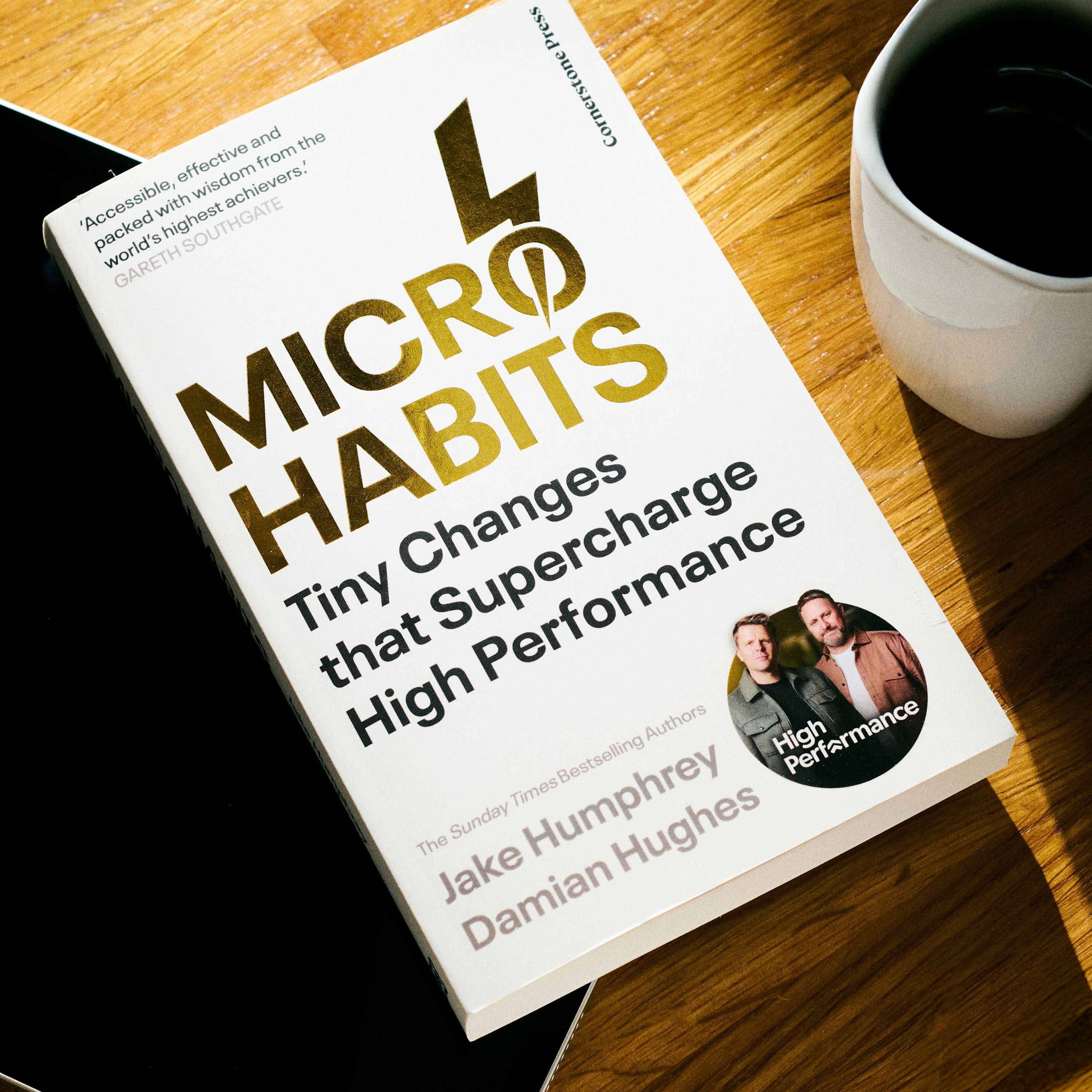
The High Performance Podcast
Micro Habits: Lando Norris' Secret Weapon + Adam Peaty's Comeback Formula (Exclusive Audiobook Preview)
00:19:36
Loading summary
Transcript54 lines
- [00:00]
Sean Linda
What's up? It's Sean Linda from two Black Guys of Good Credit. If managed supply runs is still on your to do list, here's your science upgrade. Walmart Business has the tech tools and services that make it ridiculously easy to stock up for your office or team. Think scheduled deliveries, multi user accounts and even it setup bonus with a Walmart Business plus membership, you get free shipping, spend analytics and 2% rewards. Join the smart way to shop at business.walmart.com Terms apply shipping, billing, Admin, Payroll, marketing.
- [00:34]
Stamps.com / Sleep Number Advertiser
You're managing all the things, so why waste time sending important documents the old fashioned way? Mail and ship when you want how you want with stamps.com print postage on demand 247 and schedule pickups from your office or home. Save up to 90% with automated rate shopping. That's why over 1 million small businesses trust stamps.com go to stamps.com and use code podcast to try stamps.com risk free for 60 days why choose a Sleep Number Smart Bed Can I make my site softer?
- [01:03]
Narrator / Interviewer
Can I make my site firmer? Can we sleep cooler?
- [01:07]
Stamps.com / Sleep Number Advertiser
Sleep number does that cools up to eight times faster and lets you choose your ideal comfort on either side your sleep number setting. Enjoy personalized comfort for better sleep night after night. And now during our President's day sale, take 50% off our limited edition bed plus an extra $100 off all mattresses and Saturday only at a Sleep number store or sleepnumber.com.
- [01:35]
Damien
Hey, it's Damien here. I want to bring you another little exclusive today. Over the last six years on this podcast, Jake and I have sat across from some of the most remarkable human beings on the planet. Olympic champions, elite coaches, successful business leaders, and so many more. The question we always ask ourselves after we've done the interview is what is it that the very best actually do differently and consistently? The answer, it turns out, is much
- [02:04]
Narrator / Author
smaller than you might think.
- [02:06]
Damien
It's not in the grand gestures. It's not in five hour morning routines or in some magic formula that requires a complete reinvention of your life. The answer, more often than not comes down to tiny, horrible, almost invisible behaviors. Those decisions that take less than five minutes, but that when they compound over time, completely transform what a person is capable of. We've started calling them microhabits. And today we're going to give you something a little bit different. Jake and I have spent the last year writing our new book, Microhabits. These are five minute changes that actually transform your life and it's out right now. In it, we've distilled 48 of the most powerful lessons from this show into something that you can actually pick up and use immediately. Today, we want to let the book speak for itself. So what you're about to hear are two of our favorite chapters from the microhabits audiobook read by Jake and me, that bring to life stories from two phenomenal guests who've been among the most memorable of all all the people we've spoken to here on High Performance. The first one is Lando Norris, the current Formula One World Champion and someone with a relationship to his work that I think will genuinely reframe how you think about yours. The second one is Olympic champion Adam Peaty, a man who's faced the kind of darkness that most of us will hopefully never have to experience, but who found a way through it with the help of an ancient Greek myth and the honest advice of Michael Phelps. These chapters are all about motivation and commitment, about what it really takes to get yourself to show up day after day, especially when there's a part of you that's screaming that you don't really want to. So can I suggest that you find a quiet 15 minutes somewhere? Press play and let's go.
- [04:03]
Narrator / Interviewer
When we sat down with Lando Norris, the lead driver for Formula One team McLaren, we thought we would want to talk about his recent success. In the driver's seat that he's occupied since the age of 19, he was on the cusp of helping McLaren win their first constructors championship since 1998, whilst also finishing as a runner up in the Drivers Championship. But nothing seemed further from his mind. Instead, he embarked upon an intriguing series of reminisces about his early days in the sport when he first joined the team. When he started out, he'd spent countless hours working in the garages, helping the team pack prepare and assemble the caravan of materials needed to get the fastest possible car on the track. As he explained to us before, I
- [04:45]
Sean Linda
was the driver race driver for McLaren, then I would stay with the mechanics, I would pack up the garage and take the car apart after the races and stuff.
- [04:53]
Narrator / Interviewer
At first, we were slightly taken aback. Why did a man who was at the top of Formula One want to spend all this time dwelling on his past? But eventually we came to understand he was showing us that the things that motivated him when he started out were, on some level, the same as the things that were motivating him today.
- [05:12]
Sean Linda
As he explained further, there's no downside from doing it. There's no negative. Like, what else are you going to. You're going to go home and play on the Xbox in the hotel for a bit or just go and grab dinner a couple hours earlier. Like it doesn't for me. That's not. Like there's no gain for me in doing that.
- [05:28]
Narrator / Interviewer
Why? Because he truly, genuinely enjoyed his work in the garages. It transcended just being a job to become something dramatically more important.
- [05:37]
Sean Linda
There was enjoyment in it and there's the bonus of working with the team more, you know, and our relationships improving and so on, and knowing that I'm. I didn't know at the time, but I guess more likely to be in the racing seat a couple years later. It's only going to be a good thing for me that we have that relationship and bond together.
- [05:55]
Narrator / Interviewer
Many of the high performers we've spoken to exhibit this kind of monomaniacal commitment to their job. Their thinking can be understood when we view it through the lens of research led by Dr. Amy Reznevsky, a professor at Yale School of Management who spent much of her career researching how individuals think about their work and how this affects performance. She's found that people tend to have one of three work orientations or ways in which they think about their work. She summarizes it as either a job, a career, or a calling. A job provides you with pay, benefits and perhaps a few social perks, but it's essentially about the monthly pay packet that lands in your bank account. People in this category tend to value their lives outside of the office more than their lives inside. Work is how they pay for the things they actually love, be it their friendships, hobbies or family life. People who view their job as a career work not only out of necessity, but also to advance and succeed. They tend to be more driven to seek out opportunities, strive for the next promotion, embrace training and development. People with a career orientation tend to prioritize their long term professional future, using goals and healthy competition at work to get ahead. Finally, those who experience their work as a calling tend to view work as an end in itself. They feel a deep emotional connection to their work, believing it contributes to the greater good, allows them to use their strengths, and gives a sense of purpose to their lives. Unsurprisingly, people with a calling orientation not only find work more rewarding, but they tend to work harder and and longer because of their commitment to it, and in turn get better results.
- [07:33]
Narrator / Author
Lando Norris, it seemed to us, exhibited all the hallmarks of the third approach. He wasn't just working for the sake of working, he was working because he had a deep unwavering passion for what he was doing. Now you might be thinking, oh, good for Lando. But not everyone can have that kind of relationship with their work. If your job is cleaning toilets, then you might struggle to find a deep, unwavering passion. But what if, in fact, you can? Reznevsky's findings suggest that it doesn't really matter what job you have, because a calling orientation is as much to do with your mindset as the actual work you do. The trick lies in what organizational psychologists call job crafting, which essentially requires you to adjust the way you think about work and reframing what you are doing so it aligns more closely with the sense of what matters to you. In her most famous example, Reznevsky describes a cleaner at a hospital who defined her role not as cleaning up other people's mess or scrubbing floors, but as being a healer who maintained the standards in the hospital and so in turn contributed to the recovery of everyone inside. Defining her role as a healer meant she paid additional attention to to the tasks that might help people recover and leave the hospital more quickly, revzniewski wrote. She also formed relationships with patients and their families, getting to know them as people, not just temporary patients. By reframing what her work actually was, the cleaner was able to find dramatically more value in doing it. This is quite similar to the way Lando Norris described his grueling work in the garage. He was not just fixing the odd bit of metal, he told us. Instead, he got to know the values of people and how much of a difference that can make. Even the tasks that felt most menial were making a difference to making the car go faster. Lando's experience shows the value that job crafting can have for any of us. Think about the tasks you have to do and consider how you could rewrite them in a way that would appeal to someone who is applying for the job. What additional meaning could you find in the tasks before you if you framed them in the right terms? And what could it teach you about motivating yourself? The overall lesson don't get a job, create a calling.
- [09:58]
Narrator / Interviewer
The first time we met Adam Peaty, he had his bags packed and his ticket ready to head to the Tokyo Olympic Games. And he confidently described to us how he planned to dominate his rivals and bring gold medals back to his Derbyshire home weeks later. That's exactly what he did. This series of events was entirely consistent with his whole career. Indeed, everything about Peatie's record seemed perfect. With a knack for hoovering up swimming world records and Gold medals with metronomic efficiency. He once described himself as possessing a gladiator mindset. And yet, just a year after our conversation, everything had changed.
- [10:34]
Adam Peaty
It was 14 months from that interview that I had a breakdown, basically.
- [10:39]
Narrator / Interviewer
Here's what he told us in his second appearance on High Performance.
- [10:44]
Adam Peaty
You know, this sport of swimming, any sport, is incredibly hard. Life's incredibly hard, right?
- [10:49]
Narrator / Interviewer
His troubles began when he started recording strangely pedestrian times in training. Then, as he began his preparation to become the first person to win the men's 100 meter breaststroke title in three Olympic Games in a row during the summer of 2024, everything went off the rails.
- [11:07]
Adam Peaty
You know, I got to a place after coming off a training camp for 10 weeks, missing my son, missing home, and I kept getting ill, so my body kept telling me, you know, you don't want to do this, you can't do this. And I went to Edinburgh to race, and my times were about ridiculous, like ridiculously slow to what they normally would. And three days later after that, I was already contemplating, I don't want to do this anymore. But we got to keep going. I had that thought a lot of times. And I got back home three days later and I did 400 meters warm up, as I always do. Then I did 25 meters breaststroke, and I did the breaststroke and I just felt weak, I just felt tired, I felt broken. And I finished. I touched a wall and I was just. My goggles are filled with tears.
- [11:51]
Narrator / Interviewer
Mel Marshall, his loyal coach and mentor, was waiting by the poolside and she asked him if he was okay. This is how Adam replied.
- [11:59]
Adam Peaty
I was like, no. And that's the first time I've ever said no.
- [12:01]
Narrator / Interviewer
Petey described the feelings of desolation that threatened to engulf him as he stood in the shower.
- [12:07]
Adam Peaty
So I got into the shower just crying. Mel was there, and I said to myself, I don't want to do this anymore.
- [12:13]
Narrator / Interviewer
He agreed to step away from the relentless demands of swimming for a week, which was soon extended to a second week, then a third. During this period, he began to question if Paris was even on the agenda. The solution to Adam's problem came from an unlikely source. Homer's Odyssey.
- [12:30]
Narrator / Author
In Homer's ancient story, the hero Odysseus encounters the Sirens, mythical creatures with beautiful voices who lure sailors to their deaths by singing and chanting songs. To avoid this fate, Odysseus had his crew plug their ears with beeswax and tied himself to the ship's mast, allowing him to hear the siren's song while while being prevented from steering towards them, thus successfully passing the island and escaping their deadly charm. An Odysseus contract fulfils a similar function. It draws on this story's acknowledgment that we're all weak and human and often, when faced with temptation, likely to fall if we create a constraint, the equivalent of tying ourselves to the mast and find a way to ensure it can't later be overruled. It. Even if we're faced with temptation or are of unsound mind, it can help us achieve our objectives without the risk of distraction. Mel Marshall suggested that Petey try this for himself when he felt ready. Petey was invited to a meeting with the head coach of aquatics gb, where this contract idea was presented to him in the form of three simple questions.
- [13:43]
Adam Peaty
What is the cost? And do you want to pay the cost? Do you want to pay the price?
- [13:49]
Narrator / Author
Knowing the price was the important question.
- [13:52]
Adam Peaty
You will have a receipt when you stand up at the Olympic Games in lane four. Hopefully you will have to show your receipt of hard work, because if you don't, that mindset will play tricks on you, that you don't deserve to be there. You haven't done the work.
- [14:05]
Narrator / Author
Like the sirens called in Odysseus, Petey knew he had to prepare by answering the questions. He said, it comes back to do I want to do it and am I willing to pay the price? What, we wondered, was the cost?
- [14:20]
Adam Peaty
Everyone throws around the word sacrifice. I don't believe it is a sacrifice because it's my choice to be there.
- [14:25]
Narrator / Author
He then offered an itemised account of what the contract demanded from him should he choose to accept the deal.
- [14:32]
Adam Peaty
So we're probably covering 10 to 12,000 meters, always about 10 to 12,000 meters a day, plus all the gym work. But that doesn't bother me. It's the time I lose doing that and the energy I lose because you will be broken physically and mentally, that you can't even operate, you can't even get up in the morning and get to work with a stable mind, because all these things are at play. So you've got that on the table, you've got the time away from your family, time away from the son that I see him grow without even being there, which I feel guilt. The constant effort of human excellence is a high price.
- [15:07]
Narrator / Author
He.
- [15:08]
Adam Peaty
To constantly find a pathway to human excellence, you know, is probably one of the hardest things ever to do.
- [15:15]
Narrator / Author
Before he finally committed, he chose to call upon the council of one of the greatest swimmers of all time.
- [15:21]
Adam Peaty
I spoke to Michael phelps for about 20, 30 minutes I just saw him and I goes, you've retired two times, and what did it take to bring you back?
- [15:31]
Narrator / Author
Phelps, who had twice retired from the sport he in which he amassed an astonishing 23 Olympic gold medals, had a succinct response.
- [15:40]
Adam Peaty
Basically, forget all the bullshit. What does your heart tell you?
- [15:44]
Narrator / Author
Eventually, Petey was able to find his answer.
- [15:48]
Adam Peaty
I knew that the pain of regret would be greater than pain of loss. So it was never about medals this time. It was about the opportunity and not regretting the opportunity.
- [15:56]
Narrator / Author
The strategy worked. On a balmy Parisian night, an emotional pity was denied his historic treble by the narrowest of margins, coming joint second to Italy's Niccolo Martinghi by only 0.02 of a second. Less time than the blink of an eye. But he gave a tearful poolside interview where he offered millions of television viewers a small glimpse into the torments he'd overcome to be there. It's been a very long way back. I gave my absolute all out there, he said. I executed it as well as I could. It's not about the end goal. It's about the process. And it doesn't matter what the time says on the score, because in my heart, I've already won. I'm not crying because I've come second, Petey said. I'm crying because it took so much to get here. When he looked back at this raw footage, he was unequivocal.
- [16:51]
Adam Peaty
I gave my absolute best in that environment. Obviously, some cards were dealt with me that, you know, I had Covid at the time when I was racing, my lungs literally couldn't work and I touched a wall. And I think that was my most favorite race because what it took to get to that moment.
- [17:07]
Narrator / Author
He smiled as he recalled.
- [17:09]
Adam Peaty
My son was in the crowd, my fiance Holly, and my mum and all the people I care about. It's just incredible that sport can give you so much in success, but also so many failures and so many moments of testing yourself. So, yeah, Paris was a very good one in terms of what I expected out myself.
- [17:27]
Narrator / Author
While we may not be planning to compete at an Olympic Games, the method of using a commitment contract is a powerful tool for anyone. It seems there are three component parts to designing your a clear goal, a referee to hold you to account, and a suitable incentive as a reward. In one analysis of over 125,000 commitment contracts, it was found that those who wrote one but failed to appoint a referee that is someone to hold them to account or didn't set themselves a financial penalty, succeeded only 29% of the time. This rate sharply rose to 59% when a referee was used and to 71.5% when there was money at stake. Best of all, when a commitment contract included both a referee and financial stakes, the success rate increased to nearly 80%. PT would recognise the effectiveness of this approach and the ensuing positive results.
- [18:28]
Adam Peaty
People do see, especially olympic games, the 1% of what it takes or 0.1% in the light. They don't see the 99.9% in the dark. And those are the dark moments that are going to make or break you. And I think everyone in life has those moments. Whether your 7 year old kid, you know, wanting to go to olympics, or a 40 year old picking up sport again, or having troubles in their career, you have to go through those moments to really define, you know, who you are, what values are you setting yourself, but also where do you want to be, you know, next week, or where you want to be in two years time.
- [19:01]
Damien
So there you go. Two chapters from our audiobook, Don't Get a Job, Create a Calling and the Odysseus Contract. These are microhabits that I genuinely think about more than almost anything else we've covered on the show.
- [19:14]
Narrator / Author
Neither of those moments are dramatic.
- [19:16]
Damien
What they are is quiet, private and almost invisible. And yet they're the moments that made almost everything else possible. That's what microhabits is really about. It's not the headline grabbing moment, but the small, deliberate choices that precede them. So here's a microhabit I'd like to leave you with from these two chapters. Once a week, just once, find some time to sit down and ask yourself the three questions that Adam Peaty's coach put to him. What's the cost? Am I willing to pay it? And if I don't, what will I regret? Now, you don't have to be chasing a spot on an Olympic podium for those questions to matter, but they work at every level. It might be the business you're trying to build, the relationship you're looking to invest in, or the version of yourself that you're trying to become. Now, if these chapters that you've heard today resonated with you, I genuinely believe that the book will be one of the most useful things you can pick up this year. Jake and I have poured everything we've learned from five years and 400 interviews into these 48 short chapters. Each one is validated by science and designed to give you something that you can act on today. As always, I want to say thank you to you for being part of our high performance community. It really does matter. Keep working on those habits, the small ones, because what we've discovered is that your dreams don't determine where you go, your habits do. I look forward to seeing you next week.
- [21:12]
Stamps.com / Sleep Number Advertiser
Shipping, billing, admin, payroll, marketing. You're managing all the things, so why waste time sending important documents the old fashioned way? Mail and ship when you want, how you want with stamps.com print postage on demand 247 and schedule pickups from your office or home. Save up to 90% with automated rate shopping. That's why over 1 million small businesses trust stamps.com go to stamps.com and use code podcast to try stamps.com risk free for 60 days. Why choose a Sleep number Smart Bed Can I make my site softer?
- [21:45]
Narrator / Interviewer
Can I make my site firmer? Can we sleep cooler?
- [21:48]
Stamps.com / Sleep Number Advertiser
Sleep number does that cools up to eight times faster and lets you choose your ideal comfort on either side your Sleep number setting. Enjoy personalized comfort for better sleep night after night. And now during our President's Day sale, take 50% off our limited edition bed plus an extra $100 off all mattresses and Saturday only at a Sleep number store or sleepnumber.com. you know that wellness goal you set at the start of the year? It's not too late to stick with it and make your future self proud. Especially with The all in One Nutrition Shake from Cachava with 25 grams of protein, 6 grams of fiber, greens, adaptogens and more. No fillers, no nonsense, just the highest quality ingredients. Stick with your wellness goals. Go to kachava.com and use code smoothie for 15% off. That's K A C-H-A-V-A.com code smoothie.