← The History Podcast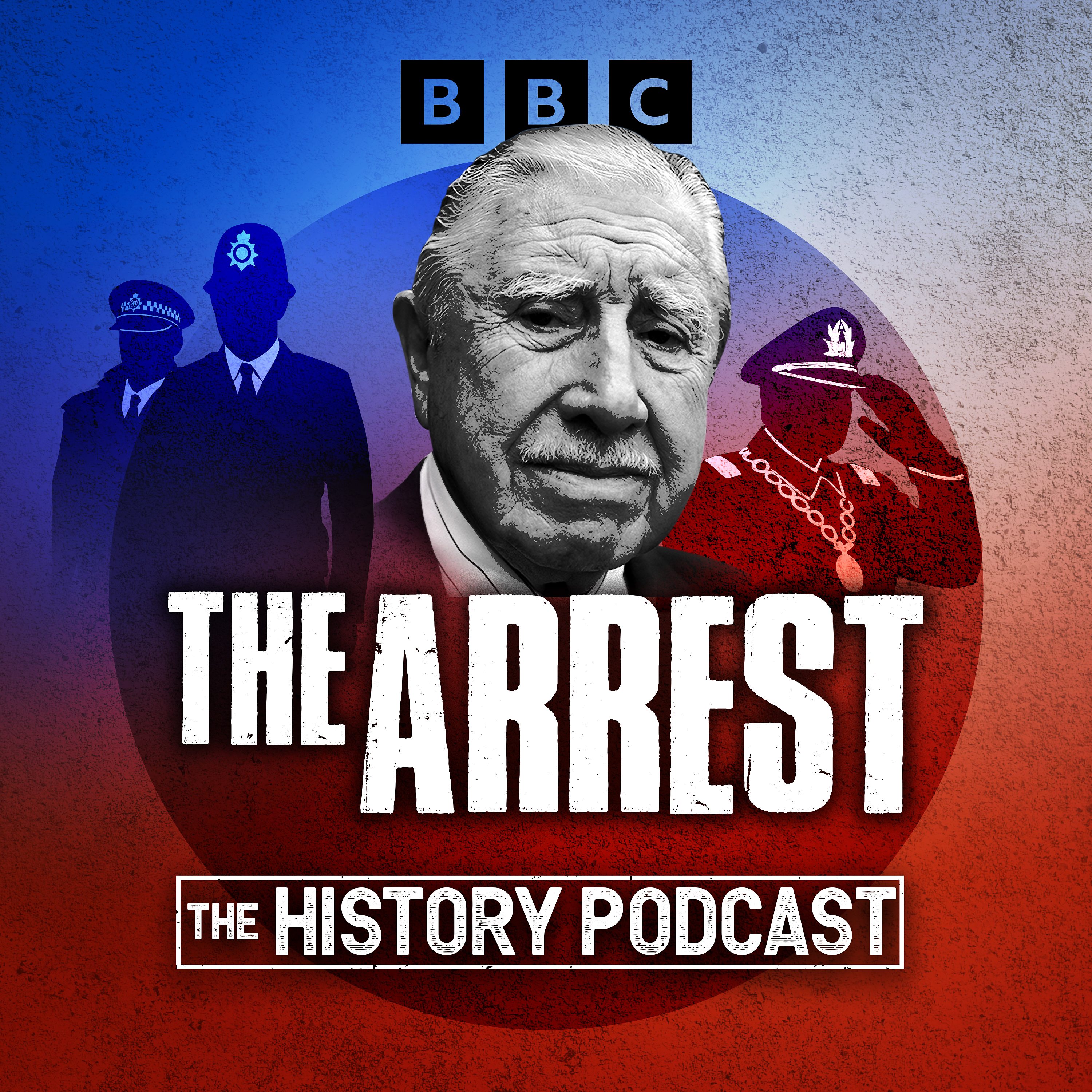
The History Podcast
The Arrest: 5. The Arrest
00:15:12
Augusto Pinochet receives an unwelcome late night visit.
Loading summary
Transcript64 lines
- [00:00]
Philippe Sands
This BBC podcast is supported by ads outside the uk.
- [00:07]
Sarah
Hey, this is Sarah. Look, I'm standing out front of a.m. p.m. Right now and, well, you're sweet and all, but I found something more fulfilling, even kind of cheesy. But I like it. Sure, you met some of my dietary needs, but they've just got it all. So farewell, oatmeal. So long, you strange soggy.
- [00:25]
Commercial Voiceover
Break up with bland breakfast and taste AM PM's bacon, egg and cheese biscuit made with cage free eggs, smoked bacon and melty cheese on a buttery biscuit. Am P M. Too much Good stuff.
- [00:36]
Ryan Reynolds
Hey, Ryan Reynolds here for Mint Mobile. You know one of the perks about having four kids that you know about is actually getting a direct line to the big man up north. And this year he wants you to know the best gift that you can give someone is the gift of Mint Mobile's unlimited wireless for $15 a month. Now you don't even need to wrap it. Give it a try@mintmobile.com Switch upfront payment.
- [00:57]
Sarah
Of $45 for a three month plan, equivalent to $15 per month required new three months only. Speed slow after 35 gigabytes if network's busy, taxes and fees extra. See mintmobile.com.
- [01:12]
Philippe Sands
It's approaching midnight on Friday 16th October 1998. Two police officers stand outside room 801 of the London Clinic, a private hospital in the centre of London. On the other side of the door sleeps a man who is alleged to have orchestrated the torture, kidnap and deaths of thousands of people.
- [01:38]
After some persuasion by the police officers, a nurse has agreed to wake him up. Augusto Pinochet is recovering from a minor operation on his back. A few hours earlier, Nicholas Evans, the duty magistrate, had signed a warrant for his arrest with a charge of murder.
- [02:01]
An interpreter, Jean Pateris, has been asked to accompany the police officers because Pinochet doesn't speak English. Jean has worked for the Metropolitan Police for more than 20 years.
- [02:13]
Jean Pateris
My first case was at Horse Free Road Magistrates Court. Some chap had stolen some soap from Boots.
- [02:19]
Philippe Sands
The chemistry Jean loves the work, mostly local matters before the English courts.
- [02:26]
Jean Pateris
That day I'd be at Southwark Crown Court doing a drugs trial, so I was absolutely exhausted. I got back at about half past five and I got a phone call from Scotland Yard asking if I was free that evening. I said yes, and what's it about? Unless it was very interesting, I wasn't going to go because I was so tired. And he said, well, I can't tell you on the phone, but if you come over here, I'm sure you'll be interested. So I got in my car, went to Scotland Yard and when I got there I said, what's going on? He said, well, we're going to go and arrest General Pinochet. So I said, oh my God, it's like a Woody Allen movie, you know, what do we do on a Friday night? We're going to arrest a dictator.
- [03:04]
Philippe Sands
An inspector had briefed her on the case before heading off to get the arrest warrant signed. Go home and wait for my call, he told her.
- [03:16]
Jean Pateris
I watched a bit of tv, actually had a glass of wine and waited for the call.
- [03:23]
Philippe Sands
And at about 9pm the call came.
- [03:28]
As Jean and the police officers stand outside Room 801 of the London clinic a few hours later, waiting for the nurse to wake the general, they spot a problem.
- [03:39]
Jean Pateris
Outside his door were two bodyguards. So I was told to tell them to leave the hospital.
- [03:46]
They said, with their hands on their hearts, I will not leave my General.
- [03:51]
I will not leave my General.
- [03:54]
Philippe Sands
Jean translates for the inspector.
- [03:57]
Jean Pateris
He said, well, tell them either they leave now or they get forcefully taken out. And one of them put his hand inside his jacket as if to take they thought was a gun. So everybody was hugely alert.
- [04:10]
Anyway, he was grabbed, but he's going for his telephone, not his, not a gun.
- [04:16]
Philippe Sands
Two uniformed police officers escort the guards out of the building. The tension eases. The nurse opens the door to room 801.
- [04:27]
Jean Pateris
So in we go into the bedroom and there is General Pinochet sitting in his bed in striped pajamas. And I couldn't believe what I was looking at. I thought, oh my God, it really is him. They said, jean, please tell him that he's under arrest for murder. So I said, listen, please listen to what this officer's gonna say. I'm gonna repeat to you in Spanish what he's saying. So, so he was arrested, the sergeant arrested him and then the whole thing is, you do not have to say anything, however it may harm your defense, blah, blah, blah. And he was absolutely livid. He said, I know who's behind this. It's that communist Garces.
- [05:08]
Philippe Sands
I'm Philippe Sands and from Radio 4 and the History podcast. This is the Arrest, the inside story of the race to apprehend Auguste Pinochet and bring him to justice.
- [05:22]
Episode 5 the Arrest.
- [05:29]
It's the next day and Jean the interpreter is still buzzing from the night before. She can't wait to tell her Chilean born mother, now living in the uk, Jean had spared her a call in the early hours of the morning when she'd finally left the clinic. But she hadn't been able to resist.
- [05:47]
Jean Pateris
Contacting her sister to say, guess what I've just done?
- [05:54]
She said, what? I've just arrested General Pinochet, for God's sake. So she was thrilled because, you know, she knew a bit more about him than I did.
- [06:03]
Philippe Sands
When Jean's mother picks up the phone the next day, I thought she was.
- [06:07]
Jean Pateris
Going to say, oh, darling, how exciting. I couldn't believe what she said. How outrageous. What a poor man. Honestly, the man was absolutely the best thing that Chile ever had. Because when she lived in Chile, she said, at least when he was there, you knew what the price of a loaf of bread was going to be. When Allende was in there, you didn't know what. Because inflation was up and down all over the place, and things were not so constant. You could leave your car door open, you could leave your house door open. Everything was safe. That's what she said.
- [06:40]
Philippe Sands
Jean's mother isn't the only one who feels this way. As word of Pinochet's arrest spreads to Chile, violent protests break out. Demonstrators tear down security barriers outside the British Embassy. Chile's government formally objects. It says the British authorities should have respected the former leader's immunity as a senator for life. And that view is echoed abroad by Pinochet's political backers. There's anger, too, from his opponents. Hundreds of Chileans in Britain demand justice outside the London clinic where he's now under house arrest. They want him extradited to Spain to face trial. There is, of course, joy as well, much of it mixed with disbelief. So many thought this day would never come.
- [07:36]
Laura Gonzalez Vera, widow of Carmelo Soria, the UN diplomat whose murder had been crucial to the starting of the Spanish case, was in Madrid when she heard the news.
- [07:49]
Jean Pateris
I felt happy, of course, and there were a lot of people.
- [07:53]
David Dimbleby
There were a lot of foreign journalists.
- [07:56]
Philippe Sands
Baltazar Garzon, the judge who'd sent the arrest warrant, was at a bullfighting festival. When he heard the news, he'd driven straight back to Madrid. The legal work was not over.
- [08:10]
The lawyer Juan Garces, who'd convinced the judge to take the case, had stayed home on tenterhooks since the warrant had been sent to London.
- [08:22]
Juan Garces
The next day, early, I looked at the Chilean press and I saw in the front page on the Santiago papers that Pinochet had been arrested in London. And about half an hour later, I received a call from Judge Garzon telling me, listen, I have News. And I said, yes, he was arrested. And he said, but how do you know? He had received the information directly and was surprised that I was aware of.
- [08:52]
Carlos Castrosana
John Garces called me Saturday morning and told he has been arrested.
- [08:57]
Philippe Sands
This is Carlos Castrosana, the prosecutor who'd been instrumental in bringing the case before the Spanish courts.
- [09:04]
Carlos Castrosana
And my response was, who has been arrested? And he said, pinochet has been arrested.
- [09:10]
Philippe Sands
Did you believe it?
- [09:11]
Carlos Castrosana
I could not believe it. I could not believe it.
- [09:20]
Philippe Sands
The signing of a warrant for the arrest of Augusta Pinochet was a landmark moment. Nuremberg was the first time that the leaders of a country who'd committed international crimes were held to account before an international tribunal. Pinochet's arrest was the first time that the former head of state of one country, in this case Chile, had been charged with international crimes and arrested in another country. It was seen as a warning to dictators everywhere, past and present, that they could no longer grant themselves immunity from prosecution and travel the world freely in retirement. The proceedings that would follow before the English courts were unprecedented. For a start, the decision to charge Pinochet with the crime of murder, rather than an international crime such as genocide or torture or disappearances, would be challenged and immediately give rise to much additional work for Judge Garzon and the lawyer Garces in Madrid.
- [10:26]
And then there would be the not so minor matter of whether, as his lawyers would argue, Pinochet's claim of absolute immunity as a former head of state would meant that he could not be arrested in England or extradited to Spain.
- [10:44]
Every act has consequences, expected and unexpected, and this one would be no different. And every act gives rise to questions. One that I am often asked is, why was the case brought in Spain of all places? Did you think about this at the time? Because there's a legitimacy issue. How can Spain, which had its own problems in the 30s and afterwards and never did anything about them, go to Chile and say, you have not behaved correctly?
- [11:19]
Carlos Castrosana
I've had always the clear idea that for us, Pinochet was like the exorcism of Francois. We did to Pinochet what we should have done to Franco. But we were a nave.
- [11:35]
Philippe Sands
The prosecutor Castrosana told me this in May 2021. He was in Madrid and I was in Totnes, a small town in Devon, visiting my mother in law, Maria Elena de la Iglesia.
- [11:51]
Lena, as she is known, was born in Spain shortly before the Spanish Civil War. Her father, a Republican army colonel, opposed Franco, so the family fled to England. Eighty years later, I shared with Lena what the prosecutor told me about how the Pinochet case started. What was the name of the Spanish victim who got the case going in Madrid? She asked after I finished telling the story. Soria. Carmelo Soria, I replied. She looked at me and was silent for a long moment. And then she said, of course, cousin Carmelo.
- [12:37]
She drew a family tree to show how Carmelo Soria became her distant cousin through marriage. And now, said Lena, because I was also part of the family, also by marriage, he's your cousin too.
- [12:52]
In this way, 23 years after the Pinochet case, I learned that his arrest was a family matter. And it wasn't the only personal connection.
- [13:05]
I'm a barrister, and on October 30, 1998, two weeks after Pinochet's arrest, I was in Paris working on a case. I was also there to attend the setting of my grandfather's gravestone. I met my wife at the large wooden gates that mark the entrance to the Pantin cemetery on the outskirts of the city. I've just received an approach from Auguste Pinochet's lawyers, I told her. They wanted me to argue that he had immunity from the jurisdiction of the English courts. Will you do it? My wife asked in a firm voice. I reminded her of the cab rank principle, the rule that requires barristers to act like taxi drivers, to take every fare, to turn down none because of politics or personality. Will you do it? She asked again. Well, you know the rules, so yes, that was my inclination, I told her. Fine, she said in a tone that was both irritated and sweet. But if you do it, I will divorce you.
- [14:14]
After the arrest, there would be rulings on immunity, on extradition, on matters of fitness for trial, and views would be divided on how the whole story eventually turned out. But one thing was clear. The world was changed. A precedent was set so that anyone, even a former president, would would know that if they committed an international crime and later traveled abroad, the risk of a tap on the shoulder was real.
- [14:44]
And oh yes, just in case you want to know, I did play a role in the proceedings that followed. And yes, I'm still very happily married.
- [15:04]
The arrest is presented by me, Philippe Sands. The series producer is Simon Tulit. The production coordinators are Helena Warwick Cross and Tammy Snow. Sound design and mixing is by Tom Brignall. The editor is Matt Willis and the commissioning editor is Hugh Levinson. With special thanks also to to Polly Hope and Tristan Redman.
- [15:29]
Thank you for listening to the Arrest. If you've enjoyed it, why not check out another series here in the History podcast, such as Invisible Hands.
- [15:39]
David Dimbleby
I'm David Dimbleby and from the history podcast and BBC Radio 4, this is invisible Hands, the story of the free market revolution. The free market isn't solving the problem of homelessness.
- [15:53]
Philippe Sands
Classic liberal values of free speech, free.
- [15:56]
David Dimbleby
Enterprise, free markets, a hidden force that changed Britain forever. Popular capitalism is a crusade and the invisible hands that shaped it.
- [16:07]
Philippe Sands
I thought I was a conservative. I thought I was a Conservative. There's a massive schism between those who believe in the continuity of our society and those who wish to destroy it.
- [16:14]
David Dimbleby
Listen to Invisible Hands on BBC Sounds now.
- [16:23]
Commercial Voiceover
If you're a maintenance supervisor for a commercial property, you've had to deal with everything from leaky faucets to flickering light bulbs. But nothing's worse than that ancient boiler that's lived in the building since the day it was built 50 years ago. It's enough to make anyone lose their cool. That's where Grainger comes in. With industrial grade products and dependable, fast delivery, Grainger can help with any challenge, from worn out components to everyday necessities. Call clickranger.com or just stop by Ranger for the ones who get it done.
- [16:53]
David Dimbleby
Hello, it's Ray Winstone. I'm here to tell you about my podcast on BBC Radio 4, History's Toughest Heroes. I got stories about the pioneers, the rebels, the outcasts who define tough. And that was the first time that anybody ever ran a car up that tough ass with no tires on. It almost feels like your eyeballs are.
- [17:14]
Philippe Sands
Going to come out of your head.
- [17:15]
David Dimbleby
Tough enough for you? Subscribe to History's Toughest Heroes. Wherever you get your podcast.