← The History Podcast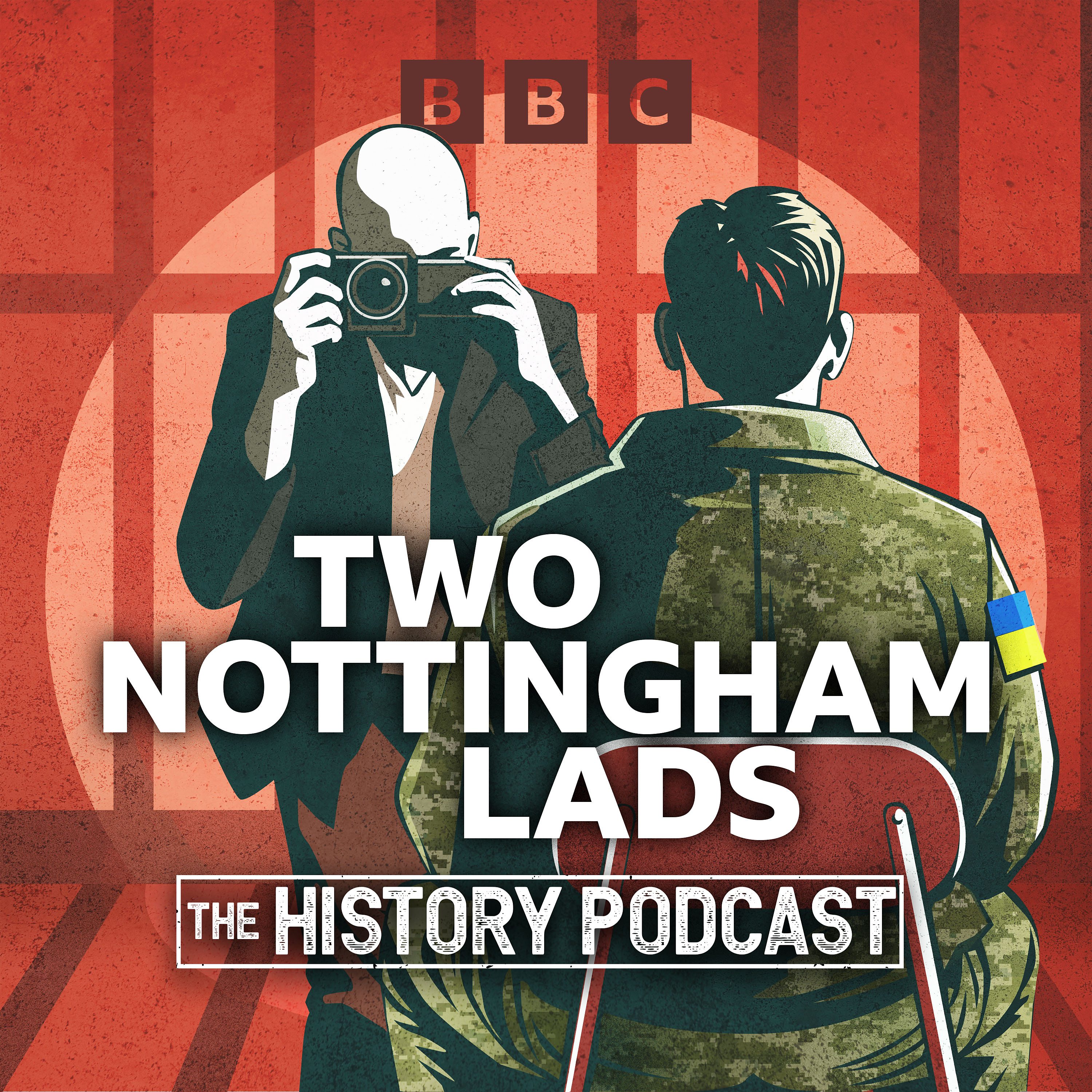
The History Podcast
Two Nottingham Lads: 1. From One Nottingham Man to Another
00:30:02
Two men from Nottingham have a chilling encounter on opposing sides in the Ukraine war.
Loading summary
Transcript112 lines
- [00:00]
Paul Kenyon
You're about to listen to the History podcast. Two Nottingham Lads episodes of this series will be released weekly, wherever you get your podcasts. But if you're in the UK, the whole series is available right now, first on BBC Sounds. It's April 18, 2022, inside a prison in Donetsk, a city in in Russian controlled eastern Ukraine. Just a couple of months after Russia's full scale invasion. Two Englishmen are meeting in a heavily guarded room.
- [00:39]
Graham Phillips
The camera on here.
- [00:41]
Paul Kenyon
One is handcuffed, the other is filming him.
- [00:46]
Graham Phillips
Because we're all good, nice, polite people here, we shall adhere to the protocols and the covenants of the Geneva Convention. Aidan would just like to confirm that you're speaking of your own will. You are fed, watered basically, that you agree to.
- [01:01]
Aidan Aslan
Yeah, I agree to this. I ask for this.
- [01:04]
Paul Kenyon
The man leading proceedings is Graham Phillips, a 43 year old self styled independent journalist, one with hundreds of thousands of followers online. Since the start of the conflict back in 2014, Graham has told the story of the Ukraine war from a perspective many in the west rarely hear, that some of us might even find troubling, one that appears at least to be sympathetic to Russia. The man he's interviewing today is 28 year old Adan Aslan, a fellow Brit who's been fighting for Ukraine in the east of the country since 2018, but was captured by not long before this encounter. As well as being a soldier, he's also something of an independent reporter himself, uploading videos to social media from his foxhole on the front line. But now he's a prisoner of war and despite stating otherwise on camera, Aidan told us he absolutely did not agree to any of this.
- [02:11]
Graham Phillips
You're a lucky guy. This is basically a week in captivity, isn't it?
- [02:14]
Aidan Aslan
Yeah, I'd say lucky, to say the least. Probably extremely lucky to be alive considering the situation that happened in Mariupol.
- [02:23]
Paul Kenyon
It's a peculiar episode, the purpose of which is unclear, but there's a real menace to the video, a palpable tension. Aiden is quiet and subdued, his bruised face expressionless, a glazed over look in his eyes. Graham, on the other hand, is animated, excited even. He confronts Aiden with accusations of war crimes allegedly carried out by Ukrainian soldiers against Russian prisoners of war, a claim that Aden appears to agree with on camera.
- [02:55]
Graham Phillips
But can you describe any of the videos you've seen of when Russian soldiers have been taken captive by Ukrainian soldiers and what's happened to them?
- [03:03]
Aidan Aslan
From the videos I've seen online of Russian soldiers being captured, there's been a lot of war crimes that have taken place.
- [03:10]
Graham Phillips
We're talking about absolute barbarism. We're talking about videos of Russian soldiers, servicemen killed by stabbing them in the eyes, tortured, mutilated, slaughtered by your colleagues, your comrades, Aiden. I mean, come on.
- [03:28]
Paul Kenyon
Graham continues in this vein for the rest of the video, some 44 minutes, rambling about atrocities and the supposed neo Nazis running Ukraine. Whatever Graham's motive, the video will soon be lapped up by his audience on YouTube, X and Telegram. It's still available online, titled Exclusive Interview. Aiden Aslan, British man fighting for Ukraine, captured in Donbass, Mariupol. When it comes to war reporting, there's sometimes a fine line between news and propaganda. Which side do we choose to believe and why?
- [04:08]
Graham Phillips
I don't even see a sketch by Mitchell and Webb. They're dressed up in Nazi style uniform.
- [04:13]
Aidan Aslan
Yeah, yeah, I've seen that one.
- [04:15]
Graham Phillips
Sensei says, are we the bad guys?
- [04:17]
Aidan Aslan
Yeah.
- [04:18]
Paul Kenyon
Who is the bad guy here in the mind? Graham Phillips. He's in the right trying to drive a bit of sense into an enemy combatant, one that he claims is a mercenary to Aiden. Well, Aiden isn't able to freely share his views at the moment because he fears for his life. With his captors waiting for him outside the door, he'll say anything to save himself from a beating.
- [04:47]
Graham Phillips
State a fact here, Aiden. It's obviously not a nice one to state, but the penalty in the Donetsk People's Republic for being. You're a mercenary.
- [04:56]
Aidan Aslan
Yeah.
- [04:56]
Graham Phillips
Do you accept that? You're a mercenary?
- [04:57]
Paul Kenyon
Yeah.
- [04:58]
Graham Phillips
What are you, Aiden?
- [04:59]
Aidan Aslan
A mercenary?
- [05:00]
Graham Phillips
It is a death penalty. Can you give a reason as to why that shouldn't apply to you?
- [05:07]
Paul Kenyon
Aidan is staring down the barrel of a Russian firing squad with Graham Phillips filming his reaction. Two Englishmen then, far from home, enemies in a foreign war, one facing death, the other hoping for a surge in his online audience. And not just two Englishmen, both these men are actually from the same city. A fact that Graham uses as if it created some kind of special bond between the two of them.
- [05:40]
Graham Phillips
I'd like to say, from a Nottingham man to another, how's it been for you? And it's good.
- [05:46]
Aidan Aslan
I just want to point out I knew about Graham. I asked to speak to him because one, he's British and he's also a Nottingham lad. Look into the interview that we're doing now.
- [05:54]
Nick Sturdy
It's.
- [05:54]
Aidan Aslan
It's legit.
- [05:58]
Paul Kenyon
This video of two Englishmen staring at each other across the chasm of war will soon be shared across the world and will have life changing consequences for.
- [06:08]
Aidan Aslan
Both men in Russian I just hear smirking a car. It literally just means death sentence.
- [06:14]
Paul Kenyon
What will become of Graham and Aiden? One embedded on the Russian side, the other facing the death penalty.
- [06:22]
Les Scott
That's nearly three years now he's been living as effectively a homeless person with a laptop and electricity.
- [06:29]
Paul Kenyon
And how did these two Nottingham lads find themselves here in the first place? This is the story of our series for BBC Radio 4 and the History Podcast. This is two Nottingham lads, a story about how and why you pick a side in a war that's not your own. Episode one from one Nottingham man to another. My name is Paul Kenyon. I'm a reporter and authority. I've covered conflicts and exposed corruption from the Libyan civil war to Colombian drug cartels. I've covered the war in Ukraine for BBC Panorama. Since 2014, when the Euromaidan protests turned into a revolution that ejected Ukraine's pro Russian president and provoked a grinding eight year long conflict in the east of the country.
- [07:31]
BBC Colleague
We've been warned that if we go in, we could be in there for at least 48 hours and for the rest of this conflict if it happens.
- [07:37]
Paul Kenyon
I was in Crimea when Russian troops suddenly arrived to support local separatists and then annexed the peninsula for Moscow.
- [07:46]
BBC Colleague
The Russians have obviously seen these Ukrainian soldiers on the move and they've positioned themselves in armored vehicles just over the.
- [07:53]
Paul Kenyon
Brow of the hill. And then in 2022, I was in Kyiv when the Russians launched their full scale invasion.
- [08:05]
BBC Colleague
And we just heard from some locals that they're Russian soldiers, that the Russians have taken over this airport which is just on the outskirts of Kiev.
- [08:14]
Paul Kenyon
I remember Aiden's story of capture that same year. It was all over the news in the uk. It brought the war home.
- [08:23]
BBC Colleague
The family of a man from Newark who's fighting in Ukraine says he has told them he will have to surrender to Russian forces. Aidan Aslan has been fined.
- [08:32]
Paul Kenyon
Then just weeks later, when I saw the video of Graham and Aiden together, more interrogation than interview, I found it deeply troubling. Despite Graham's accusations, Aiden is not a mercenary. He's a legitimate member of the Ukrainian military, therefore protected by the Geneva Convention, which generally prohibits the publishing of interviews with with prisoners of war. Graham contests this view and no wonder. A significant breach at the convention could leave him open to prosecution for war crimes.
- [09:08]
Graham Phillips
Speaking. I'm going to get a load of hassle. Yeah, a load of stick for people, you know, saying that the terrible, the evil, you know, Criminal propagandist Ben Phillips interrogated parades.
- [09:22]
Paul Kenyon
The video also affected me on a personal level. It was like watching my worst nightmare play out in real time. Being captured, humiliated, tortured. Every conflict zone that I visit, this fear is always with me. But on a professional level, I found the video fascinating. I'd heard of Graham Phillips before. He was well known amongst Ukraine based journalists. To many of us, it seemed he was simply parroting Russian propaganda. But he had amassed a huge following online who supported his narrative. His videos left me with awkward questions over the role of new media and the rise of misinformation during this war. It even left me questioning some things about my own work in the mainstream media too. So to understand how these men got here, how they got caught up in this brutal war, far from home, we need to go back eight years, to 2014 and the capital of Ukraine, Kyiv. Back in 2014, Graham Phillips was simply an aspiring journalist. He was living in Kyiv, a place very much on the up. Its cultural and political compass seemed to be pointing west. Many Ukrainians were looking forward to the promise of a future within the eu. Was it this that brought Graham here in the first place? I needed to speak to someone who knows him well.
- [10:55]
Les Scott
My name's Les Scott and I know Graham Phillips from my hometown, Perth.
- [11:00]
Paul Kenyon
Les is a businessman in Perthshire, but he's been friends with Graham since the 1990s. While Graham was born in Nottingham, he moved to Scotland in his youth. He went to high school there and attended Dundee University before, somewhat surprisingly, embarking on a brief career in stand up comedy.
- [11:21]
Les Scott
He was a real fun guy. He was very sociable. He loved to crack jokes, make everyone laugh. She went down to London and he actually started a comedy club in London. He did a few acts alongside Russell Brand, but it was a short lived career for him and I think he just sort of fell out of love with it.
- [11:42]
Paul Kenyon
After comedy didn't work out, Graham worked for the British Civil Service in London for about a decade. But all that changed after he visited Ukraine during the European football championships of 2012.
- [11:56]
Les Scott
He went to Ukraine as a supporter of the England football team. You know, he was impressed with the country. He loved this way of life that they seemed to have. He's the sort of guy who he can make a quick decision and just go for it.
- [12:09]
Paul Kenyon
Graham was seduced by the country and the opportunities it presented. In an interview with Buzzfeed, he said he was struck by the different and otherworldly women there. Ukraine draws people, he's quoted as saying. There's a certain capacity for reinvention here. Graham's reinvention would be through a new career path.
- [12:32]
Les Scott
He's always been interested in journalism and he did work for Watson magazine in Kiev for quite a few years, actually.
- [12:40]
Paul Kenyon
In Kyiv, Graham went from civil servant to journalist, as well as writing for local magazines. He had some success in the British press, writing two pieces about Ukraine for the New Statesman in 2012. But Graham was most prolific on his blog, Brit in Ukraine. It's an intriguing mix of quirky culture and lifestyle posts, including a large subsection revolving around sex tourism. Articles include Kiev Casanova or Kiev Chump, Ukrainian Girls Are Smoking and a charmingly titled two parter Ukraine Shaggers. But Graham also found genuine romance. He details in various blogs his time with a Ukrainian woman who he says he loved and who loved him back. This all feels like the Graham that Les describes. Frivolous and fun loving, if a bit salacious. It's certainly not war reporting and hardly critical of Ukraine. So what changed?
- [13:45]
Les Scott
I think what changed was really for him was euromaidan.
- [13:52]
Paul Kenyon
In late 2013, Ukraine had a political crisis, one that would set the country and Graham's life on a new trajectory. The president, Viktor Yanukovych, after promising closer ties with Europe, backtracked and pivoted towards Putin's Russia. Many Ukrainians were furious. And in the coming months, students took to the streets. They headed to the Maidan Square in central Kyiv, which would give these protests their name. Graham, a local Kyiv journalist for almost two years by this point, went down to cover it.
- [14:30]
Les Scott
Initially he went to Euromaidan because there was a pop concert on and he wanted to to interview some of the young people for the magazine. But things sort of took a different turn.
- [14:42]
Paul Kenyon
The protest began as a small student camp. Youths cooking, playing music, sleeping in freezing makeshift tents. The numbers swelled. It became a mass anti government movement. In response, in mid January 2014, protests were banned. That just brought more people onto the streets. Clashes broke out in late February. Security forces and snipers began firing at the unarmed protesters. I traveled there with the BBC and remember speaking to young people in the days that followed. They showed me phone footage of friends holding dustbin lids as shields against sniper fire. More than a hundred were killed. Yanukovych fled two days later on 22 February, flying to Russia in a helicopter, weighed down with his riches. New elections were held and a pro Western government was voted in. Many European journalists were triumphant. They saw the Maidan revolution as a victory for liberal democracy over an increasingly autocratic Russia. But there were those like Graham, who saw it differently.
- [16:02]
Les Scott
What he saw, he believed, was someone who was democratically elected being forced away by people who were appeared to him being bused into a music concert. So I think that he just thought that this was wrong.
- [16:20]
Paul Kenyon
Graham witnessed something at the Euromaidan protests that actually highlights a tricky part of the revolution for some Western commentators. Those people he thought were bused in were likely the far right or ultra nationalist element who did unfortunately have a part to play in the uprising. Graham had come across them in Ukraine before.
- [16:45]
Les Scott
I've seen his Facebook posts showing the pictures he took at the party political conference where they were doing Nazi salutes. Yeah, at the Sboda party. So that is bound to influence you as a journalist. In fact, he was quoted at the time as saying it made him feel sick to his stomach.
- [17:03]
Paul Kenyon
Far right political groups like the Svoboda party were increasingly vocal and visible in Ukraine over this period. Their role in the revolution was in reality small. However, it was quickly inflated in the Russian media as evidence that Ukraine was a neo Nazi state. A message that Graham Phillips picked up and amplified following my Dan. His blog posts changed dramatically. The quirky cultural critiques were replaced with denunciations of Ukraine, its language and even his now ex girlfriend. It seems whatever Graham witnessed at Maidan would be enough to propel him to the front lines of a burgeoning war in eastern Ukraine. A change of direction that would also prove to be his big career break. After the Maidan Revolution in February 2014, Russia moved to secure its interests in Ukraine. Almost immediately, Moscow denounced the revolution and said that the Russian speaking peoples of Eastern Ukraine now needed protection from the new European facing government. I was there in Ukraine as all of this was unfolding, making a documentary for BBC Panorama.
- [18:30]
BBC Colleague
What's happening now is they're building up the barricades around here. This is a kind of lockdown because they're expecting the Ukrainian authorities to do something.
- [18:38]
Paul Kenyon
And I had some BBC colleagues with me.
- [18:42]
Nick Sturdy
My name's Nick, Nick Sturdy. I think I've shot more documentaries certainly in Ukraine, than anyone in UK journalism or Western journalism.
- [18:51]
Paul Kenyon
Nick Sturdy is a true scholar of post Soviet Russia. He's married to a Russian, he speaks the language, he even has a PhD in Russian cinema. He's also my good friend and colleague. We were making that film together in Ukraine in 2014 and soon after Maidan, we found out what the Russian protection actually looked like. It was a land grab where the Crimean peninsula on the Black Sea coast.
- [19:22]
Nick Sturdy
We found ourselves in the capital, Simferopol, where the government building had been taken over by pro Russian separatists and by Russian military personnel.
- [19:36]
Paul Kenyon
Putin was saying there are no Russian soldiers there, but they were Russian. And I remember that we went to a place called Belbek Air Base and there was a sudden realization that the airbase was being surrounded by Russian troops.
- [19:49]
BBC Colleague
It's quite tense here. You can tell what they were doing then was they were asking for somebody to come and negotiate with them.
- [19:56]
Nick Sturdy
I worried that it might turn violent.
- [19:58]
Paul Kenyon
I thought somebody was going to get shot. Okay, okay, okay, okay, okay. The translation of that last line is I'm serious, I'm going to shoot you in the leg. The Russian annexation of Crimea was a key moment in what would become the full scale war. From then on, events in Ukraine began to move at lightning pace. Russian backed separatists in the east of the country, the Donbass took matters into their own hands, unilaterally proclaiming themselves independent states. The Donetsk and Luhansk people's republics. The world was watching and journalists like us swooped in.
- [20:42]
BBC Colleague
They just said that they're expecting some pro Kiev protesters to come today and they're saying if they do, they're here to provoke us. So state.
- [20:51]
Paul Kenyon
But when we got there, we found it wasn't just mainstream media doing the reporting.
- [20:57]
Graham Phillips
So leaving the scene now, you can still hear gunfire behind me and it's still an active war zone. In fact, it's a ferocious war zone in there at Donetsk Airport now.
- [21:07]
Paul Kenyon
This is Graham Phillips, that is indeed Graham Phillips reporting in a video titled Leaving Donetsk airport territory. 17:10. Rockets gunfire by mid-2014, Graham had been politically awakened by events in the Maidan. He'd seen an opportunity to pursue a new kind of journalism and left for the Donbas. With no prior combat experience or training to speak of. As with his blog, he was prolific, filming the growing conflict and uploading it to his own YouTube channel. He quickly amassed a real following. My colleague Nick, who was working on a film in Eastern Ukraine at the time, actually reached out to him.
- [21:51]
Nick Sturdy
I came across Graham Phillips the winter of 2014-15 when I was in Donbas. He had been filming some of these skirmishes and he looked very out of place and quite naive. I got in touch with him to ask whether we could use some of the footage that he'd shot.
- [22:09]
Paul Kenyon
What did he say?
- [22:10]
Nick Sturdy
I think he was quite pleased. He said yes, and also I guess he was pleased that the big BBC was using something that Graham Phillips himself had filmed. What his motivations were, I don't know. I think that he was excited to have seen action and drama and to feel that he was on the right side of history, as he clearly Believed.
- [22:32]
Paul Kenyon
From the nightclubs of Kyiv to the front lines in the Donbass, Graham Phillips's extraordinary transformation appears to have happened almost overnight. It shows the power that politics has to thrust people into events, into history. From 2014, Graham would spend the next decade covering the growing war in eastern Ukraine. But what of our other Nottingham lad? What was Aidan Aslan doing back in those early days of the war in the Donbas?
- [23:11]
Aidan Aslan
My name's Aidan Aslan. I'm a British national who served in the Ukrainian military for four years.
- [23:18]
Paul Kenyon
We spoke with Aydin via a series of video calls. Him in Ukraine, me in London, when he wasn't being called away for important work with the Ukrainian military.
- [23:30]
Aidan Aslan
One second, my commander's just calling. Would we be okay to delay this to tomorrow? I've just got to go handle something.
- [23:38]
Paul Kenyon
Aidan is a big guy, at least six foot and quite broad. He's imposing and serious. Mostly there's a sense of mischief about him too. I want to understand why Aidan ended up in that prison building, being questioned by Graham. What drew him to Ukraine in the first place?
- [24:00]
Aidan Aslan
So I was born on 7 January 1994 in the city of Nottingham. I grew up in Newark on Trent, which is probably like 30, 40 minutes from Nottingham. I'd probably say when I was in school I was probably more troubled. I eventually got kicked out of high school.
- [24:17]
Paul Kenyon
What for?
- [24:18]
Aidan Aslan
Just trouble, just fighting? Well, I remember one of my teachers when I was younger, they said I would probably end up in prison, which she was half right, I think, when.
- [24:29]
G
He was in the school, I remember the headmistress saying to me that she couldn't cope with Aidan and he was naughty.
- [24:37]
Paul Kenyon
That's Aiden's mum, Angela Wood.
- [24:40]
G
And she said to me that this child, she can't see him having a future.
- [24:46]
Paul Kenyon
That troublemaking continued, he tells me, until he started boxing in his mid teens, instilling in him a discipline that the sport so often does.
- [24:56]
Aidan Aslan
I matured significantly and within like two years I got my door license and started doing door security. But majority of my work time was with social care, like working with autistic adults.
- [25:12]
Paul Kenyon
Working with his fists on doors in Newark at the weekend, looking after autistic adults during the week is quite a contrast. But Aiden was becoming quietly restless. He had a nagging sense of unfulfillment. While Graham's war was beginning in Ukraine, Aydin was stuck in his room in his parents house. But within five years, he too would be in the Donbass, burning with ideological commitment. It turns out Aiden's Political awakening came from an altogether different direction.
- [25:48]
Aidan Aslan
I was probably about 18, 19, 20, 14 when the emergence of ISIS happened. And that's when I started getting a lot deeper into geopolitics. That shaped my views. A lot of how the world works.
- [26:02]
Paul Kenyon
It seems like an age ago, but the rise of Islamic State in Iraq and its expansion into Syria during the chaos of the civil war dominated the news cycle for years. And just like in Ukraine, it was fought not just on the ground, but on the Internet too. Across the globe, impressionable youths were drawn to one side or another, influenced by online videos. Aiden was one of them.
- [26:32]
Aidan Aslan
At that point, I was looking at a lot of like open source content, videos of beheadings from either the cartel or terrorist groups.
- [26:41]
Paul Kenyon
Upstairs in his parents modest home in Newark, Aiden was feeling the tug of a foreign war. But he wasn't contemplating joining isis. Quite the reverse. Those videos of beheadings made him angry, sickened. He wanted to do something about it.
- [26:58]
Aidan Aslan
I wouldn't say there's anything missing in my life at the time. Realistically, I was just frustrated with this, the lack of care and responsibility with regards to what was happening in the Middle east at the time of isis.
- [27:14]
G
He said, mom, I'm going to Syria. And again, I was shocked. I was like, why? Why do you want to go there?
- [27:23]
Aidan Aslan
Mind you, I'm only like 21 at this point. Was more about seeing the real world for myself and not only what I see on the Internet.
- [27:32]
G
I didn't think he'd go through with it. And then when we got to the, the gates where he goes through, I gave him a hug and I just said, you know, be careful and be in touch with me as soon as you can. But then as soon as he walks through and he got outside, I think I just cried.
- [27:53]
Paul Kenyon
Aiden Aslin's first taste of combat was not in Ukraine at all. It would be a thousand miles to the south, fighting against ISIS in Syria. How this changed him and set him on a path that culminated in the Ukraine war captivity. And that video with Graham Phillips is the story we'll tell next time. Next time on two Nottingham lads, Aidan sees action for the first time in Syria.
- [28:27]
Aidan Aslan
One of the thoughts that did go through my mind is how I thought I would cope in a combat situation. Am I going to be able to handle it or am I going to freeze?
- [28:37]
Paul Kenyon
Graham builds his following during the Donbass war.
- [28:41]
Les Scott
It was like walking around with a celebrity. And that's, that's not an exaggeration.
- [28:45]
Paul Kenyon
And the 2022 full scale invasion of Ukraine looms.
- [28:49]
Aidan Aslan
We got called into our first fire mission, so it was probably around 4am when we started getting to work.
- [28:56]
Paul Kenyon
Two Nottingham Lads is a message heard production for BBC Radio 4. It was presented by me, Paul Kenyon, and produced by Harry Stott. Listen first on BBC Sounds. From BBC Radio 4. The Fort, Royal Marines and Army pilots speaking for the first time.
- [29:26]
Aidan Aslan
We felt there were Taliban fighters coming through this complex called Juggernau Fort. It was the most intense firefight I've.
- [29:34]
Paul Kenyon
Ever been involved in.
- [29:35]
Aidan Aslan
The word gets around that 40 is missing. The Apache pilot said to me, you just need four volunteers. We secure them to the Apache wings and we'll go back and get Lance Corporal Ford.
- [29:48]
Les Scott
Get me four marines and I will.
- [29:50]
Aidan Aslan
Take them in and we'll get that boy home.
- [29:54]
Paul Kenyon
Listen to the fort on BBC Sounds.