
Podcast
The Human Risk Podcast
Hosted by Human Risk · EN
People are often described as the largest asset in most organisations. They are also the biggest single cause of risk. This podcast explores the topic of 'human risk', or "the risk of people doing things they shouldn't or not doing things they should", and examines how behavioural science can help us mitigate it. It also looks at 'human reward', or "how to get the most out of people". When we manage human risk, we often stifle human reward. Equally, when we unleash human reward, we often inadvertently increase human risk.
To pitch guests please email guest@humanriskpodcast.com
To pitch guests please email guest@humanriskpodcast.com
23episodes
Episodes
Newest firstAll episodes

Amy Kean on Grief
Jan 1201:04:00Tap to summarizeWhy do we struggle to talk about grief? Why that matters and what we can do about it, is the subject of this episode.SummaryGrief is something almost all of us will experience, and yet something we still struggle to talk about openly. Not because it’s rare, but because it makes us uncomfortable. We lack a shared language for it, feel uneasy about how long it lasts, and often don’t know how to sit with people who don’t simply “move on”. On this episode, I'm joined by Amy Kean, founder of Good Shout, for a deeply human conversation about grief, work, identity, and what it really means to give people space to be themselves.Amy has been on the podcast before. Since first encountering her work, I have been consistently inspired by her willingness to be unashamedly herself: thoughtful, curious, and open about experiences many of us keep hidden. When she recently shared reflections on grief on LinkedIn, it sparked a desire to invite her back; not for a tightly structured discussion, but for a conversation that could explore the wider dynamics around loss. What follows is an unusual episode. It begins with grief, but moves into related territory: compassionate leave versus compassionate return, what actually helps when someone is struggling, why workplaces are often so bad at dealing with loss, and why talking about difficult things might be one of the most important human skills we have.Rather than offering neat frameworks or tidy conclusions, this conversation creates space; for reflection, for discomfort, and for honesty. If you’ve experienced loss, this episode may offer comfort or recognition. If you haven’t, it may give you insight into how to show up better for others when the time comes. And above all, it helps normalise the idea that grief is not something to be hidden or hurried past, but something we should be able to talk about.The episode is dedicated to Amy’s dad, Lord Terence Kean.Relevant LinksGood Shout, Amy's company — https://goodshoutcommunity.com/Amy on LinkedIn — https://www.linkedin.com/in/amycharlottekean/Amy’s previous appearance on the show talking aboiut Communicating Effectively —https://www.humanriskpodcast.com/amy-kean-on-communicating-effectively/Death of an Ordinary Man by Sarah Perry —https://www.goodreads.com/book/show/60324067-death-of-an-ordinary-manAI-Generated Timestamp Summary01:05 – Why Amy, why now03:40 – Remembering Amy’s dad08:30 – Double grief and anticipatory loss10:40 – Stroke, hope, and uncertainty14:40 – Grief, work, and performance17:35 – Naming emotions out loud22:05 – Talking about grief on LinkedIn27:40 – Compassionate return 30:05 – The cognitive cost of grief33:05 – Why we don’t talk about death35:05 – How to help someone who’s grieving 41:05 – Creativity, curiosity, and grief49:05 – AI, voice, and being human53:05 – Shameless and deathbed economics01:02:00 – Final reflections and dedication
Transcribe →
Dr Guy Champniss on Business, BeSci and AI
Dec 701:01:09Tap to summarizeAre we losing our ability to think critically as we rely more on AI?Episode SummaryMy guest is social psychologist Dr Guy Champniss to explore the role of behavioural science in business and the emerging challenges of AI in the workplace. We discuss why behaviour change is so hard to sell, the myth that behavioural science is only needed when everything else fails, and how organisations often overlook the human factors in transformation. Guy brings deep insight into how behavioural science is perceived inside organisations—often as a last resort when more traditional methods fail. We examine why that is, and how a better understanding of human behaviour can actually de-risk strategy, improve engagement, and lead to more successful outcomes. We also explore the psychology of AI: how we trust it, how we interact with it, and what we might be losing in the process. From loss of credibility and collaboration among employees, to the risks of over-automation and cognitive offloading, the conversation raises timely questions about what kind of future we're building, and how prepared we really are.You'll hear thoughtful takes on the challenges of selling behavioural science, powerful metaphors to help reframe the debate, and real-world examples from the classroom to the call centre. If you’re curious about the intersection of technology, psychology, and organisational behaviour, this is a must-listen.About Guy Champniss Dr Guy Champniss is a social psychologist and behavioural science practitioner. He teaches at IE Business School in Madrid and consults through Meltwater Consulting. Guy’s current work focuses on how AI is changing human behaviour in organisations—particularly its impact on trust, agency, and critical thinking. He’s also worked extensively in the sustainability space, helping businesses drive lasting behavioural change.AI Generated Timestamp Summary[00:00:00] – Intro to Dr Guy Champniss and sets up the discussion around behavioural science and AI.[00:03:30] – Behavioural Science’s Struggle for AcceptanceWhy it’s often brought in too late and why it needs itself to be sold effectively.[00:10:00] – Organisational Blind SpotsHow businesses resist behaviour-led approaches and prefer short-term fixes.[00:17:30] – From Sustainability to AIGuy’s journey into exploring the psychology of AI at work.[00:24:00] – AI and Human CredibilityWhat happens when AI performs better than people, and how that undermines trust. [00:30:00] – Trust and Bias in AIWhy we trust AI more when it agrees with us and the dangers that brings.[00:38:00] – AI’s Impact on CollaborationHow automation can quietly erode teamwork and critical thinking.[00:45:00] – Students and AIWhat AI use in classrooms reveals about thinking, learning, and shortcuts.[00:52:00] – The Real Future of WorkWhy it’s not AI replacing jobs—but people who know how to use it.[00:56:00] – Language, Labels, and ResponsibilityThe power of how we talk about tech and what it signals.LinksMeltwater Consulting, Guy's firm - https://www.meltwater-consulting.com/drguychampnissGuy on LinkedIn - https://www.linkedin.com/in/guychampniss/His academic profile at IE Business School - https://rhe.ie.edu/speaker/guy-champniss/Guy's research - https://www.researchgate.net/profile/Guy-ChampnissMcKinsey article on AI in Contact Centres - https://www.mckinsey.com/capabilities/operations/our-insights/the-contact-center-crossroads-finding-the-right-mix-of-humans-and-aiOnora O'Neil BBC Reith Lectures on A Question of Trust:Recording: https://www.bbc.co.uk/programmes/p00ghvd8Transcript: https://downloads.bbc.co.uk/rmhttp/radio4/transcripts/20020427_reith.pdfv
Transcribe →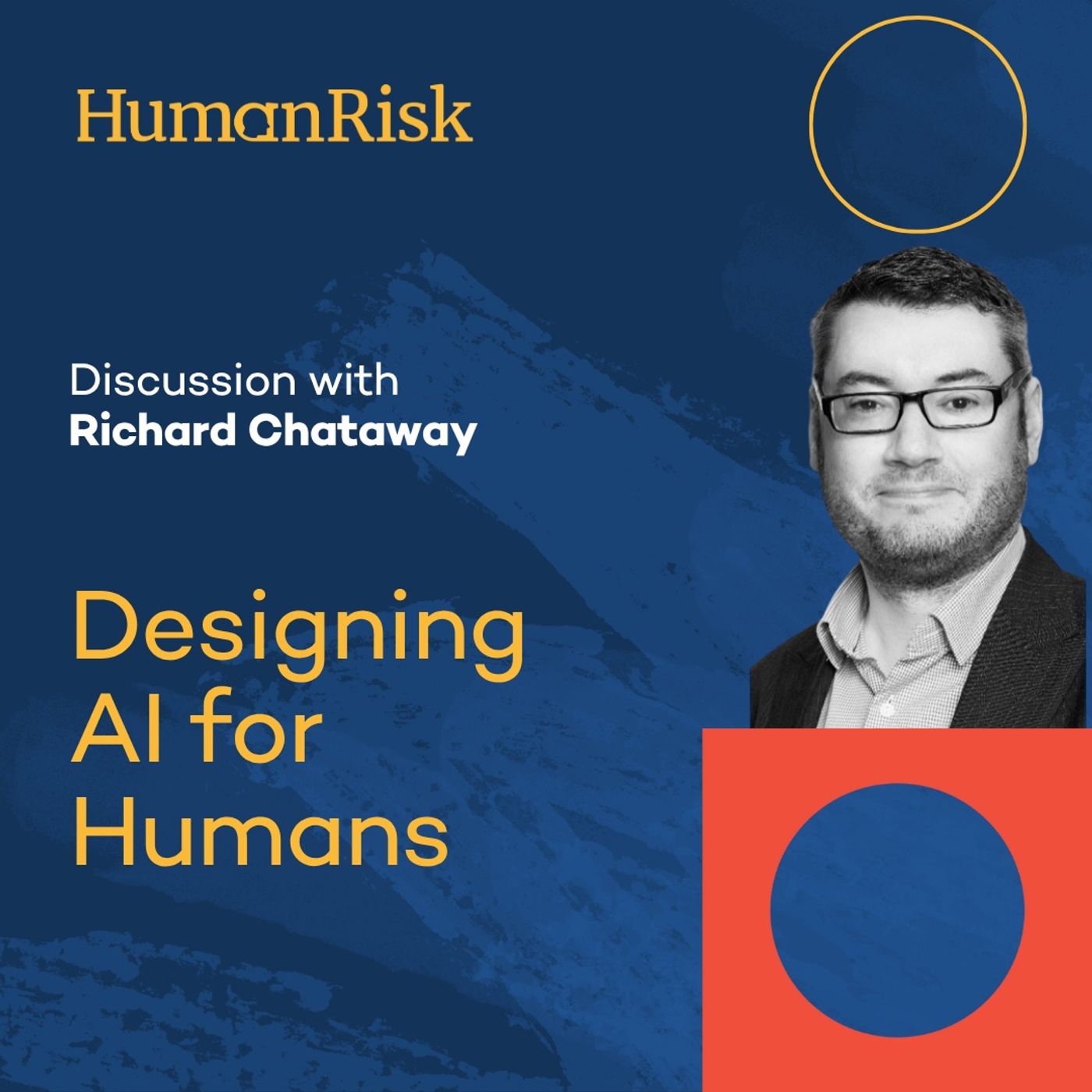
Richard Chataway on Designing AI for Humans
Oct 18Tap to summarizeWhat if the biggest AI risk isn’t bias or data, but human behaviour itself? How might AI impact the people using it and what does that mean for how we design solutions and deploy the technology?Episode SummaryOn this episode, I’m joined by a returning guest. Richard Chataway is a behavioural science expert and strategist who joins me to explore how we can design AI systems that truly work for humans. Richard brings a unique lens to the conversation, combining insights from advertising, government policy, and behavioural science to unpack the human drivers that shape how we build and interact with AI. We discuss everything from cognitive biases and persuasive tech to the ethics of design and how these hidden forces influence our relationship with intelligent machines.During our conversation, Richard explains the importance of context and behavioural frameworks in making AI more ethical, effective, and human-centric. We explore real-world examples of effective and ineffective design, examining where intentions diverge from outcomes and what can be done to address these discrepancies. Richard shares fascinating insights from his book "The Behaviour Business" and his experience in both the public and private sectors, offering a practical yet thought-provoking look at what it really means to design for behaviour in the age of AI.Whether you’re an AI sceptic, enthusiast, or simply curious about how technology intersects with human behaviour, this episode offers a compelling exploration of the invisible levers shaping our digital lives. From nudging with intent to avoiding manipulation, Richard helps us understand how behavioural science can make the future of AI more aligned with our values and less prone to unintended consequences.Guest BiographyRichard is a Behavioural Scientist, Author and Podcaster who heads up the Behaviour Change Team at Concentrix, a Fortune 500 global technology and transformation company, working with around 2000 brands globally in over 70 different countries. He is also the founder of Communication Science Group and a former board member of the Association for Business Psychology. His book The Behaviour Business is a bestselling guide to deploying Behavioural Science within organisations to solve a wide range of problems. vAI-Generated Timestamped Summary00:00 – Intro: Designing AI for humans01:25 – Welcome back Richard Chataway03:15 – Behavioural science meets AI05:20 – Why we lie more to bots07:05 – Judgement, distance & dishonesty09:10 – When design invites bad behaviour11:30 – Fraud as a design problem13:40 – The “Computer says no” effect15:25 – When neutrality helps disclosure17:15 – The empathy paradox19:05 – Data bias & unequal outcomes21:30 – When to keep humans in the loop23:40 – Behavioural science as AI insurance26:00 – When efficiency erodes trust28:20 – Friction, fairness & feedback30:05 – AI and the frontline worker33:00 – Redefining jobs, not removing them36:10 – New skills for an AI world39:00 – Beyond efficiency: meaningful work41:45 – Leadership: ask “should we automate?”44:10 – Practical design principles47:30 – The myth of full automation50:20 – Augment, don’t replace53:00 – Case studies from Concentrix56:40 – Making AI ethics actionable59:20 – The next five years of human-centred AI1:02:00 – Closing reflections1:04:30 – Where to find Richard1:06:00 – Outro & related episodesLinksRichard on LinkedIn - https://www.linkedin.com/in/richard-chataway/Richard's book The Behaviour Business - https://behaviourbusiness.com/Richard's previous appearance on the show - https://www.humanriskpodcast.com/richard-chataway-on-the-behaviour/Concentrix - https://www.concentrix.com/Richard at Concentrix - https://www.concentrix.com/contributor/richard-chataway/
Transcribe →