← The Human Upgrade: Biohacking for Longevity & Performance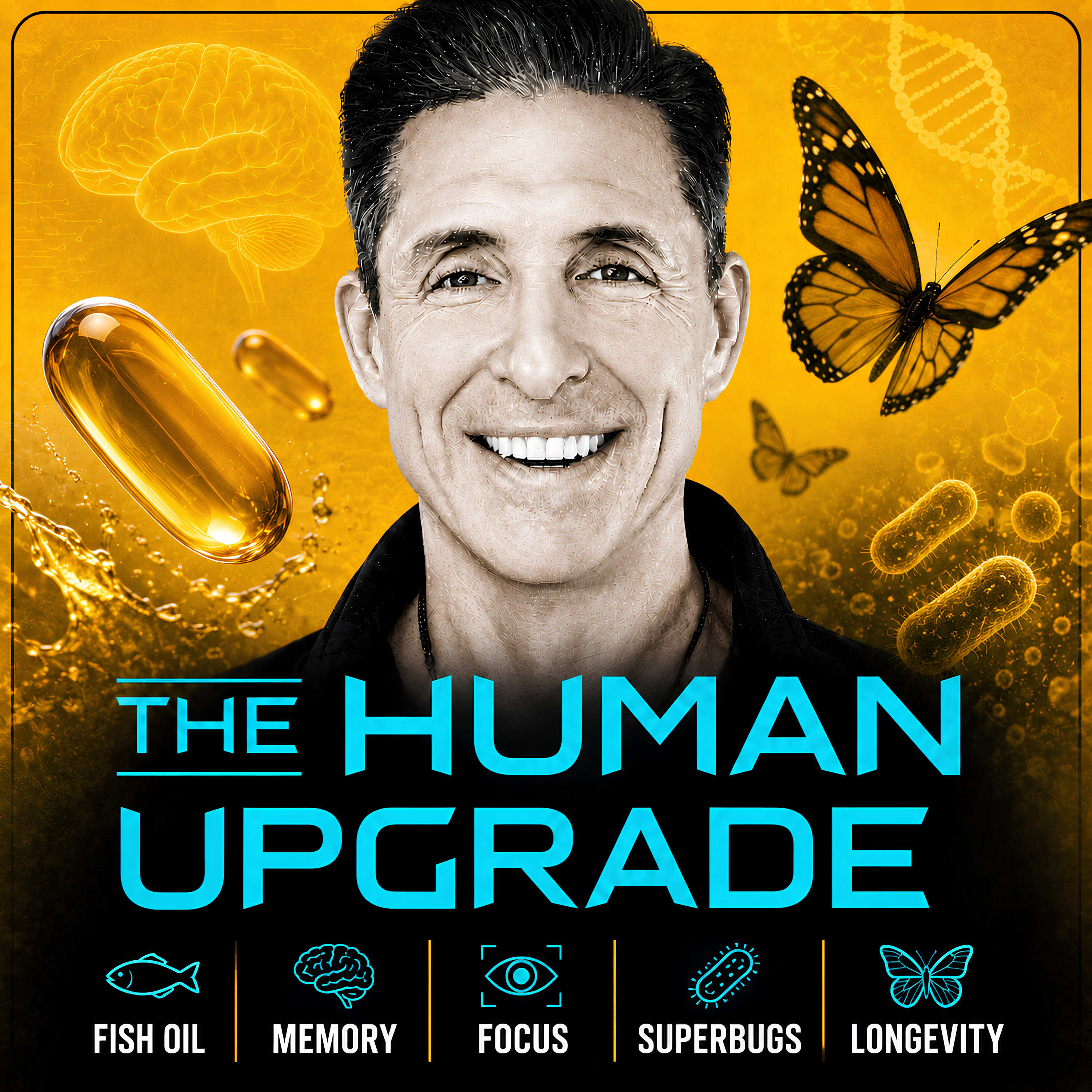
The Human Upgrade: Biohacking for Longevity & Performance
Fish Oil Doesn’t Work? Anti-Aging Butterflies, the Ancient Brain Focus Switch, and the Best Brain Diet : 1491
00:13:40
Loading summary
Transcript21 lines
- [00:01]
Dave Asprey
I'm Dave asprey. That's Dave spelled D A I V E and this is your 10 minute weekly upgrade on the biggest stories in biohacking, longevity and the world of health.
- [00:12]
Sponsor Voice 1
Let's go.
- [00:15]
Sponsor Voice 2
You can be health conscious, doing everything right and still feel like garbage. And the reason is almost always the same.
- [00:23]
Dave Asprey
Mineral deficiency.
- [00:24]
Sponsor Voice 2
And not because you're not trying to. Because modern soil is depleted, crops today have up to 40% fewer minerals than they did 50 years ago. Your food isn't what it used to be. But here's the part nobody talks about. Nutrients don't work in isolation. Minerals and fat soluble vitamins D, A, K and E work together in your body. Vitamin D helps your body absorb calcium. K2 makes sure calcium goes into your bones, not your arteries. You need magnesium to activate vitamin D so your body can use it. Without these nutrients present together, your system doesn't run efficiently. You might as well flush money down the toilet. That's exactly why I created Dake and Minerals 101D3, a K2E and a full mineral stack designed to work together. Because that's the only way any of it actually works. Cold plunges, red light, sauna, you can do it all. But none of it matters if your foundation is broken. Fix the foundation. Grab your Dake and Minerals 101 duo@shopsupgradelabs.com and use code DAVEPOD for 15% off today.
- [01:37]
Sponsor Voice 3
So here's how you can save up to 70% on your favorite brands. From rebel.com has everything for your home, family and life, from strollers to skincare at unbeatable prices. Every day, Rebel drops thousands of new products for up to 70% off. It's a constant stream of endless deals from brands like Uppababy, Nuna, Baby Bjorn, Nespresso, Breville, Wilson, Dyson, Caraway and more. Every listing is one of a kind, and the best things go first. So you have to move fast. Save big on your favorite brands. Shop now for up to 70% at from rebel.com
- [02:10]
Dave Asprey
if you caught this first headline this week, you might be second guessing a ton right now. But I'm here to help clear through the fog of journalistic warfare. A new study out of USC made a pretty bold claim. Fish oil supplements did not improve memory, cognitive function or brain cell loss in people at risk for Alzheimer's. And if you saw that headline, you probably had one of two reactions. Either you felt vindicated for never bothering, or you started wondering whether the bottle sitting in your cabinet is a waste of money. Here's what they actually did 365 adults ages 55 to 80 low fish intake at least one Alzheimer's risk factor. About half carried an APOE4 allele. One group got 2000 milligrams of DHA daily for 24 months. The researchers confirmed delivery by measuring DHA directly in cerebrospinal fluid. Brain DHA went up 17% and cognitive outcomes Memory Global cognition Hippocampal volume no significant difference from placebo now don't throw your fish oil away. Let's discuss for a second it does not say omega 3s don't matter. The researchers themselves said omega 3s are essential for neuronal membranes and synapses. What they found is that dropping a high dose DHA capsule on top of an otherwise unchanged and flawed Western lifestyle and did not move the needle at two years. The study's own authors said it Omega 3s likely work as part of a coherent dietary pattern, not as isolated supplements layered onto a broken foundation. That is exactly what this show has argued for years. Get the foundation right, then stack on top of something that can actually use what you're giving it. Keep taking your omega 3s. Get a quality source you trust. I've had some great brands on the show in the past and don't expect any single molecule to carry the weight of everything else you're not doing. A Harvard study made some waves this week claiming the DASH diet is the single best thing you can do for your brain as you age. And if you're not familiar with dash, it's a diet built around vegetables, fruits, whole grains and low fat dairy. The kind of thing that gets a gold star from every mainstream nutrition body on the planet. Except maybe the Dave Asprey Planet. So Harvard researchers pooled three large cohorts over 159,000 adults tracked for decades. People with the strongest DASH adherence showed roughly 40% lower risk of cognitive decline compared to the lowest adherence group. That is a meaningful number across a massive long term data set. Here's where it gets interesting though. The mechanisms actually driving that benefit are lower blood pressure, reduced inflammation and better insulin sensitivity. Those are the levers. DASH is a vehicle that pulls all three reasonably well and clearly better than whatever most of these participants were eating before that's worth respecting.
- [05:20]
Sponsor Voice 2
Where I'd push further is that you
- [05:22]
Dave Asprey
don't need whole grains and low fat dairy to reach those same outcomes. You can get better blood pressure control, lower inflammation and more stable insulin through a dietary approach that works even harder for your biology. And that's with a Diet high in protein and healthy fats. The destination dash is pointing toward is exactly right. I'd obviously just take a different road to get there. This next one is just the tip of the iceberg, and I can't wait for some biohackers to really make use of it. It's about your brainstem, specifically, a filter you didn't know you had. Johns Hopkins researchers found a small cluster of neurons down there. Not in the prefrontal cortex, not in the higher brain centers we always point to when we talk about attention in the brainstem that turn out to be required for selective attention. The ability to lock onto what matters and tune out everything else competing for your focus. When they switch those neurons off in mice, animals that previously had totally normal attention became immediately distractible. Faint stimuli that they would have ignored completely were suddenly pulling their focus away. Vision was fine. Motor function was fine. The only thing that broke was the filter. And here's what makes this really interesting. These neurons are ancient. This brain stem structure shows up across vertebrates. Frogs have it, Birds have it. Turtles have it. We've been crediting the prefrontal cortex with attention for decades. And the hardware doing a big chunk of the work has been sitting in a much older part of the brain the whole time. The way the researchers described what these neurons actually do stuck with me. They said the function is essentially answering one question on a continuous loop. What is the most important thing I should be paying attention to right now? Not a conscious process happening below awareness automatically all day long. They're now asking whether this circuit is impaired in people with ADHD or autism, and whether it could be a more precise target than putting everyone on a broad stimulant. The takeaway is attention is not simply a discipline problem. There is hardware involved, and that hardware responds to the same inputs everything else does. Sleep, inflammation, neurotoxic load, chronic stress. If your filter is degraded, no amount of willpower compensates for it. Our brains decline as we get older, right? That's the story we've all been told our whole lives. But a new study out of Yale is making the case that that's simply not true. Yale researchers set out to map how cognition and physical function actually change in older adults over time.
- [08:14]
Sponsor Voice 3
And.
- [08:15]
Dave Asprey
And what predicts who gets better versus who declines? They analyzed over 11,000 adults 65 and older tracked for up to 12 years. Instead of looking at group averages, they mapped individual trajectories of change in both cognition and physical function. 45% of older adults improved in at least one domain. During the study, 32% improved cognitively, 28% improved physically. Many of those gains were clinically meaningful, not just statistical noise. When you include the people who stayed stable, more than half of older adults avoided the standard story of inevitable decline. The factor most predictive of improvement was not starting health status it was beliefs about aging. People who held more positive views about getting older were were significantly more likely to show improvements in both cognition and walking speed, even after controlling for age, sex, education, depression, and chronic conditions. Your beliefs about your own biology are not soft variables. They are upstream of behavior, which is upstream of physiology. If you walk into your 60s expecting to fall apart, your nervous system starts organizing around that expectation. What makes this Yale study important is that it's not just showing that positive beliefs protect you from decline. It's showing that people actually improved. Real gains in cognition and physical performance in older adults tracked over a decade. I am planning to live to 180. That's not a joke, and it's not vanity. It's a design principle. When you build your life around the expectation of continued function and you make different choices and apparently your biology responds to that. Something else to add to your vision board
- [10:13]
Sponsor Voice 2
what if you could make your brain Sharper in just 10 to 15 minutes a day? Focus comes down to how well your mitochondria are working, because that's how your brain makes energy.
- [10:22]
Dave Asprey
When your mitochondria slow down, you get
- [10:24]
Sponsor Voice 2
brain fog, fatigue, and low motivation. Light changes how that system behaves. Scientists have been studying near infrared light for years because of how it interacts with mitochondria and supports energy production in your brain. And that's why I've been using Neuronic. It's a wearable light therapy device for your head that uses near infrared light to support clarity, focus, and overall brain performance at home without adding another complicated routine. It is simple to use, easy to stick with, and fits into your day
- [10:55]
Dave Asprey
in just a few minutes.
- [10:56]
Sponsor Voice 2
If you're ready to ditch brain fog or you just want better mental performance, this is a straightforward tool to add. Go to neuronic.online and use code Dave for $100 off.
- [11:08]
Sponsor Voice 1
You're losing hair on your head and collagen in your skin right now, even though you probably can't see it yet. That process speeds up as you age, and it doesn't reverse on its own, but you can intervene at the cellular level. Studies show that specific wavelengths of red and neuroscient infrared light will stimulate your hair follicles, and that does support collagen production Irestore has been making red light therapy devices that actually work for over two decades and with their summer savings event it's the perfect time to upgrade
- [11:36]
Dave Asprey
your hair in skincare.
- [11:37]
Sponsor Voice 1
The Irestore Elite is their most advanced laser hair growth system using 300 lasers and 200 LEDs which helps you regrow thicker, healthier hair in about three months and it is really easy to use. You can wear it while you're working, while you're reading or unwinding at night and the illumina face mask. 360 medical grade LEDs can turn red, infrared or even blue light at the same time to target all of your different skin concerns. Just 10 minutes a few times a week gives you brighter, smoother and healthier looking skin. I've been using the Irestore Elite and the Illumina Face mask while I work at home but not on video and they fit into my normal routine with no extra time cost. I really like it because I don't lose any time when I use it. Irestore is so confident you'll love their products that they give you a 12 month money back guarantee. That's because it actually works. You will see more hair. Irestore is kicking off their summer savings event with some huge discounts on their red light therapy devices. You can save on customer favorites like the Irestore Elite helmet and the Illumina Face mask. Just head to irestore.com, use code Dave to take advantage of the sale. That's Dave@irestore.com Please support the show and tell them we sent you. Give your hair and skin the upgrade they deserve so you can feel confident and refreshed.
- [12:54]
Dave Asprey
I need you to pay close attention to this one because it connects a chemical you've probably heard of to a threat most people aren't thinking about yet. A team published in Frontiers in Microbiology looked at 102 bacterial strains collected from hospitals, agricultural soils and and a protected nature reserve in Argentina with no direct herbicide application. They tested each strain against 16 antibiotics plus glyphosate and glyphosate based formulations. Here is what they Hospital strains showed extensive antibiotic resistance, 74% were resistant to carbapenems which are a last line class of broad spectrum antibiotics, and all hospital derived strains showed high resistance to glyphosate even in the protected nature reserve where no glyphosate is applied. Every strain tested showed at least some glyphosate resistance and phylogenetic analysis showed that the most glyphosate resistant strains from hospitals, farms and the wetland were often closely related, meaning resistant lineages are moving between clinical and environmental settings, likely through water. Think about what that means. We spray glyphosate on crops, it enters waterways. Bacteria in those waterways develop resistance to it. And because glyphosate and antibiotics share certain cellular resistance mechanisms, those same bacteria are more likely to be resistant to the antibiotics we use to treat serious infections. That resistance then shows up in hospitals. Glyphosate disrupts gut bacteria, it chelates essential minerals, it causes gut permeability. And now we're seeing evidence that it may be contributing to the antibiotic resistance crisis by selecting for strains that are resistant to last line drugs. If you want to dive even deeper into this subject, check out my podcast Last Year with Zach Bush. It's an all time great and in the meantime, buy organic and filter any water you interact with to close this week, we're going to look at a butterfly University of Bristol researchers studied Heliconius butterflies and found something remarkable. One species reached a maximum lifespan of 348 days. A closely related species in the Same family lived 14 days. That's roughly a 25 fold difference in maximum adult lifespan between animals that diverged relatively recently on an evolutionary timescale. The longer lived Heliconius showed lower baseline mortality, slower aging rates, and what they're deeming the insect version of grip strength across age in lab tests, while the shorter lived relatives showed clear age related physical decline. Part of the explanation is diet. Heliconias eat pollen in addition to nectar, which gives them amino acids and other nutrients that support body mass and muscle maintenance. But even in experiments without pollen, heliconias still live longer, which means the diet advantage doesn't tell the whole story. There are deeper evolved mechanisms at work. What makes this research compelling is the question it opens Insects show roughly a 5000 fold range in lifespans. By comparing heliconias to their short lived relatives at the genetic and metabolic level, researchers can start to identify what specific pathways, repair mechanisms, resource allocation strategies, and stress resilience programs are actually responsible for extending healthy lifespan. This is the kind of research that I think can really break open the biohacking world into a new chapter. Nature solved the problem of aging somewhere between 25 and 348 days in a butterfly. There is so much to learn from our animal counterparts, and every time we find a species that ages dramatically more slowly than its close relatives, we get a new map. One more thing before I sign off. This week, Scientific American and Nature both ran pieces in the last few days painting the biohacking and longevity community as a bunch of reckless tech bros running dangerous experiments on themselves with no science to back it up. And look, there are people in this space who deserve that criticism. But we've been doing this for over 20 years, and the through line that some folks miss has never changed. Find the researchers asking the right questions, understand the mechanisms, and make informed decisions about your own biology. That's not the same as injecting yourself with something you found on a Reddit forum. Look, the studies we cover on this show, the guests we bring on, the frameworks we build together, they all come from people doing serious work. Some of it gets validated by mainstream medicine a decade later. Some of it doesn't. But the process of asking better questions about your own biology is never reckless. As I always say, be your own health daddy. See you next week. All right guys, that is your weekly biohacking roundup. Join me again next Friday for another rundown of the biggest health stories in the news. Enjoy your weekend.
- [18:12]
Podcast Disclaimer Narrator
A Human Upgrade Formerly Bulletproof Radio, was created and is hosted by Dave Asprey. The information contained in this podcast is provided for informational purposes only and is not intended for the purposes of diagnosing, treating, curing, or preventing any disease. Before using any products referenced on the podcast, consult with your healthcare provider carefully read all labels and heed all directions and cautions that accompany the products. Information found or received through the podcast should not be used in place of a consultation or advice from a healthcare provider. If you suspect you have a medical problem or should you have any healthcare questions, please promptly call or see your healthcare provider. This podcast, including Dave Asprey and the producers, disclaim responsibility for any possible adverse effects from the use of information contained herein. Opinions of guests are their own and this podcast does not endorse or accept responsibility for statements made by guests. This podcast does not make any representations or warranties about guest qualifications or credibility. This podcast may contain paid endorsements and advertisements for products or services. Individuals on this podcast may have a direct or indirect financial interest in products or services referred to herein. This podcast is owned by Bulletproof Media.