← The Human Upgrade: Biohacking for Longevity & Performance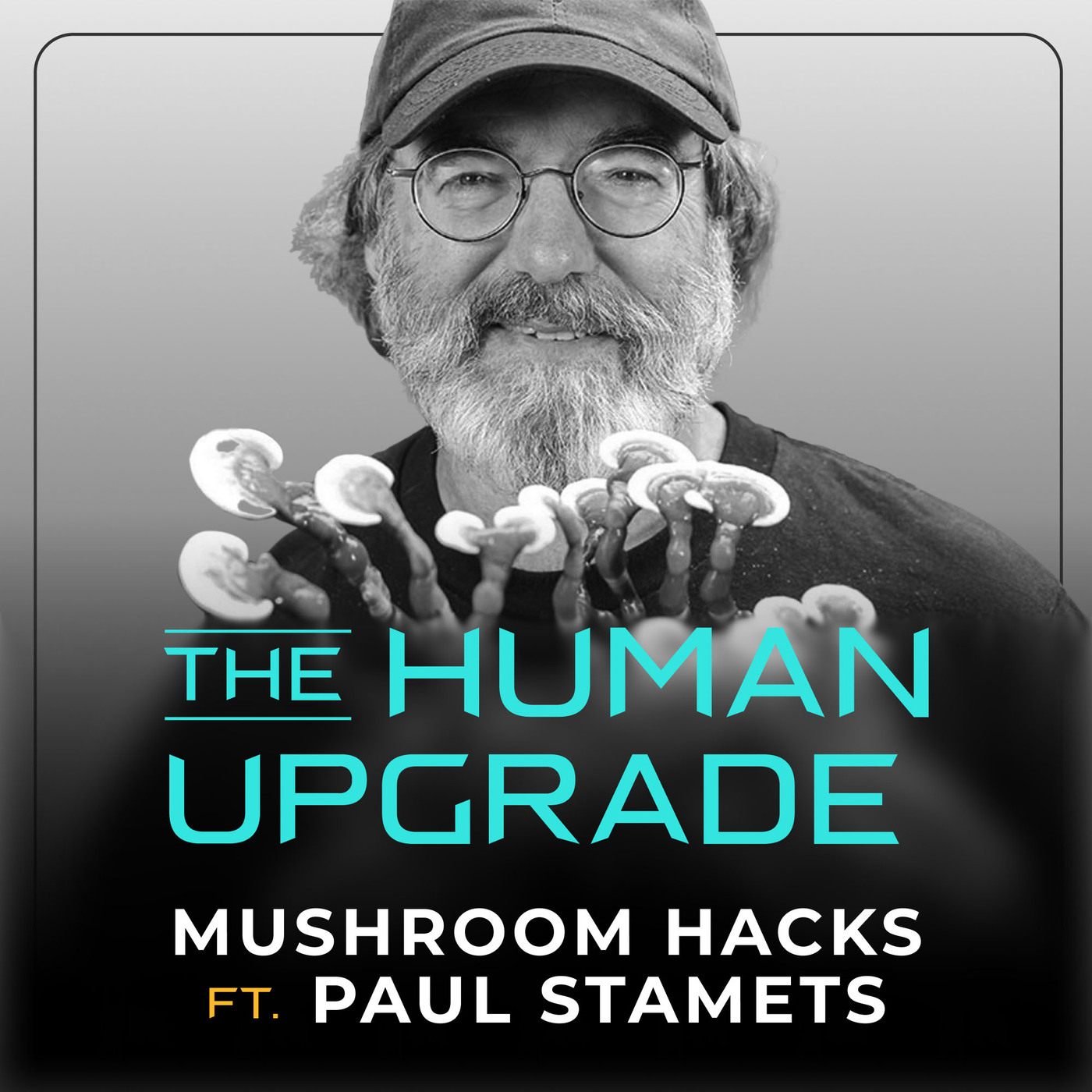
The Human Upgrade: Biohacking for Longevity & Performance
Eat THESE Anti-Aging Mushrooms to Live Longer (Paul Stamets) : 1327
00:30:52
Loading summary
Transcript86 lines
- [00:01]
A
What if there was something you could add to your water to make you perform better, have more energy and protect your cells from damage? Hydrogen is the smallest molecule in the universe and the only one that can get deep inside your cells, mitochondria and even your DNA. It fuels energy production, crushes oxidative stress and supports sharper brain function. Hydrogen's a gas, so you can't take it as a pill. So you either have to breathe it in or infuse it into your water. But your tap bottled or filtered water doesn't have it. That's why I use the Echo Flask. Echo Flask is a hydrogen generator that uses advanced electrolysis and a proprietary proton exchange membrane to infuse your water with pure hydrogen. No chemicals, no ph change, just therapeutic science backed hydrogen. I've noticed more energy, faster recovery, less inflammation and mental clarity that lasts all day. Go to ecowater.com dave and use code DAVE.10 for 10% off your Echo Flask. You'll feel the difference in days.
- [01:04]
B
Where do you see the future 20 years from now in terms of percentage of human diet from mushrooms versus algae versus some sort of cultured cellular product thing versus real food from soil.
- [01:15]
C
Mushroom based foods are going to play a huge role in the future of food as they grow quickly, require very little resources in terms of water, power and land and the amazing nutritional profile that they have. And of course being 100% natural, most.
- [01:28]
D
People love mushrooms, but about 2 to 5% of the population, they don't like mushrooms. I realize now that that's actually a scientific observation. It may be their microbiome is incompatible with the mushrooms as a prebiotic.
- [01:39]
B
Talk to me about how to cook mushrooms. What's the best way to cook them so that I get all my bioactives? You're listening to the Human Upgrade with Dave Asprey. He's a speaker, author, mycologist, medical researcher and entrepreneur and considered an intellectual and industry leader in habitat using mushrooms as medicine and producing fungi. And considers himself a mycological warrior. After 40 years plus in the Pacific Northwest and he's come to believe that habitats have immune systems just like we do in our guts. And that mushrooms are the cellular bridge that between people and the environment. And he believes that our close relationship to fungi can be the basis for novel pairings in the microbiome that lead to better sustainability in the environment and better immune systems for us. He's changing paradigms around the world. Definitely a game changer. Paul, welcome to the show.
- [02:38]
D
Well, thank you very much. I'm so Honored to be here, Dave.
- [02:41]
B
Julian Mitchell is a CEO and physiotherapy elite, sports physiotherapists with high performance people at the English Premier Club. And you traveled around with basically soccer or football, depending on what country you're in, players. And now you're a mushroom guy. Transitioned from sports in the UK to mushrooms. How the heck does that happen?
- [03:04]
C
I try to explain that it's a natural progression or natural evolution, but it's definitely not. I guess my roots were growing up in the country in farming and agriculture. But understanding high performance comes alongside nutrition and understanding what tools we have in those nutritional realms. Coming across mushrooms is, like you said earlier, there's so many applications that they have and so many properties that they can achieve for the desired outcomes of athletes as well as everyday people. So that was, I guess, one reason why we got into mushrooms.
- [03:34]
D
You know, fungi came to land first. I've been staying up this for years. You know, over 500 million years ago, fungi were the first organisms to come to land just this past month. And they found new, new fossil records. That pushes back the entrance of fungi onto land to a billion years ago. Yeah, this is hundreds of millions of years before plants. And so these true or ter truly are terraformers, and they are micro terraforming habitats. And as the mycelium, the fine threads go on the rocks and munch rocks, then plants then can follow and take advantage of those minerals. And with the mycorrhizal fungi, the plants give the fungi ulcers of sugars, and the fungi harvest growth, limiting minerals to the plants. And so the photosynthetic cycles then can spin up. There's so much of what's been known folklorically that is now being discovered to be scientifically valid, a really simple one and one that I heard from indigenous peoples. And my European ancestors, you know, have this in their folklore. When lightning strikes, mushrooms come up also. That's kind of a cute thing. Like out on the plains, lightning strikes means rains and things like that. Well, group of Japanese researchers found out that if they grow Namako mushrooms and shiitake mushrooms on logs and they zap it with 50,000 volts of electricity, it substantially, in some cases, doubles the yield of mushrooms. If they grow Namako mushrooms and shiitake mushrooms on logs and they zap it with 50,000 volts of electricity, it substantially, in some cases, doubles the yield of mushrooms. And you have to think indigenous people had this. And it's really interesting to me when you have different groups of indigenous people geographically separated all come to the same opinion. Yes. You know, so myths, a lot of myths are based on things that are factually accurate. And that's what I see now. Science is converging because I'm not religious, but I'm spiritual. And I see that science and spirituality are now merging into a greater state of awareness. What astronomer is not amazed by the enormity of the universe that we're now able to decipher and document? It's increasingly such an extraordinary tale of how small we are.
- [06:00]
C
Oh, yeah.
- [06:01]
D
And how vast the universe is. It makes our uniqueness. Well, it's a little egocentric. We think we're so unique. But I believe that matter gets life. Life becomes single cells. Single cells become strings. Strings, fork. That's mycelium. And that, you know, the way of matter is to create multicellular organisms. The multicellular organisms are based on networks. The first networks will be that of fungal mycelium. And mycelium gave birth to animals 650 million years ago. You and I are actually mycelial beings.
- [06:36]
B
Yep.
- [06:37]
D
And we are descendant of fungi. Fungi are our ancestors. And when you see mushrooms and they're out in the woods, these are ancient elders that have formed, that formed, that have their forms tens of millions, if not hundreds of millions of years ago. These are not just a recent appearance, like homo sapiens, the 200,000, 2 million years ago. These mushrooms predate us. And their forms hundreds of millions of years prior to us, in some cases tens of millions of years.
- [07:06]
B
Where do you see the future 20 years from now in terms of percentage of human diet from mushrooms versus algae versus some sort of cultured cellular product thing versus, quote, real food from soil.
- [07:19]
C
First point is that mushrooms and mushroom based foods are going to play a huge role in the future of food as they grow quickly, require very little resources in terms of water, power and land and the amazing nutritional profile that they have. And of course, being 100% natural. As for the algae industry and algae, well, actually our biotechnology engineer previously worked in this industry in Europe and moved across to mushrooms largely because the adoption was going to be very slow due to its high energy inputs, its enormous use of water, and limited applications due to its high unit economics and costs. And so less optimistic on algae and the future there. But cellular based meats, that's. I guess there's a couple of questions around. What are the key ingredients? How many ingredients are being used? Preservatives and numbers, you know, are these ingredients gmo? So these are important questions, I guess, that come alongside cellular based foods and you know, we have seen some, some great plant based meat companies and while being, you know, very good for the planet, the real question I guess is, you know, what are those ingredients and, and other inflammatory markers within those ingredients. But I think it's safe to say soil based foods, regenerative farming should take up to 65% of our plate grass fed permaculture raised animal protein sources somewhere around 15%. Same with mushrooms being somewhere around 15% and cellular based foods somewhere around 5%. I think that kind of diet attached to asking the important questions where was our food growing? How was it growing? This sets us up for a bright future of food and a healthier society.
- [09:06]
B
I know that when we run additional electricity over our brains, and I do this at my neuroscience institute in Seatt, and I've done this for 20 years, you run a little bit more current over your brain and it causes neurogenesis, it raises BDNF the same way that taking certain kinds of mushrooms, like the lion's mane, that you make. Right. We know that it does something. So is it your supposition there that inside our bodies like some of our cells are fungal in origin?
- [09:32]
D
Oh, absolutely. I mean we're coding for the same compounds. Serotonin is very common and tryptamines and these precursor compounds, even tryptophans, are resonant throughout nature. I always thought that really good graduate thesis, which someone probably has done, but as one that I wanted to do way back, you know, 20 years ago, is a dimethyltryptamine pathways in nature.
- [09:59]
B
Yeah.
- [09:59]
D
If you tracked all the dimethyl and psilocybin is a form of DMT and if you trapped those, if you track those tryptamine pathways, you would see that all nature is connected. We have a bio, there's a universality of biomolecular bridges using triptamines that per, that permeates all of nature. And that speaks to me like of a, of a sort of a nature consciousness that nature is aware. We are really, we're, we are just, we're still Neanderthals with nuclear weapons. We're just, we really have not waken up to the enormity of our presence and the miracle of our existence. But because of our prefrontal cortex and the drive for survival, it's almost like we were conditioned to have a very utilitarian and practical skill set in order to achieve the level that we have now where we can go full circle to embrace the mother that gave us birth.
- [11:06]
B
Given that most plants make defense compounds to keep Animals from eating. This is why grains are bad for your nightshades generally are bad for most people. How do you know that all these species that we're using are actually completely safe for humans versus oh, they're mostly good, but they have these gnarly downsides on them.
- [11:25]
C
Well, at last cycle, our process for deciding what mushrooms we grow and put into our product starts firstly with a detailed scientific literature review, toxicology evaluations and laboratory tests to get the data on DNA identification, heavy metals microbiology and microtoxin testing. And so I guess as a listener, you know, hearing that medicinal mushrooms and functional mushrooms play a role may be a new concept, but really there are 30,000 scientific medical articles out there in the reviews. So this gives us a lot of science to work from. And so I guess it's important to realize the vastness of the fungi kingdom with mushrooms outnumbering plants six to one. This means just like there are medicinal and harmful plants. The same goes for mushrooms as general rules. And theoretically not consuming raw mushrooms is a very good idea. And then secondly, functional mushrooms such as turkey tail, which we know possess high amounts of psp, which is polysaccharide peptide, which acts to support the growth and proliferation of good bacteria, it makes sense to incorporate these into maintaining and restoring good gut health.
- [12:44]
B
I've also seen more recent studies around specific subspecies. In fact, Cordyceps, I believe, is one of them that actually have anti candida properties. So the deal is you should know what mushroom you're using and what you're using it for. But I've always, if you're a long time listener, you might just say, oh, Dave doesn't like mushrooms. No, I've always said use them medicinally. And I'm amending that to say use them for food if they make you feel good. And your food is your medicine anyway. So if you can eat something that tastes good, that also increases ergothioneine levels and you may feel a kick from it right, then you probably won't from eating, you know, half a cup of cooked mushrooms. But if you take a tincture, you probably will, because I've noticed, you know, very, very profound effects from the tinctures that you guys make. And I did test them against a bunch of others. And at least when I look at my sleep score, I get a lot more REM sleep with the specific strains of, of lion's mane in particular that you make. I know a group of people who are convinced that they're going to deal with their traumas or achieve enlightenment or Something through frequent, multiple times a week or once a week use of mushrooms or ayahuasca or ibogaine or any of these other things like that. Is there such a thing as too much psilocybin?
- [14:07]
D
I've never been asked that question, but from my experiences and the reason why psilocybin mushrooms are so interesting, so psychotherapists, psychologists and even the FDA is that they're non addictive.
- [14:20]
B
They're not addictive.
- [14:21]
D
You have a massive dose of psilocybin mushrooms, you're on the ground, you're seeing God, you've connected with nature. The next day you look at those mushrooms, you go, no friggin way am I eating those again.
- [14:33]
B
How could you do them every day?
- [14:34]
D
I'm not eating those for a month, you know, so I think that sort of gut response also the microbiome is important. Most of your receptors are in your gut, you know, for neurogenesis and you feel queasy right after you eat mushrooms. I think it's a microbiome is waking up, you know, to all of that I would say microdosing. I don't see a frequent using use of, of psilocybin mushrooms. Microdosing. And microdosing is defined basically as 1/10 to 1/20 of a liftoff dose.
- [15:01]
B
Okay, so it's a very different effect.
- [15:03]
D
So that, that's, that's more like a vitamin.
- [15:05]
B
It's for neurogenesis, growing new neurons in the brain as well as for the gut bacteria in your sand.
- [15:10]
D
Right?
- [15:11]
B
Are there other fatty mushrooms?
- [15:13]
C
Well, lion's mane is the, the fattiest mushroom of them all with 5 grams out of 100 grams of dried mushroom being, you know, unsaturated fat for the most part. And so really though, the key nutrients for functional mushrooms such as your lion's mane, your reishi, cordyceps, turkey tail, are the amino acids, the beta glucans, the triterpenoids and the antioxidants.
- [15:35]
B
What about fats? Is it like a butter mushroom that grows fat inside it?
- [15:38]
C
I want that a butter mushroom. Well, there are thousands of mushrooms out there yet to be identified. But we're not aware of a butter mushroom even though we are commonly foraging on the weekends. We haven't come across this one though as we know. If we add some grass fed butter or some bulletproof MCT oil to mushrooms in the pan, that makes for a pretty delicious meal.
- [15:58]
B
You guys do some other weird stuff. That may be why I get a strong stronger response from your alcohol based extracts. You use something called kakadu Plum that I was entirely unfamiliar with. And this is a native heritage food from the Aboriginal people of Australia. I knew nothing about this. So what is it?
- [16:18]
C
Kakadu plum is an incredible fruit that is wild harvested by indigenous Australian communities and remote areas of the outback. So it's been shown to have the highest amount of vitamin C of any fruit in the world, 100 times an orange. And so it's very rich and rare, carrying amazing properties including antiviral and antioxidants. And so by mixing it with the mushrooms we've found definitely heightens and amplifies the benefits of the mushrooms, particularly lion's mane. As you've mentioned yourself, we are incredibly grateful for the special friendships and partnerships we've been able to form with community. And a specific mention, special mention to Gumbla, an amazing man, a dreamtime leader from the Waka Waka community who introduced us to the healing and ceremonial ways in which this is consumed in Australia, as all of our liquid extracts and powders have this amazing kakadu plum infused through the mushrooms as well as our golden mushroom chai. And we're really getting some great testimonials about dreaming REM levels, but also because of its vitamin C content, what we're finding is that it helps your body recover, building immunity, which means you have more energy and your body is less under trauma.
- [17:30]
D
There's a great study that came out, randomized placebo, double blind, controlled study on turkey tail mushrooms, the mushroom Mycelium, showing that it, it enhances the activity of Lactobacillus acidophilus and Bifidobacterium.
- [17:46]
B
It's a prebiotic.
- [17:47]
D
Yeah, it's a prebiotic. And stifles Clostridium, staphylococcus. So this makes a lot of sense to me because a lot of people, you know, most people love mushrooms, but about 2 to 5% of the population, population, they don't like mushrooms. It doesn't make, it makes them feel queasy. They don't like that. I realize now that that's actually a scientific observation. It may be their microbiome is incompatible with the mushrooms as a prebiotic. The majority of us, you know, the umami effect of the flavor enhancing, et cetera, and it actually, your microbiome is like, yes, this helps me achieve a better homeostasis and health, but, but some people are mismatched and so that mismatching may be the case. Now with psilocybin much, I'm taking them high doses several times a week. I don't see it. I Think you need to reset. I think you have to renormalize. You need to wash your receptors and then, then stimulate them again. But I think it's like, it's like the tide, you know, of the water washing onto the land, that washing and then retreating and then resetting. I think it makes the experience continually novel and fresher. And I think that stimulation, pause, stimulation. I just know from lots of other work that I've done that sort of pulse therapy is much more effective.
- [19:06]
B
Everything for diet, for exercise, for fasting, it doesn't matter if it's not cyclical, it probably doesn't work well. What does the research show about what happens when people eat oyster mushrooms?
- [19:18]
C
There are a number of different types of oyster mushrooms, such as the pearl, the king, the blue, the pink and the yellow. And we grow all of these in Australia at our farms. And they all have great compounds and nutrients from B vitamins, folic acid, calcium, iron, zinc and potassium. Probably two amazing data points that are of most interest is one around the amazing antioxidant ergothioneine. And ergothioneine is involved in the protection of mitochondrial DNA and chronic inflammation. So this I guess really lends itself to being a great mushroom as part of an anti aging strategy as it protects using its antioxidant profile. The second one would really be focusing on something called shikimic acid, which there was a great study out of the university in Japan in 2014 that showed by growing oyster mushroom mycelium and mushrooms under blue light, increased the expression of shikimic acid by 200 fold. And why that's important is because it helps inhibit the enzyme for influenza A and B viruses which are responsible for the flu. So eating oyster mushrooms that are growing this way is a great strategy for staying healthy in winter and preventing those cold and flu.
- [20:40]
B
Now, how can you take oyster mushrooms? You can eat them. Is this appropriate for a powder or a tincture?
- [20:46]
C
You can make them into tinctures? Absolutely. I guess they are a delicious mushroom. So it's like some of the other mushrooms, such as the reishi or the turkey tail, which are inedible because they've got what's called chitin in them. So they're very tough and fibrous, they're not able to be cooked down. So the oysters can be put into risottos, into breakfast dishes, into soups or broths, or a great side to some vegetables and some grass fed steak or meat. And so they are a delicious mushroom to consume, but they can be in a tincture as well. They can be in other powdered forms.
- [21:18]
B
Just to define that word for people who really probably haven't dug in on it. Tincture. What is a tincture? What are the ways of making a tincture and what are the pros and cons?
- [21:29]
C
Absolutely, tinctures are, in our case, we make a double extract, which is a water ethanol extract. So that's the process where we're extracting the medicinal compounds using water and ethanol as the process. And so by doing the tincture process with water and ethanol, you're getting all the medicinal compounds. The beta glucans, as you mentioned, the polysaccharides, the triterpenoids, the terpenes. All these long winded names that are essentially the medicinal compounds come from that extract. But in a liquid form, it's more bioavailable than in a powder form. And so that's why we're big believers of that and very passionate about making high quality tinctures. Just as you mentioned previously about the kombucha space, Kombucha comes onto the market, there's some high quality products there and then the market gets flooded with a whole range of products and the quality goes down. And so it's really a matter of keeping the quality high so people are getting those effects.
- [22:23]
B
If you're listening to this, you go, oh, tincture, that sounds hard. No, you make a tincture every morning. It's called coffee. It's a water, it's a hot water extract of arabica coffee beans. At least if you're drinking good coffee, it might be robust otherwise. So tinctures are nothing new.
- [22:38]
C
Tea.
- [22:38]
B
Tea is a tincture.
- [22:39]
D
I authenticated that the diluted extracts of mycelium with water and ethanol had extremely potent antiviral activities far exceeding that of pharmaceuticals.
- [22:50]
C
Wow.
- [22:51]
D
A natural product offers a strong. Had a stronger effects than a pure pharmaceutical. In this case, compared to ribavirin and cydofovir. These are two well known antiviral drugs. So the side by side comparisons blew them out of the water and it was diluted. These extracts are diluted 100 to 1 because they're on 35% ethanol. And these are in vitro human cell wall assays and laboratories sponsored by the US government. So they have to dilute the alcohol down to 0.35%.
- [23:21]
B
Kills the cell.
- [23:22]
D
So yeah, it's 100 to 1 dilution and 100 to 1 dilution. We beat these antiviral positive drug controls.
- [23:28]
B
You basically soak the mushrooms in alcohol, pour off the alcohol. I'm simplifying it filter it a little bit, cut it with water by a mycelium.
- [23:34]
D
Is the mycelium.
- [23:35]
C
Yeah.
- [23:35]
B
So not the mushroom, the mushroom roots. How do you even gather mycelium versus the bodies? You dig them up. How do you filter soil?
- [23:41]
D
Extensive laboratory.
- [23:42]
B
Okay, got it. You have a lab that does that?
- [23:43]
D
Yeah. Laboratories, you grow in vitro and it's in my books. Growing gourmet medicinal mushrooms. Anyone listening can look up the book. So you can all can do this yourselves. I. This is not. This is not.
- [23:52]
B
Not making mushroom abstracts is easy.
- [23:54]
D
I was going to say it's not rocket science. But this, actually, there is some heavy science involved. But like anything else, once you do it a few dozen times, you get pretty good at it. So I actually had a waking dream. I had this idea. So. Oh, my God. I wonder if these extracts using the BioShield biodefense program can red help the bees. Because the varroa mice are vectoring viruses and the deformed wing virus is the most harmful of the viruses. So it's like having a pancake on your back. These mites are that big. The varroa mite is called varroa destructor because it destroys. And once a beehive has 7% mite infestation, it's terminal. The beehives won't survive. Now, we tested about 10 species. Five of these polypores have demonstrably positive effects in reducing these viruses. There seems to be species specificity factors. Very interesting. Certain species of these polypore mushrooms are more active against certain species of virus. There's the Israeli apiary virus. There's the deformed wing virus. There's the varroa destructor virus. You know, so the different clades of viruses, but we were able to, first through PCR showed all the viruses that were harmful reduced by 90%. And then we look at specific viruses and then we reduce the deforming virus 850 or something to one lake Sinai virus 45,001 all the one treatment. So this is amazing because now I can make the argument, this is really important, that natural products can offer a greater bioshield of benefits than a pure pharmaceutical. We showed it with the BioShield program. Now we're showing with bees. Now the bee study. This is an animal clinical study. Bees are the second most well studied animal in the world. Humans being number one. But everybody missed this. We all grew up with Winnie the Pooh, right? We all knew that bears went into rotted logs where there are bees to get honey. And so this is the way of nature. You follow the mycelial path, you then come into a mutualism with fungi and there are armamentarium of benefits once you're in their guild, in the fungal guild now you have partners with bacteria that are helping you, fungi that are helping you.
- [26:09]
B
Talk to me about chaga.
- [26:11]
C
Chaga is a fascinating one from a scientific point of view. We refer to it as a sclerotia, not a mushroom, as it is actually a compact mass of mycelium growing on the outside of a tree. And so this grows wild in climates of Russia, northern Canada, parts of the US and China, typically growing on birch trees over five to 15 year periods. And so we don't have access to this in Australia. In terms of its properties. It's well known for activating B cells and macrophages. And so these play a major role in an adaptive immune system by secreting antibodies. And secondary to this, it also secretes metabolites which have potent antioxidant properties such as polysaccharides and triterpenoids. And this has been proven to provide and protect cells against oxidative stress.
- [27:03]
B
So what's the deal with lion's mane? Can you eat it and how's it best taken? What does it do?
- [27:07]
C
It's known as lobster of the woods, but it's by far a very popular mushroom for its benefits, for the fact that it stimulates nerve growth factor. And so nerve growth factor stimulates myelin reproduction. And myelin is what's around our nerve cells and our neurons. And so as we're getting older, which occurs from pretty much our early 20s, we're starting to decay slowly. It helps remyelinate the nerve cell and the nerve. So what does that mean? Well, in our elderly population or more aging population, it's where did I put my keys? What was I doing? What was on my checklist? It's just that mental sharpness and clarity starts to fade in the younger population. It's really around memory, focus, concentration, optimum performance is what we're seeing. And so you take it either in the morning or in the evening. It will affect your REM and your dreaming. And it will also increase your ability to just find clarity on a mental space and focus on.
- [28:00]
B
Talk to me about how to cook mushrooms. What's the best way to cook them so that I get all my bioactives?
- [28:05]
C
First of all, make sure you are consuming them cooked, not raw. This way you are breaking down the skin of the mushroom known as chitin to avoid any digestive issues or discomfort. And secondly, Cooking the mushrooms also kills the unwanted spores and compounds. When cooking, say the oysters or the shiitakes, to maximize your ergothionine, it's important to preheat the pan, add some water and then cook on a high flame for a couple of minutes.
- [28:31]
B
Do some of the compounds in mushrooms benefit from being cooked or eaten with fat? Or are these mostly water soluble and alcohol soluble? It doesn't matter.
- [28:39]
C
The extracts that we make are water and ethanol soluble. So you can go down either path.
- [28:43]
B
But I'm talking about in terms of cooking.
- [28:44]
C
In terms of cooking, what compounds are you going to consume or make more bio available? So if you're cooking in a fat, then you're going down the path of a fat soluble extract, which means you're going to get your triterpenoids and your terpenes. Whereas if you go down a water soluble cooking path, then your beta glucans, your polysaccharides is what's going to be more bioavailable to you.
- [29:05]
B
So that means I'll keep cooking my mushrooms and I won't cook them on low temperature. So sous vide mushrooms, not a good idea.
- [29:12]
C
Not a low temperature and not raw. They're the takeaways.
- [29:16]
B
You've almost certainly read the Secret Life of Trees. The Secret Life of Trees talks about a network effect in forests that is unbelievable.
- [29:28]
D
Deciduous trees growing in the rivers will translocate nutrients up, I think to 14% nutrients to trees like hemlocks that are nurse logs in the old growth forest. Well, and it was always wondered why, how is it those small trees survive in the dark, darkness and the low light conditions of the old growth forest? And so they radioactively tagged and they found nitrogen and carbon being transferred from deciduous trees to conifer trees over hundreds of feet. The mycelium was actually having a mothering influence to protecting biodiversity.
- [30:06]
B
It was growing the forest. Paul, it's been a profound pleasure to have you. I've got a final question for you. How long are you going to live, given what you know about mushrooms?
- [30:17]
D
I don't know how long I'm going to live, but I do feel that the impact that we have on future generations, and I feel the keen sense truly of future generations calling back in time, calling to you, Dave, calling to me, calling to all of us that's listening, that we have an enormous influence on the future. And it is time for us to take up that responsibility and to think downstream.
- [30:44]
B
What a fantastic and unexpected answer. Paul Stamets Founder OF Host Defense Perfect Fungi but your big thing right now is be mushroomed.
- [30:55]
D
Bemushroom.com I will do this to the limits of my ability. We decided to open it for the commons. I will commercialize only in order to create a financial vehicle to be able to give it away. You have to be profitable to be charitable. Yep, I have to create the revenue stream to be able to afford to do this. I can't distribute 100 million beef eaters. That's what it's going to take to save the bees is my estimate. A hundred thousand beef eaters. A hundred thousand. One hundred million beef eaters. One hundred million citizen scientists all over the world uploading their data, sharing observations and proving it.
- [31:28]
B
Well, that whole feeding your kids and your grandkids because we have pollinators out there seems pretty important. So I'm behind you and I'll put this up in the show notes.
- [31:37]
D
All right. Thank you so much. All right, Dave.
- [31:38]
C
The future will largely be determined by biotechnology and if we keep the greater good in mind and strive to reach our full potential, that means working symbiotically with mushrooms.
- [31:50]
B
See you next time on the Human Upgrade Podcast.
- [31:58]
E
The Human Upgrade, formerly Bulletproof Radio, was created and is hosted by Dave Asprey. The information contained in this podcast is provided for informational purposes only and is not intended for the purposes of diagnosing, treating, curing, or perfect preventing any disease. Before using any products referenced on the podcast, consult with your healthcare provider carefully, read all labels, and heed all directions and cautions that accompany the products. Information found or received through the podcast should not be used in place of a consultation or advice from a healthcare provider. If you suspect you have a medical problem or should you have any healthcare questions, please promptly call or see your healthcare provider. This podcast, including Dave Asprey and the producers, disclaim responsibility for any possible adverse effects from the use of of information contained herein. Opinions of guests are their own and this podcast does not endorse or accept responsibility for statements made by guests. This podcast does not make any representations or warranties about guest qualifications or credibility. This podcast may contain paid endorsements and advertisements for products or services. Individuals on this podcast may have a direct or indirect financial interest in products or services referred to herein. This podcast is owned by Bulletproof Media. It.