← The Human Upgrade: Biohacking for Longevity & Performance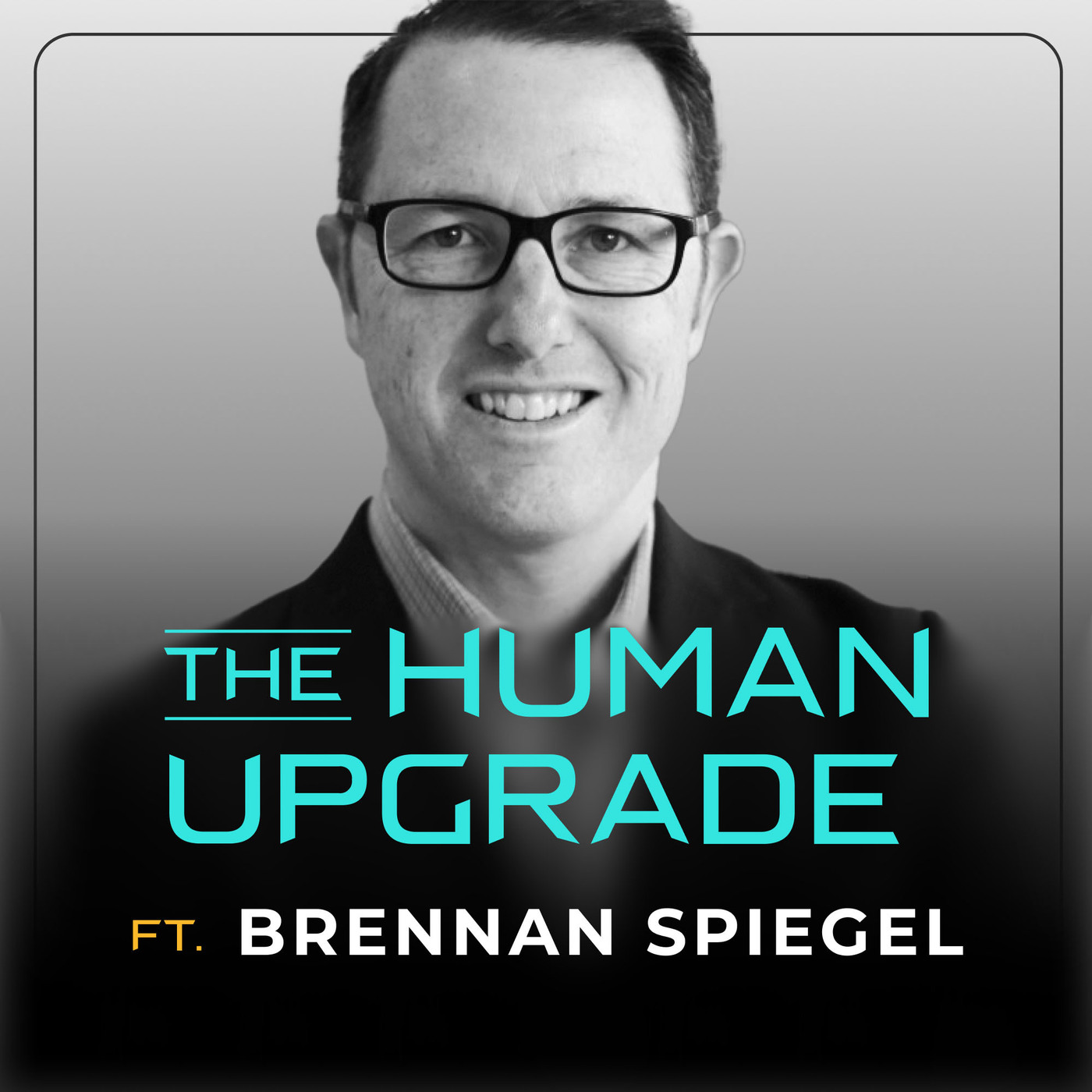
The Human Upgrade: Biohacking for Longevity & Performance
How Gravity Shapes Your Body, Brain, and Health : 1338
01:00:24
Loading summary
Transcript283 lines
- [00:00]
A
You're on a planet that's pulling you down. You can't get up out of bed, you're exhausted, you're slumped over. Those are the symptoms of depression, right? Those are also the symptoms of too much gravity. What we're trying to do is fight gravity.
- [00:13]
B
This is the missing link in biohacking and it's maybe the most ignored of all of the signals because it's always present and we just assume it's there. Brennan Spiegel is a director of health services at Cedars Sinai and a professor of medicine and public health at ucla. He has pioneered groundbreaking work on how virtual reality and emerging technolog can transform patient care. His vision is reshaping the future of healthcare and the way we experience healing. Low blood pressure is a bad thing.
- [00:40]
A
That's a gravity intolerance problem. Passing out, feeling dizzy, low back pain, ankle swelling, even depression and anxiety are forms of gravity intolerance.
- [00:51]
B
I used to weigh 300 pounds. Is obesity a gravity disease? You're listening to the Human Upgrade with Dave Asprey. If you're a founder or product creator in the biohacking and longevity space, listen up. Our industry will hit $100 billion in the next four years. Innovation is accelerating and someone is going to own your market. The question is, will it be you? That's why I created the Business of biohacking summit happening October 21st to 23rd in Austin. It is exclusive, it's interactive, we're talking hands on workshops, expert led mastermind tables and real time pitching. You'll leave with an action plan because we want to see you succeed. If you're serious about scaling smarter, not harder, and turning your mission into a movement the way I did. Go to businessofbiohacking.com to apply to get in Now. Let's hack your business to billions. I want to teach you directly. I'll see you in Austin. Hey guys, quick reminder. If you're listening to this on your favorite audio podcast app and you haven't been over to my YouTube channel, check it out. Just search for the Human Upgrade or find me under Dave Asprey bpr. I post full video versions of every episode and a bunch of other cool content outside the pod. It's a great way to go deeper into the content and connect with other biohackers like you. So leave a comment for me. Yeah, I'm actually going to read them and poke around while you're there. There is a lot of stuff specifically for you. It really helps and it means a lot to me. If you think about the definition of biohacking, it's the art and science. You're changing the environment around you and inside of you, so you have control of your biology and control of your state and of all the different variables, we have light, we have sound, we have vibration, we have food and timing and gravity is one of them. And it's maybe the most ignored of all of the signals because it' always present and we just assume it's there. And I've been interested in hacking gravity, levitating too, but that's not what I'm talking about. If we learn how to do that on this episode, I'll be surprised. But the signal of gravity is something that is a very strong signal to the body, and it's something that we manipulate with the cheat machine at Upgrade Labs, where instead of fighting gravity, you're fighting an AI system that does weird things to you. But I haven't been able to find a researcher. There's people who look at gravity and planets and things like that. But what is the direct signal, gravity on the body? How does it affect us? Well, I found a guy and he's legit Cedars Sinai, very well published and, well, he just came out with a book called Pull. And so I got to have an early copy of it and as we're recording this actually before it comes out, and I'll release it right when it comes out, but your subtitle is how gravity shapes your body and steadies the mind and guides Guides your health. So thank you. This is the missing link in biohacking that no one's written a book about. This is a big deal, I would say, at least in our study of the whole universe, of what we can tweak. Why gravity?
- [04:01]
A
Well, you just said it. You know, gravity was here long before we were. It's going to be here long after we're gone. So it stands to reason that every part of your body, you know, every sinew, every cell, every organ evolved to manage this fundamental force of physics. We are to gravity like a fish is to water. A fish is designed to survive and thrive through this aqueous, liquid world. I don't know if it knows that, but that's what it does. We are the same way. We don't think about gravity much, but every part of you right this second, on a microbial level, on a microtubular level, and on a macroscopic level, is trying to stand up and stay up as long as you can and as well as you can.
- [04:46]
B
So being alive is basically resisting gravity.
- [04:49]
A
That's almost all it is. There are only four fundamental forces in the universe as we know it. One of them has to do with stars. One of them has to do with us not exploding. Right. Like as we're talking, it's always a problem. So once we got that situated, it's about electromagnetism and gravity. And that's what we're talking about today is the gravity side.
- [05:08]
B
Okay, what do you study to become a gravity expert?
- [05:11]
A
Well, you know, I never set out to be a gravity expert. I'm a gastroenterologist. I'm a professor of medicine and public health. I teach a lot of different things.
- [05:22]
B
That's why this book is. You're not who I thought would write this book, but I'm glad you did.
- [05:26]
A
I'm not the person either who I thought would write this book. So this all started a few years ago when my mother in law was in an assisted living facility and she had cognitive decline. And she found herself lying down a lot. She was flat on her back, like a lot of our patients are in the hospital too. And she started getting stomach issues, bloating, constipation and depression. And nothing else had changed. Not her diet, not her medications. And of course my family asked me, what do you think's going on here? And I thought, you know, we're not designed to lie flat. Were designed or bipedal creatures that stand up and stay up. And I started thinking a lot about that and I ended up writing a whole paper called Gravity in the Gut. And it kind of went viral. And then I realized this isn't just about the gut. This is about the entire body. And that's what's cardiovascular.
- [06:14]
B
Glymphatic drainage.
- [06:16]
A
You got it. That's just the beginning. Inner ear and your brain itself.
- [06:21]
B
I didn't think about the inner ear, but of course. All right, you make the case in your book that medicine ignored gravity. That seems like a big thing. How did medicine end up ignoring it?
- [06:32]
A
You know, we spend a lot of time learning about the individual organ systems and how they work, but we don't talk a lot about what they're aiming to achieve. What we're trying to do is fight gravity. Like we literally emerged from this planet. We are grounded on this rock, and we are a consequence of it. And so all of our biology, physics came first and biology second. And nowhere in medical school did I hear that we came out of the Earth. It basically came out of the oceans, which is something we might want to talk about. And we evolved all these pumps and tubes to keep the hydraulics so that you can stay awake and talk with me and have your brain getting oxygen. Yeah.
- [07:14]
B
Low blood pressure is a bad thing.
- [07:15]
A
That's a gravity intolerance problem. Passing out, feeling dizzy, low back pain, ankle swelling, even depression and anxiety, I argue in the book, are forms of gravity intolerance so highly resilient.
- [07:30]
B
People resist gravity better.
- [07:31]
A
You're saying physically, metaphysically resist gravity better? Yeah.
- [07:36]
B
What does metaphysically resisting gravity really mean?
- [07:39]
A
Well, what I mean by that is there is a part of us that is hard to identify in physical space. And we can get into philosophy. I was a former philosophy major.
- [07:49]
B
That explains a lot.
- [07:50]
A
Okay, yeah. But what I mean by that is even consciousness itself, which is hard to locate in space and time, is, I argue in this book, also very much a consequence of our relationship to gravity itself.
- [08:05]
B
Fascinating. When you get into some of the more quantum consciousness, cutting edge philosophy books, they're making the case that time and space at least are hallucinations that our bodies create. Is gravity one of those too?
- [08:21]
A
Yeah. So consciousness itself is sort of a controlled hallucination in essence, and it's a narrative that we construct in our mind using the signals of the universe.
- [08:35]
B
Right, right.
- [08:36]
A
So right now we talked about two of those signals, electromagnetism and gravity. So we are sense making machines. Right now your body is taking in, you know, billions of data points. The pressure on your bottom, your cerebral spinal fluid in your brain is dependent on your elevation related to sea level. We can go through lots and lots of examples, but you're taking in all of this data and like a computer, you're compressing the data down more and more at each level. You compress it and compress it again through your nervous system, and it eventually ends up in the brain as a mental map of your relationship to this planet. And then you're making sense of it in relation to the physical reality that we're in as we understand it. And that's what we do, that is how we survive is by creating a mental perceptual understanding using the data like a compression engine. And then from there it's all dependent on the decisions we make and how well we support this body to stand up and stay up until eventually we're pulled back down again.
- [09:37]
B
Wow. That's a very different view of living and dying and being conscious, but it maps, it makes really good sense. Okay, how would I know if my anti gravity system was breaking down? What's the first sign?
- [09:49]
A
So I think of it like there's different stacks in your body okay, so the first is probably the most obvious, which is the musculoskeletal system. You know, what is lower back pain if not a form of gravity intolerance? We originally were four legged creatures and only in relatively last part of our evolution did we stand up and change our relationship and center of gravity completely. And, and then all of the viscera started dangling down and your spine became this chassis that had to hold up the sack of potatoes that you've got in your belly. I'm a gastroenterologist. There you go about this. And so that means you have to have a strong back in a way that four legged creatures don't. And back pain is a form of gravity intolerance. Pain itself, chronic pain is often a form of gravity intolerance. It's a way of your body telling you you're literally not aligned with this downward pull or upward push, depending on how you look at it, of the planet itself. So those are just a few common explanations of gravity intolerance. But then if we dig deeper, there's something called tensegrity, which is tensile integrity. So, you know, Tom Brady played for so long not because he was the biggest guy, it's because he was the most durable, zipped up guy. His fascia was working, his fascia was tight. And so resilience is about bending and not breaking. And in the body we have all these organs that we learn about, but it's actually the in between space that we rarely ever talk about. It's the connection points within the body where one system connects to another. It turns out a lot of disease begins at that point and if you toughen that part up, you toughen your gravity resilience too.
- [11:32]
B
Have you ever heard of Ni Gong?
- [11:35]
A
No.
- [11:35]
B
You wrote qigong?
- [11:36]
A
No.
- [11:37]
B
Okay, so qigong is Chinese medicine. You know, people doing energy work.
- [11:41]
A
Yeah, sure, that I know.
- [11:42]
B
So nigong is kind of its redheaded stepsister. And it's if you look at say a Shaolin monk and they're doing these one finger push ups and they have no muscle mass to explain it. So there's a third form of strength in Chinese medicine that they call wang, which is not from bones and tendons and it's not from muscle, it's from interstitial strength. And that's your tensegrity system. Right.
- [12:09]
A
So the interstitium. Just since you mentioned that, I happen to know the guy, David Carlock. Oh, wow. Who discovered the interstitium. And this is literally the most recent organ to be identified.
- [12:21]
B
Oh, this is so cool.
- [12:22]
A
And so the crazy thing about the interstitium is no one even knew it was an organ until about 15 years ago or so could have it off. But about that, I didn't learn about it in medical school. And now we understand that that space is so vital to autoimmunity, to cancer spread, to tensegrity, to gravity tolerance, that we've totally overlooked it. And now we have to really spend much more time thinking about it. Just like these guys have known long before we were thinking about it in western medicine, they probably had very different.
- [12:55]
B
Language to explain it. But we do know there are some practices that seem to be able to train it, even if they don't have the same cognitive picture of it we do. Are there things that you've learned that we can do to make ourselves stronger in that way?
- [13:09]
A
Yeah. So starting again, we're talking about this first stack of the muscles, the tendons and the connection points. Right. So in the book I talk about, I called it Operation Gravitate. So I decided to wear a weighted vest for eight weeks.
- [13:26]
B
So cool.
- [13:27]
A
All day long. I've got pictures of it in the book. I wore it to meetings. I also wore a 20 pound ankle weight on each ankle.
- [13:35]
B
Smart.
- [13:36]
A
Standing desk, balance board. So all day long that's what I'm doing for eight weeks.
- [13:41]
B
Big amount of work.
- [13:42]
A
It's a lot of work. At first it was exhausting, but as a few weeks went on, I found this strength from within that I'm not accustomed to. I run marathons and I'm somewhat athletic.
- [13:52]
B
So you're a masterpiece guy.
- [13:53]
A
Yeah. But I actually found it was very difficult to just stand there with a weight. It was like simulating life on a bigger planet with a stronger pull.
- [14:01]
B
Did you wear wrists by any chance?
- [14:03]
A
Or Swiss? I didn't wear wrists. Yeah, I didn't do wrists. Although when I box, I sometimes wear weighted gloves. I didn't do that at work. And so other than looking like you have some tactical vest on and some people looking at you funny, I got through these eight weeks and I had this much stronger strength in my interscapular space, the fascia, the tendons. And I realized I was standing up and you know, much like straighter.
- [14:27]
B
Right.
- [14:27]
A
And everything lifts when you do that.
- [14:29]
B
You have great posture.
- [14:30]
A
Yeah. Well, thank you. It's hard in these chairs, but doing it. I know, right? Anyway, so I did that and I lost weight too. That was the crazy thing. Without even trying, just weighing myself down and pushing myself up. And at the end of the day when you. When I pulled all the weight off, I felt buoyant, felt almost like I was floating.
- [14:46]
B
About 12 years ago, very early in the biohacking movement, I bought something called the anti gravity suit. And this is a weighted vest that included arm weights around the elbows and wrists and ankles, knees as well. And the inventor of this anti gravity suit, it was ridiculously expensive, like $1,200 or something. And it looks so stupid, like a blue padded superhero outfit. So I went for walks with it for a month or two, but I'm not wearing this all day long. I can't. I just can't do that. But I. I did notice some similar things. It felt like it was also affecting my proprioceptors. Like, and, and for listeners, proprioceptors, or proprioception is your body's sense of where it is in space. Just because if you don't know where your hand is and there's an extra weight on it, you're going to flop around. The same with your ankles. Do you feel like your nervous system change in addition to your muscles and your posture?
- [15:42]
A
So we call this graviception. So proprioception is part of graviception. Graviception is your perception of gravity, and it comes to you in different ways. So you have these Golgi apparati that are constantly keeping track microscopically of your angulation of your muscles and tendons that informs your proprioception, which I train with a balance board when I'm standing with the weighted vest. But it's also informing your brain in an area called the anterior insula, which is actually a graviceptive center in the brain. Oh, wow. That is like a control panel that is literally taking in the signals from your inner ear, your proprioception, and even internally inside what we call interoception and creating this mental map of gravity, which we talked about earlier. And so by doing what I did, I was training my graviceptive experience of the world and really bringing myself to a different understanding of what it means to live on a 1G planet versus, you know, a 1.2G planet, let's say.
- [16:42]
B
Wow. Alcohol hits your body hard, even though it's fun and there's something you can do about it. It's called zebiotics. Pre alcohol probiotic. It's the world's first genetically engineered probiotic, and that's a very good thing. PhD scientists invented it to tackle rough mornings after drinking. Here's how it works. When you drink, your gut converts alcohol into a toxic byproduct. Then it builds up and it's that buildup, not just dehydration, that you can blame for rough days after drinking Zebiotics. Pre alcohol produces an enzyme that breaks that toxic byproduct apart so that it doesn't torture your cells. All you've got to do is remember to make pre alcohol your first drink of the night. And yes, drink responsibly. Remember, alcohol is not good for you, but you're probably going to drink it. You might as well not take the hits and then you'll feel better tomorrow. I don't drink alcohol very often, but when I do, I have Zebiotics pre alcohol before. In fact, I put it out at parties. If someone brings tequila that way I know I'm going to wake up the next morning feeling good and so will my guests. This is even more important in the summer when people tend to drink more and you sweat more. So use Zebiotics pre alcohol and you will feel the difference. Go to ZBiotics.com Dave that's ZedBiotics. If you're not from the US and you can learn more and they'll give you 15% off your first order with code Dave ZBiotics will give you 100% money back guarantee. So if you are unsatisfied for any reason, they'll give you your money back. Mitopure is one of the rare supplements that truly moves the needle for energy and longevity. And I've trusted it for years in soft gels and now it comes in a gummy. Think of it as a treat for your mitochondria. It's a really good strawberry flavor, sugar free and still the same clinically validated dose of Urolithin A. And because it tastes good, you might want to eat more of them, which is okay too. I actually look forward to taking them. If you want a fun, effective way to upgrade your cells and maybe even stop your aging, grab some Mitopure gummies. Go to timeline.com Dave and they'll give you 20% off when you talk about a balance board. I've worked with a variety of balance boards. There's one kind that's like a flat plank with a tube in the middle so you can. You could roll all the way sideways. And then there's ones with a hard center cone so you wobble in three dimensions. And then there's the Bosu ball thing where it's a half a Bosu ball. Which kind of balance board did you use?
- [19:08]
A
I did sort of the half. The half ball.
- [19:10]
B
The half ball. Okay, got it.
- [19:12]
A
I'm at work so the one with the roller in the middle is pretty hard.
- [19:15]
B
You can fly off that.
- [19:16]
A
You can injure yourself.
- [19:17]
B
It's like a circus acrobat kind of thing. Ye.
- [19:20]
A
But I've gotten pretty good at it. I mean, I'm not doing that level of complexity of work, but I've gotten pretty good at just not thinking about it. And so I'm constantly getting that proprioceptive feedback.
- [19:29]
B
So you're always on a balance board at work when you're standing?
- [19:32]
A
Yeah. Okay. Yeah. When I'm seeing patients, obviously that's different.
- [19:36]
B
That'd be kind of fun. This doctor's weird.
- [19:39]
A
Definitely weird doctor. Yeah.
- [19:40]
B
How much of your time do you spend seeing patients versus doing research?
- [19:44]
A
So I see patients about 15% of the time.
- [19:47]
B
Okay.
- [19:48]
A
Always with our students. We have. I'm part of the UCLA School of Medicine, so I have students with me all the time.
- [19:54]
B
And you're probably going for the hard, interesting cases, right?
- [19:56]
A
I always like to do the House MD stuff if I can. Yeah.
- [19:59]
B
Okay, that's cool. So you basically keep a finger on the healing side, but you're really on the discover side most of the time.
- [20:04]
A
I'm always taking insight from my patients. That's where the ideas come from, first and foremost as clinical observations and then converting those clinical observations to research questions. Yeah.
- [20:17]
B
That's so cool. As an unlicensed biohacker, I don't do that.
- [20:22]
A
Fair enough.
- [20:24]
B
My former wife, mother of my kids, was Carolinska trained doctor. And she used to always say, I'm a trained physician. And I look at her and be like, I'm an untrained physician. All physicians are trained. That's why we have medical school.
- [20:37]
A
Right.
- [20:38]
B
It was a funny family joke. One of the things that intrigued me about your book is I've been thinking about space travel a lot since I was a kid, and I read a lot of science fiction and I had a chance to ask the president of SpaceX at an event, you've hardened all of your electronics for space travel. What have you done to harden astronauts?
- [21:06]
A
Yes.
- [21:06]
B
She looked at me and she said, In 17 years, no one's ever asked me that question. We're not doing anything. And I'm thinking to myself, going to Mars is an absurd thing because we haven't solved the gravity problem. And when people get to Mars, their vision will be gone because of gravity. Their brains will be gone because of gravity, and they'll be unable to reproduce, probably because of gravity and maybe radiation. Why do all those things go haywire in space?
- [21:32]
A
Yeah, I mean, they knew this when they made 2001 A Space Odyssey, because they had the rotating centrifuge to create artificial gravity. So we were born on this planet. We were born with gravity. And there's sort of this gravity Goldilocks zone. Too much gravity for your body could be bad. Too little can be bad. And this not only is in microgravity orbit, but even in high altitude or even in an airplane. So we might even talk about that. But we can learn a lot from what happens from astronauts and apply that back to our Earth here, our, you know, life here in the atmosphere.
- [22:09]
B
But airplanes don't lack gravity, do they?
- [22:11]
A
Well, so the pressurized cabin is about 8,000ft. And so that's a pressure versus gravity. So gravity itself isn't too different as you get that far out, but it is on the atmosphere.
- [22:23]
B
Okay, so atmospheric pressure is an aspect of gravity. Now, I'm with you.
- [22:27]
A
So it all comes down to gravity. That's how fundamental it is. So, yeah, it's very much a gravitational effect. You know, jet belly. People with inflammatory bowel disease get colitis flares when they get up in high altitude. Serotonin biology changes, microbiome changes. And all that happens in astronauts, too. So it turns out the microbiome and its diversity changes. In microgravity orbit, serotonin biology changes. And what happens also is just the fluidics. Those pumps and tubes, there's a redistribution of fluid that leads to more congestion in the head, headaches, eye issues, kidney stones, and really interesting infections start to come out in this place that's been scrubbed clean. Why would astronauts get viral infections and all that stuff happens in space?
- [23:17]
B
Okay, let's make this practical. When people are flying, how do they minimize the effects of this lack of pressure from gravity?
- [23:24]
A
Yeah. So if you ever have had like a snack bag or chips or something up at cruising altitude, you'll notice that they're taut with air. Yeah. And you can almost imagine that's what's happening in the organs, too. Especially the gut will start to stretch out a little bit, and it can be very comfortable for many people, unless.
- [23:42]
B
You just don't eat all those beans.
- [23:44]
A
So what you eat ahead of time, watch some carbs, have some, you know, loose clothing. But one thing is there's something called the jet belly release. That's what I call it anyway, where you take your. Your hand and kind of push it just under the belly button. And then you want to milk it, like towards your right hip. What you're doing is you're taking the gas in the small bowel and pushing it through the ileocecal valve into the colon. That's just a few little things you can do.
- [24:08]
B
I used to do that when my kids were really young. We just. I love you and you do this like inverted U shape, ascending transverse and descending colon, and man, they sure did fart a lot.
- [24:19]
A
But there you go.
- [24:21]
B
What I've found, and I'd love for you to poke holes or comment on why it works, is most people have heard you should wear tight socks to keep blood from pooling in your legs. And so I would do that. And then it was Nick Foles, the Super bowl champion, came on. He said, no, Dave, I fly more, even more than you and I fly a lot. And he said, just wear compression tights and a shirt. I said, seriously, a shirt? I said, yeah. So I tried it and I have super tight compression tights and a compression shirt on when I fly. And I have zero symptoms of any of this because I replace the pressure that's not there from gravity. And it's totally changed my resilience. My brain works better. I don't get any of the light stuff.
- [25:03]
A
Absolutely. So, you know, you say your brain works better and we might even talk about why we sleep. Because you're reperfusing your brain at night, literally. That's a gravitational effect too. We need to keep. This is why you gotta drink a lot of, a lot of water. This is why Alzheimer's disease is in part related to blood flow and how many orthostatic symptoms you have and how much fluids you drink and your salt levels. They're all part of gravity management. And so I'm going off on a little bit of a tangent, but it comes back to what you just said. On an airplane, if you don't stay well hydrated, if you don't have compression of the pumps and tubes, you're not going to get that venous return up to your brain. You start feeling a little bit sluggish, a little light headed, some brain fog. That's gravity.
- [25:43]
B
Wow. You mentioned a lot of things there. So we could have some sodium based electrolyte would probably be a good idea. I do that when I fly. I do carbonated water, which isn't really for pressure. I do that because increasing CO2 in the body increases your body's affinity for oxygen. And I've actually measured the change on an SpO2 thing after a lot of experiments. So I think yay. Carbonated water. No to Coca Cola, but you might burp, but you're unlikely to get bloated from that, at least from my experience. And then I'll do creatine, which solves. These are all just increasing the amount of fluid so they don't have those problems.
- [26:19]
A
Right.
- [26:20]
B
And then I do a couple other weird things. You know, I control the lighting environment and I. I wear a shirt that helps to block EMFs because those are probably bad for voltage gated calcium channels. But I don't think it makes that big of a difference. But what the hell, I'm on an airplane, who cares? I also take a ketone beverage to protect my mitochondria because we know that the presence of ketones in mitochondria reduces ionizing radiation effects, which would cause cell swelling, which are part of this whole thing. What am I missing?
- [26:46]
A
Well, you've got a lot right there. You know, let's make the diet perhaps. I mean, some people will. There are some NASA's research diets for high altitude.
- [26:55]
B
Oh, interesting.
- [26:55]
A
Not necessarily for airplane flight, which is pretty quick, but antioxidants, berries, leafy greens, almonds. There's a particular diet that NASA and I talk about it in the book Examined for maintaining, really microbiome diversity in high altitude.
- [27:17]
B
Oh, that's an interesting play. I met someone years ago who had this ancient Japanese postbiotic blend that someone learned how to make over generations. And they said this is the only way we'll ever go to space because this is what healthy gut bacteria make. The body needs it.
- [27:35]
A
Short chain fatty acids typically.
- [27:37]
B
Yeah, definitely some of that.
- [27:38]
A
And a bunch of butyrate.
- [27:40]
B
A bunch of random stuff in there. There was kind of a brown powdery thing without enough volume to be all butyrate. But it was an interesting idea that maybe to go to space we're going to have to figure out what a healthy microbiome makes here. If we can't actually get a healthy microbiome without gravity, do you think it's possible to have a good microbiome with zero gravity?
- [27:58]
A
I mean, that's an open question. Because those critters inside of us, the trillions of them, also evolved on this planet, right? Mainly in the ocean, by the way.
- [28:08]
B
With gravity and motion.
- [28:11]
A
So it's worth telling the story here real quick because it gets us to your question. We think life evolved in the oceans, probably around hydrothermal vents. Hot, gassy, sulfuric dark worlds, basically outside Taco Bell. Okay, that was something like that.
- [28:28]
B
I could laugh at my own jokes.
- [28:30]
A
I like it.
- [28:31]
B
Keep going.
- [28:32]
A
So we eventually emerged from the oceans in these amphibious forms and we needed to find another Dark Taco Bell like sulfuric, gassy place. And that was the gut. We created a hydrothermal vent in our.
- [28:48]
B
Wow, that's interesting.
- [28:49]
A
To give a refuge to these microbiome. To the microbiome which we now call it, which we co evolved with. And what did they give us? They gave us serotonin and we gave them the ability to move around the world. But we needed serotonin to do that because serotonin is a gravity management substance. That's what it does.
- [29:11]
B
Okay. I've heard of it as a cell signaling substance throughout the body. It's not just in the brain. In fact, most of it's not in brain.
- [29:18]
A
It's deeper than that. It's more fundamental.
- [29:19]
B
It's like a mitochondrial stress signal. And you think gravity drives serotonin?
- [29:23]
A
Yeah.
- [29:23]
B
Okay. Been using whole body vibration plates for 15 years and used to, used to manufacture them. Is that affecting my serotonin levels? Because you're affecting gravity with acceleration.
- [29:34]
A
I mean, I don't know. Wow, that's a really interesting hypothesis.
- [29:37]
B
You're blowing my mind here. Okay, so tell me more about serotonin and gravity.
- [29:40]
A
I've written a couple papers on this. So this isn't.
- [29:43]
B
I'm believing you're up. You're as credible as it gets in this field.
- [29:46]
A
So. So, you know, let's just think about what most people, when they think of serotonin, they think about a happy chemical. It's in the brain and it elevates your mood, by the way. Elevate is up and you know, depresses down. So that's gravitational in a way. Get to that. Wow. The vertic. The neuro. Verticality of our neuropsychology, we can get to that. But, but 95% of the serotonin in your body is not made in the brain, it's made in the gut. And it relies upon your microbiome. And we can talk about how and how to boost serotonin through diet and all that, but basically when you look at what serotonin does without it, you would be a flaccid sac right now. I mean like a baby has very little serotonin in its body. It hasn't developed its microbiome yet. It's a flaccid sac. Babies, they can't move. Yeah. What serotonin does is it primes your pumps and tubes, it helps you contract your vascular system, it helps your baroreceptor reflex, which is in your aortic arch and carotid. You have these pressure gauge gauges. That determine if you need to increase or decrease your blood pressure based upon your rising and falling and your fluid status. And that's all serotonin. Your inner ear, which keeps you from not falling over. Serotonergic, which is why people who withdraw from SSRIs get very dizzy sometimes. We can go on and on. Lymphatics rely upon serotonin, even that interstitium, and the fluidics within the interstitium. Basically, without it, we wouldn't be able to move stuff up. And there are more examples than that.
- [31:18]
B
Wow.
- [31:19]
A
And so, if you think of it that way, what it's really doing is allowing us to fight gravity.
- [31:24]
B
Does this mean that psychedelics and MDMA are gravity drugs?
- [31:29]
A
Yeah. You feel high. Okay. You literally feel high.
- [31:35]
B
Wow.
- [31:36]
A
You are floating. Psychedelics explode serotonin in the brain.
- [31:40]
B
Yeah.
- [31:40]
A
Yeah. And the felt experience, we call high. Yeah. Okay. And so I'm feeling high. I mean, you think about the words we use in our language. Looking up to the heavens, I look down to hell. I'm feeling down in the dumps, I'm feeling high. And you look up to, you know, church steeples or, you know, that's why.
- [31:59]
B
Tall people are better, you're saying.
- [32:01]
A
I don't know about that. You are pretty tall, though.
- [32:03]
B
I'm just kidding.
- [32:05]
A
So, yeah. No, I mean, it might even be, to be honest, like, there is a verticality in how we think about the world.
- [32:10]
B
They get elected more. We know that for sure.
- [32:13]
A
And actually, there's. You know, and all jokes aside, there's all this psychological research that if you go to a market and something is stationed on a higher shelf, we consider it worth more money than if that same object is on a lower shelf.
- [32:24]
B
Isn't that crazy?
- [32:24]
A
Yeah. Wow.
- [32:25]
B
Okay. I had never thought about this. You're. You're giving me a new way to see things. Thank you.
- [32:29]
A
Yeah. Wow.
- [32:31]
B
I'm still processing the serotonin thing.
- [32:33]
A
All right.
- [32:34]
B
I have a selfish reason for having you on the show. I've had low blood pressure my entire life. It's a congenital thing, apparently, which is ultimately a gravity management issue. Right. And I have it very well managed because I know all this stuff works. Why do some people get high blood pressure versus low blood pressure just in the context of gravity?
- [32:55]
A
Well, there's a lot of reasons, but one that's often undiagnosed is called pots. Have you heard of this? This is postural tachycardia syndrome.
- [33:03]
B
Yeah.
- [33:04]
A
And what's going on there is, by the way, those folks also get a lot of stomach Issues. Absolutely. Because if we take a picture of their abdomen on an X ray, their sack of potatoes in their belly also collapses by gravity into their pelvis.
- [33:20]
B
Interesting.
- [33:21]
A
And they also get lightheaded and dizzy. And what's happening is collagen in the body, which is this structural scaffolding that helps us fight gravity, keeps us together. Sewn together is different. It's often weakened.
- [33:35]
B
There's a reason that I made collagen a billion dollar industry when I was at Bulletproof.
- [33:40]
A
Yeah.
- [33:40]
B
Because I backed my way into some of that. Yeah. Having healthier collagen gives you less of those.
- [33:45]
A
Right. And you probably have some genetic predisposition to have less or different ratios of different collagen in your vascular system, because that's a musculoskelet contractile process to keep the pressure up against the force of gravity.
- [34:01]
B
I don't have eds, which is one of those Ehlers Dahmer. I see a lot of people listening, which would imply that, but probably some other weird stuff like that. And we know from a bunch of weird genetic stuff that I tend to have leakier membranes, whether it's GI or vascular.
- [34:17]
A
So it comes down to the seams. We were talking about this earlier. If you look at a medical textbook, they always label the parts, but they don't label where they come together.
- [34:27]
B
Right.
- [34:27]
A
And a lot of disease starts there. Right there.
- [34:31]
B
Is that because of gravity, too?
- [34:32]
A
Well, insofar as that structural element is managing the force of gravity, that's what it's doing. And if there's wear and tear on it because you're misaligned with literally the planet, then, yeah, you're going to start to see breakdown, physical breakdown, inflammatory immune breakdown, and then it spirals out of control when those seams start to give. And so it's so important to have seam resilience and, you know, leaky gut. We're talking about the zonula, which basically tack the system together. If those break down because of microbiome abnormalities or any number of toxins, zonula processed foods, you're going to start breaking down the seams, changing your serotonin. Now you're into something, and the net result comes down over and over again to some form of gravity intolerance. Wow.
- [35:18]
B
I've seen people use rebounding, which provides a brief period of what feels like a lot more gravity at the bottom of a trampoline. Is this a form of gravity therapy?
- [35:30]
A
Yeah. So if we think about gravity for a second through Einstein. Right. And go to physics. I'm not a physicist or at least not a licensed physicist. Like you're not a licensed doctor.
- [35:41]
B
The difference between a physicist and a philosopher is very narrow.
- [35:43]
A
That's, that's true. There's a lot of debate among physicists about whether philosophy is worthwhile or not, but that's another story. So the title of the book is Pull. But really gravity is a push up as much as it's a pull down. That's what relativity refers to. It's not like the Newtonian form of gravity where we think we're being pulled down by some silent hand or invisible hand. It's the warping of space time around an object, and it's all relative. So what I'm getting at is, for example, when you run, and I happen to run in these Vibram five fingers because I want to feel the ground that is a gravity management surface. Your foot is a gravity management surface. 5% of your body surface area. That takes your entire body weight. So we need to build that up because what you're really doing is there is an upward push and you're trampolining off of the ground. Like this trampoline exercise you're describing. We're actually using gravity as a buoyant force to push us back up stronger into the world, not to be sucked into it.
- [36:53]
B
So does this mean that padded shoes make you weak in gravity?
- [36:58]
A
Yes.
- [36:59]
B
Good.
- [36:59]
A
Chapter one's all about that.
- [37:01]
B
I have taken so much flack for wearing five fingered shoes to the point that I, I put little chrome studs on each toe so they'd be fashionable. It didn't work.
- [37:10]
A
I love it.
- [37:10]
B
But yeah, I, I don't wear padding in my shoes. I wear vivo or paluvo these days because it's the only thing that makes you feel good in gravity. I love it that you're getting into this.
- [37:21]
A
I've run 10 marathons in those shoes.
- [37:23]
B
Amazing.
- [37:23]
A
I. I shaved 20 minutes off my marathon time.
- [37:26]
B
Well, most people seem, they try to do it and say, oh, everything hurts. I can't do it. And they get all whiny. Why?
- [37:31]
A
Well, it has to do with whether you use the shoes correctly. Now, to be clear, people can injure themselves in these shoes 100%. So that's. Just be careful.
- [37:38]
B
You have to relearn how to walk.
- [37:39]
A
Correct. There's a technique to it. And in fact, in the book, I talk about my experience in these shoes because gravity management begins with the feet.
- [37:47]
B
Yeah.
- [37:47]
A
And so the problem is when you wrap your foot in a shoe, the temptation is to heel strike. And the calcaneus the hard heel bone in the back is really not designed to be the point of contact for running. It's there. So if you're standing upright, you don't fall on your butt, Right? It's like a tripod. When you're running, you're supposed to flare out your toes, almost like. Almost like a swan coming in for a landing on a lake. It's like reaching out to grab the surface. And if you look at elite runners, their toes are contact points that grab the earth and propel off. And the force is on the floor forefoot, and that requires a trampoline, like, explosion across the fascia. And you can't do that very easily if your foot is completely filled up with padding all around it. So, yeah, that's why I wear the vibrance.
- [38:40]
B
I've spent the past, really four or five years completely learning how to walk differently. And I've been wearing these shoes for almost 15 years. But I just never learned when I was young because of padded shoes and whatever else. But it's really changed how I move in the world.
- [38:56]
A
This is the Alexander technique, if you're familiar with that. And this all started from an Australian stage actor, and I forget exactly what year, a long time ago, who had lost his voice and he was losing his career because he could not speak. And he finally figured out, after all his trial and error, that it had to do with the position of his torso, which had to do with the position of his legs, which had to do with the position of his feet. And his entire mechanism, as he put it, was misaligned with gravity. And once he reoriented, he got his voice back. And so that started the whole Alexander technique. And they talk a lot about grounding with your feet.
- [39:31]
B
It's all connected, like you're saying, through gravity. And it's a little off topic, but one of the people I work with showed me that if I stretch the top of my right foot and ankle, that my visual field on the top left improves. I'm like, what is going on here? But it's a consistent thing, really. So there's all sorts of things that I think are running through fascia or the tensegrity system you talked about that we aren't aware of in most schools. And then there's probably some weird person somewhere who figured it out that no one knows, right? So I'm constantly fascinated. I hope AI helps us here. Change of pace. Let's talk a little bit about sleep. For the last, I don't know, eight or nine years, I've been recommending, based on a couple studies I saw that you elevate the height of the head of your bed by about 6 inches. Some studies on Alzheimer's and brain glymphatic flow. And so the first time someone sees my bed, they're like, what is going on with that? It's like a bit of a ramp. And the theory goes, and I want you to shoot holes in this. Okay, the theory goes, well, animals always sleep with their head slightly uphill. And if you pitch a tent, you would never sleep with your head down. You always have it slightly up or flat. So what are the pros and cons of sleeping on a flatbed versus a slightly inclined bed?
- [40:44]
A
Well, I can answer that first as a gastroenterologist, because at nighttime people will get acid reflux. That's a gravitational effect, especially if you eat too much food. That's probably not what you're thinking about, but I'll get there. Too much food. Before you go to bed, you have this bolus of stuff and it leaks up at night to the esophagus and can cause burning. And that's why we will tilt the head of the bed sometimes up to 10 degrees to try and just maintain downward flow through just the upper airways and the esophagus. Right now in terms of like the brain and glymphatic flow. And by the way, that's another example of the seams. We always talk about the neurons, but we don't often talk about the glia that hold it all together.
- [41:29]
B
Yeah, they never get any love. Like, neurons are rock stars, they're roadies.
- [41:32]
A
Right. But there's so much health and disease tied up in that system. I'm thinking aloud right now, and I can't say exactly why that angulation would make a difference. I'm trying to think about if it has to do with the bend of the neck or something like that. That's really interesting, the research.
- [41:54]
B
This is a while ago, since I read about it. It was out of Germany, and they were looking at flow of cerebral spinal fluid and that that was the primary mechanism. But it wouldn't change the angle of your neck. There are pill use a special pillow that's designed to create the right arch in the neck so you get better CSF flow into the brain. But I think it had to do with gravitational stuff on csf, not on cardiac. But I don't know.
- [42:17]
A
Well, that's really interesting. I'm going to look into that.
- [42:19]
B
Okay, cool. I was hoping that you could tell me the why.
- [42:23]
A
I Will say this much about sleep. We used to sleep in trees. We had to sleep upright. That meant all day, all night. We weren't getting as much flow into our brain as we would have liked. Eventually we got smart enough to protect ourselves down on the ground. So we went from tree to ground. We were able to lie down, have people keep predators away at night. And that's about when human intelligence exploded. And there's some theories that it was sleep that allowed the brain to reperfuse gravitationally, to basically give it a break overnight and flush out the amyloid and flush out the toxins. And there's some theories that that's actually a gravitational effect. That's why we sleep flat, is to just reperfuse at night.
- [43:09]
B
Have you told Matt Walker this?
- [43:11]
A
Oh, actually, he's got a great book. Have not talked. Why We Sleep.
- [43:15]
B
He's been on the show too.
- [43:16]
A
He's got a great book. Why We Sleep. Yeah.
- [43:18]
B
Wow.
- [43:19]
A
In fact, in that book, he talks about the tree to ground sleeping. I don't know that the intelligence is making the connection to at least the gravitational side.
- [43:28]
B
I've often wondered what would happen if I had a bed that, like gently kind of rocked, like front to back, like head to toe just to. So if someone invent that for me, I want to try it.
- [43:39]
A
Well, there used to be something called the stryker frame for hospitals where we would rotate a little bit. And for some reason it fell out of favor. And I don't know why, because here we take the most vulnerable people in the world who are sick and then we lay them flat and keep them flat for days. Now, being flat for a little bit is good. You reperfuse your brain, you get back up again. Circadian rhythm. But lying flat. And then we're surprised when they have bowel paralysis and they've got blood clots in their legs and they get cardiovascular deconditioning and they get infections and pneumonia and can't oxygenate. All of that is because if you're lying flat and you're sick, what could be a worse combination? We need to tilt people around and certainly stand up and walk if they can't.
- [44:20]
B
I think when I was a kid, Motel 6 had an answer for that. You put a couple quarters in the bed and it would vibrate for a while.
- [44:26]
A
Wasn't that like something. Fingers. There is a name for that machine. This is fingers. I don't remember.
- [44:32]
B
I don't remember the name either.
- [44:33]
A
Put it in the show notes. I don't remember.
- [44:35]
B
There you go. It feels like, there ought to be some solution for that. And if you don't have actual gravity, vibration is a proxy for gravity, Right?
- [44:42]
A
Yeah. Okay.
- [44:43]
B
Wow. Talk to me more about gravity in the gut. Things like Crohn's or ibs. What do we know?
- [44:49]
A
Well, I mentioned a little bit before, there's not much known. We do know that people with Crohn's disease can get flares at higher altitudes, whether it's in an airplane that can trigger a flare or just living at higher altitudes. So where you are on the planet may have something to do with your gut health. It's interesting, by the way, that Crohn's varies by latitude. So does Ms. There's a number of conditions that vary by latitude.
- [45:14]
B
Vitamin D thing or gravity?
- [45:15]
A
Well, we don't know. We've always thought maybe it's vitamin D, but no one's really ever talked about whether it could be slight variations in gravity, because as you move across from the equator to the poles, gravity does change very slightly. Very slightly. But that's all we've ever known. And so it may be that changes in gravity, like on the globe itself, where you are altitudinally and latitudinally, can affect your health.
- [45:40]
B
You ever have one of those days where the universe just lines things up? The guest who was just here, who you met on the way out, Roland McCready, has the largest and most detailed data set on planetary gravity of any human on Earth that's used all over the place in research. He's buried sensors all over the planet and correlates them to figure out the magnetic field and gravitational field of the Earth.
- [46:04]
A
Well, also, HRV is a measure of gravitational fitness, and so is the vagus nerve.
- [46:09]
B
Wow. And Stephen Porges has been on and. Geez, A.J. what's the guy's name who did the vagal nerve implant thing that was on here a couple weeks ago? I'm Blake on his name. It was an unusual name. I'll look it up. So another. If it's going to take a little, it doesn't matter. But, yeah, off the top of my head, we can just say so. We've had a lot of vagus nerve professional people on the show as well. I even work with a vagal nerve stimulator called Zenbud, where I'm an advisor that does ultrasonic stimulation of the vagus.
- [46:38]
A
Nerve in the ear and the auricular. Yeah.
- [46:40]
B
So why do you say the vagus nerve is tied to gravity?
- [46:46]
A
So we use it, by the way, for Crohn's disease. To finish up that discussion, the vagal nerve stimulator. Yeah, we're starting to use that because it can boost serotonin levels in the gut by activating the vagus nerve in the brain and in the gut. So the vagus is involved in serotonin stimulation and it's sort of like a spigot in the body for releasing serotonin in a controlled way. So in that regard it has to do with gravity management because I've already explained how serotonin is a gravity management substance. But when you breathe in and breathe out, right, this HRV is about not just the rate, but the beat to beat variation, the real rhythm of your inner symphony, really. And what's happening is you've got two pumps that are yoked to each other, the lungs and the diaphragm and the heart. And when you breathe in and you're upright, gravity pulls the blood to the bottom of your lung.
- [47:39]
B
Okay.
- [47:40]
A
That's where oxygenation is maximized. The lung is actually designed in the human to optimize oxygenation at its base because we're usually. And when we need oxygen, we're upright. And so when we breathe in, the lung pools the blood, the heart gets less return to it because the lungs are holding on to all that blood. And so the rhythm of the heart is going to change to kind of keep up for the changes in flow. And then when you breathe out, you're like you're extruding this load of oxygenated blood into your left ventricle and it's going to pick up and then you're getting it right up in your head, which is just what you need. If you're about to fall asleep, you want to yawn. A yawn in essence is getting you bled up into your brain. And the heart rate variability is looking at how well synchronized these two pumps are, in essence. And so in an indirect way, it's really telling you how well you're managing gravity and your relationship to these two pumps and how they move the fluid around, basically. So that's a long winded way of explaining it.
- [48:49]
B
That is really fascinating. I wouldn't have thought you'd answer it that way.
- [48:55]
A
Okay. One of the other things that's just.
- [48:59]
B
Been fascinating in the field of biohacking and as opposed to medicine, biohacking, it's like, how do we make it better than it was before versus how do we heal someone necessarily, though sometimes there's overlap. Right. And a lot of the techniques are non medical and some of them are. But cell Membranes themselves are piezoelectric. And for listeners, piezoelectric just means when you put pressure on it or it moves, it makes a small electrical current. And our bones are particularly piezoelectric. In fact, that's probably how bone healing and certainly how bone density happens. So how important is piezoelectricity in the gravity story?
- [49:36]
A
Man, you set this up so well. So the piezo channels were first observed, I think, in 2010, and there were some scientists, I believe, in San Diego, maybe the Scripps Clinic, that were kind of poking on cells and noticing that there are these voltage gates that open and close in relation to physical tension.
- [49:57]
B
Right.
- [49:58]
A
And the way I actually think of piezo channels, and I've actually talked to the Nobel Prize winner who invented it, I think of it like a conversion engine or maybe a translation system to take gravity and convert it into electromagnetism in the body.
- [50:16]
B
What a great and elegant way to explain it. Wow.
- [50:20]
A
So we are, as I said before, sense making machines. You're getting affected by the pull of the planet or the push, however you want to think about it. Spacetime, curvature, that we're all in. Your body has all of this apparatus, and it takes this physical stretch and movement and push and pull. And at the level of the cell membrane, the piezo level, it's converting it into bioelectric signals. That's what it does. And so if that handoff is broken, you can only imagine how difficult it is to survive and to thrive on this planet. So there's been research looking at what happens when you lack piezo channels. It's just. I mean, it's terrible. But if you have, well, working piezo function, you now are getting that map of the world sent to your brain and to the insulin, all the stuff we talked about before. So that's how I think about piezo.
- [51:10]
B
And that ties in cell membrane function, which longtime listeners. I'm kind of a mitochondrial fetishist. So I'm always talking about membranes and membrane composition and cardiolipin and how you can manipulate them and make them stronger. But I've never in my life considered cell membranes as a piezoelectric gravity conversion system.
- [51:30]
A
Yep.
- [51:31]
B
I think you might be the first human to have a gravity centric view of reality.
- [51:36]
A
There are some out there. And it was interesting, as I did this research to find a lot of people who have written about this, but the story hasn't been woven into a singular narrative.
- [51:46]
B
Right.
- [51:46]
A
And that's why I wrote this book, because there's a lot of research. But it's been kind of quietly under the surface.
- [51:51]
B
You've assembled it into a different worldview. And what I've learned is when I've interviewed almost 1400 experts at this point, and I'm an expert in some fields and I know nothing about others, but people tend to put on a lens about how they see the world, and you can teach it to others with a good book or with a good interview. And we're capable of swapping lenses. Oh, look at it from a transpersonal psychology lens has nothing to do with gravity. Or I look at this from.
- [52:17]
A
But.
- [52:17]
B
But this is a new way of seeing things for me. So you're kind of blowing my mind here, which is pretty.
- [52:22]
A
It's literally a fundamental force of physics.
- [52:25]
B
Yeah.
- [52:25]
A
So it makes sense that if we drop all the way down to the bottom and then work our way back up again, things start to make sense in a different, maybe more intuitive and more holistic way. Like a piezo channel. What's it doing? I always think, now, what is this doing in relation to gravity or electromagnetism? That's all we're managing. That's it.
- [52:44]
B
I've definitely been heavy on light and electromagnetism, and really the only gravity stuff I do is weights or whole body vibration. But you're adding a whole different way of thinking about this. That's. That's. It's going to shift my biohacking thinking. So thankful this is cool. And it's kind of hard to do these days because I'm pretty well researched. So cool. Let's talk about obesity. I used to weigh 300 pounds. Is obesity a gravity disease?
- [53:09]
A
For sure?
- [53:09]
B
Okay, talk to me about it for sure.
- [53:11]
A
So the mesentery is this sheet of tissue that is another one of these seams. We didn't think much of it. We thought it was just this tissue plane that holds up everything on the inside. What it is, is your gut is hanging like off of a drape. And it turns out the mesentery is an organ unto itself. It's metabolically active. It's very involved in diabetes, for example. And if it gets caked up with adipose tissue, which is what happens with obesity, it starts to throw off not only the function of the gut, the way the system hangs down, but it also affects the metabolism of the body. And then the liver gets involved, and then you're into something. Obesity is not just about the subcutaneous fat under the buttocks or arms. It's about what's happening in the pumps and tubes. And if that System is caked up visceral fat. Yeah, the visceral fat. You're going to have trouble fighting gravity, not only because the muscles and bones are straining under the excess weight that they're not accustomed to or don't want. It's like you're living on a planet that's larger. And so now you can see. Why would people get depressed? Well, if you literally feel like you're on a planet that's pulling you down, you can't get up out of bed, you're exhausted, you're slumped over, those are the symptoms of depression, right? Those are also the symptoms of too much gravity. It's one and the same.
- [54:42]
B
Depression and obesity are gravity illnesses forms of gravity intolerance? Wow.
- [54:47]
A
Okay. Yeah. So there's a guy, Lachlan Kent, he's a friend of mine. We're about to start a new podcast called the Gravity Doctors, and he's in Australia, and he created this whole idea of mental gravity and the idea of depression as fallen and anxiety is falling. So when you're on a roller coaster and you fall, you get gut feelings. Your butterfly, your stomach heats up.
- [55:11]
B
You do feel it.
- [55:12]
A
Okay, feel it. Why is that? It's like you have a G force accelerometer in your gut telling you you're about to die. That's what's happening on a roller coaster. And my patients with irritable bowel syndrome, they often don't want to ride roller coasters because they feel that all the time. They don't need to ride a roller coaster to get gut feelings. Their G force accelerometer is telling them they're falling. It's a metaphorical fall. Like, we co opted the gut to tell us when you're about to get into trouble. And so obesity only worsens that process. You see so much depression, so much. Not just the arthritis, not just the cardiovascular problems and the edema. Those are on the back pain. All of those are forms of gravity intolerance. That's how I look at it.
- [55:53]
B
Are there gravity interventions that are just not functional? Things that are being sold out there that really are just not worth it?
- [56:02]
A
I'd have to hear about individual examples. Otherwise, I'm not sure.
- [56:07]
B
I don't know. I mean, there's different types of wobble boards. There's vibration things, there's weighted vests versus weighted socks.
- [56:12]
A
I think all of these things, they're all good in the right person, if used in the right way, can be helpful. A lot of people are rucking these days. They're running around with weighted backpacks. That is great stuff. I mean, if you can do it, not hurt yourself. Balance boards. In the book I talk about a whole bunch of different ways you can fight gravity, whether it's dead hangs, which is a very helpful way to do it.
- [56:35]
B
Big fan.
- [56:37]
A
Some people, they get inner ear issues and I talk about how you can check for that and in some cases fix that. The list goes on and on of ways we can manage gravity flotation therapy. You know, float tanks, for example, vagues, nerve stimulation.
- [56:53]
B
I used to have a float tank in my barn on Vancouver Island.
- [56:57]
A
Okay.
- [56:58]
B
And I, I had a decal made that said human cloning tank. So when the media would come in to take photos, they'd be like, what are you doing? You're cloning humans. But it was just a, just a flotation tank. So you, you, it really does feel weightless when, when you're in, in fact, you feel like you're falling a lot of the time when you.
- [57:14]
A
Yeah, yeah. And they've done functional MRI studies of people after and during. Well, I don't know how you do it during flotation therapy. That'd be a hard MRI to do. But we've been able to see that it can actually affect the perception of time itself. When you no longer have the force of gravity working on your body, it leads to a flow state. And it goes back to this relationship between mind, body and gravity and how intertwined they are.
- [57:36]
B
There's that Einsteinian relationship between gravitation and time.
- [57:40]
A
Right.
- [57:41]
B
So maybe that 1980s Altered States movie where people went into flotation tanks to become. Travel back in time and become Neanderthal. Maybe it's real.
- [57:49]
A
Well, maybe at the very least it does alter your perceptions. See the hominids? I don't know about that.
- [57:57]
B
I'm with you on that one. What are things like micro movements, fidgeting. When people stand at a desk, they're actually shifting from one foot to the other. We're all rotating in a small cone that we don't see all the time. What do those have to do with gravity?
- [58:12]
A
Well, we have a very unusual center of gravity as humans compared to four legged creatures which with a much more stable base. Our base is not stable at all. That's why people fall a lot. I mean, falling is gravity intolerance. Right. We have to be very, very careful about our relationship to gravity because we're so tall and the middle is so easily eccentric or can be thrown off. So eccentric activities within a cone of safety is going to keep you really like aware of your relationship to the earth at all times. And you do want to do exercises in general, this is more fidgeting, but you want to do exercises that keep you off balance so that you're able to constantly use contralateral muscle groups to maintain your center of gravity. And if you can't stand on one leg for more than 10 seconds, that's actually concerning. And there's some evidence, I'm not saying for your listeners, like, you know, worry if this happens, if you can't do that, but there's evidence that if you can't do that for more than 10 seconds, it is tied to longevity. And so maintaining proprioception, balance, inner ear strength. This is all about maintaining gravity management.
- [59:19]
B
It's a pretty good test actually because if you have fascial issues, if you have muscle issues, if you have neurological issues, vestibular issues, it's going to pick up one of those.
- [59:33]
A
It's a holistic test.
- [59:34]
B
Yeah, it's very rolled up of a lot of different data points, like a meta test. Got it. So if you're listening to this, you should definitely practice standing on one leg so you can falsify your data.
- [59:44]
A
Oh, wait, don't fall down. Make sure to hold on to something.
- [59:47]
B
But in all seriousness, you know, one legged cable pulls across the body. Those are really hard to do. They're really good for the nervous system.
- [59:54]
A
Right.
- [59:54]
B
And those are, I guess a form of resisting gravity. And when you're doing weights.
- [59:57]
A
Yeah. Ten seconds. Gravity. Right. Band. Band training, the stuff that, you know, Brady used to do.
- [60:03]
B
Now I don't have a lot of time to go to the gym and play with gravity. And I don't think most of the listeners do either. And I started a now sizable company, Upgrade Labs, that's like, let's just do the things that work the most per minute. And for a long time I've said just fighting gravity, which 9.8 meters per second squared. Caveman, pick up rock, Crossfit, pick up concentrated rock, kettlebell. There's probably better ways. And so I recommend band training for a lot of people. What are the pros and cons of using bands versus gravity?
- [60:37]
A
I mean, I think you're still using gravity. Of course it's elastic and you're amplifying.
- [60:43]
B
It using a force that doesn't accelerate like gravity.
- [60:47]
A
Well, that's true, that's true. I think it's the sustained tension, the kind of isometric. It's a combination between isometric and isotonic. And I guess I'm not an Expert in physical therapy. But you're maintaining a. Of sense, a solid continuous tension while moving at the same time, which I think is putting that extra tension on that tensegrity system we were talking about. And that's probably why Brady lasted so long. And Gronkowski was always knocked out with an ACL or some kind of shatter issue.
- [61:15]
B
I think you're right about that. And there's a couple studies on just rate of muscle gain from that. And I believe it's because we're really optimized to fight gravity. 9.8 meters per second. Our proprioceptors know if you pick up a dumbbell, you wobble this much, you turn this off. That's built in. But when you pick it up and it doesn't. It's stretchy, it doesn't do gravity, I think it messes with the system. So it says, I better get stronger. So I don't understand the system.
- [61:41]
A
Almost makes me wonder about the piezo discussion again. Oh, if there's something. I don't know, but if there's something, I'm also thinking about ratios of isotonicity versus isometricity. That's probably not even a word, but something about that. And I'm sure probably somebody's written about this, but is there something about the piezoelectric effects of maintaining a continuous, almost isotonic pull? I don't know. That's interesting.
- [62:04]
B
It is interesting. And we replicate that continuous isotonic pull with the AI machine. We have $42,000 piece of gear run by AI where we're providing that kind of continuous force resistance. But the effects on the skeleton and on muscles and on bones and tendons and probably fascia, it's not that well studied. They're different than gravity when we do that.
- [62:25]
A
Yeah, I thought about that. I think that's right.
- [62:27]
B
I think I wrote a small part of one of the chapters in my book before this most recent one. You know, let's do something besides gravity as a signal into the body just to get it to adapt more quickly. And you've taken this. This way of thinking into an entire book and got into lots of directions I haven't even thought about, like, serotonin. Like, what are you. So I'm. I'm really impressed and enjoyed your book greatly. And guys, if you're listening to this and you like it, the book is called Pull, and the author is Brennan Spiegel. And thank you, Dr. Spiegel, for coming on the show, coming to Austin, and you get a lot to think about. I really appreciate it.
- [63:06]
A
Well, you have too, and that's a sign of a good conversation. I appreciate the opportunity.
- [63:10]
B
See you next time on the Human Upgrade Podcast.
- [63:19]
C
A Human Upgrade, formerly Bulletproof Radio, was created and is hosted by Dave Asprey. The information contained in this podcast is provided for informational purposes only and is not intended for the of purpose purposes of diagnosing, treating, curing, or preventing any disease. Before using any products referenced on the podcast, consult with your healthcare provider carefully read all labels and heed all directions and cautions that accompany the products. Information found or received through the podcast should not be used in place of a consultation or advice from a healthcare provider. If you suspect you have a medical problem or should you have any healthcare questions, please promptly call or see your healthcare provider. This podcast, including Dave Asprey and the producers, disclaim responsibility for any possible adverse effects from the use of information contained herein. Opinions of guests are their own and this podcast does not endorse or accept responsibility for statements made by guests. This podcast does not make any representations or warranties about guest qualifications or credibility. This podcast may contain paid endorsements and advertisements for products or services. Individuals on this podcast may have a direct or indirect financial interest in products or services referred to herein. This podcast is owned by by Bulletproof Media.