← The Human Upgrade: Biohacking for Longevity & Performance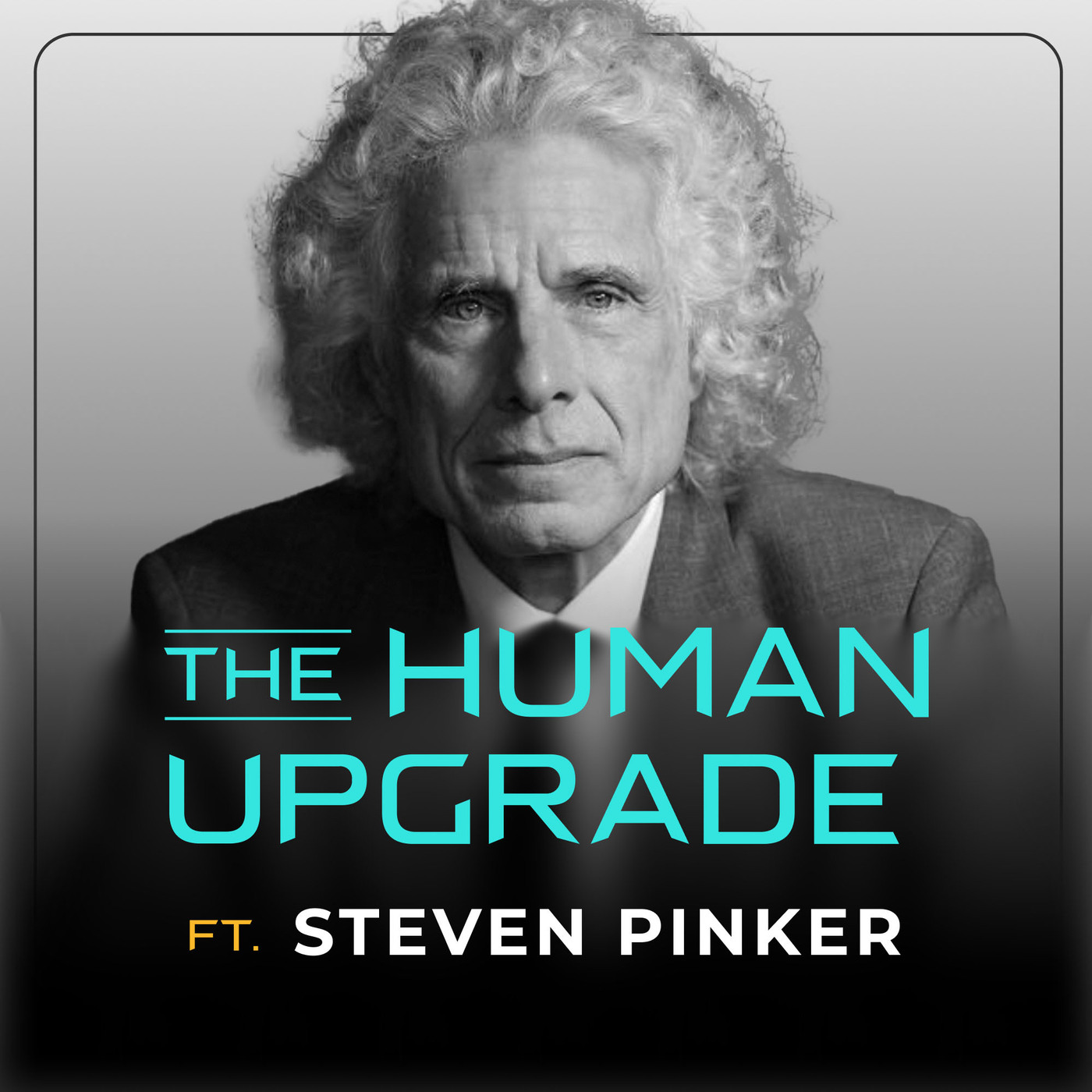
The Human Upgrade: Biohacking for Longevity & Performance
Steven Pinker: Outsmarting an Irrational World : 1333
01:03:43
Loading summary
Transcript128 lines
- [00:00]
Dave Asprey
There are some people who will do things that make them lose, and other people lose because they're too dumb to do otherwise.
- [00:05]
Steven Pinker
We think we're smarter than we are. We think we're more correct than we are. We think we are nobler than we are, all of us. And so if you empower a human with all the flaws that come with being human, things are bound to go wrong because they are not omniscient.
- [00:20]
Dave Asprey
Steven Pinker is one of the world's most celebrated thinkers. A Harvard professor of psychology, a two time Pulitzer Prize finalist, and named by Time magazine as one of the 100 most influential people in the world. His groundbreaking work on language, human nature and the power of reason has transformed.
- [00:38]
Steven Pinker
How we understand the modern mind. As the Harvard professor psychology professor whose news bestseller is Enlightenment now the Case for Reason, Science, Humanism and Progress, Steven Pinker A lot of things that seem utterly baffling, puzzling, irrational, I think fall into place when you understand the role of common knowledge in facilitating human coordination.
- [00:56]
Dave Asprey
What is the one cognitive trap that even the smartest people still fall? You're listening to the Human Upgrade with Dave Asprey. If you're serious about upgrading your mind and body, and you are, you listen to my show. Then you know that what you feed your brain matters. And that includes the podcasts you listen to. So here's a new one that's worth your time. It's called Something you should know with Mike Carruthers. Every episode's like a quick dose of cognitive enhancement. Mike brings on legit experts to break down the science and psychology behind how we think and how we feel, how we perform. Recent episodes I've enjoyed things like like why feeling sad can help you how imagination rewires your brain for better outcomes, Surprising benefits of humility. It's actually a performance enhancer and even things like what alcohol did for human evolution. So if you're looking for a podcast to add to your list of podcasts that's gonna make your brain better, this podcast is packed with practical intel you can use right away, which as you know from listening to me, those are things that I really care about. So I think you would like it to. Mike's curiosity is next level. He has the kinds of questions that I'd ask and that's saying something. It's got thousands of five star reviews on Apple, just like me. And it's a solid part of your mental upgrade stack if you're into the cognitive. So search something you should know wherever you get your podcasts and add it along with the human upgrade and you'll like what your brain does.
- [02:23]
Sponsor/Advertisement Voice
How many nights have you stared at the ceiling counting the hours until morning? Maybe you tried a sleep supplement, but it knocked you out and left you groggy like you traded one problem for another. Poor sleep doesn't just make you tired, it kills your performance, slows your brain down and speeds up aging. Kill Switch from Switch Supplements solves that problem. It works with your biology instead of against it. It contains five gut friendly, extensively researched ingredients like Gaba, magnesium glycinate and tart cherry extract to help you fall asleep naturally, stay asleep and wake up clear. And it's in the form of a delicious sugar free, no BS hot cocoa drink. Sleep tracking data proves how well it works. People consistently hit 90 sleep scores and more than double their REM sleep in only three days with Kill Switch. If you're ready for the best sleep of your life, order now@switchsupplements.com and use code DAVE for 20% off. If you don't sleep better, you get your money back. Kill Switch works with your biology. Your body does the rest.
- [03:33]
Dave Asprey
Hey guys, quick reminder. If you're listening to this on your favorite audio podcast app and you haven't been over to my YouTube channel, check it out. Just search for the human upgrade or find me under Dave Asprey bpr. I post full video versions of every episode and a bunch of other cool content outside the pod. It's a great way to go deeper into the content and connect with other biohackers like you. So leave a comment for me. Yeah, I'm actually going to read them and poke around while you're there. There is a lot of stuff specifically for you. It really helps and it means a lot to me. Steven, you're one of the rare people who's been awarded the Time Award for one of the most influential people in the world. How do you describe yourself today given all the things you've done?
- [04:18]
Steven Pinker
I still think of myself as a cognitive psychologist. I'm a professor and a scientist who's interested in how the human mind works, and all of my other interests in language, in violence in progress are really downstream in my interest in what makes us tick.
- [04:34]
Dave Asprey
When I was graduating from my undergrad with a degree in Computer Information Systems with a concentration in AI many years ago, I learned that my school had a cognitive science department and I was so mad that I'd never heard of cognitive science because I would have studied that instead. But I was just graduating so I kind of missed out on that how did you get into cognitive science? Why this? Of all the things, the world that you could have studied, where's the fascination come from?
- [05:02]
Steven Pinker
Well, I, I think starting from when I was a, a teenager and a, a, a freshman, I was, I was interested in human nature in, in part because I, I was a little too young to be at the forefront of the, all of the student protest movements and all of all that 60s stuff. I am a baby boom boomer. I was born at, at the peak year. But there's a lot of ideas in the air of rethinking society from the ground up. Should we be, should we have anarchism? Should we have communism? Should we have, you know, Ayn Randian anarcho capitalism? And people, including my friends and older brothers and sisters, my friends were talking about these ideas, which a lot of which hinged on what kind of animal are we? Are we inherently generous? Are we inherently selfish? Are we violent? Are we peaceful? Are some of these traits just artifacts of the society we grew up in, or did we evolve to have them? So these were the kind of ideas that were in the air. And early in college, I took courses in a number of different fields that were interested in human nature, including humanities, philosophy, sociology, anthropology. Psychology, for me, hit the sweet spot of being about big, deep, interesting questions, but with some promise of actually answering them through experimental studies of humans in the lab or other animals. And at the time, I also caught wind of a new movement within psychology, cognitive psychology, which was try to look at actual mental processes involved in perception and language and memory and reasoning, which in. And I thought, wow, this is an exciting new field. It's always thrilling to be part of an expanding new field. It's also good in an era in which there's already a contraction in academia and all the fears about unemployed PhDs who are circulating. To choose a field that seems to be expanding seemed like a good career move even at that age. And then cognitive psychology itself, even from the beginning, involved different disciplines. It involved linguistics, including the ideas of Noam Chomsky, which I had read about from the profile in the New York Times Magazine when I was a student. Artificial intelligence, such as it was in the 70s, philosophy of mind, some neuroscience, which was big at McGill University, where I was in, in Montreal, where I was a student. And then it was that this nexus was christened cognitive science. And that was, took the excitement to another level because it wasn't just the field of psychology. So I did get my PhD in psychology, experimental psychology, but I did a postdoctoral fellowship at mit at the new unit called the center for Cognitive Science, which had people from AI and linguistics and philosophy and psychology. I later became the co director of that center. But anyway, that's how I got into it. And then kind of in almost full circle later in my career, once I had published many papers and books on language and how we process words and visual imagery and spatial attention and shape recognition. Then I started to turn back to these big, deep foundational questions when I started to look at the history of violence and later the history of progress.
- [08:26]
Dave Asprey
You definitely described what you've done, but there's an inner yearning when you're a young man. Say, this is what I want to do.
- [08:35]
Steven Pinker
Yeah.
- [08:35]
Dave Asprey
I don't think you told me where that came from.
- [08:37]
Steven Pinker
Oh. When I was a teenager, I put myself in college. I did kind of put myself across with tutoring high school students. And I liked. I thought that I enjoyed teaching. I thought I was okay at it. I was making a living from it. But I also just liked my. My parents subscribed to a lot of magazines, and so a lot of ideas kind of flow through the house. And one day I said to my mother, you know, I read about this thing called a think tank today. Is there actually a job where they pay you to think?
- [09:11]
Dave Asprey
Okay, now I'm getting.
- [09:12]
Steven Pinker
That would be awesome. And she said, you know, what you really want to do is go into a university. You want to be a professor. Because both. I mean, there's a sense in which they do pay you to think as long as you write about it, as long as you publish. But combined with the. With. With the te. And so it became clear to me, maybe when I was a sophomore, that. Or the equivalent of a sophomore. We don't call it that in Canada, that becoming an academic was the obvious career path for me.
- [09:38]
Dave Asprey
Why do you think an unusual number of interesting thinkers come out of Canada?
- [09:43]
Steven Pinker
The most famous child of the community that. That I grew up in was not a thinker, but a poet and a musician. Leonard Cohen. Who. Who. Not my generation. My mother knew him. They were actually classmates. Oh, wow. You know, Canada did have a combination of ties to the mother country, the UK Ties to France, proximity, and huge influence of the United States. So it was a place where people from different backgrounds came together.
- [10:15]
Dave Asprey
If you had your say Today, should the U.S. be another Canadian state or Canada should be another American state?
- [10:22]
Steven Pinker
I don't think either would be terribly happy with the other swallowing.
- [10:26]
Dave Asprey
I have a passport in both countries, so I'm allowed to ask that.
- [10:29]
Steven Pinker
Yes. You know, as you as you know, if you, you know, if you know anything about Canada, the idea, you know.
- [10:34]
Dave Asprey
I've lived there for 13 years. I have a passport in Canada. So yeah, I do.
- [10:36]
Steven Pinker
Oh, very good. Okay. I mean the idea of Canada joining the United States is somewhere between outrageous and hilarious.
- [10:43]
Dave Asprey
They're very different.
- [10:44]
Steven Pinker
Canadians do not want that. No, no. And one thing you learn in, in Canada is some, some, you know, some mixture of envy and resentment is, is what it means to be Canada. And actually when I, I spent some time in New Zealand and it's interest, same attitude they had to Australia.
- [11:04]
Dave Asprey
So New Zealand is the Canada of Australia is what you're saying?
- [11:07]
Steven Pinker
Yes, New Zealand is to Australia. As you know, Canada's the United States. This is an analogy question on the, on the, the sat. It could be.
- [11:16]
Dave Asprey
I, I love that my kids are graduating from a Canadian school, high school, very soon. Actually my daughter just graduated. Is it even worth going to college anymore?
- [11:26]
Steven Pinker
Yeah, you know, yes, I mean it is. I'm, I'm saying not just because it's, you know, my, my, my employ does that. The whole business model pays my salary. Is that.
- [11:36]
Dave Asprey
Yeah, yeah.
- [11:37]
Steven Pinker
I like to think it's not just that. It's not a. Actually my salary comes from an endowed chair, so it doesn't come from a tuition stream. So maybe I can speak independently. So. Yeah, I mean part of it is you're in a peer group of other smart kids who are also must have some intellectual curiosity to be there. You do acquire skills by just sheer practice. Whether or not you get explicit pedagogy. You are writing papers. So if you don't have, you're not having chatgpt write them for you. You are engaged in discussions on intellectual topics. And I mean cynically you get a piece of paper that certifies that you have meet some minimal threshold of intelligence and self discipline. I mean that would be the most cynical view. As I put it, Harvard is a third of a million dollar iq. And marshmallow test.
- [12:29]
Dave Asprey
The marshmallow reference for listeners is the test of whether little kids are going to take the marshmallow when you tell them to wait. Right.
- [12:36]
Steven Pinker
Are they going to take one marshmallow now or two marshmallows if they can avoid the marshmallow and wait 15 minutes.
- [12:43]
Dave Asprey
Right.
- [12:44]
Steven Pinker
Also so I actually have raised this question among my colleagues that why I have students who didn't go into any kind of business or consulting related coursework at Harvard. They were, you know, psychology majors or linguistics or even philosophy. They get snapped up by the big tech and consulting firms and investment firms. And this is not my world, but I asked one of my colleagues in the business school, why does these students know diddly squad about. About business? Why do they get marched right into Goldman Sachs, into McKinsey? And he said, you know, you'd be surprised. A lot of people in business just don't. Aren't used to thinking in terms of systematic evaluation of cause and effect. They fall back on anecdotes. They confuse correlation with causation. They don't have the idea that you need, you know, a large data set to get a representative sample. So all these kind of really elementary things that you immediately learn in any social science course turn out to be pretty valuable. And they turn out that even these distinguish, including a college graduate in social sciences or any intellectually demanding field. Just this ability to think systematically about problems, break them into parts, express yourself clearly, both orally and in writing. So, yeah, together with the fact that, you know, universities, you can learn just incredible amounts of stuff that you'll never have the same opportunity to learn again. I wish sometimes I. Looking at the course catalog, I Wish I was 18 again so I could take a course in, you know, geology or folk tales or, you know, languages, deep history. It's just, you know, game theory, just a spectacular Disneyland of ideas. At any large, large research university, you've.
- [14:35]
Dave Asprey
Managed to maintain your curiosity. Just that answer was perfect to, to demonstrate that. How do you maintain curiosity over the decades? Because so many people lose it.
- [14:45]
Steven Pinker
So, you know, I don't know how much of it is just, you know, temperament. That's just, you know, the kind of person I am. I do like to, I. I do get this is, is particular to, to me, but I tend to write kind of big syntheses, big books that are kind of theories of everything. So the language instinct was kind of my take on every aspect of language, how the mind works. It was kind of hard to get bigger than that. And prior to that, I did pretty comprehensive reviews of language acquisition in children of visual imagery. And I kind of feel a bit of exaggeration to say, okay, I did it. I'm done with it, you know, now I want to do something a little different. I think that would be something of an exaggeration, but I do kind of feel that once I have put my stamp on something, tied everything together in as coherent and satisfying a package as possible, it's time to expose myself to something else. Not only just to keep myself amused, but I feel in terms of what contribution I can make. You know, I have A like any human being I have a particular way of thinking about things and once I've done it it probably needs the input of other people, including younger people that this is what I think and I'm probably not going to have hugely different new ideas about that in the near future. So I've said my piece, time for younger people to have their go at it. And then personally I just love immersing myself in some field that I, I did not know, did not particularly know that I wasn't an expert on and just kind of devouring something new. And I've done that a number of times in my career with evolutionary biology, with historical linguistics, where did English come from? With international relations and the history of violence, with global development, how countries arise out of poverty. I just find it, it great fun and addictive to come across some new field, especially if there are new ideas like really interesting things that I did not know, especially if I think other people don't know about them. And when I discovered there's a literature where these ideas are explored that kind of gives me an idea. Well, there's a book in that because I find it exciting. All the people that I talk to don't know about it. So there's my niche.
- [17:16]
Dave Asprey
I've written nine books, about half New York Times bestsellers and my bar is always I want to write something that hasn't been written before because otherwise I would just recommend the book.
- [17:25]
Steven Pinker
Yes, that's right.
- [17:26]
Dave Asprey
It's hard to find those things though.
- [17:29]
Steven Pinker
I think it was Isaac Basheva Singer who said I write books that only I can write.
- [17:34]
Dave Asprey
Oh, what a great quote.
- [17:37]
Steven Pinker
Words to that effect. Yes.
- [17:42]
Dave Asprey
There'S a really good chance your non stick cookware contains toxins. A study from the Ecology center in California found 80% of non stick pans still contain Teflon. And a brand new study from the Science of the Total Environment Journal found that a single scratch on a non stick pan can release about 9,100 plastic particles into your food. That's the food you're giving to yourself and your loved ones. And studies show that those toxins can cause liver damage, damage, thyroid dysfunction, fertility issues and more. So what do you do? Well, use cookware that doesn't have any of those chemicals. Our place makes high performance toxin free cookware and I've been using it for about the last seven years. In fact I just bought another pan. They don't use any forever chemicals like PFAS or ptfes so you can cook confidently without wondering what's in your pan. Besides what you're cooking, the Our Place cookware set will upgrade your kitchen in one fell swoop. You get two multifunctional always pans and two perfect pots in mini and full sizes. And that replaces a bulky, expensive stack of cookware with just four pieces. You can sear, saute, bake, fry, boil, roast, steam everything that you'd want to do in the kitchen. And buying the entire set saves a lot of money. $150 to be exact. This is what I cook on and what I have cooked on every single day for years. Our Place designed this cookware for performance and built it to last. It has over 80,000 5 star reviews and I'm still using the same frying pan I bought seven years ago. And it's so good that Michelin star chefs swear by it. Give it a try. They give you a 100 day risk free trial with free shipping and returns so you can experience this game changing cookware with zero risk. Stop cooking with toxic cookware and upgrade to Our place today. Visit fromourplace.comdave and get 10% off sitewide. You've probably heard that I've been taking Mitopure for years, ever since it first came out. It's one of the few supplements that actually moves the needle when you want your cells to work better and your mitochondria to perform best. Mitopure contains urolithin A, which is a clinically backed magic powder for your mitochondria. And it's backed by 10 years of research. But here's the fun part. It's now available in a gummy that actually tastes good. Yeah, a gummy that you want to eat. And it's not a sugar bomb pretending to be healthy. They're sugar free, they taste amazing, and they deliver the same high dose bioavailable mitopure I've been using in their softgels. And best of all, because I actually want to eat them, I take more and I feel better. So if you've been serious about your longevity stack, or you just want an easier and better tasting way to get started, try the new Mitopure gummies. They're that Good. Go to timeline.comdave and you get 20% off. Given all that you know about the inner workings of the mind and the brain, if you could design or select a system of government that's most compatible with humans, what would it be?
- [20:37]
Steven Pinker
You know, I mean, democracy is a pretty good start, especially liberal democracy. If it's just, you know, competitive autocracy, that is. You have an Election to elect a dictator. You know, I think that doesn't work too well. And the reason being that dictators are human. I mean leaders are humans. And I think it's not a coincidence that the framers of the American Constitution were in a sense students of human nature. I think it was shame, John Adams, who said what is government? But the biggest of all reflections on human nature. And one of my favorite quotes is from another of the founders, James Madison, who said, if, if men were angels, no government would be necessary. If angels were to govern men, no constraints on government would be necessary. So we need, and it's stated to name a third founder, Thomas Jefferson, in the Declaration of Independence. After enumerating the rights to life, liberty and the pursuit of happiness, self evident truths, inalienable rights, he says, to secure these rights, governments are formed, governing with the consent of the governed. So the idea is that we all, because getting back to your question, based on what we know about humans, we are all saddled with many cognitive flaws, biases, especially self centered biases. We think we're smarter than we are, we think we're more correct than we are, we think we are nobler than we are, all of us. And so if you empower a human with all the flaws that come with being human, things are bound to go wrong because they are not, not omniscient, they're not infallible, but they kind of think they know more and they're wiser than they are. And that's why. So we all submit to government because we're better off sacrificing some degree of freedom to, including the freedom to harm others. And in exchange for that bargain, other people can't harm us. So we submit to government and it's better that everyone does it than if only a few people, because then that just leaves the door open for predators and exploiters and manipulators. So we all agree, let's all agree to government. I sort of think of it as an example of a solution to a kind of collective action problem where everyone, if everyone just acts in their own interest, they're actually worse off than if everyone has to follow certain rules as long as everyone follows them. I mean, a really crude Canadian analogy is the rule that says you have to wear a helmet in hockey. It's more fun to skate around without a helmet. And you have an advantage in, you know, heat and peripheral vision and all these things, you know, on the other hand, you're risking getting brain damage or getting killed. And the problem is if there's no rule, then the advantage of mobility and vision would mean that you'd be a sucker if you wore a helmet. If all of your opponents didn't wear helmets, they would rather wear helmets. They don't want to get brain damage either, but then they're worried that you're going to not wear a helmet and you'll have the advantage. So if you have a rule, it constrains your freedom. On the other hand, you're kind of happy to have the rule because it constrains other people's freedom as well. So you don't have to choose something that is ultimately not in your interest, but you have no choice given what other people are choosing. So that's kind of the basis for government. Then if you're going to have government, you don't really want a despot, a dictator, an autocrat, a tyrant, because, you know, they're human. They may say that even if they say that they are ruling in the interests of everyone, they're going to tilt things their way, they're going to be biased, they're going to have their own preconceptions, they may be wrong. And the checks on the power of the leader are inherent to a well functioning liberal democracy, as opposed to democracy just meaning you vote. And so I think that it's a little bit vague. That's just the general idea. The best answer I could give you.
- [24:36]
Dave Asprey
After decades of looking at how brains work, liberal democracy is where you ended up. But I would have been surprised if you said, you know, Ayn Rand was right. But you never know. AI is on everyone's mind. It has to be on your mind. But you've studied minds. So how much of your work do you think applies to the inner workings of AI today?
- [24:57]
Steven Pinker
So the current AI, since the great AI awakening of about 10 years ago, was a big shift in a kind of back and forth debate within AI since its inception, since I was an undergraduate, before I was an undergraduate, as to two different styles of intelligence. One is a little bit like logic. You've got propositions, you've got deductions. Socrates is a man. All men are mortal, therefore Socrates is mortal. Rules of grammar. The subject is the agent of the action specified by the verb, and you have to speak rule by rule. Deduction, computation. The other is what's sometimes called neural networks, correct? That is, they're not that closely based on the neural tissue in the brain, but they're kind of based on the metaphor of neural what brains do. Namely, you've got a large number of simple units that aggregate Information and that then pass on a signal based on all the information coming in. But there's so many of them wired together and they are trained by the. Sometimes by just soaking up patterns in their input, sometimes by having to match some correct output provided by a kind of a teacher. So that's the artificial neural network approach. And over the decades, they, you know, there's some back and forth as to which became more popular. But then Suddenly, starting around 2015, real AI models based on neural networks actually started to do stuff. The previous ones based on symbolic propositions had their moments. There were expert systems and so on, but they didn't really do anything that people were willing to pay for. Now, the reason for the breakthrough turned out not so much to be a breakthrough in their design, although there was some of that. One breakthrough came in the 80s when people figured out how to train models with multiple layers between input and output. That had been kind of a barrier that was overcome in the 80s. And one of the people who invented that technique, Geoff Hinton, recently won a Nobel Prize retroactively for that discovery. But what made AI possible in the sense of Google Translate and Siri and then later chatgpt, was just sheer scale, something that was kind of impossible before because it was just unthinkable that you could throw that much data into a training set, namely the entire worldwide web, you know, all of Wikipedia and the New York Times and Reddit and just a gargantuan amount of data combined with a kind of accident that there were cheap graphic processing units probably developed mainly for gaming, but turns out that they were, because of what they do is they map, you know, a hu. A big array of pixels onto another array of pixels in parallel. That is, you don't have to go. But they're wired so that every input, thousands and thousands of inputs directly affect thousands and thousands of outputs that turns out to be easily portable to training neural networks. And so you throw the zillions of GPUs, graphic processing units from Nvidia and you throw massive gargantuan amounts of data at them, the entire World Wide Web. And they can. Can do things that no one, including me, would have predicted. You know, they can compose poetry, they can take the sat. So that was the breakthrough. Now raising the question, is that really the. Do we now based on, now that we know how to build something that we could reasonably call intelligent, is that the way the human brain does intelligence?
- [28:45]
Dave Asprey
Probably not.
- [28:47]
Steven Pinker
And probably not. I mean, it would be the, you know, the equivalent, if you think of how the rate at which, say, children are exposed to, let's say, language, input sentences when they, when they learn to talk, be the equivalent of a child having to sit for 30,000 years before they could converse. And, you know, real kids, it's, you know, it's two or three years. So it suggests that the brain has some more powerful shortcuts to intelligence than just having, you know, terabytes wash over them.
- [29:18]
Dave Asprey
Has it changed your work now that you can use AI to, say, analyze language or to work with brain structures?
- [29:27]
Steven Pinker
Some, although being kind of advanced in years and probably don't take up new technology as quickly as younger people did or as I did when I was younger. So I probably don't use it to its full advantage. I mainly use it, and I think this is true of older people as a semantic search engine that is, instead of searching for text, you can search for ideas. So that's a big breakthrough and that's really, really helpful. But at the same time, I'm always mindful, and here my experience as a cognitive psychologist is relevant, that they, you know, they make stuff up, they hallucinate, they blend, they confabulate. And I think going back to the debate between the two different styles of AI, namely propositions, models, rules, algorithms, versus aggregating lots of statistical information, the reason that they hallucinate, confabulate is they don't do the symbolic computation. They quite literally don't have ideas like the coffee cup was on the table from 9am to 10am that kind of isn't in there, at least not explicitly. It's often things that kind of look like coffee cups are often in the vicinity of things that are kind of like tables, symbols, usually for indeterminate amounts of time. They throw all that together and they get something that's often not only in the ballpark, but sometimes dead on, but very often not dead on, because they talk about things that never happened because they don't know what happened. All they know is what tends to go with what. What little pixels tend to go with what other pixels, what words tend to go with what other words. It's amazing how much they can make of that. But it is not the same as an understanding of who did what to whom, where and when.
- [31:14]
Dave Asprey
So when it comes to using AI these days, AI is disgustingly complimentary. Oh, such a good idea. You're so amazing. And then it tells you whatever it made up. How harmful is that to our psychology?
- [31:31]
Steven Pinker
Oh, yes. Is it, Is it like too, too obsequious?
- [31:35]
Dave Asprey
It's sycophantic it's sycophantic. What's that doing to our consciousness? Especially for young people, but even for any of us.
- [31:41]
Steven Pinker
Us. Yeah. So for young people whose main, you know, I. This is a. Almost a terrifying thought. If the main form of social action is social interaction is with AI, the worst possibility is that that's how they expect other intelligent beings to interact with them all the time.
- [31:58]
Dave Asprey
You're unemployable.
- [31:59]
Steven Pinker
Right, right. You know, on the other hand, you know, we're not that stupid and, you know, we do know that, you know, the way you interact with one, one, even one person is different than the way you interact with someone else. I don't think that many kids go in the world thinking that their friends are going to treat them the way their mom does or their teachers or their bosses. We do compartmentalize. We know there are different people we interact with and we have different social relationships with them. And so we don't automatically assume that the way we interact with one person or agent is going to transfer to everyone else. And in fact, that is one of the obsessions of my new book. Of the different bins that we put our social relationships in. We make a big difference between psychological difference between relationships of communality, warmth, sharing, intimacy. A whole separate bin is hierarchy, who defers to whom. And a third bin is reciprocity, fairness, trade, even Steven, tit for tat.
- [33:05]
Dave Asprey
When you talk about fairness in your new book, the world objectively isn't fair. How are people supposed to be able to come up with this idea? We feel like it should be fair, but we know it's not.
- [33:18]
Steven Pinker
Yeah. There is a literature in psychology on the just world hypothesis that. An idea that people have to varying degrees that, you know, in the end what goes around comes around, you get what you deserve. You know, there's, there's, there's karma, just desserts and. Which can also lead people to rationalize various things that happen, that there must be a reason for it. You know, everything happens for a reason. And the reason being people get rewarded for good stuff. They do. It's. It's an. And of course, that's the foundation of a lot of major religions that what doesn't immediately appear fair will, you know, in an afterlife, all be evened out. And of course there's a reason that people want to believe that that is other people will be deterred from exploiting you if you think that they have to fear some kind of punishment or retribution for being antisocial. Given that what we do actually have on Earth, namely governments, court systems, rule of law, HR departments, and networks of gossip and ostracism in more informal ways have informed enforcing social norms. But there, there's a kind of a dream that when someone slips through all those cracks and does something dastardly, they'll pay for it at the end. And maybe therefore people will do fewer dastardly things. That's the basis of the hope and the dream.
- [34:40]
Dave Asprey
I've chosen to believe in karma, whether or not it's real. Just because it brings me more peace, does that make me dysfunctional?
- [34:49]
Steven Pinker
I don't think it's optimal to be honest. I don't know how hypothetical we are.
- [34:54]
Dave Asprey
I don't have to meet out justice on that bad person because someone el will do it later, I hope.
- [35:00]
Steven Pinker
Well, yes, and you know, I think that can be a problem because if they don't, that is. And, and, and trust me, they won't. So the question is that does leave us with the problem and it's a real problem of how do we deter exploitative, aggressive behavior. And we can't avoid that problem, whether it be on the national scale with a police force and a criminal justice system, on the personal scale with, you know, networks of shaming, gossip, ostracism, choosing your partners. If all the ways that everyday life is regulated, and again, that is a big obsession in the book of how, what are the ways in which we can kind of enforce norms. Norms being assumptions that are held up by. And this voice the theme of the book, common knowledge. That is everyone knows that everyone knows a norm exists because, because everyone knows that it exists. And if it. People stop assuming that exists, it doesn't exist. That's why people often feel the need to police norms. If someone breaks a norm in a public forum, there's an urge to publish them, punish them. Sorry, in a public forum in order to prop up the, the, the norm. And, and that it isn't just in everyday social interactions, but even the law. I mean the law. We don't have a network of cameras and snitches and informants that will enforce every law everywhere.
- [36:29]
Dave Asprey
A lot of these about nine more months before we have that. Maybe 12.
- [36:32]
Steven Pinker
Yes. At least for now we don't have it. But a lot of laws are followed just because people know they're followed. They can fall back on it. When two people have an encounter, who stands his ground and who backs down. Sometimes it's brute force. A lot of the times it's everything that goes into dominance, alpha male, pecking order, saving face, losing face. Which are matters of common knowledge, namely in an encounter where you don't literally come to blows and one figures that it isn't worth fighting over. So give it up to the other. One person stands his ground because he knows the other one will give way. And that one gives way because he knows the other one stands his ground. So it's a question of common knowledge, each one with expectations about the other. So that's how ordinary authority, deference, status, dominance, hierarchy go in our informal day to day life. But it's also partly the way even laws work in practice, given that we don't have Big brother watching us 24 7. I'll give you an example. This is again from my undergraduate years. I never smoked and I really don't like breathing other people's cigarette smoke. And this is even before it was known to itself be harmful. But I just found it very unpleasant. But in a classroom where, believe it or not, for all of you younger people, people used to smoke like chimneys in classes, in restaurants, professors used to smoke. But it would take a lot of gumption for me to tell a fellow student, do you think, could you put out your cigarette? Because I'd be a little bit nervous about making a scene. They might, might say, well I have every right to smoke. Who the hell are you to tell me not to smoke? It's my right. But once there was a smoking was outlawed and there was a sign in the classroom with a cigarette and a diagonal red line through it, I could tap them on the shoulder, point to the sign and expect him to give way. I would win that confrontation. Without that sign, I'd be taking my chances at an ugly scene. And so a lot of laws actually, actually work by in practice even though they are enforceable. But you know, McGill just didn't have smoking police, they didn't have a, you know, report, a smoker hotline. It depended on people being on the common knowledge. Again, to come back to the theme of the book that you. This is something that everyone knows, that everyone knows you don't do.
- [38:55]
Dave Asprey
You talk about norms in, in your book, but it feels like the very idea of norms is going away in part because of AI and because of social networks where you have one group that has a norm and another group. There's not a lot of overlap between them.
- [39:11]
Steven Pinker
Well, there is. I mean, I don't think norms are going away in our, in our, our in in general and in fact, if anything, norms against saying anything that might be conceived as racially insensitive, even if it is completely Innocent. That is a norm that is stronger than ever. And that. That's what. What gets people canceled. That's why you have social media shaming mobs. You make the wrong kind of joke, even if it's not a racist joke, if someone could dream up why it might be racist, then your life could be made a living hell. But what we are seeing in the public sphere, especially in politics, is a shattering of certain norms that held for a long time for liberals, conservatives, everyone. For example, you don't overtly insult your opponent. You don't call them, you know, stupid. If it's a woman, you don't make comments about her physical appearance. You don't blame.
- [40:06]
Dave Asprey
If it's a man, you can. Right.
- [40:07]
Steven Pinker
Pardon me? If it's a man. Well, even then, you know, in.
- [40:11]
Dave Asprey
I'm mostly kidding, but, like, that's a question about norms. Like, you wouldn't have. Yeah.
- [40:17]
Steven Pinker
You know, George Bush and. And Al Gore, you know, may have hated each other's guts, but they didn't insult each other's looks. There was respect. Yeah. There was a norm of respect that you wouldn't. And also there was. Even though all politicians lie, because all humans lie, you had to not lie blatantly saying something that anyone could instantly see was false, you'd lose credibility. You'd be seen as a boor, as totally unfit for public service. So Donald Trump has shattered those norms. The norms are held up by the common knowledge. Again, going back to the book, no one policed the norm that you don't comment on a woman's looks in public, but people obeyed it because everyone knew you obeyed it. And the assumption was, and this would often be true, that if you did flout the norm, everyone would come down on you like a ton of bricks. They'd give you, you know, contemptuous stares. They would not invite you back. What Trump showed is that these norms are fragile, that you could blatantly shatter them and get away with it. And once you did, it's no longer a norm. And so you see other politicians, sadly, and other public figures, Elon Musk being an example, who are happy to blatantly lie, insult, exaggerate, be overtly crude in a way that would have been unthinkable even, probably even five or six years ago. Someone in the corporate world, for example, like a politician, had to obey certain norms of decorum, decency, chivalry, gentlemanliness. And we're now seeing that they, you know, no one enforced them by law. They were just things you did because everyone knew you did them. And when people no longer know that you, you have to do them, people don't do them, them.
- [42:09]
Dave Asprey
It's a fine line between having a civil society and having an anarchy and also being able to have that pesky free speech thing. Do you think that there's, that we're going to come up with a new norm? I mean, you have the wisdom of studying this intensely and seeing decades of history. So where do you think we're going to end up in five years? Are we all just going to walk in and insult someone and maybe, maybe say those negative comments about a person's body? Because now we can say that. So are we going to become uncivil or are we going to evolve?
- [42:43]
Steven Pinker
It's a good question. The reason that, not necessarily simply because. And again, this is something that I discuss in the book. Our norms are context specific. What you do varies with your relationship to the other person. Parent, teacher, husband, wife, sales clerk, customer, all the possible dyads. It depends on the context. At home, at school, at university, in a public forum, in private, depends on what the actual content or resources are we talking about food or money or sex or power and all of those. I think the human brain is pretty good at compartmentalizing those. And that's what it means to have social skills, to be a socially competent adult. You know, what, what norm applies with what other person, in what setting? So what Donald Trump gets away with in his social media feed and even in public debates, it could extend to people say on a university committee or a corporate committee, but not automatically. And I'd be surprised if the kind of boorish behavior that, that, that Trump exhibits in public characterizes, you know, committees in a, in a, in a corporation or a university or a nonprofit hope. So those are the lines that one hopes will hold.
- [44:07]
Dave Asprey
So you, you think society will still remain mostly civil, but maybe outside of some political things. And it's true in corporations you get sued for stuff. And in government you don't get sued for stuff. You can get voted out of office for stuff.
- [44:21]
Steven Pinker
At that level of government. You know, in the, in the government bureaucracy, I, you know, I think if someone in, in, you know, the HR department of the, you know, department, Department of Commerce were to make comments about a woman's appearance or about one of their co workers being, you know, stupid, you know, they, they would probably get sacked. Ironically, the most powerful person in the world doesn't get sacked. Well, maybe not ironically, but, but it used to be that that was just, you know, any politician left, right, center, you, they just wouldn't do that.
- [44:52]
Dave Asprey
We have this kind of outrage economy, and it's something you touch on in your new book, where people will play up their outrage online and things like that. And at the same time, we also have truthfulness. And there's a book from the 1920s out of Berkeley called the Basic Laws of Human Stupidity that you may have come across.
- [45:11]
Steven Pinker
Economics professors. I'm going to order that. Yeah.
- [45:14]
Dave Asprey
Oh, it's a beautiful book. And he talks about, well, there are stupid people, and people who aren't. Aren't stupid, can't see them, and they're one of the problems in society. He defines stupidity mathematically and talks about percentages and. Very short read, but very uplifting because it's not all just evil people. It's just knowing there are some people who will do things that make them lose and other people lose because they're too dumb to do otherwise. For me, it created some peace. Like, it's not all bad people. Sometimes it's just dumb people. But if we can't talk about the fact that that person's actually stupid, how do we evolve as humans if we can't ever say anything that might hurt another person's feelings?
- [45:48]
Steven Pinker
Feelings? Well, I mean, that. That is kind of one of the dilemmas of social life. And in fact, a large part of my book is about tact, social skills, savoir faire, genteel, hypocrisy, politeness, euphemism, and indeed, a lot of our language. And this is how I actually, I came into the whole topic of common knowledge. The subject matter of the book I came from. My interest in language, namely, so much of language consists of people not saying what they mean. You can't figure out what it means just by looking at the subject and the predicate and the rules, grammar. But you people are always reading between the lines and connecting the dots and catching each other's drift. Even something as basic as politeness, if you can pass the salt, that would be awesome. Now, if you actually think about the literal meaning of that, it doesn't make a whole lot of sense. It's hyperbolic. It wouldn't be worthy of awe if you got the salt. And why are you kind of pondering hypotheticals, counterfactuals, possible worlds. And the reason is that, you know, that's a case where you don't want to treat someone like a servant. You don't want to say, give me the salt, depending on your relationship with them, of course, you could, you know, in the.
- [46:57]
Dave Asprey
If it's your spouse you would talk that way.
- [46:59]
Steven Pinker
But exactly. And again, this is, you better not.
- [47:02]
Dave Asprey
Treat your spouse that way.
- [47:03]
Steven Pinker
Well, no, I'm act, you know, I, I, I say, you know, well, even there I might say, can you give me salt? Which by the way, is a question about her ability, which is again, doesn't make any sense, literally.
- [47:14]
Dave Asprey
Right.
- [47:15]
Steven Pinker
It is sense as treating the person with respect, that is not bossing them around as if they were a servant. They interpret the indirect request on the assumption that you are rational. They are rational. The only reason you'd be musing about their ability to pass the salt or pondering what it would be like if you had the salt is, well, that's what you do if you wanted salt. And also veiled bribes, failed threats, sexual come ons, cases where we're very sensitive about the nature of the relationship that we have with the other person. Are we platonic friends? Is, is, is, is he the, the, the, the, the boss and I'm the supervisee. Are we in a transactional relationship? And sometimes we have to get across messages that contradict or, or at least threaten the nature of the relationship. Say two platonic friends and they want to explore the possibility of a sexual and romantic relationship. Once you blurt out, you know, do you want to have sex? Okay, it changes everything. Can't go back to being platonic friends because it just contradicts the whole logic of platonic friendship. But still, you may want to make the transition. So how do you do it? Well, then you say, you know, I want to come up for Netflix and chill. You want to see my etchings cases where another intelligent adult knows what the intent is. As with, if you could pass the salt, that would be awesome. That you haven't overtly challenged the basis of the relationship by the content of what you said. You haven't generated common knowledge. Again, going back to the theme of the book. And in fact, I've done studies that bear this out. So there's not plausible deniability in the sense that if he asks her up late at night for coffee, she's a grown woman, she knows he doesn't just mean coffee, and so she turns him down. He also knows that she hasn't just turned him down for coffee. But does he know that she knows that he knows? I mean, he could still think, well, you know, may, you know, I know what she, what just happened. But maybe she doesn't know that I know. Maybe she thinks I'm dense and thinks that I just think she turned down coffee and she could think, well, Maybe he thinks I'm naive. Maybe he just thinks that I, that I interpret it as coffee even, or thinks that I think that he thinks that. And without those recursive thoughts about thoughts about thoughts, let that common knowledge get back to the theme of the book. They can go back to their platonic relationship. If it was just blurted out, then, you know, then that changes everything. The relationship has crossed a Rubicon. And that's when we get the emotions of awkwardness, shame, embarrassment, reactions like blushing and stammering and looking away. I have, you know, one chapter of the book is about, it's called weasel words about why we don't just blurt out what we say. Another one is called laughing, crying, blushing, staring, glaring about all of the non verbal signals that we use to generate common knowledge about the nature of our relationship, how we signal. Trust me, I know what kind of relationship we have.
- [50:30]
Dave Asprey
I saw a study about 60% of young men have never approached a woman in real life, as in not online, to say, hey, do you want to date? It's like the skill set isn't as common because it's so easy to approach online where it feels safer. It feels like reading your book would be really important if you're under 30 because you're going into some of these nuances that, that maybe were missing. What advice would you have for someone who's just terrified at approaching another person, whether it's for a job offer or for romantic offer. Walk me through the cognitive psychology steps to convince myself to go do something like that.
- [51:08]
Steven Pinker
Yeah, so actually in the chapter on weasel words, I kind of analyze what's at stake in these interactions in terms of a two by two matrix of they're willing to, they're not willing. You make the offer, you don't make the offer. Where I point out that in fact there is a third column in the matrix, namely you hint at it indirectly. It's a question of calibrating the degree of overtness from blurting it out to the subtlest of hints. And the optimal level depends on. I even have a mathematical model. I don't go through it in the book book, but I've got it in academic papers of just how blunt to indirect speech should be. Depending on the costs and benefits of a willing partner accepting the proposition, a willing partner not even realizing that it's a proposition, it goes over their head. There's that risk. And by the way, a lot of these things, you know, a lot of us learn about human nature, learn social skills from fiction, from comedies of manners, situation Comedies. And there's an episode of Seinfeld that indicates this cell in the Matrix, namely, George Costanza, is invited by his date up for coffee, and he says, oh, no, I have to get up early for work. And, you know, I can't consume caffeine that late at night. And then when he gets back to on the way, he suddenly realized coffee doesn't mean coffee. Coffee means sex, Right? So there's that. There's the. The consummated cell where you make a proposition, a willing partner understands it, accepts it. There's the danger of it going over the listener's head. They think, you know, they think you're just inviting them up for coffee. As with George, the humor in George Costanza being in that situation, there's the worst outcome of. It's an unwilling partner who does catch your drift and rebuffs it, maybe even is offended it. And there's the lost opportunity that you don't make the offer. And, you know, nothing happens. Nothing ventured, nothing gained. So those are the logical possibilities. And it really involves thinking, well, what's the worst that could happen? And you can tilt things so that you minimize the worst outcomes while providing the opportunity for the best outcomes by calibrating the degree of directness versus indirectness. I think that is what we informally mean by social skill. Tact, savoir faire, not being on the spectrum or not being too far along the spectrum. All of these skills, you often are anticipating, you know, what's the best thing that could happen, what's the worst thing that could happen, what do I want to happen? How do I calibrate my level of bluntness to minimize the downside, maximize the upside. And, you know, again, it's. I actually have a mathematical model. And we. And with. In collaboration with students and colleagues, tested the mathematical model and showed that that really is what governs how people choose their words.
- [54:17]
Dave Asprey
It's basically a calibrated model.
- [54:19]
Steven Pinker
It's a calibrated model and, you know, life is calibration. The reason I can't give advice is, you know, here's what you say. Try this line is that, you know, it very much depends on the context, on the person, and it is hard to. You're right that the. Some of the reluctance of young men to ask, say, ask a woman out or, you know, or vice versa, because, you know, women. Women ask men out too. And I don't know what the data are on that, but I have no idea. You know, some of it is you got to probably live through some embarrassing situations. To know what's right or what's wrong, we have to observe. You have to. You know, that's why we consume art, why we read novels, watch tv, go to the movies, is to see other people try things out and see what happens. If it's plausible, you learn from those, you learn from gossip. You wouldn't believe what happened. You believe he said, blah, blah, blah. And sometimes there's no substitute for experience and it is a problem. If not only to begin with are the Gen Zs grow up behind screens and forego a lot of face to face interaction. But of course Covid meant those, you know, two years in which it was even worse. They couldn't even if they wanted to. And again, going to the other chapter, you know, I have the chapter on language, I have also the chapter on non verbal communication, on eye contact, on blushing, on laughing, on tears, on angry glares. There's a lot of signaling that goes on face to face. Problem with screens is that you are missing that channel. Especially if it's text, if it's, if it's, you know, X or Facebook, you're not getting any reaction at all. At least zoom, you get some pixels that are simulating the person. But when it's, you know, texting and you don't get those signals that ordinarily regulate our social relationships, they're absent. Which is why it's so much easier to insult people, to troll, to shame on social media than in Face to Face life. Even in Zoom. And I talk about this as well because I have a whole discussion on icon contact. So right now I have a setup between you and me. I have a little camera, I think you guys may even have sent it, sent me a little mini camera. I have it propped up on a stock in front of my screen and I have the square with you so that your face is right next to the camera and go back and forth. And you know I'm doing exactly the.
- [56:41]
Dave Asprey
Same thing, like you're right behind my lens.
- [56:44]
Steven Pinker
Yeah, I like to think that you and I are having a pretty natural conversation because we're doing the closest equivalent to eye contact. The problem being in zoom there can't be eye contact because the unlike face to face communication where the part of the person you're looking at is also the part of the person that's looking at you and you looking at them, it generates common knowledge. That is when you make eye contact. I know that you know that I know that you know because each of us is looking at the part of the other that gains Knowledge about the other. You can't have that literally in human made technology because you've got a screen that displays the pictures, you've got a camera that is recording the image. And they're different gadgets, unlike eyeballs. The closest equivalent is what I'm trying to do now. Avoiding the usual camera looking up the nostrils look of most people on Zoom when they have the laptop screen down on a desk.
- [57:38]
Dave Asprey
Right?
- [57:39]
Steven Pinker
I'm doing the best to make eye contact by having your little image right next to my little microcam.
- [57:45]
Dave Asprey
It's kind of funny if you're doing say an online interview or online dating, putting the camera right by the person's face probably means you're going to get the date or the job because of all these unspoken but still important things that are mostly invisible. And when you're in person, my eyes would actually see your eyes dilating a little bit. And I wouldn't know that, but my system would know that and change how I behaved in unconscious ways and maybe some conscious ways too. Do you think that as the world becomes more and more virtual and digital and people are more remote, that this lack of, of connection that's fostered by technology is going to cause harm to society?
- [58:25]
Steven Pinker
Well, it, it, it could. And some of the, the, the, the data on the loneliness and mental health problems of younger Americans could, could, could conceivably be because the ordinary channels of communication and face to face are things that they haven't grown up with. And the, the face to face interactions and feedback. When did you make a fool of yourself? You know, when, when did you blush? It's painful, but you know, you learn something. If you don't learn it, then you know you are missing out on a, a aspect of life that really gives people deep satisfaction. My sister Susan Pinker wrote a book called the Village Effect on the the difference between face to face contact and all the various digital equivalents and how face to face contact really makes people happier, healthier, lengthens their lives and other benefits. The question is so. But before we conclude the species is doomed and Gen Z is not having sex, or at least not having as much sex as other generations, maybe because of porn also. So, so is the species just going to spiral downhill until the last 90 year old dies and then humans won't exist anymore because no one will have had sex for 100 years? Probably not. Because when social trends lead to harm, often there is correction, there's feedback, there's realization that something bad is happening. What do we do about it? And it's Very hard to anticipate what those responses are going to be. I doubt that we're just going to let it. Everyone's just going to let it happen and it's going to spiral downward. There will be corrections. We don't know how effective they'll be.
- [60:08]
Dave Asprey
Let's have some hard questions. What's one rational thing you believe that makes all your friends uncomfortable?
- [60:15]
Steven Pinker
Let's see. It makes all my friends uncomfortable. It has to be also something rational that I share.
- [60:21]
Dave Asprey
Or at least something you believe if it's the first time you shared it. Even better.
- [60:24]
Steven Pinker
Better. Yeah. Well, probably that all of our imaginations kind of seethe with wicked thoughts that would change everything if we blurted them out. I'm doing a study now with some, with a couple of former students on people's fantasies. And we know from. I'm not the first that, you know, people. People visualize a lot of pretty awful things in the privacy of their imaginations. So that's one of the reasons the last chapter of the book is called Rational Radical Honesty. Rational hypocrisy. Why? Some degree of hypocrisy is good, indispensable. And there are a lot of things that each of us thinks. Each of us, if we're at all savvy or reflective, have to know that other people think because, you know, we're birds of a feather. If I'm thinking them, probably other people are as well. On the other hand, and sharing it can change everything. It can pollute the basis of your relationship, of your marriage, your romantic relationship, your friendship, your relationships at work. There's a good case to be made for not saying everything that's on your mind.
- [61:31]
Dave Asprey
Sounds like you dodged the question pretty well.
- [61:33]
Steven Pinker
Okay, there you go. Maybe I'm following my own advice.
- [61:39]
Dave Asprey
That was very elegant. It's almost like you've done this before.
- [61:44]
Steven Pinker
Once or twice. Actually, not that question, though. I have not. I don't think I've gotten that question. I got a couple questions over again, but not that long.
- [61:49]
Dave Asprey
I even interviewed a kajillion times, so that's cool. I want to offer some real value for our listeners who tend to think about thinking the way that you or I would. And I'd love to know what is the one cognitive trap that even the smartest people still fall for?
- [62:11]
Steven Pinker
Probably the my side bias. That is the assumption that you and your tribe, your coalition, your posse, your group, your political party, your religion, your club are smarter and wiser and more knowledgeable and more moral than a rival group. Okay, so you believe Whatever makes your side look good, man.
- [62:36]
Dave Asprey
That is for sure. And I do my best to not have sides and just curious.
- [62:41]
Steven Pinker
And there is research that suggests that for most of the many biases, fallacies, errors that cognitive psychologists and behavioral economists have documented, the subject matter of Daniel Kahneman's book Thinking Fast and Slow or Dan Ariely's book Predictably Irrational, Wikipedia has a page for cognitive biases which lists 200 of them. A lot of them are going back to your discussion of stupidity. Smart people are less likely to fall into these traps on average. However, that is not true of the My side bias, that the my side bias is not correlated with intelligence.
- [63:20]
Dave Asprey
And when they do fall for it, their intelligence lets them defend it even better.
- [63:24]
Steven Pinker
I imagine that may be why. Exactly.
- [63:27]
Dave Asprey
Yeah, your book, When Everyone Knows that Everyone Knows, which is a great title by the way.
- [63:32]
Steven Pinker
Way.
- [63:33]
Dave Asprey
What's the change in the world you want to see because your work has changed the world? What is this book going to do for the world?
- [63:39]
Steven Pinker
You know, it's not a book with, you know, advice or self help or formulas for achieving, you know, world peace or anything else, but it's a way of understanding life at a deeper level of insight. A lot of things that seem utterly baffling, puzzling, irrational, I think fall into place when you understand the role of common knowledge in, in facilitating human coordination. And that's why common knowledge, that is this rather abstruse state of I know something, you know it, I know that you know it, you know that I know it, I know that, you know that, I know that, you know it at a different item, which might seem like the kind of thing that only amuse a logician. It's actually very potent in human affairs because it's what allows us to be on the same page, to work together for a common goal, to cooperate. And conversely, there are many circumstances which we were just discussing, where you want to keep things out of common knowledge. Even if everyone knows something, you don't want everyone to know that everyone knows it because you need to preserve some kind of relationship that allows people to work and live together.
- [64:41]
Dave Asprey
I'm so impressed with the way you see things differently than just about anyone else. And I'm still trying to figure out if it's because you've studied all of these things and, and put them all together for yourself or you just always see the world differently. Do you have an answer for that?
- [65:00]
Steven Pinker
I think it's because I expose myself to lots and lots of ideas, including ideas, at least that by my standards. And you know, Judging by the fact that people do read my books, they do engage me, of course, they appreciate as well. That is, you know, in the whole, you know, none of us is smart enough to figure it all out by ourselves. But if you, you sample ideas from enough people, enough thoughtful, smart people, you find an idea here, an idea there, that turns out to explain a lot. The scales fall from your eyes. Oh, so that's the way things work. And what I liked it, what I try to do is to find those ideas from the universe of academia, intellectual life science, and make people aware of those.
- [65:42]
Dave Asprey
It makes good sense. And I think that, that by reading the kind of books that you write, it gives us a new lens to see reality.
- [65:52]
Steven Pinker
And if that lens, that, that's my goal.
- [65:55]
Dave Asprey
There you go. And, and it, it makes the lens, at least if you choose to put on this lens, some of the time it's less distorted or maybe distorted in a different way than other lenses. Right. And I, and I thank you for that.
- [66:07]
Steven Pinker
I, I, I hope so, but, and thank you.
- [66:09]
Dave Asprey
My final question for you goes back to this cognitive bias things, and we talked about which one we're all susceptible to. What is the cognitive bias that you found in your own life that you're most susceptible to it?
- [66:21]
Steven Pinker
Maybe, you know, I like to win arguments, and that's being right. Being right. It's a bad thing. As one of my friends, linguist Anne Farmer, put it, the goal is to not to be right. The goal is to get it right. And I've kind of learned and been chastened by a movement sometimes called the Rationality movement or the rationality community. You know, maybe not coincidentally, because I wrote a book called Rationality.
- [66:44]
Dave Asprey
There you go.
- [66:44]
Steven Pinker
But the, the goal of that community is to get out of the mindset, which is common in academia and in debates, in, in newspapers and magazines, of kind of winning the argument using whatever debating trick gives you an advantage. But being epistemically humble, realizing, you know, you can't be right about everything, no one is right about everything. You can't know everything. You're gonna, the very fact that you want to win arguments means that you're gonna be wrong a lot of the time. You should hedge your assessments in degrees. Instead of black or white, but shades of gray, more accurately. Probabilities, when disagreeing with someone, try to formulate the strongest version of their argument, not a caricature of their argument. It's called steel Manning. Yeah, sort of straw Manning be willing to make a bachelor, as Alex Tabarrok and economists put it, a bet is a tax on bullshit, so you're really putting your money where your mouth is. Adversarial collaborations. You ought to get together with the people you disagree with most strongly with a mediator. Try to decide a priori what would settle the issue. Do the study, do the experiment and agree. Okay, if it comes out this way, you're right. It comes out this way, I'm right. All of these are workarounds for our own desire to be right, desire to win, which gets in the way of getting it right. Being truthful.
- [68:12]
Dave Asprey
Profound. Amazing advice as always. Your new book is When Everyone Knows that Everyone Knows Common Knowledge and the Mysteries of Money, Power and Everyday Life, which is a great title man. Amazing. Thank you for writing yet another book. This that has made me think differently and keep doing what you're doing for as long as you choose. I'm truly grateful.
- [68:36]
Steven Pinker
That's very kind of you. Thanks. And thanks for the conversation, which I enjoyed very much.
- [68:41]
Dave Asprey
See you next time on the Human Upgrade Podcast.
- [68:49]
Podcast Disclaimer Narrator
The Human Upgrade, formerly Bulletproof Radio, was created and is hosted by Dave Asprey. The information contained in this podcast is provided for informational purposes only and is not intended for the purposes of diagnosing, treating, curing, or preventing any disease. Before using any products referenced on the podcast, consult with your healthcare provider, carefully read all labels and heed all directions and cautions that accompany the products. Information found or received through the podcast should not be used in place of a consultation or advice from a healthcare provider. If you suspect you have a medical problem or should you have any healthcare questions, please promptly call or see your healthcare provider. This podcast, including Dave Asprey and the producer, disclaim responsibility for any possible adverse effects from the use of information contained herein. Opinions of guests are their own and this podcast does not endorse or accept responsibility for statements made by guests. This podcast does not make any representations or warranties about guest qualifications or credibility. This podcast may contain paid endorsements and advertisements for products or services. Individuals on this podcast may have a direct or indirect financial interest in products or services referred to herein. This podcast is owned by Bulletproof Media.