Loading summary
Transcript54 lines
- [00:01]
A
Npr.
- [00:12]
B
If you drive a gas powered car for weeks you've seen prices at the pump going one way up and up and up.
- [00:21]
A
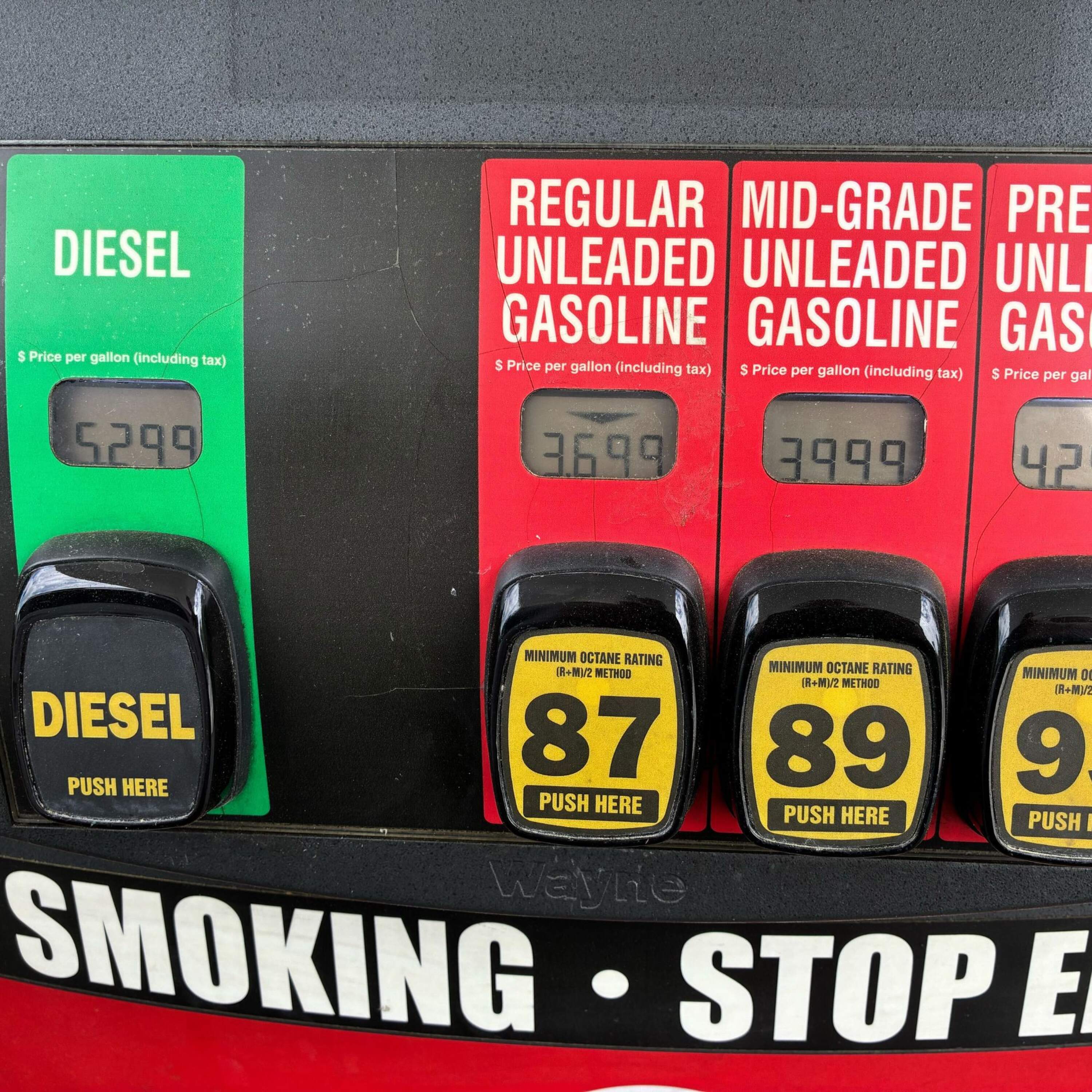
As of our recording, US gas prices are now averaging $4.14 a gallon, the highest in three years. And that's just an average. It can run higher in places like Los Angeles where Carter Victoria was filling up.
- [00:34]
C
It's almost six bucks, 579, something like that.
- [00:38]
B
It's expensive or somewhat cheaper than the national average, like in the southern United States. Gas was 369 a gallon at the Kroger gas station in Savannah, Georgia, where retiree Joseph Spellman was filling up his 2007 Toyota sedan.
- [00:54]
A
Have you noticed you've had to spend more to fill up?
- [00:57]
D
Not really because I don't drive. It used to cost me $5 to drive for a week. Now it cost me $10 so it don't bother me.
- [01:04]
B
I wish I could be as unbothered as Joseph. This is the indicator from Planet Money. I'm Waylon Wong and I'm joined by producer Julia Richie.
- [01:13]
A
Good to be back. The U. S Iran conflict is now entering its second month with no clear exit ramp, sending oil prices to their highest level since the 2008 financial crisis.
- [01:24]
B
The impact on the US and oil prices has been less severe other countries, but that doesn't mean it hasn't been felt at home.
- [01:32]
A
Today on the show, drivers describe how they're adapting to higher prices and an economist tells us when or if we might see some relief.
- [01:45]
E
This message comes from LinkedIn who knows every hire matters when you're running a small business. That's why LinkedIn Hiring Pro uses real time professional data and insights, not just resumes, to find you the best candidates. And in fact, businesses hiring with LinkedIn are 24% less likely to reopen a role within a year compared to the leading competitor hire right the first time. Get started by posting your job for free@LinkedIn.com NPR terms and conditions apply. Support for NPR and the following message come from Edward Jones what does it mean to live a rich life? Maybe it's full of brave first leaps, tearful goodbyes and everything in between. And with over 100 years of experience, your Edward Jones Financial advisor can help. Edward Jones, Member, SIPC this message comes from Dell. Dell PCs with Intel inside are built for the moments that matter. Like a big project that can't be interrupted by an update with long lasting battery life, you can stay focused on what matters built for you.
- [02:51]
B
Dell.com DellPCS Neil Mahoney is an economist at Stanford University. Neil lives in California where gas prices are highest. Still, he's one of the lucky ones because he drives an ev. Not that he hasn't noticed the prices around town.
- [03:08]
F
Every time I drive, I see multiple gas stations with signs where the price is, you know, five, even $6 a gallon.
- [03:17]
A
In California, Neil says gas is about 3% of a household's expenses. It's not as big of a category as, say, rent, but it takes up a hu mindshare.
- [03:27]
B
Yeah, we are constantly aware of gas prices because we see them when we drive and hear about them on the
- [03:33]
A
news or your favorite economics podcast.
- [03:36]
B
Guilty as charged. That's what Carter Victorio told us in LA. Well, not exactly that while filling up his Toyota 4Runner, he can't escape the creep of prices.
- [03:46]
C
I mean, luckily I walk to work, I work just down the street. But I mean, yeah, just like daily stuff is pretty annoying now. And just really when I get to the gas station, it really bums me out because I'm like, I just put in $30 and I'm not even at a quarter tank and I don't drive the most fuel efficient vehicle.
- [04:06]
A
Neil says another reason gas prices are such a big deal is because fuel is non discretionary for many, if not most Americans.
- [04:14]
F
We can cut back on summer vacation, we can switch from buying branded products to store label products at the grocery store, but if we have to commute to work to pick up our kids, we don't have a choice.
- [04:28]
B
And that's exactly what we heard from Candice Lawton in Savannah, Georgia. She was filling up her Toyota Corolla at a Kroger gas station.
- [04:35]
D
Hear more people talking about the gas prices, but honestly, I don't look at them because gas is a necessity. So in order for me to get to where me and my daughter have to go, I gotta buy gas.
- [04:46]
A
Kandas relationship to gas prices is what economists like Neal describe as inelastic.
- [04:52]
F
When we say that demand is inelastic, it means that sort of demand doesn't change based on the price. And gas is a great example of that. If you have to commute 25 miles to work and the price of gas increases, unless you can jump on public transportation, you would just have to pay the increased costs.
- [05:13]
B
Public transit isn't a good option for Candace, so she has to find other ways to cut back.
- [05:18]
D
I'm taking fewer trips, eating out less, that's about it.
- [05:26]
A
And Neil says when these prices start to make us scale back on meals out, like for Candace or bum us out, as Carter told us that has a ripple effect on the larger economy.
- [05:37]
F
So gas really punches above its weight in terms of people's expectation of inflation. So even though the real inflation adjusted impact is smaller, I think the, the impact of it on our collective conscience as consumers, as members of society is
- [05:57]
B
just as large as we've covered before. When people start to anticipate higher inflation, they may spend more before prices go up again or they may ask for a wage increase. All of this can contribute to a cycle of higher prices across the economy.
- [06:11]
A
Christian Hernandez is a small business owner who fixes mobile phones in la. He told us the higher gas prices are not affecting him personally, but will affect his business.
- [06:20]
D
We got to do what we got to do, right? I own a small business. If everything goes up, I need to raise my prices as well. So by the end of the day, it's just a cycle.
- [06:30]
B
The Federal Reserve pays close attention to these cycles when deciding where to set interest rates. It wants to keep inflation at 2% and make sure wages and prices don't keep spiraling. Higher gas prices are a part of this consideration.
- [06:44]
F
So it becomes a sort of indicator of the price in the economy and it drives inflation expectations, which then drive the behavior of the Fed in terms of setting interest rates, which determines how much we pay on our mortgage, on our credit card, et cetera.
- [07:01]
A
Neil and his colleagues did some analysis on how much extra a typical American family could expect to pay over the course of this year. And they looked at projections from Goldman Sachs on what oil prices will be if the Strait of Hormuz remains closed.
- [07:14]
B
The Goldman Sachs forecast for March assumes a three week closure with crude prices topping out at $110 per barrel. Neil says those forecasts show limited traffic at least through April 10th before bouncing back.
- [07:28]
F
I don't know if that's optimistic or pessimistic. Depends upon who you ask. But if you take that number, you can estimate how gas prices will trend over the summer.
- [07:37]
A
According to this model, Neal shows gas peaking at an average of around $4.25 a gallon in April and May before retreating over the summer into fall.
- [07:47]
F
We estimate that the typical family is going to pay $850 more for gas than they would if prices had sort of stayed at the level that folks were projecting before the war.
- [07:59]
B
Again, this is based on a forecast that the strait starts to ramp up on April 10, which now seems rather unlikely. So that $850 is maybe too conservative of an estimate.
- [08:11]
A
Neal noted this is more than the increase people were expecting to get back in tax refunds under the administration's so called one big beautiful bill.
- [08:18]
F
This something this analysis makes clear is gas prices shoot up like a rocket and float down like a feather. It's what economists call the rockets and feathers phenomenon. And so, you know, even if the Strait opens up and we start to see crude prices come down on the global market, that it will take take a while to see normalization of prices at the pump.
- [08:45]
A
This average of more than $4 a gallon for gas is a milestone nationally. But we have been here before. There were oil shocks in the 1970s and between 2009-2014 inflation adjusted gas prices were actually higher in some cases. Plus in 2022 there was an oil shock following Russia's full scale invasion of Ukraine.
- [09:06]
B
The Trump administration has used some of this economic history to fend off criticism of higher prices. It's also pointed out that the US Is a net oil exporter.
- [09:16]
A
Yeah, a Yale economist explained that the global oil marketplace is like a giant bathtub with all the country's oil going into the same basin. So it really doesn't matter who is the exporter or importer. What matters is the price the global market has landed on.
- [09:31]
B
Even if the drivers we spoke to weren't going to stop driving, at least 24 year old Carter in LA is thinking ahead.
- [09:38]
D
If these go any higher, are you
- [09:39]
C
like cooked or what's the vibe? I don't know. You just have to sell the yeah, maybe I'll get a Prius.
- [09:44]
B
But then what's going to happen to EV prices?
- [09:47]
A
We're all cooked, Waylon.
- [09:48]
B
I know.
- [09:54]
A
Next week on the show we'll zoom out to get the international view on oil and gas prices. From gas rationing in Slovenia to blackouts in Bangladesh, we'll see how other countries are handling the crisis.
- [10:07]
B
This episode was produced by Cooper Katz McKim with engineering by Kwesi Lee. It was fact checked by Sierra Juarez. Katkin Cannon is the show's Ed and the indicator is a production of npr.
- [10:20]
G
This message comes from Mint Mobile. If you're tired of spending hundreds on big wireless bills, bogus fees and free perks, Mint Mobile is for you. Shop plans@mintmobile.com Switch taxes and fees extra. See Mint Mobile for details. This message comes from NPR sponsor Charles Schwab with its original podcast on Investing. Each week you'll get thoughtful, in depth analysis of both the stock and the bond markets. Listen today and subscribe@schwab.com on investing or wherever you get your podcasts.