Loading summary
Transcript51 lines
- [00:01]
NPR Announcer
Npr.
- [00:12]
Host
The US Economy is a little paradoxical at the moment. Unemployment is relatively low and yet people are saying it's a terrible time to find a job. The share market slumped in the first month of the war in Iran and yet still talks are still way higher than a year ago. Americans are feeling glum about the economy and yet labor productivity is up.
- [00:35]
Narrator/Host
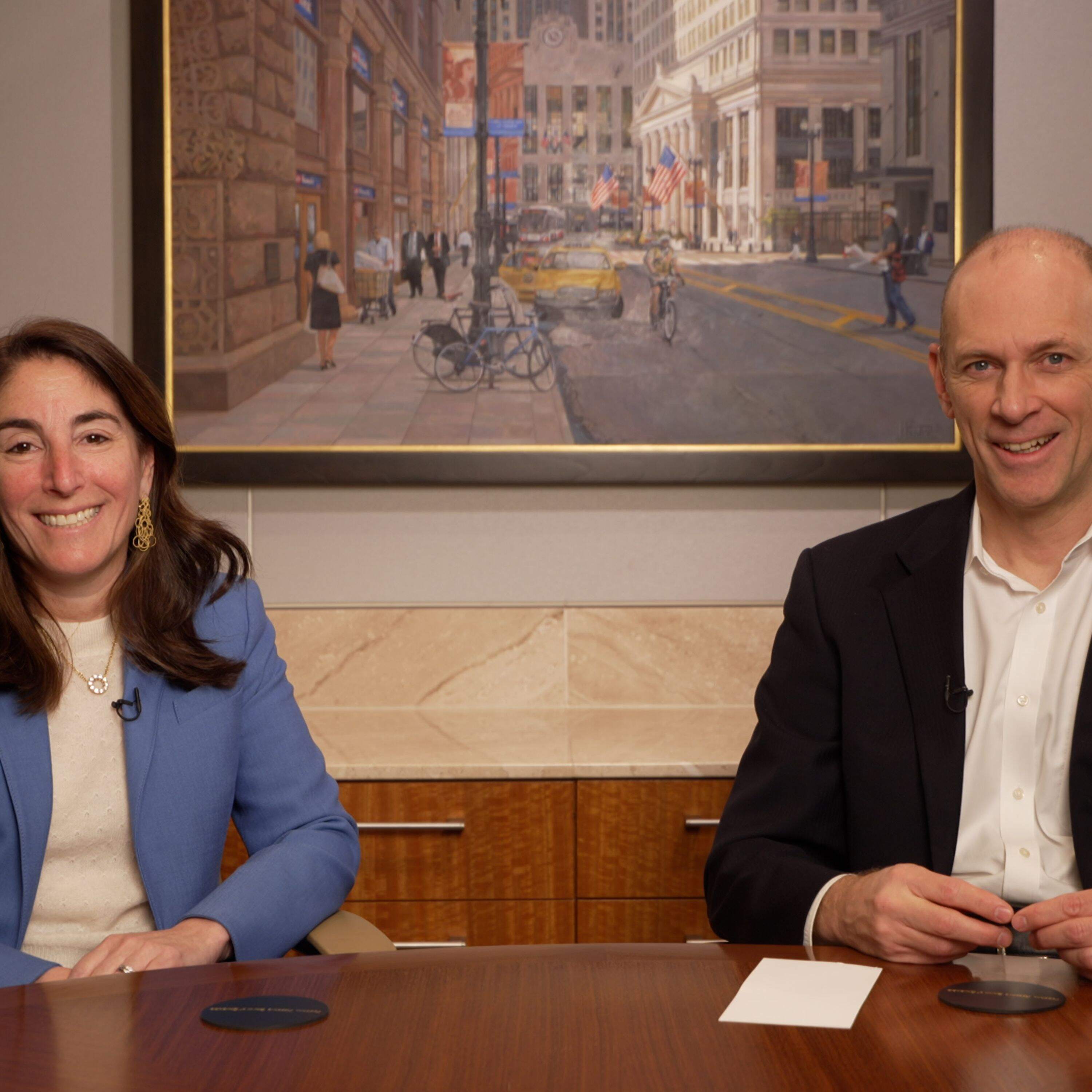
It's times like this when it's helpful to get multiple perspectives, like how about two presidents of the Federal Reserve banking system? Regular listeners will know that there are 12 regional Fed banks around the country. And Austan Goolsbee leads the Chicago Fed. Austan comes from academia and says he doesn't have a bias for higher or lower interest rates, that he's neither a hawk nor, nor a dove.
- [00:59]
Austan Goolsbee
I always said I don't aspire to be a bird of any kind. I just wanted to be one of the data dogs.
- [01:05]
Host
Beth Amic says she's also a data dog. She used to work on Wall street and now is the president of the Cleveland Fed, which covers Ohio and parts of Kentucky, Pennsylvania and West Virginia. And Cleveland has a bit of a rivalry with Chicago that was apparent right as we were getting the mic set up.
- [01:23]
Beth Hammock
Does also need to fix his hair. Is his hair okay?
- [01:26]
Narrator/Host
Austin is bald.
- [01:28]
Austan Goolsbee
If you didn't know, that was a kind of low blow. Now I have no mercy. I was going to have mercy on Cleveland and now there's going to be none.
- [01:35]
Host
And it was tensions between the academic Austan Goolsbee and the markets oriented Beth Hammack that we were keen to hear more about.
- [01:45]
Narrator/Host
So today on the show, taking the Temperature of the Economy, the latest on prices, unemployment and the stability of the entire financial system. After the break,
- [01:57]
Sponsor Announcer
this message comes from Granger. This is the story of the 1. As a procurement manager for a hospital system, she keeps every facility in her network stocked and ready. That's why she counts on Grainger to be her single source for thousands of products, from disinfectants to lighting, air filters and more. And with fast, dependable delivery, Grainger helps her keep every facility stocked, safe and running smoothly. Call 1-800-GRAINGER Click grainger.com or just stop by Granger for the ones who get it done. Support for NPR and the following message come from Edward Jones. A rich life isn't always a straight line. Unexpected turns can bring new possibilities. With a hundred years of experience navigating ups and downs, Edward Jones can help guide you. Let's find your rich together. EDWARD jones, Member, SIPC this message comes from NPR sponsor Carvana Making buying a car 100% online with real transparent pricing and customizable financing that fits your budget. Browse thousands of cars and get yours delivered. Visit Carvana.com today. Delivery fees and terms may apply.
- [03:10]
Host
Beth Hammack, president of the Federal Reserve bank of Cleveland, and Austan Goolsbee, president of the Federal Reserve bank of Chicago, welcome to the show.
- [03:17]
Austan Goolsbee
Yay. Thank you for having us.
- [03:18]
Beth Hammock
Thanks for having us.
- [03:20]
Host
So it's not every day that we get not just one, but two Fed bank presidents to talk with. So I wanted to play a game. I'm going to bring up the three main parts of the economy. The Fed looks at inflation, jobs, and the financial system. And I'd like your assessment of what the outlook is. Red, orange, yellow or green? Red. The house is on fire. Through to green, meaning everything's looking swell. Are you ready?
- [03:46]
Beth Hammock
Yes, I'm ready to go.
- [03:48]
Host
All right, let's begin with prices. The Fed's goal is to have inflation at 2% a year. What colour are we at with inflation? So just the colour first, starting with. Beth. Red, orange, yellow or green?
- [04:01]
Beth Hammock
I would say orange on prices.
- [04:03]
Narrator/Host
Okay.
- [04:04]
Host
And Austin?
- [04:05]
Austan Goolsbee
Yeah, at least orange.
- [04:07]
Beth Hammock
Burnt orange.
- [04:07]
Austan Goolsbee
Orange with the chance of meatballs. You know, it has me. Gray.
- [04:11]
Host
I. Okay. Both in the orange range. Beth, can you talk about your rationale for that color?
- [04:16]
Beth Hammock
Yeah. Inflation has been above our target for coming on five years. We've been trading closer to 3% than our objective of 2%. We made good progress by 2024, but for the past two years, it's been basically moving sideways. And so part of my assessment, and I'd agree with Austin, that it's definitely at the. The brighter, the more vibrant color. Orange. I don't know if that's burnt orange. Burnt sienna. My Crayola box is a little bit old.
- [04:40]
Host
And, Austin, what's your rationale?
- [04:42]
Austan Goolsbee
I mean, just get in your car and look out the window. The price of gas here in Chicago. And that summarizes what everybody already knows, which is prices are up and they're not happy about it. We've been going the wrong way. And we started last year with a series of what I kept calling it stagflationary dust thrown in the air, where stagflation is where both sides of what the Fed's supposed to be doing start getting worse. At the same time, the prices start going up faster than 2%. At the same time, the job market's deteriorating. And I was optimistic that we would get back to this path to 2% inflation. But yikes, it's going from orange to red. Lately we had tariffs increasing prices. That was supposed to go away, kind of didn't go away. And now we're at another stagflationary shock
- [05:41]
Host
on top of it with the oil shock right now.
- [05:44]
Austan Goolsbee
Yeah, that's a troubling moment.
- [05:45]
Host
I'd like to turn to the second of the Fed's dual mandate jobs. The Fed tries to keep unemployment low, also known as full employment. And I'll let you go first, Austan. What mood would your employment mood ring be right now?
- [06:00]
Austan Goolsbee
Yellow. I, I'd say yellow. And it's an unusual environment in the job market because there are some measures that the job market looks bad, objectively bad. The hiring rate is as low as it's been in years. But there are other measures that look fairly benign. Like the layoff rate is extremely low. It's just a low churn, low hiring, low firing labor market, which is extremely unusual. I think the thing that explains that is uncertainty, periods of uncertainty, you tend to see businesses stop hiring, but also not let go of the people that they, that they have. And we've had a lot of uncertainty, but it's mostly stable.
- [06:50]
Host
And Beth, what's your color and why?
- [06:53]
Beth Hammock
Yeah, I would agree. I think we're in that yellow, green kind of area.
- [06:57]
Host
Maybe a chartreuse.
- [06:58]
Beth Hammock
Chartreuse is a good color for it. Yeah, it's a good word for it. I'll go with chartreuse.
- [07:01]
Austan Goolsbee
I'm done with this conversation. We don't wait, Chicago Fed, we don't have chartreuse.
- [07:07]
Beth Hammock
Actually, you know what, it's like the Diet Mountain Dew, the President Bark and drinks. That's exactly the color.
- [07:13]
Austan Goolsbee
It is. We got some weird people in our, in our world.
- [07:16]
Beth Hammock
To me, the best indicator is really the unemployment rate because with all the changes that we've had in immigration, it's hard to know what job creation should be to keep things steady. And the unemployment rate that I see right now is right around my estimates of maximum employment. I think we're just in that zip code and so we'll see how that continues to play through. It is a fragile type of balance in that it is this low hiring, low firing environment. As the mother of two college age kids, I definitely am hearing about how it's been difficult for new entrants into the workforce and, but it does feel like there are still opportunities, there are still places. And you know, I'd say for my district, the fourth district, what I hear more often when I'm out talking to employers is that they have a hard time finding the workers they need, particularly in places like the skilled trades or manufacturing.
- [08:02]
Host
The other big sector of the economy the Fed takes a big share of responsibility for is financial stability. Beth Hammock, what colour would you give for your assessment of the US Economy's financial stability?
- [08:12]
Beth Hammock
I would say we're generally green right now. From a financial stability perspective, there are definitely pockets that I'm watching. Private credit is certainly one of them. But on the whole, I feel good about the state of the banking system. Market seems to be moving very well. Over the past month, you've seen financial conditions tighten a bit. That may be a little bit tricky for businesses as both interest rates have gone higher, equity prices have gone lower. But in general, I think from a financial stability perspective, I think the economy is in a good place.
- [08:41]
Austan Goolsbee
And Austan, I would split it in two ways. You said the financial system, and there is a part of the financial system that in our language is about payments and the plumbing of the financial system. And the Federal Reserve System literally runs $5 trillion of payments per day over its rails. Wire transfers, direct deposit, stuff like that. On that green, solid green, forest green, Amazon green, that's very stable. I'm a little more anxious. Something about valuations.
- [09:21]
Host
And when you say valuations, you're meaning companies. Valuations in the stock market, prices of things like gold, for example.
- [09:28]
Austan Goolsbee
Yeah, if you look at prices compared to earnings and things like that, it does look like there is a lot of frothiness there that has happened. And I don't know if that's bubble or if it's rooted in actual productivity improvements that have come from AI or other technologies. But having lived through a few of those cycles, the kind of asset bubble driven boom bust, they can end in tears.
- [10:02]
Host
Got it. So forest screen for the plumbing and what color for that more general financial sector?
- [10:08]
Austan Goolsbee
Maybe that's yellow. I don't know. You're never going to hear me say the words are true.
- [10:15]
Host
Well, this has been a full spectrum of economic insights. Thank you for joining Austan Goolsby and Beth Havoc.
- [10:21]
Beth Hammock
Thanks for having us.
- [10:22]
Austan Goolsbee
Yeah, really our pleasure.
- [10:24]
Host
This episode was produced by Corey Bridges and engineered by Kwesi Lee. It was fact checked by Vito Emanuel. Kate Concannon edits the show and the indicator is a production of npr.
- [10:37]
NPR Announcer
This message comes from Ezcator, the workplace food platform. Ezcater helps organizations order food from favorite restaurants, meet dietary needs and stay on budget with employee meal programs, flexible payment options and 247 customer support all on one platform. Learn more@easycater.com this message comes from Mint Mobile. If you're tired of spending hundreds on big wireless bills, bogus fees and free perks, Mint Mobile might be right for you. With plans starting from 15 bucks a month, shop plans today@mintmobile.com Switch upfront payment of $45 for 3 month 5 gigabyte plan required. New customer offer for first 3 months only, then full price plan options available, taxes and fees extra. See Mint Mobile for details.