Loading summary
Transcript44 lines
- [00:01]
Alex Borres
Npr.
- [00:12]
Darian Woods
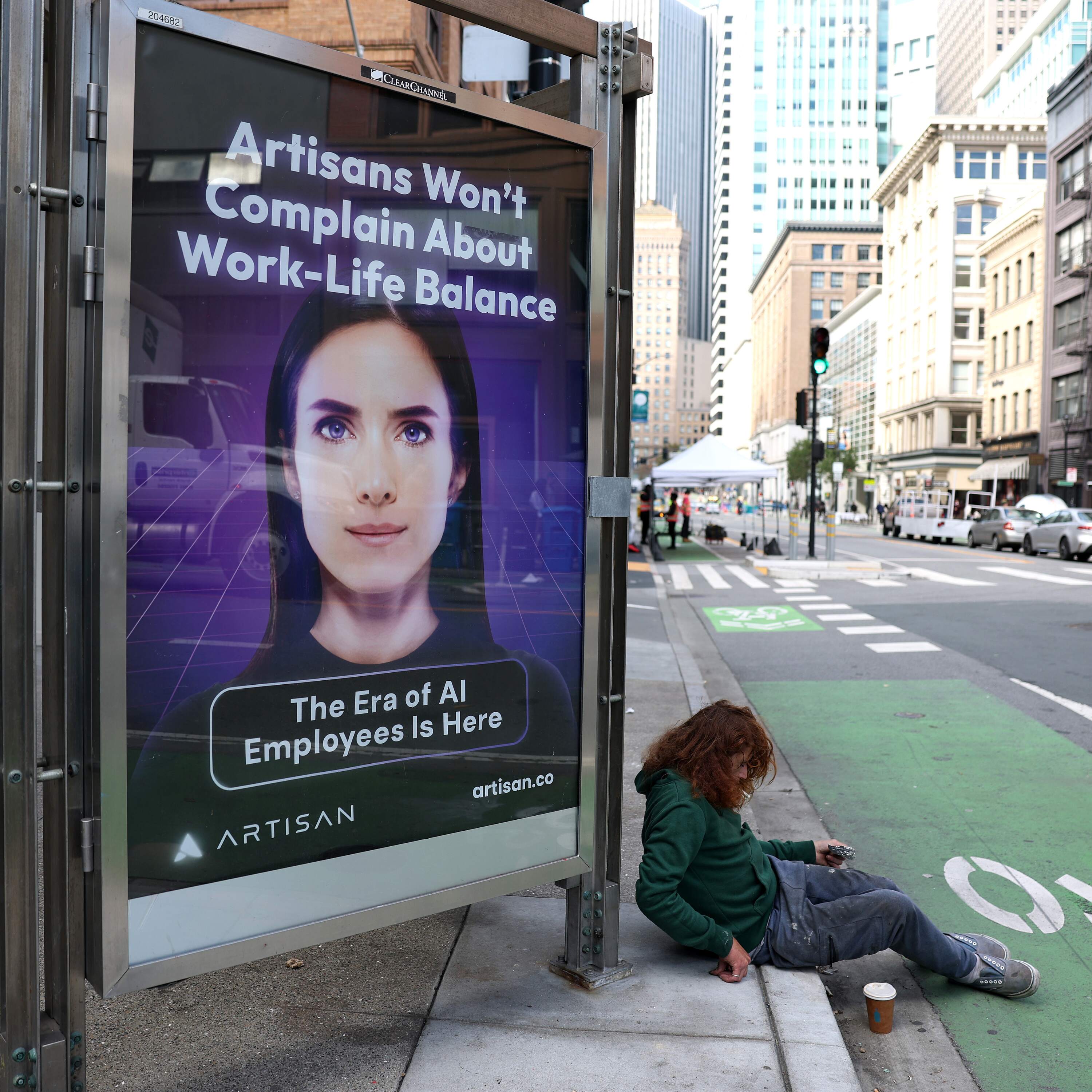
There's a lot of fear out there that AI could eliminate a ton of jobs, form a permanent underclass, and enrich just a few people. Right now. We haven't seen large layoffs, but tech hiring is slow and we've seen huge growth in wealth at the top since the launch of ChatGPT.
- [00:32]
Waylon Wong
Yeah, just scan the rich list. Elon Musk, Oracle's Larry Ellison, Mark Zuckerberg, Jeff Bezos, Google's Larry Page. These are all people whose wealth is ballooning with the race to build AI. The richest 26Americans wealth has grown an estimated 127% since November 2022.
- [00:51]
Darian Woods
And so if this is just a taste of the future, some lawmakers are demanding we tax AI and give the rest of us an AI dividend. This is the indicator from Planet Money. I'm Darian Woods.
- [01:02]
Waylon Wong
And I'm Waylon Wong. Today on the show, should we tax AI? The AI race has made a lot of people richer, but most of those gains seem to have gone to those already with metaphorical bathtubs full of money.
- [01:15]
Darian Woods
Yes.
- [01:16]
Waylon Wong
Meanwhile, everyday workers aren't seeing big pay raises. We speak to a congressional candidate who wants to tax AI, and we talk to a tax expert who has her reservations.
- [01:29]
Insperity/Capella University Sponsor
This message comes From Insperity providing HR services and technology from payroll benefits and HR compliance to talent development. Learn more at Insperity.com HR matters. This message comes from Capella University. You know that feeling when there's a spark building inside you that you were meant for more? That's your own drive pushing you towards what's next. Capella University gets that with their Flexpath learning format, you can set the pace and earn your degree without putting life on pause. You've built experience and know what you're capable of. Now this is your time to turn that momentum into more. The only real question is what can't you do? Learn more@capella.edu.
- [02:16]
Progressive Insurance/Charles Schwab Sponsor
this message comes from Progressive Insurance. Do you ever think about switching insurance companies to see if you could save some cash? Progressive makes it easy to see if you could save when you bundle your home and auto policies. Try it@progressive.com, progressive Casualty Insurance Company and affiliates. Potential savings will vary. Not available in all states.
- [02:38]
Darian Woods
New York State Representative and current Democratic Congressional candidate Alex Borres has a range of measures he's proposing to fund an AI dividend.
- [02:48]
Waylon Wong
Alex Boris is an interesting politician on AI because he really knows the technology. He's a computer scientist who's actually worked at machine learning startups.
- [02:57]
Alex Borres
I'm saying what All Americans are saying, which is, this is happening way too quickly, and government right now doesn't seem up to the task to protect us.
- [03:06]
Darian Woods
Alex's AI dividend would be a direct cash payment to Americans. It would also pay for jobs retraining and education to help workers laid off
- [03:15]
Waylon Wong
by AI, Alex has two main ways he's proposing to tax AI, which will help fund this dividend. The first is by reducing the ability for businesses to deduct AI costs as a normal business expense.
- [03:28]
Alex Borres
Right now, our tax structure actually incentivizes laying people off to invest in AI. We put huge taxes on hiring a human or keeping a human hired. We have employment taxes, we have payroll taxes. We have requirements for benefits, and we put huge discounts on using AI.
- [03:45]
Darian Woods
At the moment, AI is generally not taxed. In some states, like here in New York, I'll pay a sales tax if I use AI. But for businesses using AI, let's say they use ChatGPT, they'll actually deduct that expense from their revenue so they pay less tax.
- [04:02]
Waylon Wong
Alex's second proposal to raise government revenue from AI is what's called a token tax.
- [04:07]
Alex Borres
So a token is the basic unit of these large language models, and it can be either a small word or a piece of a word, but it is the computational unit that a model uses in processing language and understanding.
- [04:23]
Waylon Wong
So asking a chatbot for, I don't know, a lunch recommendation might only use a few tokens, but asking it to generate an essay on the major themes of war and peace would use a lot more tokens.
- [04:35]
Darian Woods
Large AI users are charged by the token. As of this recording, OpenAI charges a standard rate of up to $30 for 1 million tokens of output. So that war and peace essay, that'll cost you a few cents.
- [04:49]
Waylon Wong
OpenAI, what is it good for? Alex says we can think of this token tax as just a tax for commercial AI use, subscriptions, data usage, whatever
- [05:00]
Alex Borres
the basics of it, are taxing the commercial use of AI. The times when you're using AI to replace a.
- [05:07]
Darian Woods
But taxing AI might have unintended consequences. Martha Gimbel is the executive director of the Budget Lab, a policy think tank at Yale University.
- [05:17]
Martha Gimbel
The thing that I think is a little bit frustrating for the tax nerds, so, you know, for the 15 of us, is why, right? Like, what are you trying to do?
- [05:28]
Waylon Wong
Martha says the reason that the why is important is because addressing different problems means using different policies.
- [05:35]
Martha Gimbel
So if you are interested in decreasing energy usage, you would design the tax one way. If you are trying to discourage the use of AI overall. Then you might design something like a token tax.
- [05:52]
Darian Woods
Martha says she's skeptical of a token tax because it's a tax on businesses inputs. So for a call centre, your inputs might be office supplies, rent workers and an AI subscription to help answer customers questions.
- [06:07]
Martha Gimbel
In general, economists tend to like taxing the final output rather than inputs because it means that you don't produce as efficiently. This is the same reason that economists don't like, like steel and aluminum tariffs.
- [06:21]
Waylon Wong
Yeah, it's like the government steering how businesses should be run, not leaving that to business managers. Martha says what would happen if it turned out that not that much AI computing power was required to replace all the call center workers?
- [06:34]
Darian Woods
Yeah, I mean like we all like to think that our problems are individual and special are, but most of us calling this call center, we have the same issues. And maybe the AI bot doesn't have to work very hard.
- [06:46]
Martha Gimbel
They don't need that many tokens. And the token tax isn't aimed at getting, you know, at the increasing profit that that company is seeing from that because there isn't as much AI usage as there was relative to like the number of workers that they had.
- [07:03]
Darian Woods
Martha says contrast this with a hypothetical biochemist who might want to use a lot of AI tokens.
- [07:09]
Martha Gimbel
If you're taxing per token and you have a scientist in a lab trying to cure cancer and they're using a ton of tokens, they then bear the cost of the token tax, whereas the call center that doesn't require as many tokens to replace its workers doesn't.
- [07:30]
Waylon Wong
Martha would prefer that lawmakers look at existing policy gaps. That would be an issue with or without a big wave of job losses due to AI.
- [07:38]
Martha Gimbel
A standard corporate tax or reforming the capital gains system, things like that will do a better job of capturing the revenue that's generated from that.
- [07:50]
Waylon Wong
In other words, Martha says focus on the loopholes in the current system. That means companies in general don't pay their fair share of taxes from profits. She also wants the unemployment insurance system to be more generous to help laid off workers. Whatever the cause, we brought these critiques to lawmaker Alex Boris.
- [08:07]
Darian Woods
Are there existing tools that are more about general inequality or general ways that we tax corporations that don't kind of presuppose a particular pathway for the technology to evolve. Why does AI need to be taxed?
- [08:24]
Alex Borres
Specifically, AI is the first technology ever developed where the makers of the technology are explicitly saying that they are trying to replace all human labor. Every other technology before was by default a complement to human beings, not a substitute. Now, it doesn't mean that the labs will succeed, but having attacks to deal with that difference, that this very well could be about replacing human beings is narrowly tailored and targeted at exactly the thing we're trying to get done.
- [08:55]
Darian Woods
Are you trying to slow down the adoption of AI? And if so, do you think there's a risk that American rivals like China might advance AI faster? If the US Is taxing AI and
- [09:07]
Alex Borres
they're not, I don't primarily think so, but I also think that we shouldn't be incentivizing replacing humans with AI. That's the current policy. I think we should continue research into AI, especially AI safety. But if we're constantly thinking about the race to roll it out everywhere and to everyone, we're going to devastate the economy, we're going to devastate the job market, we're going to devastate our kids. That's not the way to win this race with all of those costs.
- [09:36]
Waylon Wong
Right now, AI hasn't devastated the labor market. Martha points to a census survey of businesses. It shows that 96% of them haven't changed their hiring because of AI, and 2% have actually increased their hiring because of AI.
- [09:51]
Darian Woods
But if that starts to change, you can bet that policymakers will be looking at proposals like Alex's. This episode was produced by Angel Carreras and Julia Ritchie with engineering by Cole Takasugi Chernevan. It was fact checked by Tyler Jones. Cake and Cannon edits the show, and the indicator is a production of npr.
- [10:17]
Progressive Insurance/Charles Schwab Sponsor
This message comes from NPR sponsor Charles Schwab with its original podcast on Investing. Each week you'll get thoughtful, in depth analysis of both the stock and the bond markets. Listen today and subscribe@schwab.com oninvesting or wherever you get your podcasts.
- [10:34]
Insperity/Capella University Sponsor
This message comes from the International Rescue Committee. Across the Middle east, in areas like Gaza and Lebanon, conflict has forced millions of families to flee their homes. IRC staff are on the ground delivering critical supplies, but they need to scale up support. All donations are matched to provide twice the emergency aid. Give now@rescue.org rebuild.