Loading summary
Transcript51 lines
- [00:01]
Gabriela Sade
Npr.
- [00:12]
Darian Woods
This is the Indicator from Planet Money. I'm Darian Woods.
- [00:15]
Waylon Wong
And I'm Waylon Wong.
- [00:16]
Darian Woods
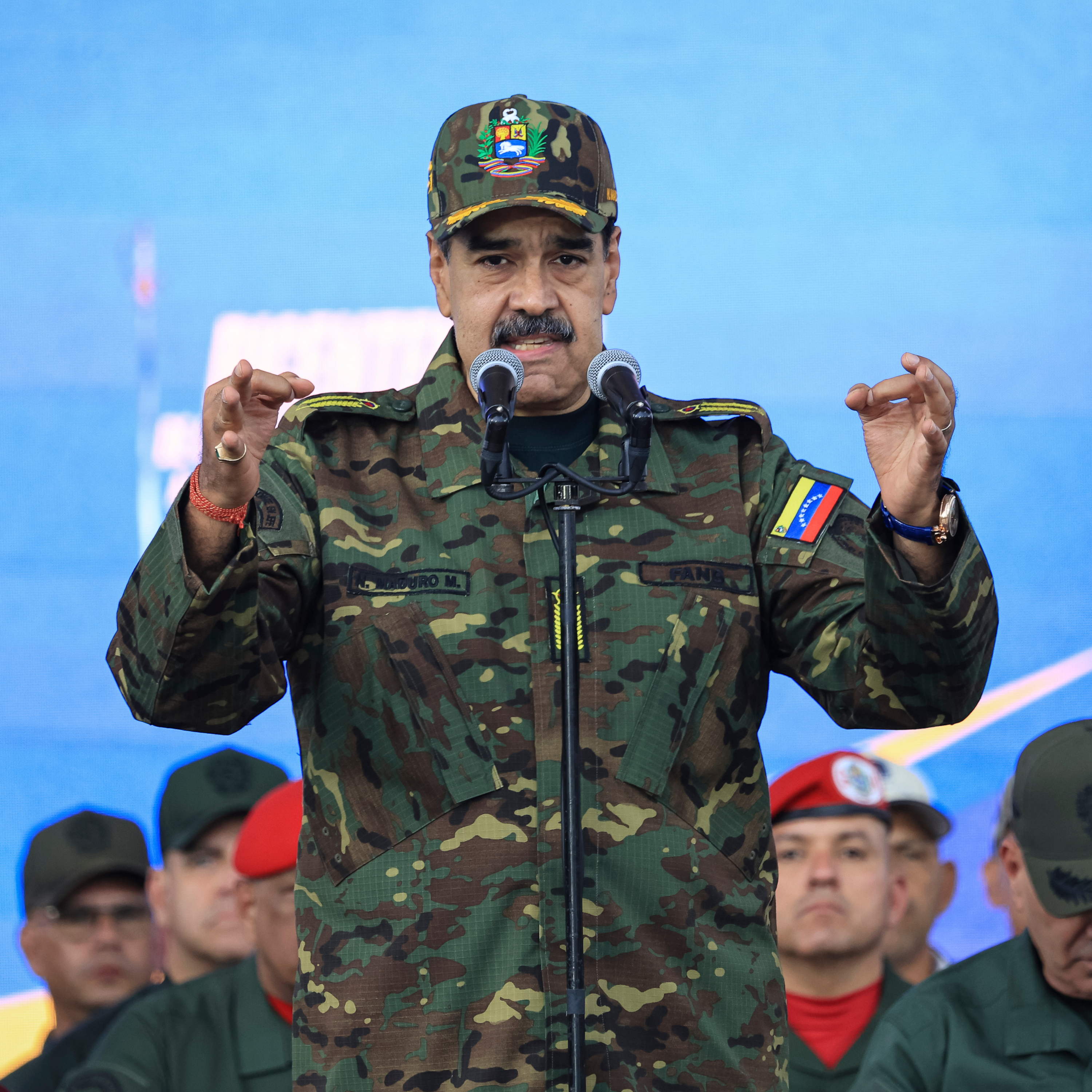
We were watching this weekend as the US military struck Venezuela and extracted its leader Nicolas Maduro at the Indicator. We've been following the conditions in Venezuela over the years. And so as we start to investigate some of the economic questions that are now swirling around around what comes next. We wanted to play you our most recent episode on Venezuela from early 2024. This is the economic background that the rest of the coverage out there often skips past. What it's been like to live there, why the economy went into free fall and then actually stabilised a little. And at the end we have an update from our regular guest who was on the ground in Caracas last night during the strikes. Here's our episode from May 2024.
- [01:06]
Waylon Wong
Venezuela's economy has been in free fall for over a decade. It's an oil rich country that struggles to drill oil. Its currency, the Bolivar, has suffered brain bending levels of hyperinflation. We're talking 65,000% in 2018. Bolivar is just crumbling in your hands.
- [01:24]
Narrator/Host
The seeds of the trouble began under President Hugo Chavez around 25 years ago. He was a leftist populist who made decisions that had some benefits like boosting education and reducing poverty. But some of his actions slowly chipped away at the country's prosperity. He seized control of farms and oil companies assets. He weakened Congress and suppressed his opponents. Towards the end of his rule, the economy faltered and it then nosedived under his successor Nicolas Maduro, who doubled down as a kind of hapless authoritarian.
- [02:01]
Waylon Wong
US Sanctions haven't helped the economy either. The South American country has had one of the largest outflows of refugees in modern history. More than 7 million people left the country in the last decade. That's about one in five Venezuelans.
- [02:15]
Darian Woods
Back in 2019, we at the Indicator started calling into one Venezuelan economist Gabriela Sade. She told us stories about what it was like in the capital of Caracas which was were often grim. Here's her description. In 2019 you go to the streets.
- [02:32]
Gabriela Sade
And people in Venezuela, they are very skinny. Yeah, it's very, very shocking to see.
- [02:38]
Darian Woods
That today on the show. Our check in with Gabriela in 2024 and again this week right after the US bombs dropped in Caracas.
- [02:50]
Sponsor Message
This message comes from NPR sponsor Capella University. Learning doesn't have to get in the way of life. With Capella's game changing flexpath learning format, you can set your own deadlines and learn on your own schedule. That means you don't have to put your life on hold to earn your degree. Instead, enjoy learning your way and pursue your educational and career goals without missing a beat. A different future is closer than you think with Capella University. Learn more at Capella Eduardo. This message comes from NPR sponsor Zoom. Work isn't just meetings. It's calls, chats, docs, emails, calendar invites, events and more. And Zoom brings it all together on one platform. Everything flows together so that you can finally focus on what matters. With Zoom, ideas happen faster, projects move forward, and your workday finally works for you. Zoom is more than meetings, it it's a unified platform powering how people get work done. Learn more@zoom.com podcast and zoom ahead in.
- [03:59]
Darian Woods
Our 2024 check in with economist Gabriela Sade, we started where we left off, groceries in Caracas and comparing them to.
- [04:08]
Gabriela Sade
2019, probably 60% of the shelves of the supermarket would be empty. I remember there was this deodorant, this brand called Mum, and it was really bad and it was the only option available.
- [04:21]
Waylon Wong
There were also more serious problems than deodorant selection blackouts, poverty. Gabriela, as a young professional, was making $300 a month. Not enough, she felt. Which is why Gabriela made the hard decision to leave and come to the United States.
- [04:37]
Gabriela Sade
I have the opportunity to actually save money and I can also, like, support my family who is living there.
- [04:43]
Narrator/Host
Gabriela is an advisor at the Behavioural Insights Team now that's a behavioural economics consultancy. Now every month she sends back $650 back to Venezuela to her mother. But she hadn't been back to visit the country until December last year.
- [05:02]
Gabriela Sade
It was a totally different country. It was pretty wild to see it, almost as an observer. It was very weird.
- [05:09]
Waylon Wong
Caracas had been a ghost town when she left. Now it was full with honking traffic. And because it was Christmas, people just.
- [05:17]
Gabriela Sade
Blasting music and like making ajacas, which is a traditional dish.
- [05:21]
Waylon Wong
That's a special type of tamal.
- [05:23]
Narrator/Host
Gabriela said she even saw some tourists from Europe. She asked them why they'd come and they said they'd heard it was nice from TikTok.
- [05:31]
Gabriela Sade
There was this ongoing joke in 2022, people would say, oh, Venezuela siareglo, which means Venezuela, like got fixed, like it recovered, Right? But that's far from the truth.
- [05:47]
Waylon Wong
One sign of perhaps a superficial fix was in the supermarket.
- [05:51]
Gabriela Sade
The prices were in dollars, so the prices were not in Bolivar. It's like the price tags for those goods. They said R, E, F, ref, which is like a reference price, and it would be in dollars.
- [06:06]
Narrator/Host
This is called de facto dollarization. What happens is you'd go to the counter and you could either pay in US dollars, or if you only had.
- [06:16]
Gabriela Sade
Bolivares, you would just take out your calculator, use the exchange rate, and know how much it is in bolivares.
- [06:24]
Narrator/Host
Yeah, I see that inflation is 200%, which is actually low for recent history in Venezuela. But even then, I guess the shops don't want to be changing their prices too much.
- [06:35]
Gabriela Sade
Yeah, yeah, yeah. So it's just easier just to have the dollar as a reference for prices.
- [06:40]
Waylon Wong
An estimated 45% of transactions in the main cities are now made in foreign currencies, mostly the US Dollar.
- [06:47]
Narrator/Host
De facto dollarization is basically just a band aid over the core problem of the declining currency. Jesus Palacios is an economist at the Venezuelan economic firm Eco Analytica. He says other reforms have been associated.
- [07:04]
Jesus Palacios
In last years. Venezuela has had an average annual growth of 4% in 2021-2023.
- [07:11]
Waylon Wong
Alongside that 4% growth, Jesus says that shortages have eased over the last few years. That's because Maduro's government has loosened the restrictions on imports and price controls he and Chavez had overseen. We know that price controls lead to shortages when more people want something like a deodorant, but the supplier doesn't have the incentive to bring that deodorant into the country. US Sanctions relief during this time pro helped too.
- [07:36]
Jesus Palacios
The economy is growing, but it's more and more unequal. In the last years, the poorest people earn 30 or 35 times less than those with the highest income. This is facts.
- [07:49]
Waylon Wong
Jesus says more than 80% of Venezuelans are still in poverty. You can kind of view the economy of Venezuela as falling off a cliff 12 years ago, and now it's made some small crawls upward, but unevenly. Inequality is worsening.
- [08:05]
Narrator/Host
I saw that there was a Ferrari dealership that opened in Caracas.
- [08:09]
Jesus Palacios
Yeah, yeah. This is amazing in this context. No.
- [08:15]
Narrator/Host
That dealership is for the wealthier Venezuelans who are often plugged into the government apparatus. It's not for ordinary people like Jennifer Antiveros. Jennifer is a housekeeper in Caracas, and as a mother of two young kids, she needs to multitask like she was.
- [08:33]
Jennifer Antiveros
Doing on this call I'm ironing right now.
- [08:37]
Waylon Wong
Jennifer says her income has improved over the last couple of years. She says she's lucky to be on $350 a month, whereas other working Venezuelans get paid as little as $4. But it's still not enough.
- [08:51]
Jennifer Antiveros
The country doesn't get better. We don't get any benefits from being Venezuelan. You can't do anything with your money, like renovate your home, take your kids out to do something. Nothing. We can't enjoy anything. Faith is the only thing that keeps us going.
- [09:06]
Narrator/Host
A lot of people have left Venezuela over the last decade. Do you want to leave Venezuela?
- [09:14]
Jennifer Antiveros
Yes. Yes, I would like to leave. This year we have a presidential election. I wouldn't leave if Maduro lost and was no longer president. But if he stays and gets elected again, which means five more years of this government, five more years like this, five more years of not having enough, not being able to build your own home, not being able to give a better life to your kids.
- [09:36]
Waylon Wong
The election is marked for July, but beneath the economic carnage, Jennifer still loves Venezuela.
- [09:43]
Jennifer Antiveros
The music, the culture, the beaches, all of it, all of the country.
- [09:49]
Narrator/Host
And that's a sentiment shared by Gabriela.
- [09:52]
Gabriela Sade
If things actually get better and there are more opportunities for people like myself, I know for a fact that I.
- [09:58]
Darian Woods
Won'T be alone in returning darian here from 2026. Maduro stayed in power until Saturday morning when the US military attacked Venezuelan targets. Gabriela was in Caracas. As it was happening, she sent me this voice memo.
- [10:15]
Gabriela Sade (voice memo)
So basically at 2am I heard the first strike. It was extremely loud and you could hear kind of like imagine like a plane falling or something in free fall and then the explosion. Then a few seconds later, the other one, the military helicopters or whatever, you could hear them like constantly. And they were flying so, so close. And we didn't know who was perpetrating this attack. But yeah, it was really, really scary because this thing happened until like 5am.
- [10:51]
Gabriela Sade
And no one really knows what's happening.
- [10:54]
Gabriela Sade (voice memo)
Now who's in charge?
- [10:56]
Darian Woods
President Trump said in a press conference that the US Was going to run the country until such time as we can do as proper and judicious transition. In the weeks to come, we will be following what this means for Venezuela's economy. And of course, our friends on the ground there like Gabriela. Send us your questions you'd like the Indicator to answer on future episodes. IndicatorPR.org this episode was produced by Julia Ritchie and engineered by Alex Goldmark. It was originally produced by Angel Carreras with engineering by Neil Rauch. It was fact checked by Sarah Juarez Cake and Karen edits the show and the indicator is a production of npr.