Loading summary
Transcript49 lines
- [00:01]
Jason Grumey
Npr.
- [00:07]
Waylon Wong
This is the Indicator from Planet Money. I'm Waylon Wong here with friend of the show and host of the public radio podcast Outside In, Nate Hedge. Hey, Nate.
- [00:15]
Nate Hedge
Hey, Waylon. It's great to be back.
- [00:17]
Waylon Wong
What do you got today?
- [00:18]
Nate Hedge
First, I've got a question for you. If the government doesn't want more of something, what does it normally do?
- [00:25]
Waylon Wong
Pass a law against it. Like a ban or a moratorium?
- [00:28]
Nate Hedge
Yeah, exactly. Remember Biden putting a moratorium on offshore oil gas drilling? Or when former New York Mayor Michael Bloomberg banned big sodas.
- [00:37]
Severin Borenstein
Remember that?
- [00:37]
Waylon Wong
Oh, yeah. I wasn't living there at the time, but it was national news. Did it end up sticking?
- [00:41]
Nate Hedge
No, it did not. I looked it up recently. Did not stick. Did not stick. Well, anyways, Trump has been doing something unusual. Instead of bans and moratoriums, he is opening the checkbook. His administration will be paying energy firms billions of dollars to completely walk away from wind farms. The latest casualty is a proposed offshore wind farm in North Carolina. U.S. company Duke Energy agreed to $129 million buyout from the White House to abandon its plans to build it.
- [01:12]
Waylon Wong
Today on the show, why is the federal government paying companies to not build things? And what does it mean for our energy bills? Stay tuned.
- [01:24]
Capella University Announcer
This message comes from Capella University. You know that feeling when there's a spark building inside you that you were meant for more? That's your own drive pushing you towards what's next. Capella University gets that with their flexpath learning format, you can set the pace and earn your degree without putting life on pause. You've built experience and know what you're capable of. Now this is your time to turn that momentum into more. The only real question is what? What can't you do? Learn more@capella.edu. this message comes from Edward Jones, where they believe rich is more than caring about the latest and greatest. It's also about taking care of what gives your life meaning. That's why your dedicated financial advisor meets you where you are with personalized financial strategies that help protect what matters so you can preserve your progress while creating a path forward. The key to being rich is knowing what counts. Let's find your rich together. Edward Jones Member, SIPC
- [02:31]
Waylon Wong
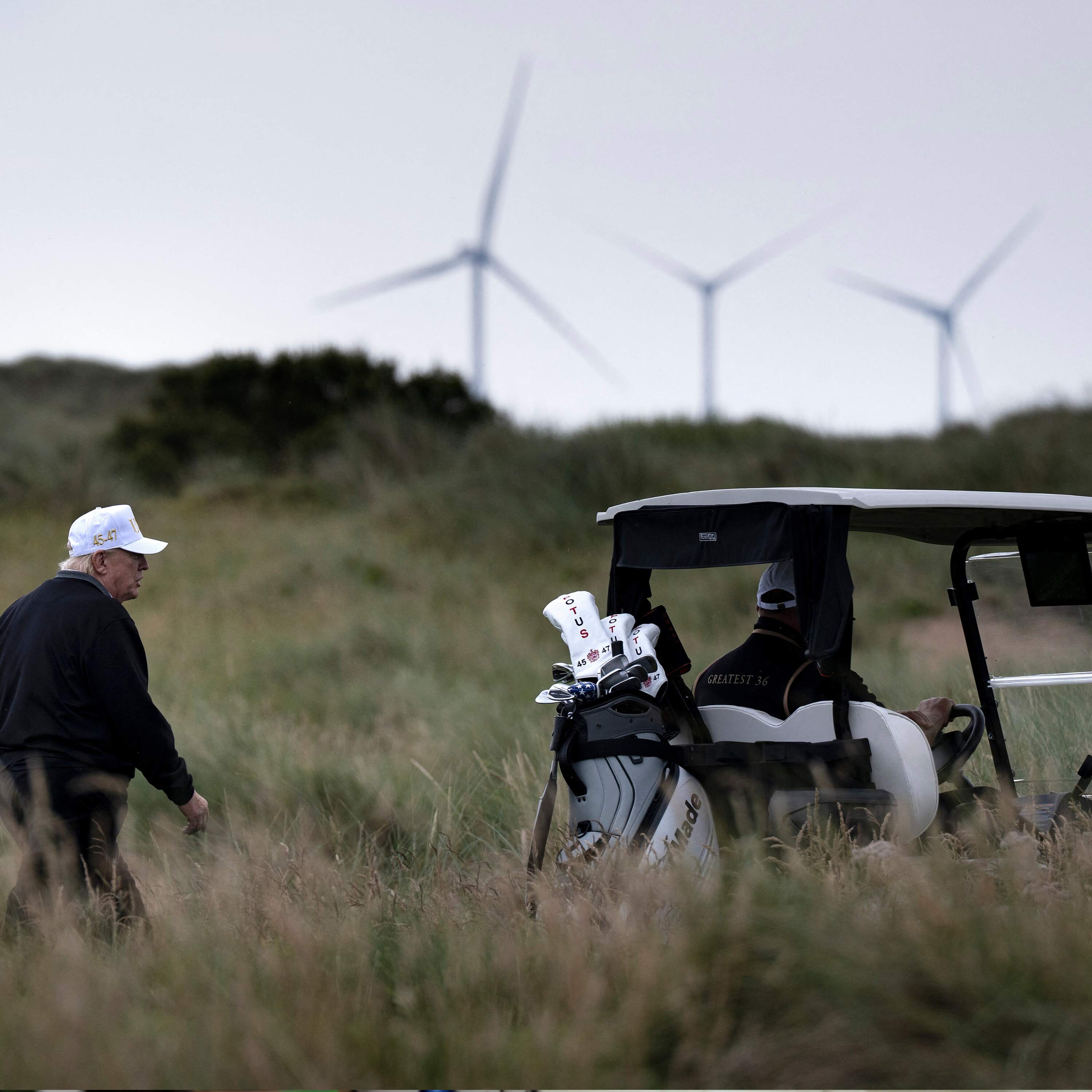
President Trump's beef with wind farms is personal. It goes back nearly two decades to when he began building what he called the world's greatest golf course in Scotland.
- [02:41]
Nate Hedge
But there were also plans to build an offshore wind farm nearby, and Trump was not happy, mainly because he thought the would ruin the view. And he still hates the way they look today. Last summer, when he was visiting Europe, he said this to reporters.
- [02:54]
Donald Trump
Stop the windmills. You're ruining your countries. I really mean it. It's so sad. You fly over and you see these windmills all over the place, ruining your beautiful fields and valleys and killing your birds. And if they're stuck in the ocean, ruining your oceans.
- [03:11]
Severin Borenstein
He has, from the very beginning of his political life, railed against wind power in general, saying many things that aren't true and many things that have a grain of truth.
- [03:23]
Waylon Wong
That's Severin Borenstein. He's the faculty director of the Energy Institute at UC Berkeley's Haas School of Business. He points out that wind farms do have some environmental impacts.
- [03:33]
Severin Borenstein
They bother some people. They have killed birds. When you put that in the context of what most other energy sources do, it's pretty minimal.
- [03:44]
Nate Hedge
I should also say that they are a problem for bats, too.
- [03:46]
Waylon Wong
Bats? I thought bats just were in their caves all the time.
- [03:49]
Severin Borenstein
No, no.
- [03:50]
Nate Hedge
They're flying around, getting hit by. By windmills.
- [03:52]
Waylon Wong
Like the wind. Is it like they can't detect where the. The windmills are?
- [03:56]
Nate Hedge
That's such a great question.
- [03:57]
Waylon Wong
I'm so concerned about bats. Okay, I got to put a pin in this. Otherwise, we'll never finish this episode. Since President Trump got back into office last year, his administration has tried a few aggressive tactics to stop new wind farms. First, there was an executive order halting permits for new wind farm lands and waters that was shot down by the courts in December.
- [04:18]
Nate Hedge
The administration also tried halting new projects, citing national security concerns. They've made an argument that the farms interfere with military radar.
- [04:26]
Severin Borenstein
But there really isn't much evidence supporting those claims, and judges, when faced with those claims, have generally rejected them. So they haven't been very successful in making a real case that there's a problem.
- [04:40]
Waylon Wong
In fact, wind farms have been operating across Europe and Asia for decades with no significant problems. So none of this was really working until the Trump administration found a workaround opening the checkbook. It has agreed to spend more than $2.7 billion to buy out and cancel nine large offshore wind leases. The leases were originally awarded by the Biden administration back in 2022.
- [05:05]
Nate Hedge
None of these wind farms were actively being built when Trump offered the money. Instead, his administration was buying back the rights to build those farms on sections of federal waters. While many of the companies are getting a full reimbursement for what they paid for the leases, a couple aren't.
- [05:20]
Severin Borenstein
So they're losing money on the resale back to the federal government. And that obviously reflects the fact that they think that the future for these projects, at least under this administration, is pretty bleak.
- [05:33]
Waylon Wong
At least one company has said as much. In a press Release, French company TotalEnergies argued that wind projects aren't in the US's interest anymore. And as part of its agreement with the Trump administration, it's reinvesting that money into a major natural gas plant in Brownsville, Texas. Severin says this is misguided.
- [05:51]
Severin Borenstein
We know that they put out significant greenhouse gases and other pollution, and so I think that that's really investing in a technology that is not likely to be the future.
- [06:03]
Nate Hedge
This idea of essentially subsidizing scarcity by paying firms not to develop energy projects is pretty novel in American history. I mean, bans and moratoriums, sure, but
- [06:14]
Severin Borenstein
actually spending federal money to take away these rights or to buy out these rights is extremely unusual.
- [06:23]
Nate Hedge
We reached out to the White House spokeswoman Taylor Rogers said the administration is, quote, simply returning the money that companies bid on offshore wind projects that are unable to be built due to national security concerns, end quote.
- [06:36]
Waylon Wong
Those security concerns that did not convince any judges.
- [06:40]
Nate Hedge
Yeah, exactly. Those security concerns.
- [06:42]
Waylon Wong
I see. Well, Severin says that this is actually going to have a pretty big impact on the development of offshore wind, which here in the US is still a nascent energy source. And that's a shame, he says, because offshore wind is actually more reliable than onshore wind. Wind speeds over the sea are generally faster and steadier, but it needs a lot of investment in the beginning to help bring prices down. And without that, offshore wind in the US will continue to be very expensive and not as widely adopted.
- [07:11]
Severin Borenstein
I'm quite concerned about this. I think the people who say, oh, no, renewables, it has such momentum now, there's nothing you can do to slow it down, are really not looking at the facts.
- [07:22]
Nate Hedge
Senate Democrats have railed against Trump's plan. An investigation they held found that these projects would have powered millions of homes and created tens of thousands of jobs. The renewables energy industry is also worried. But the pain of these attacks on wind could be temporary. That's according to Jason Grumey, the CEO of the trade group the American Clean Power association.
- [07:43]
Jason Grumey
You know, 90% of all of the new electricity is added to our nation's electricity grid over the last few years has come from clean sources. And if the administration obstructs the kind of, you know, economic reality of American energy, you're going to see prices skyrocket, at which point they'll have to back down. It's just a question of how much unnecessary harm happens to consumers in the economy while they figure this out.
- [08:06]
Waylon Wong
Jason actually sees similarities to when Biden cracked on an oil and gas during his term as president. Then the full scale invasion of Ukraine
- [08:14]
Jason Grumey
happened, gasoline prices shot up, and then they went to Houston and said, please drill more. You know, I think we're expecting some version of the same thing will happen if the Trump administration actually intentionally drives up American energy bills. You know, at this moment, when gasoline prices are spiking because of the war in Iran, you know, the idea that we would be blockading domestic American energy at the same time is pretty hard to, pretty hard to fathom.
- [08:42]
Nate Hedge
And either way, Severin Borenstein, the energy expert, doesn't think the economic pain of these buyouts will be that immediate, mainly because unlike oil and gas, these offshore wind farms aren't woven into the economy right now and it would take years to get them built and connected to the grid. This, he says, will be a future problem.
- [09:00]
Severin Borenstein
What the demand growth situation will be like five or ten years from now when we would start to see some of this offshore winds connect, is murkier. I know there are these forecasts of astronomical growth between now and 2035 due to data centers, but I think that there's huge uncertainty and the really aggressive forecasts are coming from people and companies that have a pretty strong incentive to put that narrative out there because they want to make sure that the power is available when they actually build their data centers.
- [09:41]
Nate Hedge
But he says, bottom line, it's unfortunate
- [09:43]
Severin Borenstein
not to have this as one more quiver in our arsenal to fight climate change and to grow our electricity supply.
- [09:55]
Waylon Wong
Multiple states and NGOs have sued to try and stop the buyouts. So we'll see if Trump's latest attempts to collapse America's wind power industry by subsidizing scarcity, which will actually work. This episode was produced by Vito Emanuel and engineered by Robert Rodriguez. It was fact checked by Tyler Jones. Cake and Cannon edits the show and the indicator is a production of npr.
- [10:24]
Rosetta Stone Announcer
This message comes from Rosetta Stone. Rosetta Stone is designed to make language learning intuitive. It mimics how people naturally acquire speech as children, helping users read, write and think in a second language. More@RosettaStone.com this message is from Synchrony bank who wants to remind you to stay flexible. Not the yoga bending circus performing kind of flexible, financially flexible like with their high yield savings account. Stay flexible@synchrony.com NPR member FDIC.