Loading summary
Transcript43 lines
- [00:01]
Adrian Ma
Npr.
- [00:06]
Paddy Hirsch
This is the indicator from Planet Money. I'm Adrian Ma.
- [00:09]
Narrator/Host
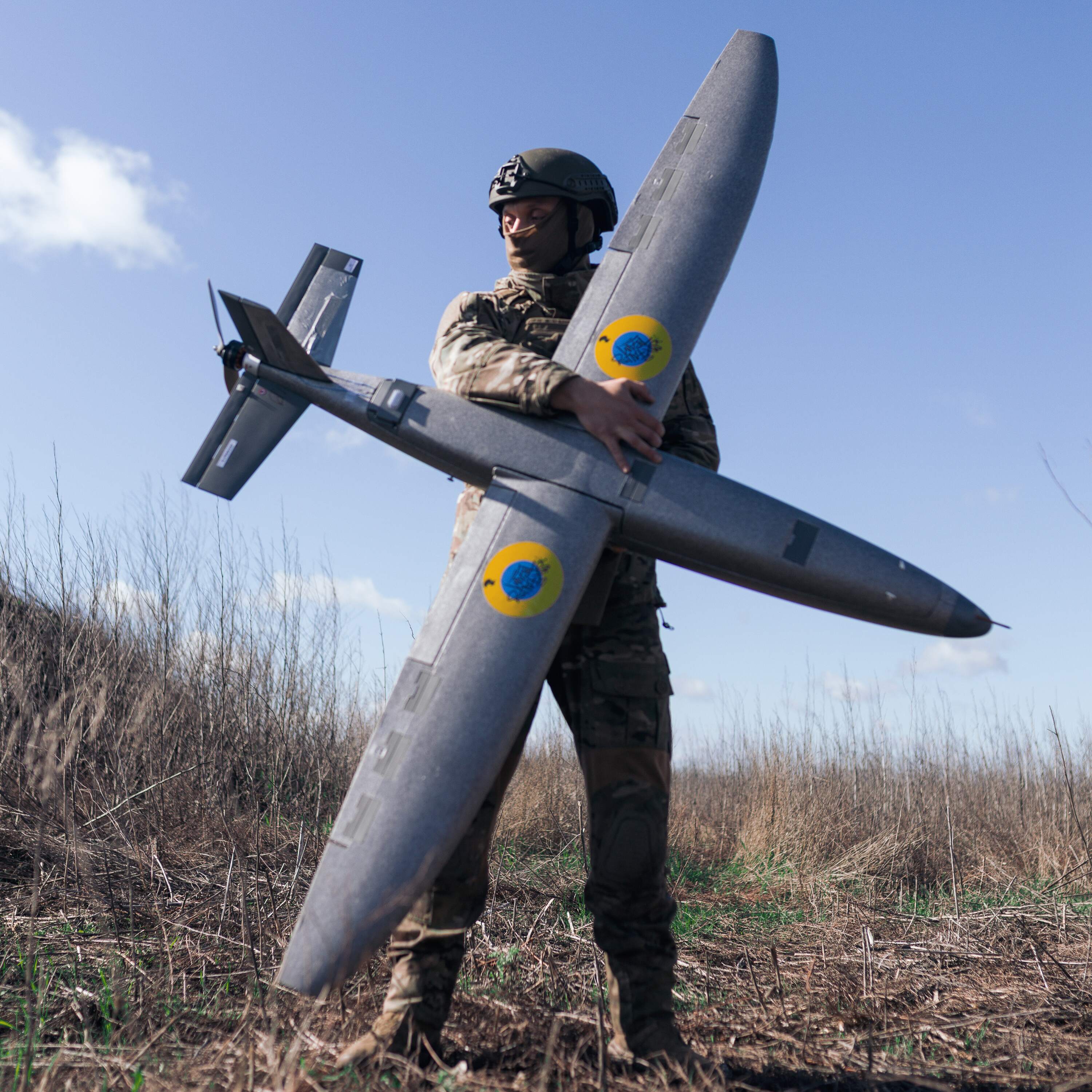
And I'm Paddy Hirsch. Over the course of history, key advances in technology have made fundamental changes in the way human beings wage war. The longbow, gunpowder, the airplane, the tank, the nuke, and now the drone drones
- [00:22]
Paddy Hirsch
that can fly in swarms over hundreds of miles. Sea drones that can attack targets underwater or on the surface and land drones that can move across terrain and hold positions for days as long as they have ammunition.
- [00:35]
Narrator/Host
Now, drones were around before the wars in Ukraine and Iran, but those conflicts have driven the proliferation of drone technology and made a fundamental change in the way we fight. Drones are now embedded in warfare.
- [00:46]
Paddy Hirsch
We reported earlier this year that combating small, cheap drones used by Iran has drained the US Military arsenal of expensive high tech weapons systems. So you'd think the US Being the world's biggest arms maker and exporter would be right on top of this, right?
- [01:02]
Narrator/Host
Yeah, you would. You'd think our defense businesses would be dominating the development and production of drones and the weapons we need to fight them. But they're not. And there are a lot of reasons for this. On today's show, we're going to focus on just three. That's coming up after the break.
- [01:21]
NPR Sponsor Announcer
This message comes from NPR's sponsor, Shopify. No idea where to sell? Shopify puts you in control of every sales channel. It is the conference platform revolutionizing millions of businesses worldwide. Whether you're a garage entrepreneur or IPO ready, Shopify is the only tool you need to start, run and grow your business without the struggle. Once you've reached your audience, Shopify has the Internet's best converting checkout to help you turn them from browsers to buyers. Go to Shopify.com NPR to take your business to the next level Today.
- [01:49]
Paddy Hirsch
This message comes from NPR sponsor Carvana. Carvana believes selling your car should be easy. Get a real offer down to the penny picked up from your driveway. You may keep waiting for a catch. There isn't one. Sell today@carvana.com pickup fees may apply.
- [02:06]
NPR Sponsor Announcer
250 years ago, the nation's founders considered a free press a critical protection for we the people. Today, the NPR network proudly upholds your First Amendment rights with reporting accountable only to you. It's something we protect together. Power, a truly independent press. Support the NPR Network@plus.NPR.org
- [02:32]
Narrator/Host
when it comes to making and selling weapons, the United States is the undisputed heavyweight champion of the world. It accounts for roughly 42% of global arms exports, and that includes drones. By the way, Stacey Pettyjohn is director of the Defense Program at the center for a New American Security. She says the US Was well ahead of the curve when it came to getting into the drone business.
- [02:54]
Adrian Ma
The US Is the leader in advanced expensive drones, and that's what the US Military acquired a lot of for the global war on terrorism, the wars in Iraq and Afghanistan. But these are 30 million or like very expensive drones compared to what we're talking about that Iran, Russia or Ukraine is building and using.
- [03:18]
Narrator/Host
And this is how the American military rolls or has rolled at least since the 1980s. The Department of Defense, or war, if you prefer, has expensive tastes.
- [03:28]
Adrian Ma
The US Military tends to prefer things that are quite high end, reusable, not like something that maybe you use it a couple times. Maybe you only get one use out of it. Even our missiles that are single use are expensive and high end.
- [03:43]
Paddy Hirsch
And this is the first reason it's become difficult for the American military and the defense industry to pivot to this new paradigm of warfare. There is what Stacey calls an institutional bias against cheap stuff. That and it's why we had $4 million cruise missiles shooting down $4,000 drones off the coast of Iran.
- [04:02]
Adrian Ma
The U.S. s military edge has been built on this qualitative superiority that you have the better technology, not the cheaper thing.
- [04:10]
Narrator/Host
Now, the military isn't stupid. It's wise to the asymmetry that drones, whether on land or sea or in the air, bring to a conflict. And the top brass is working to acquire better, cheaper weapons to combat these systems. The difficulty lies with integrating that cheap stuff with the expensive gear that we
- [04:28]
Adrian Ma
figuring out how to integrate them. When you have this much more sophisticated military that includes large battleships, you know, carrier strike groups, submarines, tactical aircraft, stealthy bombers, where does a tiny commercially derived drone fit in? And how do you make these different pieces work together?
- [04:50]
Paddy Hirsch
The second big reason the US Defense industry is struggling to keep up with the cheap and nasty drone revolution is the procurement process. That is the way the government orders its weapons.
- [05:01]
Adrian Ma
Our acquisition processes and our budgeting processes have been built and are tailored for these exquisite reusable systems.
- [05:10]
Narrator/Host
Budgeting takes years. Stacey says the Government Accountability Office find that it can take more than a decade for big weapons programs to actually start operating on the ground. Companies with defense contracts call this the valley of death because they have to hang about waiting for years without pay, by the way, for the Pentagon to complete its reviews.
- [05:30]
Paddy Hirsch
Now, once again, the military powers that be are aware that this is a problem. Last year, the DoD announced an overhaul of its procurement process designed to Speed things up.
- [05:41]
Adrian Ma
They're putting a lot of money out and trying to quickly issue contracts and have competition among small drone companies and field them. And that is intended to provide a more stable and a longer term demand signal so that US Companies can start to break into the market.
- [06:02]
Narrator/Host
The US Defence industry regards this as a welcome policy of the Trump administration. It could help US Companies develop and build the new, cheaper weapons the military needs to fight this new kind of war. Unfortunately, however, there's another administration mandate that's getting in the way of changing the procurement process. You could call this reason two, Part B.
- [06:23]
Adrian Ma
The US Military only wants to use systems that do not incorporate Chinese components or are Chinese built. And that's a real problem because Chinese companies dominate the commercial drone market.
- [06:38]
Paddy Hirsch
And Stacy's not just talking about finished drones here. She's talking about a lot of stuff that goes into drones.
- [06:44]
Adrian Ma
There are materials, things like rare earths, that China dominates the market. Different subcomponents that are really important to drones, like brushless motors, batteries, some of the sensors.
- [06:57]
Narrator/Host
You can get these parts from other countries, but they tend to be more expensive and they're just not as good.
- [07:03]
Adrian Ma
So you end up buying more expensive inputs, and you then end up undermining one of the main propositions of drones, which is that they're cheap because they're no longer cheap. You're buying a $30,000 quadcopter that doesn't perform as well as a DJI Mavic 3, which is, you know, a couple thousand bucks.
- [07:24]
Paddy Hirsch
You'd think that there would be some sort of communication between these different parts of the Pentagon.
- [07:30]
Narrator/Host
This is government as usual, Adrian. But, you know, all jesting aside, you might be thinking to yourself, well, where is the government's sense of urgency when it comes to this issue? I mean, after all, we just spent as much as $113 billion striking Iran and fending off its drones. We've seriously depleted our stocks of interceptors and strike missiles. It's clear to everyone that drones have changed the nature of warfare. And yet, while the Ukrainians are frantically innovating and adapting and churning out as many as 1,000 drones a day, the US is still lagging behind.
- [08:00]
Paddy Hirsch
And this is the third big reason we're not seeing this immediate pivot by the US Defense industry to making smaller, cheaper weapons like drones, the US Is not in a shooting war. And there just isn't the same pressing need in Washington as there is in Kyiv.
- [08:16]
Adrian Ma
The urgency of the situation in Ukraine is driving them to be very innovative, to take a lot of risk and to do pretty amazing things. It's not to diminish what they're doing at all. But we don't have any of that here.
- [08:30]
Narrator/Host
The Pentagon is in a difficult position. Stacey says it wants to keep pace with developments, but the technology is changing too fast to keep up.
- [08:38]
Adrian Ma
No matter what the peacetime demand just from the US Military is going to be much smaller than what you see in terms of Russia or Ukraine at war needing 4 million drones a year. You don't want to buy 4 million of these drones that are obsolete within a year. And that's being really generous since adaptation cycles on the front lines are much more, much faster than that.
- [09:00]
Paddy Hirsch
That mismatch in pace and demand makes it nearly impossible to place orders with small defense contractors that are developing these weapon systems. And it's just as hard for those contractors to bid. I mean, who knows what the defense landscape will look like in a year.
- [09:14]
Narrator/Host
Yeah. And meanwhile, Stacey says the big defense companies like Lockheed Martin and Northrop Grumman, they're still focused on where the real money is.
- [09:23]
Adrian Ma
While there's a lot of money right now in drones, if you're talking about a fraction of $150 million, you know, you have airplanes that cost more than $150 million for one.
- [09:35]
Narrator/Host
Just talking about fast jets like the F16 that can cost 150 million and the F35, that's about 100 million a pop. And can you guess how many fast jets Lockheed Martin delivered last year? More than 200.
- [09:47]
Paddy Hirsch
Okay, well, I guess we know where the money is.
- [09:51]
Narrator/Host
Yes, we do.
- [09:54]
Paddy Hirsch
This episode was produced by Cooper Katz McKim and Angel Carreras. It was engineered by Travis Hagan. It was fact checked by Sierra Juarez. Cake and Cannon is our editor and the indicators of production of npr.
- [10:09]
NPR Sponsor Announcer
This message comes from NPR sponsor Shopify. No idea where to sell? Shopify puts you in control of every sales channel. It is the commerce platform revolutionizing millions of businesses worldwide. Whether you're a garage entrepreneur or IPO ready, Shopify is the only tool you need to start, run and grow your business without the struggle. Once you've reached your audience, Shopify has the Internet's best converting checkout to help you turn them from browsers to buyers. Go to Shopify.com NPR to take your business to the next level today. This message comes from Rosetta Stone. New Rosetta Stone Sapphire combines their trusted immersion method with the latest innovations in technology to help you learn faster and personalize your they have helped millions learn languages for over 30 years. Take your language skills to the next level with Rosetta Stone Sapphire. Get unlimited access to all 25 Rosetta Stone languages, plus all the new Sapphire learning tools. Visit rosettastone.com NPR and receive 20% off today.