Loading summary
Transcript46 lines
- [00:01]
NPR Announcer
Npr.
- [00:12]
Darian Woods
This is the Indicator from Planet Money. I'm Darian Woods.
- [00:15]
Paddy Hirsch
And I'm Paddy Hirsch.
- [00:16]
Darian Woods
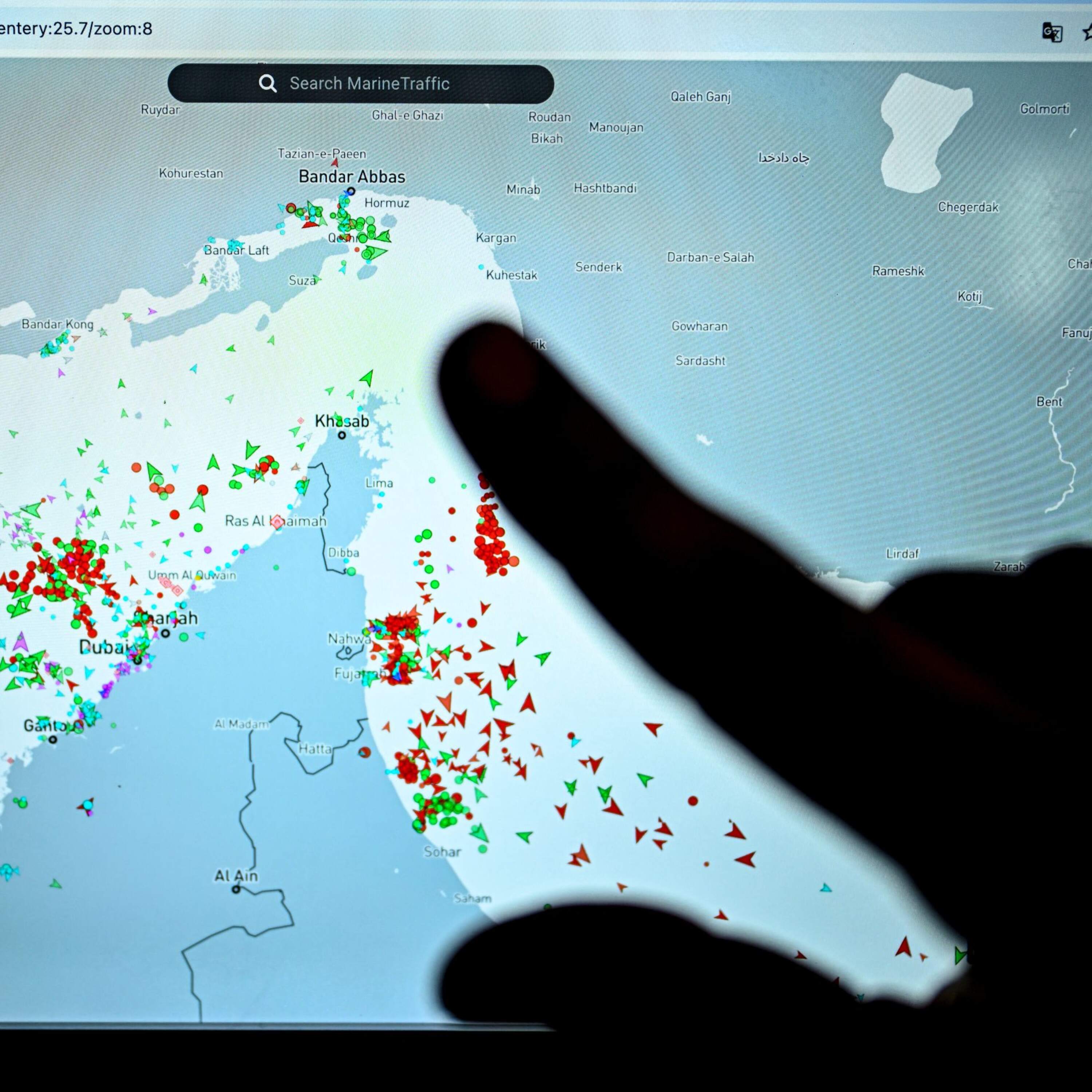
Right now there's a traffic jam in the Persian Gulf. More than a thousand vessels are stuck floating in the warm sun kissed seas of Saudi Arabia, Bahrain, Dubai.
- [00:26]
Oil tankers, gas tankers, container ships, bulk goods carriers, they're all trapped to the west of what has become the world's most famous trade choke point, the Strait of Hormuz.
- [00:37]
And there are a lot of reasons why these ships are stuck there, all related to the war with Iran. But one of the biggest of all is insurance. On today's show, we'll learn why the world's most boring financial product has turned into a trade terrorist hijacking the market in oil, which this week briefly soared to over $100 a barrel.
- [00:55]
But don't worry, President Trump has a plan. We will look into a solution to open the strait and bring the price of oil back down. After the break.
- [01:05]
Indeed Sponsor
This Message comes from Indeed hiring do it the right way with Indeed sponsored jobs claim a $75 sponsored job credit to get matched with quality candidates@ Indeed.com podcast. Terms and conditions apply Right now.
- [01:21]
Darian Woods
Rachel Siemba says the Persian Gulf is a mess.
- [01:25]
Rachel Siemba
I would describe it as a parking lot, as pathways that are frozen. These are pathways that are normally bustling that now have very few vessels going through.
- [01:41]
Darian Woods
Rachel is a fellow at the center for a New American Security where she focuses on economics, finance and security issues. She says vessels aren't moving because they're worried about being attacked or seized by Iranian forces.
- [01:53]
Paddy Hirsch
But that's not all.
- [01:54]
Rachel Siemba
They're also facing much higher insurance costs. Insurance premium for their political risk insurance.
- [02:02]
Darian Woods
Political risk insurance, sometimes called war insurance. This is a special kind of insurance to cover stuff that regular shipping insurance policies generally don't. Like being hit by a missile or detained by the Iranian navy.
- [02:16]
Paddy Hirsch
Yeah, because it's special and usually supplemental, this kind of insurance isn't cheap. Maximilian Hess runs a political risk consultancy called En Metana Advisory. He says right now war insurance is getting eye wateringly expensive.
- [02:31]
Maximilian Hess
Normally, rates for marine war insurance are in the basis points, Right? They're a percentage of a percent of the value of a cargo. Here we are very likely talking about double digit percentage points as a minimum.
- [02:48]
Darian Woods
For example, about a week ago, a tanker carrying oil worth $100 million through the Strait of Hormuz would have paid about $250,000 in war insurance. Today, it's at least a million bucks just for the day it takes to pass through the strait.
- [03:03]
And most Shipping companies don't want to pony up that much, so they're staying put. Well, most of them, anyway. And this has created a level of disruption in the Gulf and global energy markets not seen since the oil embargo of the 1970s. It could end up being the worst the world has ever seen.
- [03:19]
That said, the strait isn't entirely closed. A small number of ships do risk transiting each day, but Rachel says many of those vessels aren't insured.
- [03:30]
Rachel Siemba
Many of the vessels that are still transiting the straits are ones involved in illicit shadow trade that were already working without insurance. And we're already involved in the kind of evasive techniques and tactics that allowed them to evade sanctions.
- [03:50]
Paddy Hirsch
Yeah. Legitimate shippers, though, don't want to take the risk of sailing without insurance, and they don't want to pay the exorbitant premiums for coverage. And there's no other way out of the Gulf, of course, except by land. And that's crimping the supply of what's on these ships. Fertiliser, natural gas, and, of course, oil.
- [04:07]
Darian Woods
Yeah. So if you haven't seen already, brace yourself for higher gasoline prices.
- [04:11]
Paddy Hirsch
Yes. But like a good neighbor, the Donald is here. Mr. Trump has come up with a plan to unclog the strait by offering his own war insurance at a, quote, very reasonable price.
- [04:23]
Maximilian Hess
President Trump has offered to have what is called the DFC provide this kind of insurance.
- [04:29]
Darian Woods
The dfc, or its full name, the US International Development Finance Corporation, was created during the first Trump administration. And Max says it's designed to fund ventures in countries overseas to buy US Goods and services.
- [04:42]
Maximilian Hess
It usually takes risks, like supporting the development of an LNG plant in Mozambique. Sometimes it supports things like the export of Boeing planes.
- [04:51]
Darian Woods
Max says the DFC is not set up to take insurance risk, but it has taken a stab at this in the past. In recent years, it began offering a backstop to companies that were willing to take on the risk of insuring Ukrainian firms.
- [05:04]
Maximilian Hess
And then the DFC takes that reinsurance. They say we will take 25 million of a maximum potential $100 million loss
- [05:13]
Darian Woods
related to these reinsurance, as in insuring the insurer in the Gulf. The DFC says it will provide up to $20 billion in reinsurance.
- [05:23]
Paddy Hirsch
Yeah, Max says 20 billion is nothing to scoff at. It could offer some cover for any American insurance companies that are willing to take on the risk of backing oil and gas tankers and other ships that run the Strait of Hormuz. It could help get shipping going again,
- [05:39]
Darian Woods
but right now, it's not clear how much coverage that money will actually provide. A lot will depend on the terms. They're a little hazy. For a start, what does a very reasonable price mean?
- [05:51]
Maximilian Hess
I don't think that the administration has a clear process in place for figuring out exactly what rates that it would charge.
- [06:00]
Darian Woods
That's because it's the insurance companies that will decide how much to charge, not the U.S. government. And those companies could still charge shipping companies very high rates.
- [06:09]
Paddy Hirsch
And then there's the fact that the DFC is only providing coverage for a ship's hull to machinery and cargo. It's not providing coverage for the crew, and crucially, not for any environmental damage, which, if a ship is hit, could be considerable.
- [06:23]
Maximilian Hess
That can run up to a billion dollars per ship in insurance capacity limit because oil spills can be very damaging.
- [06:30]
Darian Woods
The DFC insurance plan is a creative use of an obscure government department to try to solve a pressing issue. Rachel says it's all government money, of course, and if losses rack up, it's the US taxpayer that will be on the hook. But it could work.
- [06:46]
With oil briefly spiking at more than $100 on Monday, though, it needs to work fast. And it's not yet clear how quickly the DFC can get its reinsurance plan up and running. Drawing up insurance contracts is not a simple business after all, and the DFC doesn't have much experience or expertise in this area.
- [07:03]
Rachel Siemba
DFC has basically said, we're open. Call us and we'll talk about what we can do. Ben Black, the head of DFC and Treasury Secretary Bessant talk about having financial measures in the market in a couple of days. That sounds. That sounds optimistic.
- [07:21]
Darian Woods
Not least because the people who are going to be looking at what coverage the DFC is offering are insurance people.
- [07:28]
Paddy Hirsch
Yeah, you know the types. Gray suits and steely eyes. You know, the kind that read the liability notice on their Instagram update from top to bottom every time.
- [07:37]
Rachel Siemba
There's a number of things that haven't been resolved yet and a number of questions about the fine print and whether companies would actually be able to collect on and be refunded the full costs. The devil's always in the details, but I would be looking particularly closely at these contracts.
- [07:58]
Darian Woods
The most important thing, Rachel says, will be the US Military's ability to make the Strait safe and provide security to shipping. If it can do that, insurance costs should fall and the oil, gas and fertiliser should flow. But Max argues, because of the asymmetrical nature of this war with Iran, the Strait of Hormuz is still some way from being safe to traverse.
- [08:21]
Maximilian Hess
I think people need to be focusing a lot more on the long term drone risk. Something we haven't seen yet is the Iranians really successfully deploy naval drones. The cost of a naval drone is essentially the cost of a small car. You basically need a jet ski, Starlink or an equivalent, some kind of control system and a bomb. And that may very well prove to be a key part of this aspect as well.
- [08:47]
Paddy Hirsch
Insurance is only part of the solution. In other words, it can only work when the strait is seen to be relatively safe. That's what's going to have to happen for Mr. Trump's plan to work.
- [09:00]
Darian Woods
This episode was produced by Cooper Cats McKim with engineering by Senna Lofredo. It was Factor to Sierra Juarez Cake and Cannon is our editor and the indicator is a production of npr.
- [09:13]
NPR Announcer
This message comes from BetterHelp International Women's Day is this March time to celebrate all women. The leaders, the caregivers, the hype, friends, the how do you do it? All types. Women deserve to be reminded how much they matter and that therapy offers a space to care for themselves. BetterHelp makes it simple by matching you with a qualified therapist based on your needs and preferences. Visit betterhelp.com NPR for 10% off.