← The Interview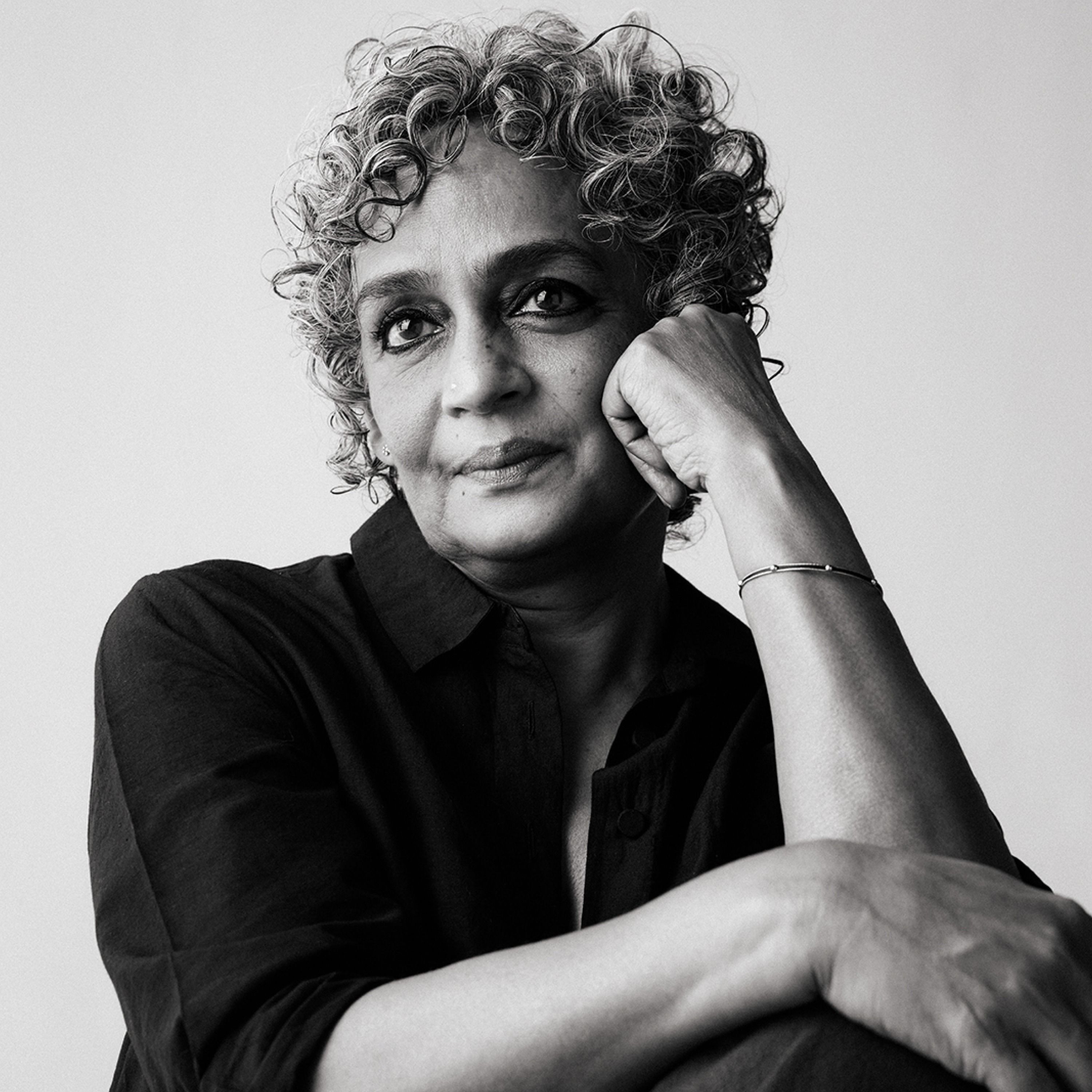
The Interview
Arundhati Roy Knows Where America Is Headed
00:41:54
The acclaimed writer has a new memoir, and a warning.
Loading summary
Transcript74 lines
- [00:00]
Arundhati Roy
Okay Pilates board meeting and find new tires.
- [00:03]
Lulu Garcia Navarro
Here are the top 20 tires for mid size SUVs. Top 20 you have enough to do.
- [00:08]
Arundhati Roy
Without becoming a tire expert.
- [00:10]
Lulu Garcia Navarro
Buick Certified Service technicians are factory trained to fit your vehicle with the tire specifically developed for it and with our tire price match guarantee, you get the best fit for the best deal. The to do list is endless, but your energy isn't.
- [00:20]
Arundhati Roy
Let us do the work.
- [00:21]
Lulu Garcia Navarro
Buick Exceptional by design. Available on select eligible tire brands and participating dealers only. Offer ends 1231, 25 terms apply. Seat Dealer for complete details, visit Buick.comService to learn more from the New York Times this is the Interview. I'm Lulu Garcia Navarro. As we get older, we often struggle to untangle the impact our parents have on our lives. For acclaimed author Arundhati Roy, that process of excavation happened after her mother's death in 2022 through writing. Her new memoir. Mother Mary Comes to Me is more than just just a chronicle of her complex relationship with her mother, whose bouts of clawing lashing fury, as Roy describes it, scarred both her and her brother. It's also about Roy herself and why she's become a writer transfixed by the pain and suffering of those around her. Roy has spent her career writing about the rich lives and deep struggles of marginalized and oppressed people in India. Her Booker Prize winning first novel, the God of Small Things has sold over 6 million copies and made her an international literary star when it came came out in 1997. What followed over the next several decades were dozens of articles pointing her pen at a range of injustices from India's caste system to the treatment of Muslims, especially in Indian controlled Kashmir. Both her work and her person have been repeatedly targeted by India's government under populist leader Narendra Modi, and she's currently facing possible prosecution under anti terrorism laws for comments she made years ago about the territorial conflict in Kashmir. When we spoke, we started with her mother's story, but in our second conversation she talked about the cost of speaking out and her fears for America under President Trump. Here's my conversation with author Arundhati Roy. Hi.
- [02:28]
Arundhati Roy
Hi Lulu, how are you?
- [02:29]
Lulu Garcia Navarro
I'm very well. I thank you so much for coming onto the interview. I'm very pleased to have you.
- [02:36]
Arundhati Roy
Thank you.
- [02:38]
Lulu Garcia Navarro
This book really resonated with me. It's a memoir of you, but also a biography of your mother who died in 2022 at the age of 89. And she was a very complicated and difficult person as you describe her while I was reading reminded me of this quote by the writer Czeslav Milosz, who wrote, when a writer is born into the family, the family is finished. Did you struggle with how much to reveal about your mother and your family just in the personal context of how difficult your upbringing actually was?
- [03:17]
Arundhati Roy
Well, obviously, you know, when you write something like this, you choose what you write and what you won't write. But I know that this doesn't work as literature. If you're trying to present some acceptable version of yourself or of her, then you might as well not do it, you know. But to me, it wasn't so much of a struggle, because I think what was incredible about her was that there was a part of her which hammered me, but then it also created me. But then there was this public part of her which was so extraordinary, you know, so I could never settle on what I really thought or felt. I could never remove myself from her because I admired her too. And I just felt that the entire range of what she had was a challenge to me as a writer. Can I put down this unresolvable character?
- [04:18]
Lulu Garcia Navarro
Well, let's talk about Mary Roy and that public part of her before we get to the part of her as your mother. I mean, on the most basic level, tell me about who she was outside of your relationship. I mean, she was indeed a well known person.
- [04:34]
Arundhati Roy
She belonged to the Syrian Christian community in Kerala, which is pretty tiny but privileged community that's insulated from the wildness and the poverty of the rest of India for many reasons. But then she married outside the community and then got divorced, which was absolutely taboo, you know. And she started a small school initially in the rented premises of what was called the Rotary Club. I used to think of it as a sliding folding school because we had to sweep up all the stubs and the coffee cups of the men and put out our furniture, and then they would come the next day and mess it up again. And then ultimately built this beautiful school which still runs. I studied that too, in the early years. But what she's equally well known for is that when she left her husband, my father, we lived in this tiny little cottage that used to belong to her very cruel father, who was dead by then. And then her mother and her older brother came there and they asked us to leave the house. And they said that as a daughter, according to the Travancore Christian Succession Act, a daughter can inherit quarter of her father's property or 5,000 rupees, whichever is less. So we were literally going to be turfed out onto this road in the Middle of the night by my grandmother and my uncle, and we ran to the lawyer and he told us that law applies in Kerala, not in Tamil Nadu. So we weren't kicked out. But she nurtured this humiliation and kept it to herself for a long time. But when she was able to, when she was economically stable, when she could afford to, she filed appeal to the Supreme Court challenging this law, you know, calling it unconstitutional. And the Supreme Court actually struck down that law with retrospective effect and made it equal inheritance for everybody. And it took years and years and years in court, you know, before she actually won the case. And she had very few people on her side while she was fighting it.
- [07:01]
Lulu Garcia Navarro
So there's that side of your mother. You start the book, though, really discussing how you were raised by her. And your early life, as you describe it, was one of hardship, poverty, instability and abuse, both verbal and physical. I should ask, before we continue, is abusive actually the word that feels right to you in describing your relationship to her?
- [07:30]
Arundhati Roy
I flinch, you know, when we use these words. Because nowadays there are a lot of these words that are used, and I suppose they are useful in some ways, but I don't know. I didn't use any of these words in the book. And if it was a single thing that one was dealing with, you know, if it was just abuse or just violence or just one thing that you could settle on and decide how to feel about it, that's one thing. But I think I had a schism in me very early, where even as a young child, I could see that her anger against me and my brother was somehow connected to what she herself was going through. So one half of me was taking the hits and the other half of me was taking notes. And somehow that, in a sense, made me a writer very early, where you're trying to understand, why is she doing this to me? It was so often clear that had nothing to do with what I had said or what I had done. It had something to do with something that I couldn't fully understand or control and was always struggling to understand and control.
- [08:57]
Lulu Garcia Navarro
I just want to give the audience just a sense of some of these incidents that you describe in the book. Some of the moments that were hardest to read about were when she would berate you, belittle you. You tell a story about being on a plane for the first time when you were about 6 years old. Can you recount that story?
- [09:18]
Arundhati Roy
Yeah. Well, my mother had an older sister who was very different from the rest of the family because she was the only one who had Held her marriage together. And she was married to someone who was a pilot who worked in Indian Airlines. And she had a, as I say, a proper house and a proper husband and proper children. Because this uncle of mine was a pilot. We had free tickets to get on a plane which we had never been on. And on the plane, I asked my mother how come her sister was so much thinner than her. And my mother was. She was a very, very severe asthmatic, and she was, at the time, you know, on steroids, and she had just become very overweight, and she had this moon face. And she just turned on me in a fury and mimicked me. You know, she had this way of mimicking my baby way of speaking. And that used to just rip through me, you know. And then she said, by the time you're my age, you'll be three times my size. And, of course, very quickly she said, well, I'm your mother and your father, and I love you double, you know, so you forgive her, and yet you're shredded also. And so that was the constant, you know, thing that you had to manage, that something would tear you up and then stitch you back together, then tear you up, then stitch you back together.
- [10:54]
Lulu Garcia Navarro
That leaves a lot of scars.
- [10:57]
Arundhati Roy
Well, it does, but maybe it also made me the writer that I am.
- [11:02]
Lulu Garcia Navarro
You know, you write that her mimicking you and calling you names made you feel that. I swirled like water down a drain and disappeared. And I think that anyone who's had a difficult parent, which I have, can identify with that line. Did you think that you had to hide yourself, disappear when she was attacking you?
- [11:30]
Arundhati Roy
Yeah. Well, it's not only that she was the only parent, she was also the only person in a society and in a family that makes it clear that you're not part of it. So she's all you have. I mean, there are no relatives, there are no neighbors. There's just nobody, you know. So for me, in some ways, I've welded myself to her, you know, when I was very young, and then exploded apart when I was older. But, you know, she had this. These terrible attacks of asthma. And she used to keep telling me, I'm going to die, and you better figure out what you're going to do. You live on the street, who's going to look after you? And so I became like her lungs. You know, I was. I used to breathe for her. My body was an extension of her body. And then when I was 16 and I went to architecture school, and I just walked into those lawns and watched all the students And I knew that I would be fine, I would be able to work, I would be able to survive. I wouldn't die. If she died, I didn't have to breathe for her. And she sensed that the valiant organ child of hers, the lung, extra lung that she had suddenly was breathing for itself. And that generated a whole lot of hostility.
- [13:02]
Lulu Garcia Navarro
I just want to clarify that you ended up leaving your home at 16. There was a huge period of separation where you didn't see your mother at all. And you basically raised yourself.
- [13:12]
Arundhati Roy
Yeah, I left Kerala to join architecture school when I was 16. And after my second year, I just stopped going home because it was too painful, you know, So I. I put myself through the rest of it.
- [13:27]
Lulu Garcia Navarro
And we should say sorry.
- [13:29]
Arundhati Roy
I just keep wanting to say that I don't want this to end up like some litany of, you know, horrors about her because as I keep keeps saying in the book, I had huge admiration for her too.
- [13:45]
Lulu Garcia Navarro
I mean, you talk about the battles that she was fighting even within the school, how she taught women and the men to look at gender dynamics in a completely different way. I mean, you tell a story about her making the boys parade around in bras because one of them had disrespected one of the girls.
- [14:05]
Arundhati Roy
Not parade around in bras, but something similar. She learned that they were making of the girls because they'd started wearing bras. So she said, go to my cupboard and get my bra. And then she showed them, she said, this is a bra. This is what it's for in assembly, you know. And she said, if it excites you so much, you can keep mine. So it changes the ph balance of what goes on between boys and girls. You know, when the girls know that there's someone who's got their back.
- [14:38]
Lulu Garcia Navarro
One of the most interesting things in the book is how you write about gender dynamics. In the book, you describe India as the land of sun worshipers. That's s o n. But you also describe how harsh your mother was with your brother in particular. I mean, she would call him a male chauvinist pig when he was only a child. When he was a teenager, she said to him, you know, you're ugly and stupid. You know, you should kill yourself. You write that the way she treated him was like she was punishing him for the sins of the world. And that that complicated your own views of feminism. And I'm wondering how that played out for you.
- [15:17]
Arundhati Roy
Well, I mean, even today, I think that my brother, he's one of the most amazing people that I know. You know, and having endured all that from her, my brother, the one that asked me, I don't understand how you can be so. So upset about her death after everything that she did to us. And I understand that it's very puzzling for him and perhaps even hurtful that I. I don't hate her, you know, but I think it's just because I see that her public battles were making space for women in ways that included making space for me. But at the same time, just because you're a feminist doesn't make you a great person. You know, feminism doesn't have only to do with women's rights. It has to do with a way of looking at the world in which men and women are equal and men and women are respectful of each other. It doesn't mean disrespecting a lovely man. It doesn't mean that. Which is what I saw happening with my brother and which. It affected me deeply.
- [16:41]
Lulu Garcia Navarro
I want to just linger here for a moment because I am curious, because you and your brother saw your mother so differently, what the conversations around this book have been. I mean, has he read it and what has he thought of it?
- [16:57]
Arundhati Roy
Yeah, I mean, he has read it, and I think it was hard initially for him to read because he, in a way, has, or maybe thought he had put it behind him. But then he wrote to me saying, I'm laughing and crying and I can't breathe, and if I die, it'll be your fault. And then. But then he did say, you know, I don't understand why you, you know, feel so much about her, because I said, I can't hate her because there is so much of her in me, I'd have to hate myself. You know, I see that he's been. And I respect that he's been deeply, deeply hurt by her, but he, too, has made his life on his own. And so both of us survived.
- [17:51]
Lulu Garcia Navarro
There is this other moment that really struck me in the book where you describe you and your brother being sent to boarding school. And you write that your brother got a report from school that said, average student, and your mother beat him with a ruler until it broke. And in the morning, she then turned to you and gave you a hug because your report card had been good and said that you were brilliant. And you wrote, on the occasions when I am toasted or applauded, I always feel that someone else, someone quiet, is being beaten in the other room. I have to say, that stopped me in my tracks.
- [18:31]
Arundhati Roy
Yeah, I think the sentence after that is, if you stop to Think about it. It's true. Someone is. And actually, that is the truth. You know that when you get applauded and rewarded and everybody claps, and you know that somebody you love and somebody quiet has been beaten. And to me, that expands far beyond my brother and me. It expands into the country that I live in now, you know, that. Or the world that I live in now that I might be a writer with, you know, whatever is conventionally known as success. But the things I write about and the people that I write about are being beaten. They are being beaten down even as we speak today. You know, they are being starved in Gaza, they are being broken, they are being occupied. And so what does it mean when you are applauded, when your heart belongs in the whole world?
- [19:33]
Lulu Garcia Navarro
When you wrote that section and were thinking about that incident and how it applies to your life as someone who has been frequently publicly applauded and given so many awards, was it a sense of discovery that this was the root of that connection?
- [19:53]
Arundhati Roy
No. I mean, I don't think that the process of writing this made me understand it deeper, because I wrote it because I understood it. You know, I. In order to survive or in order to make sense of my life, I've had to think and think and think and think and think about all these things, you know, so even, for example, when I won the Booker Prize and so on, I. There was like more than one half of me that was, you know, thinking about what does it mean to be this bestseller novelist in this country where people can't read in this country, where is hurtling towards what we have now? So there was hardly a moment for me to feel great about myself, you know, before things started to unravel quickly. And even the celebration of me had this whole nationalistic fervor, which I despised at that time in 97. So I was very quickly kicked off that pedestal, and I kicked myself off it, too. So I always have this feeling that those of us who've been very unsafe as children, we seek out the unsafe. We seek out the lack of security. And if you have security, you blow it up.
- [21:30]
Lulu Garcia Navarro
I mean, you've risked your security many times in your career. We should say that at the moment, actually, you are under legal threat in India for your writing and the things that you've said. I mean, what do you think the role of writers and creators is at a moment when there is censorship and people are trying to shut you down?
- [21:54]
Arundhati Roy
I think that writers have survived, whether it's in the Soviet Union or whether it's in East Germany, or whether it's in the darkest places and times, they have managed to survive. Their work has survived. And it's for me, very important to understand that. I just can't keep striking the same note again and again. You have to change it up. You know, you have to vary things. You have to experiment. You have to insist that your work is not just a reaction to what's happening to you. Your work is a thing in and of itself and a way of positing another vision of the world. And that's a challenge because you can't do it as a manifesto, as some clumsy, you know, hitting everybody on the head with some ideological hammer. You've got to do it beautifully. Somebody told me the other day that, oh, you know, the reason I like your writing is because you write as though they've already killed you. You don't hold back, you know, stuff for another book or another essay or something. Let's just put it all out there.
- [23:08]
Lulu Garcia Navarro
It's your epitaph to bring this back to your mother. One of the things that I was most curious about is once you had this immense success and the pressures that it brought because of your nonfiction writing about the situation in Kashmir, about huge dam operations and many of the other issues that you have passionately written about, including the rise of Hindu nationalism in India, how did she view that? Was she worried for you? Was she proud of you? Was she jealous of you?
- [23:46]
Arundhati Roy
You know, of all the people that I know in my family, she's the one who used to read it every. Especially every political essay, and she used to follow it closely. I know that she was worried, but not because she told me she was worried, but because other people in the school used to tell me she's worried. But to me, she was always like, what the hell do you think you're doing? And, you know, whatever. Very dismissive. But perhaps she also had as unresolved feelings about me as I did for her. Because once she called me up to say that, you know, I went to buy some fruit, and that woman asked me, are you Arundhati Roy's mother? And I felt as though she had slapped me. And she called me to tell me this, you know, and. And at the same time, she was also proud because I was not just her daughter, I was also a product of her school. So I think she had her moments when she was very, very ill. She used to get very upset if I wasn't there in the hospital. But if I was there, she would say, oh, these people, they're just Coming here because of you, they don't care about me. And, you know, how did that make.
- [25:00]
Lulu Garcia Navarro
You feel that she seemed to have a complicated relationship with you even as you became an enormous success?
- [25:10]
Arundhati Roy
Well, first of all, as we've spoken before, you know, success was in itself without her and her opinions. A complicated thing for me. But occasionally it used to break my heart that she had such a thorny response to it. But at the same time, I always was very clear in my mind that I never wanted to defeat her. I wanted her to go out like a queen, which she did. And that involved reducing myself. Sometimes that involved being mauled and shredded and having to piece myself together. Sometimes that involved calibrating how many days I could be there before I was absolutely corroded. It involved coming home and being quite sick physically for a long time just to get over it, you know. But at the same time, somehow I had that ability to detach myself and sit on the ceiling fan and think, God, this is quite funny, the whole thing, isn't it? So I think that sort of saved me. And also because the more I traveled, the more I saw of the world, the more I wrote about things that were happening, the less able I was to put myself at the center of some great tragedy. You know, I was just like, it's okay. Things are bad elsewhere, you know.
- [26:48]
Lulu Garcia Navarro
Well, we are going to speak again in a short time, and I want to talk more about your political writing, your activism, and the situation in India, and we'll pick up there. But I want to thank you so much for this conversation.
- [27:02]
Arundhati Roy
Thank you. It's my pleasure.
- [27:05]
Lulu Garcia Navarro
Can I ask you one more question, actually?
- [27:07]
Arundhati Roy
Yeah, sure.
- [27:09]
Lulu Garcia Navarro
Is it hard to talk about this?
- [27:13]
Arundhati Roy
I'm, I'm just learning to talk about it.
- [27:16]
Lulu Garcia Navarro
I can see your physical self when I ask certain questions, and it might be uncomfortable territory, I imagine.
- [27:24]
Arundhati Roy
Yeah, I mean, I, I, I read the audiobook, and the audio engineer producer, he told me, you know, it's okay, you can take some breaks, and if you get upset, I said, me? Why would I get upset? I wrote it, I lived it. You know, I'm going to get upset. He says, oh, well, the last third of the book, your voice is completely different from this first 2/3. So I have to see how it goes. I think, to me, it's important that people don't think that this is just a book about a mother and a daughter, because this is a book about two women who happen to be mother and daughter, but it's also about the village and the city and the state. And the country and the world. And if it weren't that, it would not be as important to me.
- [28:20]
Lulu Garcia Navarro
After the break, I talked to Arundhati again and I asked her about the parallels she sees between Indian politics and American politics.
- [28:29]
Arundhati Roy
I look at it in shock because you thought that there was a mechanism in place, there were checks and balances in place. But clearly there isn't a way of handling someone who's completely, completely out of control.
- [28:54]
Lulu Garcia Navarro
How do you make an Airbnb a vrbo? Picture a vacation rental with a host. The host is dragging your family on a tour of the kitchen, the bathroom, the upstairs bathroom, the downstairs bedroom and the TV room, which surprise, is where you can watch tv. Now imagine there's no host giving you a tour because there's never any hosts at all, ever. Voila. You've got yourself a vrbo. Want a vacation that's completely and totally host free? Make it a vrbo. Hey there. Are you sitting down? Good. Cause Wayfair's end of season sale is here and you can shop it from your couch. It's Wayfair's Labor Day clearance and it's on now. Right now you can score up to 70% off everything home at Wayfair. Like up to 50% off outdoor furniture and decor and up to 70 off area Bronx plus amazing door buster deals and 24 hour surprise flash deals on Wayfair Home finds in every style and get it all with fast shipping on everything right to your door. From furniture to faucets. This is your last chance of the season to score huge deals at Wayfair. Don't let the final days of summer pass you by without shopping these end of season savings. So don't wait like summer, these savings won't last. Head to Wayfair.com today to score up to 70 off everything home. Celebrate your holiday weekend with can't miss savings before they run out. Shop Wayfair's Labor Day clearance now through September 2nd at Wayfair.com Wayfair Every style, every home. Hi, nice to see you again.
- [30:40]
Arundhati Roy
Hey Lulu, nice to see you too.
- [30:43]
Lulu Garcia Navarro
You know, after we spoke last time and we talked a little bit about the political situation in India and the situation for you in particular. Just in the past, the Indian regional government of Kashmir has banned one of your books. And of course this is not the first time your work has been targeted this time. The book is Azadi. It was published in 2020. It's about the fight in Indian controlled Kashmir, the concepts behind freedom and authoritarianism more broadly. And I'M gonna quote what the directive said. It said that your book and others. It wasn't the only one that was targeted. Would, quote, deeply impact the psyche of youth by promoting a culture of grievance, victimhood, and terrorist heroism. Why do you think your book was included in that list, and what's your response to that more broadly?
- [31:36]
Arundhati Roy
You know, my response to it is to not respond because, I don't know, it sounds like some list they got out of ChatGPT or something. You never know why these things happen, when they happen. And when they target me now, I just don't say anything because you never know whether they really mean it or it's just some side game to distract from something or whatever. So I have no idea. So I'm not gonna say much about it.
- [32:10]
Lulu Garcia Navarro
Okay. As we mentioned in our first conversation, you are currently under threat of arrest in India for comments you made about Kashmir in 20. I mean, for our audience, do you feel comfortable explaining your position? And can you tell me a little bit about the status of that legal case?
- [32:29]
Arundhati Roy
I really don't want to talk about it, actually, because, you know, it just increases the risk of something being taken out of context and something blowing up. It's dormant right now, so I just let it be, you know?
- [32:46]
Lulu Garcia Navarro
Then let me ask you this, because even the manner in which you're responding, which is that you do not want to address this because of the fear of legal repercussions, that could even mean jail and other punishments. What does that say when governments try and silence authors, writers, academics regarding their work and what they try and put out in the world?
- [33:16]
Arundhati Roy
Well, I think in America, you're beginning to head in that direction. Ours started a long time ago, and one has to learn how to navigate it. And the reason that I don't talk about it is because I would much rather write what I want to write than have some controversy about something you just say off the calf. It's like they're always trying to trip people up and trying to prevent you from thinking clearly. And so this culture of fear is everywhere here now. People are arrested for things they say on Facebook, on Twitter, or what they don't say. Like, in the US it seems new to you, but we have been living with this and is increasingly becoming normalized. And it's a very disturbing situation, and especially disturbing, obviously, for Muslims, where it doesn't stop with just, you know, court cases and jail. It goes on to lynching and murder and social boycotts and economic boycotts and their homes being bulldozed. So One thing leads to another, to another, to another, and you end up being in a situation where you meet people who have stories that you can't look away from.
- [34:42]
Lulu Garcia Navarro
This thing is, I think, seminal to your work. You know, when you have seen injustice, you have not been able to look away. Many people do look away. What do you think it is about you that makes you not flinch?
- [34:59]
Arundhati Roy
Actually, I think the point is that I do flinch when I see it. And most people don't flinch. They just accept it as a part of daily injustices. And the thing is that India is a society that is built on a social hierarchy which is amongst the most cruel in the world. We have a situation where people are divided up hierarchically according to what is considered levels of purity and impurity, and the dehumanization of people who are considered outcast, which has been actually institutionalized. So it's a society that accepts injustice as a given.
- [35:44]
Lulu Garcia Navarro
You touched on this a little. And so I would love to hear your thoughts on how you view parallels between the Hindu nationalist movement in India and the MAGA movement here in the United States.
- [35:59]
Arundhati Roy
There are a lot of parallels. So one of the first things that happened when Modi came to power was demonetization was this direct hit on the economy where he suddenly said 500 rupee notes were illegal, like overnight. If you look at the attack on citizenship, the attack on universities, the attack on students, the attack on Rohingyas, the continuous uncertainty, the fact that you might be ambushed by anything at any time, it's so similar that you wonder, is there a playbook, or is it just osmotic authoritarian behavior? And of course, there are other things like voter suppression. The leader of the opposition had a huge expose of how voter lists have been manipulated. So basically, what you're seeing is that the ruling party is confused with government, and all of it is confused with one man. You know, so you're seeing that in the US And I look at it in shock because you thought that there was a mechanism in place, there were checks and balances in place, but clearly there isn't a way of handling someone who's completely out of control. You know, and the way statisticians are being fired for giving out figures that the authoritarian doesn't agree with. Same thing here. You can't believe any of the government figures on economics, because everything that doesn't suit the ruling establishment is dismissed. It's thrown away, and a new picture is put in its place. The one big difference between what's happening in India and what is happening right now in the US is that in India, the mainstream media has completely compromised. It's not just rolled over. It is actually an organ of the authoritarian state. It's actually calling for people's arrest or making up lies. And of course, America is sitting on top of a crumbling world. Whatever Trump does affects the whole world, whereas here it just affects this country.
- [38:26]
Lulu Garcia Navarro
Why do you think authoritarian leaders go after people like you, people who deal in ideas? When you said there's like an echo of a playbook, I mean, we've seen that. Yes. In places all around the world.
- [38:40]
Arundhati Roy
I've covered it from time immemorial.
- [38:42]
Lulu Garcia Navarro
Exactly.
- [38:43]
Arundhati Roy
Yes.
- [38:43]
Lulu Garcia Navarro
But as someone who's the subject of that kind of censure, I'm wondering why you think it happens.
- [38:50]
Arundhati Roy
I think they are terrified of people who they feel like can communicate not just cerebrally, but emotionally and otherwise with people, you know, so people who can, even however small they are, and even however little access they have to the mainstream or to the thundering pulpit thumping television anchors, they know that there are some people who somehow people eventually do listen to. They know it, you know, they know who is read. They know who is loved. They know also who is not invested in the things that everyone else is invested in. You know, it's not just about fame and money and awards and whatever it is, you know, there's something else going on and there are a lot of people like that who they know just will not bow down.
- [39:58]
Lulu Garcia Navarro
I think what you're referring to in part is people like yourself who also deal with emotional truth, not just facts, but being able to capture ideas that resonate on a different level.
- [40:14]
Arundhati Roy
Yeah. And you see, you know, I mean, it's really interesting because now you see the government moving to capture Bollywood and one after another after another, they churn out these absolutely hateful films. Hateful, violent, literally almost evil films, but they just don't work.
- [40:39]
Lulu Garcia Navarro
In our first conversation, when I asked you about how you see the role of artists in turbulent moments, you said something that struck me. You have to insist that your work is not just a reaction to what's happening to you. Is that feeling specific to your fiction? Because you're, as we've said, a very prolific political writer. Yeah, but maybe that work feels different.
- [41:03]
Arundhati Roy
That work is different because that work is often an argument that is made at a time when things are closing down. When I see the media, the government, everybody sort of closing in on a vulnerable community or lie about them, pretend that they are what they are not, and so on. And it's really like trying to blow a space open, you know, that I would go in. And almost all the essays are written. Despite my telling myself I'm not going to do it. I'm not going to do. Because you get into so much trouble after. And then when it just becomes harder to keep quiet than to write, I write. And for me, it's not about the product or how many books I write. I'm not interested in that output being huge. I I'm interested in living the life of a writer, which does not involve just sitting and writing. It involves a lot of living, a lot of listening, a lot of traveling, a lot of inhabiting worlds and worlds and worlds, you know, which is why I love this place, because there's so much about it that I still don't know.
- [42:27]
Lulu Garcia Navarro
That's Arundhati Roy. Her memoir, Mother Mary Comes to Me, will be published on on September 2nd. To watch this interview and many others, you can subscribe to our YouTube channel@YouTube.com the interview podcast this conversation was produced by Seth Kelly. It was edited by Annabelle Bacon, mixing by Sonia Herrero, original music by Dan Powell, Rowan Nimisto and Maren Lozano, photography by Nishanth Radhakrishnan. Our senior booker is Priya Mathew and Wyatt Orme is our producer. Our executive producer is Alison Benedikt. Video of this interview was produced by Paola Neudorf and Shivani Khattar, cinematography by Zach Caldwell and Ranak Chopra, lighting by Kamal Seni and sound recording by Rajiv Ristogi. It was edited by Mark Zemel. Brooke Minters is the executive producer of Podcast Video. Special thanks to Rory Walsh, Renan Borelli, Jeffrey Miranda, Maddie Masiello, Nina Lassom, Jake Silverstein, Paula Schuman and Sam Dolnick. I'm Lulu Garcia Navarro and this is the interview from the New York Times. Sometimes an identity threat is a ring of professional hackers, and sometimes it's an overworked accountant who forgot to encrypt their connection while sending bank details. I need a coffee. And you need Lifelock. Because your info is in endless places. It only takes one mistake to expose you to identity theft. Lifelock monitors hundreds of millions of data points a second. If your identity is stolen, we'll fix it, guaranteed, or your money back. Save up to 40% your first year at lifelock.com specialoffer terms apply.