← The Interview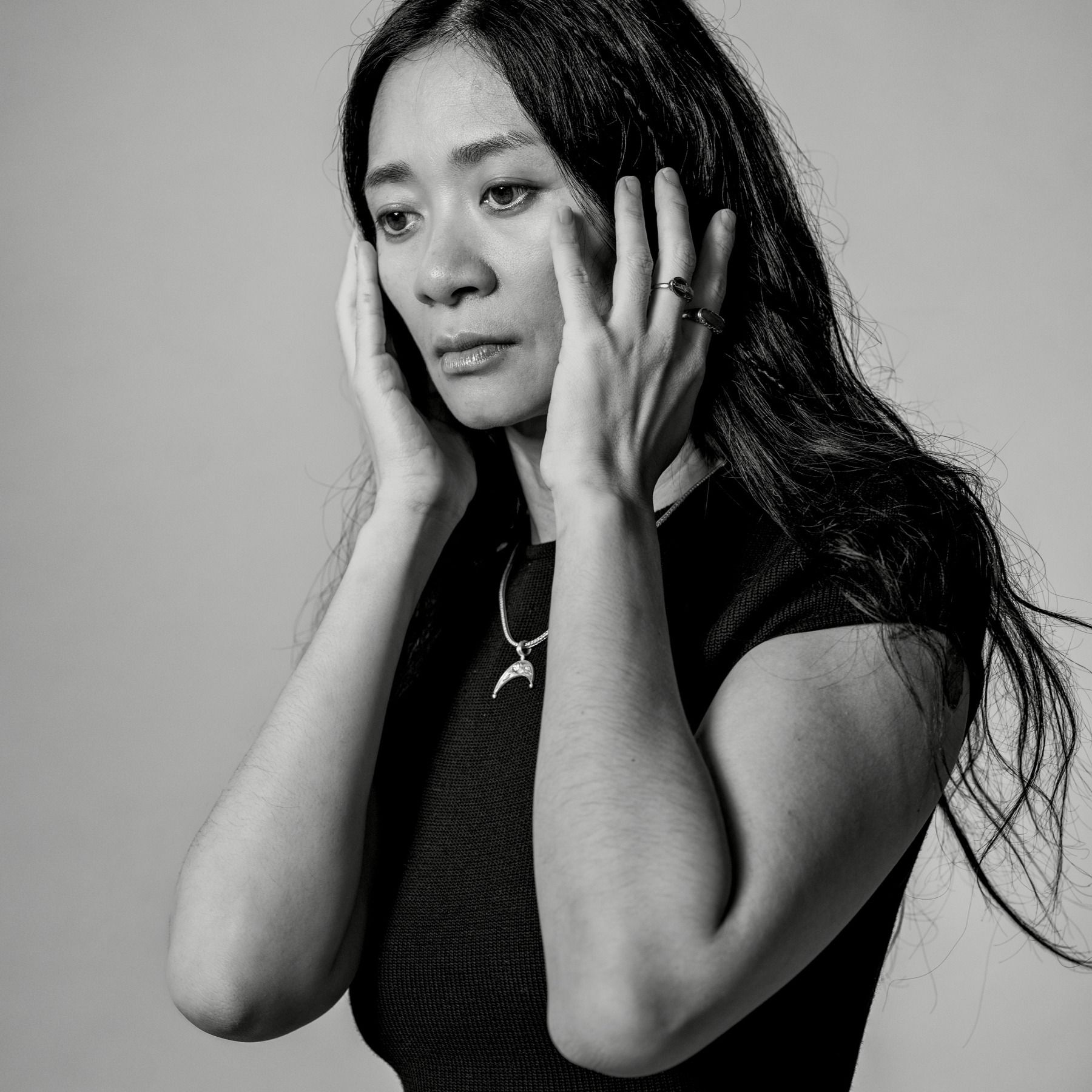
The Interview
Chloé Zhao Is Yearning to Know How to Love
00:48:30
The “Hamnet” director on trying to overcome her deepest fears — and open her heart.
Loading summary
Transcript162 lines
- [00:00]
Chloe Zhao
Hi, I'm Katie Duke and I've been a nurse for over 20 years. Listen, I think style and confidence only get better with age, and that is.
- [00:08]
David Marchese
Why I love figs.
- [00:10]
Chloe Zhao
These scrubs are built to last.
- [00:12]
David Marchese
They fit perfectly, they feel amazing, and the quality is just wow. My favorite color, burgundy.
- [00:20]
Chloe Zhao
It's chic, it's timeless, and it's even the same color as my apartment. So there's that.
- [00:25]
David Marchese
Get 15% off your first order at WearFigs.com with the code FIGSRX. From the New York Times. This is the interview. I'm David Marchese. Chloe Zhao is an anomaly. At only 43, with just five feature films under her belt, she's already established herself as one of cinema's most distinctive and distinguished directors. And she's done it at a time when the movie business is increasingly averse to artistic risk and originality, qualities on display in all her work. She started with independent film, including the sparsely poetic neo Western Nomadland, which won Academy Awards for best picture and for Zhao, Best director. She then tried her hand at an ambitious mega budget Marvel movie, Eternals. And her latest is last fall's heart wrenching drama Hamnet, an adaptation of Maggie o' Farrell's historical novel about the death of Shakespeare's young son from the plague and the grief his parents experienced after it won two Golden Globes and is up for several Academy Awards, including best director. So how has she done it? Because as I learned firsthand, Zhao is an enigmatic, even somewhat mystical presence in person. Not exactly the sort of hotshot personality we often associate with big time Hollywood directors. But as it turns out, Zhao isn't much interested in simple or straightforward answers. Here's my conversation with Chloe Zhao. Chloe, thank you for taking the time to come speak with us today. I appreciate it.
- [02:00]
Chloe Zhao
Thank you for having me.
- [02:01]
David Marchese
So I want to start with an award season question. Your eyes just glazed over a little? I'm sorry.
- [02:09]
Chloe Zhao
No, it's excitement.
- [02:10]
David Marchese
Yeah. Yeah. That was a look of excitement.
- [02:12]
Chloe Zhao
Yeah. Like an animal in the jungle.
- [02:15]
David Marchese
There's obviously a lot of awards season buzz around Hamnet, and by the time this interview comes out, will know what nominations the film did or didn't get. But right now, the thing that I'm curious about is sort of what like the whole awards rigmarole stirs up for you, because I imagine it could involve feelings like of envy or competition or it involves salesmanship or glad handing, which I feel like are not necessarily the kinds of feelings or ideas that are interesting to you or come naturally to you. So how do you deal with this moment?
- [02:54]
Chloe Zhao
I love that. That's almost like a form of compliment. You just did. You think of me a lot more highly than maybe you like doing it.
- [03:05]
David Marchese
I don't know.
- [03:06]
Chloe Zhao
But I think all those quite basic emotions, none of us can escape it, right. And especially artists. So many of us, majority of us started telling stories because we didn't have the easiest childhood. So when your work, right, which is the only way that you can see connection and validation since you're a little child, is being compared and judged, you could go as far as feeling a rejection of that is a rejection of who you are and whether your ability to belong to a tribe or be safe or be loved, you could go that far. And it does go that far to me at times. But what I like about it, I don't know if people know, is that filmmaking is quite of a lonely process. At least speaking as director, you're like a ronin, you know, you're like a.
- [04:05]
David Marchese
Samurai, a wandering sailor.
- [04:06]
Chloe Zhao
Yeah. You're getting hired to do jobs and jobs and jobs. And then you create this family and then you have to leave again. So a worse season, especially if someone like me, who came up from independent films, having to go festivals and labs after laps to even get money to grants and to make my first film. I was exposed to a lot of my fellow filmmakers over a decade ago. So to be paid, to be brought together and to see each other and to hang out at these, you know, events and roundtables and stuff is actually really nice. I try to ask them to let me come to their set and just shadow people. I think there should be a system where directors get to be on each other's set. Otherwise, how do we keep learning?
- [05:01]
David Marchese
What do you think someone could learn from watching you work?
- [05:07]
Chloe Zhao
How to embrace chaos. I mean, pretty much Hamnet was created that way. For example, when Hamnet died. Spoiler alert. Don't think you can spoil this one.
- [05:24]
David Marchese
It's a historical fact.
- [05:26]
Chloe Zhao
Yeah. Someone died. Someone wrote a play. Hamnet died. And on that day, Jessie and I would not talk about. We don't really talk about the scene coming in. She would. In the morning, she would do a lot of fever writing about her dreams, and then she would pick some music. And so as soon as I get to set, I will just put the music on repeat. So the whole set sort of get harmonized to the vibration she wants to be vibrating in. And other than a conversation about which setup we want to do, we just go in there and do it. And so when she let out that very guttural scream of grief. That was not something that was planned from me nor her. But I do believe it didn't just come from her. It came from the collective, the village. And when that happens, I can feel it. And it's the most exciting thing for me as a director, because I go, there's no way any of us could have thought of that, because that is truth happening in the moment. And I would bottle that up and I would defend it. And they added, and I'll make sure it goes into the world.
- [06:38]
David Marchese
You know, it's so interesting to hear you talk about the practicalities of directing for you, because, you know, often when I've heard other directors talk or read about other directors, there's recurring images or tropes of how a director behaves that are. You know, it's like. I want to say. I want to say Francis. It's Francis Ford Coppola who said this. I could be wrong, but he compared being a director to, like, being a ringmaster of a circus that's inventing itself every day. Or sometimes you hear directors compared with Jack or something like that. And these are all sort of very, to my mind, kind of like alpha, aggressive, macho metaphors for the job of directing on the day. That's great too, but it's so not what you're describing. And I just wonder if you could talk a little bit about how you handle the necessary leadership aspects of being a director and making a movie.
- [07:29]
Chloe Zhao
You know, I like thinking about myth. If you think about in myth and in archetypes, what are the types that can lead? Traditionally, yes, you have a general, but you also have a priestess. Both can evoke the desire for people to get excited, to follow their vision. Doesn't mean that the example you give of what Francis said, that he is that and I'm this. Both of these two archetypes is within ourselves. So there is a general inside of me, but there's also a priestess inside of me. It just depends on the scene, it depends on the film. And some filmmakers have a bit more priestess energy in them than general, but both can lead and both are needed. If you only have the priestess, it's total chaos, black hole. If you only have the general, it's total order and just one beam of light and nothing else. But I like to be in those two extreme polarities, as opposed to constantly kind of have my hands in everything, controlling everything, but also not fully controlling everything. No, I like to be total surrender and then total control.
- [08:52]
David Marchese
I have kind of a historically inclined question for you. So in Shakespeare's time, the time period in which Hamnet is set, the death of a child was a much more common occurrence than it is now, at least in rich Western countries. And I assume that as a result of that, people just had a different perspective on what it meant to lose a child or different feelings or expectations. And I'm just curious how you thought about that with your film. And if you think it's possible to recreate older emotional perspectives.
- [09:33]
Chloe Zhao
That's a really good question. I think about that all the time. Maggie said that she doesn't believe it's possible that the grief is any less.
- [09:46]
David Marchese
Maggie o', Farrell, the author.
- [09:48]
Chloe Zhao
The author, yeah. She said that to me from the start, and I tend to agree with her because even though things are so different, our biology hasn't changed, and the design that we have to want to protect a child will not change. However, the stories we attach to that pain, which is suffering, might be different because they also have a different relationship with the unseen back then. Right. You know, I recently trained to be a death doula, really? In the uk, I just finished level one training, foundational training. And in one of the training sessions, we had to research indigenous cultures from around the world, how they deal with death and dying, both today and also in the past. And you can see that the grief of losing a loved one doesn't change. Right. However, the societal understanding of what death is and the space it gives to grief and the ceremonies and how it's embedded in the culture has shifted so much. And the medicalization of death. Right. And also in the modern world, when death is no longer seen as a natural part of. Because now it's about staying alive as long as we can. There's almost some kind of shame around death because it's weak or something or it shouldn't happen. So there's so much of that starting being attached to death and dying that actually cause suffering that's not natural to the human condition. So I think that's different.
- [11:37]
David Marchese
I want to rip up all my questions and ask you more about wanting to be a death. Dua.
- [11:41]
Chloe Zhao
We have another session in a few days.
- [11:45]
David Marchese
Why are you interested in becoming a death doula?
- [11:53]
Chloe Zhao
Because I have been terrified of death my whole life. I still am so afraid. And because I've been so afraid, I haven't been able to live fully. I haven't been able to love with my heart open because I'm so scared of losing love, which is a form of death. So when you're in your 40s, which is great, by the way. Midlife crisis is the best thing that can happen to you because what it does is you're on your way to a rebirth. You can't run from this feeling. Your body is changing and you can feel death. And I, because I'm so scared of it, I have no choice but to start to develop a healthier relationship with it or I'm not going to make it. The second half of life would be too hard.
- [12:46]
David Marchese
So it's a way of facing your fear.
- [12:49]
Chloe Zhao
It's a way of understanding, because making hamnet helped me understand that. I just know there is another way. I just have a feeling that whoever designed this have decided that you will be born and then die. You will love deeply, but then lose love. It's almost like a cosmic joke. We're the only one in nature that have a problem with that process. Yeah, we must be designed to know how to die. It shouldn't be this terrifying that I can't even live. That must be not the intention.
- [13:28]
David Marchese
Oh, it's not this terrifying to everyone.
- [13:31]
Chloe Zhao
I hope not. But I just. I do know that a lot of the issues we have in the world comes from ultimately that deep fear of death.
- [13:40]
David Marchese
Are you afraid of your own non existence? Are you afraid of the pain of death?
- [13:45]
Chloe Zhao
I think it's impermanence. You know, the impermanence. So in Hamlet, right, there's a line that goes, all living things must die, passing through nature to eternity. If in your life, eternity doesn't exist, right, because you didn't grow up with spirituality or religion, so the eternity part is out. You also lost your connection with nature, Even your own body. Your own body, wisdom. Then passing through nature part of that sentence is gone. All you have left is all living things must die. That's no fun, you know, and that's like, wait, well, then what's the point? You know? So you sort of separate it from the oneness. But for me, I feel separated often from that oneness. And that illusion of separation makes me afraid to connect, makes me afraid to create freely or even just live in the way I want to live.
- [14:43]
David Marchese
You alluded to a midlife crisis. Is that something you're currently experiencing or.
- [14:49]
Chloe Zhao
I might have. I'm kind of at the. So if it's four seasons, I'm at the end of winter, beginning of spring, like, I'm coming back up. So actually, a better metaphor. I like metaphor speaking metaphor because it makes more sense to me. In the chrysalis period, I have passed the deepest part of the decomposing from the caterpillar, let's put it that way, which was extremely uncomfortable. About a year and a half of just sitting there, having every part of who you used to be grinded down.
- [15:27]
David Marchese
Can you tell me what did that look like for you?
- [15:29]
Chloe Zhao
It looks like getting out of bed is hard, you know, being interested in anything, just getting through the day because everything that I used to use to distract myself or everything that I thought is what I wanted in life and everything will be fine if I get them or everything that I thought is who I was no longer is. So I'm sort of at the end of that. And Hamne, by the way, was what saved me in many ways to have that film during that time.
- [16:03]
David Marchese
And you said you struggled to connect with people, struggled to feel loved. That's very sad.
- [16:12]
Chloe Zhao
You have no struggle.
- [16:13]
David Marchese
I mean, I have tons of struggles in my life. But when you talk about not feeling, are you talking about having problems with feeling love in relationships with your family? I just want to know more about.
- [16:26]
Chloe Zhao
What you mean by that. If you're terrified of being abandoned, cast out a tribe, then you don't make an effort to belong or truly love from a place of vulnerability and trust. Right. And that's really sad because we, I don't think we're designed to be alone, to do it alone. We're designed as like wolves, you know, like pack people and try. But to be cast out of your tribe is the most painful thing you can experience. Or to be abandoned by people that you know that you love and that love you doesn't even mean intentionally, someday could die.
- [17:13]
David Marchese
Can I take a stab at something? You tell me.
- [17:15]
Chloe Zhao
Yeah, I can discern and all my publicists can come in, throw a bottle at you, one or the other, you.
- [17:23]
David Marchese
Know, when you talk about being cast.
- [17:24]
Chloe Zhao
Out of your tribe or I'm discerning.
- [17:26]
David Marchese
What do you mean?
- [17:27]
Chloe Zhao
I know what you're going to say.
- [17:28]
David Marchese
Am I going to ask about family stuff? Oh, okay, yeah. You grew up in China and then moved to the United States when you were 14?
- [17:39]
Chloe Zhao
No, actually I moved to the UK first and then yes.
- [17:43]
David Marchese
Was there some sort of familial separation there that's related to the casting out you're talking about?
- [17:55]
Chloe Zhao
I can't really go into it, but I will answer it the best I can is that it is an investigation I have been doing the last four years of where does that come from? You know, and I think it's a lot older than I feel like even in this life. I really do, you know, you started by asking me about a worse season. Yeah, Right.
- [18:22]
David Marchese
It feels like a long time ago.
- [18:25]
Chloe Zhao
But it's relevant because what is this fear of failing?
- [18:29]
David Marchese
Yeah.
- [18:30]
Chloe Zhao
What is this fear when my film, you know, gets rejected by the critics? What is this feeling if the box office is terrible? You know, what if I lose? You know what? I look around at an awards show, right? And I look at the tables, and then when the winner is announced and I look at the faces of the people who didn't win, and I try to feel like, what are they feeling?
- [18:53]
David Marchese
Yeah.
- [18:54]
Chloe Zhao
And at best, it's like, that person must have had an easier childhood. At worst, it's like, I don't belong. They reject me. I may as well just die.
- [19:06]
David Marchese
Do you think people sitting around the tables at award shows are having that feeling?
- [19:10]
Chloe Zhao
I think there's a few, probably. And probably more than that.
- [19:14]
David Marchese
Yeah.
- [19:15]
Chloe Zhao
Because then, you know, what if work is your sense of belonging? You know, what if you feel like you don't belong anywhere but with your family? Then what if your family is gone? It makes me realize any kind of belonging has a risk of being cast out. And then you have to ask this. People might roll their eyes when I say this, but that kind of home, the one that cannot be taken away, is the one within and is the one that you connect with the divine, with this great mystery that you have different culture of different word for it. And if you do an ayahuasca ceremony or plant medicine, you feel that. That oneness, and you have no fear in those moments. Right. That's why warriors would take medicine before they go to.
- [20:07]
David Marchese
Have you done ayahuasca ceremonies?
- [20:09]
Chloe Zhao
No comment. No, I have not done ayahuasca ceremony. I have experience facilitated plant medicine healing journeys by my therapist. And I've experienced that kind of oneness that when all the stuff goes away, you really do feel like you're one with everything and truly no fear, you know? And so to answer your question about did it happen when I left China to go to school, you know, or did it happen when a film of mine didn't work out? Or did it happen when.
- [20:44]
David Marchese
Yeah, I'm trying to locate the source of the feeling you see about it.
- [20:48]
Chloe Zhao
That is, I tried that for many, many years. Because we have to understand why, right? We must know, because that's how we feel safe. We must understand why this thing happened. But I sort of got to a point where I realized that even the need to understand where it came from is a form of control, and it's a form of fear. And I let that go a little bit and now it's more about, can I sit in that? And maybe that is the great paradox of what it means to be human. You know, it is to constantly hold that tension of to be or not to be, to love or to be abandoned. This is a long way for me to avoid your question because I think this could be interpreted very simplistically if I were to try to pinpoint one moment in my life that this made me. And I think we try to look at trauma that way. Is that. Yeah, because once you pinpoint it, then you can fix it. But it's not like that. Sorry, I'm not giving you all your.
- [22:00]
David Marchese
That's okay. I was also just thinking you brought up the to be or not to be. The stupid thought in my head was like, oh, that William Shakespeare really had some good ideas.
- [22:12]
Chloe Zhao
That guy, dude, that guy. I have to say, I really.
- [22:15]
David Marchese
Underrated.
- [22:15]
Chloe Zhao
Underrated. I used to think, oh, you know, he just. Writer, you know, but then I think he is actually like a druid, you know, I think I really do. I think he's tapped into the unseen because the symbolism, the archetype that he creates is being used in. In depth psychology. You know, it's so mirroring all the gray myth all around the world. You go, he must be on something.
- [22:44]
David Marchese
His finger on something. Yeah.
- [22:45]
Chloe Zhao
Or maybe there were mushrooms growing in. I mean, sometimes high out of his ear. I gotta say, some of his plays, you think he must be on something. I didn't say that, by the way. I did not hear the record.
- [23:03]
David Marchese
Shakespeare's not gonna have a problem with.
- [23:04]
Chloe Zhao
To suggest William Shakespeare took mushroom.
- [23:07]
David Marchese
This.
- [23:07]
Chloe Zhao
The director of Hamnet did not say that for the record, but maybe.
- [23:14]
David Marchese
So the question I want to end on for this part of the conversation is, you know, there was a German sociologist named Max Weber from like the late 19th century, early 20th century. And he had this idea that the modern world has become disenchanted, that, you know, because of science and rationality, that we've lost a sense of enchantment about the world. That people who lived in a pre modern time, it was just their birthright was to have a sense of enchantment about the world.
- [23:47]
Chloe Zhao
They awe.
- [23:48]
David Marchese
Awe, yeah. Or, you know, one might have felt that spirits were present or ghosts were present or. But my hunch is that you do experience enchantment. Is that true? And also, how might one cultivate a sense of enchantment?
- [24:09]
Chloe Zhao
Beautiful question, really. I have deep feelings about that question and it is a passion I have now to sort of search for, bring back some tools of cultivating that enchantment for everyone. Everyone should have access to that. Not just people who are artists or people who went to school to study. And I do have to. Plato and Aristotle did great things, but I do have some problems with them as well. I think they talk hot take. I think I feel right again. I know very little. I won't claim I know, but my. My instinct makes me feel that there were students of great mystics. And then for whatever reason, they seemed to be leaving out of the mystery part, out of a lot of their teachings. Instead, they did keep it for themselves, you know, but the bedrock of Western civilization became about rationality and reason as opposed to mystery. So I feel because of that, suddenly only certain people have access to the divine, to the unseen, to the underworld. However you want to name this realm where great messages comes from. And you shouldn't have to pay money to feel you're connected to some kind of bigger thing, because a pop star is the only person who has that connection with the divine. Actually, you yourself, waking up in the morning has those tools to feel that kind of aliveness and enchantment. So then creativity, imagination, and this access to something beyond became something that only if you have certain skills to learn in a school do you have access to. And so as a result, there's a spiritual hanger in modern life. Doesn't matter. We have so much more. And yet there's a deep loneliness and soul level of hanger and emptiness that I have felt in my life and still struggling with. And I think it's because we forgot that we have that ability.
- [26:46]
David Marchese
Chloe, thank you so much for talking with me today. I really enjoyed it.
- [26:49]
Chloe Zhao
I did, too. Thank you.
- [26:54]
David Marchese
After the break, I talked to Chloe again, and she tells me about the surprising ways she coped with uncertainty when she was growing up.
- [27:02]
Chloe Zhao
I would spend hours and hours and hours and hours playing sims so that I could control these virtual characters. Choose to lean into it. Every Mazda is engineered to give you effortless control.
- [27:39]
David Marchese
Awake up.
- [27:42]
Chloe Zhao
If you've been diagnosed with moderate to severe plaque psoriasis, this is what it sounds like to be a million miles away. Imagine being a million miles away. Trimpaya, taken by injection, is a prescription medicine for adults with moderate to severe plaque psoriasis who may benefit from taking injections or pills or phototherapy. With Tremphya, clearer skin is possible. In clinical trials, at least 70% of patients saw at least 90% clearer skin. At 16 weeks, results may vary. Tremphya is also Indicated for adults with active psoriatic arthritis. Serious allergic reactions in England. Increased risk of infections and liver problems may occur. Before treatment, your doctor should check you for infections and tuberculosis. Tell your doctor if you have an infection, flu like symptoms, or if you need a vaccine. Tap this ad to learn more about Tremphya, including important safety information. Hi, I'm Chandler Garcia. As a PICU nurse and global health advocate, I've cared for women and children all over the world. And no matter where I go or how tough the conditions get, I always wear my figs. These scrubs are lightweight, breathable, and super soft. Perfect for long shifts in any environment. Wherever my work takes me. Figs helps me show up ready to make a difference while looking and feeling my best. Get 15 off your first order at Wearfigs.com with code FIGSRX. That's Wearfigs.com code FIGS RX. No days.
- [29:20]
David Marchese
Hi, Chloe. I've been looking forward to speaking with you again, so thank you for making the time.
- [29:25]
Chloe Zhao
Of course.
- [29:28]
David Marchese
I felt like our first conversation kind of was really. The energy kept accumulating. We got deeper and deeper the longer we went. And now that it's been a little while since we spoke, it might be a little difficult to get right back into it.
- [29:42]
Chloe Zhao
Well, when we're on set, if that happens, we. We take a minute and we drop in physically.
- [29:51]
David Marchese
How do you drop in physically?
- [29:53]
Chloe Zhao
How do you drop in physically?
- [29:54]
David Marchese
Yeah. What do you do?
- [29:54]
Chloe Zhao
Okay, so put your hand in front of you. Like this? Yeah. It doesn't have to. You don't have to lift it all the way up. And then just like move towards this slowly. And stop when you can feel the other hand.
- [30:10]
David Marchese
Move my hands close together.
- [30:11]
Chloe Zhao
Yeah. And just very slowly. And then at some point, you're going to feel the energy of the other hand. Like there's a ball in there. Do you feel it?
- [30:24]
David Marchese
Sure.
- [30:25]
Chloe Zhao
Yeah. Exactly. It's right there. Close your eyes. Yeah. And then can you, like, let that energy between your hand just grow a little bit? You're going to feel that. Your palm getting warmer. Like you're. You're forming a ball. Yeah. Like Dragon Ball Z, you know you're about to fire.
- [30:52]
David Marchese
All right.
- [30:53]
Chloe Zhao
All right. You open your eyes.
- [30:57]
David Marchese
All right, let's. Let's just do it. Let's just do it.
- [31:00]
Chloe Zhao
We're ready.
- [31:00]
David Marchese
We're ready. So I just want to ask one more question about your adolescence or your formative years.
- [31:08]
Chloe Zhao
Sure.
- [31:08]
David Marchese
And now I know the director, Terrence Malick was important for you or is important for you.
- [31:13]
Chloe Zhao
Yeah.
- [31:14]
David Marchese
And I have a distinct memory of being 16 years old and seeing Terrence Malick's Thin Red Line and then Wes Anderson's Rushmore maybe within the same week when they came out in the theaters back then.
- [31:29]
Chloe Zhao
Wow.
- [31:29]
David Marchese
And it was a totally mind blowing week of movie going for me were both because I didn't really understand that movies could do what those two movies did. And also because I felt like something about both those two films in different ways. They showed me something that I already understood about myself but hadn't quite really been able to articulate for myself or seen depicted in a film. And as a result, I think it really. Both those films, I can say, kind of changed in some ways changed who I was at the time and maybe still now. And I want to know if you have any similar experiences with film, where you saw films and then after seeing them, understood yourself better.
- [32:17]
Chloe Zhao
What was it when you said you feel like it made you understand? Well, the things that you couldn't quite.
- [32:24]
David Marchese
Yeah, but what was it with Thin Red Line? There was a. You've seen that movie, right? Yeah, of course.
- [32:32]
Chloe Zhao
Sorry.
- [32:33]
David Marchese
So it's a Terrence Malick, World War II. The simplest way of describing it would be Terrence Malick's World War II.
- [32:38]
Chloe Zhao
I think it's one of the greatest war films ever made.
- [32:41]
David Marchese
But despite being a war film, or maybe because of being a war film, the thing that touched me so deeply was that there was a mysticism in that movie and a transcendental feeling about the natural world and a transcendent visual poetry to that film that I hadn't seen in a movie before that, that I just felt connected with so deeply. And then with Rushmore, there was a combination of alienation and open heartedness that I certainly had been feeling back then. And then again, just to see it represented so beautifully, like I said, felt like it made me understand something about myself.
- [33:23]
Chloe Zhao
Oh, that's really beautiful. I think it was One Car Way's Happy Together.
- [33:29]
David Marchese
A beautiful movie.
- [33:31]
Chloe Zhao
Yeah. And of course Terrence Malick's Tree of Life and the New World, but Happy Together. It was when I was younger. And when you describe your experience, I mean, that is the reason why we have art and storytelling. It's not trying to teach us something that we don't know is trying to help us remember who we are, to bring us back to the source. So for me, that film made me realize that this deeply uncomfortable tension I feel in my body, this yearning that sometimes feels like it's just going to consume me, it is actually this loneliness this isolation that film captured on the other side of it is actually my deep, deep yearning for connection and for relatedness and for love and that there's nothing wrong with it. And that film is full of mystery. So is the Thin Right Line. And that's why, when we're going through our greatest heartbreak and most difficult time, we don't look for facts. We look for poetry. Tree. Because it allows us to stay in the mystery.
- [34:57]
David Marchese
I have to tell you a quick little anecdote about Tree of Life. That's the one that has the flashbacks to, like, the time of Dinosaurs, right?
- [35:04]
Chloe Zhao
Yeah.
- [35:05]
David Marchese
I remember seeing that movie at the Bam Theaters in Brooklyn, the Brooklyn Academy of Music. And there was an older couple sitting beside me who I'm sure bought a ticket for that movie because they thought it was just a Brad Pitt movie. They didn't really understand what they were getting into. And they were sort of muttering to each other the whole time. And then there's one scene in that film where, like, a predator dinosaur puts its foot on the chest of a smaller dinosaur, but then lets the smaller dinosaur go. And you're split up.
- [35:36]
Chloe Zhao
Cause he was already dying.
- [35:38]
David Marchese
Already dying.
- [35:39]
Chloe Zhao
Yeah.
- [35:39]
David Marchese
It's like the dinosaur has shown an act of mercy. It's like a pretty wild, wild film. And the lady beside me just says, morris, what is this movie? Got up and walked out.
- [35:52]
Chloe Zhao
Oh, that's such a big moment, that scene for me. Yeah. Because he is suggesting that grace is the natural state of the universe. And that's what Terry believes in. I've seen that film. I don't know how many times, as many times. I've seen Happy Together. Yeah. I have never met him, Terrence Malik. Never spoken to him. But on January 1 this year, I got a phone call from a unknown number. Well, a number I don't recognize. I thought it was the dog workers I was interviewing. I said, hello, and then I hear this very soft voice and goes, hello, this is Terence. Oh, no, I was thinking Terrence. Which Terrence? For the first 30 seconds, I was still wondering if it was actually him as he's talking about Hamnet.
- [36:50]
David Marchese
Oh, what did he say to you?
- [36:51]
Chloe Zhao
I can't share that, but give me.
- [36:55]
David Marchese
The gist, because Terrence Malick, you know, famously, he doesn't give interviews. I mean, as far as the media is concerned, is reclusive.
- [37:01]
Chloe Zhao
Yeah, it was surreal. But I won't share what he said. But I can share with you. This is something that. Go back to the sitting right line. I said to him that I feel that I come From a lineage that is found. Not necessarily. Like, I'm still trying to get back to the lineage of storytellers from my own culture, from the Chinese culture. I'm slowly working my way there, but I didn't have access to that. Just life circumstances, you know, I came to the west and I was, even as a storyteller, wasn't sure what's my lineage. And so his films allowed me to become a part of a lineage. I feel that I come from his lineage, you know, even though he never told me, as a student or he didn't, I didn't give him a choice. I told him, but I did. It is very significant as a storyteller, because you feel like you belong somewhere.
- [38:11]
David Marchese
It's also nicer to say I come from his lineage rather than I rip him off with all those shots of wind gently blowing through the natural landscape.
- [38:21]
Chloe Zhao
That's really funny you said that. I said, there's a fine line between what I just said and I pretty much copied a lot of yours. He says, oh, no, that's not. I know. I have no shame around that. In Eternals, the sequence of the creation of the universe was very humbly inspired by the sequence, Fergus of life. You'll see exact shots.
- [38:50]
David Marchese
There's something I want you to try and help me understand a little bit more about you. You know, you talk about your desire for connection, but then you also described yourself as someone who has never been able to give love fully. And I wonder, is it that you're able to express that side of you through your work, but not so much in life? Like, neither your work nor you seems like they're evidence of someone who has a problem with connection.
- [39:26]
Chloe Zhao
Oh, you can't judge book by its cover. No. Well, thank you, that's really kind, by the way. But, you know, you make the work that you aspire to be right. And if you see in Hamnet, Will couldn't express his grief, but he could write a play about it and then create such an intimate environment for people to grieve together. But he himself may be hoping through the act of doing that he himself could grieve. And to give him that moment at the end of the film is the grace I'm giving to myself. Say, hey, you worked pretty hard too, so maybe, hopefully your work can give it back to you. The vulnerability that's required to love fully, to be loved fully. Also, I can see in your eyes the desire to figure out, like, out of care for me as a human being, to figure out a definition so that we can make things better, you know, like it's meaning. I guess what I'm trying to say is, unfortunately I've learned and I hate that discovery so much. I try to resist it every day. Is that we just sort of wandering between the two extreme, which is to be able to like really be in the moment and feel and then to love without fear and then total, just like annihilation. Just wanted to completely disappear into the end of the world where no one can find me. And I start over and I never have to worry about any of this. I find myself just ping ponging between the two. And I used to think something's wrong with that. But at the end of the midlife crisis, I feel like I came to the conclusion at this moment that's actually the natural state to be in. We've just never been taught how to ride this wave.
- [41:41]
David Marchese
Can I say, you know, because I like talking about this kind of stuff. I feel like I have a sense of what you're talking about, but I could very easily imagine somebody listening to what you're saying and thinking, what the hell is she talking about?
- [41:54]
Chloe Zhao
Well, okay, fine. The easier version is that the easier version to digest is in nature everything moves. And that's really scary because we want to hold on to something. Listen, I'll give you another fun little adolescence story, since that stuff seems to be interesting to people, is that I was so afraid of change and the cycle and movement and being present to them. I was so obsessed with Sims. Playing Sims. Oh. So that I would spend hours and hours and hours and hours playing Sims so that I could control these virtue characters. And even within Sims, I couldn't just let things be. I would tap on it so that they would fall in love and they will have this job. I would just control everything with such extreme to regulate myself. Gosh, I played Sims for so long, years of my life.
- [43:07]
David Marchese
I'd like to ask a little more about the work that you're doing as a death doula, which you had mentioned before.
- [43:14]
Chloe Zhao
Training, training, training. I have now started doing that work.
- [43:19]
David Marchese
So you're just learning about it?
- [43:20]
Chloe Zhao
Yeah, I finished, I completed the foundational course and then the next stage would be the diploma. And then during that stage I believe I could practice, but with a mentor.
- [43:31]
David Marchese
Have you ever been with someone at the moment of death?
- [43:35]
Chloe Zhao
Yes. Have you?
- [43:39]
David Marchese
I have, yeah.
- [43:43]
Chloe Zhao
Well, I can't tell you in general of what that is because from what I learned in training, that every experience is different. But the biggest thing I learned both in that experience and also in the training is that it's a solitary experience. They say, oh, well, I'll die alone. It is true. Even when you're surrounded by loved ones, it is a very internal, solitary experience, just like birth, as you're going through the birth canal. And when you see that it is a very individual journey, there's a solace to that. You know, it made me realize I don't have to accumulate and try to make life decisions so that I won't die alone. Because it's so scary to die alone. It's not true. I know that for a fact. But I don't try. I'm not telling that to anyone else. You know, everyone has their own journey to get to that. But I do not want to spend my life preparing for my death. You know, I want to live. And if that decision led to me being completely on my own in the moment of death, I know that won't make a difference for me in those last moments than being surrounded by accomplishment. Security, loved ones is still going to be an individual experience. My experience.
- [45:18]
David Marchese
That'S also my experience. I was with my mom when she died, and my mom, it was interesting because I was there with a couple other close family members there as well. And my mom wanted us to all be there. And just knowing the type of person who my mom was, I would have thought that she wanted us to all maybe have our arms around her or something like that. But it was so clear. Sorry. It was so clear just in the few moments before it happened that she, she went somewhere on her own, you know. So, yeah, I also had. Have witnessed the same sort of thing that you witnessed.
- [46:00]
Chloe Zhao
Wow, how special it is that you were there to be with her in that moment.
- [46:07]
David Marchese
Yeah, I mean, I certainly don't see life the same way after that, of course.
- [46:12]
Chloe Zhao
Exactly.
- [46:13]
David Marchese
You learn some things.
- [46:13]
Chloe Zhao
Exactly.
- [46:16]
David Marchese
Oh, how do I segue out of that? Let me find, let me find. Oh, accomplishment. That's what I was going to talk about that thing earlier when we spoke. And it was mostly in the context of Hollywood awards and things like that. You know, you touched on things like fear of rejection or wanting validation from peers. And it was interesting for me to hear you talk about those feelings because purely from the outside, you're an Oscar winning director seemingly in the prime of her career. And even you have those kinds of difficult feelings that arise from your professional life. And I just wonder, is there any relationship for you between professional success and personal satisfaction?
- [47:04]
Chloe Zhao
Ideally. Ideally, your sense of self worth is not defined by how many awards you win or how much money your film makes. Ideally, or, you know, what the critics say about your film. Ideally, ideally. But as we have been talking about, the paradox. But I'm trying to learn to be more human, you know, because the reality is you're going to be sort of dancing between the two. It's like a wave, right? And then that can happen in one night. When you go to a worse show. My goodness, it's ups and downs that are going. But imagine if you could go to those things and actually enjoy, like a surfer, every part of the wave and you actually, like, can you have pleasure in losing and. And being criticized and failing? I have been investigating that because I refuse, because I know. I know now at 43 years old, 50% of the time, it's going to be the other side. 50% side is going to be great. The other 50% is going to be shit. And I want to find pleasure and joy and all in the shit, too. So in the. So I'm working on that.
- [48:32]
David Marchese
How is it going for you, learning to enjoy the shit?
- [48:37]
Chloe Zhao
I had a lot of shit, you know, in my life, and so I don't call it shit. I call it like the compost. It's the same thing, but, you know, it's not something you can just say it. You have to learn the tools. Plenty people are trying to figure this shit out because plenty people come to terms with, like, okay, half of my life is going to be in the compost and I want to learn how to compost. I don't want to numb myself or buy a new bag or take on a job I don't want, you know, or fall in love with somebody like, I don't actually love just so that I could avoid the feeling of sitting in the compost or the chrysalis. I want to learn how to do it so I make good life decisions for myself.
- [49:26]
David Marchese
Chloe, I think I've asked you everything I want. Yay. Thank you. Thank you very much for taking all the time to speak with me. I appreciate it.
- [49:34]
Chloe Zhao
Thank you for being very graceful and open.
- [49:42]
David Marchese
That's Chloe Zhao. Her movie Hamnet is in theaters now. To watch this interview and many others, you can subscribe to our YouTube channel@YouTube.com betheinterview podcast. This conversation was produced by Seth Kelly. It was edited by Annabelle Bacon. Mixing by Sonia Herrero. Original music by Dan Powell, Leah Shaw Dameron and Marion Lozano. Photography by Devin Yalkin. The rest of the team is Priya, Matthew Wyatt, Orme, Paola Neudorf, Andrew Karpinski, Joe Bill Munoz, Amy Marino and Brooke Minters. Our executive producer is Alison Benedict. Next week, Lulou talks with the Jesuit priest Father James Martin, about his new boss, Pope Leo. Look, his mission is to preach the gospel. And if the gospel has political implications, so be it. I'm David Marchese, and this is the interview from the New York Times.
- [50:50]
Chloe Zhao
Choose to lean into it. Every Mazda is engineered to give you effortless control.
- [50:59]
David Marchese
I wake up.