← The Intrinsic Value Podcast - The Investor’s Podcast Network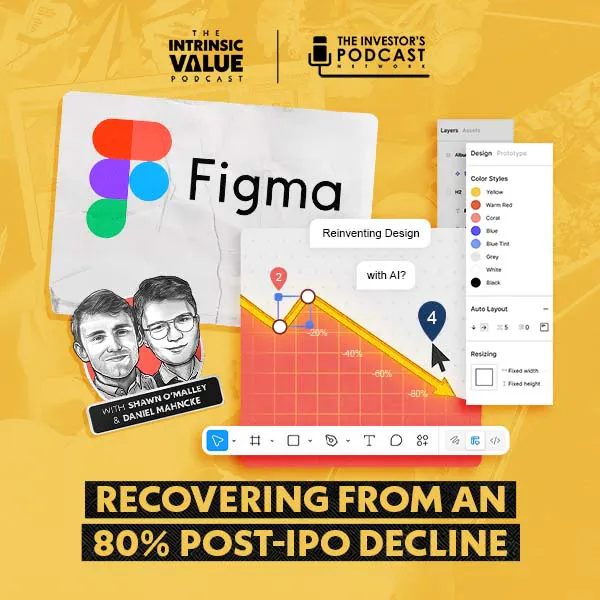
The Intrinsic Value Podcast - The Investor’s Podcast Network
TIVP063: Figma Inc. (FIG): Recovering From An 80% Post-IPO Decline w/ Shawn O’Malley & Daniel Mahncke
01:12:10
Shawn and Daniel break down the emerging design giant Figma Inc. (ticker: FIG).
Loading summary
Transcript74 lines
- [00:01]
Sean O'Malley
Overhyped IPOs are not a new phenomenon. But when the market discards a growing business because it was priced very ambitiously, perhaps that creates opportunities for us.
- [00:10]
Daniel Munka
Well, I would think so. Nearly four years ago, Adobe was trying to buy Figma for nearly twice the valuation that the public markets now value Figma at.
- [00:19]
Sean O'Malley
And yet, during that time, the company has unveiled a really impressive suite of products and maybe the most impressive generative AI tool for building apps that I've seen.
- [00:33]
Podcast Narrator
You're listening to the Intrinsic Value Podcast by the Investors podcast network. Since 2014, with over 180 million downloads, we've learned directly from the world's best investors. Now we're applying those lessons to analyze businesses and investment opportunities every week, helping you uncover intrinsic value. And now here are your hosts, Sean o' Malley and Daniel Munka.
- [01:04]
Daniel Munka
In light of SAS Magetta, everyone is asking themselves whether this is a generational buying opportunity for software stocks or a value trap in an industry that's about to be hugely disrupted by the advancements LLMs have made in coding, significantly lowering the barriers to software creation and potentially eating into the modes of businesses that were until recently considered some of the best in the history of capitalism.
- [01:30]
Sean O'Malley
Oh man, it's a good setup. A lot of people in particular are asking questions about Adobe's ability to generate excess returns going forward, considering just how good generative AI content for images and videos has gotten and has gotten really, really good and. And so today's pitch though, won't be for Adobe, even though we've covered it numerous times in in depth discussions in our Intrinsic Value community with members there. I'm actually interested in going through the business of one of Adobe's biggest emerging competitors in Figma. And my hope is that doing so will not only help us better understand the implications of AI on the creative design industry, but also Figma as a company is interesting because they had one of the hottest IPOs in recent memory last year in August, only for the stock to be down 80% since then. So that definitely catches my attention.
- [02:20]
Daniel Munka
That was quite incredible. And for anyone not familiar with Figma, it's this very slick interface for designing websites and apps. And what makes it special is just how collaborative it is. So you might say it's the equivalent of Google Docs, but for graphic design. So designers from across the world can simultaneously work on the same file in real time, which pretty significantly streamlines both workflows when you consider that designers used to be more siloed working on their own local versions of a file. So that would Create tons and tons of different file versions across the team though. And that core problem is basically what gave rise to Figma. But what's interesting is that Figma is in Adobe's footsteps, trying to expand into a more diversified platform of design tools and basically wants to penetrate deeper into enterprise customers rather than just the lower end customers like individuals and smaller design agencies.
- [03:14]
Sean O'Malley
Well, it's funny because in this narrow vertical of design, Figma has totally eaten Adobe's launch. Adobe had a product called Adobe XD that was meant to rival Figma, but it flopped. And so Adobe pretty quickly sunsetted the app because they were just so far behind Figma. And famously that's what led Adobe to offer $20 billion to acquire Figma. And Figma accepted the deal, but, but then the deal was blocked by European regulators, so Figma walked away with this billion dollar termination fee and, and Adobe got nothing out of it. And so, you know, now at a $12 billion market cap, which is about where Figma trades at the time of recording, the stock is not only down 80% from IPO, but it's now valued at 60% of the price that Adobe offered to buy the company at it nearly four years ago. So you know, yeah, today's pitch is an excuse to learn more about one of our largest portfolio holdings, competitors with Adobe, and then to try and learn more about how AI is impacting these different types of SaaS companies and also to determine whether there's any merit to the massive repricing and revaluation in Figma shares that we've seen or whether this is maybe a chance to buy a super fast growing company at the cutting edge of design technology that is maybe at a rock bottom point in sentiment. That's, that's the setup.
- [04:37]
Daniel Munka
It's kind of incredible just how fast the market can sour on the company. I still remember that right after the ipo, the stock just skyrocketed and there's no doubt about it actually being a fast growing company. I mean since 2023 revenues have compounded at a cake of 45%.
- [04:54]
Sean O'Malley
Yeah, it's, it's blistering growth and, and the thing is though, that, that Figma isn't profitable, so that, that doesn't help. Right. But you know, partly that's because of when you IPO that can trigger huge amounts of stock based compensation to employees that vests and maybe it's been accumulating for years and years. So all of a sudden that all gets written off basically at one time or over the course of a year. From the time that the IPO is announced to when it actually happens. And then that makes the financials just look really, really bad. Which, if you open up Figma's income statement for the last few years, it looks like horrendous. And I'm not necessarily saying that Figma would otherwise be profitable, but the numbers are, they're definitely distorted for the worse. And the question is just how distorted are they and what will be more normalized earnings for them looking forward and really what's possible? And then of course, just how long is the Runway for that sustainable growth? So that's just a little preview of everything we'll try to get into today.
- [05:51]
Daniel Munka
I know the company is still quite young, and yet I still want to go into the backstory a bit. I think the protagonist of today's story is Dylan Field, who is basically the person that founded the company as an 18 year old intern back in 2011. And I think we've looked at a lot of companies and founders now, but I'm not sure anyone was younger than him when their company was founded. Even Zuckerberg was only 19 when he created Facebook, still a year older. But for him it only took four years to become a billionaire. Dylan Field had to wait 15 years. He reached that milestone, I think last year when Figma IPO'd. And I guess nobody has lost more money than him in this post IPO crash. Full stock.
- [06:28]
Sean O'Malley
Yeah. So Dylan was working at a social magazine called Flipboard, and he kept getting derailed by these issues that he'd run into with Adobe Fireworks, which was a product from Adobe. And as the story goes, he began venting to his friends and coworkers about why design work just could not be as smooth as Google Docs. Which drove him crazy because. Because, you know, he grew up in school using Google Docs and he's not so much older than us that we probably can't relate to that either. At least I know I can. And so much of my school experience ran through Google Docs too. And the great thing about Google Docs is, you know, you don't need a Microsoft license to use it, like with Word, nor do you have to pay anything at all. It's totally free, it's widely available, and most importantly, it's collaborative in real time. You could have multiple people as part of a group project in school. They can be typing in and editing a doc simultaneously.
- [07:19]
Daniel Munka
I gotta be honest, I think the first time I used Google Docs was Citip. I don't know, perhaps German schools are a Bit less digital, but as far as I can remember, we didn't get past PowerPoint, honestly.
- [07:32]
Sean O'Malley
Fair enough, but. So I just think the funny thing is that you have these schools that discovered collaborative work platforms, maybe not in Germany, but here in the us and they found that they were incredibly useful. And yet if we go back maybe 15 years, the corporate world very much was lagging behind them, particularly the graphic design world. And so that's what drove Dylan crazy as he transitioned from being a student to, you know, working in the business world. And basically he's described that he would sit with designers and just watch them work. In the corners of their screens were just this nonstop stream of Dropbox notifications constantly lighting up. And that's because design team saved all of their files in a shared file system like Dropbox, such that each time a coworker made a revision, everybody would get a notification. And as we've alluded to, this is the fundamental problem that Figma solved. Designs in figma are not just stored in the cloud, they are edited in the cloud too. And so in other words, Figma users are always working on the same design. That's really not a concern. Whereas with Dropbox, while the files may be stored in the cloud, all of the editing is done locally on your local device. In Figma, designers can also do things like comment directly on each other's files instead of having to send the emails back and forth with feedback. And all of this was pretty unthinkable not that long ago. But honestly, Figma changed the paradigm of how people work, especially in graphic design.
- [09:01]
Daniel Munka
I think it's fair to say that in the past it has been very difficult for non designers to be involved during the entire design process, because if product engineers, for example, wanted to see the full designs for a new tool, the designers would need to send them the current file. But to download it, the product manager would need to have design software like Adobe Product or Sketch installed on their computer, which wouldn't really make sense for them to pay for and actually just have it if they not frequently use it. And the latest version of the file was also constantly changing, so comments were being made and communicated over email. And non designers would need a design designer to walk them through the preview, which is just thinking about it, not entirely an efficient way or process to handle the workflow.
- [09:44]
Sean O'Malley
No, it's not. And it's always so funny because in hindsight we're sitting here struggling to imagine how or why anyone would have dealt with this. But this was just the reality at the time. And Nobody had made an alternative of this possible, at least not within this specific professional niche. And so it took Field some time to do it, but I think for the first time, three years after raising capital from a Peter Thiel backed fund, that was how long it took him to release the product that would then shift this entire paradigm. And, and you know, in interviews he's talked a lot about how he was basically a perfectionist. And so he and his co founder would work late night for years and years trying to make everything just absolutely perfect. And you know, I think that was a learning lesson for him. At some point you need to start making money and start sharing your project with the world and getting feedback. And so Field has talked about how holding onto Figma for so long before releasing it was basically one of his biggest regrets. And if he had started hiring people faster, outsourcing work and publishing the minimally viable versions of his tools rather than waiting for them to be perfected, in his mind, they could have moved so much faster and had an even bigger head start that could have compounded to a much bigger market valuation versus where the company's at today. So that's not what happened, though. It is still a success story, but I think there's some regrets there that Field feels like he dragged his heels for what at the time probably felt like an eternity.
- [11:08]
Daniel Munka
I'm not sure if we already passed the point of the story that I certainly want to cover. I think you told me that Field's co founder was going by the name Computer Jesus. So tell us about that. How exactly did he get this name?
- [11:22]
Sean O'Malley
So Dylan Field was at Brown University and that's where he met Evan Wallace, who was nicknamed cj, short for Computer Jesus, as you said. And so Wallace was a teaching assistant in a course that Field took. And as they got to know each other a bit, at some point, Field asked Wallace whether he, or, sorry, I mean, Computer Jesus, would like to start a company with him. And this was actually before Field had had the revelation that he wanted to change how design work is done. So instead he was just so impressed by Wallace that his idea was to literally build any business he could with him. Because working together with Computer Jesus would surely lead to greatness, in his view. And he just didn't know what it was yet.
- [12:05]
Daniel Munka
I mean, apparently it did, right?
- [12:07]
Sean O'Malley
Well, absolutely. I mean, once they narrowed in on the idea for a collaborative design tool, it was probably clear to outsiders that they didn't have the manpower to build such a sophisticated platform. But there's also no convincing Fielder Wallace of that. I mean, there's two extremely, extremely driven guys. And so by late 2015, three years into this journey, the two of them shared their work with the world finally. And so actually it's interesting because the initial response was pretty tepid. And so I have a quote here from Field, who says a lot of designers at that point were coming from an agency culture where, you know, you go explore, you come up with a few solutions for the client, you present three solutions, and then you have a grand reveal of like, here is this big, amazing thing that you should obviously do, and that's just not the way that product development should work on a team internally. So these are Field's words. And just continuing the quote, he says, but people were so used to that agency method of working that some of the initial comments in the launch were stuff like, hey, if this is the future of design, I'm changing careers. And then he says, there's this one comment that it felt like this was a camel being designed by a horse, by committee. And yeah, it's not exactly the kind of feedback you want after you've been obsessing over your design product for three years in secret and then make it available to the world.
- [13:29]
Daniel Munka
It's brutal. I can't imagine getting that feedback and then going to continue and building that company. But I mean, it's a great illustration of why you need to get external feedback earlier in the process. No matter how smart or how capable you are, even if you have computer Jesus by your side, you're not omnipotent, right? I mean, you can't know what issues or concerns thousands of different people will have without actually just sharing your work with them. So better to do that sooner rather than later.
- [13:57]
Sean O'Malley
And looking back, I'm sure Field would agree with you. But the crazy thing is they basically got bailed out. Figma had organically caught on within a bunch of circles at Microsoft. And as Microsoft became more structurally dependent on Figma for their work, they basically went to check in with the Figma team, only to be shocked when they found that Figma didn't even have a salesperson. They had none of the operational infrastructure in place that you would need to have a functional business other than the software. So Microsoft actually intervened. Figma had become too important internally for them to tolerate the risk of the business going bankruptcy. And so they pushed Field to start raising prices, building a sales team and doing all this other stuff to actually turn it from, instead of just being a cool product, actually being a real enterprise. So it's Pretty funny when Microsoft has to come in and tell you, hey, you are not running your business very well, but we really like what you're doing. Here are some tips that's probably a
- [14:53]
Daniel Munka
good example of what bottom up organic growth looks like. I mean, you become so entrenched in one of the biggest tech companies in the world that they deem your startup to be critically important and help you basically professionalize your operations. I mean, it could have also turned out differently where they just built their own tool and then replaced Figma completely.
- [15:12]
Sean O'Malley
Absolutely, absolutely. And the thing about viral growth is that it can only go so far. So the set of designers that a single designer maybe at Microsoft works with directly is fairly limited. They only have so many close colleagues to spread the word about Figma to. And while that may spread via some kind of word of mouth to other designers, the network effect can't spread as dramatically as something like Facebook or TikTok naturally can. But the thing about Figma is that it's not only useful to designers, it's useful to engineers and product managers too. Meaning by encouraging their non designer colleagues to be involved in the process of building a software product and designing it, the number of people onboarded into the Figma ecosystem could actually expand dramatically further than just the set of designers that would directly be working on the products. And so therefore the network effect around Figma could extend well beyond only design workers. And so as these non designers learned to appreciate Figma, they then began to evangelize it to other teams they worked with on different project. And this is known as a cross sided network effect. And it's a great illustration of how an early decision like wanting to make a collaborative software design tool that was useful for all stakeholders, not just designers, can shape and broaden your addressable market really meaningfully over time.
- [16:37]
Daniel Munka
So then you get this, this period of rapid adoption where basically the cat is out of the bag. And then designers around the world begin to actually adopt Figma. And finally there's somewhat of a collective relief that designers can use a graphics editor as fluidly as something like, as we said, Google Docs. And then big bad Adobe enters the picture. I mean, they realized, hey, they missed a huge opportunity here to address a pain point in the market. And you know, you might say it's kind of an innovator's dilemma paradox. And then they decided to try and just buy Figma rather than compete with them. And in the fall of 2022, Adobe offers $20 billion in cash for the company.
- [17:16]
Sean O'Malley
Yep. And at that point, I'M guessing Field and a bunch of other employees were just planning their retirement trips around the world. They're ready to cash out because they're going to be so rich, they're not really thinking about the future of Figma anymore. And, you know, as it became increasingly clear, though, that the Adobe deal would fall through, they realized that they just couldn't rest on their laurels. And so if they had sat around for a year just waiting to get paid and the deal fell through as it did, they would lose their first mover advantage. So at some point along the line, the vibe flips from this dramatic exuberance to, by the end, a real point of desperation and this realization that, hey, we are going to have to do this on our own. No one is coming to save us with a big payday. And so there's still a lot of work left to be done. And there's this really great quote from Dylan Field reflecting on the Adobe deal and he goes, quote, at the start, it was kind of like, oh, 95%, it'll go through, no worries. But every time we checked in, the certainty of the deal went down. Eventually, at the end, it was maybe a 5% chance that it would go through. And, and somewhere in that arc, we realized quickly, this is not a sure thing. Keep the foot on the gas, keep building. That's the best outcome, whether we join Adobe or whether we're independent. You can't be in this constant state of we're so back and then it's so over. Rapidly cycling through that just makes your brain fall apart and turn to mush, in my opinion. So the word of the year for me was equanimity. I think I said equanimity more times that year than I ever will for the rest of my life. It's just, how do you find peace in every option and know that everything's going to be okay? We're building a great company for amazing customers and we have a lot of stuff to do, let's go do it. And so, yeah, that was. That was quoting Dylan Field. And the irony is that previously, Figma had only ever raised in the neighborhood of $300 million from outside investors. So when Adobe suddenly pays them a $1 billion breakup fee just for the deal getting blocked by regulators, that was three times as much cash at once coming in the door as the business had ever received from previous fundraising in total. And for that massive influx of cash, Adobe shareholders received nothing, nada, not a single share of equity once regulators intervene. And so it was effectively a Charitable donation to one of their most promising emerging competitors. And you can imagine from Figma's perspective, they're thinking, holy cow, we have all this cash now, we really got to start building and ramping up.
- [19:49]
Daniel Munka
I'm honestly not sure though whether I find it good that they wanted to sell the company or if I wanted a more, I don't know, enthusiastic founder who wanted to build this company themselves and not just hope for a big payday selling to Adobe. But I think we'll talk about this later on a bit more when we talk about, you know, stock based comp and all of that stuff. But you know, generally such is the risk for M and A at this scale, even if Adobe didn't want out of the deal, part of the reason these fees exist, the fee 1 billion basically that you just mentioned in theory, is that, you know, a business could offer to buy up a competitor, then drag their feet on it for, let's say, a year, and then keep anyone else from buying them and also make the arrival a bit complacent before actually canceling the deal. So for Figma or, you know, most growth companies being acquired, there needs to be a financial guarantee that the acquirer actually has skin in the game to not bail on the deal at the last minute and will fight as hard as possible to overcome regular obstacles, which is something that Adobe certainly did, because otherwise the whole thing becomes kind of like a distraction and a waste of legal fees, planning and time. And now that I think about it, since this was all pre ipo, Figma went into the public markets at least with a uniquely strong balance sheet bolstered by, you know, that Adobe infusion. And that was less consequential for Adobe. Although as shareholders, obviously we would have liked to see either the acquisition go through or them not paying a billion dollars. But for Figma, I don't want to say it was everything, but it was huge. It gave them huge degree of discretion. Right when they IPOed. Right, so we get to why there's a breakup fee. But what actually was the issue that European regulators flagged? I mean, what was the basis for blocking the deal? As you know, my co host Sean and I are obsessed with analyzing companies. But you probably have noticed from personal experience that talking stocks is not everyone's favorite hobby. And I'm reminded of that every time I bring up investing at dinner or when I'm out with friends, they tolerate it for about 10 minutes, but then I get this look, the one that says, we get it, you love stocks, but this is not the place. So Sean and I thought, why not build that place? And we did it. It's called the Intrinsic Value Community. Our members range from pilots and firefighters to lawyers and engineers, but also hedge fund managers, actual rocket scientists and CEOs. And despite those different backgrounds, what connects all of us is the passion for value investing and continuous learning. And each week we host live calls covering everything from vetting the group's best stock pitches to analyzing portfolios, investing case studies and conversations with expert guest speakers who are either prominent portfolio managers, CEOs or authors. And the best thing is that if you ever miss a call, we have a library of recordings for watching back every single call we've ever hosted. And if you prefer reading over watching, well, then we have dedicated spaces in the community to share write ups, discuss investing ideas, or just your thoughts on the general market. And multiple times a year we bring the community from the virtual world into the real world, including private dinners in Omaha for Berkshire Weekend and meetups in New York City to explore, hang out, and most importantly, talk stocks. Our last cohort of members brought together 20 incredibly thoughtful people, some of the sharpest investors that Sean and I have ever met. And if you want the chance to learn alongside people like that, you should join our waitlist@theinvestorspodcast.com intrinsic value community that's the investors podcast.com intrinsic value community.
- [23:18]
Sean O'Malley
The UK Competition and Markets Authority, the European Commission, were the primary roadblocks that led the companies to terminate the agreement. And so regulators argued that Figma was an emerging threat, in their words, to Adobe's dominance. And so UK regulators believed the merger would effectively eliminate competition between two major players in the product design software market, which I do think is true and would create this near monopoly situation. And so while Adobe insisted that its own competing product, Adobe xd, was failing against Figma, regulators were concerned that Adobe was acquiring Figma specifically to neutralize a threat that had successfully captured market share from them, which would be an anti competitive practice. And so the whole episode drew a lot of comparisons to Facebook's acquisition of WhatsApp, which is also seen as a move to prevent a competitor from growing into being a core threat. And that deal was actually allowed to go through. So I think they're not to link them too much, but I think there is some lingering regret about how that unfolded that may have biased how people thought about this Adobe Figma deal.
- [24:27]
Daniel Munka
Generally. It doesn't surprise me that the EU was the one blocking the deal, but honestly, I was surprised more than once by you could say the inactivity of U.S. regulators in the last decade when it comes to actually regulating monopolies. And I think it's more than obvious that, you know, buying Figma would have turned Adobe into even more of a monopolistic company in the space that they operate in. And I think that's why they wanted to pay $20 billion for a company that was arguably worth less than half of it at the time. And I know though that you know, you've used Figma in the past, Sean, so I think you told me that you used to make mockups for the TIP website with figma. Right? So how exactly did that go? Was it a positive experience with the product or more of a negative one?
- [25:11]
Sean O'Malley
No, it's true. I'm not sure I was getting nearly as much out of the platform as I could have, but I made some bare bones website designs to show how I wanted things to function for our design team and programmers so they could go then implement those ideas. And I don't think I use Figma in any kind of real collaborative sense as it's supposed to be, but still I thought it was really nifty. It was recommended to me by a colleague who is also not a creative professional. So that's just kind of an interesting data point as we were talking about earlier about these cross network effects and non designers having reasons to recommend Figma because it is such an inclusive platform. But even if I was not fully equipped to appreciate Figma at the time, I do think it's important to emphasize that Figma has essentially reshaped how teams design software, turning what was once a painfully siloed process into a very collaborative workflow enabled by the cloud.
- [26:04]
Daniel Munka
So Figma Design, as it's known, is basically the flagship product that we are referring to whenever we talk about this. But what I'm most interested in, I think is their transition from product to platform. So users have normally a one way relationship with products, right? So with a product you use it in a certain way and it delivers an output for you, but with the platform, well, the product becomes more decentralized. So typically anyone who uses a product can also work on features that then can be used by all others. So that's basically when a product becomes a platform and the relationship becomes two way. So you follow inputs and then you get a certain output, but you can also manipulate the platform to offer different types of outputs or tools for efficiency. And I think this might sound a bit wishy washy as I'm saying it, but the idea is to Talk about Figma's plugins. So it kind of reminds me how in a lot of video games nowadays, anyone can actually become a developer. So you can create your own world or your set of rules for a game that can then be published and played by anyone else, really. And so you go from having a single game designed by just one company to basically a gaming platform that still has that primary game functionality, but also can host thousands of different types of games generated by users. So would you say that's what Figma has done with design tools as well?
- [27:27]
Sean O'Malley
It's a wonky idea to kind of wrap your head around it first, but I think that gaming example makes the point really well. I mean, Reddit is similar in a way too. Anyone can go and build a community, define its purpose and rules and so on, and make it available for anyone else to participate in. And it's kind of the same idea. This is what decentralization is all about. And so most Figma plugins are intended to do one simple thing very well. They save you from tedious work and create automations that other designers have found helpful. And odds are, if you've encountered an issue, someone else has also probably encountered the same issue. And maybe with plugins, they've created a solution for that problem faster than the team at Figma could identify and resolve it. So that is really the promise of decentralized platforms as opposed to a centralized platform where it would just be Figma trying to make every single change itself internally. And so, for example, you do need baseline designs of your product, but also designers need to produce designs showing how, say, the app or website will look in dark mode or when viewing in mobile versus on a desktop. And you can actually generate plugins that automatically create dark mode versions of each of your designs, so saving you from doing double work, basically. And so you could argue then that plugins make the entire ecosystem for all users smarter and more robust, which, you know, further compounds the value of the company when you think about it moving from a standalone product being run by a single company to being a platform that's really almost anti fragile in a way, where you have all these different people contributing to improving it.
- [29:02]
Daniel Munka
It's somewhat of a subtle point, but you know, the reason it matters is that scaling a product is is not as simple as adding more users and then making more money infinitely as the customer base grows and diversifies, I think the user experience basically splinters into thousands or even millions of edge cases. So teams using the product in ways that you didn't originally anticipate they would use them. So you can either keep patching every new workflow internally or you can shift the burden to the entire ecosystem. And that's basically the platform trade off. So you give up some control and therefore you invite unpredictability. But you get the compounding innovation from plugins, widgets and integrations. And the prerequisite is making the underlying building blocks accessible so permissions, data access and developer tooling so the community can actually start building. And I think figma has opted for the more communal approach.
- [29:55]
Sean O'Malley
Evidently they have, and that's one of the things that makes me think about they could be somewhat resistant to AI. LLMs can spin up viable apps and thousands and thousands of lines of code really, really quickly these days. But instead of seeing that as competition, now LLMs can be used to develop integrations that make Figma more robust, for example. So not to say I know how this will turn out for all SaaS companies in AI, but if that assumption is true, then again Figma is actually kind of antifragile in a way, which is a really powerful concept that we're borrowing from the SIM Nicholas Taleb, who's the author of the Black Swan. And so, as we've discussed a few times today, one of the unique and ambitious decisions Figma made was to build a platform relevant to everyone involved in the product development cycle, not just designers. And so figma's plugin ecosystem is therefore intended to blur the line between designer and developer by letting designers create plugins, maybe with coding for their own workflow. So again, it's like, you know, who is a designer, who's an engineer and a programmer, it's, it's, it's, it becomes blurry, right? And so they're betting that a meaningful portion of the platform's compounding advantage will come from individuals wanting to improve their own workflows and then basically shipping those improvements into the comments, sharing them with everybody else, and just continuing to take this decentralized approach to incrementally improving how useful figma can be to all different types of users well beyond the original target audience.
- [31:28]
Daniel Munka
Going into this, I didn't think that Figma would actually have somewhat of a moat against AI, but when you think about this, and you know how it basically becomes a platform to use AI on instead of losing users to outside AI tools, then especially asked you before, like when you combine this with the collaborative approach, which is exactly what they're doing, I think that's a stronger mode than I initially thought figma would have. And as I understand it. There's a lot more to figma than just the flagship figma design product. So what else does figma have to offer and how does that Compare to potential AI threats?
- [32:01]
Sean O'Malley
Well, so there's FigJam, which is essentially an online whiteboard for brainstorming. FigJam gives designers, and also non designers a space to sketch user flows or to map out ideas with these digital sticky notes, stuff like that. And literally this is stuff that would have happened on physical whiteboards. But by bringing the ability to do early stage ideation into figma's ecosystem, teams can then transition from these rough ideas to professional designs in one workspace or ecosystem. And then there's also figma Slides, which is this collaborative presentation tool. Honestly it's not wildly different from Google Slides, but because it's part of figma, designers can embed live prototypes or interactive elements directly into these slides from designs that they're working on elsewhere within the figma ecosystem. And you can imagine that being very helpful in presenting the design work that's already been done to non designers, which of course is an important part of the design work process. And so the last year has really been actually the year of lots of releases for figma. Figma stepped up their product launch timelines and launched a few different apps that are still mostly in beta testing, but for context. Figjam came in 2021 and then dev mode turned Figma into this more decentralized platform as we were talking about that launched in 2023 and then Figma slides came in 2024. But in 2025 we had four new products drop. So they went from this cadence of a new product every year or two to four in a single year. And those four new products were figma Sites, figma Make, figma Buzz and figma Draw. And so all of these new products are heavily integrated with AI tools that are just baked into them. Figma Buzz is specifically for building creative assets for social media, where. Well, figma Sites is for building websites. And so figma Draw then is for drawing out sketches and then figma make, well, that is the one I'm most interested in. That's the most impressive one to me. With Figma make, you, you can basically code whatever you put your mind to in plain English or. So basically what I mean is you can use regular language requests to have an LLM code something on your behalf. And it's good, it's like scary good. So good that it makes you wonder if all those fear mongering AI posts are going to Take all of our jobs kind of things, These doom posts, whether they actually maybe have a grain of truth to them, not to be too morbid, because it's like it is really good without any code or really any effort. I think I put in like two sentences of text. I asked Figma make to develop a meditation app for me.
- [34:40]
Daniel Munka
I remember when you messaged me on Slack, basically saying, look what I just wipe coded. And it is pretty incredible. I think you said it take you a minute or two and as you just said two sentences of input and then it considered everything you would need. From there, it iterated on its own creations and, you know, tested out how to improve the product. And then at the end, you get what is actually a functional app for meditation and you send it to me. It actually looks quite good as well. And I don't know, I mean, Figma is not the strongest tool out there. So, you know, there are things like Claude Anthropic or openclaw that can do similar things and obviously significantly better. But if you think at the average customer that Figma has and how good that tool already is, and then you think two, three, four years out, it's quite an astonishing thing to think about where this could go or where this heading to, actually.
- [35:26]
Sean O'Malley
Well, and also that Figma is collaborative in a sense, that some of these other AI tools may be more individualized. And, you know, really what I did is only scratching the surface. I mean, all I did was go with one of their preset prompt templates and it was as easy as that. But yeah, I mean, it had different types of calming sounds, breathing techniques, different timers and stuff that it all came up with on its own with very, very little guidance for me. I didn't give it any explicit instructions other than just saying, hey, build a meditation app. So what I think is really fascinating is it figured out things that I would probably want to have and then, you know, it did that. It iterated and tested it and then built out all these different features that it thought would make sense there with kind of like stylistic discretion. And I can only imagine me, seriously, how powerful this is of a tool for someone who actually knows what they're doing. Right. If I can spin up a meditation app in a few minutes of my first use, what could a pro do in an hour or during a whole workday or a work week? I think it's mostly an exciting thing to think about, but, man, it's a lot to process, honestly. I mean, it's overwhelming what the possibilities could be. And so Just for context, Figma make was first launched last summer in July 2025 and is now being used by 30% of Figma's customers who are signed onto $100,000 plus ARR contracts. With the point being, Figma's largest customers are pretty clearly adopting Figma Make Very Quickly. And based on my experience, I can see why they really like it.
- [36:59]
Daniel Munka
I think to sum things up, you say that Figma's strategic focus has basically shifted from being a singular design tool to somewhat of an end to end collaborative platform. And now figma make is central to this next chapter in their journey as they embed AI into the applications they provide.
- [37:19]
Sean O'Malley
The thing is, Figma is not at the cutting edge of AI, right? It's not like they're building LLMs from scratch, but they can make acquisitions that enable them to do more with AI. And that's why they acquired a company called WeVee, which is now known as Figma Weave. And before this acquisition, designers using generative AI faced a really fragmented workflow. They would have to leave Figma to use tools like Mid Journey or Runway. They'd be generating assets through this kind of one shot prompting process that can feel like, you know, you're pulling a lever on a slot machine and you don't know what the output is going to be. It's just totally unpredictable and hard to refine from there. And so I'm sure a lot of people who experimented with AI image creation maybe a year or two ago can relate to that. And with Weave and Alpha Weave, I mean, it's just totally different reality users can chain different models together. So sort of like generating an image with one model that then animating it with another and then refining the outputs using professional editing tools, all without leaving the Figma workspace.
- [38:18]
Daniel Munka
So just so I understand it correctly, WEAVY basically allows designers to treat AI outputs like, I don't know, moldable clay that can be then sculpted, layered and iterated up on. Right?
- [38:31]
Sean O'Malley
It's correct. And while Figma make focuses on generating interface layouts and code for things like my meditation app, Figma Weave focuses on generating the content inside those interfaces. So like high fidelity images, videos and motion graphics. And so anyone who has followed along with the Adobe story can probably recognize this as a defensive move against Adobe's Firefly, which is their generative AI tech that's trained only on legally licensed ip, that's kind of their claim to fame.
- [39:03]
Daniel Munka
So I presume Weave will be monetized probably on a usage basis as opposed to a per User or per seat basis, which is what the norm was in enterprise software for a long time. But now we're seeing AI changing that dynamic. Companies might not need as many designers anymore, so selling on a per user basis wouldn't be the optimal strategy with AI tools. So there's a single user who only can be so productive and you basically want to build based on how much computing power they use effectively. But the bigger question for all of SaaS that the market is trying to wrap its head around is whether software businesses are becoming more like variable cost businesses. I mean normally you can scale software with very little incremental costs, but now if incremental use comes from compute heavy AI tools, well then the inference costs are very high. And that could mean that many software businesses, including figma, become significantly lower quality. And that's basically the overall market concern.
- [40:01]
Sean O'Malley
Yeah, and I think that's why Figma Weave is currently a standalone product, but it's expected to be integrated into figma's greater platform over time. And so yeah, I mean it utilizes this separate system for AI credits which sort of hints at a world where enterprise design subscriptions will be provided on a consumption based model as opposed to a per seat model. And for now though, they're not actually charging anything for AI credits. So we haven't really seen this even come to fruition yet. They want to get people to try and try the tools you and embrace them before they start charging any money. So at the moment figma is entirely shouldering these inference costs and again that's why I say it's really hard to understand how profitable figma's normalized margins will be because you know, we're not even at a point where they're actually fully monetizing products and their ecosystem. They're treating them as loss leaders that they're subsidizing.
- [40:55]
Daniel Munka
So let's talk about figma's overall billing strategy then. How do they actually approach monetizing their software?
- [41:03]
Sean O'Malley
There's been some big changes recently actually early last year FIGMA underwent a significant overhaul of its subscription billing model. So we just talked about the future that may rely on consumption based pricing with AI tools. But in the present what we've seen is a shift to admin approved upgrades. And so for context on what that means, previously figma had a user driven model and basically where if you used figma you could order new paid seats for your colleagues or anybody who you worked with, who you thought needed access to the tool and then they would get billed and retroactively account Administrators at those companies would review the charges. So basically any user had the discretion to order more licenses or seats, whatever you want to call it, for their co workers to be able to use without needing direct approval from, you know, the higher ups at their company. And when you're working with young companies, they, I'm sure, appreciate that flexibility. But as you move up the chain, more mature enterprises do not want that. They want to know where every dollar goes, they want to be able to track it, they want to know who expensed it and why. And so this is kind of a trust based policy that leaves the door open for unexpected costs, which, yeah, I mean, nobody likes that. But especially these stale, more mature enterprises do not want to get unexpected bills. So the new model requires upfront admin approval before any new licenses are provided. And so the trade off is that while this gives enterprises, you know, bigger customers more visibility and control over what their spending will be in a period, it introduces this friction to the organic growth loop that figma had really long benefited from, where people would start using it and then say, hey, let me sign you up and let me sign you up and we can all work on this and then you start recommending it to other people. That organic viral growth loop really gets kind of a boot on it in this situation. It just gets absolutely smothered. And you know, the other thing is that figma, as it focuses more on enterprises, it's moved away from selling individual products like figjam separately. And so instead you, it introduced a handful of different seat packages with kind of varying degrees of access to the company's suite of products. And so it's similar to a lot of the packaging that Adobe offers. And because a bunch of new tools were released last year, what they did was they raised the price for a full seat. So a seat with access to everything that Figma offers and they increased the price of that by 30%. And if you go on into some Figma subreddits, as they did, I saw a handful of people complaining about this, saying that like, hey, they really enjoy having full seats, but they don't appreciate the price going up for new tools being added if they don't use them. Right? If you don't use Figma make, but now your overall subscription is increasing 30%, that's going to be really annoying to you. And so that is the challenge with bundling. Generally to some folks, for people who use the whole bundle, it's an incredible deal. And to others it's a point of frustration because you can't Shop for the specific products a la carte that you might want to and are instead implicitly paying for maybe things that you will never use. And yeah, that can be a real a drag on sentiment when you're forcing people into these more, you know, prepackaged purchasing options.
- [44:20]
Daniel Munka
That's a common criticism with a lot of these software companies where, I mean, honestly, that's one of the arguments AI could come in and then only replicate the tools that most people are actually using while currently they pay up for the entire suite of products, even though they're not using them. One of the numbers though, that I've heard, which is fairly impressive from figma, is their NDR metrics. Any thoughts on that?
- [44:42]
Sean O'Malley
Yeah, so NDR stands for net dollar Retention. It's not a term that I think everybody will know. And there's some good and bad news to having a good NDR with Figma. The good news is that for customers spending over $10,000 annually, so larger corporate customers, but not the biggest ones, their net dollar retention hit 131%. And so what does that mean? Well, if you look at how much money in total these customers paid in, let's say, 2024, and then you look at their spending in 2025, in aggregate, that spending increased by 31%. So that includes customers who might have canceled their contracts or, you know, downgraded their contracts or also expanded their contracts with figma. With the point being on net of a, you know, basically a sample size of customers, that spending increased pretty significantly. And so that 131% NDR figure is a net figure. And the takeaway is that enterprise customers and aggregate are, as I've been saying, spending more on Figma's tools. The bad news is that this NDR number primarily reflects results from before Figma changed its billing strategy with these admin approvals. So it's almost stale information. It's one of the biggest selling points for the strengths of the company. And we don't even know what that will look like going forward. We just literally don't have the data yet to know how these changes in strategy will impact ndr. But I'm sure we'll see some growing pains along the way. Even if it is ultimately the right move.
- [46:12]
Daniel Munka
It's not exactly the same, but it kind of reminds me of when Adobe switched from selling its products on annual licenses so they would release Photoshop 2009 and then the next year the 2010 version would come out, and then you could buy it and own it to then charging Recurring subscriptions. So rather than owning the software, you're basically renting it or, you know, paying to access it for a period of time. And that's super common now, but 15 years ago it was a big change. And Figma's move here isn't on the same scale. But, you know, the point is, as technology changes or simply as businesses mature, changing pricing models can become necessary. And even if it's ultimately the right move, like I think we can say pretty confidently now, it has been for Adobe, they definitely had some ups and downs from the transition to SaaS. And honestly, when you look back at the headlines back in the day, it was not only negative feedback from customers who now had to pay more money, it was also a lot of analysts not thinking that you would make more money with this model because to that point, if you buy a license for Adobe, you would get $2,000 upfront. Now you're basically only getting $200 upfront, and then month by month you're paying. So it's basically a bet on a high retention rate with your customers. Now, we know it paid off, but it's not always clear in the beginning.
- [47:27]
Sean O'Malley
So in their S1 IPO filing, Figma reported having 450,000 paying customers as of March 2025. And they don't report that number quarterly. But given Figma's $1 billion in ARR annual recurring revenue today, it would imply that they have about a revenue per customer of maybe $2,000 per year or $185 a month. And so one wrinkle to that is how they define paid customers, which is that a paid customer can technically refer to an entire organization, or if there are multiple departments with an account and their own plans, then those can get counted as multiple different paid customers, even if they're all within the same company. And I don't say that as like a yellow flag, but it does show me that they have a very top heavy customer base. And honestly, it may be even less diverse and more top heavy than we think. Right. Just from the reported data, the top 0.2% of Figma's customers in early 2025 generated approximately 40% of the company's ARR. And then the top 2.5% of paying customers comprise more than 60% of Figma's ARR. So you have just a small number of customers that are basically driving the entire business.
- [48:38]
Daniel Munka
Wow. Okay. So it's very much not a tool used by other individuals or, you know, just small companies like, for example, Canva and more so it competes with Adobe for SMBs and perhaps even more medium businesses than necessarily the smaller ones. And I don't necessarily think, you know, if that's a positive or negative, but it's different from what I thought the customer diversification would look like.
- [49:00]
Sean O'Malley
I should also mention that to my surprise, Figma is a pretty international business. You know, good design transcends borders, I guess. Their revenues are basically 50, 50 US and international. But, and stop me if you've heard this before, with so many of the companies we cover on this show, they monetize their US customers significantly more. So with only 15% monthly active users being based in the US almost half of the company's revenue comes from customers in the United States. And so the other thing we should mention is that deal momentum has been picking up, which is a great leading indicator for the company. Customers signing multi year deals increased by 27% quarter over quarter for Figma. So it is full steam ahead for the company right now.
- [49:44]
Daniel Munka
So just taking a step back still, I mean I see a business with, you know, viral word of mouth adoption. You have low churn, you have expanding use cases and a mix of, you know, self serve and enterprise sales contributing to what is very strong top line growth. Unless AI, you know, suddenly flips everything upside down, it is easy to see why the market was so excited about figma at ipo. And beyond, you know, general exuberance, it's less clear to me why it has declined about 80% since then.
- [50:15]
Sean O'Malley
The ironic thing is that within its niche, Figma looks pretty close to being a monopoly. And normally investors love monopolies. So you know, this is why after all, regulators blocked the deal with Adobe. Not because a combo of the two would create a monopoly in collaborative design, but there already was one. And allowing that to be merged into all the other verticals, that Adobe has monopolies over it, that would be problematic. And just from 2020 to 2022, Figma's market share went from about 50 to 60% to as much as 90% in 2022. And so as basically that happened as competitors around the globe failed to keep up with them. So many of figma's competitors just outright failed. But I think the problem is that the tam, the total addressable market and figma's core business is just not big enough. And so as they scale into these new areas with figma make and Figma sites and Figma Buzz and all these new exciting products, they're facing much more intense competition because they're more directly stepping on their competition's toes, whether that's Canva or Adobe.
- [51:18]
Daniel Munka
That's the downside of, you know, working in between Canva with mostly individual customers and small businesses and Adobe with, you know, Hollywood studios and large corporations as customers, and your time's relatively limited and expanding it then automatically means dipping into territory that already has its incumbents and to some extent, monopolies. And I mean, Canva's on the one side, Adobe on the other. Both are strong companies. And I think many people outside of the creative industry don't even see these companies as monopolies because they mostly think they compete for the same customer, more or less, although we now know that's not necessarily the case. But we also like to emphasize that founder led companies are much more likely to reinvent themselves and, you know, find ways to succeed even when the odds are stacked against them. And Figma is still founder led. So I want to ask you about one of the most important things for us when assessing the CEO or, you know, the management team in total, which is the comp package. It looks quite generous at first glance, but what are your impressions of, you know, Dylan Field? I know Brian Chesky is your favorite, you know, eclectic tech CEO, so maybe you can tell me how Dylan compares.
- [52:28]
Sean O'Malley
Oh man, you're putting me on the, putting me on the spot there. I mean, I probably don't like him as much as Brian Chesky, but I do, on a personal level, really like Dylan Field. He comes across as just being sincerely kind. I think if you listen to 20 minutes of an interview with him, you'll see that. And, you know, that's why people often paint him as being a CEO in the tech world who has managed to find success without being some kind of manic psychopath who's like, sleeping on, you know, the factory floor every night or like firing half the company impulsively and just doing all kinds of crazy things. He just seems like a normal guy. And granted he's a very smart and very rich guy, but he's not trying to be king of the world either. And I might be biased though, because in one of his interviews he said that he just loves Tusana. And so maybe he likes Tusana as much as I do. And yeah, maybe that's why I like him. But no, he seems like a. Just a really solid guy. It's, it's hard to find any issue with him.
- [53:21]
Daniel Munka
Well, then you're too biased for me to believe whatever you say about him because, you know, just for the audience, Sean would live in a sauna if it were possible. When we went to the Tip Summit in Montana last year, he went into the sauna more often than I walked by it. So, you know, just to give listeners an idea. But getting back to serious investor research, what's his take on AI?
- [53:42]
Sean O'Malley
Yeah, so he's definitely maybe talking his own book a little bit when he talks about AI, but I think there's some truth to his insights. And so whenever he talks about AI, he mentions how AI lowers the barrier to the creation of images and graphics such that design and craft are the true differentiators. And kind of sounds like something Hermes would say, honestly. And you can summarize this view of design in an AI world as being that for the best artists and brands globally, AI is a tool they can use to push beyond the prompt rather than having AI creations be the final destination on their own. And so for individuals and small to medium sized businesses, maybe AI output with some light prompting is all they need. But I think he would tell you the most valuable brands globally are, aren't going to settle for that. And more than ever, taste and distinction will matter. And brands that lean too heavily on AI generated content will ultimately be penalized for that. That's his outlook.
- [54:42]
Daniel Munka
Perhaps that's true, but from what I'm seeing though here, the only people being penalized currently are shareholders. I mean we touched on it a bit earlier, but if you look at figma's financials without context, they actually look terrible. It's like, you know, they IPO and the second that happens, margins just collapse.
- [55:01]
Sean O'Malley
It does look that way. I mean, yeah, this is the RSU restricted stock units release that we were alluding to before. And so effectively for years, and I'll say this is common practice, but Figma was not recognizing the expenses associated with the stock awards that they were giving to employees as part of their compensation packages. And so maybe for years, if half of someone's comp package was stock, well, only the cash portion would have been reflected in the company's pre IPO financial statements. So only the cash was being written off as a business expense. And with those stock grants, there are basically these caveats that have to be fulfilled, like continued employment for certain periods of time for the shares to vest and then be paid out. But also a liquidity event can trigger vesting. So in Figma's case, that could trigger the vesting of huge chunks of the company's accrued stock based comp. And what is a liquidity event? Well, that's an IPO. So you could say that the company's 2024 and 2025 financials are artificially bad because they include many past years worth of employee costs. Or you could say that their private company accounting was artificially favorable and did not account for real economic costs that should have been accounted for. And I think both are true. Just a matter of perspective. The reality is that looking at their pre IPO or post IPO financial statements, at least for 2024 and 2025, they're just not all that meaningful and that makes FIGMA hard to value. We don't have a ton of insight into what the businesses markets will look like in the future when properly accounting for stock based comp also without all of this catch up stock based comp biasing things. And so you know, they had to recognize something like $800 million of stock based comp just at IPO. So yeah, I mean for a company with a billion dollars in revenue, that really distorts things. They then facilitated a tender offer where investors bought 24.4 million shares at 2319 a share. So it was another $566 million.
- [57:03]
Daniel Munka
I've actually seen people on X making memes about this, but apparently even though Figma accounted for a lot of this stock based comp, vesting the shares weren't necessarily immediately liquid for employees. So you have these insider lockups which are pretty common. So basically employees can sell tranches of stock for certain periods after ipo. So sometimes that's three months, six months, nine months, you know, stuff like that. And the rationale behind that is you don't want to have one huge wave of selling the stock when you know the IPO comes. So the stock's down 90% because there aren't enough buyers to absorb all the insiders wanting to sell out. So that's why you space the basically sell off these stocks out. And these waves of selling have come now and as the market has soured on SaaS, companies generally and Figma specifically, you now have some insiders who've waited for years to finally cash in their stakes in Figma. And now those shares are down 80% from IPO. So think about how painful that is. You could have sold your shares for five times as much, but you weren't legally allowed to. And now $5 million becomes $1 million and we likely don't need to shed tears for them because I'm sure they still going to make out pretty good in terms of compensation at least. But that can't be great for internal culture either, right? And you know, you have cohorts of insiders who miss out on significantly better prices. And this is a company that after all has had stock based comp costs and this is incredible, exceed 100% of revenue for two years in a row.
- [58:35]
Sean O'Malley
And the other thing since you mentioned, I wanted to know about Dylan Field's comp more earlier is that his comp structure was based on these multi year price targets. So basically if the stock hit certain price levels to the upside, he unlocked more and more comp. And in hindsight, oh my gosh, we were joking about it before the call. I mean, it might be the most terribly implemented plan we've ever seen at any business because in a very short order after ipo, the stock burst through what seemed like unimaginable levels beforehand only to crater back down to earth immediately. And you know, the implication is that Dylan Field has already earned his bonuses for stock performance that the board thought it might take him years to reach and he did so almost immediately. So now on top of all this other stock based comp vesting that we're talking about, he's owed a great deal of money and yet the stock is now at the lowest point it's ever been. So that's what you get when you just don't incentivize people for sustained value creation. And the result is that field had 11 and a half million shares vested in like two months. So that did not help at all with the distorted financials last year. And in theory he has no bonus incentives to keep him motivated over the next few years since he has already achieved all of his goals. Even if the company did not stay at those price levels, they didn't draw out that caveat where you have to stay at these prices for a month, six months, a year. Basically they just touched him, he unlocked all this money and then the stock collapsed.
- [60:07]
Daniel Munka
You can certainly argue that just having price targets in general as part of your compensation package is not the best way to do it. But without having these periods of, let's say a month or maybe two, for the stock price to actually be above that, it's just ridiculous. I mean, I don't think I've ever seen a worse pay package here on this show. And I mean these are the perils of poor compensation packages and not tying comp to things like earnings per share or at least total returns per share over time. And I already know what you're going to say, Sean. I mean, you don't understand why Dylan Field even needs bonuses to be incentivized when he already owns a big chunk of the stock anyway.
- [60:43]
Sean O'Malley
I don't. You know me really well. But seriously, I mean, does anyone in the world think that Dylan. Dylan needs bonus stock grants to keep him focused on running the company? Well, when he already owns 13% of the equity, anyone should want to control dilution and drive shareholder returns. It should be him. And it just, it baffles the mind. And I mean, to be clear, I don't blame him for negotiating a deal that pays him more, but I do blame the board. It shows really a total lack of independence. No board with any real critical thinking or an intention of keeping the CEO in check would sign off on a package like this where so much money can be earned for hitting such fleeting targets that have really nothing to do with how the business compounds its underlying intrinsic value over time. And so, I don't know, a CEO should not be rewarded for their stock becoming a Meme stock. And that's basically exactly what happened.
- [61:39]
Daniel Munka
It sounds brutal, but I think you're absolutely right. And I mean, it's no coincidence that thanks to a dual share class structure, despite owning only 13% of the equity field, has 73% of voting power. So Hughley does control the company fully with no checks in place. And speaking of meme stocks, or at least unconventional finances, is it true that Figma holds $100 million worth of Bitcoin on its balance sheet?
- [62:05]
Sean O'Malley
Well, it's not helping with the Meme stock bear arguments against Figma, and I'm more of a bitcoin bull than most. And I'm not totally sure where you land on it, Daniel, but I mean, it doesn't make my stomach churn that they're invested in Bitcoin, But I mean, yeah, this has got to be the first company we've covered that actually has a substantial bitcoin investment. And there are some others out there for sure. There's most famously microstrategy. But I think it's just a perfect narrative point, though. If you're bullish on tech and figma's growth, then there's a decent chance you're excited about them owning Bitcoin. If you're skeptical of AI disruption and paying up for unprofitable tech companies, you're looking at this bitcoin exposure and just thinking it's kind of a ridiculous thing to do for a company that has never generated a dollar in real profits. And so I'm being a little stereotypical. But my point is less about Bitcoin in actuality and more about maybe illustrating how two People can look at the same company and come away with such wildly, wildly different perceptions and sometimes for good reasons. I think in this case it either makes you inspired by management's forward lookingness or on the other stream it makes people think that these are capital allocators who are speculating and not making mature decisions on behalf of shareholders, like focusing on managing stock based comp instead of buying bitcoin.
- [63:22]
Daniel Munka
I don't necessarily or particularly dislike them holding bitcoin, but I think it just fits the picture too well. I mean it's atrocious compensation structure and on top of that you buy $100 million worth of Bitcoin. And again, it's less about bitcoin, you know, than about companies that speculate by putting money into bitcoin instead of investing it back into the business, which communicates something to shareholders. And I personally don't like what it communicates. And it's not like a cash position that you could see as, let's say, a buffer for bad times. I mean, bitcoin is down 50% over the last six months and that doesn't mean it won't be worth multiples of that in a couple of years. But if you hold cash as a company, you usually don't want that type of volatility so you can use that cash in bad times and that's arguably even more important when your company is burning money. Anyway, where does all of that leave us? Do you want to get into a valuation discussion for this business?
- [64:17]
Sean O'Malley
It's a little uncharacteristic for our show, but I kind of don't. Just to be fully transparent, I have no idea how to value figma. I'm sure I could throw some numbers into a spreadsheet and we can make some guesses. But seriously, I have no idea what their future holds. I think some of the tools from FIGMA are really, really slick and I've enjoyed using them personally. And the way they're integrating LLMs I think is super impressive. But it's not at all obvious to me that as they move up the chain and target more enterprise customers that they can compete with Adobe's product ecosystem. To say nothing of how AI will impact things or how these various other changes they've implemented are. I mean, we don't even know what their normalized financials will look like once all this IPO related stock based comp vesting falls off alongside the kind of obscene bonuses that Dylan Field has earned. Nor do we know whether their new billing strategy will drive substantial subscriber churn or reduce growth in the future. And so risk and uncertainty are not always the same thing. But in this case there is so much uncertainty I would not even know where to begin trying to underwrite the risk reward profile going forward. I mean, we just literally need more data. We need years worth of more data. I mean, perhaps another full year's worth of financials at a minimum and we might have some clarity. And so my feeling is that Figma is an impressive growth company and I'm glad to have studied them. But I'm not walking away from this terrified for Adobe's future. And I'm definitely not anywhere close to wanting to invest in the business myself at this point in time. And I think I was maybe excited about it initially when I first dove in. How could you not be with the kinds of growth numbers that they've been putting up and you know, and just the decade becoming a multi billion dollar business and you know, being a user in the past who loved Figma, I think that all has biased me a bit. But it's one of those, you know, where the more we've dug in, it's just the uglier and uglier it's gotten.
- [66:11]
Daniel Munka
I've never been a user and I didn't really have an opinion on the company before today's pitch since I never really considered investing in Figma at the IPO valuations either. I gotta say though, that after today's pitch, I'm probably even less excited about it. I mean, the incentive system might be one of the worst we've looked at. Stock based comp is outrageous. And while I like the personal user experience and Figma seems to have good AI tools themselves, I would still consider Figma to be at least more prone to be disrupted by AI than Adobe. And just because, you know, the customer profile and the lower switching costs that you see with Figma, and you know, the market doesn't even like to take a chance with Adobe, so why should it with Figma? But you also mentioned before the call, and I totally agree, this could be a company that quadruples in a couple of years from now because you see this inflection point where all of the stock based comp doesn't look as bad anymore and they suddenly start to make money, you know, margins going from negative to positive. So I could easily see how the stock performs well in the future too. And then people will tell us that we're idiots because we didn't see it. But as you pointed out before, some of the stocks we look at just go on the too hard pile. While this could be successful, they don't show us much. And I told you before the call that what I really don't like to see is that at least to me it looked like the CEO was already willing to sell the company to Adobe for 20 billion. And since then it felt a lot like he just wants to have a payday, so getting a compensation package where he can make a lot of money as soon as possible going into the ipo. I don't think that a lot of the founders that we looked at here on the show, I mean, Brian Chesky, Mark Zuckerberg, they wouldn't have sold their companies at the first chance they get. They wanted to build something huge. And it doesn't seem to me like Dylan Field is trying to do the same. And if I see these numbers and I don't trust the founder to the same extent as some others, it's just on the too hard part for me.
- [68:03]
Sean O'Malley
Yeah, I mean we saw Reed Hastings at Netflix back in the late 90s decline a sale offer from Jeff Bezos and Amazon. So yeah, I think the really, really special ambitious CEOs of the world are not going to sell at the, you know, what could be the midpoint or an earlier stage in their journey. So I, I, I definitely think it's kind of concerning that Dylan Field was so willing to just tap out and then all of a sudden had to re energize himself about wanting to work on Figma further, which is maybe why he needed all of these egregious stock based comp packages. But yeah, apologies to the Figma bulls and bag holders that we couldn't be a little bit more optimistic on the future of this thing. That's just, you know, based on what we know today and a year from now, I think we could have a 180 and we see what the business looks like after these billing shifts and how the AI tools and pricing for them unfolds, what more normalized earnings look like. I wouldn't be surprised if, yeah, like we had a very significant sentiment shift on it, but it's just hard to feel that way today. So with that, we're on to the next. There's nothing holding us back. So Daniel, give us your hints for next week's pitch.
- [69:14]
Daniel Munka
Well, I told you recently, Sean, that I think it's much more fun to research companies right now than it was maybe a year ago because the AI sell off offers so many opportunities to search for value and you won't always find that as you see today. But next week we will look at another company that was caught up in the broader market sell off. And it's a small business, probably the smallest one we have looked at yet. And it's not operating in America, it's actually operating out of Australia. So I actually think this is the first time we will cover an Australian company. And it's a business that is also growing through acquisitions like Constellation Software and Transdigm that we already talked about. But it operates in yet another industry and its track record is truly amazing. And so we basically get a company which is in its own early stages and has a lot of room to grow with, you know, a track record that is amazing. And also its founder led. And I would say, you know, the founder is pretty confident about building this business.
- [70:09]
Sean O'Malley
All right, well I think this is going to be a little more niche and yeah, for our fans of serial acquirers out there, you have a lot to look forward to next week. So on that note, I think we'll leave it there for today. And before we go, I just want to share some inspiration. A little quote, as we always like to do today's is from none other than Steve Jobs, who says you can't connect the dots looking forward, you can only connect them looking backwards. So you have to trust that the dots will somehow connect in your future. And I see the dots at figma. I'm not sure I totally trust how they'll connect, but I'm not betting against them either. Best of luck to Dylan Field and figma. We'll see you all next time.
- [70:51]
Podcast Narrator
Thanks for listening to tip. Follow the Intrinsic Value Podcast on your favorite podcast app and visit theinvestorspodcast.com for show notes and educational resources. This podcast is for informational and entertainment purposes only and does not provide financial, investment, tax or legal advice. The content is impersonal and does not consider your objectives, financial situation or needs. Investing involves risk, including possible loss of principal and past performance is not a guarantee of future results. Listeners should do their own research and consult a a qualified professional before making any financial decisions. Nothing on this show is a recommendation or solicitation to buy or sell any security or other financial product. Hosts, guests and the Investors Podcast Network may hold positions in securities discussed and may change those positions at any time without notice. References to any third party products, services or advertisers do not constitute endorsements and the Investors Podcast Network is not responsible for any claims made by them. Copyright by the Investors Podcast Network. All rights reserved.
- [71:47]
Sean O'Malley
SA.