Podcast
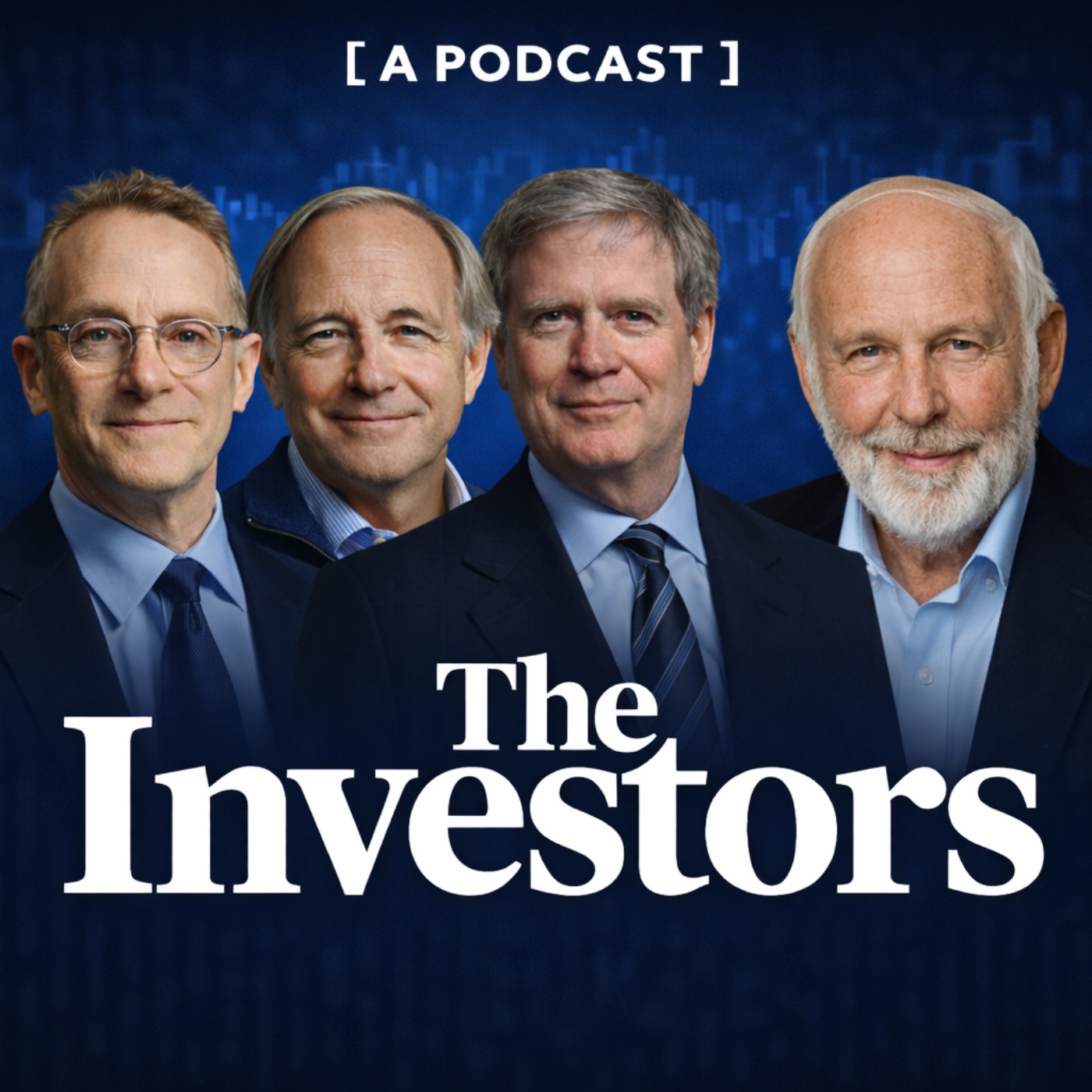
The Investors
Hosted by Investing Wisdom · EN
The Investors is a long-form podcast dedicated to the thinking, principles, and decision-making frameworks of the world’s most respected investors.
Each episode explores the ideas of investors such as Warren Buffett, Charlie Munger, Howard Marks, Ray Dalio, Jim Simons, and Stanley Druckenmiller, not through headlines, but through qualitative and quantitative investing.
Hosted on Acast. See acast.com/privacy for more information.
17episodes
Episodes
Newest firstAll episodes
Warren Buffett Partnership Letter 1967 H1
1w ago00:20:52Tap to summarizeWarren Buffett's mid-1967 letter to partners. After a rough January, the partnership finished the half up 21% against the Dow's 11.4%. Buffett names Diversified Retailing and Berkshire Hathaway as his controlled companies — and candidly warns that Berkshire's textile business faces real difficulties and won't earn a good return, dragging on relative performance in a rising market. He shares his tax philosophy ("Don't worry about the income; just the outcome") and previews a special October letter that will revise his "Ground Rules" — the coming moment where he lowers his ambitions and redefines success for the partnership. Hosted on Acast. See acast.com/privacy for more information.
Transcribe →Warren Buffett Partnership Letter 1966 Full Year
1w ago00:25:03Tap to summarizeWarren Buffett's tenth-anniversary letter, covering 1966. The partnership gained 20.4% while the Dow fell 15.6% — its widest margin ever, 36 points — capping a decade that turned $105,100 into a $54 million partnership. But Buffett strikes a cautionary note: the flood of bargain ideas that fueled the early years has slowed to a "trickle," and those results won't be repeated. He breaks down where 1966's gains came from across his four categories, defends his heavy concentration in a single dominant holding, and reaffirms that he won't chase "fashion" investing or businesses beyond his understanding. Hosted on Acast. See acast.com/privacy for more information.
Transcribe →Warren Buffett Partnership Letter 1966 H1
1w ago00:13:36Tap to summarizeWarren Buffett's mid-1966 letter to partners. In a falling market — the Dow down 8.7% — the partnership still gained 8.2%, and Buffett shows how the eight largest companies in the world lost 16.6% over the same stretch. He draws a sharp line between true conservatism (losing less when others lose) and mere "conventionalism," announces his first outright purchase of a whole business, the Baltimore department store Hochschild, Kohn, and delivers a pointed defense of ignoring market forecasts — pointing partners to Benjamin Graham's chapter on treating market swings as opportunity rather than instruction. Hosted on Acast. See acast.com/privacy for more information.
Transcribe →Warren Buffett Partnership Letter 1965 Full Year
2w ago00:33:25Tap to summarizeWarren Buffett's landmark 1965 annual letter. After a record year — up 47.2% versus the Dow's 14.2% — Buffett reveals the story behind Berkshire Hathaway, the struggling textile maker he began buying at $7.60 a share in 1962 and took control of in 1965. He lays out his case for concentration over diversification, introducing the rule that lets him put up to 40% of the partnership in a single conviction bet and mocking the "Noah School of Investing" of owning two of everything. He also warns that the partnership's growing size may finally start to weigh on returns, and closes the door to new partners. Hosted on Acast. See acast.com/privacy for more information.
Transcribe →Warren Buffett Partnership Letter 1965 H1
2w ago00:10:38Tap to summarizeWarren Buffett's mid-1965 letter to partners. The partnership gained 10.4% while the Dow was essentially flat, extending its edge — though Buffett candidly notes the gain came during the market's rise, not its fall, the opposite of how he'd prefer to earn it. He revisits his "duck on a pond" point with fresh backing that mutual funds pick stocks no better than random, and explains his logic for borrowing and lending with partners at the same 6% rate. Most significant for the story ahead: he reveals he has quietly acquired a controlling interest in one of his holdings — the beginning of Berkshire Hathaway — with the full account promised for the next annual letter. Hosted on Acast. See acast.com/privacy for more information.
Transcribe →Warren Buffett Partnership Letter 1964 Full Year
2w ago00:45:12Tap to summarizeWarren Buffett's 1964 annual letter, one of his richest. The partnership gained 27.8% against the Dow's 18.7%, but Buffett spends much of the letter on ideas: why nearly all professional money managers fail to beat an unmanaged index, and his now-famous definition of true conservatism — "intelligent hypotheses, correct facts and sound reasoning," not crowd agreement. He expands his method to four categories, adding "generals — relatively undervalued," and lays out his long-term goal of beating the Dow by about ten points a year. He also delivers a memorable case for maximizing after-tax gains rather than dodging taxes, skewering the era's "swap funds" along the way. Hosted on Acast. See acast.com/privacy for more information.
Transcribe →Warren Buffett Partnership Letter 1964 H1
2w ago00:11:01Tap to summarizeWarren Buffett's mid-1964 letter to partners. With the Dow up about 10% in the first half, the partnership only matched it — a reminder that Buffett's edge comes in flat or falling markets, not booming ones. He reports patiently accumulating three "general" holdings where the partnership is now the largest shareholder, and delivers his memorable "duck on a pond" metaphor: most professional managers rise and fall only with the market itself. He also lays out his philosophy on measuring performance against a fixed yardstick and on paying taxes rather than distorting decisions to avoid them. Hosted on Acast. See acast.com/privacy for more information.
Transcribe →Warren Buffett Partnership Letter 1963 Full Year
2w ago00:24:28Tap to summarizeWarren Buffett's 1963 annual letter, capping "seven fat years" with a 38.7% gain versus the Dow's 20.7%. He uses the Mona Lisa to illustrate the staggering long-run math of compounding, warns partners his huge margin over the Dow can't last, and gives his clearest breakdown yet of the three-category method: undervalued "generals," timetable-driven "work-outs," and "controls." A cornerstone letter for understanding Buffett's early philosophy and why he measures success against the market rather than by absolute gains. Hosted on Acast. See acast.com/privacy for more information.
Transcribe →Warren Buffett Partnership Letter 1962 H1
2w ago00:18:28Tap to summarizeWarren Buffett's mid-1963 letters to partners. He reports a first-half gain of 14% against the Dow's 10%, but reminds partners the edge should come in down markets, not rising ones. The centerpiece is the completion of the Dempster Mill story — how Harry Bottle's turnaround converted a failing manufacturer's assets into a $2 million securities portfolio and lifted the holding's value to roughly $65 a share. Buffett also shares his philosophy on taxes ("pay large amounts of income taxes — at low rates") and why he'll happily borrow and lend at 6%. Hosted on Acast. See acast.com/privacy for more information.
Transcribe →Warren Buffett Partnership Letter 1962 Full Year
2w ago00:31:07Tap to summarizeWarren Buffett's 1962 annual letter, one of his most foundational. He lays out his famous "Ground Rules" for judging performance, illustrates the staggering power of compounding, and explains his three-category method: undervalued "generals," work-outs, and control situations. In a down year for the Dow (minus 7.6%), his limited partners gained 11.9%. The highlight is the Dempster Mill turnaround, how new manager Harry Bottle converted a failing manufacturer's assets into cash and roughly doubled the holding's value. Buffett also defines what true conservatism means to him: knowledge and reason, not crowd agreement. Hosted on Acast. See acast.com/privacy for more information.
Transcribe →