Loading summary
Transcript433 lines
- [00:07]
A
Journey on the magic lies within the trails we ride. You're listening to the Journey on podcast with Warwick Schiller. Warrick is a horseman trainer, international clinician and author who helps empower horse people from all over the world with the skills, knowledge and mindsets needed to create trusting partnerships with their horses. Warrick offers a free seven day trial to his comprehensive online video library that includes hundreds of full length training videos and several home Study courses@videos.warwick shiller.com.
- [00:45]
B
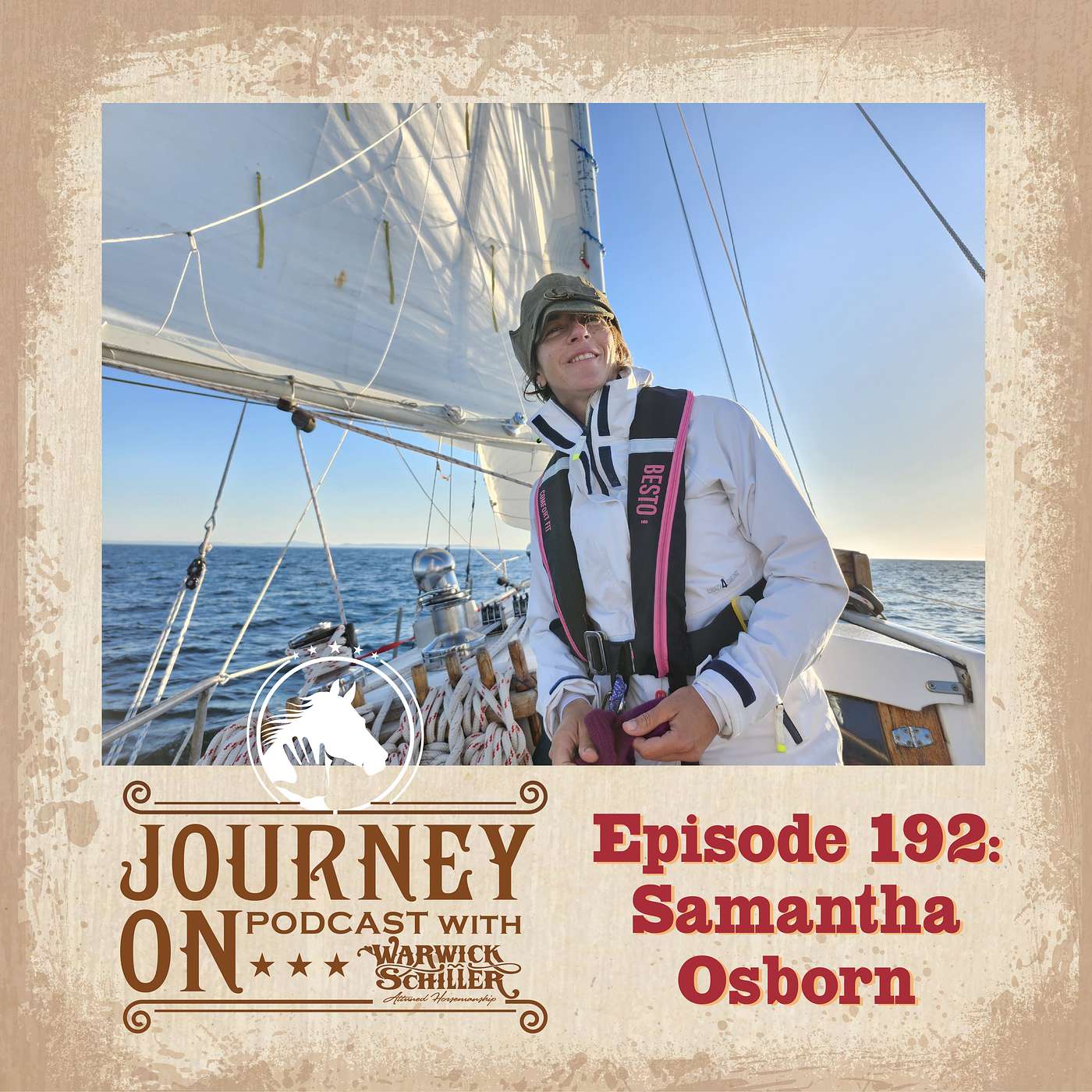
G' day everyone. Welcome back to the Journey On Podcast. I'm your host, Warwick Schiller and my amazing guest this week on the podcast is Samantha Osborne. So if you guys remember here, a couple of years ago I had an amazing, adventurous dude named Jesse Osborne on the podcast. Well, Sam is the wife of Jesse and just as much of an adventurer. I asked Sam for a bio before we did the podcast and the bio she sent me says samantha Osborne loves horses, dogs, and making things go. That's apparent when you talk to her. You'll hear her talk about her animals, her current job as a medevac pilot, her sailing adventures with her intrepid husband, Jesse Osborne, and how she's growing her range of emotions and deepening her relationships. No surprise, horses play a big role in her life. An Arabian horse enthusiast this year she fulfilled a lifelong dream to breed and raise a foal, a chestnut purebred colt named Firestar Barani, born in July 2025. So I don't know if you guys remember the story of Jesse Osborne telling us how he met his wife, Samantha Osborne, but it had something to do with him sailing a boat through the Northwest Passage and her flying a plane spotting musk ox. So, you know, in case you can't tell, these two are quite an adventurous couple. And I couldn't wait to get Sam on the podcast and hear her adventurous life. And I was so glad I did because there's so many cool stories that came out of her. So hope you guys enjoy this episode as much as I did recording it. Samantha Osborne, welcome to the Journey On Podcast.
- [02:23]
A
Thanks, Warwick.
- [02:25]
B
I think we might start out with you telling our lovely listeners what you where you currently live, what you currently do. And then I want to, I want to unravel the backstory because you have an amazing story about an adventurous life that I want to pass out of you.
- [02:42]
A
Okay, well, I'm sitting in Roswell, New Mexico. It's in eastern New Mexico, made famous, of course, because of the aliens. And I work here as a medevac pilot. That's a fairly recent job for me. And I work. I really enjoy the schedule that it gives me and the flexibility and. And I really love New Mexico, but that's where I am right now. Yeah.
- [03:09]
B
So you're a fixed wing medevac pilot, not a helicopter Medevac pilot.
- [03:12]
A
That's right. Yeah.
- [03:14]
B
So where's the. Where does the flying bug come from? Did you grow up with anybody that flew, or did you. Are you. I remember reading a. I remember reading a book years ago. It was a novel, but it was about this rich guy and, you know, wealthy guy, and he. His son started taking flying lessons. And the first time they took off, the old crusty old pilot guy who was teaching him, the old crusty old pilot guy, when they took off, he thought, holy cow, this kid's petrified. And then he said, hang on. He thought about. He looked at the kid a bit more and he's like, oh, no, he's mesmerized. He is bird was the, the. The term he used. This kid is bird, meaning this kid loves to fly. The first time he did his lake, he loved to fly. Are you. Are you bird?
- [04:03]
A
Yeah. I grew up with adventurous parents, and my father was a pilot, and he worked in this. The very high Arctic. And his job was he would be gone for three weeks at a time into what I remember from a very early age as the Arctic. I'm going to the Arctic, he'd say. And he'd be gone, and then he'd come back and he would take pictures, and our slideshows were always pictures of the Arctic where he would work with his airplane in it. And then family reunions in central Ontario, which is very lush and green, as much like New York State, and, you know, this bright greenery and then contrasted with, again, remote places, no people, no trees, the high Arctic. And he took me and my mother and then me alone a few times for Christmases over the years. And I got to go in small airplanes into these remote places. And, you know, as a kid, you just think that's. That's normal. Like, that's just what people do. Where are you going? Oh, I'm going to Resolute Bay for Christmas. Well, where's that? Well, it's up by little Cornwallis Island. Like, nobody knows where that. That is. That's a very high central Canadian Arctic. Anyway, we moved to Yellowknife, Northwest Territories. I kind of floundered around for a job. After high school, I started college for one year. I'm. I'm still probably on probation at the University of Toronto for my performance there. And I came back to Yellowknife and I needed to, you know, I had the real pull to have some sort of quote, UN capital C career. But I did get a job loading airplanes and I just loved everything about it. I loved moving. I love that the airplanes came and went, that it had a purpose. And it, it finished at the end of the day and you weren't at a desk. I remember saying, I don't want to work at a desk. I don't want to work at a desk. And it was challenging enough intellectually. You still have to learn a bunch of things, but you. It's not academic, it's not a deep study. So I tell people now, I say, well, if they told me that the airplane flew by magic, I would still fly, fly it the same way. They'd say it flies by magic. You don't need to know. Just follow these rules that would get me here, you know.
- [06:33]
B
Wowzers. So where did you grow up?
- [06:37]
A
Initially, Ontario, just outside of Ottawa, the capital.
- [06:41]
B
And then for people who might not be terribly familiar. So that's just above like New York State. So on the very eastern side of the North American continent.
- [06:52]
A
Yeah, yeah. I think Toronto and Buffalo, which share a board, a lake. And then I moved to Yellowknife, Northwest Territories, which is the very edge of the tree line in what they call geographically the Canadian Shield. And it's, I guess geologically, and it is a tiny city. It's 20 of 20,000 people on the very north shore of Great Slave Lake, named after the Slavey people, not slavery. And I was shell shocked at. As a young teenager, started high school there. I really kind of resisted being there. It was hard to move into from my suburban, comfortable, normal life to this place where I didn't know anybody. Everything was, was very different. The climate, of course, was extreme. And I fell in love. I recognized that I still like places that people would describe as being in the middle of nowhere. And to me they are somewhere because I live there and I know the people that live there. And I ended up staying 25 years until I met Jesse there. And I worked as a, as a pilot. So I got my pilot's license. The best thing about Yellow Knife was they needed pilots. And there was a flight instructor that was working there that I could get lessons with and I didn't have to travel too, too far to do it. I bought an airplane and built time and just started, started flying.
- [08:39]
B
Well, you just did the whole podcast. Okay, thank you very much. We're not going. Now let me ask you about some of that. So let's go back to growing up. So your dad, how did your dad become a pilot? Do you know the story about how. Because he didn't just become a pilot. So you live in Ontario, so the very lower part of Canada. So the very civilized, quote, unquote civilized part of Canada. So if you want to be a pilot, he could have been a commercial airline pilot and flown to, you know, Singapore and Malaysia and Australia, whatever, but he's flying up into the Arctic, had you. Do you know the story about how he got into not only being a pilot, but going to those wild places?
- [09:24]
A
Yeah, he, he wanted to be a pilot from a very young age. He was very precocious and he would read these military textbooks about flying when he was nine and he'd tell his mom that he wanted to fly. And, and his, his, his dad had loved airplanes and had wanted to fly in the war, but his eyesight was poor. So there was always the, I don't say myth, but this mythology behind flying, that it was this, this wonderful adventure. And my dad did that. So he started flying in the town that he grew up in. And he also flew Medevx way back in, oh gosh, it would have been 72 or something in a very small airplane. And then the company he was working for asked him to also become a mechanic on airplanes. So he did that. And he did all of this before he was 19. He was just a gung ho guy. And when he was 20, he met the owner of the company that had started flying in the Arctic. It was during the, you remember the oil crisis in the 70s. In the 70s and also the Cold War. The Arctic had a lot of attention drawn to it for oil exploration and also to build a defense shield against Russia, you know, the bear. So they, there was a lot of activity up there, surprising amount of activity going on. And they needed pilots. So my dad got a job as a co pilot on the Twin Otter, which happened to be. That was my first flying job as well. Same airplane, different, different decades. And he learned how to fly in very, very remote places with very few tools and resources. And he did that for, oh, gosh, 15 years. His whole career was, was a one of adventurous flying. But he did that specific job until we moved to Yellowknife when I was 14.
- [11:30]
B
So, okay, I don't want to get to Yellowknife yet, because that sounds like quite the adventure. So when you were, you were saying when you were little, it wasn't unusual to fly with your dad to Resolute Bay. So I had to look up, I had to look up Resolute Bay and Resolute Bay is on an island. What's the island called?
- [11:49]
A
Cornwallis Island.
- [11:51]
B
If you guys have a computer handy right now, look up Cornwallis Island. It is the top of the, like there's the whole North American continent, the land mass and very type of Canada. And then you go further and further. I mean it's damn near the North Pole.
- [12:11]
A
It is, it's. They actually stage North Pole expeditions in Resolute because they have, have jet service in there. I can't remember how many times a week now. And so people can fly in their, their supplies and for the, it's a base station basically for their North Pole forays.
- [12:30]
B
When your dad was flying up there, what sorts of things were they delivering and who were they delivering him to? Like apart from I'm going to do an expedition to the North Pole. Who lives in Resolute Bay and what are they doing there?
- [12:44]
A
That.
- [12:44]
B
Oh, Resolute, sorry.
- [12:45]
A
Yeah. How it is Resolute. How Resolute and Resolute Bay came to be is a real debacle of the Canadian government trying to patriot the Arctic. They, the Inuit are nomadic. They lived where the hunting was good. Resolute Bay is very sparse. There is not a lot of hunting. And my understanding is in the 50s, the Canadian government said, hey, we'll move you to different places where the hunting is better and we'll put up a school and set you up in a community and you can stay. Inuit from another region were kind of packed into a boat and an airplane and then taken to Resolute Bay and they built a community there and they put in a Runway. It also is a flat. So land mass wise, I think it was useful for a Runway. A lot of those decisions were made from people that don't live there or have even ventured there that they sort of looked on the map and said, we need, we need security here. We need here, here and here. And that, that's where these communities just ended up.
- [14:01]
B
So do you know, I don't know how much you know about Cornwallis island, but did. Was it inhabited by Inuit?
- [14:10]
A
I think it would have been transited by Inuit and, and certainly there's a large Inuit community now there. But there were there. This is the, the trick with nomadic peoples that no place is, no one place is permanent.
- [14:30]
B
Right.
- [14:30]
A
They would have transited there and been able to get there. And certainly they hunted and traveled on other islands nearby that's that's the thing.
- [14:38]
B
Yeah. Okay. So they're nomadic. Not on Cornwallis Island. They're nomadic in that region. So they'd be crossing. They'd be crossing. Does that the, you know, the Cornwallis Island. It's an island sticks out of the water. But is the water frozen most of the year? So they.
- [14:54]
A
It is.
- [14:55]
B
Okay.
- [14:56]
A
And they also, you know, the kayak. Was the Inuit all across from, I would imagine the whole circumpolar region. You know, they have several types of boats, including what they call an umiak, which means wife boat. And that's a big Kurek style, like a dinghy style boat. It's about 15ft long that they would put women and their supplies and their. And cross to different areas. So it's hard to describe because they're not bound by land in their area. They. They roamed extensively and hundreds of hundreds and hundreds of miles. There was no one spot that over a lifetime, I couldn't even tell you how far these folks would have had to travel on foot or in a boat with their belongings as they needed them.
- [15:48]
B
I'm gonna admit my ignorance here. I get several questions. Inuit, Eskimos. Is Eskimo a term they use or is Eskimo like a thing? I probably shouldn't even call them.
- [16:05]
A
It was the French term for Esquimaux and I'd have to write it and spell it for you with the. And it got. Was how. And I'm not sure what if it was a geographic reference or if it was describing a feature, but it's an old term and they're how they call themselves is. Is Inuit the people. And I should double check that that's exactly what that means. But Inuit. And then there's different. Different areas where the Inuit would encompass sort of the whole territory. And it's sort of generically the. The people that live there. And then each, like the Greenland people, have their own names for themselves in their own language. It is similar, but it's. It's their own. And certainly where I lived along the mainland in the central Canadian Arctic, they. They call themselves Inuvialuit.
- [17:03]
B
And. But are they the people that us dummy Westerners refer to as Eskimos?
- [17:09]
A
Yes. Yes.
- [17:10]
B
So when your dad was flying up, there were people living in igloos.
- [17:13]
A
Yes. One of the craziest things he did and he was blessed to recognize and have a camera that he was seeing the end of an era and he loved and really respected the people that lived there. So he would go to these communities and See the little old ladies who made parkas that were just unbelievable with. With wolf and polar bear and wolverine trimming around the collar and. And. And they beaded incredible decorations for their husband. So if a husband had a. Had a wife that loved him, his coat was really nice. You know, he. He got to see places where they could only access it by air. So. And there were people that lived there and had been living there for thousands of years, untouched, that he got to sort of witness and say, wow, what are you guys doing here? And he loved that. They price family and community and are extraordinarily welcoming. And I remember as a little kid growing up and meeting these kids that grew up and how much we hadn't were able to relate and play, you know, play is the same for every. For every kid, I think, around the world. Yeah. Yeah.
- [18:47]
B
You were telling me these kids had never seen a tree.
- [18:49]
A
They'd never seen a tree. And I remember they came to the camp where my dad was staying, and they had had a Christmas tree up and. And I said, yeah, there's trees. Like, I think the conversation went something like, you know, trees. And they're like, what are you talking about? Like. And I remember feeling kind of sad. I'm like, oh, they don't know what trees are. This is so sad. And they. When I was there in the deep winter, it never gets light, so it was dark all the time. I think I got up in the middle of the night and slept during the day. I didn't. As a young kid, I think I was six, I didn't really understand clocks or a schedule. And I remember playing outside and being delighted. And I frosted my cheeks. Cause I played so much sliding. I'd climb on top of this big snow drift that was on the top of a house and slide down the snow drift and then climb back up and slide down. Yeah, that was. And I ended up my frost biting my cheeks. And I couldn't go outside again. And I couldn't. I was really disappointed that I. That I couldn't go back outside and play anymore.
- [19:56]
B
Yeah, Kids are. Kids are funny. Like, they don't get cold like the rest of us. Or as cold. Have you ever slept in an Eaglet?
- [20:07]
A
No, I haven't.
- [20:08]
B
Have you been in an Eaglet?
- [20:10]
A
And I haven't been in any glue.
- [20:11]
B
Okay. Have you seen an igloo?
- [20:13]
A
I've seen it. I've seen igloos. Yeah.
- [20:15]
B
How big are they? How. When they made an igloo? How. How they're about.
- [20:23]
A
Maybe inside eight feet. I mean, you can make them. You can make them any size, but they're about, you know, think about what you could reach without a ladder, you know, to build it. Yeah. And. And the Inuit typically aren't particularly tall. So inside, maybe they had an entrance that was lower and then they'd have a sleeping shelf that was snow, hard snow, and. And the igloo was around it and it was all heated by a stone lamp that was fueled by seal oil. And I've seen those and smelled those.
- [21:05]
B
What's seal oil burning smell like?
- [21:08]
A
A bit like burning rotting fish, you know. Seal steel in general is not my favorite. Some people love it. I've eaten it. I describe it as sort of beef that's been soaked in rancid salmon oil for a while. But. But I think it's an acquired taste. There's, you know, fresh. It's probably a little better. But I think what you had to do to eat and what was considered normal things don't deteriorate and bacteria doesn't grow as quickly there. So fermentation, you know, I think the Icelandics have a dish that is fermented shark.
- [21:45]
B
Yeah, I was just going to say it the way you described it sounded like I was Robin. I were in Iceland last year and I tried the fermented shark. Immediate, immediate projectile gag response. I didn't vomit, but the thing that I put in my mouth projected like 15ft across the room immediately.
- [22:09]
A
I worked with a man who worked in the Arctic his whole career, and he described going to a feast in one of these communities at the community school's gym and everybody had brought in meats. And this still occurs closer to Yellow Knife, where I flew primarily was a different kind of feast. But he said he went in and somebody would have some arctic char frozen. This would be in the winter, and some caribou and they'd leave knives or everybody would have their own knife. And the. He would. To. To feast, you would go and. And just cut off pieces that you wanted to eat and right into your mouth. And little kids with, with big knives, he said, would do this. And he said they were just so agile with the. The knife. And he described another time going, this is a. Where he ate what they. I can't remember how they. They do it, but it's a.
- [23:08]
B
Meat.
- [23:08]
A
That is left under a rock in a. In To. To ferment and not go bad, too bad. And then they pull it out and serve it later. Yeah, he vomited, but everybody else. And they all laughed, but everybody else thought this was Just delicious. They're like, wait till you get it next year. It's going to be better. You know, it's sort of an acquired taste and I also think there's a.
- [23:30]
B
Little bit of.
- [23:33]
A
Like teasing, you know, haha, this right. You know, stretching it a little bit. But yeah, crazy. Different diet and, and ability. Just the ability to be able to find and eat and have sustenance, warmth and comfort and have time for games, et cetera. It's incredible to me.
- [23:58]
B
Right. You mentioned Arctic chow. I had that in Iceland. That is really nice.
- [24:03]
A
It's delicious.
- [24:04]
B
It's like, it's like a mild salmon.
- [24:07]
A
Yeah, yeah.
- [24:09]
B
Delicious.
- [24:10]
A
Yeah, yeah, I love it. And they this. The char runs are, are always a, a time when I lived in Alaska. The Alaskans measure their wealth by how much fish they have put up for the winter. And I think the same is true anywhere that there's char. If you anyway dry it, I think across. They think they do that in Greenland as well. They'll gut them and then slice them in half, take the bones out and lay them over any kind of rack that they can to dry them in the air. Dried fish.
- [24:52]
B
How big is an arctica? Is it a big fish?
- [24:55]
A
I'm trying to, I don't, I'm not very good. Maybe 8 to 12 pounds would be an average size.
- [25:03]
B
Okay, that's good.
- [25:04]
A
Yeah, good sized fish.
- [25:06]
B
So this Resolute Bay or Resolute, going up there as a kid, you know, like travel, you know, travel's cool because broadens your senses or you know, you just get a different sense of, of life. And a lot of people travel to a country that's you know, a bit different to theirs or whatever. You know, I bet that had an influence on you as. What'd you say you were eight and you went up there?
- [25:32]
A
I think it was six the first time and then eight again when I went back and then I went back at 12 and then we moved north, not quite that far north. When I was a teenager it made me realize how little people understood about distances and it also skewed my scale for distances. I don't. When I look on a map and I see Texas and Arizona, I think, oh, they're, that's not a big deal. Like that's a, that's close. But that's not, that is not how others grew up. And I also, my parents moved around a lot. I didn't stay at any one school for very long. And I felt more at home weirdly in the Arctic with these kids because it felt Like I could belong there versus where I was actually living at the time. And that took me a long time to sort of recognize, but I see that now that the Arctic was home and was always incorporated. And my parents really loved that part of it too. They, they acknowledged that it was, it was a special place. It was always spoken with, with reverence and joy and, and my dad didn't say he, he would be sad because he had to leave his kids and wife behind for three weeks to go, but he wasn't sad because he had to go to work there. He was, he enjoyed that very much. Yeah.
- [27:00]
B
Yeah. What a special thing to like when he was going there in the 70s and witnessing the, I don't know, the end of a way of life that's been unchanged for probably thousands of years.
- [27:16]
A
He happily the. There's been a resurgence in the idea that this culture is worth preserving, investigating and nurturing. So they have a pretty good program for learning the Inuit language, teaching the kids traditional hunting skills and getting out on the land. But of course it's only, it's like, it's like summer camp. It's not a full time lifestyle.
- [27:48]
B
Right.
- [27:49]
A
Yeah. So I wouldn't say there's no loss. That's, that's not correct. But it is. And especially I think in general, culturally across Canada recognizes this is worth preserving and seeing and acknowledging. Yeah.
- [28:06]
B
When you, when you would go up there when you're young, did you get a sense? Because you think about, you grew up in Ontario, you think about safety, you know, like you have police and you have ambulance, you have fire brigade, whatever. These people are very, very self reliant and they live in a very hostile environment where it's easy to make a mistake and be unalived sort of a thing. Did you, did you have a sense even at that young age that these people view the world differently? Did you have a sense of that?
- [28:42]
A
I was so welcomed that I didn't even consider that I would have any danger there. Which is weird because you're right, it's, it's very sparse, you know.
- [28:58]
B
Yeah, I didn't mean, I didn't mean. Did you feel like you were in danger there? But just the, just the culture of a people who live day to day in a place that has, you know, you have serious consequences for.
- [29:18]
A
I think for making errors.
- [29:21]
B
Yeah. Making errors that have a narrow margin of safety.
- [29:27]
A
So I think one thing that I've seen that has. I'll tell you a couple stories. One, I flew a fellow and this is his story, but I Tucked it away because I thought it was so wonderful. He was out on a caribou hunt or in the fall or some sort of hunt. Maybe it was a grizzly hunt or it might have been a polar bear hunt, but he had Inuit guides, and him and his other hunter were with the Inuit, and they were on snow machines and they were.
- [30:02]
B
That's what the rest of the world would call snowmobiles, I think.
- [30:05]
A
Snowmobiles, yes, snowmobiles, yeah. And they were tootling along in the. In the tundra over. Over lakes and. And they were on the mainland, but very close to the ocean and over the different lakes and then ground and then lakes and a blizzard rolled in and it was white. So all of a sudden it's now white top and bottom and you can't see. And the visibility got worse and worse and worse. And his guides, when the visibility got to be too much and to. Or too little to see really where they were going or what, what they needed to navigate, just stopped the snow machines. They built a snow wall to protect the snow machines from getting buried. Then they built an igloo, and then they drilled a hole in the ice in the igloo and started fishing. There was no. He describes that he was panicked and like, what are we going to do? And we have to get back. And they were like, what are you. What are you talking about? We're here. This is it. And that ability to just be so comfortable in the place that you don't have a destination, you don't rely on a specific thing, place for safety, that you have what you need right there, that is just so amazing to me. And I. I hope I don't know how to keep that aspect alive because all technology has kind of creeped in. You know, even just a snow machine running out of gas, you have to get somewhere for more gas, you know. But these guys were. Were not fussed at all. And. And they caught a fish and they. They little. They had fuel enough to make a little fire, and they. They were. They were toasty. They just waited it out.
- [31:41]
B
That's amazing. Yeah, just like, oh, okay, we're in the middle of the tundra in the blizzard, and.
- [31:48]
A
Right.
- [31:48]
B
This is where we are.
- [31:50]
A
This is where we are. Where are we? We are here. And, you know, anytime I read, Eastern philosophy about, you know, being where you are and that, finding yourself, I think of that. Those two guys and their guides who were like, hey, don't worry. They didn't even say don't worry. They just smiled and were. And said, here Come, do this, do that.
- [32:11]
B
You know, it's almost like the. The. Like the Buddhist concept of acceptance. It's like, this is. Okay.
- [32:19]
A
Yeah.
- [32:20]
B
Whatever. Whatever. Whatever happens, happens. Yeah. Was it. Was it a Ram Dass book? Is. Or was it a Ram Dass quote? That was like something like, wherever you are, there you are, or something like that. But it sounds like that, like, okay, we. We're here. And not only did they. They're not. The thing is, it didn't sound like when that happened, they were in survival mode. They were in. They weren't surviving. They were thriving. Like, okay, build a snow wall. Okay, let's build an igloo. Oh, good. Let's have something to eat. It's right here.
- [32:52]
A
Yeah, yeah, yeah. It wasn't. It wasn't a panic. It wasn't a. It was we. I. And that. There's something in that ability to adapt to the circumstances that are around you, right where you are without striving, that makes that story so beautiful. Like their. They're totally comfortable and accepting of the environment that they're in, and that is where they belong. Then they took it as a moment to stop and share stories, and they swapped and talked all night. They got some sleep, and then the next day or whenever it was, they dug out the snow machines and tipped them over and started them up, and off they went again.
- [33:42]
B
Tip them over.
- [33:44]
A
I think they.
- [33:45]
B
What?
- [33:46]
A
I think they put them on their side to help keep the track free from snow. I think that was so that the. The track, instead of it being perpendicular to the wind and the snow could blow in and fill up all the.
- [33:59]
B
Oh, fill up. Yep.
- [34:01]
A
They turned it sideways so that. Yeah.
- [34:04]
B
Okay. So it didn't get snowbound in the. In the track.
- [34:07]
A
Yeah. Yeah.
- [34:08]
B
Holy cow. Okay, so if you guys haven't done it yet, you should pause and look up on the map, Resolute or Cornwallis island, and see exactly where in the world we're talking about, because it is further up there than you would think.
- [34:27]
A
That particular story happened near the community of Kubluktuk on the Canadian. On the mainland. But very close to the Arctic Ocean.
- [34:36]
B
Yeah, very close. Okay, so tell me about. You mentioned Yellowknife. So when you were a. Oh, actually, before we get to Yellowknife, the very first thing you said about your parents was, I had adventurous parents. Apart from flying planes to the Arctic, what else. What other did your dad do? Other adventurous things.
- [34:54]
A
They really. Their adventures were like, my mom. So I'm the oldest of five kids. I hate to describe Them as hippies. Dad, I'm sorry. You weren't really a hippie. You had a job. But they really wanted to break free of the mold of urbanity and living in a normal life. My mom was always willing to join my dad whenever she could on going to the Arctic. And so I remember one time we went to Grandma and Grandpa's because mom and dad got to go up to the Arctic, but we had to stay home. And they. They moved a lot. We moved to a place in the country, and then we moved to actually out to the east coast and back. And they were really just ready to try different things. They were ready to embrace new things, new places. They. We traveled to Europe. My mom's family was from Germany. We traveled there two or three times growing up, before I was a teenager over to Europe. And at a time when that wasn't that common, the whole, you know, the whole family going. And we didn't go to Disneyland, we went to museums and stuff, and they. They were just ready to let their kids. We. We led a very unstructured lifestyle. We went to school and. And. And such, but they were really ready to just let us be kids and explore the world, and they really wanted to set us up for that any way they could.
- [36:30]
B
Yeah, well, it shows. It shows.
- [36:32]
A
Yeah.
- [36:32]
B
Okay. So when you're a teenager, you move to a place called Yellowknife.
- [36:37]
A
Yeah.
- [36:38]
B
And so I looked up Yellowknife, and so, you know, I've been to Canada, and I've been kind of part. Probably. I don't even know half. If I've gone halfway up one of the provinces, you know, like, halfway up Alberta. And I. I feel like I'm a long way up there. But if you look at, you know, all those provinces have a line at the top, you know.
- [37:04]
A
Right.
- [37:04]
B
And that's like the end of the earth. Well, Yellowknife is way past that. You're up there in the. In the Northwest Territory, is what it's called in it.
- [37:13]
A
Yes.
- [37:14]
B
It's one of those places that I don't think most people know much about the North. If you're someone. If you said, where's the Northwest Territory? Like, I don't know.
- [37:22]
A
Yeah.
- [37:22]
B
Is it in Canada? Yeah, it's. It's like for you Australians, it's almost like from Brisbane up. For Americans, if you think about the continental United States, it's from, I don't know, North Carolina up. It's like. It's half the. It's half the country. And the bottom half the country is Huge. And then. And Yellow Knife's way up there, right?
- [37:48]
A
Yeah.
- [37:49]
B
And so what? So you, you moved to Yellowknife. Did your dad get a different job or something or other?
- [37:54]
A
Yeah, he got a transfer within the company, but they. They opened a base there. So he moved to Yellowknife to fly.
- [38:01]
B
Oh, yeah, sorry, let's back up. Sorry, I forgot to ask you before. What was he flying to Resolute? Is it supplies? And I was asking you, what are the. The people that live in Resolute? What do they do apart from survive?
- [38:15]
A
There's some science, I think, that goes on, most of it. The funding for the whole town is government funded. The Northwest Territories and the whole Canadian Arctic does generate a bunch of royalties from mining revenue. So that gets funded back into schools and hospital, healthcare centers, airports, snowplows, infrastructure. Most people probably, I would say most work for the government or run some sort of part of the government. Like fellow will drive the snowplow and the water truck and someone will be the caretaker for all the buildings and make sure that all the components work and order the parts. And then there'll be somebody who runs the store. There's a. There's usually one, a cooperative store that'll have groceries in a mail system and there's usually a church, sometimes two, and an RCMP station and a health center. So all of the communities kind of have those. And then there's a lot of folks that I think they don't. They don't do much work. Quote, unquote, eight to five work. Right.
- [39:33]
B
But yeah, you said rcmp, so some people might not know that stands for the Royal Canadian Mounted Police. They're not mounted. They're not mounted though, are they?
- [39:42]
A
No, not up there.
- [39:43]
B
Not on horses.
- [39:44]
A
No. No. At one point they had a dog patrol, I think, but not, not in Resolute. I think that was more in Yukon side.
- [39:53]
B
Okay. Okay, so let's transfer back to Yellowknife. You were what, 14 when you went to Yellowknife? Yeah. So tell us about Yellowknife, because there's some interesting facts about Yellowknife. It's the. It's basically the end of the paved road, isn't it? So I lived. This is nothing like living in Yellowknife, but in Australia. Back in the mid-80s, I lived in a town in. It's the outback of New South Wales. It's not really the outback of Australia, but it's the outback of New South Wales. So we were. It was a town of 500 people. And it was 100 miles of dirt, or 150 kilometers of dirt road to the nearest town, which was a thousand people. And that's where what we called the bitumen, the pavement, you know, the paved road. That's where the paved road started. And you.
- [40:41]
A
Pretty remote.
- [40:43]
B
Yeah, relatively. And so, like, if it rained, you can't leave town. Right when I end up leaving town, at the time when I was. When I was, you know, I was finished working there and I was leaving town, I had to actually put my car on a train on a flat. On a flatbed of a train. And that's how. And I had to. I went on the train too, to get out of town because it had been raining and the roads were impassable, but.
- [41:09]
A
Nuts. Yeah.
- [41:11]
B
And that's, you know, that's a totally different thing, but you're talking about that on a grander scale, like Yellowknife. The end of the paved road, and then from there it's all. What do they call that TV show? Ice Road? Truckers.
- [41:24]
A
Truckers, yeah. There's. There's only a few ice roads, and they're very seasonal. I think they run about eight weeks total, and then it's no roads.
- [41:34]
B
So the. So the ice roads, they only run about eight weeks. That means they're frozen solid enough to drive a truck across it for only eight weeks of the year.
- [41:46]
A
Yeah, the loads, I think they built them originally in support of the mining industry, and they went almost 300 miles. What were they, 450km, ballpark. From Yellowknife up to almost the Arctic coast. And they've been doing that since, I want to say, the 50s, 50s and 60s. And then the roads. What happens with the roads has to be cold enough that the ice is frozen to a depth that will allow these. I don't even know how many tons, these large trucks with freight to travel. And they do it in this. What's the spring? You know, I think they start about early January, and they go till about mid March. By March, the sun is up nearly 14 hours a day, and it's starting to get quite strong. And anywhere that there's a heat sink, like brown exposed dirt or a rock, it will hold the heat and start melting in the heat of the heat of the day. And closer to shore, the ice will start to break up close to shore. And then the ice in the middle of the lake would be fine, but close to shore to get onto land, because they do have several. I can't remember how many, they call them portages between the lakes, those start to get very mucky and not suitable for travel. So they, they have to do it in the depth of winter, which is January to early March.
- [43:20]
B
So it's not the middle of the lake that you're worried about falling through the ice, it's the getting from the land.
- [43:25]
A
Yeah, yeah. And there's a speed limit which is strictly enforced of about 15 miles an hour and 25 kilometers because the trucks, even at, with that much ice, they depress the ice, it pushes the water underneath down and it forms a wave. And then that wave hits the land that, the shore that it's going into and bounces back and it will start, if you go too fast, it will start undulating too much and it will lift and crack the ice and break it up.
- [43:57]
B
So this speed limit's strictly enforced. There's not a cop out there with a radar gun, I imagine. God strictly enforces the speed limit. Like, you go faster than this, you're gonna die.
- [44:11]
A
Yeah, they, it won't be the, the guy who speeds who dies. It'll be, you know, the next.
- [44:16]
B
Yeah, the next.
- [44:17]
A
Yeah, yeah, yeah, yeah. But they have a checkpoint, so every truck that goes over that is delivering a load. The small vehicles don't, don't make a difference on it, but the large vehicles do. So they check in with a log and a time and if they're ahead of their time schedule.
- [44:40]
B
Wow. Have you ever driven that road?
- [44:43]
A
I've driven parts of it in my own vehicle and I've driven parts of it to get to other camps at night. And it's, it's. The portages are pretty cool because you go up especially close to Yellowknife, you're still in the tree line. So you're going off this lake where there's this big wide, four lane, at least wide road. And then you, you get onto a kind of humpy, almost four wheel drive needed frozen, very narrow portage. They don't, they want to make their footprint on land quite small, so they're very, very compact and they flood those with lake water to make a kind of a buffer on them.
- [45:22]
B
Oh, really? You guys listening? Once again, I think you should get on your little Google maps and have a look at Yellowknife, Northwest Territories, and then have a look above Yellowknife. And the land is just, it's as much lakes as it is land. Like it's just dots of lakes. And that's what. So when you go on that ice road, you were driving across all these frozen lakes. Yeah, that's to Me, that's just insane. That's.
- [45:50]
A
I. When you see how thick the ice is, you. You realize, oh, it's very, very solid. When I moved to the continental U.S. i started to understand why people were so entranced with the ice road. Because here a lake could be frozen one day, but maybe even frozen enough for someone to walk on it, and then two weeks later, it's open in the middle of the winter just because the temperature ranges are. Are different. And I realized I was like, oh, wow, this doesn't happen everywhere. Yeah, I like seeing the ice road. It's cool. You know, part of me is always a little sad because it just really means more vehicles in places where there aren't kind of the last place where no vehicles have been.
- [46:37]
B
Yeah.
- [46:39]
A
But it is cool to see and there's a incredible amount of work that goes into making it safe and tenable and. And clean.
- [46:50]
B
So you moved to this town of Yellowknife as a, like 14 year old. How big, how big is yellowknife?
- [46:55]
A
Like about 20,000 people.
- [46:57]
B
Oh, really? Okay.
- [46:58]
A
Yeah, yeah, it's bigger than you expect. And because it's on the end of the road system and it's a hub for all these other little communities, it has a lot of amenities that you wouldn't see in a town that size anywhere else.
- [47:13]
B
Right. It's. Yeah, it's interesting. Where we live in Paso Robles. You've been here. It's a town of. I think it's 30,000 people here.
- [47:21]
A
Yeah.
- [47:22]
B
But we have all these amazing restaurants.
- [47:26]
A
Right.
- [47:27]
B
And the town we lived in, two hours north of here, Hollister, it's a town of about 30,000 people, but it's very close to Silicon Valley, so it's very easy to drive up to Silicon Valley to go to a really nice restaurant. So Hollister doesn't have many, but this is almost a bit of a standalone thing here to where. And we have all the wineries here, which is. Oh, yeah, people come here and you have all. That's why I have the restaurants. But yeah, it was a. It's a bit like that. Of course, Yellowknife's on a totally different. Different scale, but yeah, so there's a lot more stuff there than you'd expect to find in a town of 20,000 people.
- [47:58]
A
Yeah.
- [47:58]
B
In the millennial way.
- [47:59]
A
It was very multicultural. They had Thai, Vietnamese, Chinese restaurants, a pizza joint. Just naming the restaurants an Italian place, classic steakhouse, a bistro. And then the. The one statistic I remember about Yellowknife was there's One bar, I don't know if it still holds, but in the 70s it was the highest grossing bar, not per capita, just the highest grossing bar in all of Canada was the strange range, real wild bar in the 70s, you know, sort of peak oil boom. The oil shortage and mining. There was two, two or three gold mines right in Yellowknife. And a lot of somebody described it as three levels of government traffic between two gold mines. And that, that was Yellowknife at the time.
- [48:54]
B
Really?
- [48:55]
A
Yeah. And naming all the restaurants. There's also the first nations who live there. Two different tribes that sort of intersected in Yellowknife. The Metis, which is a French and First Nations. I don't say mix, but they have their own unique culture. They were there Inuit as well, because it was, it's the government seat for at one point for the whole of the Canadian Arctic and now just the Northwest Territory, the east side has its own. But yeah, a lot of, a lot of activity for a very small town. It was, it was quite a hub.
- [49:30]
B
And so that's where you went to high school. After high school you said you did a year of college. Where did you do this year of college and what, and what were you studying?
- [49:41]
A
I studied first. I did all of the first year science courses. So I did Chem 101, Physics 101, Biology 101. And I had two other courses. I had humanities course, which was an English writing course, and calculus, which I dropped the first three days I was in calculus. There's no way.
- [50:10]
B
So with all these scientific courses you're taking, what was your idea? Like, what did you want to do with those?
- [50:16]
A
I wanted to, I wanted to be as. I had some idea that I wanted to work on hockey players and do sports medicine. And I thought, okay, I'll get a science degree and see where. Because you need that and see where that takes me. And it could go. I could do sports medicine or I could do veterinary or what. But I really just needed to go to college. I think that in my head it was ticking the box that I was going to college and I was going to pick the, the, the courses that were going to give me the most flexibility to do something that I could really make a living at.
- [50:52]
B
So for, you know, we have a lot of listeners from Australia and probably Europe too. Hockey is like a religion in Canada, isn't it? Hockey is the sport, like the sport.
- [51:05]
A
Akin to football in the US but probably even more passionately followed by most Canadians.
- [51:12]
B
I was at a horse expo in I think maybe Red Deer, Alberta. We go to a restaurant at night for dinner and I get up to go to the loo, the restroom, you know, and I go. So there's all these screens in the restaurant playing the hockey. I go to the loo, to the urinal, and on the wall in front of the urinal is a small TV screen and they separate. In each. Front of each urinal is a TV screen playing the hockey. You don't want to miss. I don't know if you don't want to miss a fight or whatever you don't want to miss, but they don't want to miss anything. Yeah, I don't know if in the store, I don't know. I imagine, I bet in the stalls on the back of the door there was one too, you know, I bet.
- [51:49]
A
You in Red Deer, you're right smack between Calgary and Edmonton, which both have hockey teams that have a serious rivalry. So it would be very important to. To get all the games there.
- [52:01]
B
Yeah, to get all the games. Okay. So you. When did you start. When did you start flying? When did you learn to fly?
- [52:10]
A
I was. I soloed in 2001.
- [52:13]
B
I mean, what age? Sorry, you moved to Yellow?
- [52:16]
A
I would have been. I'm thinking I would have been 23. 22 or 23.
- [52:19]
B
Oh, you didn't start flying lessons and stuff earlier than that?
- [52:23]
A
No, I went to high school that went to college when I was 19 to 20. And then I kicked around Yellowknife. This before I got the job loading airplanes, I worked. I worked in one of the remote mines. I got a job as a. I was basically the. The front desk clerk for the rooms for this work camp in the middle of the Canadian Arctic. And that was my first foray without my father back into the Arctic. And I went north of the tree line to a place called Lac de Grace. And that is now the home of two diamond mines. I think one is closing Ekati. It's owned by bhp, or it was at the time. BHP Billiton, a big mining company, they found diamonds in the mid-90s in the. Just north of the Tree Line in the Northwest Territories. And a huge mineral boom came up and I got a job working there. So I flew back and forth to there for a couple of years.
- [53:20]
B
North of the tree line. So how far north of Yellowknife is the tree line?
- [53:26]
A
Maybe 100 kilometers. 120 kilometers?
- [53:30]
B
Not that.
- [53:30]
A
Yeah. No.
- [53:31]
B
So it's close to the edge of the tree line?
- [53:33]
A
Yeah. And the tree line, it's. It's not a hard, hard line. It is, of course. Yeah. But the trees sort of slowly peter out towards it until there's none.
- [53:44]
B
And is that because the ground is so is it a cold thing? Is it a. The soil is different. Like it's more rock than soil or what, what, what causes the. Like that tree line?
- [53:57]
A
I think it's just temperature. So it's at a latitude where the sunlight that the. If you're farmers talk about like frost days to frost free days. The frost free days are just not enough to support the trees. Big trees. And you'll see even in some valleys that are very sheltered, you'll have more greenery.
- [54:19]
B
But.
- [54:20]
A
Yeah. So it's just temperature. Yeah.
- [54:22]
B
And so you would fly back and forth to this mine. How, how often?
- [54:27]
A
I think I was two, two weeks on and a week off. And then I had different. Different schedules. But usually two or three times a month I would get on an airplane and there was a. They had built a Runway. That was one of the first things they built. And. And I. I remember my first day in there. I flew in and they were still. Everybody was still living in what they call weather havens. They're big tents. And it was this construction camp. And I had really didn't understand what I'd gotten myself into with this job. And there were these men in their work clothes in a huge drying room where all their coveralls were hanging up. And then we went into a kitchen.
- [55:05]
B
Yeah. So what's it like, a young lady living in a mining camp in the.
- [55:14]
A
It was great. I really learned a ton about the mining industry, about the land that I had been living in sort of ignorantly for since high school. It exposed me to all the different people that lived in the Northwest Territories that had been there and knew about these places and had traveled to these places before the mine was built. I got to see wildlife. I got to see caribou. I got to see a wolverine there up close. Over a Christmas break, I saw a wolf from 30ft away. It was incredible. Yeah.
- [55:48]
B
Tell me about the wolverine. I just had to have.
- [55:50]
A
Oh, they're cool now. They are a fearsome predator and they are. Have. Nobody speaks of them without respect because they can take on a grizzly. They're the only. Only thing that will take on a grizzly.
- [56:04]
B
How big is a wolverine?
- [56:05]
A
They're about the size of a small golden retriever. Like maybe 50 pounds and not very tall. You know, like a. A large badger trying to. Yeah. And this was a sunny winter day. It was over Christmas break. And most of the camp was gone. And I had stayed to do whatever I was doing. And I came out of the corridor to walk outside. I like to walk outside in the sunshine between the buildings. And I was about to go down the steps and I saw this brown, brown back with, they have a golden stripe along them, along their ribs. And he was sort of just tootling along and I was transfixed. I'd never seen anything that comfortable. It. I just watched him and, and he paid me no heed and just wandered along just alongside the building and then to turn the corner, I, I told our wildlife man, hey, I saw wolverine, like just so you know, because they were very cognizant of not disturbing the wildlife and also not having interactions too much with. That would be negative. So they said, okay, great, cool. But I had, I remember taking a deep a breath because I was like. And then I realized he, this wolverine wasn't fussed at all. I didn't have to be scared. But I remember my heart was pounding and I was, I was like, wow, cool. Was super cool.
- [57:35]
B
I bet. I just looked up wolverine. I did a Google search on wolverine. I got pictures of work boots and Hugh Jackman. I had to scroll down. That's what the world's come to. I had to scroll down quite a ways before I found a picture of an animal. There's a, apparently there's a, a brand of work boots called wolverine. But I got, I got, I got work boots and Hugh Jackman.
- [57:56]
A
Yeah.
- [57:56]
B
Fascinating looking creatures.
- [57:57]
A
Yeah, yeah. But they are extraordinarily tough. They travel, travel huge distances. They are protective of their food sources and they are, of course, they have huge claws like Hugh Jackman has shown in the movies. And if they do get trapped, and I've heard stories where they've been trapped in kitchens, in camps and such. And they, they just wreak havoc because they are so incredibly strong. They're just all muscle. They have like a badger just very.
- [58:28]
B
Very tear the place to pieces trying to get out.
- [58:30]
A
Yeah.
- [58:32]
B
Did you, so when you were there, did you like, did you get out and hike around?
- [58:39]
A
As much as I could. I would go, I went with the biologists. When they did, they would do a patrol once a day. And when I was finished work, I, I would, I really tried to get out. And fortunately, as a young lady working in camp, I had lots of opportunities to go places. You know, people were like, yeah, come on, go for a truck ride, you know.
- [59:00]
B
Right. That's got to be cool out there with a biologist who can like tell you like, oh, this is a such and such. And this.
- [59:10]
A
Yeah, yeah, yeah. When I saw the wolf, I was in a truck with the, with the engine shut off, just having lunch at a kind of quiet place on the south side of the camp. A fair maybe, maybe three or four miles, like 8 kilometers away from the camp. And this huge white wolf came. And I remember the presence that they have. It's no wonder people write about them because this wolf came absolutely in charge of his domain, looked around, saw us, sat down, stood up, stretched, and then sort of just walked off behind us and came within 30ft, you know, whatever that 10 meters of the truck close that. I could really see that the ribs on him and the hair, you know, where his hair was, the patterns on it. He was like a kind of creamy white. But yeah, I could see him. And his eyes. I remember his big yellow eyes and huge paws. They have very, very big paws compared to dogs. Yeah.
- [60:20]
B
Wow. That'd be a moment, wouldn't it?
- [60:22]
A
It was, it was. And, and was the. You know, you have moments in your life where you're like, I'm in the perfect moment in the perfect place just seeing this exactly as it should, should be, you know. That was cool. Yeah.
- [60:37]
B
Wow. What about bears? Did you see any bears out there?
- [60:41]
A
I've seen a lot of bears from the air and I've seen a few on the ground. I've seen lots of grizzly and the tundra. The grizzly on the there. They now cross a little bit with polar bears into the polar bear terrain. But the polar bear is a marine animal and the grizzly is a land. Land mammal. So I saw it flying up and the, the tree line right around where that mine was. I saw many bears, especially in the, in the fall because they'll come out before they go hibernate. And they're, they're cool. They gallop like a horse and they. When they're fat, they're flat ripples. And they also have a. Have a lighter band of hair along their rib lines and that. That sort of swirls in this beautiful golden flowing hump almost as their fat ripples back and forth when they run.
- [61:36]
B
Really? Okay, so that's when you, you first get out. That was your first job. You're up in that mine then. When did you. When did you transition to flying or wanting to fly or had you wanted to fly all along? Was that a thing?
- [61:52]
A
I kind of. I didn't want to actually go back to school. I knew that and they. I had a funny. I applied to become an Electrician to become a electrical apprentice. And I didn't get the job. And then the mine, the company I was working for was the construction company and the mine was built. So when it was finished being built, I was out of a job. So I went back to Yellowknife and I got a job with the company that loaded the airplanes that went to the mine. And I really liked loading them. I just, and I thought, heck, I could do that. I could fly these planes. And I got to meet all the pilots because they would come in and I would show them their manifest and say, hey, you have £3,000 and here you go. And, and I would see, I knew how long their trips would take and I would kind of got a sense of being involved in the planning a little bit. And I realized I was like, I could do that and I, any, any chance again that I could go for a ride along in the plane. I did. And then it wasn't long after that that I said I'm going to get my license. And I started on it right away.
- [62:56]
B
So when you got your. So what did you get licensed to fly? Because isn't it, there's different types of licenses, isn't it?
- [63:03]
A
Yeah, so I have, I started with a commercial single engine land airplane. They, they. And now I, I'm licensed to fly any single or multi engine land or sea airplane. So I can't fly helicopters, but I can fly anything, anything else. And I have, there's three types, classes of licenses both in Canada and the U.S. they have a private, a commercial and then what they call an airline transport license. And I have the airline transport license which if I wanted to go fly a big jet, They, I have the. I'm, I'm ready, I'm credentialed to do that. I would just need training in that particular aircraft.
- [63:43]
B
So you got to be credentialed before you get the training?
- [63:45]
A
Yeah, yeah, yeah.
- [63:47]
B
And so what was your, what was your first flying job? What were you flying and where to?
- [63:51]
A
Well, I got a job with the company that I helped load airplanes with and I worked on the ramp for a year loading more airplanes. And then I flew. I was a Twin Otter co pilot and I was, we flew all over, usually within 300 nautical miles. So like 500, 550 km of Yellowknife in a sort of semicircle all the way to the west, north and all the way to the east. We didn't go south that much and I loved it. I got to fly with really experienced guys who really loved the job and loved the places that they went to and the, the work that they did. And I get to fly on floats and on wheels and on skis. So landing on very unprepared places. And that was super cool to be able to just go. And they say, yeah, we're going to land here. And they'd circle over and I'd see this white snowy lake. I'm like, oh. And then we'd land and. Yeah. And then we would. Typically, if another airplane was going to come in, we'd had orange garbage bags which we would fill with snow and we would make the Runway for them so they could see where the. Where the safe place to land was.
- [65:07]
B
Really orange garbage bags full of snow as Runway markers.
- [65:10]
A
Yeah. Yeah. And then we'd. It was gps was. Was coming along really well. So we'd mark that waypoint and then they. Another pilot could come and find it.
- [65:22]
B
Wow. When you said you only flow, you know, like in a semicircle from west, east, north, I was gonna say you wouldn't be flying south much because you wouldn't fly something from Yellowknife further south because you could probably, you know, it would be coming from somewhere else.
- [65:38]
A
Yeah.
- [65:38]
B
You wouldn't take stuff to Yellowknife to take it back down again.
- [65:41]
A
Right.
- [65:42]
B
Okay, so let's, let's get to the. To the Jesse story. So you are married to Jesse Osborne, who's been a previous guest on the podcast. And so Jesse, like you, he's very adventurous and he sailed a boat through the Northwest Passage and he was what, the 254th, 208th boat to ever. Yeah, ever in the history of planet. To sail the Northwest Passage.
- [66:18]
A
Yeah.
- [66:19]
B
And he was doing that when you met him. So what, what were you doing up there?
- [66:25]
A
I was flying in a turbine beaver.
- [66:30]
B
Which is a what, It's a big. Little.
- [66:33]
A
No, small.
- [66:35]
B
How many seats?
- [66:36]
A
Seven seater bush plane. And it has a. The original version had a radial engine, like a piston engine. And this one has a turbine like a turboprop. It's a little more reliable engine. And I was flying it on what they called bush tires, which are huge low pressure tires that are very bouncy. Like it looks like a Tonka truck. Almost.
- [66:58]
B
Land on all sorts of.
- [67:00]
A
Yeah.
- [67:00]
B
Unprepared terrain with that.
- [67:02]
A
Yeah. You could land on the tundra. And it's a. What they call a stole airplane. Short takeoff and landing airplane. So.
- [67:07]
B
Okay.
- [67:08]
A
Yeah, like less than a thousand feet. The beaver is probably less than 600ft Most of the time.
- [67:14]
B
And so is. Does it get up to speed very quickly or does it have a very low. It'll take off in very. At very low speeds. What's the. What's.
- [67:26]
A
Yeah, it's take off at very low speeds. It also has a lot of power to get to that speed very quickly.
- [67:31]
B
Okay, so it's both.
- [67:32]
A
So, yeah, high lift wing and a big engine. Yeah.
- [67:36]
B
Okay, so you're flying the beaver, and what are you doing in the beaver?
- [67:39]
A
And I'm flying a wildlife survey, specifically looking for musk oxen in. On Victoria island, which is an island that is home to a town called Cambridge Bay and then maybe some. Some camps. But the only real settlement on that island is Cambridge Bay on the south side. And it is in the middle. Roughly the middle of the Canadian portion of the Northwest Passage. Yeah.
- [68:07]
B
And so you had a. Do you have a word, a biologist with you?
- [68:11]
A
Yeah, I. So when they did these surveys, they would charter the aircraft and say, okay, we need you for three weeks and you're going to fly every day as much as you can. So I could fly up to eight hours, I think, and I might have been able to do more. But we did six hour legs. So we would take off and fly. The beaver flies very slowly, and we flew even slower than its normal cruise. We went about 80 miles an hour and flew these transect lines, these big long lines that are about, I don't know, maybe three miles. We wanted a mile and a half between the middle of each leg.
- [68:46]
B
Okay.
- [68:47]
A
And the whole island. They wanted to do the whole island. So I was flying very slowly, looking for muskox with a biologist and two spotters and myself.
- [68:57]
B
And they're counting the musk ox population. That's.
- [69:01]
A
Yeah.
- [69:01]
B
So, okay, yeah, so you're flying back and forth here. So then how do you come across this Jesse Osborne character?
- [69:08]
A
So at the end of one of the days, coming back into Cambridge Bay to land at the airport, I flew right over the town. And this airplane is very slow and we're already used to looking out the window all day. So that's. My neck's pretty much stuck in that position. And I was looking out the window and I saw a sailboat. Like I saw the mast of a boat at the community dock. And that is not a usual site for Cambridge Bay for anywhere really, in the Arctic Ocean that I. In my experience. So I thought, huh, there's a boat there that's. Somebody's come in by boat. Cool, right? And that new people in the town is always interesting. So I told the biologist, I said, hey, we should go. We should go check out that sailboat. She said, yeah. Yeah, we definitely should.
- [69:55]
B
So, yeah, like, what's this crazy guy doing sailing a boat up here, right?
- [70:00]
A
We had no. I had no idea. I didn't even know that I'd heard of the Northwest Passage sort of in. In myth and legend, but I didn't really know that it was still a thing or that people did it. I had. Wasn't really connected to that adventure community that way. And I landed and we. We put the plane away, walked to town and. And went and knocked on the boat after dinner. And that's when I met Jason, his first mate, and Jesse a few. Few moments later at his hotel room where he just had a shower. I remember he just, like, sparked with. With energy, you know.
- [70:42]
B
That's. Yeah, that's Jesse Osborne. He's. He's like a. Yeah. He's like a lit fuse.
- [70:50]
A
Oh, yeah. Yeah. And I had a sailboat at the time in Yellowknife that I really just used in the summer. We had a beautiful summer and sailing on Great Slave Lake. And I. I really just. It was purely recreation. I didn't even ever drop the hook. I'd never slept on a boat overnight. I had never gone anywhere that I couldn't visually reference myself to. And, yeah, I met Jesse, and he was like, well, you know, you know, we should. We should see each other. I'm like, that. That seems like a good idea. And. And so I joke that he asked me three questions, like, did I want to go sailing with him through the Northwest Passage, and was I single and did I want to get married?
- [71:37]
B
How. How. This sounds like Jesse's pretty direct.
- [71:40]
A
Yeah.
- [71:41]
B
How soon was this after he met you?
- [71:45]
A
He was in. He had told me pretty soon after he met me, maybe a week after he met me, that he was. He was definitely interested in me. And I was like, well, I. I'm not really looking for anything, like, short term, if you want a relationship with me, you know, I really was looking to get married. I really. I didn't want to. I told him I didn't want to waste my time with just flings, and I thought he would just go to Alaska and that'd be that. Like, I'd never hear from him again. But. But he took it to heart and. And said, well, yeah, we could. We could. We could do that, you know? So it wasn't a week that we got that he proposed, but it was about three months later.
- [72:19]
B
Oh, really? So how long was he anchored there?
- [72:22]
A
He was there. That boat actually did not move back till the following spring. He was. It was a month in Cambridge Bay. And then it got put onto the hard with the crane. That was a whole process. And then. And I was there pretty much the whole time that that was going on. And then when they were done, he was able to fly back with me to Yellowknife in the plane. I talked to the people that paid for the charter and said, hey, we have an empty leg. Can I take these guys? And they said, yeah, no problem.
- [72:52]
B
When you said they put it on the hard with the crane, that sounds like a very nautical thing. I have no idea what that means. What did they do?
- [72:59]
A
They picked it from the water and put it on land onto, onto cradles to stay out of the water over the winter. So on the hard as opposed to soft water.
- [73:12]
B
Okay.
- [73:13]
A
Yeah, yeah.
- [73:14]
B
And they pull it out of the water so there's the ice. Like put pressure on it. Cause things to crack.
- [73:21]
A
It's easier to manage if you're going to be away because the boat can't sink on the hard. Other things can happen to it. But if your pump stop working or most, most boats have some water that comes in somewhere from. They'll have through hulls that have check valves that fail or. And most boats will have a battery and a bilge pump. And they can, they can deal with it, but they need to be tended. So if you're going to leave your boat untended, it's best to put it on the hard. So also in Cambridge Bay, the ice, probably not where it is you want to. Ice can exert an incredible amount of pressure.
- [73:56]
B
Right. That's what I was wondering. Yeah.
- [73:58]
A
When it's. And it'll crack the hull, you. There are places where you can freeze in and it won't have much pressure, just in the nature of the little bay. But that wasn't the case.
- [74:08]
B
So few listeners. You also need to Google Cambridge Bay because I just had a look at that. It's a long ways up there. And so I think I might want to go with the, with the, the whole Jesse story because how, you know, how we came to know each other was I, I had a, I had a, a girl working for us and we just had our own horses at home and she wanted to start a horse with my help. And so I put a post on Facebook about anybody, anybody got a horse that they want to start, I'll start it for free, you know. And you had messaged me and said, oh yeah, I've got one down in. I think it was down here in maybe Orego Grande, was it?
- [75:01]
A
That's right.
- [75:01]
B
Yeah. And. But. But where. I forget what your message said, but it alluded to the fact that you were sailing somewhere. And my son Tyler was living in Hawaii at the time and had just bought a sailboat and was gonna do himself some damage. Didn't know what he was doing. And you. And so we messaged back and forth, and you said, oh, yeah, we've just. We're in Honolulu. We've just raced the trans pack. I'm like, what's the trans pack? And it's like, oh, it's. It's a race from. Is it San Diego?
- [75:30]
A
Los Angeles.
- [75:31]
B
Yeah, I was from Los Angeles to. To basically Diamond Head in Honolulu.
- [75:38]
A
Exactly.
- [75:39]
B
And so I'm like, you know, you said you and your husband. I'm like, my son has just bought a sailboat. Is there any. Any chance you could stop him from killing himself, you know, or doing something stupid? And so, yeah, so that's how we. We first met. And Jesse went over and spent some time with him. Then. Then I was like, this guy sounds really interesting. So I think I had him on the podcast. I think he recorded that podcast at Tyler's house.
- [76:05]
A
It was. Yeah, it was in Hawaii. Yeah, yeah, yeah, yeah.
- [76:08]
B
So that's how. That's how we met. So. But you and Jesse had been, you know, sailing boats around the world by this point in time. So where did. Tell me, how did you get, you know, tell me the bit of the Jesse story and the sailing stuff, because I'm sure you've got some pretty crazy sailing adventure stories, too.
- [76:25]
A
The transition happened when I met him. I was getting set to leave Yellowknife. I had been there 25 years. I really wanted to go somewhere that the winters weren't quite so hard and along the universe as well. Here. Here you go. Here is your perfect. The perfect way to exit. So I met Jesse and I moved to Alaska with him, where he lived for that winter, kind of between. With the plan to go back in the spring and finish sailing the Northwest Passage. And that was really all we had to go on. So we moved to Alaska. I. I joked that I was a mail order bride. I got my immigration stuff sorted and. And I couldn't actually move full time until 2015, but we tried to spend as much time together as possible. And the following summer we went back to Cambridge Bay with a pile of excess baggage because we flew it all in and got on the boat, put it back in the water, and then sailed it to Greenland So that was my first time being on a boat for more than a day or two and thankfully I at least felt familiar with the places we were going to and I had some understanding of the weather. That was it. That is all I knew. I really didn't know. I knew and I knew how to sail, sort of, so it was, it was fabulous. We.
- [78:07]
B
So you actually, you finished the, the, the, the, the leg of the, the Northwest Passage? Yeah, I didn't, I didn't know that.
- [78:17]
A
Yeah, yeah, it was. People ask, well, what was it like? And I remember it was cold and I was tired a lot because we were always that to keep the boat moving when we were. It was sort of. We'd staged up so we, we'd get the boat going and the weather would be good and the ice conditions would be suitable and we'd, we'd make passage and then the weather would change or the ice conditions were not suitable and we, we try to find a spot to, to get to where we could just sort of ride it out. So we would. And if we could get to a community, that'd be great because then we could do laundry and pick up some fresh groceries and. And so we did that three, three times along the way. Three, Three different communities.
- [79:03]
B
How long did it take you to get from Cambridge Bay to, to Greenland?
- [79:07]
A
We left August 11th from Cambridge Bay and we arrived in Greenland September 17th, I think so just. Just about a month and a half. We weren't sailing the whole time, but we probably had. Was probably 50, 50 sailing and stopping.
- [79:29]
B
All right, the. So what, what were the communities like that you would, you would pull up into, like pretty small and remote.
- [79:37]
A
Yeah, smaller. Cambridge Bay was the, the biggest community. I, I want to say Pond Inlet is a little bigger, maybe the same size, but we went to Jo Haven, we went to Tilohuac, and then we went to Pond Inlet on Baffin Island. And they're all tiny and people were ecstatic. The kids were always very curious about the boat. We had kids on the boat at every community except Pond Inlet. I don't think we had to. We had to. We couldn't dock. We had to anchor out. So. And we got invited for dinner to various communities to meet people. I think we spoke at the school both in Johaven and Toloiwek about, you know, what a privilege it is to be in this place and see it up close and personal. And boat travel, even fast boat travel, is very slow by our travel speed standards. And it's a really, really cool way to see the World. Yeah.
- [80:41]
B
So you guys spoke at a couple of schools.
- [80:44]
A
Yeah.
- [80:44]
B
How did, how did they get Jesse to stop talking?
- [80:48]
A
They rang the bell.
- [80:50]
B
Because. Because when that guy gets in front of a crowd of people, you can't pull him up.
- [80:54]
A
Yeah, yeah, yeah.
- [80:57]
B
Really? So I hate, I hate to do it again, but you guys have got to get on Google and, and Google Cambridge Bay and then figure out how you guys got, how you guys got from there to Greenland. Because I just had a look at it like, wow, you're on the top of the world up there.
- [81:10]
A
Yeah. And we encountered a lot of ice that year. And the ice is measured and the information is disseminated in tenths. So they would say, oh, it's 3:10 ice and it's this type of ice, you know, so anything more than 310 really is very difficult to navigate, especially in tighter quarters. And I remember we'd been pressing through at 3/10 to 4/10 ice, trying to get to a 2/10 area. And I was really exhausted and kind of just tired of being tired and scared. Kind of resigned myself. We'll just do the best. It was kind of pushed into acceptance. And it was early in the morning and the sun was just starting to go down, down and set and rise. And the sun was just coming over the horizon and I saw a plume and it was a whale and I saw a bowhead whale. It's still one of the coolest experiences I've ever seen. I didn't see him very closely, but I saw his body, her body come up through the water, the plume twice, and just effortlessly traversing this area that I was struggling to be in. And I thought, man, that is so cool. Yeah. Yeah.
- [82:37]
B
Wow. So the sun's just coming up and you say, oh, wow.
- [82:43]
A
Yeah. And the sun was behind the plume, so I could really see it. And just enough light on the water and ice everywhere and not big icebergs, but, but broken up pack ice, like kind of small automobile to large bus sized pieces of ice floating around on the surface of the water. And this, this whale was just hunky dory.
- [83:14]
B
How many of you are on the boat?
- [83:16]
A
Just Jesse and I, yeah.
- [83:19]
B
Oh, so you're now the first mate.
- [83:21]
A
Yeah. Okay.
- [83:22]
B
Oh, wowzers. What?
- [83:24]
A
Yeah. Yeah.
- [83:26]
B
What an adventure that must have been.
- [83:28]
A
It really, it really was.
- [83:31]
B
So when you got to Greenland, where did, where did that boat go from?
- [83:34]
A
Greenland we got to Greenland and where we initially made landfall, we didn't end up staying, but so we stayed a few days in Greenland and then we went to Another community where they had a haul out so they could haul the boat out. And they hauled the boat out for us in exchange for Jesse agreeing to repair their marine. The track that the haul out machine ran on that went underwater, Jesse said, yeah, I'll come back and fix it. So that was the following spring, but that was in Asiat, which is about halfway up the west coast of Greenland, if you're looking at it on a map. And then we flew out from there and actually I flew pretty much, I want to say straight to Indonesia, but I went from there back to Yellowknife and then my company had a contract and they wanted me to fly this, this Indonesian contract for them before I quit. So I went to Indonesia right after, like very shortly after the Northwest Passage and was in Jakarta, the most popular, densely populated area in the world after the, after the Arctic. It was, it was a shock. Yeah.
- [84:45]
B
Well, it's not only the most densely populated area in the world, it is also tropical and hot. Yes, and humid. So you went from the Arctic to the jungle.
- [84:58]
A
Yeah, yeah. And Jesse joined me there for, for the time in Jakarta.
- [85:03]
B
And what were you flying there? What were you.
- [85:06]
A
That. That airplane is called the Dornier 228. It's a German made airplane. Again, stole airplane and it was used by a company that it could hold 19 people as opposed to the planes that they were using that could only have nine. They wanted to expand so they had ordered new ones, but they were going to take 10 years to be delivered from Dornier. So they tried to contract ones that they were working that were around the world.
- [85:29]
B
And you were flying people, not cars, people?
- [85:32]
A
Yeah, sorry, yeah, two people from one side of the Jakarta to the other side of the. Of West Java island to a little town called Pangandaran. And it, Indonesia is incredibly mountainous. It goes from sea level to nearly 10,000ft, especially on West Java. And the road to do that drive, although it's not a very long, I want to say it was a 30 minute flight or 35 minutes was about 100 miles. But to do the road took 12 hours or something crazy and it would wash out and such. So there was a lot of business traffic, business people that wanted to fly back and forth to this other less populated but industrial area, I guess of Indonesia. So I did that flight three times a day when I was on.
- [86:23]
B
Oh really?
- [86:24]
A
Five days a week. Yeah.
- [86:25]
B
How, how different does a plane handle in extremely cold temperatures versus extremely hot and humid temperatures? Is it a, is it a big, is it a big difference?
- [86:37]
A
It is Noticeable and good on you for asking. That's. I would say it's probably any. At least a 15% performance decrease depending on the temperature and altitude. You know that you're. That your elevation above ground. So Jakarta at least is at sea level. I didn't notice maybe 10, 10, 10% difference, but it can be if you're at an altitude and it's hot at a higher elevation, like, you know, Denver, Colorado would be an example. In the summer, you definitely notice performance decrease. And certainly in the winter, the cold, that cold dense air is just really snappy and helpful for flying. Yeah.
- [87:24]
B
Oh really? It's like, like really grippy.
- [87:26]
A
Yeah. You, it really just, it wants to fly. You notice right away. Yeah.
- [87:32]
B
Whereas in the, in the hot stuff is everything's a bit more sloppy. It.
- [87:37]
A
Yeah. Hot air is thinner, so the, the wing doesn't produce as much lift and the propeller pulling on it doesn't. Can't, can't get as much power, you know, for every stroke. It's just not, not moving as fast.
- [87:49]
B
Right. And what about maneuvering? Is it decreased a bit too, or not much?
- [87:55]
A
Probably we, the type of flying I do, I'm not an aerobatics pilot. We wouldn't really be right on the edge of the performance envelope, which is good. So I didn't, I didn't notice a huge decrease, but certainly, certainly it would be there. Yeah.
- [88:12]
B
Wow. Okay, so you get done in Jakarta then, then how do you end up. Because when I first, you know, met you guys, you guys are just were sailing this sailboat in this race from LA to Hawaii. How did you guys get back into the sailing thing from there?
- [88:29]
A
Well, that Jakarta trip was the last time that I flew for almost 10 years. And I was ready. I was fine. We moved to Alaska and we started a sailing business where we fixed boats, we babysat boats for people who were absent owners, and we sailed boats and we taught sailing and we delivered sailboats from Alaska, typically from Alaska to Seattle and back as boats got bought and sold. And we met a fellow up there who had a boat that he wanted to do a fairly extensive refit on. And we said, well, yeah, we can do all of that, but we really should move. We're. We're going to move to Washington and that's a better place to do this kind of work. And we moved to port towns in Washington, which is a great marine community and they have a lot of sailing and wooden boat resources and businesses there that support that. So it was a great place to do. So we moved there and, and Brought this particular boat with us and that was our full time work for two and a half years. Refitting the boat, refitting that boat. And then the owner. So that refit was, was two and a half years. That's when I got a horse and we lived in Washington and the owner said, well, now that the boat's done, I, I really want to do the Transpac and I want to do this other race and I, I want to sail around the world with it. We said, okay, how are you going to do it? Well, I might need some help. Okay. So we, we sat down and we worked out that he, he was going to need help pretty much full time for at least the first couple years. And so we ended up crewing on the boat that we had rebuilt. And the first mission for that boat was the Transpac was doing the sailing race from Los Angeles to Hawaii.
- [90:20]
B
Right. I think maybe you and Jesse were telling me, but it's like refitting a boat like that's a very expensive proposition, isn't is.
- [90:32]
A
It's almost. If you know what you want and someone can build it for you, you probably spend the same amount of money. The trick with the refit is you're, you're tearing down an old boat and then building a new boat inside it. So it's a little more awkward. Yeah, it's possible. And this boat certainly was worthy of the effort. It's, it was a really well made boat initially and, and needed, needed refitting anyway. You know, boats just like everything that is mechanical, needs, needs maintenance. So.
- [91:09]
B
Yep.
- [91:09]
A
Yeah.
- [91:12]
B
So then you were silent. But you're back into flying now. When did you get, when did you get back into the flight line?
- [91:20]
A
When we moved. When we stopped sailing on that particular boat, the owner kind of wrapped up what he wanted to do with it. We thought, well, heck, we'll go to our place in Pie Town, which we had bought after we left. When we got on the boat, we left Washington and bought a place in New Mexico that was more remote, that sort of suited. We wanted a, a base camp place. And that is pie Town, New Mexico. It is also not close to anywhere. It's about 50 miles from the Arizona border, east of the Arizona border on Highway 60. And you can get pie there and you can go to the post office most days of the week. And that's it.
- [92:07]
B
Pie Town is noted for its cul. Place name and it has a pie festival. How many people in. How many people in Playtown? Oh, population of 186. Sorry, I looked it up.
- [92:17]
A
Yeah, there you Go. Yeah. So we moved there, and we.
- [92:22]
B
You guys like living in remote places, don't you?
- [92:24]
A
We really do. And I. I really do love Pie Town, but it was very difficult to. We tried to. We did run a business. We ran a mechanic business there, but Jesse was deeply unhappy having to stay in one place. And I didn't mind, but no one wants to see their spouse miserable. And I was not. Also was very busy and not being. Not able to do the things that we thought we'd be able to do. And I ran into a friend who was friends with a fellow Canadian who was working as a medevac pilot. And he said, hey, I work as a medevac pilot. Yeah, it's great. I said, really? You do that here? And he said, yeah, it's. It's just. He just really was down the road, and I thought, I could do that. And I said, jesse, you know, I could make enough money that you wouldn't have to work, or at least not as much, and you could do. We could get back to what we were meant to do. We were going to develop a sailing school, an online sailing school, which is still happening, but it didn't happen at the same time. We were trying to run a mechanic. This was just. Just too much. We just bit off more than we could chew. Even us.
- [93:30]
B
I'm looking at a map of Pie Town right now.
- [93:33]
A
Yeah.
- [93:33]
B
And I zoom out so I can see more of New Mexico and then more and then more and then more and then more. And I don't see a spot of water on this. Like, I know I've. I've now got. I've now got the water near Baja California. Like, that's the closest thing. So tell me in the middle of the basically desert New Mexico, and you decide you want to have a sailing school.
- [94:01]
A
An online sailing.
- [94:02]
B
Online.
- [94:03]
A
Yeah. The magic of the Internet. Yeah.
- [94:06]
B
Magic of the Internet, Yes.
- [94:07]
A
Yeah. So we have this. 2025 was definitely the year of. Of growth, was real challenge. You know, when I took the job, we'd worked together since I'd been in the U.S. this is the first W2 job that I've had since moving to the U.S. in 2015. And it was a struggle, and I was also away, and then Jesse was home in a place where he never really signed up to be with horses and not sailing. And he was miserable. And I liked my job, but I would like my husband to be happy. So we really, you know, we did counseling. I remember when Robin was on the podcast, she talked about when you guys first started Working together and she worked full time. That transition was difficult.
- [95:01]
B
Yep.
- [95:02]
A
This transition was difficult and we really had to reinvent our marriage to see how it works. So that's been different. I wouldn't difficult worth it. And, and we're coming out the other side with. I'm still flying and enjoying that. Jesse is now, he's on a boat in Thailand right now as a relief captain and he has sailing opportunities throughout, peppered throughout the year where he will come back to base camp, which is where I, where I am. And my work is scheduled enough that I can, I can join him often.
- [95:47]
B
Oh, really?
- [95:48]
A
Yeah.
- [95:49]
B
So he's in Thailand on a boat?
- [95:50]
A
Yes, he's on a big, big sailboat.
- [95:53]
B
Are they, they sailing or is he babysitting?
- [95:57]
A
He's doing a, a mostly babysitting. They are going to move the boat a few times before he's done and he'll, he'll get a chance to sail it, but it's not on any voyage right now.
- [96:07]
B
Okay.
- [96:07]
A
Yeah.
- [96:08]
B
Very cool. I'm glad you guys are coming out the other side of it because it's never fun in the muck. But I tell you what, when you come out the other side, it's better than it's ever been.
- [96:19]
A
We're definitely seeing that. It's, it's really, it's really cool. I think it's Esther Perel who says that you have relationships like three or four big relationships in your lifetime, and often they're with the same person.
- [96:34]
B
That's awesome. I love it.
- [96:35]
A
And I thought, oh, that's perfect. Thank goodness. Because that's what's happening. Like, talk about adventures. This is the biggest adventure. The undiscovered country.
- [96:44]
B
Yeah, you know, you know, it's really interesting. Tomorrow, not tomorrow, Saturday. I'm doing a webinar on separation anxiety with horses. And almost every, not almost everybody, but most of the people that have, you know, contact me about it, they've got a horse and when they take the other horse away, that horse loses its mind and they want to know how to fix that. And I'm going to, you know, share quite a bit of information about that. But before that, I'm going to share the information about this is how I go about interacting with horses from the very beginning so that that doesn't happen. And it's the, the, the solution for the problem is the same as the create not creating the problem in the first place. It's almost like, you know, if you know anything about, like inner child work or whatever, where you go back and you Reparent yourself and you. And you. You know, you reparent your younger self, and you are the adult you should have had in the first place. So it doesn't matter if you provide your child with that in the first place or you're an adult who's got some issues and want to go back and forth, fix it. It's the same things. And what we don't do, like, what I do with horses, for me, is I don't want to create the problem in the first place. But in our marriages, we tend to go looking for help to, like, to deepen our communication and, you know, all that stuff until it's a problem, and then it's always retroactive. But, like. But, you know, what if we were. What if we. What if there was, like, resources that instructed us about before you have problems in your marriage, do these things rather than after? It's the same thing.
- [98:31]
A
Yeah, but.
- [98:32]
B
But maybe that. Maybe the, you know, Maybe The. The having the problems and having the struggles makes. When it gets good, even. Even better than if you haven't had the struggles, you know, so maybe it's not a bad thing to have the struggle.
- [98:47]
A
Yeah, you're. You're. It's music to my ears. I. I got a little horse in 2018 when we were in Washington who was quite anxious under saddle. He's. He's not fearful of the environment. He's quite brave, but he would get very, very anxious. And that's how I found Work Schiller, because work had a video about Arabian horses. Crazy. And they're not. And it turns out he just needed some nervous system regulation. And it turns out that that's what I needed. And all the things that I did with Henry to help him become aware that he's safe and that. That he can recognize the moment and not panic. I. I look back now, I'm like, oh, that's what I've been teaching myself. When I feel, you know, they will use words activated, or your nervous system is triggered or you're. You're getting defensive. That would be a therapy where they view you're being defensive. Oh, no, I'm not. Oh, yes, I am. Why. Why am I defensive about this and being able to pause and just waiting for your nervous system, you can tell yourself you're safe. Deep breaths. All the things that I did with Henry, just. Just being present, holding space. When I did that for myself and when I did that for Jesse, our relationship got much better. It. All of a sudden he started understanding me. You know, I could see his perspective. We were able to have disagreements without it feeling like the world was ending. I really struggle with when. If somebody had any criticism of me at all, it was like, oh, I'm broken. That I can't. I must not face it. I'm just going to turn away and forget that that ever happened. And learning to.
- [100:38]
B
That.
- [100:39]
A
That's. That's not how it is. You're going to be okay. Conflict is actually good. Having disagreements is normal. It. It's not learning that it wasn't the end of the world because it really. My. Inside my nervous system. My little child told me it's the end of the world.
- [100:55]
B
Right? Yeah.
- [100:57]
A
Yeah.
- [100:59]
B
Yeah. Well, that's good. I'm glad you guys are on the. On the. On the. Coming out the other side of it. That's. That's so cool. Yeah, I imagine, you know, I've commented that Jesse's very high energy. Imagine when things aren't good. Oh, my God. That energy would like. But if things are good and that energy is directed towards things that enrich the both of you, it's like you're plugged into the cool stuff. But imagine if. Yeah, that energy on a. On a negative side would be a lot.
- [101:31]
A
Yeah. Fortunately, that energy. I think I probably needed that much pushback to really dig. And I went into the year with. When we had this conflict with the idea that, okay, what I've been doing isn't working. What if my husband is right? Just what if. Let me explore that. And I started. I'm really glad that I took that chance. That was very difficult. And I learned to feel my feelings. It's funny, my. My brother's kids, when they're in school, they actually get emotions class where they talk about what. What certain feelings feel like in their body. I had to learn that. Yeah, no, they. They get that. They get emotions class and. And also how to react. Oh, I feel angry. You can say you feel angry, but it's not okay to hit somebody. It's not okay to yell at somebody, but you can talk about being angry. I was like, wow, talk about awesome.
- [102:32]
B
I didn't even know that was a thing because I have talked. I don't know if I know. I mentioned it on the podcast a couple of times, like, what if at school we learned how to meditate? You know what I mean? What if you would learn about feelings? And I didn't even. I've talked about this in past and I know some, you know, sometimes. Some schools these days, they do talk about, you know, meditation and mindfulness. Whatever. But I didn't know there was a feelings class. Is. Where is that. Is that in Canada?
- [102:58]
A
No, that's in Seattle. In downtown Seattle.
- [103:00]
B
Yeah. Well, that's cool. It.
- [103:03]
A
It is super cool.
- [103:05]
B
Think about. Because think about that. Think about. How old are your brother's kids?
- [103:09]
A
They're. I think when they did the feeling test, they were like 7 and 9 or 8.
- [103:14]
B
Think about it. Think about how different your life could have been if you'd have learned to do that at seven and not last year or whenever. You know what I mean?
- [103:22]
A
Yeah. Yeah. What's been amazing is my whole life is better. Not just my relationship with Jesse, my relationship with everybody, with myself. Yes. I wouldn't have even told you that I was an anxious person, but I'm feeling so much. I just am more real, more myself, more grounded. I'm able to laugh more. I. One of the saddest things I read and was that if you suppress your emotions and you learn to suppress emotions to get emotional safety as a kid. And it is. No, this is not implying that your parents were. In any case. Right. They just. They just didn't have emotional capacity to show you how to handle your feelings. You live. You actually. Your brain doesn't develop enough as much to have more capacity, so you're actually have less capacity for all the feelings, which just made me really sad. And I thought, oh, I'm. I don't want to miss out if. If I have a lack. I. I want to grow that. I want to rehab myself into more feelings, which is. You get all the feelings.
- [104:27]
B
That's the hard part.
- [104:28]
A
Yeah, you get them all, but. But they're not as terrifying as we thought. Yeah. Yeah, yeah.
- [104:36]
B
That's super cool. Yeah. I'm happy for you guys. That's super fun. I might get to some of the questions you chose, because I think these are going to be pretty cool. The first question you chose was what book do you recommend most? Not necessarily your favorite book to read, but the one that you recommend to others the most.
- [104:53]
A
It is, and I've recommended it over the years. The Gottman book, the Seven Principles for Making Marriage Work. I read that before I got married to Jesse because I really wanted to get it right. And I've referred back to that over and over. And it's just good on how to live with humans, not just marriages. Yeah. So that. That's. That's the one I recommend a lot.
- [105:19]
B
Yeah. I've talked about the Gottmans before, so they're from the Gottman Institute. John and Julie gottman from the Gottman Institute. Yeah, they're in Seattle actually.
- [105:26]
A
I think they are. Yeah, they're wonderful.
- [105:29]
B
Yeah, they're great people, aren't they? Yeah, I went up to a weekend up there with them and. Yeah, super cool people.
- [105:36]
A
Yeah. Yeah. I like Helping help. It's a helpful book in that it doesn't point fingers or say, if you do this, your life will be great. It just says, hey, these are the things we've seen. This is what you can do. And it's possible, even in really troubling times, to make things better. And I like, I like that optimism.
- [105:56]
B
Yeah, very cool. Next question you chose was, what's something out of the ordinary that you enjoy doing apart from going to Resolute as a six year old? You know what I mean? I don't know if there's anything else out of the ordinary that you like, but tell us about that.
- [106:17]
A
Well, I've been reading. It's. It's something that I. I didn't think I would like and I love. I've been reading a series called Dungeon Crawler Carl. And for those not in the know, these are written by a man named Matt Deniman who's from Seattle. He's actually from Gig Harbor, Washington. And it's called in the genre, RPG lit, role playing games literature. And the story starts off in Seattle in the middle of the night and there's a man in his boxer shorts chasing his girlfriend's, his ex girlfriend's cat because she's jumped out of their wind the window. And then the world collapses and he enters a Dungeons and Dragons dungeon scenario and he's forced to fight for his life, him and the cat. And it goes on from there. It's a crazy, bizarre story. It's gory. I've never played Dungeons and Dragons. I've never. I'm not really into video games, but it's. It's fun. The characters are cool and interesting and they grow and it's a kind of a cross between sci fi, fantasy and reality with some modern culture thrown in. They're just very fun and I've listened to them as audiobooks and I really love them. And so it's a book, It's a book series. I think there's seven books, but I mean.
- [107:43]
B
But you said it's. It's role playing.
- [107:47]
A
Yeah, that is the genre is RPG literature, role playing games literature. Because it's as if.
- [107:54]
B
Oh, okay, yeah. You're not role playing games. No, it's not. You're not playing like Dungeons and Dragons?
- [108:01]
A
No.
- [108:02]
B
Okay.
- [108:02]
A
I've never played in my life. I might now, actually, but maybe. Yeah.
- [108:08]
B
How did. How did you. How did the bush pilot, you know, person who observes wolverines and musk oxes, how did you come across that?
- [108:18]
A
I'm very fortunate that my brother, the one in Seattle, keeps me apprised of cool things, and he makes very lucid recommendations, and that was one of them. Yeah.
- [108:28]
B
Really?
- [108:29]
A
Yeah.
- [108:29]
B
When I did the gaucho derby in Argentina a couple of years ago, you know, you end up riding with different people. You know, people catch up to you and whatever. And I was riding with this one girl from Australia, and she is a contract musterer, which means she goes out in the outback of Australia and gathers cattle for people. Like, you go to someone's place and you gather their cattle, you know, so real outbacky sort of girl, you know, whatever. And we ride along and you're just asking each other questions and chatting about stuff. And she told me she reads. It's very similar to that sort of thing, you know, it was real sci fi, fantasy, whatever. And it was just like. I would never have guessed this outbacky girl was into reading that stuff. It was pretty cool.
- [109:13]
A
Cool.
- [109:13]
B
Okay, next question. What quality do you most admire in others?
- [109:19]
A
I was trying to figure out the word for this quality, but it's earnestness and not naivety, but the belief that even though you. You see the world how it is, but you choose to face it with joy and optimism. And I have an example. Jane Goodall, bless her.
- [109:44]
B
Did you watch that show?
- [109:46]
A
No, I haven't yet.
- [109:48]
B
Famous last words.
- [109:50]
A
No.
- [109:51]
B
My God.
- [109:53]
A
She. I heard her on the radio a few years ago. It was when the gorilla. And I don't remember all the details, but the gorilla attacked someone in one of the zoos in America. And the zookeeper, his keeper had to shoot him. And she called to say, how are the other gorillas doing? How are you doing? That must have been so hard. And she. That kind of kindness and her ability to see the whole perspective, there was no judgment there. She understood it was very, very difficult. She understood for the human that it was difficult. And she cared about the gorilla. She's like, how's everybody doing? You know, not. Oh, my gosh, I can't believe that this happened. And what she. None of that.
- [110:35]
B
You shouldn't have done that and all that.
- [110:37]
A
Yeah, yeah. But it. You knew that she felt the tragedy of that very deeply.
- [110:43]
B
Yeah.
- [110:43]
A
And that made it even more powerful to me. So that quality of earnestness, like she chose the. A path to See, a non judgmental human way to approach very difficult things. Hard to do. Yeah. I love that quality.
- [110:59]
B
I'm sure there's a. I'm sure there's a word for that. And when someone listens to the podcast and messages me, sends me an email or something and says the word you're looking for is. I'll make. Make sure I forward it to you so that you.
- [111:10]
A
Thank you.
- [111:11]
B
So that you, you know, because I'm.
- [111:12]
A
Good tattoo.
- [111:15]
B
Yeah.
- [111:16]
A
Right word. The right word. Yeah.
- [111:19]
B
Would that be your first tattoo?
- [111:21]
A
No, I have two. I have one on my arm.
- [111:26]
B
Of.
- [111:27]
A
Of. It's a Zen proverb. So that's a bucket for water and an ax for chopping wood.
- [111:35]
B
And chop wouldn't carry water.
- [111:37]
A
Yes. Because that is the path to enlightenment.
- [111:40]
B
Yes. Chop wood and carry water.
- [111:42]
A
Yeah. And we live in our cabin in Pie Town. We haul water and chop wood to live there. So.
- [111:48]
B
So you. Are you off grid?
- [111:50]
A
We are there, yeah. We have a massive solar array and a power bank that supplies whatever we need, really. But.
- [112:00]
B
Wow. Yeah, that's super cool. And the other tattoo, did you want to share that?
- [112:05]
A
I have. It's. Let's see if I can do it. It's horses. They're mythical horses. Water horses.
- [112:12]
B
Are they kelpies?
- [112:14]
A
They're a hippocampi. So they're really just creatures of my imagination. I mean, they live in water. I like that. I can make the skinny horse, big horse, depending on.
- [112:26]
B
So it's all up?
- [112:29]
A
Yeah.
- [112:29]
B
Sam's just pulled her shirt up. It's on a lift. Rib area. And so as she twists her body, she can make the horses fatter and skinnier.
- [112:39]
A
Yeah.
- [112:39]
B
Oh, goodness. Okay. What is your relationship like with fear? This is going to be good.
- [112:45]
A
Oh, gosh. So fear. I used to ignore all of my feelings and squish them and rationalize them and. And try to attach them to. To things to make sure that I had a reason for them. And I would never acknowledge it. And I remember I would only feel fear when it became completely overwhelming. And I was pretty good at managing my fear and. And suppressing everything that. I didn't feel it very often, but every once in a while it would come out and I would be a crazy, anxious person, like, panicking. And it came out just. Just a couple times. Once I got. I got. Actually got trapped in a bathroom, was locked in a building that was totally empty and nobody really knew that I was in there. And I was thumping on the door and I didn't have my phone, and you can hear I'm already getting worked up about. I was very, very terrified about all the things. And one of the discoveries since I really started recognizing how I'm feeling, describing what's in my body, allowing it, and then moving on is I recognize I feel fear a lot more than I ever thought. So I fly a single engine airplane at night over mountains and things could go bad. Wrong. Generally they don't. I take all the precautions and prudent decisions to make sure that we have some outs if things do go wrong. But I'll be flying along and I'll get this, this feeling, you know, this tightness. And I do what I would do with my horse and what I've learned to do, the grounding exercise, which is funny because I'm in the air. But hey, what do I feel? What do I smell? What's happening? Looking at my instruments, this is happening. My engines and just acknowledging the feelings in my body. Oh, my stomach's a little tight. My, my throat's, my chest is, is tightening up and I can't take a deep breath and, and I'm feeling tension in my jaw. Oh, I, I can just let that go and I don't even have to do anything. You just acknowledge it and wait. And then it passes and off we go. And that now I give fear. It's due. Maybe it's telling me something. Maybe I need to check. Maybe I need to check in. But I now feel like fear is an ally and not something to suppress or ignore or pretend doesn't exist. And I'm much more. I don't want to even say at peace with it because it doesn't mean that the feeling isn't real or that I have no fear. That's not it. But I'm like, oh, thank you, fear. I acknowledge you. Deep breaths. And I can carry on with what I was doing or maybe change my decision. Maybe I need to pay attention to that inkling and my gut feeling and make a different decision. So it was more informed. Yeah.
- [115:48]
B
Very cool. Love that. And the last question you chose. Do you have any regrets that you would like to share with people?
- [115:57]
A
Oh, gosh. I really regret not trusting more and not really diving into relationships. I don't know that I would have been able to. I. But I really wish I'd just taken the chance more and, and shown myself more, you know, earlier and been a little braver that way. And I hope in the future to just make sure that the people that I meet are able to be themselves around me. Maybe that would be, that would Be what I would learn from that, you know.
- [116:34]
B
Yeah, well, you, you know, in that case, you kind of lead by example doing that, don't you? Like you, you share a bit more of yourself and you almost give them the opportunity or the invitation to.
- [116:45]
A
Yeah, yeah. I think a lot about mistakes and mistakes in the flying business can be fatal. So. But the acknowledgment of them that taking ownership and accountability for errors, for mistakes, for anything, is very, it's the only step forward really to sorting it out. And it also makes it okay for other people to then admit their mistakes.
- [117:11]
B
I think when that's, you know, that's one of the reasons I want to have, you know, people like you on the podcast to share all sorts of crazy stories. Because this is not about mistakes, but this is about, you know, sharing your story to inspire other people to maybe try things they hadn't tried or do things they hadn't done or think about things they hadn't thought about. You know, maybe you're, you being vulnerable about you and Jesse, you know, getting some counseling might spark somebody to go, you know what? Yeah, I didn't ever think we should do that. But yeah, let's, you know, that's, that's what I love about having all you guys on the podcast because you inspire other people to, you know, maybe try something they never tried before.
- [117:56]
A
Yeah, yeah, for sure.
- [117:59]
B
Perfect. Well, we might wrap this up here, but thank you so much for joining me. This has been great having a chat with you because I've been around you a bit but I haven't got to know you that much. And it was so good getting to chat with you, hear more about your story and get to know you much better.
- [118:13]
A
Yeah, I appreciate it. Hi to Robin and Tyler.
- [118:16]
B
I shall, I shall. And thanks for joining me. So if you guys at home, thanks for joining us and we will catch you on the next episode of the Journey on podcast.
- [118:26]
A
Thanks watching for thanks for being a part of the Journey on podcast with Warwick Schiller. Warwick has over 850 full length training videos on his online video library@videos.warwickshiller.com Be sure to follow Warrick on YouTube, Facebook and Instagram to see his latest training advice and insights.