← The Joy Reid Show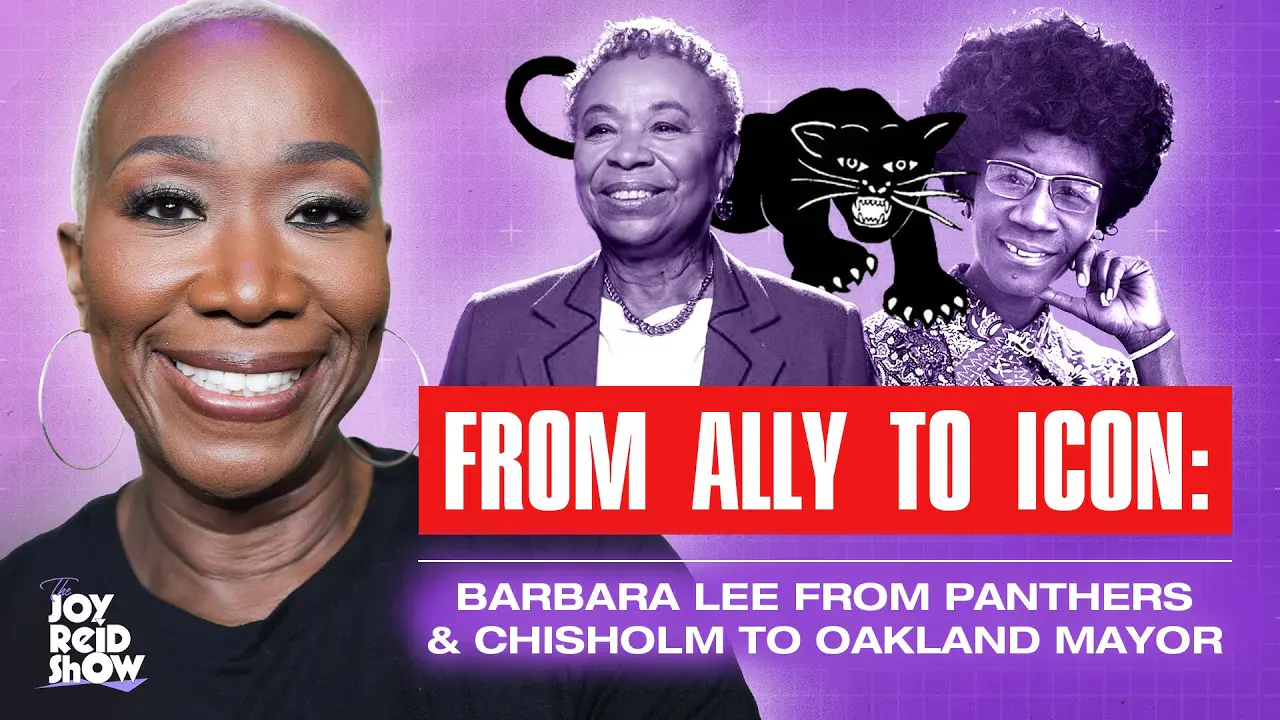
The Joy Reid Show
Barbara Lee: from Black Panthers Ally & Shirley Chisholm Mentee to Oakland Mayor | TJRS Mayors
00:50:18
Loading summary
Transcript232 lines
- [00:00]
Expedia Announcer
Bundle and safe. With Expedia, you were made to follow your favorite band. And from the front row, we were made to quietly save you. More Expedia made to travel savings vary and subject to availability. Flight inclusive packages are atoll protected.
- [00:15]
Joy Reid
Hello, everyone, and welcome to a special edition of the Joy Reid Show. Back in June, the Joy Reid show team headed to Oakland, California to interview newly elected mayor and longtime congresswoman Barbara Lee as part of our Black Mayor series, highlighting what the people governing closest to black America are doing to help their constituents survive the challenges of the present autocratic moment in America. Take a look.
- [01:08]
Unidentified Guest/Interviewer
Thank you.
- [01:08]
Barbara Lee
Today is a big day. You know, we have good news. We are having our swearing in, our public swearing in. We heard that 3,000 people had responded, but we wanted to come here first to say thank you and to say how much you give me inspiration. Let me thank our 40 by 40 group of brilliant entrepreneurs, brilliant activists, developers, people who really want to make not only our community here survive, but thrive. Because my mother, my late mother, Mildred Parrish Massey, who passed away 10 years ago, yesterday was her birthday. And she told me, even with all the challenges of her being the first black woman civilian working at Fort Bliss, Texas, or one of the first 12 plaintiffs to integrate the University of Texas at El Paso with the naacp, she grew up in the Jim Crow South. And even with all those challenges, she said to her three daughters, she said, can't is not in the dictionary. It's not.
- [02:27]
Look it up.
- [02:27]
And when I started whining, she made me go to the dictionary. And so what you all are doing here is reminding me of my mother's message to us, that in spite of the challenges, in spite of pushback all the time, and in spite of all the difficulties we faced, that can't is not in your dictionary. And yes, you all are making us proud and doing everything that our children and our elders and our community need and deserve. Thank you again and may God bless you.
- [02:58]
Thank you. Thank you, thank you. And with that, I believe I'm going to introduce another special guest, an amazing.
- [03:06]
Unidentified Guest/Interviewer
Woman that I watched every night back in the day.
- [03:09]
Joy Reid
I am looking for her.
- [03:11]
Barbara Lee
Ms. Joy Reid.
- [03:13]
Come on up.
- [03:13]
Joy Reid, the one and only Joy Reid came to see us in Oakland.
- [03:35]
Well, hello, everyone.
- [03:37]
Unidentified Female Guest
It is always beautiful to be in sunny California. I just came from rainy, rainy, rainy East Coast. But it is so beautiful to be in Oakland. Sadly, I have never been to Oakland before. This is my first time. But I am so proud of your mayor. I love everything about her because she was just a. I Know it's Sunday. Can I say badass on Sunday? I'm sorry. Hallelujah. She was a badass young woman. She represented the people in the most progressive, grassroots way from day one, from Shirley Chisholm being her mentor to taking over the seat of the great Ron Dellens, one of the champions of the reparations movement. She is somebody who is a movement politician. And there are two kinds of politicians. There are politician politicians and there are movement politicians. And what you want, if you want change and you want something to actually change in your life as a result of voting, what you want is a movement politician. Because otherwise they're just taking up space face. And they don't care what they do at the time. They just want to stay in power. And so when I encounter, in my very long, long, long years, even though I'm young and fresh, even my long, long years of covering politics, I have encountered many, many, many politician politicians, but only a handful of movement politicians. And your mayor, the great Barbara Lee, is a movement politician. So I want you to give her one more hand. And I'm so proud of you. Congratulations on a victory. Well, wonderful. And also congratulations to you because you are going to be led by the greatest. She's one of them.
- [05:17]
Joy Reid
God bless.
- [05:20]
Barbara Lee
Tell her you've got to come. It's been at least a day.
- [05:22]
Joy Reid
Yeah, we are.
- [05:23]
Barbara Lee
Oakland has so many different communities. Like yesterday, we did cleanups.
- [05:28]
Joy Reid
Okay.
- [05:28]
Barbara Lee
So I was in the Montclair area, which is the fire area, where is in the hills, primarily white and upper and go. Right. We started there with cleanup. Then we went down into North Oakland, which is closer to Berkeley.
- [05:42]
Joy Reid
Right.
- [05:42]
Barbara Lee
Then we went. Which is very progressive, black and white, very progressive. I went in that area. Then we went to Chinatown. Right, okay. Did a cleanup there. Then we went to Fruitvale, which is the Latino community. Right. And then we came out here to Deep east over. And so you have all these different neighbors. The Vietnamese community, right. The Japanese American community, Korean community, all along International Boulevard. And it's just like you just go from one world to another.
- [06:09]
Joy Reid
It kind of reminds me of New York. Like what you're talking about is this very cosmopolitan place. We have all these different communities. Do they interact?
- [06:15]
Barbara Lee
Interact some. You know, we. Because we have. I mean, we've never had really race riots here, but we have an Afro, African American Latino coalition. And I've all these years had to keep the coalition to get, you know, with progressives, white, progressive whites, Latinos. With aapi, you have Native Americans.
- [06:35]
Joy Reid
Right.
- [06:35]
Barbara Lee
And the black community.
- [06:36]
Joy Reid
Okay.
- [06:37]
Barbara Lee
And so you see what's happening out here now? And 10, 15 years. No, 20 years ago, we brought in money to help in the Fruitvale district, the Latino community, build a transit village with housing and supermarkets and, you know, really a senior center, daycare, you know, a library. So now, finally into where the largest number of black people live, you know, is where we were. But it's been. Some people work together, but sometimes, like right now, for example, I have to keep. Make sure the black community stays strong with the immigrant community because, you know, Trump and them like to. Black folks divide us. That's right. And so I think we've worked it out where if anything takes place with ICE here, black community is going to stand solid with the immigrant community.
- [07:28]
Joy Reid
But there is this way in which the right has tried to divide African Americans from Latinos.
- [07:33]
Barbara Lee
Oh, yeah. Oh, yeah. Oh, yeah.
- [07:35]
Joy Reid
Is that happening here, too?
- [07:36]
Barbara Lee
Not. Not really. But it's subtle.
- [07:38]
Joy Reid
It's.
- [07:39]
Barbara Lee
Right, it's subtle because oftentimes it's kind of like, you know, like, how did they get $100 million? Right? And I said, well, remember when I brought in, you know, you. Oh, yeah, yeah. So, you know, you have to kind of keep at it. And then it was really proud of CJ when we press conference to get up to 100 million talking about all of us, you know, in all communities. This is for everyone and, you know, intersectional kind of work. And so it's. It's there, but it's not. It hasn't surfaced.
- [08:09]
Joy Reid
There's more cohesion.
- [08:10]
Barbara Lee
Yeah. Because we know who the enemy is. But when you look at my election, direct line. It's a line, a straight line up there, which I've always represented, where the more wealthy population of voters are.
- [08:29]
Joy Reid
Right.
- [08:29]
Barbara Lee
I won some votes, but my opponent won the majority of votes.
- [08:33]
Joy Reid
Okay.
- [08:33]
Barbara Lee
The line here where they said people never vote, and this was a special election.
- [08:37]
Joy Reid
Yeah.
- [08:38]
Barbara Lee
These people turned down.
- [08:39]
Joy Reid
That's right.
- [08:40]
Barbara Lee
They projected maybe a 25% turnout. Okay, listen. No, we got 35%. We have so many people who are formerly incarcerated, you know, System, Systems, Impact. They didn't know that they could vote.
- [08:54]
Joy Reid
They could vote.
- [08:55]
Barbara Lee
Yeah. We. And. And the Ray people don't understand how I won. We saw them, we know them, they registered, they helped in my campaign. We read and they voted. Okay. Unsheltered people. We have the largest number of unsheltered people in Alameda county. Now. We're 24% of the county, 58% of the unsheltered people. Out of that, over 70% are black living in the streets, 70%. Okay. They didn't know they could vote, but if you have an address. So we had to get people who never got engaged before, never were seen by anyone.
- [09:30]
Joy Reid
They probably were never asked.
- [09:31]
Barbara Lee
They were never asked. They were out holding my signs. It was like, whoa. And that's how we won.
- [09:37]
Joy Reid
And I feel like some of that, it comes from your background. I mean, you have that Black Panther background. That's an organizer background.
- [09:43]
Barbara Lee
The people have to stand up and demand. They have to understand that they have a right, we have a right to demand that these judicial procedures be carried out in the right manner.
- [09:54]
Unidentified Female Guest
The revolution has come of the pavement.
- [10:01]
Joy Reid
And do you feel that that has changed the way you do politics?
- [10:04]
Barbara Lee
Oh, yes, it has. Because it's interesting because when I have 100 day plan, like in 100 days, we're going to do boom, boom. It's a 10 point plan.
- [10:14]
Unidentified Female Guest
Right?
- [10:15]
Barbara Lee
Of course. Black Panther.
- [10:17]
Joy Reid
The Black Panther was born in Oakley.
- [10:20]
Barbara Lee
Next time you come, I'll take you to the museum. Frederica Newton does the Huey P. Newton Black Panther Party Museum. It's phenomenal.
- [10:27]
Joy Reid
It's phenomenal. What do you think people fail to understand about the Panthers? Because I feel like there is. People know more about Black Panther than comic than they really do about the Panthers. And I think they misunderstand who the Panthers were.
- [10:40]
Barbara Lee
Yeah. What they don't realize, or they're beginning to, but they don't. Yeah. Fully realized. The Black Panther Party, first of all, was a coalition party. They had AAPI people, Latinos, led by black people, but was a coalition party. The Black Panther Party made a coalition.
- [10:57]
Black Panther Party Member (Historical Clip)
With the People of Freedom Party, which is primarily a white group. We see it necessary to fight on two fronts. We must liberate the colony as well as stimulate revolution in the mother country. Because I think the revolutionary students play a great part in saving America. If it were not for the white students, the Black Panther Party would react to the racism in the country and therefore respond with racism. White students have been very interested in the past of the foreign policy of the United States. They're demanding that the United States withdraw from Vietnam, stop brutalizing the Vietnamese people. And we feel that the white students should relate and pay more attention to the colonized situation here of the blacks first. Because after all, this is home.
- [11:46]
Barbara Lee
And it was an international party. Huey Newton, Elaine Brown, Bobby Seale traveled all over the world. Every time I go, say to China or to Algeria, you know, everywhere I go, it's like they're there and they were there. Okay, so they were an International, because they understood. Understood what this New World Order was about and about how the disproportionate numbers of people living below the poverty line with all the inequities that we had a common international struggle. So they were an international party. Secondly, a lot of people don't realize that they had the Ten Point Program. I mean, they were the ones who started the whole movement for sickle cell testing, the George Jackson Medical Clinic. And I was involved with that. They were the ones that were the movers and shakers behind the free lunch program of the federal government. You know, they were the ones who talked about housing, affordable housing, police accountability. And, you know, cops were killing black people. So, hey, gun. Couldn't. You know, you have. You can carry a gun. You could. And so they carried their guns. And that's when. Oh, my goodness. Because they were, you know, that's what.
- [12:50]
Joy Reid
Ronald Reagan was for, gun control.
- [12:52]
Barbara Lee
Yeah, that's right.
- [12:53]
Joy Reid
That's what. Because of that. With telepathics.
- [12:55]
Barbara Lee
And so the school. I helped them start the school out here. It was called the Community Learning Center. And I had to form a corporation because the money wouldn't go straight to the Black Panther Party. So I had a legitimate nonprofit where I was able to raise money to help start the Panther School. And it was called the Community Learning Center. And these kids had music, they had art, they learned to read and write. They excelled, okay? Because these were kids who public school just wasn't teaching. And so the party, really, they were a visionary party, but they incorporated grassroots people to run the show. And I mean, Shirley Chisholm, okay, they weren't involved in voter registration or politics. And so because I met Shirley at Mills College. You saw the movie? I did. Okay? So I went to Bobby and Huey because I wasn't a member. I was a queen work. I said, look, I said, we have this black woman, black progressive woman who's running for president. Why don't she speak into the issues the party speaks to?
- [13:55]
Unidentified Speaker (Historical Clip)
I deem it a pleasure, an opportunity, and in a sense, a kind of obligation to spend this time with you here this evening, spend this time on behalf of a little woman whom I knew would make it and whom I knew that at some time in the future, this same woman is going to deck the halls of the United States Congress. Now, the winds of change are crisscrossing this land. The winds of change are reflecting not the pressure of physical bodies, but individuals who understand the need for the prioritization of bringing to the legislature legislation that will redound to the benefit of the poor and the underprivileged peoples. Who can say that there's not a need for political blood trans confusion in the body politics? A need for men and women who have already exhibited courage in the face of political situations, concerned in the form of the visibility of any form of human suffering. Commitment in the face of actions rather than the raw nifty political expediency of politics. And such a person is Barbara Lee.
- [15:58]
Barbara Lee
So I ended up organizing her Northern California campaign from my class at Mills College. I got an A in the class that I was going for. I registered to vote. I went on to Miami as a Shirley Chisholm delegate. The roll call vote which would either confirm McGovern's victory or show that he had fallen short and now faced the probability his support would erode on succeeding ballots. Three votes for Senator George McGovern 1.1 for Shirley Chisholm, 6.05 for Senator Jackson. That one person that I could relate to. Yeah, but before then, Are you kidding? And I wasn't apathetic at all. I was right.
- [16:41]
Joy Reid
I think people just assume that people who don't participate don't vote, don't care. Yeah, it's not that they don't care. They just don't feel seen or heard.
- [16:48]
Barbara Lee
They don't feel seen or heard and they don't, don't know how their government and elected officials should. What to do. They're not working. They don't see them working for them.
- [16:58]
Joy Reid
But. Well, so I have to ask you this about the Democratic Party because you were in Congress, you were in the.
- [17:02]
Barbara Lee
And I'm on the dnc.
- [17:04]
Joy Reid
I hear you, but I gotta ask because I've had so many particularly younger people say their disillusionment with the party is that it feels like they don't do anything. Even though Democrats have done all the things Medicare, Medicaid, Social Security, you name it, Obamacare. So they do these big programs, but they don't see any impact in their day to day lives. And Democrats look weak, like they don't even know how to wield power. Whereas Trump comes in and in 100 days he's flipped the whole government, he's destroyed the federal government, he stripped it to the studs in 100 days. And so people look at him and say how come he can wield all that power without complaining about not having 60 votes in the Senate or not having the votes in the House? And Democrats go well, yeah, I don't.
- [17:47]
Barbara Lee
Think Democrats are quite going well, but I do know that he is an autocratic leader. And this is what autocrats do. You know, Democrats are Democrats, and we take too long to do stuff, but we're Democrats. Right. And so democracy is like President Obama is messy. Right. I'm not taking up because. For Democrats, because one of my roles in the Democratic Party is to make it more relatable and progressive and connected to ordinary folks in terms of their aspirations. Right. But I also know that when people say that to me about Democrats, you know what I do? I look at them, I say, you're alive, ain't you? You remember Covid? Now I'm telling you, if it weren't for President Biden and Kamala Harris, millions more would have died. Okay, Unemployment. But people don't even. They say, that was then, this is now. Wait a minute. So we need to better connect people. And that's why, again, going back to Oakland, grassroots organizing, meeting with people where they are, I don't have. That's why I was out here, not going down to City Hall. I don't want people to feel they have to come downtown if they don't want to, or camp and making people know what, what's the budget like? How's it go relate to you? Like, okay, so I'm fighting to get a hundred thousand dollars, 100 million, 200 here. It'll do this. So we have to do better explaining what it is. Explaining what it is. And then fighting. Yeah, you know, we have to fight hard and not, you know, there are times. And let me tell you, George Bush I disagreed with on every single thing.
- [19:18]
Right.
- [19:18]
Voted against war. The only one, the whole bit. But I worked with him on PEPFAR and the Global Fund. We've saved over 25 million lives. And that's because I went to him and I said, you got to help us do this. And he did. And so you got to know when to fight and when to work together, you know?
- [19:34]
Joy Reid
But I think also you talked about the war, and I was just going to ask you that because so many millions of Americans are sick of these foreign wars. And it helped Trump to get in because people thought, well, he's the guy who's not going to have wars.
- [19:45]
Unidentified Guest/Interviewer
Mr. Speaker, members, I rise today really with a very heavy heart, one that is filled with sorrow for the families and the loved ones who were killed and injured this week. Only the most foolish and the most callous would not understand the grief that has really gripped our people.
- [20:03]
Joy Reid
Being against the war was a majority position among Americans. But Democrats all toed the line for the war. See, that Is the thing about Democrats.
- [20:12]
Barbara Lee
I think, that frustrates. But you know what? Then it was a difficult circumstance because 35 million people had died, and I am defending their votes. But through the terrorist attacks, we had never been hit. I had to.
- [20:28]
Joy Reid
Well, 3,500 people.
- [20:29]
Barbara Lee
3,500 people died. I had to escape again from the Capitol because of the plane coming in. I was there early. I could go to work early and had to run down Pennsylvania Avenue. So. And then my flight. My district director, his sister was Wanda Green, and she was on Flight 93 that went down, down. So you can imagine how hard it was. And so it was hard for me, too, because, you know, you always want to go after. I said, but wait a minute. Not three days after you've been attacked, because this could set the stage for forever war. Then they bring this authorization for 60 words. And all it said was, president. Any president can use force wherever they want to.
- [21:11]
Joy Reid
And then they used it on a country that had nothing to do with.
- [21:12]
Barbara Lee
Nothing to do with it. And they tried to link everything with everything. I said, oh, no. I said this. My dad was a military officer. I said, no way. I said, and I'm not a pacifist, but my background, psychology and psychiatric social work, so I understand human behavior. I said, we're in mourning. We're grieving. This is not the time to make decisions like that. You have to step back, think it through, and respond appropriately, but not in the moment of emotion. And then second. Well, everybody wants us to do something. I said, but they elected us to do leaders. Oh, they said, oh, Barbara, come on. That's. You know. So I said, well, I'm sorry, but this is overly broad, and any president never has to come back to pass.
- [21:57]
Unidentified Guest/Interviewer
Members, I rise today really with a very heavy heart, one that is filled with sorrow for the families and the loved ones who were killed and injured this week. Only the most foolish and the most callous would not understand the grief that has really gripped our people and millions across the world. This unspeakable act on the United States has really forced me, however, to rely on my moral compass, my conscience, and my God for direction. September 11th changed the world. Our deepest fears now haunt us. Yet I am convinced that military action will not prevent further acts of international terrorism against the United States. This is a very complex and complicated matter. Now, this resolution will pass, although we all know that the president can wage a war even without it. However difficult this vote may be, some of us must urge the use of restraint. Our country is in a state of Mourning, some of us must say, let's step back for a moment. Let's just pause, just for a minute and think through the implications of our actions today so that this does not spiral out of control. Now, I have agonized over this vote, but I came to grips with it today. And I came to grips with opposing this resolution during the very painful yet very beautiful memorial service. As a member of the clergy so eloquently said, as we act, let us not become the evil that we deplore. Thank you. And I yield the balance of my time.
- [23:55]
Barbara Lee
And so I voted against and all hell broke lease on me. You talk about death threats and craziness and all, but let me tell you, fast forward every year I tried to repeal it. Finally got 49 Republicans two years ago to say, yes, it's time for it to go. I got it passed like two or three times off the floor and then it ran the clock in the Senate. And there were a couple of senators who wouldn't get it off the floor until this last time, Bob Menendez, Senator Kaine and others finally let it go to the floor. And then the clock rang out. So we had to start all over. But by now, I built up a Republican and Democratic coalition to repeal that. I suspect Trump would sign it if it ever got to his death. That'd be good politics, you know. Yeah. So it takes time. But that's why people were worried. They were fearful, they were angry, you know. So the psychology of what happened during that time, I understand. But what I don't understand is how if you're elected to lead, you came in a moment of crisis, even national security crisis.
- [24:54]
Joy Reid
Talk about the moment that we're in now because I don't know how much you still talk to your friends in the House, but it feels like there's a lot of fear now. Donald Trump is an autocrat in training. He's trying to be a dictator, I think that's clear. But it feels like Democrats don't know what to do or are intimidated by him. What is going on?
- [25:12]
Barbara Lee
Well, I think that there's sometimes a good cop, bad cop. I mean, when you look at there's a good core. And I was co chair of the Progressive Caucus too, and the Black Caucus, they're a good core. Democrats who are out here moving around. And I think, you know, Democrats, like Republicans will wait till the wind is blowing in their direction and that direction is blowing. So I think once people say, hey, enough.
- [25:36]
Joy Reid
But I mean, there are Democrats like the jasmine Crockett's of the world, the AOCs who are standing up and when then they present themselves for leadership, they get swept aside because they don't want that flavor of leadership to be pushed forward.
- [25:50]
Barbara Lee
But not. Not always, I think, well, when you look, well, okay, now I'm gonna have to take a little credit for something, but I was in leadership. And when.
- [25:58]
Joy Reid
Which was amazing that you were in leadership, because, I mean, they're like, wait a minute, they let Barbara Levy, as.
- [26:04]
Unidentified Female Guest
Progressive as you are.
- [26:05]
Barbara Lee
So. Yeah, but when they came, the squad quote, came in, they got every single.
- [26:09]
Committee they asked for.
- [26:10]
Right, okay. And they've been able to be very effective. You look at what Ayanna has done, you look at what Ilsa has done, you look at what AOC has done, you look at what Jasmine. So they're working it.
- [26:20]
Joy Reid
Absolutely.
- [26:20]
Barbara Lee
They really are. And they'll be. They're moving into leadership and. And I've been helping them.
- [26:26]
Joy Reid
And we'll continue to use that. Politics can stop autocracy because it feels like politics is too slow to stop autocracy.
- [26:35]
Barbara Lee
I think it's going to be a critical moment where all hell is going to break loose and then it'll stop. And this is one time when you wonder about the military, how they are going to step in, because this can't go on like this.
- [26:49]
Joy Reid
Yeah, well, this. Well, that's. That brings me to a very immediate issue, which is this militarization. Sort of state police, this militaristic state police that are operating in Los Angeles right now. We're seeing what they're doing. They're going in and provoking protests by raiding a Home Depot and dragging people out and saying, well, we're taking you away where ICE is taking you. And they took, you know, they've arrested something like 44 people in Los Angeles because when ICE shows up, people protest. That's predictable. But what I've noticed is that we were driving around LA pretty much for the last three days. There's nothing going on in LA other than where ICE is. And they're only in a small number of places. Most parts of LA are perfectly peaceful. And yet you're having Tom Homan and Donald Trump and Pete Hegseth, the guy from Fox, threatening to essentially invade California to send in the Marines and the National Guard. That is a dangerous escalation.
- [27:42]
Barbara Lee
It's very dangerous. And this is where it's coming.
- [27:45]
Joy Reid
We're in Oakland, another woman run city.
- [27:49]
Barbara Lee
And I'm sanctuary.
- [27:50]
Joy Reid
A sanctuary city.
- [27:51]
Barbara Lee
Immigrant community.
- [27:52]
Joy Reid
An immigrant tribe of diversity.
- [27:54]
Barbara Lee
Oh, yeah. Oh, yeah. It's A warehouse.
- [27:55]
Joy Reid
Oakland's a target alert.
- [27:58]
Barbara Lee
You know, it's something that. And we're going to resist, and it's.
- [28:02]
Got to be appropriate so we don't.
- [28:04]
Get the National Guard coming in, you know, so we'll manage this.
- [28:10]
Joy Reid
How do you stop the federal government from sending federal agents into a sanctuary city and taking people?
- [28:15]
Barbara Lee
Yeah, it's very hard to stop them from doing that. We have to lawyer up, first of all, and we have to have everybody in the community circling our immigrant community and making sure that we provide that circle of protection and make sure the police know what they're doing and not cooperating. And we have to fight hard, but not allow the fight to be such that people get hurt or get arrested, you know, so we have to be very strategic with that, and it's very hard. But what this moment, and I'm telling you, most people don't understand the signs of the dismantling of democracy. People will wake up one day if we don't fight back harder and find out where are we? They won't even recognize this country anymore. They'll see barbed wire everywhere. Okay. They'll see people in jail and internment camps. I mean, this is the moment. And so educating people about what the signs of authoritarianism is because every. People are just struggling to survive.
- [29:17]
Joy Reid
Yeah.
- [29:18]
Barbara Lee
You know what I mean?
- [29:18]
Joy Reid
And I think because you come from an organizer background, when I see the protests, you know, against it, to me it is the most predictable thing ever. When ICE is taking people, people get very angry. They get into the streets, they throw rocks, they do the things. What would you advise people to do if they are. They want to resist this state police that are coming in and taking people, how should they do it in a way that doesn't give Trump the excuse to come in to Oakland and do what he's trying to do in la.
- [29:47]
Barbara Lee
Yeah. You know, we need to have some safe spaces, which we're encouraging people to find and we're helping for people to be able to voice their First Amendment rights and to be able to. I mean, that's the essence of our democracy. But we also have to make sure people understand the perils and the dangers of certain locations, for example, and make sure people know that is not the most safe location to do this. Maybe we should do it here. There are Yahoo. Also making sure that our vulnerable, like children and these sensitive spaces are protected. And we have to. Because in sanctuary cities, you know, you can't go to a church. Supposedly, federal law is not.
- [30:31]
Joy Reid
Can you explain what a sanctuary city is? For people who don't.
- [30:33]
Barbara Lee
It's a city that has just said we're going to protect immigrants from the federal government and from deportation because we have. We believe that they have a right to be here and to work. And so we're not going to allow the police to cooperate with ice.
- [30:48]
Joy Reid
So basically, California is a sanctuary state. It's a state. So that means that when people are saying police are arresting people, it's not police, it's feds.
- [30:56]
Barbara Lee
It's feds, it's ice, it's the federal government.
- [30:59]
It's Donald Trump's police.
- [31:02]
Joy Reid
It's his police.
- [31:02]
Barbara Lee
It's his police. Yeah. The thing is we can't give them. We can't give this to them. And that's why I'm saying we have to be very, very strategic, and we have to be able to protest in places and raise our voices and let them know what we feel and help our immigrant communities while not provoking what they want us to do. That's what they want us to do, is provoke.
- [31:27]
Joy Reid
And, you know, I also take note of the fact that you already knew the elected mayor of Oakland, and black mayors are under particular threat from this regime. It's hard for me to call them an administration because they behave like a regime. But, you know, you think about the mayor, Chokwe Lumumba in Jackson, Mississippi, you think about Karen Bass being constantly badgered and attacked on Trump and on Elon Musk's social media and trying to blame her, as if she started the fires that in heat and Palisades, which had nothing to do with her, and she was taking care of it. And some of it's not even in her part of the city where she has leadership, responsibility, you name it. If there's a black mayor, I mean, calling the mayor of Baltimore the DEI mayor, I love the way he flipped and he said, you know, when he's a duly elected incumbent, which I love that. But there is a particular focus on black mayors.
- [32:26]
Barbara Lee
Yeah.
- [32:26]
Joy Reid
How do you stay out of that fire?
- [32:27]
Barbara Lee
Yeah, there's a focus on black people. I mean, when you look at. And then a black mayor, of course, because we're the closest to black people.
- [32:34]
Joy Reid
Well. And most black Americans who live in urban environments actually live under a black mayor. Atlanta, you know, you think about New York for what it's worth, you know.
- [32:43]
Barbara Lee
So we're just targets about people. This is about the other. It's about. It's really an attempt to marginalize black people and not allow us our total free, our freedoms and our justice. That this country holds.
- [33:00]
Joy Reid
And I wonder if you, when you approached the idea of being mayor, did you always want to be mayor because you didn't want to even vote? Because when you want to run for office, you didn't want to run for anything.
- [33:08]
Unidentified Speaker (Historical Clip)
I sense that this young woman was going crazy. But has been said nothing happens before it's time. I remember that walking down the street of Oakland, I was hearing a couple of rallies and this little girl, I.
- [33:30]
Barbara Lee
Don'T know why I call her a.
- [33:31]
Unidentified Speaker (Historical Clip)
Little girl because I'm really small. But this little girl, she was about 17 or 18 at the time. And she had her nice little afro, her nice little round face, and she had on a tiny dashiti. And she was listening to everything I. Following me around. And then she had the nerve, the audacity to say to me she wanted to run my campaign. And I looked at her, I said, what did you say? And she said, I want to be involved, I want to participate. And I like her stunk. I liked her nerve. And I gave her the chance to participate my campaign here in Oakland. And believe it or not, she delivered them finally.
- [34:26]
Joy Reid
Right? So, I mean, when you were running and helping Shirley Chisholm, did it put the spark in your mind? Went, you know what? Maybe, maybe I want to never, never, never, never.
- [34:34]
Barbara Lee
I, I went to graduate school. I got my MSW Master in Social work. I'm a clinical psychotherapist. I started my own mental health center, the Miami based mental health center.
- [34:43]
Joy Reid
I'm gonna call you to walk, take me through the therap.
- [34:48]
Barbara Lee
I'm talking to a lot of people. Yeah. Using those skills, listening is something you have to really do is. And that's a good background for politics too, to listen. But no, I never expected nor wanted to run for office.
- [35:00]
Joy Reid
Yeah.
- [35:01]
Barbara Lee
What happened was when I was working for Ron Dellums and I was working out his district office and the mayor of the assembly member was going to run for mayor of Oakland. And so everyone came to me and said, look, we never had a black woman in the California legislature north of Los Angeles. You've got to run. I said, what do you mean? They said, you're progressive, you're black, you're a woman. Who else? So please. So I got, I run and ran and I won. So I was the first and only black woman north of Los Angeles in the California Center. So then after term limits, okay, Barbara, no black women in the state senate north of Los Angeles. Come on. I said, really? And I wasn't sure because I had a business then no state Business. But my mother, I had a company, an 8A company, mind you.
- [35:53]
Joy Reid
Right.
- [35:54]
Barbara Lee
My mother and my sister managed the company, a security company, almost 400 employees. I know workers, comp, insurance, how to run a business. Right. Comes in handy here as mayor. Anyway, so I wasn't that interested. But they said, you got to do this to help pave the way. Plus, you're the only one experienced. So I ran for the state senate. So I was the first black woman North LA in the state Senate. So then few years in, Ron says, I'm retiring, Bob, but call me Bob. You better be ready to run. I said, ready to run. I'm like, okay. So that's what happened. So then. So I served in Congress 27 years now. 27 years in Congress, Joy. Seven and a half years in California legislature and 11 years working for Ron Della. So you had all that since I.
- [36:42]
Joy Reid
Was a child, yeah.
- [36:44]
Barbara Lee
You know, and so when I did not win the states, the U.S. senate seat, then there were a lot of different options. Right. And at the same time, the mayor of Oakland was being recalled. And so, I mean, I'm thinking, I've never thought about running for mayor, but again, the same kind of something. So the pastor started saying, barbara, you know the book of Queen Esther, you come from such and such. Then I went to the Mother House, Sister Loretta taught me. I went to Catholic school, and little did I know, now they made me study Latin. I spoke Latin, sang in Latin, studied the catechism, diagram, sentences, studied logic, everything. It was a rigorous elementary school education. Right. But I didn't like these nuns because they made me. They were disciplinary. Little did I know, though, until recently, their whole value system and their motto is, go where the need is the greatest. So they were infusing those values. And then their framework for teaching catechism is, you've always got to work for peace and justice wherever you are. And you look up the Sisters of Loretta, you'll see. Oh, there's Barbara Lee.
- [37:48]
Joy Reid
Wait, but how much do you love.
- [37:49]
Barbara Lee
It's a lot going on.
- [37:50]
Joy Reid
It's a lot going on. How much do you love this Creole pope?
- [37:54]
Barbara Lee
I'm. Wait and see.
- [37:57]
Joy Reid
You want to see if he's.
- [37:59]
Barbara Lee
I'm waiting to see. I did like I went to actually to. And I'm not a Catholic now. Yeah. But I do remember my Catholic religion, so. And I always wanted to go to Christmas Eve midnight mass at St. Peter's I've done that twice since Pope Francis, and it was so good.
- [38:16]
Joy Reid
Pope Francis was great.
- [38:17]
Barbara Lee
Yeah. I had a chance to Meet him.
- [38:18]
Joy Reid
Yeah.
- [38:19]
Barbara Lee
So now it's like I'm waiting.
- [38:21]
Joy Reid
But I like having a black vote.
- [38:22]
Barbara Lee
I do, too.
- [38:23]
Joy Reid
I know it triggers some.
- [38:25]
Barbara Lee
It does, it does.
- [38:26]
But I was hoping when the cardinal from Ghana, I was pulling for him.
- [38:32]
Joy Reid
But he's a conservative. See, I think people would have been. Yeah. Would have been disappointed. Yeah, he would have been concerned. I want to ask you, because you did work for Ron Dellums, who was a big part of the anti apartheid struggle that the CBC really was the moral leader of in this country against Ronald Reagan and Dick Cheney and others. This whole thing about welcoming Afrikaners while barring those from every sub Saharan African country, much of the Middle East, Asia, everywhere else, except white Afrikaners. And what do you make of that? And do you see seeds of the apartheid system in what Trump and Elon Musk are building? Because I know they say they're fighting, but they agree on everything that I noticed.
- [39:15]
Barbara Lee
No, that shows who they are, first of all. And if people don't believe that this is not a white supremacist kind of agenda, then I don't know what they're. This is an example. And apartheid during the beginning of apartheid. Now you double check this, but I read. And then I was told this during the. Because I got arrested. My first arrest was during the anti apartheid movement that South Africa, white South African sent their police to train in Alabama, in Arkansas, in the south of the United States so they could learn the system of oppression. And then went back. Yeah. And strengthened their system.
- [40:01]
Joy Reid
I mean, that would make sense to me. I mean, the Nazis learned how to treat Jewish Germans from the United States Jim Crow system. So we taught the world how to do racism.
- [40:12]
Barbara Lee
We taught the world. So this is no surprise to me. And so people need to. In history, you don't look back except Sankofa. Right. You look back in order to be informed and understand where you've been and what historical context we're in so we can move forward. So we need to really understand that about what's taking place.
- [40:31]
Joy Reid
How do you think. What's the end game here? How do you think that we get out of this mess that we're in?
- [40:35]
Barbara Lee
Well, people better can better speak out and organize and register to vote. I'm still going to say you got vote for Democrats.
- [40:43]
Joy Reid
I mean, what's the alternative?
- [40:45]
Barbara Lee
We have to be that. That.
- [40:48]
Joy Reid
What about third parties? I mean, look, there are some third parties.
- [40:50]
Barbara Lee
There's a Working Families Party, you know, and I. The working families parties always supported me. And I, I love their agenda. And their fight. And, you know, I stand with them. And until we get enough people registered as a third party, the movement could trigger just like what happened without a third party of Donald Trump. So we have to be very strategic in that. But I think that, of course, as a Democrat and member of the dnc, I'm putting. Pushing.
- [41:21]
Joy Reid
Have you talked to Karine Jean Pierre about her exit?
- [41:24]
Barbara Lee
No, not yet. How's she doing?
- [41:26]
Joy Reid
She's doing great.
- [41:27]
Barbara Lee
Where is she?
- [41:28]
Joy Reid
She's doing great. She's still in D.C. tell her to call me.
- [41:30]
Barbara Lee
I will.
- [41:31]
Joy Reid
Let me arrange this call.
- [41:33]
Barbara Lee
No, it's not for you. You got to believe in this stuff, that it's going to help people. You see that graffiti. Oakland's known for art. Graffiti. But now I don't know if it's. I don't know if it's. Some people say people are committing crimes by painting, but I don't know the difference between.
- [41:51]
Graffiti and art.
- [41:53]
I do, too, but it's everywhere.
- [41:56]
Joy Reid
I'm so used to this from New York that I think it's so pure, and it makes. It gives the place, like, style.
- [42:01]
Barbara Lee
Yeah. And Oakland's got grit and style and.
- [42:04]
And so.
- [42:04]
But it's a big issue. I think it gives you guys getting your lesson in politics. You guys got the inside story. Yeah, it does. Oakland has. It's the best chart, naturally, of any. Of any city. Well, well, well, here we are.
- [42:21]
Okay. Okay. Okay.
- [42:24]
Roxanne, how are you doing? We've been sitting in the car.
- [42:31]
So honored to meet you.
- [42:32]
Unidentified Female Guest
Jo. Thank you. Yes. Wonderful to meet you. This is very cool.
- [42:37]
Unidentified Guest/Interviewer
Welcome to our restaurant.
- [42:38]
Unidentified Female Guest
Thank you.
- [42:39]
Barbara Lee
Jamaican restaurant. Yeah.
- [42:40]
Joy Reid
I'm excited now. I can't wait to try this food. We're here in Sweet Fingers, and this is just one of the areas that's really redeveloping East Oakland, because I think you mentioned a couple times, Fruitvale, and you know what people think when they hear Fruitvale? They think Fruitvale Station.
- [42:54]
Barbara Lee
They think that the.
- [42:54]
That's where.
- [42:55]
Fruit Bell station, and that's where.
- [42:56]
Unidentified Female Guest
And it's near here.
- [42:57]
Barbara Lee
It's right here.
- [42:58]
Joy Reid
It's down the street.
- [42:59]
Barbara Lee
Yeah.
- [42:59]
Unidentified Female Guest
And so I think that is sort of the last.
- [43:01]
Joy Reid
The last image people really kind of had in their minds about Oakland. Right.
- [43:06]
Unidentified Female Guest
How has it changed?
- [43:07]
Joy Reid
And how do you change the perception?
- [43:09]
Barbara Lee
Well, first, thank you very much for being here, because we have to change the narrative about Oakland. Of course, Covid and Donald Trump, first time around turned the world upside down, and most communities have not recovered from that period. And we are recovering. And so a Lot has happened since then. And what we have done though is when you see the fact that the cost of living, of course, in Oakland and throughout California is not consistent with the wages. Some people end up not being able to afford to live here. And especially black people, they live now have moved to Nevada or up to Brentwood, Antioch, Pittsburgh, or back home down south to Georgia, Alabama, Texas. And so the impact of what that period also brought was gentrification and the diminution of the black population in Oakland, because now we're down to about 22, 23% black lives.
- [44:17]
Okay?
- [44:18]
And so Fruitvale Station, you know, Ryan Cooper did a brilliant job in that. And so we have police accountability issues that we're dealing with. We have, though, a public safety strategy. The crime rate has gone up. Smashing grabs. But you know what? And I was so proud of our city council members and our interim mayor and myself. We work to make sure that we enhanced funding for our Department of Violence prevention. The crime rate is ticking down by 30% now. So the narrative has got to change. People don't feel safe, they don't see it, they don't hear that. But also they don't hear all the great things that are happening in Oakland like the 40 by 40 and the Black culture and all of the development that's taking place and all of the efforts to keep the city clean and safe and green by ordinary folks. Yesterday, for example, we had cleanups all over the city. In Chinatown, in high wealth areas, in the Fruit Bell district, in deep East Oakland, in North Oakland, everywhere. Over 250 people out cleaning the city. You know, and so a lot here is changing and we're coming around out of all of these terrible dynamics and terrible socioeconomic challenges that we've had. Budget deficit, you know, we balanced the budget this year. We still going to have a deficit. We're going to have to make more cuts. We're a union town and I'm proud of that. There's some here who want to bust the unions. And so we got to hold the line. We have people here, we have people here who are very wealthy, several billionaires who just want to kind of buy Oakland. And so we're pushing back on that, saying every Oakland is a city where everybody is welcome, regardless of whether you have money or not. And so that's what we're doing now is trying to make sure everyone can stay here, feel safe. Our small businesses, of course, have left many of them them because of the public safety issues, because we don't have enough customer traffic downtown or in our neighborhood. So it's really challenging but people are really hopeful. And I think you see that everywhere we go people are really hoping and, and anxious to work, not just the mayor. And during this campaign we got to do this together.
- [46:44]
We got one open.
- [46:45]
Unidentified Speaker (Historical Clip)
Moving.
- [46:48]
Barbara Lee
This is good.
- [46:49]
Joy Reid
I have one extra question. I have a bonus question for you. Can I have a bonus question?
- [46:54]
Unidentified Speaker
I wouldn't be surprised if we don't have a woman present for the next 20 to 25 years. Particularly if the women continue to move in the direction in which they're moving now in this country by constantly fighting for recognition on the basis of their talents and their abilities and not on the basis of their sex. And they're making the gentlemen in this country be begin to realize that ultimately all discrimination, whether it's anti woman or anti black, all discrimination is anti human.
- [47:22]
Joy Reid
Are you hopeful about 2026? I mean does it even you think we're going to have election, free and fair elections?
- [47:27]
Barbara Lee
We better. Except we had better have some election monitors. We better lawyer up now and we better have some election protection in place because we know how that can go. I've been election monitors in South Africa.
- [47:41]
Joy Reid
And now we need them in America.
- [47:42]
Barbara Lee
I've tried to get the UN to come last time in Nigeria. I've been elect monitoring elections all over the world. We need election monitors here. We need the UN and isn't that.
- [47:51]
Joy Reid
Sad that we need that in the United States?
- [47:53]
Barbara Lee
Yeah, it is. But it's to be expected, you know, when you haven't dealt with the issues that underlie this country's founding. You know, genocide of the Native American slave, the internment of Japanese Americans, the Chinese Exclusion act, you know, so we've got a lot of stuff that we.
- [48:11]
Have to deal with.
- [48:12]
So as hard as it is to say, that's to be expected, you know, and we need to be clear headed about this.
- [48:19]
We do.
- [48:20]
Joy Reid
It would be courageous to do that and it would be nice if the US could be courageous about that.
- [48:24]
Barbara Lee
We'll just get there. These young people, let me tell you my hope. These young people, this is a new day. They see, see it clearly, Joy, you.
- [48:32]
Know that they do. Very clearly. They see it very clearly.
- [48:36]
Joy Reid
Unambiguously.
- [48:37]
Barbara Lee
Oh yeah.
- [48:37]
So I have a lot of hope. Yeah.
- [48:39]
Joy Reid
Good. I'll take it.
- [48:41]
Barbara Lee
I'll take what I.
- [48:43]
Joy Reid
Thank you.
- [48:44]
Barbara Lee
No, I have a lot of hope.
- [48:45]
I'm glad.
- [48:46]
Yeah.
- [48:47]
Joy Reid
Thank you for tuning in and many thanks to Mayor Barbara Lee and her team. Big ups to everyone watching on YouTube and substack and those listening on Spotify. And special thanks to our team TJRS members. We appreciate you. Be sure to hit like and subscribe so you never miss a moment and do share this video to support this independent media venture. Thanks again and see you on the next the Joy Reach out to the.
- [49:12]
Musical Performer/Rapper
Basics grassroots level Let me dig a little deeper with the shovel plenty can't tell the forest from the trees that I'm hard to detect Like a black hole in the dark and just justice anywhere It's a threat to justice everywhere Let me make this clear I got a bone to pick and I'll never fear the threat of poverty they don't want to talk about it they rather party so I'm a real talk about it for sure.