Loading summary
Transcript218 lines
- [00:01]
Marshall's Buyer
Marshall's buyers are hustling hard to get amazing new gifts into stores right up.
- [00:05]
Joy Reid
To the last minute.
- [00:06]
Marshall's Buyer
Like a designer perfume for that friend who never RSVP'd wishlist topping toys for her kids who came too.
- [00:13]
Joy Reid
Belgian chocolates for the neighbor, a cozy scarf for your boss and a wool.
- [00:17]
Marshall's Buyer
Jacket for your husband that you definitely.
- [00:19]
Joy Reid
Did not Almost forget.
- [00:22]
Marshall's Buyer
Marshalls, we get the deals, you get the good stuff.
- [00:25]
Joy Reid
Even at the last minute, the find.
- [00:28]
Marshall's Buyer
A Marshall's near you.
- [00:35]
Joy Reid
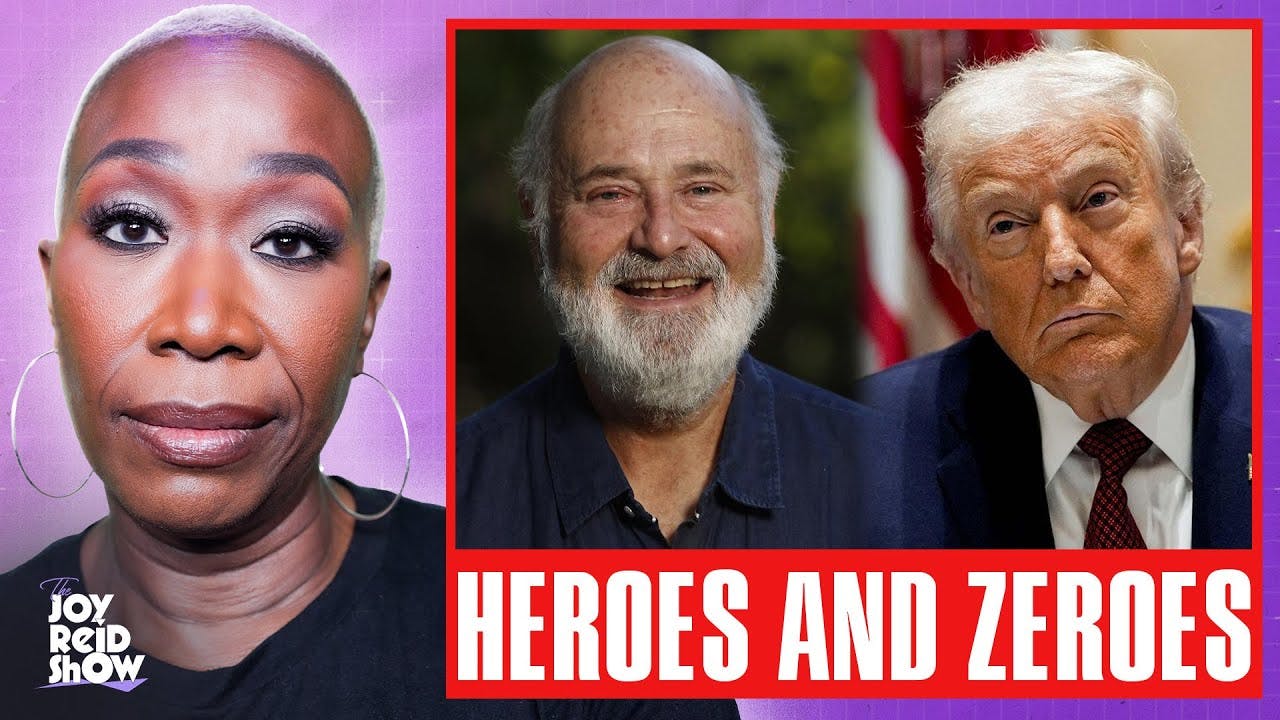
Okay? Hey everybody. Welcome to the Joy Read Show. Big up to everybody in the chat, you guys. You get in early and you're already spicy and hot. We love it, love it, love it. Thanks everybody who's watching on YouTube on substack, those of you who are listening, wherever you get your podcast, we appreciate and love you so, so much. I want to remind you all that this is the re date where we're going to do the after party. So after this podcast is over, those of you who are members, if you are Team TJRS or if you're readers, meaning you are a paid member over at Substack, you can join me for a one hour Ask Me Anything Friends Only chat. So this is going to be an insiders only chat we're going to have. We can talk about anything you like. We can talk about the vile gross Donald Trump insult against Rob Reiner. We can talk about whatever you guys want to talk about, how the state of our democracy. You can ask me questions, whatever that is. So. And of course I do have many thoughts about the death of the wonderful and lovely Rob and Michelle Reiner, including some personal pictures which you may have seen on my social media. And also Donald Trump's reaction which I can only describe as demonic. It was demonic. But before we get to that, this past weekend was just chock full of tragedy. Not just the murder apparently by the closest possible family member inside of the Reiners home in la. It was also a weekend that had kind of equal parts heroes and zeros. Hence the name of this podcast. Today I want to start with what has become a familiar theme in America. Our children having to shelter in place and hide from a mass shooter at school. In this case at Brown University, my sister's alma mater in Providence, Rhode Island. We now have the names of the two students who were tragically killed. This post is from Students Demand Action. The names of the students are elta Cook, a 19 year old second year student and beloved church girl from Alabama and Mukhamad Aziz, a first year student who dreamed of becoming a neurosurgeon There are their wonderful pictures. Deepest condolences to their families. It's a horrible thing to lose your child for having done the thing you wanted them to do, which is to go to college and to aspire to something greater. It's all they did. They committed no crime. And there they are. Ella. Let me say, I could pronounce her name wrong. Ella and Mukhamad Aziz both killed. Local student. Local station WCVB captured the terrifying end of one set of Brown students ordeal. We're going to play that for you now. It says A1. Please.
- [03:30]
Wajahat Ali
Please.
- [03:31]
Joy Reid
Promise.
- [03:32]
John Cusack
Please.
- [03:32]
Wajahat Ali
Hands, hands, Hands, Hands, hands.
- [03:36]
Joy Reid
Promise. Everybody's Hands. Hands, Hands, hands, hands, hands, hands, hands, hands. Everybody get your hands. Hands, Hands, hands, hands, hands.
- [03:45]
Abbas Alawiyeh
Just keep your hands up for us.
- [03:47]
Wajahat Ali
Obviously there's something going on.
- [03:49]
Joy Reid
We're here to help you. Just listen to what we have to say.
- [03:51]
John Cusack
Okay?
- [03:52]
Ali Velshi
All right. Breathe.
- [03:52]
Joy Reid
Anybody hurt? No? All right, just let's do our commands. We will get you out of here safely. Is this it? Is this the group?
- [04:01]
Wajahat Ali
If you have your bags, your phones.
- [04:03]
Abbas Alawiyeh
Go grab it now.
- [04:04]
Wajahat Ali
Quickly.
- [04:05]
John Cusack
Go quick.
- [04:05]
Wajahat Ali
Go in orderly, fast.
- [04:06]
Joy Reid
Let's go. Good job. Grab yourself.
- [04:17]
John Cusack
Hurry up.
- [04:19]
Joy Reid
It's really just insane how routine this has become for our young people. And not just college age students. High school students, elementary students, they're all taught how to do this. This is a 6, 6 situation and our country is unique, almost unique in the world in having this happen to our kids. Local law enforcement held a press conference on Sunday showing the shooting suspect. This is A two. We'll show you this. Sees a video from the building where this incident took place, 184 Hope Street. It's a of who we believe is the suspect leaving that area, walking on Hope street and taking a right on Waterman towards the water. He's going to be wearing dark clothing. You're not going to be able to see his face, dark gray or black clothing. And some of the witnesses have also told us, told us that he may have been wearing a camouflage gray mask. That is unconfirmed. But if anybody should recognize this person in any way, seen him earlier, recognize his gait, obviously we want to know about that. I mean local law enforcement doing their job, law enforcement doing their job to protect the students at Brown, putting out information to try to find this suspect. But of course, leave it to the cash out FBI to screw it all up. Releasing a photo and a name and the military record of the wrong guy who they detained and then released. No wonder MAGA folks don't believe FBI's story about who killed Charlie Kirk, the FBI has become a joke, unfortunately, under the podcaster who dreams of winding up at Valhalla, but who maga just wants to deport to India along with Usha and Vivek Ramaswamy and hell, maybe even Vivek Vance too. And if it is crass, your president is doing it. Donald Trump here he is the slave to the NRA who is unable to cobble together more than his usual sociological. When a shooting occurs in the country he ostensibly leads.
- [06:17]
Ali Velshi
This is a three university, great school.
- [06:21]
John Cusack
Great, great.
- [06:22]
Joy Reid
Really one of the greatest schools anywhere in the world.
- [06:26]
John Cusack
Things can happen. So to the nine injured, get well fast.
- [06:30]
Joy Reid
And to the families of those two.
- [06:32]
John Cusack
That are no longer with us, I.
- [06:35]
Ali Velshi
Pay my deepest regards and respects from.
- [06:38]
John Cusack
The United States of America.
- [06:40]
Joy Reid
Thank you very much.
- [06:41]
John Cusack
It's a very.
- [06:43]
Joy Reid
Things happen. According to Donald Trump, things happen. I mean, you know, his friend Charlie Kirk did say that it's worth it to have a few tragic mass shootings so that we could keep the second amendment broad and permissive. Meanwhile, overseas, also on Sunday, a terrifying attack in Australia at Bondi beach in Sydney, where two gunmen opened fire on a Hanukkah party, killing 15 people and injuring dozens more. Now, by the way, Australia is already upgrading its already strict gun laws as a result of this very rare but deadly gun attack in their country. Now, one of the killers, who are believed to be Muslims, one of them is dead, the other is in hospital after getting shot by Sydney police. But the incident produced a national hero in Australia who, who committed a just extraordinary act of courage that is both amazing and also terrifying to behold. This is a four. Take a look. Oh, This guy gang tackled this killer and then took the gun from him and aimed it at him. He then gets shot multiple times and wound up in the hospital. This dude is a g. Like, he went in there and unarmed tackles this guy, strips him of his firearm and aims a gun at him, then leans it on a tree. He took. I mean, this is incredible, right? So there are two kinds of courage. There's moral courage and then there's physical courage. And to be honest with you, moral courage in some ways is actually easier. Right? You just have to say the right thing or do the right thing. Now, you can certainly face consequences for saying and doing the right thing. There are risks to saying and doing the right thing. But physical courage, physical courage is actually a lot harder. I, you know, I wrote this Medgar Evers book and that was one of the themes of it, right? You know, Medgar Evers had both, right, moral courage and physical courage. But physical courage is really hard. Like, think people who charge into burning buildings. Think on 9, 11, the people who ran into the towers rather than out. People who, you know, run into the line of fire rather than run away. Like, that's physical courage. It's incredibly difficult and it's incredibly rare. So physical courage is what that guy had. It's amazing when you watch it, right? But we've also seen that there are tremendous consequences, right? The consequences of his physical courage are that fewer people died, like 15 people died. But reports are saying a lot more would have died because these two men were just opening fire. And one of them was up high. They were just opening fire. And by him taking one of the guys down, it enabled police to swoop in and get the other guy. So his physical courage saved lives. Moral courage, though, can also cost lives. And we have seen the consequences in this world of a lack of moral courage. When you have a lack of moral courage, you get the idiocy. Like what we've heard coming out of the mouth of war criminal Bibi Netanyahu. Bibi the Butcher, as I call him, who immediately, immediately took full advantage of this tragedy to blame Australia itself for the attack, blaming them for the apparent crime of recognizing a Palestinian state earlier this year.
- [10:05]
Abbas Alawiyeh
Your call for a Palestinian state pures full fuel on the anti Semitic fire. It rewards Hamas terrorism. It emboldens those who menace Australian Jews and encourages the Jew hatred now stalking your streets. Anti Semitism is a cancer. It spreads when leaders stay silent. It retreats when leaders act. I call upon you to replace weakness with action, appeasement with resolve. Instead, Prime Minister, you replaced weakness with weakness.
- [10:43]
Joy Reid
You know what? Whenever I hear Bibi Netanyahu speak, it makes me really happy that the ICC has refused to reverse course, even though Israel keeps asking them to reverse course on their adjudication of that guy Bibi the Butcher and two of his cabinet members as war criminals, which, by the way, our idiot president is clearly terrified of happening to him, given that the regime in the United States is now threatening new sanctions against the International Criminal Court and the International Court of Justice. They are threatening them, and this is a six if we have it. They're threatening to put sanctions on the icc, meaning individual members won't be able to use Amazon. Banks will reject them. This is already happening to some ICC people, and they're saying they're going to do extensive sanctions against individual members of the ICC unless they literally amend their founding charter to put into their charter that Donald Trump will never be brought up on war crimes charges like Bibi Netanyahu was. I promise you this is something there. Unless Trump is assured that he will never be brought up on war crimes charges, they're going to just sanction the icc, put sanctions on them. I wonder why they're worried about that. You know, maybe because they're murdering people in the Caribbean and doing a fake war against them. They want an assurance that Trump will never go the way of Bibi the Butcher. But I have to say, as bad as all of that is, you really cannot beat the dumbest member of the United States Senate, Tommy Tuberville, for stupid comments. He reacted to the shooting that happened in a totally different country with this tweet. Islam is not a religion, it's a cult. Islamists aren't here to assimilate, they're here to conquer. Stop worrying about offending the pearl clutchers. We've got two all caps. Send them home now or will become the United Caliphate of America. First of all, you don't even know what a caliphate is, Tommy Tuberville. You don't even know. You couldn't even define. I'm shocked that you spelled it right. And here's the problem with Tommy Tuberville's take, other than the fact that he's not very smart and every take that he has is really dumb. The other problem with his take is that the hero in the video that I just showed you earlier who has emerged as a literal national hero in Australia, far more respected any day of the week then Bibi Netanyahu or Tommy Tuberville will ever be if they live to be 100. The guy with the incredible physical courage who gang tackled a gunman to stop them from killing more Jewish Australians who were just out there trying to enjoy Hanukkah. That Guy is a 43 year old Muslim fruit shop owner and father of two. He is an Australian hero named Ahmed Al Ahmed. There he is. That's your hero who took gunfire to to save Jewish people at a Hanukkah party. That's the problem with your stupid take. Tommy Tuberville. War here. I mean hero, hero of Australia. He's being hailed as a hero all across that country. So just shove it, Tommy Tuberville. And also you too, Bebe the Butcher to come back to Bibi for a second. If anybody in the world has blood on their hands for the unchecked rage and violence that's being directed at innocent Jewish people all over the world, it is you, Bibi Netanyahu. It's you. You, who bragged about killing the Oslo Accords, making you perhaps the single most responsible party for the lack of peace in your region and for the terrorism committed by terrorist groups all over the world who claim to be killing in Palestinians. Name You, Bibi. You, who is boastfully running an expansionist struggle supremacist, nuclear, armed, belligerent state that is so busy stealing Palestinians farms at gunpoint, bulldozing their towns and creating apartheid roads just for Jewish Israelis. Flattening Gaza so you can hand the rubble over to Trump and Jared and friends for real estate development, bombing your neighbors, exploding cell phones near children, which is literally terrorism, while protecting your own crooked self and your crooked wife from criminal trials that should have started a long time ago, while failing to protect your own citizens or really trying that hard to get your hostages back while clinging to apparently permanent office. You, Bibi. You, who shows zero interest in making peace so that your citizens can live peacefully in the land they either were born in or emigrated to. You, Bibi, you're a moral coward who has made it your life's work to prevent a two state solution or even a one state solution where indigenous Palestinians could live in dignity in the farms and apartments their families have lived in literally for hundreds of years. You, Bibi, Bibi the butcher. You are the dismantler of peace. And it doesn't seem like you actually care if that puts Jewish people all over the world at risk. Because you keep claiming that you and Israel represent every Jewish person on Earth, that every Jewish person, no matter where they live, if they live in Romania, if they live in Brooklyn, if they live in Queens, if they live in Australia, that they are all represented by you, which isn't true. More Jewish people actually live in the United States than live in Israel. But you still claim everything you do inures to every Jewish person everywhere. And everything Israel does inures to every Jewish person everywhere. It's you who says that, Bibi. And I don't know that you care whether that puts Jewish people all over the world at risk. Because the fact of the matter is there are lots of Jewish people in the world who oppose you and who oppose the things you do, who oppose the genocide you've committed in Gaza. They're against it. Yet you keep claiming that you represent every Jewish person on earth and then you go out and do things in the name of your crazed religious zealotry. Or maybe you don't believe it yourself, or at least your friends like Smotrich and Ben gvir, they are crazed religious zealotry you support that just so they give you more power. And then if that causes Jewish people all over the world to be at greater risk, you don't seem to care. That is a total lack of moral courage. It's actually a moral catastrophe. Bibi Netanyahu, you're no better than Trump. In fact, you're actually worse than him because you don't even have dementia. You're not senile like he is, so you can't even have that excuse. You're just mean and greedy and cruel. So for him to come out, Bibi Netanyahu, for you, you to come out and try to say it's Australia's fault for recognizing a Palestinian state. Nah, bro, it's your fault. Everything is your. Because you're the one claiming that the horrible, terrible things that you do supposedly in the name of a religion that actually condemns it on paper, for you to try to stitch yourself to every Jewish person on earth, it's your fault when bad things happen, not Australia's fault for doing the right thing and recognizing Palestine. In just a moment, we're going to talk with a Muslim American who may have some thoughts on all of this and who is actually running for office in the great state of Michigan, even with all of the Islamophobia that is raining down from people like stupid Tommy Tuberville. But before we get to that, I just want to big up our sponsor, because we are here because of the people who support us. And the Joy Reach show tonight is brought to you by MSI United States, one of the great organizations in the world. And we know this has been a very difficult year, not just for politics, not just for democracy, but also for a lot of the things that make life better for people, especially women and girls. Around the world, international aid has taken some serious hits. Needless to say, programs are disappearing, vanishing organizations are shutting down, and the limited options that women had in so many countries are shrinking even more. But here is something that you do not hear enough good news about. The lights are on, the doors are open because MSI Reproductive Choices is still standing as an organization and women are still getting the care they need. Through this organization, MSI provides contraception, skills, safe abortions, essential reproductive health care, even in communities where they are the only sole provider left. After the first Trump administration, MSI made a strategic decision. They decided to diversify their funding so they would not be dependent on US Government aid. That was smart. But even with that planning, they still lost $15 million. So how are they still operating? How are they still standing because of people like you. People who believe that women deserve choices. People who believe that health care is a right, not a privilege. People who understand that when women have control over their bodies, they have control over their lives and their futures. Because of donors, millions of women still have access to care and to hope. And here is where you can keep that hope going. If you want to give toward the end of the year, this can be a great holiday decision that you could make. You could text Reid to 511511 or just visit MSI United States.org that is M for Modern Safe. S for Safe. I for Informed MSI United States.org or you can just text my name, Reid. That's Reid to 511511. So text, read Reid to 511511 or go to MSI United States dot. And for $65, you can provide contraception for 10 women for an entire year. Let's keep those lights on and those choices alive. Okay? With all that having been said, I want you guys to take a look at this video. Here it is. It's B1.
- [20:07]
Abbas Alawiyeh
Just like you. I'd do anything for my family. After years working behind the scenes in Congress, securing millions for clean water, helping people keep their homes, and stopping unjust deportations, I came back home to Michigan to care for my mom after her cancer diagnosis.
- [20:22]
John Cusack
Us.
- [20:23]
Abbas Alawiyeh
Because that's what we do here. It's who we are. A parent, a cousin, a neighbor. Anyone who needs help is family to us. I'm Abbas Alawiyeh, and I'm running for state senate. To fight for your family like it's my own. I know what it takes to stand tall when others tell us to sit down. When the establishment was funding genocide abroad while failing to deliver for working families here at home, I took action and led a historic anti war movement that mobilized 1 million pro peace democratic Democratic voters to demand change. We deserve leaders focused on serving our communities. Leaders who are unbought and unafraid of taking on billionaire special interests to deliver investments in what matters. In our kids, our students, our elders, in our workers, and in every neighborhood we call home. This is the people's state senate seat. And winning will take a movement that includes all of us. Join us because we're building something bigger than ourselves. And I'll fight for you like we're family.
- [21:26]
Joy Reid
All right? And I do believe. Joining us now is Abbas Alawiyeh. Is he there? I believe he is there. Checking, checking, checking. He's coming. Oh, he's coming out. Okay. All right. He is running. I'm gonna, I'm introducing before we get him on, on the screen, he's running for state Senate in Michigan's newly drawn second district, District 2. It's an open seat in 2026, representing Dearborn, Dearborn Heights, Melvindale, Allen park and parts of Taylor and Detroit. In 2024, Abbas served as a Democratic National Convention delegate after leading the pro peace uncommitted movement, helping to reshape the national conversation on foreign policy. Abbas, it is good to see you my friend.
- [22:04]
Abbas Alawiyeh
Joy, it's so good to see you. How are you?
- [22:07]
Joy Reid
I am wonderful, blessed and highly favored. A little annoyed at the politics out there and I just had a little bit of a tizzy about Bibi Netanyahu blaming Australia for an attack in Australia because they dare to recognize Palestine as a state. I thought that was gross and disgusting. I don't know if you have any thoughts.
- [22:26]
Abbas Alawiyeh
I do have thoughts. I think the scourge of antisemitism and all forms of hate is something that transcends any specific political decision or position. And the only way we're going to push back against anti Semitism is by linking up our hands, our, you know, shoulder to shoulder with our Jewish siblings all around the world and fight for each other's humanity with the fierceness that Ahmed al Ahmed fought to make sure that those people's, that, that, that he saved a few lives in that moment. That Lebanese Muslim man who put himself in harm's way and ripped, ripped the gun away from that, that hateful anti Semitic attack, the shooter there, that's, that's precisely the level of fierceness that we should tap into when we're fighting for each other's humanity.
- [23:13]
Joy Reid
Yeah. And I mean, I think nothing shows how the shared humanity and shared tragedy, nothing shows that like those least two stories that we started with on the show tonight, you know, in Sydney, Australia, you have a Muslim man, a dad, a fruit store owned fruit shop owner risk his own life. I mean I have never seen anything like that except in a movie. The way he tackled that man and then was shot with multiple times to save these Jewish folks who were just at a Hanukkah party trying to live their lives and have fun. Then you come to Brown University where it is a young, you know, young white girl who is, you know, 19 years old, she's a church girl in Alabama and a young guy who wants to be a neurosurgeon who, you know, his name, to me sounds like he is Southeast Asian. He could very well be Muslim. He's A brown young man. They're killed together by the same government. So it's like it's just one human. One human family and lots of tragedy. And for people like Tommy Tuberville and Bibi Netanyahu to try to politicize that, to take political advantage, to me is sick.
- [24:24]
Abbas Alawiyeh
My dog's saying hello to you, Joy. Braco's here.
- [24:30]
Joy Reid
Literally right next to me on the floor. The only thing stopping her from barking is that no one has rung the doorbell. If someone rings the doorbell, it's on.
- [24:39]
Abbas Alawiyeh
Well, I, yeah, I'm speaking of, speaking of Rocco and speaking of the horrific moment that you're describing that we're living in, Joy, I. I'm stepping up right now to run for state senate specifically on the message that we've got to fight for each other like we're family.
- [24:56]
Joy Reid
Right? For.
- [24:56]
Abbas Alawiyeh
Because for me, family's everything to me. I worked in D.C. for a long time. I worked on Capitol Hill. And I moved back to my community as soon as I learned of my mom's cancer diagnosis. And it was with that in my heart that I moved back. And it was during that time that the horrific attacks of October 7th happened. And then the horrific response by the Israeli government, a continuation of years long ethnic cleansing against the Palestinian people. And so for me, I know how to fight for my mom. I know how to fight for my family. I'm going to fight for those kids in Gaza just like I would fight for my own family. Even though I'm not from Gaza, I can fight for them like we're family. And I'm running in this seat to fight for every single person in this district like their family. That's the spirit that I think we need in our public service. When we are hearing of the horrific stories from Brown University all the way to Sydney, we need leaders who are willing to step up and say an attack on any of us is an attack on me personally because we're like family. That's why I'm running.
- [26:03]
Joy Reid
Yeah. Amen. And I think your microphone is rubbing a little bit. So I don't know if it's your mic. It might be mine. Let me ask you this, because there was a. An autopsy. You know, the politics loves an autopsy. And it was done and it talked about why Kamala Harris did not win. And a lot of people, you know, whenever we have our friends on our. Some of our Muslim American friends on, people say, well, did you vote for Kamala? Like, people get very in their feelings about uncommitted. And I try to Explain to them. No, uncommitted was trying to get committed at the convention. You were a delegate. Like, the goal was to become committed. I remember talking with you during that time. There was no opposition. It was like, we want to be with you. We want to. Let's, let's, let's link up, let's work together. But one of the things this autopsy talks about is the failure to wrap the campaign's arms around young voters and voters who are passionate about Palestine. And this is including young Jewish voters who are passionate about Palestine. It was young, secular, Christian. It was all across the board, racial groups, black, white, in the middle. And that was one. And I don't think it's just shocking to anyone that that is one of the reasons Kamala Harris didn't win. And a lot of people talked about her not going to Dearborn, Donald Trump going to Dearborn. So how much sort of, how strong is that Trump drift in this place where you're running for state Senate? Does it feel like it was a permanent drift or do you think it was temporary based on the Gaza politics of the time?
- [27:33]
Abbas Alawiyeh
I'm so grateful for the question. I want to nerd out about this all day because Dearborn and the surrounding communities are going to be relevant for a long time coming. Not just because our needs are urgent day to day, but also come 2028, when you've got, when you've got a new face of Trumpism, maybe they'll be parading around J.D. vance's family saying, oh, look, you know, we're, we're the fat. We're the pro family party. I'm running in this district on a message that the party has totally ceded to the folks who want to promote a politics of division. I'm running on a message of family, so that when folks come and say, oh, family is an exclusionary thing, it means anti this or anti that. I say, no, I'm running on family. It means investing in our kids, just like we want to invest in our elders and everyone in between. My frustration in the 2024 presidential elections, I was doing everything I could to make sure that the campaign, presidential campaign, whether it was Biden's or Vice President Harris's, that they listened when we were raising up the flag saying, hey, you're out of touch with where young voters are. And ultimately, Vice President Harris and we as Democrats didn't lose because we listened to the young voters. We lost because we didn't. And my frustration when I was communicating directly with the campaign was, hey, I just feel like they're not listening. Is it just on the Gaza issue or are they not? Is this a failure across the board? And, you know, for all, for all anyone wants to say about Dearborn, Michigan, or Muslims in Dearborn or anyone else, the reality is we as Democrats lost in every single swing state in the country. You can't blame the loss in another swing state on the Arabs in Dearborn. And the reality is, for a lot of folks here, there is a real need not to be treated with disparagingly, not to be treated like folks are inherently bigoted because they don't share your view on one particular issue or another. Folks here in this community need to be treated with dignity and respect. And let me tell you, Joy, for all the moralizing of, oh, well, y' all let you know, Donald Trump into Dearborn. And first of all, Vice President Harris didn't show up. And that's a failure of leadership, not just on her, but on the folks who ultimately took over her campaign. But B, where is the Democratic Party now? They're not in my community talking to the faith leaders who came out and supported Trump. I am. The folks I'm organizing with are, because we understand that it's our own family's livelihoods on the line and we can't wait for the party to come down and save us. So we're doing the organizing right now to ensure that we have a better tomorrow.
- [30:04]
Joy Reid
Yeah, there's no. I don't remember who it was. No permanent friends, but permanent interest, Right? And people's permanent interests include being able to afford their lives, afford rent, afford food, have a decent job, have opportunities for education. Like, these are, like, pretty common things. Right? And if one party comes in and says, I'm going to provide that and the other party isn't there there at all, people might say, well, this is my temporary friend. It doesn't mean it's permanent. And I feel like Democrats need to understand. This is what happened to Florida, by the way. They lost a couple times. All of them. They're like, we're out of here. They lost the South a couple times. They're like, we're on. No, you still have permanent interest in these places. And I would say Dearborn is ripe for taking back. If you've got a plan, talk to me about what you specifically want to do and what you're hearing from people, because I'm assuming you're door to door going out and talking to folks. What are their needs?
- [30:51]
Abbas Alawiyeh
It's been one week since launching this campaign, Joy. Already, what I'M hearing from folks is it feels like the national politics is way more concerned by whoever the most popular billionaire of the moment is than they are about the pain that I'm experiencing. One of the most incredible things that's happened in just one week of being a candidate is folks are reaching out, sharing deeply personal stories of pain, of struggle. The kind of stuff that we don't put out on social media, but the kind of stuff that's really hurting. Like some, a loved one who was incarcerated and who saw things that they didn't think should happen to anyone who's fighting for that person or you know, losing a job and getting kicked off of food stamps and Medicaid as a double whammy for, for a young person who's just trying to make it in the world. These are the kinds of issues that are, that are, that folks are experiencing day to day. And what I'm hearing is a national party that is prioritizing the interests of billionaires and making more and more money off of bombs dropping elsewhere rather than putting food in the mouths of, of babies here. That's not, that's a party that's out of touch. So what I'm hearing is, and really a lesson that I'm taking away from, from my years of organizing is the best thing that we can do is prioritize the needs of the folks like, like Ayanna Pressley says. Representative Pressley, Folks closest to the pain. Go seek out those folks. We'll have our policy agenda and have them. So I'm running on a care agenda. I'm running on, let's make permanent the program that was passed here in Michigan, the RX Kids program that gives a guaranteed benefit to every single mom and her infant every time someone in our communities has a child. A few communities here in the 2nd district have that now we want to make sure to expand it to every community in this district and make it permanent. Statewide I'm running on universal childcare to make sure that at this expense that is so overwhelming it costs more than a mortgage most months that, that, that young families where, where that dream of, of being able to provide for your family feels, feels increasingly out of reach, that we can actually attain that. I'm running on taking care of our elders, basically invest in our people, you know, and this is one of the things that I, I had, I had a conversation with actually a community member who was telling me how best. I just don't understand. I don't understand why does our government spend so much time, an effort and you know, sending. Sending bombs elsewhere. And when I broke it down for him, said, you know, every time another bomb drops, these big companies get to sell more weapons. So they're actually making more money. The more, the more people who are harmed. That's really hurtful to people when they hear it. And so I think it's a pretty straightforward message. Don't fund the bombs, fund the babies. And that's what I'm running on.
- [33:25]
Joy Reid
Amen to that. All right, exit question to you, because I know it's going to happen as, as nice of a guy as you are, and I can tell Foley is a very nice guy. You're still gonna get. You're gonna catch the Islamophobia. It just, it, you know, welcome. This is America, right? This is the way it is. But there, there's the positive signs is it doesn't always work, right? We, I mean, we have Vro Rahman running in Georgia, of course, Zorhan Mamdani winning in New York City, which is historic and huge, with Ghazala Hashmi winning statewide in Virginia, becoming the first Muslim woman elected statewide there. You could go on and on and on. I think there are 38 different candidates that won across the country out of 76 candidates who ran. That's according to CAIR. So it's been a good year for Muslim politicians who've really been making traction. But have you started to receive the kind of Islamophobia that I unfortunately expect? And if so, what is your response to people who say you're Muslim, you can't be an American state senator?
- [34:21]
Abbas Alawiyeh
I appreciate that question, Joy. Of course, as soon as I posted my launch video, which folks can check out, my handle is abbas4m. I go to abbas4m.I.com, make sure you're getting your news from the right places. Make sure to subscribe to Joy's show. Okay, this is how we're going to change things is supporting the folks who are out here doing the work, getting the good information to folks. For me, as soon as I posted that first launch video, and I do hope folks will go onto my Instagram and watch it. It's a story about my own family, how I'm going to fight for folks like their family. The kinds of comments that I got overwhelmingly were from folks, you know, wishing me well, community members who are so excited by the run, who see themselves in a message of taking care of each other, like, we're family. And I immediately started getting the, you know, little emojis of pork and bacon, you know, little comments saying you're just trying to turn, turn America into a Muslim country. I, I couldn't turn America into a Muslim country if I wanted to. I live in a home with my partner who's not Muslim, and with my dog who certainly isn't Muslim. I think he's agnostic. And my, my wife and I are a representative of, of a future in this country that yes, for sure certainly includes Muslim American leaders like Sohran and others who are running and winning not because they're Muslim or just because they're getting some Muslim votes, but because they understand that our humanity is fundamentally interlinked with every single voter, regardless of who they are. Black American, white American, working class, all of us. We need multiracial movements rising up together if we're going to protect each other. Muslims alone aren't going to protect ourselves, you know, other folks alone aren't. It's going to take all of us linking together and saying, joy's humanity is my own humanity. If someone comes for Joy, they're coming for me. That's, that's how we got to be across the board. And I think that's the strength of the, the Muslim candidates who are winning is they are running on, on an agenda of taking care of each growing multi, multiracial working class power. That's how we win.
- [36:27]
Joy Reid
Amen. Amen. Amen. Give the website one more time before I let you go, my friend.
- [36:31]
Abbas Alawiyeh
Thank you so much, Joy. Abbasformi.com Follow me on Instagram A boss for MI. I'm so, so excited and feel so privileged. I'm so grateful to you, Joy, for the opportunity to talk. Can't wait till the next time.
- [36:44]
Joy Reid
Anytime, anytime. Come back often. Abbas Alawi, thank you very much. I appreciate you, friend. Thank you. All right. Y' all see people say, well, there's no one to vote for. I don't vote because there's no, no. There are really great candidates out there. And notice he's running for state senate. We want to get you all the way down to school board. Don't, don't, don't, don't tempt me with a good time. If y' all know of a good school board candidate, I will put them on this show. Because one of the challenges is, and this is when I was in corporate media, people who are running for like state representation don't even get booked because they're, you know, the major. The mainstream media doesn't view those as worth talking about on a national stage, but this is an international stage and we can talk to anybody and so we want to make sure that you understand that if you can find good people, and I'm vouching for this brother, he's a good guy and cares about people. That's what you need, someone who actually gives a shit about people. Let's bring in. Look, because we also. Sometimes, sometimes we just got to. We just got to hit them straight with it. Let's bring on my friend Wajahat Ali. Because when we get together, Fox, do they gain wings? Like something happens when we get together? I feel like they gain an A block.
- [37:45]
Wajahat Ali
No, no. I think what happens is they take their hoods off and put on the swastikas. I think that's what happens. And a person of color gains its wing and ascends to the position that Pete Kecseth took from us. Too soon or not soon enough?
- [37:59]
Joy Reid
Joy at me for jingle bells, brother, it's never too soon to troll.
- [38:03]
Wajahat Ali
I actually reached out to you shamelessly and said, joy, I saw what you're talking about today. Can I come on? And you're so kind to allow me to come on. First and foremost, allow me to say that Muslims aren't vampires. Please don't kill pigs. You know, you don't need to, like, you know, if their blood is on, we don't evaporate. We're not the wicked witch of the east, right? We love pigs. We just don't eat them. Jake Lang, Republican senator hopeful who marched with pigs against Muslims and put the pig blood on Quran over the weekend. I don't know if you saw. And furthermore, I want to just call out these hate mongers for a second, right? And use their tired, hateful talking points against them, right? They're saying, oh, look, it's a Muslim problem. Oh, look, you know, these Muslims, they can't integrate. Oh, look, these Muslims, they can't assimilate. Oh, look, maybe we should stop Muslim immigration. Maybe we should earn birthright citizenship. Look at the Afghan national shooter. He was a Muslim. Look at these two Muslims. And then I want to say, well, okay, let me use your logic and I just want to share this on your show, Joy, and to ask your community if they agree with me. Using the same logic, not all Muslims are extremists, but a few are. And we need a solution for these few people, like the war on terror and of course, racial profiling and deportation. Well, the number one domestic terrorist in America is radical right wing terrorism and white supremacist terrorism. The identity of the number one mass shooter in America is white men. We've had 380 mass shootings in America this year. Australia's had 13 since 1996. The identity of the number one sexual offender of children. White men. The number one serial killer in America. White men. The person who tried to assassinate the two people who tried to assassinate Donald Trump. Wait for it. White men. The person who's a suspect for killing Charlie Kirk. Wait for it. Another drum roll, white man. So using your own logic, we gotta find out what's happening in these white families. What is it about this white culture? Why are white men not being able to moderate? Why are white men not mainstream? Why are white men not assimilated? Why do white men hate American values? What is something happening in the white water that white men are drinking that is making them so violent? Now, obviously, Joy, you and I would never say this. We would not demonize all white people. We would not advocate racially profiling all white people. We would not ask for the deportation of white people because you and me are not sociopaths. And also because we're not cruel and we're not bigoted. But just notice that each and every single time it's a black shooter, a Muslim shooter, right? They get like these erections, like these small micropenis erections like Hitler, right? Then they take their horny goat weed in order to get themselves hard. Too soon. And then they usually swipe right on Grindr at the, at their conferences. Too soon. Sorry, let me just be petty for these people because they're so hateful, they're so disgusting, they're so weak, they're so, they're so pathetic. And they keep promoting this bullshit and it's falling apart in real time because we see in real time that the number one domestic terror threat is white folks. And they don't do shit about it, right? And then you saw on my TED Talk, I promise, they were so frothing at the mouth, Joy, last night. Oh, yes, two Muslim shooters. Let's do it. Let's talk about ending birthright citizenship. Let's increase the Islamophobia. Let's go against the Haitians and the Somalis and the Muslims and the Palestinians. Let's do it. Let's somehow rationalize the genocide against the Palestinian people. Let's crush the pro Palestinian activists. You saw Bret Stephens in his shitty New York Times op ed, right? And then the hero, Ahmed Al Ahmed, 43 year old Syrian Muslim, who without any training, without a gun, took out that man took his gun, Joy. And you'll appreciate this, I think all people of color saw this, didn't shoot the man.
- [41:57]
Joy Reid
That's right.
- [41:58]
Wajahat Ali
Heard the sirens. And being a person of color, did you see what he did?
- [42:03]
Joy Reid
Put his hands up. He said, I'm not.
- [42:04]
Wajahat Ali
The cops are coming. Oh, he knew. And what he knew because, you know, you're not. I don't know if I talked about this. I've talked to Danielle, my coach, about this. I've always thought, God forbid I'm in that situation and. And I get to disarm a terrorist and I have the gun in America, you know what would happen if the cops come? They'd shoot you and me, a thousand. And they'd say, whoopsie. And this man did it while being shot at. And he was shot twice.
- [42:26]
Joy Reid
Well, not shot at. Shot. Yeah, shot.
- [42:28]
Wajahat Ali
He was shot twice. And then also, you were saying, did you know the two victims of the brown shooting? Right. One was a white Christian, leader of the Republican movement. Her name was Ella. The other is Muk Ahmed, I believe is his name. Came here from Uzbekistan. A Muslim immigrant.
- [42:44]
Joy Reid
Yes.
- [42:44]
Wajahat Ali
Mass shootings affect all of our kids, regardless of ethnicity, religion. It is a disease. And the number one mass shooter in this country. I'm sorry, folks, facts are facts. I'm just asking questions. It's white men. So if they play this game against Somalis, black people, Haitians and Muslims, I recommend everyone switch it up and play it against them. I'm sick and tired of this shit. I had to say that on your show.
- [43:08]
Joy Reid
No, I appreciate that, and I'm really glad that you reached out. The great thing about this kind of new media is we can literally insta book. We could literally be like, WA's. Like, can I come on and say this? I'm like, better come on and say it. We can just do it really quickly. But the reality is you are speaking factually. We're not speaking emotionally here, guys. I think what you guys have to understand, we're just speaking factually. The difference between privilege and not having privilege. A black and a brown person, you and me, we don't have the privilege of being individuals. We are not individualized.
- [43:35]
Wajahat Ali
That's right.
- [43:36]
Joy Reid
One Muslim does something. Every Muslim is then asked, do you condemn that? Do you condemn Islam? Does this have something to do with your religion? It's broadened out. That one person doing something is broadened out to all of you. Even though in the case of the afghan shooter in D.C. that person was trained by the CIA, used by the CIA to kill his own people in what other Afghans called a death squad. Trained to kill by Americans to kill his own People and then brought here after we abandoned Afghanistan at Trump's command, which Biden finished. Let's just be clear. We shouldn't even had a war in Afghanistan. We shouldn't have been there in the first place. So that's the first place. So that's the first piece of it. But white Americans are not individualized. I'm going to go back. I just googled really quickly the number the most notorious serial killers of all time. See if you can spot a trend. Ted Bundy, There's a guy named H.H. holmes, which I had not heard of. David Berkowitz, who is Son of Sam. Gary Ridgeway, not heard of him. Dennis Raider, who was the BTK Killer. Ed Gein, who was that notorious killer who was like the basis for like eight different various serial killer movies.
- [44:47]
Wajahat Ali
Also Hannibal the Lecter, right? He took off the Face Lecter.
- [44:50]
Joy Reid
He was a basis, a bunch of these different characters. Jeffrey Dahmer, who was eating black people, eating them and then leaving their carcasses in his bedroom. Kenneth Lo Bianco and Angelo Buono. Robert Lee, I could go on and on and on. John Wayne Gacy, the one who dressed up like a. A clown to kill people. And if I continue to scroll and go on and on. Dylan Roof. The trend is that we used to have FBI profilers on the. When I was at the Artist, formerly known as msnbc and they would always say, whenever there was a shooting, we would put the FB profiler on and they would say the likelihood is it's a white male between 24 and 50. That is literal. Before we had, you know, the current FBI director standard profile for a serial killer. So we. But we don't turn around and then take that one individual. We all say, well, what was it about the way he was raised? Was he a drug addict? Did he have mental health problems? Did. Was Dylan Roof troubled as a child? They individualize white Americans and make any Somalis, 70 Somalis commit a crime in Minnesota and all of a sudden it's all Somalis. Yep.
- [45:55]
Wajahat Ali
All garbage people. All garbage, garbage people. And then they use it as a pretext for their white nationalist agenda. You had this week, Stephen Miller, openly, proudly say, we have ended all immigration to this country except making an exception for white refugees. There's no such thing as a white refugee from South Africa because that's also based on a bullshit neo Nazi conspiracy of white genocide.
- [46:18]
John Cusack
Right.
- [46:18]
Wajahat Ali
They want to end birthright citizens. Here's one more. Because we're on a roll.
- [46:21]
Joy Reid
Sure.
- [46:21]
Wajahat Ali
They keep saying we can't assimilate. Right? They keep saying that, you know, we're not part of Western civilization. They keep saying that we can't integrate. They keep seeing that we're a threat. I say that they are traitors to the Constitution. The Constitution has birthright citizenship. You hate the Constitution. The Constitution has separation of church and state. You want to be a white Christian nationalist nation. We're not the ones inciting and participating in a violent insurrection. When our team loses, we say, that sucks. Okay? Let's just do our best to tolerate this bullshit. We don't sit there and go beat up cops and try to. We don't smear shit on the Capitol Hill. We wash our asses. Right? We don't sit there and try to kill Mike Pence and Nancy Pelosi. Right? We don't sit there against diversity, which is a US Value, right? An American value. So they're against our values, against free and fair elections. They're against the Constitution. Leave. You clearly hate America. Go to Hungary. Go meet your friend Viktor Orban that you love, that you said was Trump before Trump.
- [47:16]
Joy Reid
Oh, yeah.
- [47:17]
Wajahat Ali
What did Viktor Orban do? Destroyed the democracy of Hungary. And now Hungary is literally a shithole. One of the poorest countries in Europe and the eu. I feel like we should go on offense against these people. I'm sick and tired, Joy, because, look, I was on another show earlier today, the same Talking points from 2001, 2002. If even 1% of Muslims are a problem, then, I mean, that's like 170 million people. Which is the same exact, perverse, twisted rationalization that the Germans use against Jews that Israel uses right now in its genocide against Palestinians that every colonizer has ever used against the colonized. Well, some of them might be Joy's the good black, but these other blacks, Waj is the good Muslim. But that Afghan shooter, right? And so if you just flip it, they have no answer for the fact that the number one domestic terror threat in America is radical right wing terrorism. In fact, the DOJ under Donald Trump folks scrubbed that information. They scrubbed it from their website and they have no response to the number one pedophile white men. Number one serial killer white men in the Epstein files. So far, I haven't seen any Somalis or Haitians.
- [48:28]
Joy Reid
Have you enjoyed no immigrants. It's literally. And here's the other piece, and I think it's really important you've touched on something I want to go bring you back to for a second watch because this idea of assimilation is a very interesting concept. The United States is not Europe. The United States is a multiracial democracy formed on accident by slaveholders who deliberately brought in 10 million some odd black people. They brought in millions of blacks. So they took a country that could have just been white. If they wanted to make a little Europe, a faux Europe, they would have just pick their own cotton. But instead they were like, no, we want to remove all of the indigenous people. We'll kill them all or our germs will kill them all. But we're going to then bring in deliberately because we couldn't enslave the indigenous because they were dying of the germs. They were like, we'll bring all these blacks here expecting that what? To not change the country and make it less European. The minute you brought those Africans, a third of whom were Muslim, by the way, at least you've already changed the culture. So you've already made it. You can't be Europe, right? Because suddenly you, the United States is far more multiracial than Europe. Then you go and you take a country where the blacks finally get their liberation by fighting in the civil war, taking up arms, and you're like, but we still need people to do the dirty work. Let's go get these brown countries. Let's go grab Puerto Rico. Let's go take this country, let's go grab the Philippines. And you keep bringing in non white people. And then you start bringing in the Europeans that you really don't respect. And like, at first, right, the Irish, the Italians, because you still need cheap labor, you've now created a multiracial democracy. But rather than assimilate into that, a multiracial democracy, people like Stephen Miller and Donald Trump think that they can create Europe. And so my question, just as you said, why won't you, Stephen Miller, assimilate into the multiracial democracy that your precious founders created? This is a multiracial nation. Why don't you assimilate to that? A multiracial democracy that has black music, country music is black. Jazz is black rock and roll. It has black music. It has Italian food, it has Mexican food, which, you know, Kristi Noem loves to eat. It is a multiracial country. But rather than assimilate to that, they are trying to violently undo that and create Europe. If they want Europe, they can get on a plane and go to Europe. That's what I'm saying. Love it all.
- [50:53]
Wajahat Ali
And also, we're students of history. It just the tragic irony that these people who claim that their ancestors built everything and they are white Italians weren't considered white in this country until the 20th century. Irish weren't considered white until the 19th century. Benjamin Franklin hated the Germans. Eastern European Jews weren't considered white. White nationalists still don't consider Jews to be white. So what are you talking about? It used to be in America in the 19th century they said no N word for black people. No dogs, no Irish. So white, as you know, Joy, is a construct. White, black, brown, it's all a social construct. There's no pure race, there's no master race. If you do the 23andMe, we're all a mix and match of all these people. So first and foremost, right off the gate, white supremacist. You're a loser. You have a loser's ideology. You're already wrong. Number two, there's too many of us all around the world, black, brown, white, biracial, white people and brown people, white people and Asian people. Yeah, I know it's crazy, but that's how it works, folks. And then third, even if they're right, even if I'm not right, but even if they're successful, suppose they get rid.
- [51:56]
John Cusack
Of all of us.
- [51:56]
Wajahat Ali
They get rid of the biracials, the browns, the bad whites. They can figure out the whites, right? Because Stephen Miller's wife looks a lot more like me. And I've seen a lot of Arabs who are blonde and blue eyed and white. Just saying, Kat Abu Ghazali looks way more white than Stephen Miller's wife. This is probably going to give Stephen Miller nightmares and make him impotent for the next two weeks. But I digress. Or actually it's going to do the opposite. But I digress. But what the point is is even if they are successful, what's going to happen to America overnight is going to turn into a shithole. The economy is going to go to shambles, you're going to be isolated. No one's going to be doing the work. Canada's already turning to China. People aren't coming to this country. We've lost billions in loss of tourism, right? You literally will make America into a shithole. No jobs, no economy. You'll have measles, you have shitty asses, you have bland food. No one's gonna come here. Everyone's gonna go to Canada, everyone's gonna go to Europe, everyone's gonna go to China. They're gonna be leading in AI, which is probably gonna kill us all. They're gonna be leading in technology, in vaccines and opportunities and education and congratulations, white supremacists, you just played yourself and you Killed yourself.
- [53:07]
Joy Reid
Yeah. And the thing that's so interesting is that they want so badly to be Europe, but Europe is the thing that is the fear, right, that they have. Europe is aging because of its lack of diversity. And if you just isolate Britain right now, Brexit has destroyed the economy of Britain because without the Polish nurses and the Southeast Asian doctors and all of the Asian workers that were powering the economy, they're just an aging country with a workforce that's aging out and not enough people to support the tax base. If the United States were to go to the same demographic sort of disaster that Europe is, as they're kicking out all of the brown people, trying to push the Syrians out. But the problem is, I was just reading a piece about the fact that most rural doctors, and I know a couple of them, are not American born. Most rural communities in their hospitals wholly and completely rely on Southeast Asian, African American and Asian doctors and nurses. So if you kick all the brown people out, you're not just getting rid of field workers and construction workers, and by the way, not getting rid of them, they're just making them work for free as slave labor in these prisons. So they're not letting them out, they're letting them work for free. But if you get rid of everyone, if you get rid of all the H1B visas, Silicon Valley will just fall apart. It's not true that if you got rid of all the H1B visas and all the people who look like Wajahat went away, suddenly you in, you know, Monarch, North Dakota would suddenly get a six figure job in Silicon Valley. No, you wouldn't.
- [54:36]
Wajahat Ali
They're going to replace you with AI and they're also, you're already not going to be able to afford health care and grocery prices are too high. So you're going to be poor, you're going to be sick, you're going to have measles because you don't have vaccines anymore. You're not willing to do the jobs already that undocumented immigrants and people of color come and do. Because listen, those jobs are available. I don't see white people picking fruit and vegetables. You and me aren't picking fruit and vegetables. You know, we think these jobs are beneath us, but these poor guys come and do all the jobs no one's willing to do, which keeps the economy alive. Also, I'll say the irony in Europe, which is so obsessed about birth rates, right? Elon Musk, do you know what's keeping the birth rate in Europe and America from even sinking? Even More. Anyone take a guess. Immigrants of color, specifically Muslim immigrants, are keeping the birth rate from falling down even further than they have fallen in Europe, right? And so without immigrants, literally, this country turns into a bland shithole. But that's white supremacy, Joy. They are willing to destroy themselves if given a choice between living in a giant mansion with you and me and burning down the house. They have elected three times in a row to burn down the entire village. And you're seeing it in real time, Joy. And we still haven't talked about the big, beautiful bill, which is going to be the greatest wealth transfer in American history from everyone else to the rich. Permanent tax cuts. How do they pay for this? Permanent tax cuts. They're going to completely destroy Medicare. As you destroy Medicare. We know at least 20% of rural nursing homes are going to collapse. Rural hospitals are going to collapse, right? Pregnant moms, babies all in threat of dying. Right? Senior citizens. And like you said, in rural communities, my in laws. And so many of my friends, so many Pakistani Americans, doctors, they populated these places, right? Because they need a doctor. So they went there. They set up these small little communities. People are alive because of immigrant doctors. A heart transplant, right? Literally, they can walk again because of us. And so they will leave. They will be kicked out. And what's going to happen? Oh, yeah, you have no doctor because you have no hospital, because you have no freaking health care because all that money went to pay the richest 1%. And congratulations, now you're eating a Mayo sandwich.
- [56:49]
Joy Reid
Well, no, you're not eating a Mayo sandwich. Mayonnaise is made from eggs, and they can't afford eggs anymore. Oh, yeah.
- [56:53]
Wajahat Ali
So now they're eating what's after dirt? Sandwich.
- [56:56]
Joy Reid
Just bread. Yeah, just bread. Bread, bread and more bread. And last thing before I let you go. Watch it, because I love the way you framed it. I mean, rather than live in a mansion, they're willing to tear the mansion down. You know, for this idea of white supremacy. There's just anger. You know, I hate hearing Spanish at Walgreens. Like, I can't. I'd rather deport everyone than have to hear Spanish at Walgreens. But the premise of it never works because if you believe yourself to be superior, then you shouldn't feel threatened by hearing Spanish at Walgreens.
- [57:24]
Wajahat Ali
That's right. That's right.
- [57:25]
Joy Reid
Because in your heart, you know you're superior. That means you don't think you're superior, Right? The idea of supremacy falls on its face when you need to deport away the people you claim to be superior. To, because if you were superior to them, they could stand right there, they could apply to Harvard with you, and you'd always beat them. You'd never worry that they were gonna beat you. Right? And I will close with this. In the elite universities, what we're now finding since they've gotten rid of DEI action, is that one of the groups that is really losing traction in terms of admissions are white men. Because as it turns out, one of the things DEI was doing was trying to equalize the gender balance in colleges, which, if you just let everybody apply, mostly women would get in. Women tend to get into college more than men and tend to attend college more than men. But to equalize the male female ratio, they were letting in more white men than were actually qualified. That's dropped significantly. So they've cut off their son's noses. Despite their face.
- [58:27]
Wajahat Ali
White supremacy. Joy is fragility. And the avatar of white supremacy is Donald Trump, a weak bully with weak knees, a weak jaw and weak ankles. Every confession, every admission, every accusation is a confession. They're weak, they're fragile. They're like the bully that picks on the. The smallest kid. But then whenever someone stands up to them, what do they do? They cower. Look at Donald Trump, a weak, pathetic man, despite having everything in the world is still empty. And that's white supremacy. It's a loser's ideology. And for the people watching all the haters, this is my invitation, if I may. I'll end on a positive note. Life is too short. Give up your ideology of hate. Taste the rainbow. Be expansive. Be generous. Enjoy seasoned meat. Wash your ass. Come to our parties. The people are better looking. The music's better looking. The economy is better. And I'll finally say this is, I don't need you to suffer in order to feel great again. They need us to suffer in order to feel joy, feel great again. I want your children to have healthcare. I want your children to have a good education. I want you to succeed. But you need me to suffer in order to feel great again. And that's the difference between you and me. So the caravan of the majority. We're sick and tired of your bullshit. We're going to move forward. The door is always open. It's up to you to jump on.
- [59:43]
Joy Reid
Amen. And don't worry, you won't be alone. The spicy whites are right here with us. They're right here. You're going to walk in the room and you're going to see my spicies and you're going to be like, oh, Look, I'm not even alone. Look at God. Wajahat Ali, my friend, thank you so much. We appreciate you always. We'll wait for that a block on Fox tomorrow.
- [60:01]
Wajahat Ali
Because we'll be juicy.
- [60:02]
Joy Reid
Oh, it's gonna be good. Thank you very much, my friend. I appreciate it. All right, y' all see, that's it. Look, we love to get watch on because he pisses them off, but he's telling the truth. The truth is the truth. And if the truth makes you uncomfortable, then maybe you're living a lot. So there it is. Welcome to hour two of the joy reach of the chat is Chatting. The chat is chatting and the reality said. They said shout out the spicy wise. Can you shout out if your spicy whites are in the thread? Shout yourselves out because y' all are in the garb. We're talking about this stuff. People are like, oh, you're always talking about. No, no, no, no. We, the Spicies are part of our gang. We have a, we have a. We have an incredible game. We've got the browns, we've got the blacks, we've got the lgbtq. We got all of the people. We got the indigenous folks and we've got the spicy whites. We have everybody, we have the aapi, we have them all. As a matter of fact, I even did team TJR shirts for everyone. Like, I'm trying to think of all the different groups. I'm like, we got to make a team TJR shit for everybody because everybody's in our gang. We have a big gang and they're. We're a good looking gang. Got the Muslims, we got the Christians, we got the non aligned. We got the unreligious, the irreligious. We got them all. And there are white people in the group. They are just spicy, meaning they're not bland, meaning they will actually stand up against racial oppression. They'll stand up for people who are minorities. They're actually, they're just down with us. They're cool with us. We love them. All right, y', all, it's gang, gang. Everybody said, gang, gang, gang. That's right. We are just a better gang. We're better looking, we're more fun and we're not angry. One of the things that's so interesting about MAGA and you know, and I get them sometimes in the comments, sometimes they try to troll here. They're just not happy. They're just mean and miserable and angry. We're always laughing and smiling. They're just always enraged. They like making this face. They're always like enraged, you know what I mean? They're always, their faces are twisted with rage all the time. I'm like, why are you so angry? I thought you all won and you won the last election in Trump rules. You've got your Cankells, big cankles, Geriatric sundowning president. That's what you wanted. He's broken the White House and ripped off the East Wing and he's, you know, got a big hole there, just like you wanted it. He's breaking the country like you want. He's abusing brown people just like you want. Why are you so angry? Y' all are still pissed off. I think one of the reasons that they're so angry is because they're realizing that getting everything they want, people on the right only actually shows their mediocrity in full vision. There's, there's no hiding it anymore. When there was an affirmative action at dei, they could blame that for their, their own lack of success. They could blame brown people or, you know, the one trans kid playing soccer somewhere in outer Slovobia where they've never been, that they'll never meet, but that they'll never meet. They could say, well, that kid playing soccer, that's the reason that I don't have what I want. If only that trans kid, that's, that's good as a, as a footballer. If only they didn't exist, maybe I'd have the things I want. If only that H1B visa guy from India or Bangladesh didn't have that job in Silicon Valley, I'd have it. I, me and Sheboygan that does not know how to program. I have no skills in this matter, but I would have that job. It's them that made me. I don't have a six figure Silicon Valley salary because of the brown Pakistani. It's them, they say Pakistani, it's their fault. But when you, when you, when you start like abusing those people and those people start leaving. And by the way, we are having a crisis in tourists not coming here. The new requirement, what, five years of your email history, your social media history, references, or pay a million two dollars and people are just not coming. Our tourism is in the toilet right now. Yeah, Fox will be whining about us tomorrow. Absolutely. Yes, Karen, I know. Oh, I know. Just what they mentioned, the show. This time they'll be whining. By the way, just a reminder again, if you guys want to keep this conversation going and be in it even more than you are in the chat, we love it they said they just want to live in peace and be left alone. Amen. That is what people want. Be left alone. Don't forget, the members only chat is right after the show, so y' all can weigh in even more. But I think what's happening on the right is that they're realizing that without having dismantled the things they claimed were keeping them from having the things they want, they still don't have what they want. And the people that they've pushed forward in what was supposed to be a meritocracy have shown themselves to be inadequate. That the people they've put forward to claim that if only we got rid of dei, if only we got rid of diversity, if only we got rid of affirmative action, if only we fired all the blacks from the federal government, if only we fired all the women in the military and sent them home, we would then be able to let our best and brightest shine. But instead of their best and brightest shining, the most mediocre people in this country are the most visible in Trump's America. I'm gonna say that again. The most mediocre people in America are the most hyper visible in Trump's America. They've suppressed the talented, brilliant people who happen to be black or brown or trans or gay or a woman. Right? They don't want them. They want MAGA people, they want their people. Right wing people. But it turns out there aren't a lot of them that are impressive enough to put on the public stage. Raise your hands in the chat if you guys watch that. Erica Kirk Town hall on cbs. Anybody out there? I'm looking at the chat. Nobody? Is y' all watching? No. Nobody. Yeah, okay, me neither. I watch the clips. Oh, but the clips. Ooh, the clips, baby. So just to give you some background and this, I'm gonna give you guys some news insidery information. I, you know, I've been around a while and I've been in newsrooms from local to national to cable. You know, I've been in all of them. And I promise you, never in the history of journalism and the media has the editorial director of a real news organization ever been seen on air. Now, there are some exceptions where somebody has a title as like an executive producer type, like Brian Williams did, right? Where he's like news director, but he's also the anchor. That is very rare. Typically the news director, the editorial director, the person that's over the news organization is a behind the scenes person who you never see, you never see them, let alone hear them, let alone do they ever Star in a town hall or have like a whole promo leading up to a thing. But Bari Weiss, Bari Weiss is the exception. This is a woman who has never run a newsroom in her life. She was a opinion writer at the New York Times. Not even a great one. Can you recall a Bari Weiss article? I promise you, if I said, can you recall anything Ta Nehisi Coates has ever written, you could probably name a few things. Bari Weiss, though I couldn't. Gun to my head, if I had to name a Bari Weiss article, I couldn't do it. If I had to name a Free Press article from her substack she created for I Couldn't do it. Well, I Could do one. She did have that inside video from the meeting internally at CBS after Ta Nehisi Coates was called a terrorist by her favorite anchor, who's now going to be the CBS Nightly News anchor. That's the one thing I can remember from her thing. But Barry Weiss, let's play C1. She did a whole promo for something she herself. But again, again, it's unusual. She's the editorial news director at CBS News, meaning she's supposed to be supervising the newsroom. But here's the promo that she dropped this to.
- [67:30]
Marshall's Buyer
See one just sat down for an hour with Erica Kirk and we talked about everything. We talked about what was going through her head when she stood on that stage and forgave her husband's alleged murderer. We talked about all of the conspiracies surrounding his assassination. And of course we talked about grief, political violence, and so much more. Watch this Saturday night on CBS at.
- [67:52]
Joy Reid
8Pm okay, so that was the promo, right? And first of all, John Marcos cerese on his YouTube, I was watching it over the weekend. He pointed out a couple of things. First of all, show me you've never done news without showing me you've never done news because you're literally doing this. You're literally doing the hand chopping. You're chop handing the whole way. You're chop. You can tell I talk with my hands. You can move your hands around. But she's doing the hand chop and she walking. And he pointed out, which was really interesting. Where were the people behind her? Like, you're supposed to be leading a newsroom and behind you is one guy, everyone else. It's like they all went, yeah, I'm peace and out of this shit. I'm not gonna sit around for this. I'm out of here. Like, where will the people. She's tan, chopping and walking by and there's one. Please watch this thing. She's, like, begging for you to. Okay, watch. You're supposed to promote. Fine. Okay. Starring in the promo and being the person you're promoting. You're promoting a promo. That's. It's like. It's your podcast, but it's not your podcast. It's CBS News. You know what it's giving, Jason? It's giving C2. We play C2. It's giving this. It's giving this. It's given. All in the video. It's given. Supposed to be about my best friend dying, but I'm all in the. I'm all in the video. Supposed to be Craig Mack's video, but here I am doing my dance. I'm doing my puffing dance. All in the video. That's what it's giving. She's supposed to be the marketer, but she wants to be the star. Like Puffy. I feel like Puffy is such a metaphor for so many people. He's a metaphor for Trump in that he's a narcissistic, wicked individual with bad morals and is lascivious toward women. But he's also a metaphor for this lady. Bari Weiss. You're supposed to be the marketer lady. Why are you starring in a thing you made a special star in? You what? I've worked for a lot of executives, news execs. None of them has ever hosted a town hall where they were in the public. They're supposed to be in the back. And you're not even, like, a good television presenter. It's not like you're good at tv. You don't have any experience for that. But you all in the video, try to be the star, not the marketer. What's that about? But let's talk about the actual broadcast, because it was also not great. So I wanna play you first, the part that everybody's talking about. This is all over your social media. You've probably heard it before. This is the part where Erica Kirk goes from happy Barbie to angry Barbie.
- [70:20]
Marshall's Buyer
Podcaster Candace Owens. Okay, at one time a friend of Charlie's, at one time an employee of Turning Point. She has been one of the main peddlers of these conspiracies, and she is making a huge amount of money on it. She is building her business off of these lies. What do you want to say to her and the other people that are putting these lies out into the world right now?
- [70:46]
Joy Reid
Stop.
- [70:49]
Erica Kirk
That's it. That's all I have to say.
- [70:52]
Joy Reid
Stop. Okay. She went. She went from. She Went from. From happy Barbie to that Barbie in your room that you think is staring at you at night. You ever have a doll that you're like, mommy, I don't want this in my room anymore. This doll possessed this. The doll that eyes follow you around the room. All in the video, she said, so what? And again, I'm getting somewhere. But why is she interviewing Erica Kirk? The purpose of this thing, this interview was to promote a book, right? To promote Charlie Kirk, the late Charlie Kirk's book, I guess. Right. And to sell books. So they kicked this thing together to do that. And so they do this interview where she was all happy Barbie and then she was crying Barbie. And she's like, you know, Charlie would come home and he would just say, shabbat Shalom. Shabbat shalom. Why is he saying Shabbat shalom? He would say Shabbat Shalom. Okay. You know, she used to be a beauty pageant contestant and Trump in one of Trump's beauty pageants. So she's a trained beauty pageant person. So she was. And then she's like, stop, okay? And what she's talking about is Candace Owens doing this series of podcasts in which Candace, and I'm not a fan of Candace, but Candace has been doing a thing where she. Who was friends with Charlie Kirk in a very weirdly intimate way, she was like, really? She really loved Charlie. She said she loved Charlie Kirk more than Erica did because she's more passionate about Charlie Kirk. Sometimes it seemed like, well, Erica's rubbing on J.D. vance's head. She's doing this series of podcasts in which she's questioning the narrative about how Charlie Kirk was killed and whether there was international involvement, whether there might have been Mossad involvement, Israeli involvement. And this is something that's really going to. That's really going to egg Barry Weiss, because Barry Weiss's main purpose in life, apparently, is to defend Israel and to make sure no one's mean to Israel. That's like part of her purpose, her sort of life, life's work. So she's getting Erica Kirk to join her in rebuking Candace Owens for putting. For these questions and conspiracy theories about whether there was international involvement, namely maybe Israeli involvement. There's another part in the interview where she goes through and she talks about how much she and Charlie Kirk loved Israel, which is interesting, right? Because on the right, I don't know if you're paying attention to the sort of right wing maga podcastosphere. There's a lot of question about whether he had turned against Israel and was also, like so many other people, upset about the genocide and was turning against Bibi Netanyahu. So she's assuring, oh, no, no, no, that's not happening. Good way to make sure that the funders keep putting money in Turning Point usa, which Erica Curt now runs. I also want to show you another clip here. This is the part where Erica Kirk offers this word salad when she's asked, will she condemn Donald Trump for his politically violent rhetoric? C4. But any good faith effort to stop political violence must hold both parties to the same standard and expectation. So in that spirit, will you condemn the violent rhetoric of Donald Trump, the most powerful and influential person on earth?
- [74:08]
Erica Kirk
I appreciate your question. You know my heart. Why would I ever say, yes, go murder people? This is so much deeper than just one. I understand your sentiment. I do. But this is also so much deeper than just one person. This starts at the home. Okay. This starts with family. This starts with a seed that grows and grows. You can choose to have evil in your heart, or you can choose to have light. What you consume and what you absorb from the outside world will manifest itself. No, I will never agree with political violence. My husband is a victim of it. I'm a victim of it. But what I'm trying to say here is that we can blame everyone else. We have to look in the mirror. When you become a father, when you become a mother, how are you raising your kids? Are you taking responsibility or are you giving them a device and saying, go down that rabbit hole? I'm trying to go to Pilates class. You can just sit in the corner and look at your iPad or look at your phone and go down that rabbit hole and see what you can learn from that instead of being a parent. So my call to action from that is parents step up. Do you want your kid to be a thought leader or an assassin? That's where we're at.
- [75:53]
Marshall's Buyer
Do you think our political leaders have a responsibility to turn the temperature down right now?
- [75:58]
Erica Kirk
Well, I think everyone has a responsibility to do that. And I'm doing my part. I'm not in control of other people.
- [76:06]
Joy Reid
Okay, ahead.
- [76:08]
Marshall's Buyer
A father.
- [76:10]
Joy Reid
Okay, ahead. First. First of all, you put him C5J. This man. This. We are all this man. We are all this man. We are all this man. First of all, I appreciate your question. And then she didn't answer it. Like, what are you talking about? And then because Barry Weiss is not a journalist, she didn't even try to clarify what was that people tried to say Kamala Harris gave word salad that wasn't even that was like word hash. What was that? And also to the chat's point, why does she have a town hall? Again, like what? Oh, but there was more to the Bari Weiss media blitz. Bari Weiss, when she then goes and appears on CBS Morning News on this Morning, where she's now trying to bask in the glow of her nobody can explain why she had it town hall. She says at one point that she didn't even understand what forgiveness even is until Erica Kirk explained it to her. She also got right to the heart of the matter where she was sitting. So she seats herself in the exact same seat where Ta Nehisi Coates was sitting when Barry Weiss's now handpicked CBS Evening News host called Ta Nehisi a terrorist. To make the point that we have got to stop all these impressionable TikTok kids from believing a genocide when they see one here.
- [77:33]
Marshall's Buyer
See six murdered three months ago. If you go on the Internet and frankly it is left beyond the Internet now into real life and you talk to many seemingly sane people, they do not believe that the 22 year old named Tyler Robinson that has been arrested and charged with his murder is the actual murderer. Who do they think they believe any number of theories. They believe that Erica Kirk was his Mossad handler and that he was killed by a foreign government. They believed that she was tracked by Egyptian planes. They believe that the rings on her hand are signs of Illuminati. The theories themselves are absurd. What matters is that because she speaks about this in the interview, the brain rock that social media is allowing to spread the way that it is detaching us from humanity, from our ability to talk to one another and our ability to discern the truth from just out and out lies is something that is incredibly important as a theme. I think that's what so she which.
- [78:35]
Joy Reid
Is why my bosses at Skydance, the Ellisons, are soon going to take over TikTok to shut down all that seeing things and reacting to genocide and maybe have these college campuses stop opposing my favorite country so they can keep doing the genocide without being complained about. That's all going to get shut down when me and Erica Kirk begin to. Yeah, okay, whatever, lady, whatever. And here's an idea, Barry, since you now run CBS News, rather than do a town hall with that lady who most Americans had no idea who she was, nor did they really know who her husband was before Donald Trump decided to turn him into a national martyr and bring all the flags that have staff down for him, which he has not done for anyone else who has died in school shootings, whether it is a or even prominent politicians. Other people have died. He's done none of that. They've turned it into we want to have streets named after all that stuff instead of doing joining in that cavalcade. Barry, I know you're a maga. Why don't you have CBS News do an investigative report if you think that this murder was so important that it needs to be investigated further? I'm not sure a town hall with Bari Weiss is where I'd go with that. You've got the resources of CBS News. If there are, if there if you want to debunk those conspiracy theories, want to have the news people do that, maybe not you. By the way, advertisers were apparently not feeling the vibes. This is Variety's reporting. The event marked a new offering from CBS News. The organization does not typically host town halls or debates on trending issues or with newsmakers. And the choice of Weiss as moderator also has raised eyebrows because in most modern TV news organizations, senior editorial executives, as I explained to you guys, remain off camera rather than appearing in front of it. More may be on the way during the program. Weiss told viewers that CBS is going to have many more conversations like this in the weeks and months ahead. Also, she can star in them. More town halls, more debates, more talking about the things that matter. That would suggest CBS is planning to devote more hours to the program. The new Special aired at 8pm on Saturday, one of the least watched hours in broadcast tv, and that may have contributed to a relative dearth of top advertisers appearing to support the show. During the hour. Commercial breaks were largely filled with spots from direct response advertisers, including the dietary supplement Super Beats, the home repair service Homeserve.com and Carfax, a supplier of auto ownership data. Viewers of the telegast on WCBS, CBS's flagship station in New York, even saw a commercial for Chia Pet, the terracotta figure that sprouts plant life after a few weeks. Yikes. The reviews also not good. Internally, CBS staffers apparently were mortified. Here's what Roger Friedman at Showbiz411 wrote:70 years of CBS News was chucked out the window tonight by Barry Weiss. Could there have been anything more cringe and embarrassing, as Weiss's Christian Hour interview with Erica Kirk, widow of right wing evangelist Charlie Kirk. My favorite part was when the closed captioning misread the word intifada as frittata. Every one of the great CBS legends in heaven rose out of their graves. The purpose of Weiss's Town hall was to sell copies of Charlie Kirk's latest book, Now Stop in the Name of God is number two on Amazon. The bookseller says the title now is sold out. Temporarily self published. Kirk's book probably had a low first print run so they could claim a sellout. Weiss's Town hall had an audience, but they looked like they'd been pulled in from a cosmetic infomercial. None of them were allowed to speak or question Kirk. They just shook their heads in assent to anything mentioned. For all we know, they were applauding a new copper saucepan. Those who did speak were split between Christian fans and a couple of people who did throw Kirk curveballs. One was a Jewish man whose daughter and fiance were killed on the Streets of Washington, D.C. in an anti Semitic attack. He asked Kirk what Turning Point her Looney Tune cult was doing about anti Semitism on the right. He didn't get an answer. Oh, ouch. All in the video. She said she got out there and she said, I'm kicking new flavor in your ear. That's the brand. What are you doing in here? This is my video. Why are you back here doing this when I'm trying to do my song? CBS CBS News staffers also less than thriller with the idea of Barry Wythe, the network's new editor in chief, booking herself as the moderator for a television town hall that will feature Charlie Kirk's widow. How embarrassing, one network staffer told the Independent. Barry's been editor in chief for five seconds and has revealed that all she really wants is to be on TV herself. However, now that the top editor, who has already been heavily scrutinized by much of the staff over her perceived lack, perceived lack of qualifications in broadcast journalism. I don't think it's perceived y' all has given herself a primetime television special. Employees at the network are less than impressed. Bonkers, one reporter said, adding that the staff was initially left in the dark about the event when the Guardian first reported it, quote, we've been told nothing about this officially, the reporter added. No emails or press releases or anything. It's absolutely absurd. The same source also suggested that Weiss, who reports directly to David Ellison, was using her perch atop the newsroom to promote herself. She wants to be on tv, not make tv, they declared. The network staffer who echoed those sentiments also wondered whether Ellison, who took over Paramount after the politically fraught merger with Skydance Media was approved by the Trump administration in August, was perhaps already regretting his hiring of Weiss. It doesn't get more toe curling than this, the staffer said. David Ellison must be mortified by his $150 million investment in someone who so quickly revealed themselves to be the most shallow, least interesting person in TV news. Yikes. I'm not so sure he's sorry about it, though, because she is going to make sure no one's ever mean to Israel again. Let's take an ad break. This is a really good time to note that our advertisers and our staff actually like us. The Joy Reid show is brought to you by the Freedom From Religion Foundation. So let's talk about freedom. Not the performative kind that you see in headlines, but the real foundational freedom laid out in our Constitution. Because as we close out this year, it is worth remembering. Today, December 15th is Bill of Rights Day. In the very first right listed in the Declaration is freedom of religion. And just as importantly, freedom from religion. Freedom from it being imposed by your government. Now, I don't need to tell you this right now, but I will tell you anyway. Christian nationalism is not just knocking at the door. It is already walking the halls of power. And it's not just a threat to non believers, it's a threat to democracy. Period. And by the way, to Christians as well. That's why the Freedom from Religion foundation matters. Since 1978, FFRF has been fortifying the wall between church and state, standing up for everybody. Religious people, non religious people, anyone who believes that government has no business pushing theology. And as this year ends right around winter solstice, a time for reflection and resilience, I want you to think about what kind of country that you want to live in. If you're ready to stand up for real constitutional freedom, for equality, for public schools that teach fact instead of faith, join ffrf. Support their legal work, support their voice, support the fight for reason. These are not holiday stocking stuffers. They're tools for resistance. So go to FFRF US Winter 25 or just text my name Joy to 511-511 and take action before the year ends. So text JOY to 511-511 or go to FFRF Winter 25 or text JOY to 511511 because freedom doesn't defend itself, y', all, and the Constitution doesn't enforce itself. So message and data rates may apply. We're also excited to be brought to you tonight by Cards Against Humanity.
- [86:29]
Abbas Alawiyeh
If left untreated, this could lead to stealing an election.
- [86:32]
Wajahat Ali
Polyamory.
- [86:38]
Joy Reid
I know it sounded like it said we was brought to you by Deez Nuts. But I mean, yeah, where there were the cards against Humanities, the company. Listen to what they did. They bought land on the US Mexico border just to stop Trump's wall, then sued elon Musk for $15 million for trespassing on that land, then used profits from red states to fund abortion access and paid people they don't give a shit about the 2024 election. Cards against Humanity is one of the only companies just stupid enough to stand up to Donald Trump. They do not profit from their political stunts. So if you want them to be able to afford a good lawyer, do consider buying one of their fun new games like Cards Against Humanity Tales, a book of fill in the blank stories for horrible people. Or Shit List, a new way to play the game where you get to write the answers. Or party mouth a new party game about shouting obscenities as a coping mechanism for the hellscape that we live in. Listen, you guys are listening to this show right here, so you're probably smart enough to figure out how to buy their stuff. Anyway, Cards Against Humanity apologizes for interrupting your podcast with their bullshit. All right, so let's round out the show tonight. As everybody knows by now, the wonderful Rob Reiner and his lovely wife Michelle were killed in their own home on Monday. There they are. I had the absolute pleasure of getting to know these lovely people back during my days at the Artist Formerly known as msnbc, which is Ms. No, no, we like to give them their name. Where Rob was a frequent guest, we would have him all the time on AM Joy. He was just a really kind guy, just a really sweet person. Super woke, super liberal. He and his wife were always amazingly supportive of me personally. They were always accessible. You could. You could reach out to them in a text. They text you back. They were just really wonderful. And a lot of people who do what I do for a living, they will tell you the exact same thing. I've gotten so many texts from people who were on AM Joy with Rob Reiner. I believe he also was on. On the readout as well, but people who just were on with him, but he was on amjoy, like all the time. And, you know, even when we go out to la, we'd be in person with him. He was just just such a great guy and his wife is such a sweetheart. So it is really sad to hear what happened with them. So everyone who knew them, I've been getting texts from people who met them either through AM Joy or who worked with them in Hollywood. They're all saying the exact same thing. Sweetest, kindest people ever. The statements are coming out in support of this wonderful couple and of their family. They had four children, one of whom is arrested for the whole thing. We'll get into that. Los Angeles Mayor Karen Karen Bass issued a statement saying she was heartbroken by the Reiners deaths, calling them a devastating loss for our city and for our country. This is the quote from her release. Rob Reiner's contributions reverberate throughout American culture and society and he has improved countless lives through his creative work and advocacy fighting for social and economic justice. That's what she said in her statement. Mayor Gavin Newsom issued a statement saying, Jen and I are heartbroken by the tragic loss of Rob Reiner and Michelle Singer Reiner. Rob was the big hearted genius behind so many of the classic stories we love. With projects as wide ranging as the Princess Bride to A Few Good Men. His boundless empathy made his stories timeless, teaching generations how to see goodness and righteousness in others and encouraging us to dream bigger. The empathy extended well beyond his films. Rob was a passionate advocate for children and for civil rights. From taking on big tobacco to fighting for marriage equality to serving as a powerful voice in early education, he made California a better place. Through his good works, Rob will be remembered for his remarkable filmography and for his extraordinary contributions to humanity. Let me read what Barack Obama posted. He said, michelle and I are heartbroken by the tragic passing of Rob Reiner and his beloved wife Michelle. Rob's achievements in film and television gave us some of our most cherished stories on screen. But beneath all the stories he produced was a deep belief in the goodness of people and a lifelong commitment to putting that belief into action. Together, he and his wife lived lives defined by purpose. They will be remembered for the values they championed and the countless people they inspired. We send our deepest condolences to all who love them. There are just lots and lots of these, lots of Hollywood big wigs weighing in. He had really great big ticket friends like Billy Crystal. He was also still an active filmmaker. I mean, just this September he released Spinal Tap 2 the End Continues, which was a sequel to his iconic 1984 mockumentary, this is Spinal Tap, which he co, wrote, directed and also appeared in. He was just on late night promoting that. So let me tell you all what we know so far about what happened Reiner, according to tmz, which, you know, people are like, ooh, don't quote tmz. I remember back when I was at Miz. Now when I was at the grio. We were not supposed to quote tmz, but I'll tell you, they're right more than they're wrong. They catch this stuff early. And they were the first to report that Rob Reiner, Michelle Reiner, and their son Nick Reiner attended Conan o' Brien's Christmas party on Saturday night. Now, according to tmz, at the party, Rob Reiner and his son Nick Reiner, who's also a filmmaker, got into a very loud argument, loud enough for many others to hear. Reiner family sources have told TMZ that that happened. They're also told Rob and Michelle then left the party. And they don't know and cannot report whether Nick also left the party. TMZ was also the first to report that argument before the murders. And Michelle, according to tmz, had also been anguishing to friends over the last few months that she and Rob were at their wit's end over Nick's mental illness and alleged substance abuse issues. Now we know that he's admitted to substance abuse issues, was even homeless for a time. According to tmz, Michelle had been complaining that she and Rob did not know even what to do with Nick saying, we've tried everything. And then leading up to Saturday night when they were found in their LA area home when the initial call said there was a man of 78 and a woman of 68 years old who were found dead with knife injuries. Some of the knife injuries have been described in really gross detail. Eventually, their son Nick was arrested. He's being held on $4 million of bail. We have a video, actually. This is D3. This is Nick and Rob Reiner actually addressing the topic of addiction in an interview not too long ago. Reveal that stuff for you? That would seem to be hard for me.
- [93:03]
Wajahat Ali
It's not hard to reveal that stuff. It's only hard to reveal that stuff to then get told you're a spoiled, white rich kid. And it's like, okay, maybe all these things.
- [93:13]
Joy Reid
Who would say that to you? Not your dad.
- [93:14]
Ali Velshi
No, no. But the world. You know, listen, I. I had to talk to him about this. Listen, I know what it's like to be the son of.
- [93:22]
Joy Reid
Yeah.
- [93:22]
Ali Velshi
And to have people assume certain things about you, and it's very, very difficult.
- [93:27]
Joy Reid
Well, how did you handle that?
- [93:29]
Ali Velshi
Well, I mean.
- [93:29]
Joy Reid
I mean, obviously you didn't go to drugs, but you had. Must have had those issues. Your father's an i6.
- [93:34]
Ali Velshi
There was plenty of drugs around.
- [93:35]
Joy Reid
Yeah.
- [93:36]
Ali Velshi
But I. You just have to know what you do and that you have to Block out all that extraneous noise. And it's hard for him because this is the first time he's, you know, all of a sudden, there's a lot of attention. People are talking and, you know, he has the double whammy. He's got me and he got his grandfather. And they're going to say whatever the heck they want, but they don't know. They don't know what he's experienced. They don't know what he's gone through. They don't know why he's done what he does and that, you know, and it's pretty dumb, pretty ignorant of people to say just because you're. You're, you know, you're born and you have money and that, that doesn't mean anything. You know, people have their own issues.
- [94:12]
Joy Reid
Human beings are complicated, messed up.
- [94:14]
Wajahat Ali
And also, it's like the Kardashians can go shopping and complain about how there's no air conditioning in the store. And, you know, no one bashes them. It's like, I wrote a movie about doing drugs and having a hard time.
- [94:27]
Joy Reid
And people still, you know, people have.
- [94:29]
Abbas Alawiyeh
Really said stuff about that.
- [94:30]
Ali Velshi
Oh, yes.
- [94:31]
Joy Reid
That's insane to me.
- [94:32]
Ali Velshi
Absolutely.
- [94:33]
Joy Reid
Yeah.
- [94:33]
Ali Velshi
But you have to keep yourself focused and know what you do, know what you do. This is what we set out to do.
- [94:39]
Abbas Alawiyeh
Right.
- [94:40]
Ali Velshi
And I told him, you know, while we were making the movie, I said, I don't care what happens. I don't care if, you know, they. They. People, they don't even see the movie, and nobody wants to. I said, we're winning. We are winning.
- [94:51]
Joy Reid
Yeah.
- [94:51]
Ali Velshi
Because we're, you know, we're throwing ourselves into our work.
- [94:55]
Joy Reid
Yeah.
- [94:55]
Ali Velshi
And good things are coming out of it. And hopefully it can help some people because we've been on some shows. We were on a show the other day on NPR where people were calling in and were saying, thank you so much for sharing your story. And they were telling us about what they were going through. And so if you can be helpful in that way, then that's good.
- [95:15]
Joy Reid
So, of course, Carl Reiner is Rob Reiner's father, who is a legendary comic who actually just passed in 2020. They did, because of COVID They did, like, a funeral thing. I actually was logged into that. It was really beautiful. They're just really, you know, and what he's talking about, it's interesting because there is this thing where if you're famous and wealthy, people assume you don't have any problems. They assume that you're good and that your kids are good and that they're set for life and that there really shouldn't be any issues. But they're. You can have issues and be rich. You can be a rich white dude and have a woke dad and a woke mom and still have freaking problems. Right? The thing that's different and what's interesting and it goes kind of back to what we were talking about at the top of the show, is that the one sort of benefit that you have of being the rich white guy is that you're individualized. People will say, well, you had problems. They're not saying all white men have problems. They're saying just you. And everybody realized that this guy had issues. ABC did a really great rundown of Rob Reiner's life and I wanted to play that if we could, please. That is D4. Mr. Bunker.
- [96:31]
John Cusack
You figured that out, huh?
- [96:33]
CBS News Narrator
A Hollywood legend who may have started out in television comedy, but I would.
- [96:37]
Joy Reid
Be proud to partake of your pecan.
- [96:38]
CBS News Narrator
Pie, but whose expansion into filmmaking gave us perhaps the greatest romantic comedy.
- [96:43]
Joy Reid
You can't handle the truth.
- [96:45]
CBS News Narrator
The most quotable courtroom drama and the first mainstream mockumentary. This morning we are remembering the incredible life and career of Rob Reiner, who has passed away at the age of 78.
- [96:58]
Wajahat Ali
There she is.
- [96:59]
CBS News Narrator
You could say Reiner was both born for this and into this, with his father being comedy legend and 11 time Emmy winner Carl Reiner. Meanwhile, not only was his mother Estelle.
- [97:07]
Joy Reid
Also a performer, I'll have what she's having.
- [97:11]
CBS News Narrator
She was even tapped to deliver this iconic line in Reiner's 1989 classic, When Harry Met Sally.
- [97:16]
Joy Reid
You are a meathead.
- [97:17]
CBS News Narrator
Back in the 70s, after finding national stardom as the recipient of Archie Bunker's affectionate nicknames on all in the Family.
- [97:23]
Joy Reid
You know what we do? Put it up to 11. 11, exactly.
- [97:25]
CBS News Narrator
Reiner would emerge as a versatile director with his documentary about a fake band, this is spinal tap, in 1984.
- [97:32]
John Cusack
Sweet.
- [97:35]
CBS News Narrator
From there, he would continue to rattle off hit after hit with memorable films such as Stand by Me, can you move at all? The Princess Bride.
- [97:43]
Joy Reid
Oh, you bought the wrong paper, Annie.
- [97:44]
CBS News Narrator
And the Oscar winner, Misery.
- [97:46]
Ali Velshi
Hi, I'm Marty Deburghy.
- [97:49]
CBS News Narrator
Most recently, Reiner returned to direct the sequel to his very first film, Spinal Tap 2. The end continues. He recently appeared on Jimmy Kimmel Live along with the members of the band, acting in character as the documentarian he plays in the films.
- [98:01]
Ali Velshi
And I was just lucky enough to be the one chosen to document it.
- [98:05]
Wajahat Ali
All right, so the only one we knew.
- [98:07]
Joy Reid
But you, you chose yourself to do It.
- [98:09]
Ali Velshi
I did well, I chose. Yes, I chose myself.
- [98:13]
Joy Reid
Joining me now is a great actor in his own right, John Cusack, who is joining us, I believe by phone. He literally just got off a flight. So I really appreciate you being here. Is John there? And let's see if we can get him in. There we go. There he is. John Cusack. How are you? We got you. I think we got you. Do we have John? Can you hear me? Okay, we'll take him backstage. I don't think he can hear me. He's actually muted the unmute. Aha. Are you unmuted? There we go.
- [98:43]
John Cusack
I got a problem.
- [98:45]
Joy Reid
No, we got you. Thank you so much for making the time. I know you're moving around today. I just wanted to get your reaction. I've been sad all day about this. Rob Reiner and his wife are such sweethearts. But give me your reaction to their deaths.
- [99:04]
John Cusack
Oh, does that one work?
- [99:06]
Joy Reid
Aha. Now we got you. Absolutely perfect. Oh, you can't hear me. Oh, no. Okay. Can't hear you. Okay, we'll take him backstage and we'll try to see if we can get him to come on. While we're fixing his audio, I have to show you all this post by our demonic president. And I'm sorry to call people demonic when I had the Freedom From Religion Foundation. This is demonic. This is a sign of somebody who is mentally unwell. A very sad thing happened last night in Hollywood. Rob Reiner, a tortured and struggling but once very talented movie director and comedy star, has passed away together with his wife Michelle, reportedly due to the anger he caused others through his massive, unyielding and incurable affliction with the crippling disease known as Trump Derangement Syndrome. He puts that in all caps. Tds. He was known to have driven people crazy with his raging obsession with President Donald J. Trump and his obnoxious paranoia reaching new heights. Yada, yada, yada, yada, yada, saying we're in a golden age of America upon us. Like, nothing. I mean, just. This is unhinged. This is sick. There's a sickness to this person. Y' all let me know when John is ready. It's just. It's sick. There's something wrong of him. With him. Any normal president. This is a. This is a phone in moment. You literally release a statement written by your comms team if you don't have the wherewithal to do like Barack Obama and write your own freaking tweet if you're such a nimrod that you can't churn out even a bland statement of condolences, just do that. This is the job of President of the United States is actually not that hard in this part of it. The public communications part of it is easy. You just have your staff write a kind condolence tweet and you post it. But this guy is so envious of Rob Reiner's celebrity and the love people feel for him. He's so envious of the fact that this man is a star, which he can never be. Can we pull that Puffy video again, Jason? If we can put that. Because Donald Trump, the reason I always have called him the Puffy of politics, is that rather than appreciate the things that he actually has and the things that he's been afforded through no talent of his own, he just wants to be the star. He can't stand that Biggie and Tupac are stars and are incredibly talented and beloved. He wants to be Biggie and Tupac. He can't stand that Craig Mack has a Grammy nomination. He wants the Grammy. He is the Puffy of politics. Should we try Jonigan? He can't stomach the notion that somebody is beloved and is cherished, particularly by Hollywood, because Trump has always desired to have Hollywood's love and support. Let's see if we've got John. We've got you.
- [101:58]
John Cusack
John, hi, can you hear me?
- [102:00]
Joy Reid
Yes, we can hear you. Got you just fine. Perfect, thank you. Please tell us just your reaction to the death of Rob Reiner and Michelle.
- [102:11]
John Cusack
I don't, I don't know how to be super coherent about it, but I just want to wish the Reiners and the extended family all my condolences. And I'm heartbroken for them. Not just his wonderful family, but I think every actor or person that he worked with over the years. I think you'll probably hear a very similar refrain where they would say, everything I learned, you know, about the business, I learned from Rob. He gave me my break, he took care of me. And literally for me as a 16 year old kid, he, you know, gave me my break and really looked after me. And everything I learned about the good parts about filmmaking were from Rob. So just a. An amazing human being. So he wasn't just a great writer and producer and director. He was a mensch in every way. He was. He was a real human being. You know, there's integrity.
- [103:13]
Joy Reid
Yeah. I mean, there's a thing where being famous, it shows who you are. Right. It doesn't. It can't necessarily turn you into something, but it does amplify who you actually are. And, you know, it's one of those things where I'm such a huge Princess Bride fan, is such a fan of all his movies, that when you meet someone like that, you always are like, please let them be as nice and cool as I. As. As you would think they would be. He was beyond that, just the nicest and genuinely cared about our culture. Genuinely cared about.
- [103:43]
John Cusack
Yeah. Yeah. I mean, he was. Yeah. I don't. I forgot the quote. You know, you. You circle the earth looking for an honest man, but he was one of them. You know, he was who he said he was, and. And you could count on it. And I think he was like a son in a way, where he had all these wonderful people in his orbit. And if Rob liked you, you know, that was your connection to these other people. And then he would be so generous, nothing transactional about the man, ever so generous with himself. So he would then introduce you to the other people in his orbit, and you got instant street cred because you're like, well, Rob likes me, so I must be okay, and so I guess I must belong here, you know? And then he would introduce you to these, you know, this wonderful group of people that he had out in Los Angeles, and, you know, from Norman Lear to across the board and. And I think every actor I saw reaching out today on social media was saying, he's the greatest guy in the world. Everything I know, I learned from him. He gave me my break. I wouldn't have my career if it wasn't for him. And I'm one of the. Absolutely. He was an extraordinary person. Loved justice, meant what he said. I'm just. I'm just gutted.
- [104:56]
Joy Reid
Yeah. I think. I mean, I think universally, people, whether they knew him or not, feel the same way, because his. His filmography is kind of like. It's almost like the soundtrack of our lives. Right. Obviously, Stand By Me, but also Misery, When Harry Met Sally, where, like, his mom is the lady who's saying, I'll have what she's having. Right. Like, it's a family affair. You, the Princess Bride, again, my favorite one. But all of his films, you know, you can't handle the truth. Like, it's part of the lexicon of our lives. He's so interwoven. But I want to talk really quickly, you know, about Meathead, about him being Carol o' Connor's foil in all in the Family, where basically, Carol o' Connor is like Trump, but with charm. Like a charming version of Trump, you know, but that has a little bit of a Soft edge and this, you know, Michael, his son in law, who they're just constantly battling. But their relationship on screen was so important, I think, culturally. What do you think the import of that show was, that series?
- [106:03]
John Cusack
Well, I think obviously it gave, it gave voice to issues that had never been on television before. And, you know, he was such a wonderful actor and, you know, when the cement was still wet and people really needed to start having conversations of importance, there was a time when it was on network television, just like there's a time when 60 Minutes was reporting, you know, without fear or favor, on the powerful. And so he was, he was right there. He was right there at the center of that. I think he had a very close relationship with Norman Lear, who he introduced me to. And so the sense of social conscience. And I really honestly believe Rob probably woke up every day thinking, you know, I want to make the world a better place for him here. I mean, I really do believe he has had as much passion for that as he had for, for the arts.
- [107:01]
Joy Reid
I agree, I agree. Let's play D6. Jason, if we could. This is Rob on the great Ali Velshi's show recently.
- [107:07]
Ali Velshi
It's just the beginning. And people have to understand our democracy is being taken away from us and we only have about a year, you know, just to be clear about this. And people, you know, you're doing a great job and a lot of other people are doing a good job to tell people what is actually happening in this country. But make no mistake, we have a year before this country becomes a full on autocracy and democracy completely leaves us.
- [107:40]
Joy Reid
I mean, he was saying that, you know, to me in 2016, you know, on my weekend. So he was very serious about his public advocacy and his whole advocacy. That's why Trump hates him. What do you think of the President's response? Because that is why he hates Rob Reiner. Right. Because he would do things like that. What do you make of that tweet of his today?
- [108:00]
John Cusack
Who?
- [108:01]
Joy Reid
Trump. Oh, well, there you go. Well said.
- [108:08]
John Cusack
I guess, I guess, I guess you could say that he was the pretty much the opposite of Trump in every way. Polar opposite as a human being. Charismatic, talented, generous, like to give praise, like to give to other human beings, cared for other human beings, knew how to care for other human beings, knew how to make people feel seen and loved, you know, how to protect people. All the things that the guy, the man you mentioned could never do. Never, could never do it.
- [108:39]
Joy Reid
Yeah.
- [108:40]
John Cusack
So, I mean, I remember one time I was, when we were filming and we were in a lobby, airport lobby. We were filming the sure Thing when I was a kid, and we sat into the flying back from Stockton and we were in the bar and all the family came on, and I just looked at him and looked at all the family and I thought, you know, is it just music? Is that all it is? But then slowly everybody in the bar started watching and then they got all into it and, you know, that's, that's class. That's, that's what it was. That's who he was. He was a. I, I'm still in shock. I don't believe it's very hard to blink.
- [109:20]
Joy Reid
It is. And I mean, his son was very open about his battles with drug addiction and with mental health issues. You know, that obviously is the biggest shock. Right? I mean, these men worked together, made friends together, even a film about addiction. I just, I can't even imagine how folks in, you know, your world are reacting to his involvement.
- [109:45]
John Cusack
Yeah, I mean, it's just terrible. I mean, I can't, I can't speak to how he, how he passed, but I can tell you, you know, how he lived and, and he lived in service of other people, in service of his art. And, you know, he, he had the ability to make you feel like he saw you. He knew you had a soul, and he knew he saw the very best in you. And he, and he said, let me bring that out of you. Not just as a director, as a person, as a, as a person. I was just very grateful that I, last time I was in la, I wanted to hook up with him and tell him how grateful I was just for all he'd done for me and for his friendship and counsel over the years. I'm not unique. There are probably 50, 60 other people who would say the exact same things about him. He's really, he was a great man and that he was, he was filled with love and he was, you know, beyond his talents. You know, he could do almost anything. I mean, he could even hit a major league fastball. I mean, he was a very talented man. But, yeah, what made him great was his heart. What made him great was his soul. And, and that sense that, you know, he was never class conscious or. I never watched. I never once saw him talk down to, or at any. Ever. I mean, maybe he did. We're all human, right? No one's perfect. But, you know, there was a sense that we are human beings first and then we're artists and let's try to do it the best we can. And then I think he took the same view with his role in. In politics, and all he had to do is meet his father and see them together and. No, you.
- [111:35]
Joy Reid
Yeah.
- [111:35]
John Cusack
Who this man was.
- [111:37]
Joy Reid
Yeah, for sure. No, for sure. A great man who produced. A great man who just did such good things in the world and made everyone so happy. You've told so many wonderful stories about him. Do you have a favorite sort of moment from the time that you knew Rob?
- [111:52]
John Cusack
Well, so many. But, I mean, I remember one time I was a young kid on the set, and, you know, on a movie set, things can get. Get very hectic, and, you know, producers are very worried and anxious and all that, and I started to get wrapped up in it, and he just stopped and he went, wait, come here. Let me tell you something. All these camera trucks, all these. All these people, they're only here so we can film you and watch something happen to you. So you have no pressure. Just stay with me. Don't worry about any of that noise. And I remember going, wow. And I felt so. And I'm sure he did that with every actor he ever worked with. And then I did that with every actor I ever worked with. So, yeah, he. It's. It's pretty much impossible to. To express how generous a guy he was and how loving a guy he was. I mean, somebody who really admire. Really admired him. He wanted to grow up to be like him.
- [112:50]
Joy Reid
Yeah, indeed. John Cusack, thank you so much for being here in your grief and talking with us. It means a lot to me that you were willing to do this. So thank you. God bless and condolences.
- [113:02]
John Cusack
You, too.
- [113:03]
Joy Reid
Thank you.
- [113:03]
John Cusack
Thank you.
- [113:05]
Joy Reid
The great John Cusack, I mean, and you always know when somebody passes the impact that they had on people, when that is the kind of encomium that they receive. The person he did not want to name will never get that. And I will just say that right now, he was too nice of a guy to say it, but I can tell you, Donald Trump will never be that beloved. He will never be that genuinely loved by decent people, by good people, by people who care about other people. He is worshiped by people who love cruelty. But Rob Reiner was beloved by everyone who met him, knew him, worked with him, worked for him, made films with him, or got to be on TV with him. And I got to be on TV with him. And I can tell you that he and Michelle were. They were the kind of people that you just wanted to hang out with. I mean, I can tell you that our laughs, you know, when we would Be on set with them. Even when they were remote, they were the easiest segments to do. When Rob Reiner was on, you didn't have to do much work. You just let him cook. You just turn the mic on and let him cook. Because everything that he would say would be profound but also come from a deep kindness and a belief in humanity. I will note there's even a Medgar Evers connection. He made a film with Whoopi Goldberg about Medgar and Merle Evers and Whoopi starred in that film. He's made so many incredible films. Shout out what your favorite films are. There's so many to choose from in the chat. I know you guys are all loving John Cusack. What a great guy. And Michelle, equally lovely. Like if I ever needed to reach out to, you know, Mr. Reiner, you just reached out to Michelle and she would always hit you back. Just as sweet and kind and loving and giving as her husband. Two awesome people. The way they died is horrible. And their son, I can't imagine how their daughter is feeling. The daughter, Romy. They have four children total. One of the daughters found them, which is unbelievable. Hard to imagine how horrific that is for that family. But I think the most important thing to do in this moment is to remember the great man that Rob Reiner was and the great woman that Michelle Reiner was. I think that's the most important thing. And not to distill them down to the diabolical evil human being who's supposed to be the president of all Americans but who could not take the time to have a moment of decency for one great and wonderful and beloved American. The fact that he can't do that, by the way. He couldn't even do it for Charlie. Kirk was supposed to be his friend. He is so self centered. He can't do anything other than be wicked and cruel. He doesn't have the capacity, the emotional or mental capacity to be anything other than what he was in that diabolical post and has the nerve to call it truth. How dare they even call it that. Go to hell, Trump. You're not a good person and this country deserves better than you. Our moment of joy tonight is gonna be one more look at, and this is E2, one more look at the great and wonderful Rob Reiner. It's our moment of joy.
- [116:25]
Ali Velshi
Is always putting this country down. Far as he's concerned, nothing is right unless it's left. Hey, hey.
- [116:33]
Joy Reid
I happen to believe in this country.
- [116:34]
Ali Velshi
More than you do.
- [116:35]
Joy Reid
Why was that? That's right.
- [116:37]
Wajahat Ali
Because I Believe it's strong enough to accept some changes.
- [116:39]
Joy Reid
Well, it ain't gonna accept communism, buddy.
- [116:42]
Wajahat Ali
Who's talking about communism? I'm talking about civil rights.
- [116:45]
Joy Reid
That's communism.
- [116:47]
Ali Velshi
You know something? Your thinking is really Neanderthal.
- [116:50]
Joy Reid
Listen, you're gonna talk to me.
- [116:52]
Ali Velshi
Talk American or clam up.
- [116:55]
Joy Reid
If Trump was. Was half the man Archie Bunker is, and by the way, Carroll o' Connor was like a big lib. He was a big liberal. If Trump was half the man either Carroll o' Connor or Archie Bunker was, we'd probably be okay. But Trump is like Archie Bunker with zero charm. He's the also from Queens, right? Both from Queens, both racist. But at least Archie had a heart. And he loved his. He loved his son in law, Michael Stivic, who he called Meathead. Rob Reiner once said that he could win a Pulitzer Prize. And people would say Meathead won a Pulitzer Prize because he was so associated with that film. But his filmography was legion. People mentioning Misery, that actually is a film Kathy Bates won the Oscar for because she was so freaking good. If you ever read the short story to Misery, Wild, the Stephen King short story, and she played the hell out of that. Misery was amazing. When Harry Met Sally, also incredible. But I'm telling you, Princess Bride. My name is Inigo Montoya. You killed my father. I'm prepared to die. My name is Inigo Montoya. You kill my father. Prepare to die. That's my film. That's it. That's my best film. That's my favorite film. Thank you all for tuning in. They said we laughed at Archie. Here's a quote from the chat. We laughed at Archie's stupidity, but he was still likable. Exactly. That's the difference between Archie and Trump. And you know, my first book, I wrote Fracture, I did a whole thing about how Archie Bunker was relevant to the. To Trump in that. One of the great things about the 1970s, it was probably the most honest decade in American history. The kind of honesty you saw. I mean, people were dropping in bombs on Saturday Night Live. Like the seventies were very blunt. It was a blunt moment, a very. Norman Lear had all of these shows, the Jeffersons, all in the family, Good times. These films talked about race in a way that you cannot do now. You couldn't do most of what was done in the 70s today because it would be considered not politically correct. But the bluntness in the way that this country tried to reckon with its racial challenges was unmatched. The 70s was unmatched for that. And by the way, all in the Family, very interesting side note. Was actually a remake of a British show because if there's one thing the British can do is they can make an incredible show that's blunt about some shit. And all in the Family was actually a remake of a British version of the same show where a racist British man was. The same kind of thing. People shouting out all sorts. Good times, Maude. Oh, Maude was everything, y'. All. Maude was the shit. I mean, these shows. Sanford and Son, which featured, you know, Red Fox, who's one of the greatest comedians of all time. Very underrated. Malcolm X's best Friend. It's hard to kind of get the ages to work, but Malcolm X and Red Fox were best friends and they were both called Red. They were Minnesota. They were both. They were Red but from different cities. But they were buddies. And he was a genius comedian who had these incredible hit comedy albums. But this was an era when people told the truth about race in a way that there was unflinching and people were unafraid and the entire. And people were saying Saturday Night Live, Saturday Night Live. It was open, it was honest. And that kind of honesty we did lose when we got to the more politically correct era of the 1990s. And then there's Maude and then there's. Right. It was a great decade musically. It was a great decade disco. But then all of that kind of changed in the 80s and we got Reagan and everything kind of got for cacked. Anyway, thank you all for watching. People who grew up in the 70s, all the seven days people are all in the chat right now. Yes, Malcolm X and Red Fox, Unknown factoid. They were both called Red and they both were light skinned with reddish hair and they both were nicknamed Red and they were buddies. That is a true thing.
- [120:34]
John Cusack
It.
- [120:35]
Joy Reid
Thank you all for watching Ms. Roy Reacho. We appreciate it. Please hit like and subscribe. If you have not hit like and subscribe as of yet, please do so. The algorithm likes it when you hit like and subscribe. It shows that you guys are not just enjoying the content, but you're. You're engaging in it. And the engagement is what the algorithm loves. If we're building independent media, we build it on engagement. And we want to make sure that you guys are always engaging. Please engage with our sponsors as well. We vet the sponsors to make sure they're people that we actually really like, that we really use. I mean, I got my little 120 life here. We try to make sure it's stuff we actually would use. That we actually would like. By the way, if you are taking pictures. Thank you. For those who have placed photos of their merch, you guys have put it on the website. You can also put it on your own socials and just tag us and we'll find it. We're going to start culling all of those little photos so that we can show you guys. You know, we can show little pictures of you guys because we think you guys are beautiful and we want you all to be seen in your fabulous merch. Right now, I'm wearing a team tjrs. We did do a team TJRS for all of our different fabulous categories. We've got them for the proud to be black. We've got them for lgbtq. We've got them for indigenous folks. Aapi, of course, we got our spicy whites representing. I've got everybody represented. If there's some Latinos. Latinos, we did Latino and Latina because you may. We wanted to make the distinction. We want to make sure everybody is included because our fam is big fam. We're gang, gang, gang. We are a big family and we want you all to be a part of it. People are saying, I was 10 years old in 1970. People putting their ages in the chat. That's how, that's how confident and comfortable people feel in the TJRS chat. If you're sticking around and you're a member, it's about to start the members only chat. But if you're not, it's not too late to join. But members only chat begins right now. Thank you all for watching the Joy Reid show and we'll see you on Wednesday. Same that time, same bat channel. Thank you. Love you. God bless Rob Reiner and Michelle Reiner. May their spirits be a blessing. Good night.
- [122:41]
CBS News Narrator
The holidays mean more travel, more shopping, more time online and more personal info and more places that could expose you more more to identity theft. But Lifelock monitors millions of data points per second. If your identity is stolen, our US based restoration specialists will fix it, guaranteed.
- [122:57]
Joy Reid
Or your money back.
- [122:58]
CBS News Narrator
Don't face drained accounts, fraudulent loans or financial losses alone. Get more holiday fun and less holiday worry with LifeLock. Save up to 40% your first year. Visit LifeLock.com podcast terms apply.