← The Joy Reid Show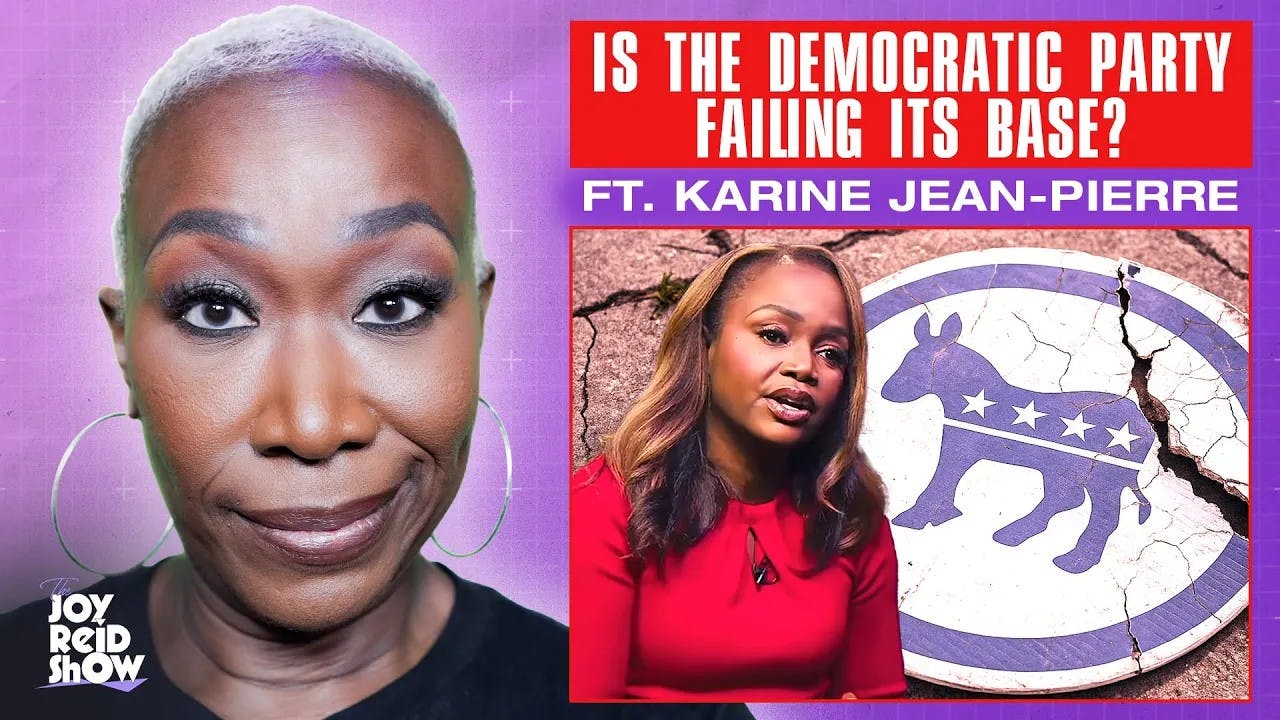
The Joy Reid Show
Is the Democratic Party Failing Its Base? ft. Karine Jean-Pierre | The Joy Reid Show
01:06:56
Loading summary
Transcript327 lines
- [00:01]
A
This episode is brought to you by Lifelock. It's cybersecurity awareness month. And Lifelock has tips to protect your identity. Use strong passwords, set up multi factor authentication, report phishing, and update the software on your devices. And for comprehensive identity protection, let Lifelock alert you to suspicious uses of your personal information. Lifelock also fixes identity theft, guaranteed or your money back. Stay smart, safe and protected with a 30 day free trial@lifelock.com Podcast terms apply. Okay. Hello and welcome to this special episode of the Joy Read Show. Thank you to all who are listening on YouTube, Spotify and Substack. Now, be sure to hit those like and subscribe buttons to help us with the algorithm. The algorithm loves the like and subscribe. And also do hit share to share your TJRS experience with a friend. Also, big ups to our team, TJRS members, and our faithful readers. We appreciate you. Now, when Karine Jean Pierre stepped behind the podium on May 26, 2021, she became the first black woman to deliver a White House press briefing in 30 years, since Judy Smith, the inspiration for scandals. Olivia Pope did the job back during the Bush 1 administration. Soon, Karine would succeed her friend Jen Psaki in the main job, becoming the first black woman and the first openly queer woman, the first openly queer person at all to speak for the White House. Fast forward more than four years, and Karine Jean Pierre, lifelong Democrat, is leaving her party behind and charting a new path. In her new book, A Look Inside a Broken White House, Outside the Party Lines, she lays out the neglect of key communities by party operatives and, yes, the betrayals that brought her to this decision. And Karine Jean Pierre joins me now. Hey, girl. Hey.
- [02:08]
B
Hey, girl.
- [02:09]
A
Welcome to the basement.
- [02:10]
B
I'm so happy to be here. It's been a while.
- [02:12]
A
It's been a while. It has been a while.
- [02:13]
B
I love this.
- [02:14]
A
Thank you.
- [02:14]
B
I love this. Congratulations.
- [02:16]
A
Thank you very much. Well, you know, I really do want to talk about your book. I promise you I'm going to get to it, but we got to talk about this hair. Can you flip it for us? Can you do it for.
- [02:24]
B
Okay, let's see. Let's see. I'm new to this.
- [02:25]
A
Okay.
- [02:26]
B
I'm new to this. Okay. Here we go.
- [02:27]
A
Throw it. Yes. Yes, ma'. Am. And that's all you, ma'. Am. Don't listen. Let me tell y' all something about this. This is not a wig. This is her.
- [02:35]
B
I saw you were like.
- [02:36]
A
And I asked. I asked.
- [02:38]
B
You were like, wait.
- [02:39]
A
I was like, is that a wig? No.
- [02:41]
B
It's not. And there's nothing wrong. There's nothing wrong.
- [02:44]
A
And if it was a wig, it.
- [02:45]
B
Would be fine, too. If it was a wig, it would be love.
- [02:47]
A
You could do whatever you want.
- [02:48]
B
Right? Right.
- [02:49]
A
Whatever. Black women are versatile.
- [02:51]
B
Versatile, but versatile. Short, long, wavy, curly. Whatever you want, however we do it.
- [02:55]
A
But you know what? All the time I've known you, and I have known you for a long time. A long time now.
- [03:00]
B
Very iteration.
- [03:01]
A
Every iteration. I've seen every hairstyle, but they've all been curly. Yeah. All your hairstyles, right. They've been short, curly, long curly. I've never seen you with straight hair.
- [03:10]
B
That's true.
- [03:10]
A
Tell us what is behind this metamorphosis, darling.
- [03:13]
B
So wait a minute. So, you know, one of the reasons I started growing it because I had it short for a long time when it was because of COVID and I was like, all right. Well, all right, let's. We're going to do what we're going to do. And I think for me, in this moment, I wanted to do something different. New book coming out. You know, I'm not. No longer in the White House.
- [03:35]
A
You free and single.
- [03:37]
B
I am free and single.
- [03:38]
A
Ready to mingle?
- [03:38]
B
I'm ready to mingle. Oh, gosh. Don't get me in trouble.
- [03:41]
A
Oh, wait. Maybe not ready to mingle. Don't be trying to mingle with Careez up here. Leave her alone. No, no, no. Let her live.
- [03:47]
B
It's all good. And so I just wanted something different, you know? And I was like, oh, I'm going on this book tour. New book. And I told my stylist, let's do something new. And she was like, you know, I've never seen your hair straight. Let's do it. Let's do it.
- [04:00]
A
Were you sorry when they blew it out how much length there was? Yeah. You weren't ready for the length?
- [04:04]
B
I was not ready for it. I'm still getting used to it.
- [04:07]
A
It's cute. Thank you. It's cute. How does your daughter feel about it?
- [04:10]
B
Does she, like, a little anxious about it? I think it took me, like, three, four to be like, okay. I think I'm okay.
- [04:15]
A
Yeah. She.
- [04:16]
B
She started off saying, mama, I really like it. Yeah, keep it. And then probably yesterday, she was like, I need you to go back to curly.
- [04:24]
A
She wants her original mama.
- [04:26]
B
Yeah, she wants her original mama. But it's. You know, we'll see how long it lasts. I'm trying to enjoy it.
- [04:30]
A
Yes. You know, she gets a vote, but not the vote.
- [04:33]
B
Yeah, right. She Definitely gets a vote. For sure. For sure. But not the vote.
- [04:36]
A
Yeah, not the vote. And so before we get into the book, I mean, what have you. I mean, obviously working on this book has been what you've been up to. But, you know, the election, the last election was traumatic, I think, for every black woman in America. Really, for most American. Well, the most Americans with. Since. How have you been since the election?
- [04:54]
B
You know, and it's a combination. It's the election and the administration. Right. Leaving the administration. The results of the election for me was very interesting, and I think I talk about. I do talk about this in the book. So the next day I had to go to the podium, so I really couldn't reflect and have a deep, kind of that deep visceral effect that you would have when you lose, when something is lost so deeply and badly for you, for the country and the future of the people that you. You love. And so my friends were like, I can't get out of bed. I can't get out of bed. And they were, you know, they were like, is this real? Is this real? And I had to tell some of my friends, I can't talk to you about this right now because I have to go to the podium and talk about this and take questions. So. So I kind of had to shut it all down and couldn't have that. That reaction. And then we went into full, okay, we are ending the Biden Harris administration. We have a legacy that we need to make sure we push forward. And we had things to do. And so when I was leaving the administration, in my mind, I was thinking to myself, okay, how am I gonna manage? Because I've been on a. On like a 10 for four years plus.
- [06:05]
A
Yeah.
- [06:06]
B
How. And two and a half years in the job, and am I gonna have the jitters? Am I gonna miss the White House? Am I gonna miss this? Am I gonna miss that? And January 21st came around and I woke up and I was like, oh, okay, I think I'm okay. And I, like, I went to the basement of my condo and started cleaning out the storage room. And what was nice is no one could reach me. Like, I was trying to go back to normal, picking up my daughter from school, spending time with her, dropping her off, spending time with my family. So there was this little slice of my life that I was able to protect and own and just be like, okay, I'm just gonna try. Try to jump back in and have normal, normalcy. Not wake up at 4:30 in the morning.
- [06:52]
A
Yeah.
- [06:52]
B
Not have to be on the ready at all times. So that's been my transition out. And, and so it's been, it's been interesting. And then obviously there's so much more after that. But that's kind of been my thought process.
- [07:05]
A
And it's interesting because you do write in the book, and this is the book. The book is fabulous. It's called Independent. We're going to talk about it. It was a good read. Very interesting read, very revelatory. But you do talk about the fact that when you came in, when you started on the podium, this was around the time that you then had to almost immediately start talking about some really devastating shootings. The one at the supermarket.
- [07:25]
B
Buffalo.
- [07:26]
A
The buffalo. And then also.
- [07:28]
B
Yeah, yeah. And it was a black community of all kinds of people. A grandmother, a mom. I mean, it was, it was, it was a devastating moment. And obviously it was connected to hatred. And that was my first briefing, was talking about that. And then weeks later, 17 days later, 16 days later, what have you, was Uvalde. And that was really also very personal because at the time, these kids were the same age as my kid.
- [07:57]
A
Yeah.
- [07:58]
B
And so this was what was going on in the country. And this is what you have to talk about. And people want comfort, right. They want to hear from the administration, they want to hear from the president. And Joe Biden was very much a comforter and someone that you could look to, to his administration to hear like comfort. And that's one thing that I think we were able to do, to talk about people who were left behind, people who were othered and we lifted up from that podium, which I was lucky to be able to do. A lot of it is because of this president, be able to talk about it in a real way, even though there was all of this nastiness and hatred and violence that was going out on the. Out there in people's communities.
- [08:41]
A
Did you have the sense at that time, just yourself as a voter, as a. As an American, that we were done with Trump, that that was it, that when Biden beat him, you're like, we're done.
- [08:49]
B
I mean, look, the first term was horrendous. Yeah, right.
- [08:53]
A
Million dead from COVID Right, Covid.
- [08:56]
B
The economy, children from their parents, splitting children from their families that we had. The Biden Harris administration had to try to reunite, which was incredibly difficult to do. But we started that process and it was. You would never think that people would say to themselves, first of all, we're going to vote for that guy again. Because it was so great the first time.
- [09:18]
A
Right.
- [09:19]
B
And also, let's not forget, millions of people stayed home. Millions of people who did not, who voted for Joe Biden and the Biden Harris ticket in 2020 stayed home in 2024. So there was this, like, disillusionment, this disconnect that occurred that you saw during, during this past year, certainly, and that is part of what I'm writing about in the book. But it was, it was surprising. But. And like, we're so politically connected and stuck in our partisanship in this moment. We're in this bizarre political time where people are so wrapped into their views and ideology. And so when you have someone like him come in and just be bombastic and espousing Hate Project 2025 and, you know, pushing that out there, you know, it's, it's. You can see why it happened. You can see why it happened. Let's not forget the Biden administration. We had the most diverse, you know, administration in modern politics. We had Kamala Harris, who was a woman of color, black woman, who was the vice president. There were all also these changes that were happening that I think people, people were like, especially white men. They were uncomfortable.
- [10:40]
A
And it was interesting because Biden, I.
- [10:41]
B
Talk about that in the book a little bit.
- [10:42]
A
Yeah. In some ways he was like, it was obviously a continuation of Obama because this an old white man, older white man who was, who played second fiddle to the first black president for two terms. He had been willing to do that. And then he comes in and yeah, he governs pretty progressively and I think really angered people with that. But I want to get more into some of the meat of this book. But one of the things that I do have to ask you, because you talk about Biden and his compassion, I want to talk about how you even got to know Biden at all. But do you feel like. And I asked Kamala Harris about this as well, the compassion broke down when it came to Gaza and that the. You just personally, because you got protested a lot over this as well. Whenever you would go places. When you now look back on it, do you think it was that, like, breakdown in compassion that Joe Biden couldn't be that way for Gaza? Do you think that Costco, the election.
- [11:33]
B
And so here's the thing. I was in the bubble, right. And when you're in the bubble, it looks very different than when people, when people are outside of the bubble. Right. And it was obviously what we have seen in the Middle east. And thank goodness there's a agreement on the table, a ceasefire, and let's hope that we get to peace because we need it. And you can't look at what's happening right now and not be heartbroken and devastated. And I would say that that's not how we wanted things to be. And I could honestly say this is not how the devastation, the starvation, the killing of people, especially in Gaza, of the Palestine, that is not what the outcome that we wanted in the time. And this is the thing about being White House press secretary. You are speaking. I am not Karine Jean Pierre's White House press secretary. I am Joe Biden and the administration's White House press secretary. And at the time, what I was doing was speaking for the president. And you know, and sometimes it's tough topics that you have to speak to. We started off talking about a killing in a community, in a black community and a. And at a school a week or two later. And there are tough times that you have to deal with. Look, I didn't make the policy.
- [12:54]
A
I was just going to say people should know the press secretary doesn't make the policy.
- [12:58]
B
I don't make the policy.
- [12:59]
A
I'm telling them what it is.
- [13:00]
B
And what I will do is let Joe Biden and his foreign policy team speak to that, speak to their policy and why they, why they made the decisions that they made.
- [13:11]
A
Did he ever explain it to you behind the scenes, why he had this sort of hard heart toward that issue?
- [13:15]
B
You know, we never talked about it in depth, but certainly we had conversations about here's where the coverage is going, here's what the press is asking. And again, he's going to write his book and I want him, I want to give him the space to speak to that only he can speak to, and his foreign policy team, obviously, who were very much involved in making these decisions. But it is heartbreaking. And I would definitely say this is not how we wanted it to go.
- [13:43]
A
Yeah.
- [13:44]
B
This is just now how we wanted it to go. And it is one of those things that I think about for sure.
- [13:50]
A
Yeah. So let's talk about this. You have, you worked for. And you talk about this a bit in the book. You go through your history. A lot of us knew you were at some point with moveon.org but you worked for four presidential campaigns, two of them being Barack Obama, one of them being John Edwards, and then the fourth one, I'm going to now lose his name.
- [14:10]
B
Martin Malley.
- [14:11]
A
Martin. Martin. He worked on four campaigns and of course, obviously, two of them very successful, obviously, the Obama campaign. You met President Joe Biden because of the Obama connection. How'd you meet him. How did you get to know him? Because you ended up being very close to Joe Biden.
- [14:27]
B
Yeah, well, I developed a closeness to him and an affection to him because of my. Even my first interaction with him, which was in 2009, and it was during the Jon Corzine reelection campaign. And I was on the. I was part of the White House political office. As you know, Patrick Gaspard ran that office. And we did this very differently than the way it looked in the Biden Harris administration. I got to. Even though I was part of Obama's team, I got to travel with the president. I was the Northeast, the Vice president, then Vice President Joe Biden, and I was the Northeast political director, and he traveled in the Northeast a lot. Let's not forget, there was Alan Spector, who switched over from Republican to Democrat. There was Ted Kennedy, who had passed away. There was his own Senate seat in Delaware. So he was just in my. In my region a lot. And so I got to travel with him. And my first experience with him was in 2009. We were on Air Force Two. I was, like, minding my business, sitting there, and he comes and he sits next to me, and I don't even know if he remembers this. This is obviously, I remember it. And he was just like a regular person. I had worked for many politicians at that point, even in my young, kind of. My young time in that administration. And he was just asking about myself and talking about Delaware, his love for Delaware, and. And his kind of political career. And I remember looking at him, I'm like, you could be doing anything right now. Why are you sitting with me for 45 minutes and having this conversation? And it really. It lasted with me for a long time. And look fast forward to three years ago, when I became White House press secretary. Picking a White House press secretary for a president is a very personal decision. And it is something that you do because you believe that person represents you and speaks for you, and you are entrusting them with that. With that job. And so the fact that he chose me for me really meant a lot. I don't think I would have ever been White House press secretary for anybody else.
- [16:36]
A
And he did it. I mean, Joe Biden really did seem interested in making history. Obviously, Ketanji Brown Jackson, putting her on the court, putting you the first LGBTQ woman, the first black. Second black woman. Because we do have a previous black woman.
- [16:48]
B
No, I was the. I was the first. First black woman as White House.
- [16:51]
A
As White House secretary. Right, exactly. Judy Smith was. She was com.
- [16:56]
B
Direct she was a deputy press secretary for H.W.
- [17:00]
A
Bush. So you became the first. So you're a first in multiple. Multiple ways. Right. And I think that was something he was obviously interested in doing. Did you all have that conversation about what this means?
- [17:10]
B
No.
- [17:11]
A
Or did you just have it in your own mind, like, oh, my God, this is happening.
- [17:13]
B
We never have that conversation that he. When. Because there was obviously, Jen Psaki had decided to. To step down, and she had a young family that she really wanted to take care of and wanted to obviously continue her career outside of the. Of the administration. And so there was always, like, you know, who was going to be next? Who was going to be next? And I was a principal deputy, so there was always some. A thought that I would be next, but you never know until, you know.
- [17:38]
A
Right.
- [17:38]
B
And so he. The day that I got announced, he called me into his office. He's like, all right, kiddo, I want you to be my press secretary, and would you take the job? And I was like, yes, sir, I would. And then he left. Like, he had to go. I think he had to go to the Situation Room. Like, he had another meeting. He's like, okay, great. And then we had a couple of other words and that we discussed and talked about, and that was it. Yeah, I mean, that's the story. And he just expected me to step in and do the job.
- [18:11]
A
Well, I mean, he had already. And you write about him getting you to go in and be a principal in the vice president's office as well. At first, he wanted you to be on his campaign, and you were like, well, if you're the nominee, I'm there. And then, of course, when he was a nominee, he was like, let's go. And he was like, well, I guess I gotta say yes.
- [18:30]
B
I mean, yeah, the trajectory from 2019 to, like, 2022 was pretty interesting. Like, I didn't want to do a campaign that very, very, very early on as, you know, primary presidential campaign could go forever. And I had a little. My kid was really young at that time, and so I didn't want to do that. And I made a promise, hey, if you become the nominee, I will drop everything. Because we were in an existential threat with Donald Trump in his first. First. First time in the.
- [18:59]
A
In.
- [19:00]
B
In the Oval Office. And so I wanted to do my part. And so when he became the nominee, I jumped in. And then that's what I. Basically, the story goes from there till today.
- [19:10]
A
So, you know, reading the two books, Vice President Harris book and your book, they are interesting in that they kind of work in tandem in some of the same way. I'm gonna blow all y' all minds. That sinners and the Color Purple and the Great Gatsby all take place in the same time period. And so those things could all have been happening at the same time in three different states. Very interesting. But your two books tell a lot of the same stories, and some of those stories are about betrayal. Let me read just a little bit. From read you to you. It says the Democrats blue tent that once felt big enough to hold all the pieces of a black queer, immigrant woman like me had collapsed. And such uncertainties have brought me to a question of my own. Do I remain with a party that no longer fights for the ideals that matter most to me and to the communities to which I belong? Now that I can speak fully from the heart, I have an answer. After being a party insider for 20 years, I. I now believe I can fight harder for my country from outside the Democratic Party than from within it. From here on, I am politically independent.
- [20:09]
B
I felt that like even hearing you read back my words, because even writing it, I felt that. And it was not easy to come to. And there are a couple of things I do want to talk about the betrayal, but I also want to talk about me as Karine Jean Pierre and who I am. Because again, I'm speaking for myself after years, either moveon.org or the White House for other people. And this is the first time in years that I get to reflect as a private citizen and think about how I want to move forward in this world. Not very different in a sense of like my moral compass, but in a different way, because I'm speaking for myself. And I think if you know me, you know that I have a bit of an independent streak, an independent spirit. And what. And the reason why I say this, and I think many people who are first can understand this. If you are first of something, there's something about you that moves around in this world in your space differently than everybody else. You know, there's something that you see differently than anybody else. And my mom would say when she. When people would ask her, did you know that she would be able to do this? Did you know what was she like as a kid? And my mom would always say cream was always very different. She did things her own way. If she couldn't figure out something, she would stay up all night and try to figure out. She is not like any other of my children. And obviously every kid is individual, but she was different. And so I think And I've always been proud of all of the things that I represent. Yeah, I came out. I've been queer and part of the LGBTQ community my whole entire life. Once I knew, I was like, okay. And it didn't matter if it wasn't accepted in communities or other communities or in even rooms.
- [21:49]
A
And just to be clear, as a Haitian American woman, as a Caribbean American, that's not easy. That's not easy.
- [21:53]
B
And so the fact that I have always been able to carry all of me unapologetically, I don't think. If you think about this book and what I wrote, you shouldn't be surprised.
- [22:04]
A
Right? You shouldn't be. And honestly, I'm not. Because I know when the little excerpt came out, you know, I got texts. Everybody knows that we're friends. And they're like, wait a minute. And I was like, no, I actually get it. I totally. Because if you do know, you. You know, that you really are an independent person. It has to be interesting being. And that's such a great point, being a person that has a very singular mind, but having to mainly speak for other people. How hard was that?
- [22:27]
B
I mean, it could be tough, right? Because again, I was talking about White House press secretary moments ago. You're not speaking.
- [22:34]
A
It's not your own voice. Right.
- [22:35]
B
It's not your own voice, but.
- [22:37]
A
Well, it's your voice, but it has to be for their policy.
- [22:39]
B
For their policy. Exactly. You're 100% correct. But this is why even when I tell young people who are interested in politics, and I always say to them, you do have to try to find a politician that you are closely aligned with, they're not going to be perfect closely aligned with, because you have to breathe that and live the platform that they're presenting. And you have to be okay with it, right. To some degree, even if it's not perfect. And you're gonna work so hard, and you're gonna be so passionate about the work, and you're gonna be disappointed. So be mindful of that. And sometimes you're gonna be like, great, I'm so glad to be part of this. Right. And so another thing I would say about Joe Biden and my relationship with him, you know, in 2012, when he was. When he was on Meet the Press and said basically, love is love and supported same sex marriage before Obama had.
- [23:36]
A
Before President Obama had authorized him too.
- [23:39]
B
Exactly. That was also the person that I knew.
- [23:42]
A
Right.
- [23:43]
B
And so there's this connection. And it mattered because even when I was starting off as a young politician, There were Democrats, the mainstream Democrats were not for same sex.
- [23:54]
A
Including President Obama.
- [23:55]
B
Including President Obama. And when he was a senator.
- [23:56]
A
Right.
- [23:57]
B
But that was the way it was back then. We had not moved. And so we have to understand, like, there's always been this process in civil rights movement, in the human rights movement, that sometimes things are behind. Right. And they haven't moved to where you are. So fast forward to the lines that you just read from my book. So now I'm a private citizen and I represent all of these communities. I am part of all these communities. They're under attack. They're literally under attack. Project 2025, folks, if you really have. You've heard just this is what, like.
- [24:34]
A
Literally everything that you are is part.
- [24:36]
B
Of the exact enemies list for Donald Trump.
- [24:39]
A
They are after LGBTQ people, They're after black people, they're after women. They're after successful women who are educated. They don't want us to be educated. They want us to be in any.
- [24:48]
B
Any space. Anything. Right. So we're out of the administration and here we are. And my. Everything that I am.
- [24:56]
A
And the immigrant community, principally.
- [24:58]
B
Exactly. Or being under attack.
- [24:59]
A
Yeah.
- [25:00]
B
And I'm looking at what's happening with the Democratic Party, and I'm thinking to myself, no, this is not okay. We knew this was coming. Project again, Project 2025. We knew this was coming, folks. We knew this was coming. And you're rubber stamping appointees.
- [25:19]
A
Yeah.
- [25:20]
B
This shouldn't be business as usual right now. The Democratic Party should be the opposition party. That's how they should behave and reimagine how we can be as a country. And there's the whole lgbtq, like you said, under attack. And I'm just thinking, this is not the moment to be about politics. This is not the moment to be about testing what line is best, poll testing. This is the moment to stand for something and to care about these communities that are under attack. This is about humanity. And that bothered me. That bothered me tremendously. And I was going around the country, it was very early on, after January 20th, and people were coming up to me and some people were crying and they say, what do we do? Where's the leadership of the party? Why am I not hearing from them? And so that's the kind of the ethos of the book. It really, truly is what is happening? How do we move forward? The political system is broken. The two party system is not working for people. Millions of people feel left out, and we need a functioning two party system in order to have a democracy. If you're a poli sci major, you understand that. And right now that is not currently happening. So what I wanted to do is use my voice, if you will, to start a conversation.
- [26:48]
A
Yeah.
- [26:49]
B
And being independent is part of starting that conversation. Being independent is saying, you know what, maybe I have to work from outside of the two party system.
- [26:56]
A
Well, I mean you can communicate outside of just talking to Democrats because you're not a Democrat.
- [27:02]
B
That's. And that is like the, the thought process. Obviously in the book I use the three weeks of, you know, Biden's debate and deciding to pass the baton to then Vice President Harris as a form of like one of the issues that I see with the Democratic Party.
- [27:18]
A
Let's talk about that. Because that is exactly where I was going to go. That's where the betrayal comes to.
- [27:23]
B
Go back to that.
- [27:24]
A
Let's set that up. Because what I feel like the trigger for you finally coming to the conclusion that you start with and then you start to really tease it out is that you had a sense, and I don't want to speak for you, that the Democratic Party writ large, betrayed Joe Biden. Is that accurate?
- [27:41]
B
I believe the Democratic Party writ large in that moment of three weeks, betrayed Joe Biden.
- [27:47]
A
So the debate happens.
- [27:48]
B
Yeah, the debate happens. And look this, I'm speaking for myself, the President, President Joe Biden is going to speak for himself. I am literally not speaking for him right now.
- [27:56]
A
This is.
- [27:57]
B
And I think one thing that you have to. I hope people understand during that period of time, during that period of time, it was really only me dealing with how to respond to the debate. Joe Biden, obviously the president had to respond. It was like me, the two of us. And so I lived it and I want people to understand incredibly personally, me and my team lived it incredibly personally on what was happening and the attacks that were occurring in that moment and.
- [28:33]
A
The attacks on you and saying that you were covering up, that he was.
- [28:35]
B
Covering up and all of it. Right. And I was feeling it very personally. So of course I'm going to have a reaction that is going to be different than many.
- [28:44]
A
Well, you also knew what happened leading up to it. So there had been a lot of travel. Give us some sort of TikTok of what happened before that debate.
- [28:50]
B
Yeah, the book I talk about, you know, look, it was awful debate. No one is denying that it was a bad debate. It was awful. He has owned up to it and we never denied that there was a lot going on leading up to the debate. His son was going through trial, as you know, Joe Biden, he loves his child, his children. He is a family man. I could not imagine going through that. And he was going. His son was going through that because his dad was president.
- [29:19]
A
That's right.
- [29:19]
B
We gotta be really honest about that. We're doing extensive travel, and I don't want to put it too much on the travel, because presidents travel. We have. They have to manage multiple things.
- [29:29]
A
You know what they don't do, though? They don't debate. It's not a part of the job.
- [29:32]
B
And. Correct. They don't debate. That is not part of the job. And we had this debate that was much earlier than it should have been. I believe I talk about that in the book. It would normally for. For a president that is an incumbent. It would have normally been in the.
- [29:44]
A
Fall, and it was with somebody who had now been an adjudicated felon, which you do write about in the book. You were questioning why are we debating this guy at all?
- [29:52]
B
Yeah.
- [29:52]
A
Why.
- [29:53]
B
Why are we putting. I mean, he wouldn't have passed vet to come into the White House.
- [29:56]
A
Right.
- [29:57]
B
That's the. I mean, that's true. And so we're putting this on him after travel, after what is happening. I mean, devastatingly, him watching what's happening to his son. And I think all of that played into the debate, obviously. This is my perception. He's gonna talk about his perception on his reality, obviously, of what happened. And so all of that plays into, I think, the debate and what happened and him getting sick and. And having a hoarse voice and not performing to his best.
- [30:31]
A
Yeah. And then it immediate. I mean, after the debate happens, you know, we were on. I was on msnbc. It's now msnow. Msnow, as they call it. They changed it to Ms. Now. I just say it's Miz now. That's what it looks like to me when I see it written out. It's like Ms. Now to me. So I'm like, oh, I don't know if they've officially gone to Ms. Now, but that's what they're changing the name to. It's their company. They can do whatever they want. But we were on set, on the big set, and two people came on. Vice President Kamala Harris and Governor Gavin Newsom. And they were right or not. And you talk about it in the book. They were. But other than them, it seemed that everyone else said, oh, he's got to drop out. Yeah, talk about that.
- [31:06]
B
And so. And. And so this is where I do the. Do what was happening on the other side. Right. This is when in this moment. Oh, what was happening on this? They were quiet when it came to Joe Biden, they were pretty quiet. And even Donald Trump was quiet. I mean, they had their convention happening, the picking of the vice president. I mean, that. All those things. But they didn't talk about Joe Biden. Why not? Because they were looking at what we were doing, and they were like, whoa, we'll let them destroy themselves. And we're focused on what we're doing right here. There was actually a moment, I talk about this in the book. I think Donald Trump was pretty quiet about Joe Biden, but there was a moment where he was like, on the golf course and somebody captured him on an iPhone and they asked him and he was like, woof.
- [31:53]
A
They're mean that they don't work. Yeah, yeah. They don't love it.
- [31:56]
B
They're like, wow. You know, he doesn't feel sympathy for. I mean, right. And he was. You kind of could see the, like.
- [32:02]
A
Those people are rough. What's wrong with them? Yeah, they were like.
- [32:05]
B
He was like, wow. You know?
- [32:06]
A
Yeah.
- [32:07]
B
Look what they're doing over there. And my thinking is here, the Robins are behind. They're ride or die on their guy.
- [32:15]
A
Felony E. Jean Carroll adjudicated sexual abuse of her $500 million owed to the state of New York for defrauding the people of New York. His family can't even have charities in the state of New York because the son that ran the charity, I think they were robbing money from a charity for what? Was it for veterans or for the children of veterans? I mean, so these people are fraudsters. And, you know, you look at Carolyn Levitt, who has your old job, Donald Trump could literally shoot a person on Fifth Avenue and cheat, say there's absolutely nothing wrong with that. And she represents each and every one of them in the party. Nothing that he does is ever wrong.
- [32:52]
B
And so that.
- [32:53]
A
And he says a lot of crazy shit.
- [32:56]
B
And so that was part of it, right? I'm like, okay, why are we doing this? And here I'm going to be objective for a second. Joe Biden objectively had a successful first term. He wasn't a criminal. You know, he wasn't. He wasn't being investigated for anything credible. And he was trying to do the right thing. And this is what we do. For someone who has served 50 plus years. And I. It really. It really bothered me because I was looking at this party, I'm like, are y' all crazy? And not only that. So then he decides, okay, he makes his decision.
- [33:34]
A
But wait, before you get there, I know you're gonna get to the decision, but you, you called out a couple people by name. Yeah. I mean, George Clooney, clearly it rubbed you the wrong way that he wrote this op ed Nancy Pelosi you talk about. I mean, and it's, it's interesting. They were vocal. They were like the, they were the.
- [33:49]
B
Most vocal, like famous, well known people who were the most vocal.
- [33:53]
A
Yeah. And so inside of the White House, how was that landing?
- [33:57]
B
It was a, you know, it was a kick to the gut, if you will. Right. And I also have to take us back to post midterm elections. The winter spring of 2023.
- [34:10]
A
Right.
- [34:11]
B
Coming out of 2022, that's when the decision had to be made for Joe Biden to do a reelection. Right. If he wanted to do that. And at the time, no one said boo. Right. There was somebody who ran against him in the primary, but no one, you know, people like Nancy Pence.
- [34:27]
A
There was no demand that he drop out.
- [34:29]
B
People like Nancy Pelosi even said he has the right to run for reelection. And the reason why, again, popular objectively did a really good job as president and had a successful, objectively a successful midterms because it was supposed to be a red wave and it wasn't. And a lot of the reasons why is because the things that we were able to be to get done with the president and Democrats and on the Hill, they had talking points in their own districts in their own states to talk about.
- [35:01]
A
Right. But you know, he did, when President Biden ran at first, he did say he was going to be a transitional president. People expected that to mean a one term president. Were there conversations after that 2022 midterm that as you said, was a huge success, really for Democrats. It was historic. The least, you know, the least losses, I think historically in the modern era.
- [35:18]
B
And nobody was expecting it. And that was not, that was not what the people thought the outcome, the prediction would be.
- [35:24]
A
Oh yeah. I mean people were guaranteeing, even on ms, I think Steve Kornacki was guaranteeing a giant railway. Did that cause him to say, you know what, I'm going to run? Was there ever a conversation saying I'm going to run.
- [35:33]
B
So this is the part where he's going to have to answer to that. I was not part of any conversation. The politics of it, as, you know, because of the Hatch act and all of those things. I just was not included in that. And so I can't really speak to that. But yes, you are correct. Even in his Oval Address. When he decided to turn over the baton, he talked about being a transitional person and hence Vice President Kamala Harris and wanting to give the baton to her. And so any internal things, I really do believe he has to speak to that. But then we get to the moment he decides that he's not going to. He's going to drop out of the race, stay as president, drop out of the race, and endorse then Vice President Harris. And even there were a brief moment, but moment where there was talk of an open priority.
- [36:31]
A
One of my lines that I really do, it stayed with me that you said that this idea that Kamala Harris would have to compete with a bunch of governors and Congress people for a slot that she rightly owns, and that you found that incredibly offensive.
- [36:45]
B
As a black woman, I found it incredibly offensive. She was more than ready. Is more than ready to be President of the United States. The fact that it has to be, oh, wait, you know what? We have, like, whatever amount of days left, let's do a primary. She technically was on the ticket for the 2024 primary with Joe Biden, the 14 million people who voted for Joe Biden in the primary. She was on that ticket, and she's currently the vice president. And the president, who's the leader of the Democratic Party at the time, also picked her to, you know, endorsed her. And so I think there was some. There was some audacity there that was just, I think, really cruel and. And hurt us. I think even though that was actually a short period of time, I think she handled it very well. From the moment she stepped up tremendously, from the moment he said, okay, I'm handing over the baton to the moment that she got the. The nomination fully, and then the convention and then the rest. The rest is its own story. Well, as her story, and I think that I was, as a. Just as a person, I know I say as a black woman, but as a person, I was like, wait, what's going on here? Why are we. Why are we doing this? We have an existential threat on the other side again, Project 2025. Why are we doing this? And so this is again, the part of the book where I'm like, okay, the system isn't working. It's just not working. It's broken.
- [38:18]
A
You're questioning the people. I mean, you're essentially saying that these are people who were. Maybe they had their own ambitions to be president. They had their own sort of backroom deals they were doing, and those were more important than winning the election against Trump.
- [38:28]
B
And that's what it felt like. That's what it looked like. And these are leaders of the Democratic Party. Right. And that's what it felt like to me. And of course we got through that. We got past that. But I do think behavior like that, actions like that have some sort of lingering effect.
- [38:44]
A
Yeah.
- [38:44]
B
And I'm not saying that is the main reason why millions of people stayed home in 2024. I think that has to be like we need to, I think Democrats need to look under the hood, kick some tires and really do this for self reflection as to why are people disillusioned.
- [38:59]
A
Well, I mean, the arrogance of saying, as you said, you had 107 days. You know, you know, Kamala Harris's book is called 107 Days. Like that's how much time they had by the time President Biden stepped aside and said, we're going to pick Vice President Harris as his successor. He wanted her as his successor. And as you said, there's this whole, she talks about it a bit in her book as well, that there's this whole fight about, well, maybe we have time to do another little open convention in a primary. No time.
- [39:23]
B
There's no time.
- [39:23]
A
But it also feels to me from my read of your book that you, number one, you say, you say straight out you didn't believe she could win.
- [39:31]
B
And it has nothing to do. I want to be very clear. It had nothing to do with her qualifications and her as a person. I think she did a fantastic job in the 107 days that she had. It has nothing to do with that is everything to do being a black woman, someone in the skin and in this, obviously part of, in this gender and walking through life. And I was skeptical. I was skeptical. I was skeptical when Obama and I worked for him. I was skeptical the first time with Obama because I'm like, okay, are we ready here?
- [40:01]
A
Yeah.
- [40:02]
B
And it was nice to be surprised, right? And this time around, I was like, ooh, you know, we had 20, 2016. They couldn't do a woman. I walk, you know, I'm a black woman. I experience being at this podium as White House press secretary for two and a half years. You know, you feel it a little bit more. Right. And so I definitely was like, I don't think so. I want to be, I want to be pleased. I want to be wrong. I want to be wrong. And you know, she had that debate with Donald Trump. She, I mean, she, the people were excited, thousands of people. And I was like, okay, all right. I was, you know, I was, I Had the bug. And I was like, okay, I'm excited. This is okay. We're gonna do this. We're gonna do this. And then it didn't happen.
- [40:48]
A
Yeah.
- [40:49]
B
And that's when I was like, yep.
- [40:50]
A
Mm.
- [40:51]
B
That's what I thought.
- [40:52]
A
America's still Americaning. You don't say this outright in the book, but it is implied. Do you believe that what Democrats should have done after that bad debate was put their head down, do what Republicans would do, and run Joe Biden through the tape?
- [41:07]
B
I think that's what we should have done. You think he would've won at that part? I don't know.
- [41:10]
A
Okay.
- [41:11]
B
I don't know. And I. And I get asked that question a lot. And I know there's polling and all of that, and I think I've gotten into this space, especially when I was White House press secret, not answering hypotheticals. I mean, I genuinely. And I don't think anyone knows. Right.
- [41:26]
A
You do believe they should have stuck. I think.
- [41:28]
B
Well, here's what I think. I think he shouldn't have been treated that way. I don't think he should have been embarrassed in public so that he would step down. I think that's what they were trying to do. And I don't. You know, I wasn't. I wasn't in the room for conversations he was having with people on this particular issue. And I don't know if they were talking to him quietly. I don't know. Like all of that needs to be. But the way it was, he was embarrassed. And I just. And I. You know, this is my compassion. And it broke my heart.
- [42:07]
A
Yeah.
- [42:07]
B
And as someone. Again, I think people need to understand. I literally breathed this every single day until he decided not to run. I lived it in a very personal way, and it broke my heart to see someone being treated that way. And, look, maybe they could have found another way if they really believed that he should have stepped down. And I don't know if that occurred, but that way. That way did not make sense to me.
- [42:37]
A
Yeah.
- [42:38]
B
And it just. I think this is something where it harms us. It harms us. And this is. You know, this is kind of, again, going back to the system that doesn't feel like. People feel like millions of people don't feel like it's working for them. They feel disillusioned. They feel like their voices are not being heard. And I think the two parties right now are not. Obviously, one of them is completely lost.
- [43:05]
A
One party that's very loyal. I mean, there's one thing you can say about the Republicans, they're very loyal to their leader. And the other party, as you're describing it, is very tending to be disloyal and fractured and doesn't stand behind their leader. But what you seem to be saying is they should have just. If you're gonna lose, lose loyal and lose as a group and as a team and not throw your guy under.
- [43:25]
B
The bus, I think there's something to that. Or do it differently. Yeah, that's, you know, like do it, do it differently. And that we have. I mean that's one thing that I do care, that I did care about, that I believed in the party is the compassion part of it. But it's not just stuck there. Right. It is very much in this moment today. And what I'm seeing and I'm like, you guys, what is going on? You can't be throwing communities under the bus here. This is not, this is not what we should be doing. And that bothered me and troubled me. And it's like I do believe in this time an opposition party has an opportunity to make a difference. And you have very powerful people who are, I feel, behaving as if they're powerless.
- [44:09]
A
Yeah.
- [44:10]
B
And American people are seeing this.
- [44:12]
A
Yeah. Well, it's interesting because as you say that you have a party that really mounted no defense of trans people during the campaign. Even though they were like one of the biggest targets for the Trump campaign. They launched no real robust defense of dei, diversity, equity and inclusion. They all sort of retreated from it. And all the so called Democrats in Hollywood are like, yeah, bye bye dei. All these media companies like, yeah, we don't need them blacks anyway. You're seeing like really no defense. What I was sort of shocked by, there wasn't a robust defense of immigrants. I've heard it from like Mamdani, the one that they don't want to even endorse even though he's a Democratic nominee. There's just this weird thing where.
- [44:49]
B
And he is the Democratic part of me, like people decide decided for him to be the Democrat and they're like.
- [44:54]
A
You know, we like Columbus Hill.
- [44:55]
B
It's like it's a weird and it's. And it's odd because he went through an election. Yeah. And the part the people who participated and did their civic duty made that decision for him to be the. So, you know, so that's, you know what I mean? So it plays out, I mean even.
- [45:12]
A
Today I would even say, and to go back to the Palestine thing, your base is saying we, we, we are, we want Palestinians to live. And they're saying, we don't care. We love a pac. Like, there's just a resistance to even listening to the people who are asking, begging you to be with them. But I want to talk a little bit more about some of the reasons that you, as you said, living in your black woman's skin. You said, ooh, this party may not be for me. You tell a story in here that is. It is teful, as we say. I made up a word.
- [45:41]
B
Oh, no, I think we should get coin at people.
- [45:44]
A
Because you talk about the fact that when you get this podium, not everyone around you in the White House supported you and affirmed you and uplifted you. There was one moment where there was a trip to Israel. This is after the October 7 attacks by Hamas, and President Biden was going to travel to the region. And you, as press secretary, it would normally be your job to go. And a person in the White House said, you shouldn't go. You're a mom and you should stay home, and this isn't your lane. You should stay home. And you were like, no, I'm going to write an email, a memo, and say, I'm going. And then this person really, Karen Ed.
- [46:18]
B
You say more so this particular person. And I'm not gonna go beyond, like, you know, I think I know who it is. It was devastating. When you have someone who's older than you, who's a woman, and you are in this difficult, tough job, you know, you hope you have allies, and you hope you have people who can have your back and support you and help show you the robes. And this is somebody who actually started off supporting me. And I think the moment that I started to speak for myself and stand up, it became a problem. And a lot of stories were written around this relationship, around this, and you. And I think many. I feel like I'm hoping that what I sang rings true for many people who've been in my situation. And it's tough. It's hard because that person has power, more power than you do. And so it's like, how do you fight for yourself and manage through that? And everything is happening in a very public way, and I can't really defend myself outside in the press. I have to hold it all in because that's just the way I am, and I didn't want to fight it in the press. Reporters would call me all the time, like, do you want to respond to the story about you? Do you want to respond to what's being said about you? And I would just Ignore it. And so there. So it was. It was a very isolating place to be. But I didn't stop. I continued to push and push and push. And I will say this, I ended up being the last person standing.
- [47:57]
A
I will just say, just from a journalistic point of view, reading your book and also again, Vice President Kamala Harris book, the one name that stands out, that feels like it is the person that you are speaking about is Anita Dunn. Do you wanna.
- [48:11]
B
Not gonna confirm or deny? I'm gonna keep doing what I say.
- [48:14]
A
Because in terms of powerful women who are white in that world, there'd be Jenna Malley Dillon, Anita Dunn. Like, these are the names we cut. If we're. If you're an insider, if you're in politics, these are the names that are thrown around. And so that is. That is my.
- [48:27]
B
I will say I had a. I've known Jenna Mali Dillon for a very long time. She's the reason I got into the Obama campaign. And she's been a friend and someone that I have known for a long time.
- [48:36]
A
Checking that bo.
- [48:38]
B
I don't want to leave that out there because I've actually known her for a long time.
- [48:42]
A
Let's talk about how with all of that happening and being press secretary and being the first black woman to hold that space and being in a sometimes very hostile room, you talk about the media and the performative nature of some of what they do in that press briefing room.
- [49:01]
B
Hold on, hold on. Wait, wait, wait, wait a second.
- [49:05]
A
Eight times or at least once in.
- [49:07]
B
Regards to president specifically. Hold on a second.
- [49:10]
A
You should be able to answer by this point.
- [49:12]
B
Wait, no, no, no, no, no, no. Wait a minute. Ed, please, a little respect here, please. So every year around the president's physical examination, he sees a neurologist. That's three times, right? So I am telling you that he has seen a neurologist three times while he has been in this presidency. That's what I'm saying. I am telling you that he has seen them three times. That is what I'm sharing with you, right? So every time he has a physical, he has had to see a neurologist. So that is answering that question. No, it is. It is. You're asking. I also said to you, and I also said to. To you, for security reasons, we cannot share names. We cannot share names. We have to. We have to.
- [50:04]
A
Others he would have met with. We can share names in regards to. If someone came here.
- [50:08]
B
We cannot share. We cannot share names of specialists broadly from a dermatologist to a neurologist. We cannot share names. There are security reasons. We have to. We have to protect. I understand that. I hear you right there.
- [50:25]
A
For anyone to see head.
- [50:26]
B
I hear you. I cannot from here confirm any of that because we have to keep their privacy.
- [50:31]
A
How did you deal with it? And as you say, without triggering the angry black woman meme.
- [50:38]
B
It's hard, right? I think when you are a first, there is stereotypes that you understand live out there in worlds that you don't belong in and.
- [50:50]
A
Or that people think you don't belong in.
- [50:52]
B
People think that you don't belong in. And so I was very mindful. I was very mindful. The beauty about. And I do want to say this, being White House press secretary for me was a privilege and an honor to have been able to speak for the President of the United States as this immigrant, queer, black girl who was told you I would never amount to anything. And to have been able to have that opportunity was just amazing to me and be trusted with that opportunity. I honor. Honor it with every fiber of my being. So I do want to say that it was one of the hardest experiences, but one of also the best experiences that I've ever had in my career thus far. And so, and so, you know, you have to. You think about everything, every question that comes at you. How am I going to answer this? You know, how am I going to. Because I have to. I have to. Like, there are all these communities that I represent, but I'm speaking for the president. Like, the things in those milliseconds before answering a question that goes through your mind is vast and insane.
- [52:03]
A
Yeah.
- [52:04]
B
And, you know, I didn't have the privilege of the people before me to just speak or do or behave or be combat or be combative.
- [52:12]
A
You tell a story about Steve Doocy from Fox saying about gentle Malley Dylan, that when he.
- [52:18]
B
No, Jen Psaki.
- [52:19]
A
I'm sorry.
- [52:19]
B
Jen Psaki.
- [52:20]
A
Sorry. That when he would go, you know, back and forth with Jen Psaki, it's like she felt like she was there for a fight or it felt like a fight.
- [52:27]
B
And these were his words.
- [52:28]
A
That's his words. That's his words.
- [52:29]
B
Not my words. His words.
- [52:30]
A
And then when it was with you, it felt like you were really genuinely trying to answer his question. And you write that you didn't feel like you could fight him in that same way.
- [52:36]
B
I mean, look, I fought him in my way. I pushed back in my way. And there were many times where, you know, our people, our folks in the black community would be like, oh, I saw it in your face.
- [52:47]
A
We would see the side eye, and we would be like. She said, she's speaking to us through.
- [52:51]
B
The TV you held at you. Oh, we saw it. So it was actually really funny because there was, like, this unknown language that was being spoken, and only the black.
- [53:00]
A
Ladies understood, because, look, I promise you, we understood. We understood.
- [53:06]
B
And people would come up to me, strangers, and would say, oh, we saw that look. Yeah, we saw that look.
- [53:11]
A
We knew.
- [53:11]
B
And so I was really aware of it. And you have to remember, I'm also representing someone else.
- [53:18]
A
Yeah. You also talk about having to deal with all that while your mom. You're taking care of your mom who had cancer, and that had to be really hard. Your mom is, by the way, one of the sweetest and wonderful.
- [53:29]
B
Wonderful. I know she loves her joy. She's like. She'd say, how's my joy? How's my joy? And I'm like, joy is fine, Mama. And so she. So about a year in the last year and a half, my mom got colon cancer, was diagnosed with colon cancer. And it was devastating to all of us in our family because she's always been the beaming light. She's always been the backbone. She is the backbone of our family. And when that happened, thank goodness my brother and my sister were able to step in and really do most of the work. And there was a moment, and I talk about this where I told her, hey, I think I'm going to quit. Because I. You're like, you're sick. I need to be here with you. And she looked at me and she's like, if you quit, I will be really angry with you. Basically, she's like, do not quit. I mean, that's kind of. If you think about it, that's the mentality that I was in because my mom was. Was really sick and. And still is having. You know, she's. She's. She's also one of the most amazing people that I know. The strongest. I've never seen someone who wants to live, who wants to be there for their grandchildren and their children, because I don't know if I would have given up, I think. But she is. I get encouragement from her because I watch her. I'm like, wow. Like, she fights to live. And it's one of the most beautiful things that I've ever seen. And my mom has gone through a lot just for us to be. For me to be sitting next to you, to her joy. My joy. And so I had to live, and I did it quietly. My team didn't know the president and a Couple of other people knew. I kept it even the people that I was the closest with in my. My friendship zone, my colleagues, no one knew. And I felt truly. And I wrote, I wrote this article about this, specifically the specific time in Vanity Fair, and it's an op ed, and it came out the day after I left because I didn't feel like I can talk about it while I was White House press secretary. I think women understand that. Women of color, black women, understand that sometimes you have to, in order to protect yourself, you can't share anything.
- [55:41]
A
Oh, no. This system would really literally be like, oh, I'm just going to see my mom. And you were always like, what a good daughter.
- [55:46]
B
Yeah.
- [55:46]
A
And no one really knew why. Nobody knew. All right, let's do a quick little rapid fire questions for the end. But I want to. Before I get to the rapid fire questions, you are now an independent. You are free of party. You are free of obligations to any White House or any political organization. What are you planning on doing with this new independence?
- [56:02]
B
So hopefully the book starts a conversation. And that was my hope. My hope is I know people are gonna disagree with me. I know people are gonna have their own opinion. That's totally fine. I mean, I was, you know, I've spent years. People not being happy with me. So that's okay. That's not, that's not a problem.
- [56:19]
A
You gotta be okay. Jackie Reed has said to me, you gotta be okay with people being mad at you.
- [56:23]
B
Yeah. And no one, and no one is living rent free in my mind. And I think about. Actually today I was thinking about formation. Beyonce's formation.
- [56:32]
A
Yes. You know, you.
- [56:33]
B
That. That's starting all this conversation.
- [56:35]
A
Come on. That's it. And that's just facts. That's just facts.
- [56:38]
B
And that's just facts. You know, and, and, and it's like, okay, well, yeah, if I'm starting all that conversation, we need to be having a conversation about this. Millions of people feel like they have been left out of the process. Young people, more, more and more young people are becoming independent and because they feel like they're not being represented. Yeah, that's a problem.
- [57:02]
A
Yeah, absolutely. Okay. These are my rapid fire ending questions. Question number one. Will the United States ever have a woman president that is elected and doesn't simply accede to the seat because the president either dies or retires?
- [57:15]
B
I think if we, if that happens, we have to work really hard to make that happen. Look, right now the power needs to go into the hands of the people. And I think right now we can Reimagine what this all looks like. I think when we are in these moments, and I think history has shown us this, yes, you feel powerless, and, yes, it's very fearful. And yes, there's this authoritarian regime happening, but this is it. This is when you come together. This is it. This is when we all come together. Because if they come from one, they're going to come for all. And I want to be hopeful. That's why I don't want the answer to be no. I actually want to be hopeful. My daughter, when VP Harris was running for president. This is really funny. I told my daughter. I was like, oh, my gosh, VP Harris is going to be running for president now. She's at the top of the ticket. My daughter was really upset, and she was upset because she was like, mama, I wanted to be the first woman president. Not because of anything. She loves VP Harris. Loves her, but she envisioned and saw herself as being the first.
- [58:26]
A
Yeah.
- [58:26]
B
And so for her generation and other. Other. Other peers of hers, I want them to be hopeful in that. But if we do not do something right now, then I think it's less likely.
- [58:39]
A
Look at this little black girl who has met multiple United States presidents and vice presidents. Look at her life.
- [58:46]
B
She's living a pretty rarefied life. A little. My mom is always like, wow, I wish I was her. She's had a really great life.
- [58:52]
A
That's an amazing black woman.
- [58:52]
B
I want to be clear. She loves Vice President Kamala Harris, and they actually have a really lovely relationship.
- [58:58]
A
But they all know her.
- [58:59]
B
But she was like, I want to be.
- [59:01]
A
I was like. And she may be. It may take that long. It may take that long. It may take that long. Do you think we'll have free and fair elections next year?
- [59:07]
B
I'm concerned about that in 2026. I'm concerned because we have clearly someone who is trying to cheat.
- [59:13]
A
Yeah.
- [59:14]
B
And I'm concerned about 2028.
- [59:16]
A
Yeah.
- [59:16]
B
Do you believe we should be concerned about it?
- [59:18]
A
Do you believe. And particularly, you know, your family having come, you know, you know, the places that you've. That your family are related to, from Haiti, from Martini, but really more Haiti. Do you feel that the United States is an authoritarian country now?
- [59:31]
B
I think we are in a authoritarian regime. When you have someone who's politically going after. Using their power to go after political opponents, I think we're here, and that's scary to me.
- [59:46]
A
What is your message to immigrants who are terrified right now?
- [59:52]
B
I mean, my heart breaks, and this is why I want the Democratic Party to become an opposition party, and to do better. Because people are disappearing, Americans even are disappearing because there's military in cities being told to behave in a way that is going after American citizens, even because it's just writ large, is what's happening to brown and black people.
- [60:20]
A
The stuff that's happening in Port au Prince right now is happening in the United States, in Chicago. Look, in Portland.
- [60:27]
B
Look, my parents grew up in a dictatorship. They came here because they believed in what they can in the freedoms that this country offered.
- [60:36]
A
Yeah.
- [60:37]
B
And now what you're watching right now is scary. And democracy is hanging by a thread. And in order to have a democracy, you have to work at it every single day. You know, President Joe Biden would say this, and I'm paraphrasing, and it always. Anytime he said it in his speech, I would be like, oof. He said, this is an experiment. This country, our democracy. It's an experiment. It's a young, young democracy. And if we are not careful, we will lose it.
- [61:11]
A
And we. We have not been careful. All right, a couple fun questions. We just lost the great d', Angelo, one of the best of all time. We were playing a little bit of music before we started. Do you have a favorite d' Angelo song?
- [61:21]
B
I have so many. I have so many. Brown Sugar was like one of those songs that you just saw yourself in. That song, Voodoo, the album was.
- [61:30]
A
He was 100% singing about us.
- [61:31]
B
He was 100% singing about Us.
- [61:34]
A
Personally.
- [61:34]
B
Personally. Just us.
- [61:36]
A
Yeah, just us.
- [61:37]
B
I mean, he. When you think about Neo soul, the first person that you think about is d'.
- [61:41]
A
Angelo. Yeah. Did you know before he passed? Because I didn't. That he wrote the Jason's lyric song.
- [61:47]
B
I did know that.
- [61:48]
A
I did. I'm like, wait a minute. That's one of my favorite songs ever.
- [61:50]
B
The man was brilliant. And may he rest in peace.
- [61:53]
A
Rest in peace, indeed. What brings you hope and what brings you joy? I love to end with this question. Oh, I didn't ask my other question. Best musical ever. There's a right answer.
- [62:02]
B
Oh, my God. I'm such a. I'm such a Broadway.
- [62:05]
A
I know.
- [62:06]
B
Insane person. Can I do current? Maybe.
- [62:10]
A
Can I do current? You can do whatever you like. There's still a right answer. But, yes, you can pick any musical you like. Best musical of all time.
- [62:17]
B
Seeing Audra McDonald in Gypsy was phenomenal. Buena Vista Social Club. You couldn't sit in your seat. I have to say Hamilton or my daughter will kill me. Wicked. I mean, it is the beauty about. To me Broadway. And we have to support the arts because the arts are under attack. And it's important to have that because it is a form of freedom of expression. And if you look at history, the arts played a really big part in resistance, and we have to continue to support that. And you look at what's around and you can find yourself and experience having these different experiences. And the brilliance. The brilliance of acting and performing and singing and dancing, and it brings my heart joy. And so that's. I mean, it's hard to pick.
- [63:12]
A
That was a very long way of saying the Wiz.
- [63:14]
B
The Wiz. Because that's the right answer.
- [63:17]
A
I love. I love it.
- [63:18]
B
Well, you know, ragtime is back.
- [63:20]
A
And. Oh, it's really.
- [63:21]
B
Yeah.
- [63:21]
A
Oh, I have to go see that.
- [63:22]
B
And I want to see how they reimagined it into this moment.
- [63:26]
A
That is very interesting. Okay, I might go see that. Okay, we'll forgive you for that. One last question. What gives you and what gives you joy?
- [63:34]
B
My daughter's generation, and watching her and her peers and how they see life and how they see their world and how they're very expressive and they're very aware of this political moment. Sometimes I'm like, whoa, okay.
- [63:47]
A
Yeah.
- [63:47]
B
It's like, let's all calm down a little bit. And they're very expressive, and I. That gives me hope. Like, literally, sometimes I just listen and watch them and I'm like, oh, this is so interesting.
- [63:59]
A
Yeah.
- [64:01]
B
Joy. What brings me joy? Us, right? We have to remember that joy is a part of resistance. And we have to have some joy. We have to enjoy life. We have to figure out, how do we be in a community and Kiki and laugh and that. When I see that, you know, when I see that, I'm like, okay, yeah. When I see us and people that I care about and love enjoying and joy and Kiki, even though we're under attack, that's important because that is also a form of resistance. Because what they're trying to do, when you're asking me if we are under an authoritarian regime, what they're trying to do is put fear into us. The chaos leads to fear, and obviously the policies leads to fear. And fear is a form of silencing us. We're too fearful to speak back and to fight back. We cannot allow that to happen, because they win. And so part of joy is also that resistance.
- [65:03]
A
Amen. And you know what's giving me joy right now? You, Karine Jean Pierre and that hair, that little Beyonce hair. Give us a flip. Give us one more flip.
- [65:12]
B
Yes, Queen. Starting all that conversion. Fabulous.
- [65:15]
A
Karine Jean Pierre. The book is called Independent. Here it is. I'm gonna put up on the screen as well. It is a read. You're gonna want to read this book.
- [65:21]
B
Thank you. Thank you, sis.
- [65:22]
A
Thank you, sis.
- [65:22]
B
I appreciate that.
- [65:23]
A
It's so good to see you. I appreciate it.
- [65:24]
B
Thank you. Come back anytime. I come back and hang out with y'.
- [65:27]
A
All. Yes, please do.
- [65:29]
B
This afternoon.
- [65:30]
A
And we're doing it all day. All right. Thank you very much. Bye. Thank you. Karine Jean Pierre. You can pick up Independent a Looking inside a broken white house outside the party lines at the Joy Reid show store. Just go to shop.joyanread.com or wherever you love to buy books. We'll also include a link to the book in the show description so you can make sure to pick it up now. Also, be sure again to hit like subscribe and share this episode to support our new media enterprise. Thank y' all for tuning in and see you on the next the Joy Reacho. Getting back to the basics Grassroot level Let me dig a little deeper with the shovel plenty can't tell the force from the trees that I'm hard to detect Like a black hole in a dog Injustice anywhere it's a threat to justice everywhere Let me make this clear I got a bone to pick and I'll never fear the threat of poverty they don't want to talk about it they rap the party so I'm a real talk about it for sure.