← The Joy Reid Show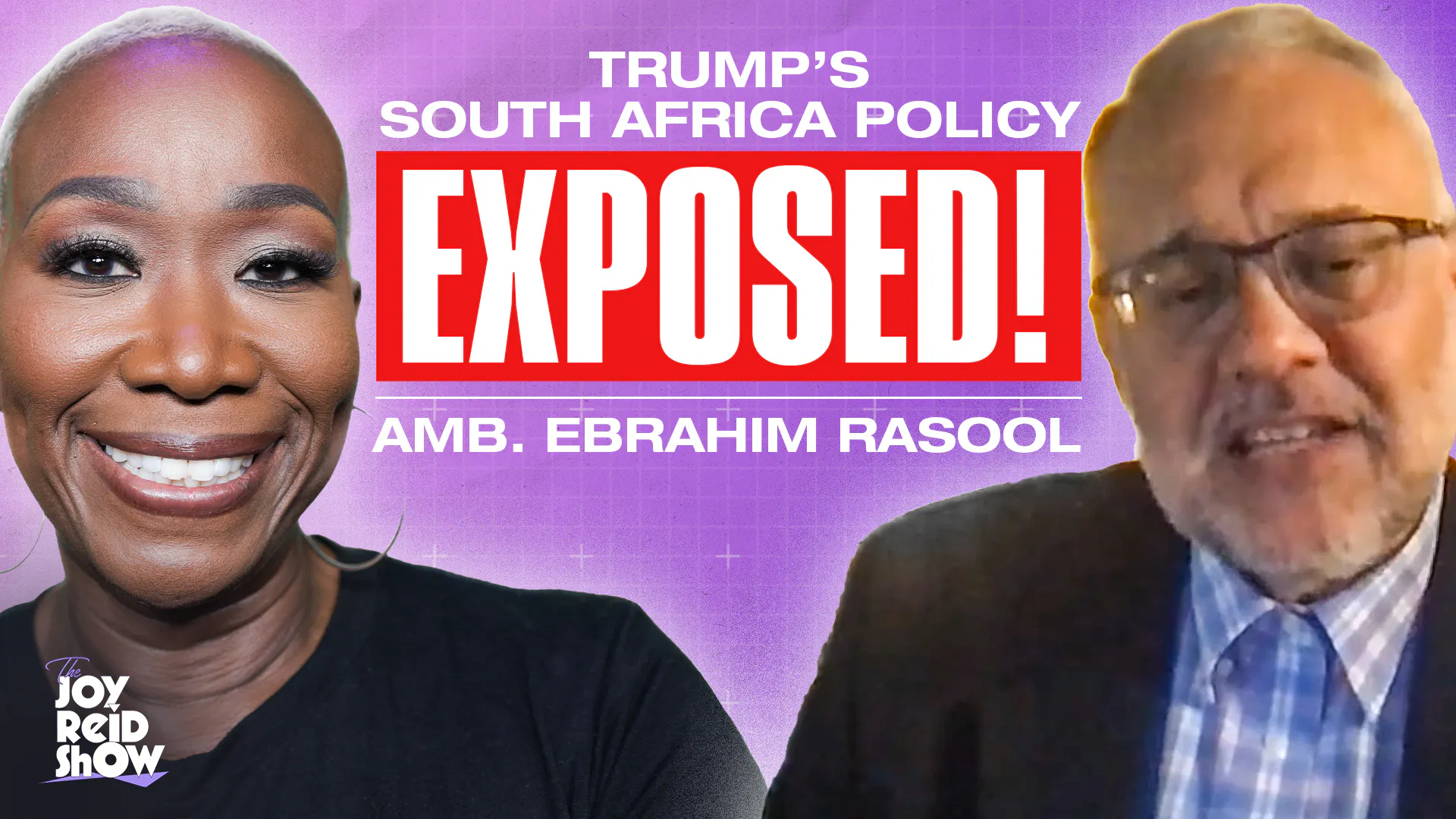
The Joy Reid Show
The Truth Behind Trump's South Africa Policy Ft. Ambassador Ebrahim Rasool | The Joy Reid Show
01:00:25
Loading summary
Transcript43 lines
- [00:00]
Joy Reid
Your burger is served.
- [00:02]
Marco Rubio
And this is our finest Pepsi Zero Sugar. Its sweet profile perfectly balances the savory notes of your burger.
- [00:09]
Ibrahim Rasool
That is one perfect combination.
- [00:13]
Unnamed Speaker
Burgers deserve Pepsi.
- [00:15]
Marco Rubio
The second one is that he's creating a false moral equivalent by saying, if you, South Africa, charge Israel with genocide in the International Court of Justice, I am charging you with genocide of white Afrikaners. If you, South Africa, charge Israel with occupying Palestinian lands in the west bank and Gaza, then I am charging you with confiscating white lands. That is not only a false moral equivalent, it is fundamentally founded on an absolute blue lie.
- [00:56]
Unnamed Speaker
Okay.
- [01:04]
Joy Reid
Welcome to the Joy Reid Show. We've got a big interview that I suspect the regime will not enjoy. Please, someone do a wellness check on Marco Rubio. Thank you. Well, when former South African ambassador to the US Ibrahim Rasool was expelled from the US In March of this year and declared Persona non grata by the Trump regime, it was a linchpin moment in a bilateral relationship that had already been battered by Trump's executive order a month earlier that cut off all foreign aid to South Africa and called for white South African descendants of Dutch colonizers, known as Afrikaners, to be treated as refugees from a supposed white genocide and allowed to quickly relocate to the United States, while the administration bans pretty much every other actual refugee from war torn and impoverished places from coming to the US and while violently removing many others. The February 7th. The February 7th order was entitled Addressing Egregious Actions of the Republic of South Africa. It focused on a 2024 South African law called Expropriation Act 13, which allows under certain circumstances for the return of land to indigenous South Africans. Now, I should note that no land has actually been expropriated under that law, but it has fed a right wing conspiracy theory popular on the American right, that South Africa is engaging in a white genocide, taking white South Africans and particularly Afrikaners farms and homes and then killing them. The Trump executive order reads, quote, in shocking disregard of its citizens rights, the Republic of South Africa recently enacted Expropriation Act 13 of 2024 to enable the government of South Africa to seize ethnic minority Afrikaner agricultural property without compensation. This act follows countless government policies designed to dismantle equal opportunity in employment, education and business, and hateful rhetoric and government actions fueling disproportionate violence against racially disfavored landowners. Wait, wait, wait, hold up. So Trump does favor equal opportunity, AKA diversity, equity and inclusion in education, business and employment, but only for white people in South Africa and per his other executive orders and policies for white people here in America. And sorry, how are white South Africans racially disfavored when, despite being 7% of the population, they own more than 70% of the land. And to be clear, they own all of that land because their forefathers came to South Africa, colonized it, and drove indigenous Africans off of their land, forcing them to become slaves and then tenant farmers living in shanty towns. And they did this for more than 300 years. But offer Connors of the disfavored group, you know what, let's keep reading from the executive order, shall we? And I quote, in addition, South Africa has taken aggressive positions towards the United States and its allies, including accusing Israel, not Hamas, of genocide in the International Court of Justice and reinvigorating its relations with Iran to develop commercial, military and nuclear arrangements. Okay, let's pause again because it is true that South Africa in December of last year filed a formal case to the International Court of Justice at the Hague charging Israel with violating the 1948 Convention on the Prevention and Punishment of the Crime of Genocide. And in February, South Africa accused Israel of engaging in apartheid for the treatment of Palestinians in the west bank who were being dispossessed of their land by religious extremist Jewish settlers, often with the Israeli Defense Forces looking the other way. There was a public trial at the International Court of Justice in early January at which both the South African led delegation that also included barristers from Ireland and an Israeli delegation made their cases. And there was a provisional ruling on January 26, six days after Donald Trump was sworn in as president again in which the International Court of Justice ordered Israel to take steps to prevent acts of genocide against Palestinians in Gaza and also calling on that country to enable the provision of basic services like food and fuel and humanitarian assistance, and to prevent and punish incitement to commit genocide. Now, I will note that according to Human Rights Watch, Israel is not complying with those binding ICJ orders and continues to deny Palestinians in Gaza access to fuel and food while continuing to bomb schools and hospitals and private homes. And more than 50,000 men, women and children have been killed, many with US supplied bombs. That is what South Africa objects to. But instead of addressing that, the Trump regime is. Sorry, I'm sorry, just checking my notes here. Punishing South Africa for taking a case against a third party nation that is not part of the United States to the international body that the United States helped to design to hear such cases and enforce international law and norms. Okay, got it. On Iran Last time I checked, the Trump regime is also talking to Iran about perhaps doing a nuclear deal to replace the one that Trump didn't like because the black president was behind it. But okay, okay, let's just keep reading from the executive order. Quote, the United States cannot support the government of South Africa's Commission of Rights violations in its country or its undermining United States foreign policy, which poses national security threats to our nation, our allies, our African partners, and our interests. Rights and violations, you say? Hmm. And our African partners, you say, Would that be the countries like South Sudan and Rwanda that are considering maybe taking money to allow the Trump regime to ship migrants to their prisons without trials? You know, the way El Salvador has those kind of African partners. Well, this past month, Trump made good on his promises to resettle white Afrikaners as just under 60 of them arrived on a US government plane at Dulles Airport, where they were greeted by Christopher Landau, the US Deputy Secretary of State, and a whole lot of balloons and personally welcomed to their new home. Left unanswered is who are these supposed refugees from white genocide? And if they are indeed farmers, did they abandon their farms to move here? In which case, how does moving them here save their farms from expropriation? Because if they're here, and stop me if you've heard this before, they can't also be on their farms in South Africa preserving their precious property. Now, we do know the identity of at least one of these supposed refugees. 46 year old Charles Kleinhaus, who per the BBC, left his family farm in Mpumalanga Province, South Africa, with its scenic beauty, wildlife and deep canyons for a budget hotel near an American highway. The BBC goes on to report that Mr. Kleinhaus left behind his five bedroom house, which he says he will now lose, along with his car, his, his dogs and even his mother. I had to leave a five bedroom house which I will lose now because I'm not gonna pay for it. Behind my car, behind my dog's, behind my mother, behind. It is not. I didn't come here for fun, but my children are safe. I mean, if you fear for your life and your family, who leaves their mother behind? Mr. Kleinhaus also had to delete some rather unsavory anti Semitic social media posts on his way to American mag. Martyrdom. According to the Guardian, Charles Kleinhaus posted on x Twitter in 2023 that quote, Jews are untrustworthy and a dangerous group. In another post last fall, he shared a right wing nationalist YouTube video that was later removed titled we'll shoot illegal immigrants, Poland's illegal Islamic immigrant solution with clapping emojis A number of Kleinhaus's posts also promote the conspiracy theory that white people in South Africa are persecuted. Kleinhaus confirmed to several media outlets, including the Bulwark and the New York Times, that he was indeed the owner of the account that contained the anti semitic and racist posts, though he insisted to the Times that he was not anti Semitic and claimed to have written a post in error while on medication. Okay, well what medication was that anyway? The Department of Homeland Security DHS said last month it will begin screening immigrant social media activity for antisemitism, using it as grounds for denominator denying immigration benefit requests. Kleinhaus, however, was recently granted refugee status by the US government along with 58 other white South Africans, and landed this week at Washington Dallas International Airport. Quote, we just packed up our bags and left for safety reasons, kleinhaus, who according to his LinkedIn profile owns a mining company in South Africa, told the New York Times on arrival, Afrikaners are a white ethnic minority that ruled South Africa during apartheid the implementing harsh policies of racial segregation in that country until the regime was officially abolished in 1994. Yeah, 1994. That's like yesterday. We here at the Joy Reid show also did have a look see at Mr. Kleinhaus's LinkedIn which does indeed say he's the co owner of Nespruit Mining Company. His LinkedIn also says he's the co owner of the Honey Badger Mining Company. So will he now be running those mining companies from the Budget Hotel and is he a farmer and a mine operator? Inquiring minds want to know. More importantly, it is worth asking why Donald Trump and his friends in right wing media are so keen on pushing this myth that there is a white genocide going on in South Africa or that white people in South Africa are subject to more violence than other groups. It's also worth asking, because this whole white genocide myth is not just a benign and annoying online meme, it has resulted in real and deadly consequences. The white genocide conspiracy theory has mostly lived online and on Fox, but it's clearly also seeped into mainstream conservative and Republican politics. The notion of a great replacement plot against white Americans, where a supposed Jewish conspiracy is plotting to import masses of brown people and especially Muslims into the US to displace white citizens and white voters has become standard Republican fare. And this year's Afrikaner airlift isn't even Trump's first go round. Back In August of 2018, first time President Trump tweeted that he was instructing his then Secretary of State Mike Pompeo, aka Marco Rubio 1.0 to look into the South Africa land and farm seizures and expropriations and the large scale killing of farmers. The Southern Poverty Law center called that Twitter announcement a huge victory for South Africa's far right, which has been lobbying foreign governments intensively over the past year. So far they have managed to find a few sympathetic legislators in Western countries. But Trump is the first head of state to make such overtures. I mean, of course there's barely a racist conspiracy theory that this guy won't believe. The SPLC called Trump's then embrace of the South African white genocide myth, quote unquote troubling because it signifies the mainstreaming of white nationalist narratives about white genocide, of which South Africa's farm murders are an essential component. And the great Daniel Dale over at CNN crunched those numbers on supposed white genocide even further and came to the following conclusion. Quote, the most recent South African official data shows that the country had 19,696 murders from April 2024 through December20, and that the victim in just 36 of these murders, 36, that's 0.2% was linked to farms or smaller agricultural holdings. Further, only seven of the 36 victims were farmers. South Africa has black farmers too. The official data is not broken down by race. The other 29 victims included farm employees who tend to be black. Data from groups representing South African farmers also shows that farm killings number in the dozens per year. The dozens a miniscule percentage of the country's total. Under the United nations definition, genocide requires acts such as murder and serious bodily or mental harm committed with intent to destroy in whole or in part, a national, ethnical, racial or religious group. As such, there is no evidence that South Africa, whose Agriculture minister is white, has made or overseen such an effort. And to reiterate, the whole notion of a white genocide in South Africa has its origins in white nationalist propaganda, which apparently works brilliantly on Donald Trump. The question is why Trump and why so many US Conservatives are so eager to get on the white genocide bandwagon? I mean, is it just the influence of all the billionaire white South Africans who hang around Trump and Republicans? I don't know. Elon Musk only started being a functional Republican last year, though Peter Thiel has been at it longer. What seems logical in finding the answer is that you have to look back at the rationale for why the former South African ambassador, Abraham Rasool was dismissed in the first place. Here is the way the Guardian reported.
- [14:44]
Marco Rubio
It.
- [14:46]
Joy Reid
The US is expelling South Africa's ambassador to Washington, with the Secretary of State Marco Rubio accusing the envoy of hating the US and Donald Trump. Rubio accused Ambassador Abraham Rasool of being a race baiting politician who hates America and hates potus, referring to Trump by his White House X account handle we have nothing to discuss with him and so he is considered Persona non grata. Neither Rubio nor the State Department gave an immediate explanation for the decision, however. Rubio linked to a Breitbart story about a talk Rasool had given on Friday as part of a South African think tanks webinar in which he spoke about actions taken by the Trump administration in the context of a US where white people would soon no longer be a majority. Rasool pointed to Elon Musk's outreach to far right figures in Europe, calling in a dog whistle in a global movement to try to rally people to see themselves as part of an embattled white community. He must leave by 21 March, a state department spokesperson said. The article noted that Rasool is a former anti apartheid campaigner who served time in prison for his activism and went on to become a politician in the African National Congress, the party of Nelson Mandela, the country's first post apartheid president and someone Rasool worked closely with, as did Cyril Ramaphosa. And while he isn't a black African, Rasool's forebearers were brought to South Africa by European colonizers as slaves and the anti apartheid movement was multiracial, much like our own civil rights movement and Black Lives Matter. And like those movements it was also deeply hated by the American and the European right in the US from Ronald Reagan on down back in the day, because it ultimately challenged the idea that the descendants of those who colonized indigenous people have an automatic and permanent entitlement to the land and the power they inherited and that people of color must never ever, ever challenge that power or those stolen landholdings. The idea is deeply frightening to the conservative Afrikaners who already lost their ability to rule South Africa and who are now raising the alarm that black Africans might also want to have some land back. In other words, there is a particular sensitivity on the right both in South Africa and here in the US to any person of color pointing out the existence or consequences of white supremacy anywhere Ambassador Rasool crossed that red line and the reaction from Trump world was immediate and predictable. And that same sensitivity among many on the far right and even some on what used to be the regular normie right to ever being confronted with not just the fact, but also the consequences of white supremacist history and policies contains an inherent fear that the victims of that past oppression will seek deadly payback any minute, stripping the descendants of their former colonizers and enslavers of their property, their superior social status and unlimited economic and educational opportunity, or maybe even their lives. The far right lives in constant fear that the people that they celebrate having conquered as a matter of supposedly superior Western civilization are just waiting for the chance to pay them back in kind. Maybe because that's what they would do. But the fact of the matter is that is not what most people are looking to do at all. It's certainly not the position of the South African government. And the South African President, Cyril Ramaphosa has said that explicitly and said it to Donald Trump. And since most of the world operates under a capitalist global financial model, there is zero incentive for struggling countries to defy entities like the World bank and risk being cut off by punishing minorities in their country, no matter what the history is. In the rare cases where formerly colonized people took violent revenge, they wound up isolated and punished by the global economic community. Think Zimbabwe, where Robert Mugabe led the expulsion of many of the former white settlers essentially at gunpoint and wound up completely isolated by the west with his country's economy destroyed. Or Haiti, which is still being punished for its successful violent revolution to oust Napoleon and the French enslavers. In fact, France made them pay reparations, just as American enslavers received reparations from the US government under good old Abe Lincoln. The fact of the matter is it is really hard for formerly colonized people and nations to get off the mat. And South Africa has actually been more conciliatory than one might have expected given the suffering the vast majority of its people were subjected to over three centuries. Whatever you think of the African National Congress, it has chosen to govern the country, including writing a new multiracial constitution and even a multicolored flag to showcase multiracial unity and declining to forcibly exile or punish the Afrikaners and other white South Africans who so brutalized the black, South Asian and so called colored majority. To this day, white South Africans enjoy the highest standard of living in South Africa and the lowest unemployment, the lowest murder rates. They live in a dramatically unequal economy with themselves sitting firmly on top of a largely impoverished pyramid because that's the way their forefathers designed it. Laws like the Expropriation Act 13 are frankly a mild attempt at using what amounts to the eminent domain rules that we have here in the US to siphon off public and underutilized and unutilized private lands to give black South Africans a fighting chance to have something, anything rather than nothing in their ancient home. And given that the richest man in South Africa is literally a white dude who came to the White House with South Africa with a South African president to try to woo Donald Trump with his golfing friends who are also white South Africans, it is kind of hard to square that with a supposed white genocide. And yet Trump, who was born on third base in America with both racial and money privilege to the point where Americans made him president despite having zero qualifications for the job, and who yet still sees himself as a victim, thinks they're the ones who need saving. Up next, my interview with Ambassador Ibrahim Rasool.
- [21:31]
Marco Rubio
The second one is that he's creating a false moral equivalent by saying, if you, South Africa, charge Israel with genocide in the International Court of Justice, I am charging you with genocide of white Afrikaners. If you, South Africa, charge Israel with occupying Palestinian lands in the west bank and Gaza, then I am charging you with confiscating white lands. That is not only a false moral equivalent, it is fundamentally founded on an absolute blue lie.
- [22:07]
Unnamed Speaker
This episode is brought to you by LifeLock. Between two factor authentication, strong passwords and a VPN, you try to be in control of how your info is protected, but many other places also have it and they might not be as careful. That's why LifeLock monitors hundreds of millions of data points a second for threats. If your identity is stolen, they'll fix it, guaranteed or your money back. Save up to 40% your first year. Visit lifelock.com podcast for 40% off terms.
- [22:35]
Joy Reid
Apply the number one selling product of its kind with over 20 years of research and innovation. Botox Cosmetic Adobotulinum Toxinae is a prescription medicine used to temporarily make moderate to severe frown lines, crow's feet and forehead lines look better in adults.
- [22:51]
Unnamed Speaker
Effects of Botox Cosmetic may spread hours to weeks after injection, causing serious symptoms. Alert your doctor right away as difficulty swallowing, speaking, breathing, eye problems or muscle weakness may be a sign of a life threatening condition. Patients with these conditions before injection are at highest risk. Don't receive Botox Cosmetic if you have a skin infection. Side effects may include allergic reactions, injection site pain, headache, eyebrow and eyelid drooping and eyelid swelling. Allergic reactions can include rash, welts, asthma, symptoms and dizziness. Tell your doctor about medical history, muscle or nerve conditions including ALS or Lou Gehrig's disease, Myasthenia gravis or Lambert Eaton Syndrome and medications including botulinum toxins, as these may increase the risk of serious side effects. For full safety information, visit botoxcosmetic.com or call 877-351-0300.
- [23:33]
Joy Reid
See for yourself@botoxcosmetic.com I had the opportunity to speak with the exiled former South African ambassador to the U.S. rasool. It was a wide ranging conversation. Take a listen. Joining me now is the former South African Ambassador to the United States, Abraham Rasool. Ambassador Rasool, thank you so much. I appreciate you being here. I want to start by asking you about your own history in fighting apartheid in South Africa. Talk about how you became involved in the anti apartheid struggle and your connection to the great Nelson Mandela.
- [24:12]
Marco Rubio
I want to say that growing up in apartheid South Africa was growing up in a bizarre, scientifically systematic system of discrimination. They determined where you lived, who you could marry, who you could dance with, which schools you could go to, what you studied, etc. Etc. And so you are almost pushed into this anti apartheid struggle not as a career choice, but. When I entered high school in 1976, I had my first taste of tear gas, my first feel of rubber bullets that were shot at us because that was the year the Soweto students gave our nation their courage again by rising up against apartheid. I continued by leading the student movement. By the 1980s, I was on the executive of the United Democratic Front, later the African National Congress and faith organizations that I led into political struggle. And we felt the harshness of the discrimination, the bigotry, the racism against us. But we also felt the harshness of the repression because within a matter of three, four years, I found myself in prison twice. One of that was a great meeting that I had where I met Nelson Mandela for the first time. And therefore I won't give up that experience with all its harshness. I also spent quite a bit of time being house arrested or banned, where I couldn't leave my house and chose rather to go into the underground so that I can continue the work that I would do. But I think my parents, for example, never the sadness never left them because the house we lived in comfortably in Cape Town, that area was declared white. And I came home from school one day and our furniture was on the pavement with the bulldozers waiting to throw down our house. And my father was scrambling to find alternative accommodation. Now that's the kind of sadness that gives you a glimpse into the heart of darkness, of supremacism and in our case, white Supremacism, it's that DNA that makes us repel when we see the early signs of supremacism, that makes us see the monster and that makes us confront it and call it out. So that's the harshness of growing up in apartheid South Africa.
- [26:45]
Joy Reid
And you know, there is a, I think, a sort of respectability politics version of that struggle that a lot of Americans are taught. They're taught that, you know, they're sort of Nelson Mandela and something similar is done to Dr. King, that there is no struggle. There are only beautiful words that somehow change the hearts of white people and that they suddenly come together and decide to live as one and that there is no struggle. But, you know, what do you say to Americans who don't and who dismiss, I should say the part of Mandela's legacy, the part of the anti apartheid struggle, that was a violent struggle.
- [27:20]
Marco Rubio
You know, Nelson Mandela for the whole 1950s led Gandhi type defiance campaigns, occupying white spaces, giving themselves up for arrest when the police confronted them, kneeling down and being arrested. But by when that was met with a Sharpville massacre in 1962, a peaceful protest where 69 people were shot in the back. That's when Nelson Mandela realized that the ANC would have to have a guerrilla army. And reluctantly, he needed to confront the apartheid army, which became a nuclear army with the help of Israel, became a nuclear army. He needed to confront it, but keeping guardrails of morality, not attacking civilians, not attacking people in their residential areas, but isolating apartheid installations, apartheid foot soldiers and so forth. And when the opportunity came to negotiate, he relaxed that part of the struggle and immediately sought out negotiations. This was the Nelson Mandela. He was an all of the above type of person. He was the absolute synthesis between a Martin Luther King and a Malcolm X, understanding that the one comes in when your oppressor closes certain doors. And we are sure reading the trajectory even of a Martin Luther King, that he was losing patience with what he was up against.
- [28:55]
Joy Reid
Indeed. And I think that's an important context to give people because after Nelson Mandela then becomes the president of South Africa, it's first black president, a lot of white South Africans left the country. They were not willing to live in a multiracial democracy. They preferred the old times. And there's some criticism of the current president of South Africa, Cyril Ramaphosa, that when he came to the White House, to Washington to try to talk to and negotiate with Donald Trump, who has imposed a 30% across the board tax on African countries and cut off all aid to South Africa over A law that allows for some reclamation of land from the white South Africans, who are 7% of the population but own 73% of the arable farmland. When he came to negotiate with Donald Trump, he brought three white men with him. They are businessman Johan Ruppert, who is the richest man in South Africa. And I think we can understand why South African golfers Retief Goosen and Ernie Ells. And one of the controversial things that came out of that is that one of the comments that was made, and I believe this was by Mr. Rupert, was quote, I feel we need the U.S. to push this thing through, meaning a trade deal. We've got a great ally. The US has always been an ally of South Africa for a very long time, even in the days of the war in Angola. You know, you guys helped us so very important for us to have your support and to get the change we need. I'm Sorry, that was Mr. Goosen who said that. And it seemed to some to be him having some nostalgia for the days when the United States was supporting the South African white government in that Angola conflict. And basically it seemed like nostalgia for the old days of apartheid. So what do you make of the criticism of the president bringing those particular men with him to meet with Donald Trump?
- [30:53]
Marco Rubio
You know, President Cyril Ramaphosa was right on the right hand side of Nelson Mandela through those 1990-1996 negotiations in which we negotiated our white supremacists out of power and into power sharing with us. And so Cyril Ramaphosa is used to having to be the adult in the room, talking down the virility and the aggression of white supremacy and assuaging them that there is a better life for them when they are at peace with their neighbors and their fellow black citizens. He did exactly the same thing in the White House against the belligerence, almost bullying of a Donald Trump. He retained his dignity, even though he didn't get much to say because he was spoken over, interrupted and so forth. But what he did was as the adult in the room, he accommodated his interlocutor Donald Trump, by bringing along three translators who could, as if he was going to speak to a Chinese president. He brought three translators who could translate black aspirations and black needs for trade and investment translated into white Africana English, who could then speak to white supremacist Donald Trump so that he could be understood. And so Retief Hursten was absolutely tone deaf. All three of those gentlemen may well have been in Angola on the border because it was compulsory conscription. So they may have been those adversaries. But certainly we had to risk that kind of tone deafness. The very awkward, patronizing gestures that were made, the language that was not always politically correct. We needed to tolerate that so that the adult in the room, Cyril Ramaphosa, could salvage a trade deal, a tariff deal, and maybe claw back some of the aid because we paid a high price during the first hundred days of President Trump.
- [33:14]
Joy Reid
Let's talk about some of this. Because the imposition of this executive order that ended aid to South Africa was built on this sly, this myth that there is white genocide, that white, particularly Afrikaners, who were the ruling party during apartheid, they were the ones who imposed apartheid when they were ruling South Africa. There is this conspiracy theory that they are now being subjected to a genocide and that their farms are being taken due to this 2024 law that was passed in South Africa that allows some confiscation and redistribution of land. Where in your mind did this conspiracy theory come from? And do you have a theory as to why Donald Trump is so eager to believe it, to the point where he was handed pieces of paper that had supposed images of the results of this genocide that included a picture of a Congolese protest that had grave sites at it that was not even in South Africa? Do you have a theory as to why he's so eager to believe it?
- [34:23]
Marco Rubio
I think firstly, one has to say that Donald Trump has a coterie of very powerful ex South Africans around him that I think he, he trusts or he works with. Secondly, he has opened the the White House to these Africana delegations who treat him as their uber president that they can complain to when they have tough times and they feed him with these kind of lies. Everything he showed he got from them. And therefore I think he needs. Why does he need to believe that there's a genocide against whites and that there's land confiscation of white farms? I have two theories. The one is that every supremacism needs a victim. Our white supremacists, Afrikaners, need a total power. And they needed to justify that on the basis that they were once the victims of British colonialism who put them in concentration camp, and therefore they need total power in order to prevent that ever happening again. You can hear echoes of that in Israel, but with Donald Trump, he is not satisfied simply that his story hasn't taken of Mexican rapists, of white people, etc. He needs that South African component to be the victims that he points to, to say we must never stand back in the world again. The Second one is that he's creating a false moral equivalent by saying, if you, South Africa, charge Israel with genocide in the International Court of Justice, I'm charging you with genocide of white Africanus. If you, South Africa, charge Israel with occupying Palestinian lands in the west bank and Gaza, then I am charging you with confiscating white lands. That is not only a false moral equivalent, it is fundamentally founded on an absolute blue lie.
- [36:33]
Joy Reid
Let's talk about these two things. I want to break them up. I want to start with talking about the part about the support that the South African delegation to the Hague, they implemented a case, an unprecedented and historic case against the state of Israel, against Israel, charging them with genocide against Palestinians that was cited in Donald Trump's executive order stripping aid from South Africa. The claim that by making that case that South Africa had somehow abrogated the national security of the United States states. What is the basis of South African support for the Palestinian people? Because I know it is something that goes back to Nelson Mandela's time.
- [37:21]
Marco Rubio
I must say, when I accompanied Nelson Mandela in 1990 on his African trip and we came to Cairo and I had the absolute honor of being a witness to the reunion between Nelson Mandela and Yasser Arafat, it was only then that I understood that this was a relationship forged in blood, sweat and tears between our two nations. And that's why Nelson Mandela could declare that our freedom isn't complete until the Palestinians are free. I think that therefore meant that when we saw the way Israel reacted to October 7, even more intense than since 1948 when they first stepped into that land, we waited and hoped that the world would be horrified by the disproportionate evil that was unleashed using the fig leaf of October 7, the evil that was unleashed. And when that didn't come, South Africa felt morally obliged. Not the government, not the African National Congress, but the majority of South Africans felt that this was something we needed to do everything in our power. Because what we saw was all the signs. We had massacres in South Africa. Compared to that, we saw a genocide. We saw our denial of statehood as black South Africans. We saw the destruction of even a two state solution in Palestine with facts on the ground. And we saw a United States and a Western world that was not just standing by and granting impunity to Israel, but was actually aiding and abetting with arms and finances, the very machinery that was, that was propelling that genocide. It was at that level. We thought it would be touch and go in the ICJ, but we were so surprised that 14 of the 15 judges gave an interim order that there is something afoot and we did not believe that we could stop the genocide. But what we felt good about was the fact that the campuses in the west, the streets in the west, turned against their capitals and said there may be a case of genocide. We will not be silent in terms of this.
- [39:53]
Ibrahim Rasool
I'm Livy Dunn, All American gymnast and Viori athlete. When you travel and train as much as I do, you find happiness where you are on the mat or on the sand. Movement and comfort are essential. That's why I live in performance. Joggers by Viori made from Dream Net fabric that's made of 89% recycled materials, effortlessly soft and made to move as much as I do. My happiness starts here in the softest joggers on the planet. Get 20 off your first purchase at Vuori.com Libby that's V U-O-R-I.com L I V-V-Y exclusions apply. Not only will you receive 20 off your first purchase, but enjoy free shipping on any US orders over 75 and free returns. Go to Vuori.com Libby and discover the full versatility of Vuori clothing Exclusions apply. Visit the website for full terms and conditions.
- [40:49]
Joy Reid
Hablas espano spiest du dzoi nosk.
- [40:52]
Unnamed Speaker
If you used Babbel, you would Babbel's conversation based techniques teaches you useful words and phrases to get you speaking quickly about the things you actually talk about in the real world. With lessons handcrafted by over 200 language experts and voiced by real native speakers, Babbel is like having a private tutor in your pocket. Start speaking with Babbel today. Get up to 55% off your Babbel subscription right now at babbel.com Spotify spelled B A B-B E L.com Spotify rules and restrictions may apply.
- [41:20]
Joy Reid
And let's talk now about the 59 white South African, South African Afrikaners, I should say specifically, who were brought to the United States on a government plane, greeted by a high government official at Dulles Airport in Washington and granted essentially instant citizenship in the United States. What do you on the South Africa side know about these 59 people? Because the claim is that they were rescued from a genocide.
- [41:50]
Marco Rubio
I think that you can even ask on this matter, white South Africans, whether those are the kind of people who qualify for the kind of refugee status, whether it was a supremacist gesture of rescuing whites under supposed attack in South Africa. And the supremacy thing comes to mind because you can't import white refugees into the United States and deport black and brown migrants, some with green cards, into a jail in South America. I mean, the imagery speaks for itself. And so no one here, it's a laughing matter. In South Africa. The only one who looked very serious was that State Department official standing there, believing that he's speaking to highly skilled white South Africans. And they may be the kind of people who help you when you come out of Costco with your trolley. They are the kind of people who will help you park your car when you're looking for a. For a. For a parking space. So. And so opportunism is a reason for them signing that. But I think there's a debate unfolding in South Africa that says, have we been too lax with the way in which we've allowed people to seek citizenship in the United States, but we let them retain the South African passport? They can come back and forth, even though they said the most heinous, if not treacherous, things against their country. Should we be able to do that? And refugees technically don't have assets, and therefore, should their assets not go to those who truly deserve, who were the victims of apartheid, who truly deserve the benefit of such assets? That's the kind of what I would call a blacklash that is beginning to emerge in South Africa, to be clear.
- [43:48]
Joy Reid
Because I was going to ask you that question. I mean, if, in fact, these 59 were farmers and they're claiming that they fled because they feared their farms would be taken away. Well, if they've left South Africa and if they've moved to the United States, are their farms, if they are indeed farm owners, now available to be distributed to black South Africans under that 2024 law?
- [44:12]
Marco Rubio
Unfortunately, I don't think that they are farmers. Most of them are not farmers who would come. And I think that that's part of the disappointment of the Trump administration. He thought he could. He could send them someone to the rural hinterlands and be productive in agriculture. He's going to find he's going to be very disappointed. But the fact is, some of them. Do white people generally, even the poorest, generally have an income and an asset base that is bigger than that of any black person? And I think that that's the debate that is being had in South Africa at this moment. The very question that you are asking.
- [44:57]
Joy Reid
And this is the question, because, you know, the other piece of having two golfers, two champion golfers come with President Ramaphosa, obviously, to try to charm Trump because he loves golf. There's been a piece that's been written about the history of these golf resorts in South Africa by a woman named Zanelle MJI. And she writes about the fact that inside of the walls of some of these great golf courses lies a world largely insulated from the realities of South Africa. A world that is overwhelmingly white, even though more than 80% of the South African population is black. And she writes about a place called Fourways and says that before it became a hub of luxury living, it was an agricultural region made up of farms and small holdings. The land was seized in the 19th century by Afrikaner settlers who forced the original black residents into labor tendencies. Stripped of land rights, those tenants could only stay on their ancestral land if they worked, worked it for the settlers. Meaning that under previous South Africa law, under the law the Afrikaners imposed, black people were disinherited of their land and forcibly moved. So in the logic of many people who look at this, they wonder why not have a law that says that the reverse could be also done? Your thoughts on that?
- [46:16]
Marco Rubio
The law of 1924, 2024, that tries to reform land is by itself very mild because it says that blacks, people who are land hungry, must be given land, firstly unutilized state land, then underutilized private land. So if someone has a mine underground, but you can farm on top, let's look at that. And as a last resort, the expropriation of private white land in the national interest. So it's a very logical, very carefully constructed piece of legislation. And it is a careful reversal of a callous and ruthless process of land dispossession. Wars were fought to push in the Eastern Cape the Xhosa of their land. In 1972, this was going on when I returned home from school as a 10 year old. I found our furniture with a stove still hot out on the pavement. Because the area in which we lived close to the CBD was declared a white group area and that we needed to find another place to live somewhere in a township on the Cape Flats. We are not speaking about something that happened 100 years ago and then it froze. It was a systematic process of land disposition. Because apartheid was both discrimination and disposition and therefore the idea of reversing it that causes this kind of running to Trump enlisting his help and him responding by cutting off 8 billion rands worth of aid, putting 20,000 health workers on the streets, closing 200 clinics, dispensing antiretrovirals to HIV patients, risking 1 million new infections. I don't think we've ever seen a White House more unhinged than we've. We've always had problems with foreign policy choices of the United States. But this is on a scale that and a profundity that is understandable.
- [48:34]
Joy Reid
A couple more questions. One question is what do you make of and what do South Africans make of some of your former citizens, Elon Musk, David Sachs and Peter Thiel who have inordinate authority in this country including a tremendous influence with Donald Trump? What do South Africans think of them, particularly Elon Musk?
- [48:58]
Marco Rubio
I think people were quite happy to see a South African make his mark in the world when he was Tesla, SpaceX and all of those kind of things. Then we saw a side of him that we that that just spoke to the true nature of the masks who relocated to South Africa and took up their positions in all these right wing organizations. And suddenly he was unmasked with that. And then we saw the bullying around things such as Starlink's entry into different countries, including South Africa. David Sachs we know from Cape Town, he wrote a book called the Myth of Diversity as a response to post apartheid South Africa. And it has become the template on which to oppose DEI in the United States. Joel Pollack, who ran a very heavy personal campaign against me, wrote a book called the Agenda in which he said which 200 executive orders must President Trump implement in his first hundred days? Where do they get this kind of power? Did the United States elect them into such positions of power, awesome power that they could create a complete antipathy from the White House down to the southern tip of Africa? Did they carry all that hatred with them and all that alleged disempowerment politically to the United States and waited for the moment to punish us? Because they certainly are trying to punish us.
- [50:48]
Joy Reid
Do you believe that people like Elon Musk and Peter Thiel and David Sachs, etc. Want to recreate the former white South Africa in the United States?
- [51:00]
Marco Rubio
I think that they coming fairly close to the most explicit and they found the perfect bumblebee who doesn't care about consequences to implement it for them. And so to a large extent I think that there is going because they are accompanied by 83,000 South Africans who fled in the period just before 94 during the negotiations and in the first generation of Nelson Mandela's governance there's 83,000 white South Africans in the United States. They are disproportionately better off than the average American. They taken an enormous amount of wealth over with them. We have granted them that as a free choice that they could make. But I think there is a disenchantment as we see that they have not bought into the reconciliation that we have, that they are ungrateful, that the pace of our transformation has been measured and cautious, and that they have stood by, if not encouraged, this punitive approach against South Africa.
- [52:17]
Joy Reid
Two more questions. First, being a question about yourself, sir. You were labeled Persona non grata, disinvited from the United States by Secretary of State Marco Rubio over your bluntness, and we've seen that bluntness in this interview about white supremacy and about the Trump administration. What was your reaction to being labeled Persona 9 grata?
- [52:40]
Marco Rubio
Look, when you hear it the first time on a tweet, rather than the order itself, you know it's designed to humiliate you, and you know it's designed to hurt you. And my sense immediately was I'm not going to show any weakness, any vulnerability, and I'm certainly not going to lose my dignity in the face of it. It. So that was the first thing. The second one is to then consider that of over 200ambassadors, how did you get to be heard in the Oval Office to the extent that they felt hurt? And then you knew maybe you did speak truth to power. And when you return to South Africa and you are welcomed by rapturous crowds who affirm that you indeed spoke the truth, then you get the sense that it's a badge of honor.
- [53:36]
Joy Reid
Let's talk about what South Africa needs. As my exit question. South Africa obviously is a country that has great potential, phenomenal people, a wonderful place. I can attest to that personally. But it obviously has a lot of troubles as well. President Ramaphosa spoke to the violent crime problem and the challenges that South Africa faces internally. In your mind, what are the biggest challenges South Africa faces and what are the solutions?
- [54:06]
Marco Rubio
I think South Africa, because it chose a path of reconciliation, chose a hard path to transformation and to equalizing and integrating our society completely. So we went into the transformation led by Nelson Mandela, very aware of its imperfections, but willing to pay the price in order to use Nelson Mandela's word, that we don't destroy what we want to inherit. So that's the first thing. Because of that, we have persistent poverty and unemployment and criminality. And what makes it dangerous in South Africa is that it's color coded. If you are white, you are on the better side of society. If you are black, you are on the worst side of society. We are not so much a violent nation. We are a brutalized nation. And it's a brutalization that comes from the fact that my ancestors were enslaved, that there was a genocide against the Khoi Anderson, that there was a hostile war of disposition against the indigenous black community and that even our workers were paid not with money, but were paid and rewarded with alcohol. And therefore today still you have a fetal alcohol system. Those are the ingredients of a very fragile and vulnerable nation that we have in South Africa. Where is the hope? The hope lies in the fact that, that all of us who have memories of apartheid know that what we have now is infinitely better than what we had and that tomorrow may be infinitely better than even today. That's the hope, the Ubuntu that guides us. And most importantly, I think our president went to the White House very conscious that we don't stand naked. We have leverages. We have 80% of the world's platinum critical minerals. No car can drive without platinum in its catalytic converter and therefore we don't need to bend the knee. We can go to Donald Trump, say we need to trade. But these are our we also have a leverage that says 600American companies are in South Africa. They are not just surviving, they are thriving. They are making business and they are using South Africa into the African continent. And lastly, we are part of an emerging multilateral world, a world that says we can't any longer put all our eggs in the American basket. We need to diversify our partners because we can't decide in which mood the President of the United States States will wake up in. And if he wakes up on the wrong side of the bed, we may be faced with harsh punishment.
- [57:12]
Joy Reid
Ambassador Abraham Russell, thank you so much. It's been a. It's been a pleasure speaking with you. Thank you.
- [57:17]
Marco Rubio
Thank you very much, Joy.
- [57:23]
Joy Reid
Okay, thank you for tuning in to the Joy Read Show. Please be sure to share this channel with all of your friends and family. And also hit that like button so that we know that you're enjoying the content. And throw some comments in there too. We want to hear from you if you're a true reader. Also, head over to substacktojoyannreid.com and subscribe to Joy's House. There you will have access to my daily reads, exclusive content, behind the scenes footage of the show, also exclusive chat and after parties. There's some cute merch over there as well. And also you'll get first dibs on getting your questions answered right here every Friday by me. And also first dibs on telling us who won the week. Head over to Joann Reid.com to subscribe for free, but only after you hit like. And subscribe right now on the screen below and throw us a comment. We want to know what you thought of the interview, what you thought of the show, and what you'd like to hear in future episodes of the Joy Reacher. All right, thanks for watching, and see you next time on the Joy Reach show. Okay, so that's that one.