← The Joy Reid Show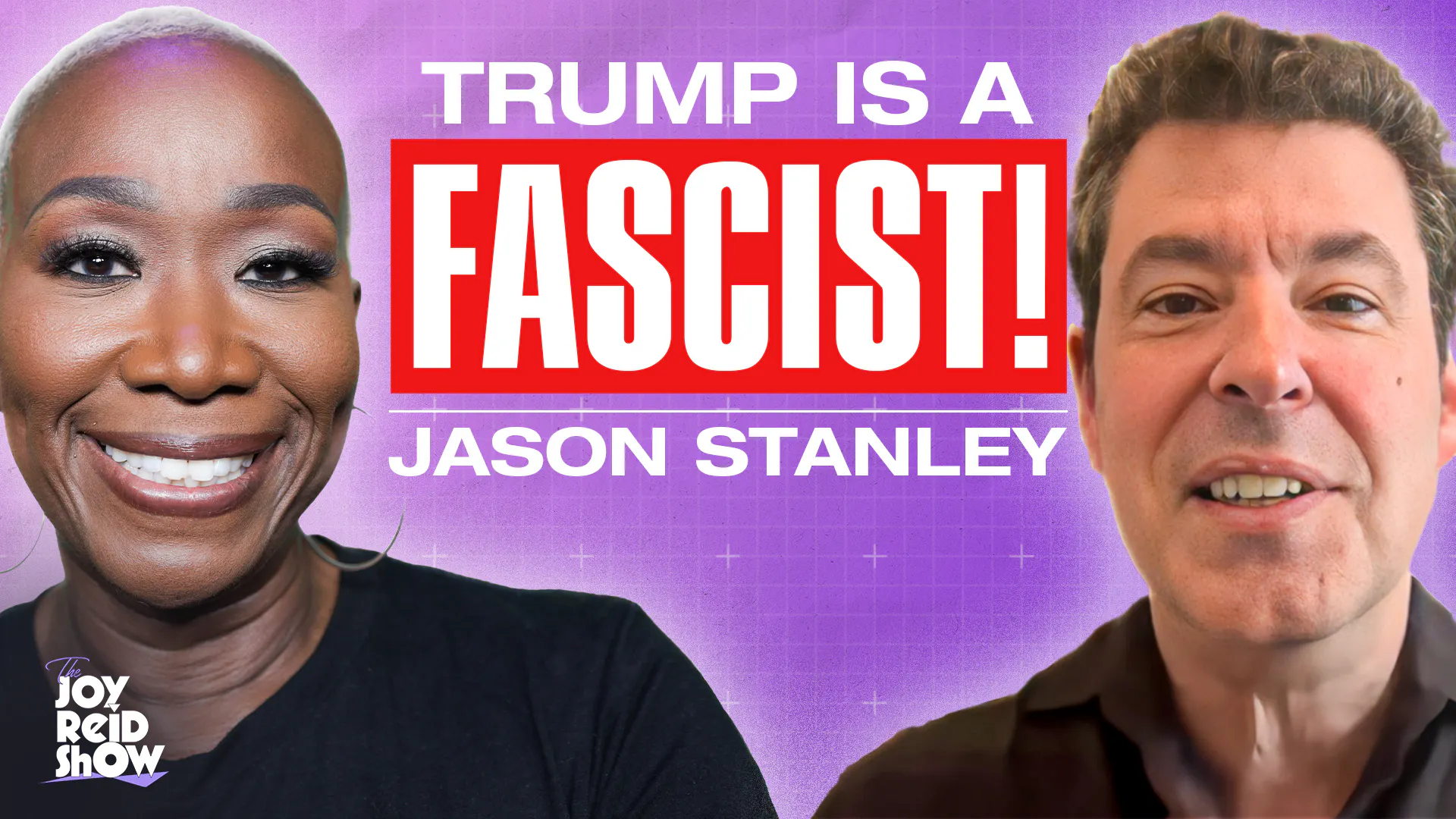
Loading summary
Transcript58 lines
- [00:01]
Joy Reid
I'm Livy Dunn, All American gymnast and Vuori athlete. When you travel and train as much as I do, you find happiness where you are on the mat or on the sand. Movement and comfort are essential. That's why I live in performance. Joggers by Viori. Made from Dream Knit fabric that's made of 89% recycled materials, effortlessly soft and made to move as much as I do. My happiness starts here in the softest joggers on the planet. Get 20% off your first purchase at vuor.com libby that's v U-O-R I.com l V-V-Y exclusions apply. Not only will you receive 20% off your first purchase, but enjoy free shipping on any US orders over $75 and free returns. Go to vori.com libby and discover the full versatility of Vori clothing exclusions apply. Visit the website for full terms and conditions.
- [01:02]
Jason Stanley
Ok.
- [01:10]
Joy Reid
Hello everyone and welcome to the Joy Reid Show. We have a great guest coming up for you shortly. But first, a wee recap. This past weekend was Father's Day weekend. Happy Father's Day to Jason and all the dads out there. It was also a big birthday weekend. Marla Gibbs turned 93 years young on June 14th. We absolutely love her as Florence Johnson on the Jeffersons and also Mary Jenkins on 227. It was also the US Army's 250th birthday, which coincided with a certain portly orange President's 79th Big Boy Day. But let's just be honest, that dude had a really, really bad weekend. Perhaps you haven't heard about it. Yes. No. Donald Trump finally got one of the things he has wanted most in life besides world domination and to finally be a billionaire. And apparently to become a political Jim Jones because maybe his parents didn't love him enough. Namely, he got a giant military parade that he could Mussolini over, but it didn't exactly work out the way he wanted. What Trump was clearly hoping for was something that looked a lot like this. Or even this.
- [02:28]
Jason Stanley
So same pace here.
- [02:31]
Joy Reid
What he got instead. Well, soldiers also wore uniforms representing other conflicts, like the Civil War. Yikes. And if you are wondering why colonial troops are in there, it appears that the US army decided to pull off what in sports is called a head fake. They gave the Commander in Chief his precious parade as ordered. But they did it their way as a rolling history lesson, with troops dressed in historical looks and tanks from ages past parading in succession right up until they got to the robot dogs. That is what you call good order and message discipline, which rather brilliantly thwarted Trump's goal of turning the Army's 250th birthday celebration into a North Korea style spectacle that would be all about him. Well done. Kim Jong Don may finally have the unserious cartoonish Pentagon boss of his TV dreams in pdagseth, but once again, we have learned that literally everyone, everyone is smarter than Donald Trump and his Fox TV marionettes. And if you want to truly understand how upsetting this failure has got to be for Donald, understand that he has craved this parade since the day that he stood next to French President Emmanuel Macron in July of 2017 in Paris during his first administration. I mean, you could almost smell the envy through the TV screen, along with the stale cheeseburger, stolen national security documents in cheap cologne. In fact, Trump. Trump went back to D.C. after that 2017 trip and demanded a military parade of his own. I want one too, and I want it now. He was ultimately told no by the adult Pentagon leaders at the time because, well, both the exorbitant cost to taxpayers and the damage that tanks would do to the D.C. streets, plus the small matter of giant military parades being something that they do all the time in Russia and in China and North Korea, but generally not in the United States. Even in France, the parade that made Trump so jelly was part of their annual celebration of Bastille Day, which commemorates the overthrow of the French king and queen. Remember Marie Antoinette, let them eat cake, Louis xvi getting to guillotine, all that stuff, you know, Y' all read Tale of Two Cities in middle school, right? The storming of The Bastille on July 14, 1789, a year after the ratification of the U.S. constitution, was a galvanizing event in the creation of French democracy. The Bastille was a state prison at the time, and the French revolutionaries, including soldiers who switched sides and joined these small R Republicans, famously threw open the prison bars and freed the few remaining detainees, who in many cases were held on the direct orders of the king without trials and no possibility of appeal. Stop me if this sounds familiar. Bastille Day is literally France's no Kings Day, which makes Trump's envy over a parade celebrating France going from a monarchy to to a republic, while he and his techno feudalist pals are trying to flip the US From a republic to a monarchy. Super ironic, despite the rather anemic look of it. Glass half full, Donald. You finally got your stupid parade, okay? On your birthday, no less. With the regime stapling the event onto the celebration of the US Army's 250th birthday. Yes, they were formed for our war against the English King. Well, and of course they stabled it onto Flag Day. And to make little Donald's birthday dream come true, the regime spared no expense putting 45 million of your tax dollars on the national credit card to encircle DC in tall chain linked security fencing and to truck in three dozen horses, dozens of tanks, some pulled out of mothballs at state museums, and to bring in nearly 7,000 troops. So I think in Trump's mind we were meant to march in goose step formation and salute dear leader and his royal court as he snappily saluted back, but who instead just kind of walked by, maybe glass not half so full. During the ceremony, Melania sat on one side of a very grim looking Trump who didn't seem to be having such an awesome birthday behind that heavy glass. TV's Pete Hegseth sat on the other side looking like frankly, he'd rather be blackout drinking at Don Jr. S new members only DC Club multi job. Marco was also there, looking about as enthusiastic as he generally does when flacking for the man whose penis size he once mocked. Can we show the squeaky tank thing again, please? I just absolutely love it. So good. It's literally the screeching for me. Just so good. I don't know, maybe even the regime people are tired of watching an enfeebled Lee Greenwood try to belt out his Proud to be an American song for the first 440th time, which at this point really kind of feels like elder abuse. The MAGA state authorities boastfully projected 200,000America first revelers would pack the nation's capital to glory in the making of America great again. Yeah, well, that didn't happen either. The parks near the Capitol were sparsely populated, as was most of the parade route. The AP was kind enough to blame the stormy weather for the tiny crowds, but come on, who really wanted this foolishness? Other than Donald? Nobody. Polls show even the Republican Republican military veterans oppose. Well, most of them anyway. Most Republican military veterans oppose the expensive spectacle. For comparison, the last time the US Held a big military parade with tanks rolling down the D.C. streets, it was in June of 1991, commemorating the end of the Gulf War under George Bush the first. I remember it personally because that was the month I graduated from Harvard and I hated that dumb war. Per CBS News quote, the festivities in the Capitol back then featured around 8,000 military personnel. Tanks, missile launchers, fireworks shows, and an address by the then president. Some 800,000 people attended at a cost of around $12 million, or just under $29 million in today's money, hunter Ledbetter, a Marine reservist at the time who was deployed to Iraq during the war, told the Post. It was the most exciting moment of my life. So more troops, more enthusiasm, far less money spent, and like 10 times more people showing up. And that was for a war, literally for oil against a country we went right back and invaded and occupied 13 years later, also for oil and so Dick Cheney's company could get the contracts to rebuild Baghdad. It is all quite embarrassing really, and it was not lost on many critics, including military veterans we interviewed right here on this show and during our Weekend Live coverage with Don Lemon and Jim Acosta. How ironic the massive parade spending is when Trump and Doge are slashing military benefits and the VA and even the programs designed to prevent veteran suicides, they are cutting it all. Plus Medicaid, which by the way, 1 in 10 children who live in active duty military households with TRICARE coverage depend on all to make room for Trump's permanent monster tax cut for himself and his wealthy friends and also to pay for that pitiful parade. But despite the clear humiliation the president faced this weekend, Jeff Bezos, Washington Post Went full state media with this splashy front page which probably looked better in the original Korean, although there was a better article, I have to say in the opinion section. Meanwhile, the nationwide protests also on Saturday, which was dubbed no Kings Day, were huge. Some 5 million people were estimated to have participated in rallies from Chicago to Los Angeles to Philly to New York City. Even Alabama, the Carolinas, even Florida. Just massive, massive crowds, all gathering to tell Trump not just no, but hell no to his pathetic desire to be our king. The protests were peaceful, even joyful, with the only violence provided by the police, including sheriffs and cops on horseback, seemingly wilding out in la, Texas officials warning of credible threats to lawmakers who were slated to speak at a no Kings rally there, and a man who plowed his car directly into no Kings marchers in Virginia. He was arrested. Ron DeSantis Ron DeSantis of Florida seemed excited to remind right wing TV viewers that running protesters over with your car is something drivers can legally do in Florida. I guess that is why they call it the Sunshine State. And Ron's wasn't the only dire MAGA warning trying to dissuade people from protesting here was. Trump himself was with his draconian version.
- [11:41]
Jason Stanley
Any protester wants to come out, they will be met with very big force.
- [11:44]
Joy Reid
Well, clearly millions of Americans ignored Mr. Pudding Fingers and as well as Trump. And that was not the only sign of Trump's weakness this weekend. For all the for all of his determination to show off America's military might and global strength under his control, he couldn't even get Russia to to do the peace deal with Ukraine that he promised that he would have signed, sealed and delivered on day one of his second presidency. Israel either completely ignored him and Lo Marco when they attacked Iran, which could drag those same troops who would not march for him into World War three. That or Lil Marco was lying when he put out a statement saying the US had nothing to do with with the attack. Which actually sure seems like a lie since Trump has since told ABC News that we could indeed get involved in Israel's latest war even while we're still arming them to genocide Gaza. That would mean that after some 15 years of trying to drag US presidents from George W. Bush to Joe Biden into joining an Israeli war with Iran, Bibi has finally found his sucker in Donald Trump. And the troops that Trump is currently wasting guarding the federal building in Los Angeles and being used like stormtroopers in America's second largest city for no reason at all are likely to get a new and even more absurd assignment to be away from their families. In yet another humiliation, Trump was forced to reverse another bad policy that he's letting his diabolical minions execute while he's guaping crypto cash, avoiding releasing the Epstein files, and plotting military adventures that other people's sons and daughters have to fight. After weeks of ice, racially profiling, harassing and arresting dishwashers and grandmas, day laborers volleyball kids and tourists in the bus parking lot at Disneyland, even turning off Republicans and podcast bros like Joe Rogan. Also on Saturday, the AP reported that Trump had finally told Nosferatu and Lurch to back off, directing immigration officers to pause arrests at farms, restaurants and hotels after the Associated Press claimed that Trump expressed alarm about the economic and visual impact of aggressive enforcement of Nosferatu's 3,000 brown person a day kidnap quota. In just the past week, Trump's ICE secret police have raided meat packing plants in Nebraska, a strawberry farm in Ventura County, California, and so many workplaces across this country, immigrants are literally afraid to go to work and not showing up, which is causing even Trump loving businessmen to complain. But Tom Homan, yeah, he's like yolo. We'll bankrupt every single business in America until citizens start turning over those brown people to the secret police USSR style and to stave off the humiliation of this weekend and all of his failures. Late last night, Trump pulled the full Klan playbook straight out from under the sheets, desperately trying to change the subject from his failures by declaring war on blue states while exempting red states from the ICE crackdowns. Trump posted on his private social media outlet and I quote, we must expand efforts to detain and deport illegal aliens in America's largest cities such as la, Chicago and New York where millions of illegal aliens reside. These and other cities are the core of a Democrat power center where they use illegal aliens to expand their voter base, cheat in elections and grow the welfare state. None of that is true by the way. Robbing good paying jobs and benefits from hardworking American citizens. These radical left Democrats are sick of mind, hate our country and actually want to destroy our inner cities. The deranged, sad failed president went on and on and on before listing a dog's breakfast of every right wing hate buzzword his poisoned mind has ever heard. Transgender men playing women's sports. Sanctuary cities, which he closes by noting you don't hear about in the heartland because he needs every white Christian nationalist in the heartland to hear those buzzwords and forget that they too actually rely on immigrant labor to keep their restaurants, farms and construction businesses open. But not to worry, Trump will force Lurch and Nosferatu to focus on the sick, transgender filled America hating blue sanctuary cities. You're welcome. Donald Trump is a sick failed president. Full stop. He has failed to accomplish any of the things that he promised to do in a second term. Prices are up, the economy is down. But that doesn't mean that he hasn't accomplished any anything in just his first six months back in office. He has made this country angrier, meaner, more broke, more racist, more desperate and more dangerous. And that shouldn't surprise anyone since according to two of the men who used to work for him, his former Chief of Staff, General John Kelly and former Joint Chiefs Chair Mark Milley, Donald Trump is a fascist. Fascist to the corporate According to General Milley as quoted in Bob Woodward's latest book, I mean Trump talks like a fascist with those threats to wage ice war on blue cities and literally naming it as a political decision. And all this sick talk about immigrants poisoning the blood of our country and Haitian immigrants eating pets and the racist travel bans while admitting white Africanos from South Africa. And he is worshiped just like a fascist leader. His MAGA Americans are devoted to him the way historical fascist societies have elevated their glorified leaders. And like any good fascist leader, Trump uses theater to make himself seem more popular and more beloved and more powerful than he really is, to make it look like he has the kind of personally loyal, devoted military that old fascist leaders had or that Kim Jong Un has. The regime handpicked soldiers from the elite 82nd Airborne to position behind Trump's podium at Fort Bragg in North Carolina about a week ago, where he was supposed to be giving remarks celebrating the Army's 250th birthday, but where he instead launched into a screed of blatantly partisan attacks on the governor of California, the mayor of Los Angeles, as well as Joe Biden, of course, and the press. According to Military.com directives to the troops at Fort Grab Fort Bragg included the following and I quote, one unit level message bluntly said no fat soldiers and notably those positioned behind Trump were all men and almost all white and they were screened for ideology as well as appearance. And I quote again, if soldiers have political views that are in opposition to the current administration and they don't want to be in the audience, then they need to speak with their leadership and get swapped out. Another note to troops said also this Adding to the spectacle, a pop up shop operated by 365 Campaign, a Tulsa, Oklahoma based retailer that sells pro Trump and other conservative coded memorabilia, was set up on site at Fort Bragg with campaign style merchandise. On army property, soldiers were seen purchasing clothing and tchotchkes, including Make America Great Again chain necklaces as well as faux credit cards labeled White Privilege Card trumps everything perfect. The white privilege card nonsense. Well, that speaks for itself. But as for that Make America Great Again BS which he stole from Ronald Reagan but insist that he developed. Note that fascism supposes that there was a glorious past in the nation that was ruined by a particular set of hateable people. Gays, trans people, liberated women who aren't producing enough children to keep the national numbers up, university academics, liberals who are all deemed as communists and socialists, Jews, Muslims and especially non white immigrants. The idea being that if those people got hurt, got pushed out of their jobs, maybe even got jailed or deported or even got dead, the nation could be great again. That is the literal definition of fascism. The demand for racial and gender uniformity and blind loyalty not just from military troops, but from everyone associated with the state. Peep this leak I got from a federal government source that says every single job applicant or for any federal position going forward must now write a series of essays, including on their commitment to the Constitution. Okay, that seems fine. Their history of creating efficiency. Okay, a little doji, but we'll take it. Explaining their strong work ethic. Okay, a little right wing Cody, but not fatal. And a fourth requirement that applicants explain, and I quote, how would you help advance the President's executive orders and policy priorities in this role, Identify one or two relevant executive orders or policy initiatives that are significant to you and explain how you would help implement them IF hired. No AI assisted answers allowed. That is literally torn out of Project 2025, which is in itself a pretty damn fascist manifesto. In the style of the Handmaid's Tale. The Council on Foreign Relations defines fascism as follows. It defines it as a mass political movement that emphasizes extreme nationalism, militarism and the supremacy of the nation over the individual. This model of government stands in contrast to liberal democracies that support individual rights, competitive elections and political dissent. Fascist regimes are revolutionary in nature. They advocate for the overthrow of existing systems of government and the persecution of political enemies. They're also highly conservative in their championing of traditional values. Now, I'll note here this story in the Guardian today that the new VA rules under Trump's executive orders will allow doctors, psychiatrists, psychologists, even dentists to refuse to treat veterans who are unmarried or who are Democrats. Quoting from the article until the recent changes, VA Hospital's bylaws said that medical staff could not discriminate against patients on the basis of race, age, color, sex, religion, national origin, politics, marital status, or disability in any employment matter. Now, several of those items, including national origin, politics and marital status, have been removed from the list. And although fascist leaders typically claim to support the Everyman, in reality their regimes often align with powerful business interests. Hello, Palantir, Grok, Starlink, all you South African billionaires. Fascism is also characterized by extreme nationalism and the belief in the supremacy of certain groups based on characteristics like race, religion, ethnicity and nationality. Not all those erasures from military and government websites. Also a cult of personality in which the dear leader is beloved, admired and even worshiped and no negative information about them is allowed. And lastly, popular mobilization in which the base is whipped up to stifle dissent. And the fascists people are encouraged to get really, really involved in public life in order to glorify the nation, the party and the leader, and to crush anyone who stands in his way. I mean, if that's not maga, I really don't know what is. And the thing about this determination to restore a great glorious path is that it often involves violence. Which brings me to Minnesota, because the other thing that happened this weekend Besides the massive no Kings protest and that sad little Trump birthday parade was the political assassination of two Minnesota state lawmakers, including the female former speaker of the State House. This shooter the shooter disguised himself as a police officer, covered his head and face with a creepy latex mask and went to the home of Democratic State Senator John Hoffman in the wee hours Saturday, shooting him and his wife Yvette multiple times after they opened their front door. According to one account, Yvette hoffman shielded their 20 year old daughter with her own body, protecting her from being hit. The couple thankfully survived and were admitted to the hospital. The killer then proceeded to the home of the former Speaker, Democratic State Rep. Melissa Hoffman, Melissa Hortman, sorry, and her husband Mark in a neighboring town and shot them multiple times, killing them both. As he was leaving their home, the gunman was confronted by real police and got into a shootout, but he got away triggering what's been called the largest manhunt in Minnesota history, including a $50,000 reward. The suspect in the case, 57 year old Vance Butler, was caught last night after nearly 43 hours on the run with hundreds of detectives and 20 SWAT teams reportedly joining in the search, according to CNN Update on the breaking news from Minnesota where the manhunt for a suspected.
- [25:22]
Jason Stanley
If you used Babbel, you would.
- [25:24]
Joy Reid
Babble's conversation based techniques teaches you useful words and phrases you speaking quickly about.
- [25:29]
Jason Stanley
The things you actually talk about in the real world.
- [25:31]
Joy Reid
With lessons handcrafted by over 200 language.
- [25:34]
Jason Stanley
Experts and voiced by real native speakers. Babbel is like having a private tutor in your pocket. Start speaking with Babbel today. Get up to 55% off your Babbel subscription right now at babbel.com Spotify spelled B-A B-B-E-L.com Spotify rules and restrictions may.
- [25:49]
Joy Reid
Apply 10 years from today, Lisa Schneider will train in her office job to become the leader of a pack of dogs as the owner of her own dog rescue. That is a second act made possible by the reskilling courses Lisa's taking now with AARP to help make sure her income lives as long as she does and she can finally run with the big dogs and the small dogs who just think they're big dogs. That's why the younger you are, the more you need AARP. Learn more at aarp.org skills assassin is now over. Authorities have caught 57 year old fans. Here's Governor Walls on the capture Unthinkable actions have altered the state of Minnesota. A moment in this country where we watch violence Erupt. This cannot be the norm, of course. Right wing social media, led by Trump's on again, off again bestie Elon Musk, rushed to try to distance MAGA from Boltler as soon as he was named as a suspect, trying to pass him off as a Democrat because he once held a seat on a nonpartisan workforce development board to which he was appointed by Governor Waltz, who likely never even met the man. Problem for them though, is that Boatler's best friend told reporters on the record that his buddy was a strong Trump supporter and voted for the MAGA president. And Boltler and his wife, who was pulled over and briefly questioned by police over the weekend, were registered Republicans when they lived in Oklahoma in the early 2000s. Boteler reportedly owns a security company, which is how he was able to even dress his car up to look like a police vehicle. There's also a whole recorded history of him online showing him preaching at right wing churches in the Congo against trans people. He seems pretty clearly to be a right wing faux Christian, maybe even a Christian nationalist. A hit list was found in his fake police vehicle after he fled the scene that included some 70 people, all Democrats, including Governor Walz, Congresswoman Ilhan Omar, Senator Tina Smith, and the whole Democratic Congressional delegation, plus State Attorney General Keith Ellison, who was both black and Muslim, plus abortion providers. He also had a stack of flyers for the no Kings protest on Saturday, which the shooter may have also been targeting. And keeping in mind that Boteller has not gone on trial yet, so that process has to play out. But the Minnesota shooter is exactly the kind of killer fascism breeds. The shooter targeted Democrats, powerful, elected women, immigrants and Muslims. Abortion providers. Exactly the kind of people the MAGA movement spotlights as keeping America from being great again. So even if, even if, as author Michael Wolff told me, Trump isn't smart enough to be a card carrying fascist, what he has unleashed in this country on purpose and with deliberation is fascism. Even if it's incompetent, embarrassing fascism. Recently I had the chance to speak with one of the foremost experts on the subject, Jason Stanley, author of How Fascism Works and a must read new book called Erasing History. Take a listen. And joining me now is Professor Jason Stanley, who is one of the foremost experts on the site of fascism. And Professor Stanley, thank you so much for being here.
- [29:15]
Jason Stanley
Thank you, Joy. It's an honor to be in discussion with you.
- [29:19]
Joy Reid
Thank you. I wanna start by asking you just to set the stage, talk about your own history. I am reading and enjoying your book, or have read and Enjoyed your book Erasing History. And you talk pretty extensively about your family's flight from Europe. Can you talk a little bit about that?
- [29:36]
Jason Stanley
Yeah. So my father was almost seven when he came to the United States from Berlin in August 1939. So right before the war started, with his mother, my grandmother, who had been an actor in Berlin in the 20s and 30s, and then did underground work rescuing many people from the concentration camp Sachsenhausen. So they were German Jews, Berlin Jews, very prominent family. And my mother had a sort of diametrically opposite experience. She was. She and her sister and parents were among the Polish Jews taken to Siberia and put in the Gulag where she was raised for the first five years of her life. And then she and her sister were repatriated back to Poland only to discover that they were the only survivors of their family. And then seven of my great uncles were killed in Sobibor and all of their children. And then at the age of eight, my mother, after experiencing a lot of anti Semitism in Poland, came to the United States, where she ultimately became a court stenographer in Manhattan criminal court for 33 years.
- [30:59]
Joy Reid
And you write about your father in his academic work, writing a dissertation about the rebellion of the Kikuyu people in Kenya. Talk a little bit about his research and what that taught you about the subjects of authoritarianism and fascism.
- [31:19]
Jason Stanley
So the link between colonialism and fascism is deeply embedded among scholars of fascism. And so my father, his whole career as a sociologist was devoted to thinking about the causes of authoritarianism, the causes of fascism. And so early on, as a graduate student, this led him. He was familiar with the work of theorists like Hannah Arendt and Cesaire, Massachusetts. Cesaire, on the relationship between colonialism and fascism. Essentially, you treat one population as savages. You destroy their education. You make them think like they have no history. And then fascism is when you're just like, okay, we did that to one group of people. Why don't we kind of be brutal to everyone? So my father. And if we think of black Americans as an internally colonized population along with indigenous Americans, then we can sort of see the parallels here between African colonialism and what's happened in the United States. So my father spent three years in Kenya, 1959 to 1962, right before independence, and studied the school systems. So he looked at Alliance High School in Makarere and saw how Kikuyu's identity, the identity of Kikuyu, was being entirely extinguished in these schools. The language, the Kikuyu language, the traditional Kikuyu religion, was being supplanted by Christianity. And they were basically being told that they had no history, no identity, no civilization. And the only people with a history and an identity were the British. Gugi Wathiongo, who passed last week, writes very movingly and powerfully about this experience in his memoirs.
- [33:22]
Joy Reid
And it strikes me, of course, that our former and our first black president, Barack Obama, has Kenyan roots on his father's side. And one of the insults that was used against when he was running for president very typically was the term MAU MAU. And what struck me as I was reading your book Erasing History was the ways in which just the idea of struggle against colonialism has been used by authoritarians to make the whole idea of resisting a negative. There was a thing during slavery called drapetomania that was a made up notion that slaves who resisted slavery were suffering from some sort of psychological, you know, condition, and that's the only reason they were resisting. What do you make of that? You write a book about history and erasing history. How does trying to turn people against resistance play into that?
- [34:18]
Jason Stanley
Yeah, brilliant. I mean, my father writes about this a lot in his field notes and dissertation. And I talk about this in the book. MAU MAU was represented as a rebellion as like done by mad savages. I talk about. My father talks about this repeatedly. You know, the reports on MAU MAU is a primitive reversion to savagery, insanity. I should say that President Obama was Luo and MAU MAU was generally a Kikuyu rebellion, just to put my Kenyan friends. But there's a saying from the mid-60s in Kenya, Aluo will be president of the United States before Aluo is president of Kenya. And that turned out to be true. So there are standard counterinsurgency tactics against resistance movements. It's utterly standard to represent people who are resisting as reverting to savagery, criminals, terrorists. I'm thinking of teaching a course called who's a Terrorist? So the idea is you want to delegitimize resistance. Look at how textbooks represent John Brown. Even the textbooks I was raised on, they probably still do. One of the most virtuous white men in human history and he's represented as an insane person in textbooks. We all remember that from our childhood. Instead of someone who's totally reasonably saying, look at the situation. So this thing of representing people as feminizing them, what we've seen is like the attack on universities in the United States that began in 2015 from people like Jonathan Haidt and Greg Lukianoff. The idea was that students protesting racism were coddled snowflakes. They were like effeminate children. You reduce them to children or you treat them like primitive savages. My colleague Robin Dembroff has this concept of adult human, male. They say if they're going to attack anyone, then what they do is represent them as a child, a woman or non human. And their theory explains why we see what we do in these counterinsurgency tactics. You say the resistance has no, there's no reason behind it. That's why they're attacking critical race theory here. They're attacking critical race theory because this or blend black history because if you understand the racism of practice, of the structural racism, if you understand that there are these practices and structures that keep the racial wealth gap in place, that keep our cities segregated. If you understand that history, then you're going to understand black political resistance. So what's essential is to erase that history.
- [37:43]
Joy Reid
Give us, for those who have not yet read how fascism works or erasing history, give us a good working definition of fascism.
- [37:52]
Jason Stanley
So fascism is, I'm gonna give you a working definition of European fascism and say a little bit about how the long history of American fascism relates to that. The classic structure of European fascism is a cult of the leader who promises national restoration after supposed national humiliation by immigrants, minority groups, be they religious minorities or ethnic minorities, LGBTQ citizens, liberals, Marxists. And they say, the nation has been embarrassed and I will restore the pride of the nation. So the idea here is really the nation has been feminized. Patriarchy is really essential to thinking about fascism. So the literature on mid century literature on fascism clearly shows that the fascist leader is like the father of the nation. He represents the sort of, he's restoring the manhood of the nation against these feminizing aspects of like giving, like ceding power to groups that traditionally haven't had power. And the idea and fascist movements, the classical fascist movements, say in the United States, the fascist movements, the fascist fascist ideas and structures in the United States that deeply influenced Hitler had this idea that there was a pure race, the great race, as Madison Grant called it in his 1916 book, the Passing of the great race that was being destroyed or polluted by immigrants. And so the greatness of the nation was the greatness. And the greatness of the nation in fascist ideology is the great men of the nation like the great German men. And the idea is all civilization and all history comes from them. So you're really shifting fascist ideology really shifts the identity of the nation from values like Democracy, freedom to national pride, self aggrandizement, the idea that the nation is simply stronger and tougher than other nations. That's, that's the structure. Now, American fascism, the Jim Crow south would be a sort of classic American. The black intellectual tradition has long spoke of Jim Crow as fascism, from Du Bois and Langston Hughes on. And that structure, Jim Crow fascism, a racial hierarchy predicated on racial superiority, didn't have a leader. But now I think we're looking at a structure that looks much more akin to the European mid century fascist movements.
- [40:54]
Joy Reid
So are you saying, and would you say that the current Trump regime maga ism is fascist?
- [41:03]
Jason Stanley
Yeah, of course. I mean, fascism targets. So the pillars of democracy are the media, the press, the courts and the universities. So if you're attacking any authoritarian movement has to attack those. But fascism also comes for the cultural institutions because the idea is this reconceptualizing of the nation. The nation is about its symbols, its flags. The nation is about its great race. You know, we're seeing a return to explicit white supremacy. We had a long period of implicit white supremacy, I guess, but now we're seeing very explicit white supremacy. The only refugees allowed in are Afrikaner. I mean, it's almost, I mean, it's so open that it's. The level of openness of this fascist regime actually contrasts with Latin American dictatorships who tended to do what they did sort of in a hidden way. So, yeah, I mean, we're seeing the classic fascist ideology. Now. The Nazis were anti Semitic. I think that this administration is clearly anti Semitic, but I don't think that we're going to see a genocide of Jews. But, but as we see from Israel, you can have Jewish fascists too. The moral of history is anyone can be, anyone can do terrible things.
- [42:39]
Joy Reid
And you mentioned Israel and I wanna talk about that just for a moment. And then we're gonna come back to the United States. In how fascism Works, you named a number of countries that are driven by these fascist ideologies that are either wrapped around religion, as in Modi's party in India, where it's about the supremacy of Hindus over Muslims. You mentioned obviously Hungary and Viktor Orban's version, which is about this sort of Christianity elevating the family, ending abortion and having more women return to their sole role as making babies and ending LGBTQ rights, obviously the Russian regime. But in your new book you do add Israel. Talk about that for a minute. Would you describe that regime of Benven Netanyahu and Mr. Smotrich and the Other right wingers as fascist.
- [43:35]
Jason Stanley
Yeah, I mean, sure. I mean, it's an ethno. It's become an ethno nationalist country. I'm a liberal. I believe no country should be based on an ethnicity or religion or a race. I think there are ways of talking about Israel that are incorrect. Like, I don't think what's happening is. Is fits us racial categories since Palestinians and Jews are cousins and look alike. And, you know, so, you know, there's a confusion about the way we talk about that conflict. And I think that it's odd talking about Israel as a settler colonial state when more than half of Jews in Israel are indigenous to the Middle East. But Israel is definitely engaging in settler colonial actions. They're ethnic cleansing, they're committing genocide, and they're committing genocide being justified by an ethnonationalist identity. This doesn't mean that. I don't know what the phrase Israel has a right to exist means. Israel is there. Countries that are there, you know, have rights. I don't think Israel should be. Or any, you know, state that is there should be, you know, wiped off. I mean, I'm. In that sense, I guess I'm a Zionist. But Israel has tried, you know, in a sense. I mean, Albert Einstein and Hannah Arendt and a few other Jewish intellectuals published a letter in the New York Times in 1948 worrying that Israel would become fascist. Because if you start off basing your state on Jewish nationalism or any kind of nationalism, or privileging one group over another, and of course, Israel is founded as a liberal democracy, but has changed, but always had these seeds or elements of ethno nationalism that have become. That have come to just dominate the country. And so you have just a classic. Bibi Netanyahu has been in power for 16 years. That's just 16 consecutive years. This is not a democracy we're talking about. And not just that, it's an ethnonationalist regime, a state based on a religion. And, you know, I don't think there should be any state. You know, people talk about a Palestinian state. I'm not comfortable about that if that means something like Israel, but for Palestinians. I'm a liberal, so I don't believe that. So. But when you have an Israel, you have a. Marco Rupio was just parroting the Hasbara Israeli propaganda. They made the. This episode is brought to you by.
- [46:25]
Joy Reid
LifeLock between two factor authentication, strong passwords and a VPN. You try to be in control of how your info is protected. But many other places also have it and they might not be as careful. That's why LifeLock monitors hundreds of millions of data points a second for threats. If your identity is stolen, they'll fix it, guaranteed or your money back. Save up to 40% your first year. Visit lifelock.com podcast for 40% off terms. Apply the number one selling product of its kind with over 20 years of research and innovation. Botox Cosmetic Adobotulinum Toxinae is a prescription medicine used to temporarily make mop, moderate to severe frown lines, crow's feet and forehead lines look better in adults.
- [47:08]
Jason Stanley
Effects of Botox Cosmetic may spread hours to weeks after injection, causing serious symptoms. Alert your doctor right away as difficulty swallowing, speaking, breathing, eye problems or muscle weakness may be a sign of a life threatening condition. Patients with these conditions before injection are at highest risk. Don't receive Botox Cosmetic if you have a skin infection. Side effects may include allergic reactions, injection site pain, headache, eyebrow and eyelid, drooping and eyelid swelling. Allergic reactions can include rash, welts, asthma symptoms and dizziness. Tell your doctor about medical history, muscle or nerve conditions including ALS or Lou Gehrig's disease, Myasthenia gravis or Lambert Eaton syndrome, and medications including Botulinum toxins, as these may increase the risk of serious side effects. For full safety information, visit botoxcosmetic.com or call 877-351-0300.
- [47:50]
Joy Reid
See for yourself at botoxcosmetic.com dessert bloom.
- [47:54]
Jason Stanley
It'S like, you know, the totally that's colonialist ideology. There's no question that Israel is founded on colonialist ideology, right?
- [48:03]
Joy Reid
And you write in the book, and I thought this is one of the really fascinating parts of the book because you write about the fact that indeed Mizrahi, the Mizrahim are native to the area. They were always there. And they are, as you said, if you put a Mizrahi Jew and a Palestinian next to each other, God help you. Try to tell them apart, right? They're very similar people. There are Falasha Jews that come from Africa and then there are Ashkenazi Jews that come from Europe. And you write about that distinction and the fact that you do have people who came in the 1940s and themselves said it was a colonial effort. They called it a colonization effort and claimed that the land was empty. And you write about that being a very similar way that Europeans talked about the United States and well, there was the land was empty because the indigenous people had no real civilization. So there was no problem in taking that Land talk about that, because people get very angry when protesters who are protesting the way that Israel is waging that war talk about settler colonialism. And when they talk about colonialism or even really criticize the way that war is being waged. Can you talk about that a little bit?
- [49:11]
Jason Stanley
Yeah. So the founding ideology of Israel is clearly colonialist, as is the founding ideology of the United States.
- [49:19]
Joy Reid
So.
- [49:21]
Jason Stanley
Where you go from that is morally, ethically, politically, is not clear. But it has to be seen that all of this is the idea that whenever anyone talks about empty spaces, virgin land, that is always gonna be colonialist or almost invariably colonialist. And it's no different in the case of the founding of Israel, where they drove 750,000 Palestinians off the land. So they try and destroyed many villages to try to make it seem as if there was nothing there. They destroyed the history. They destroyed the existence of Palestinian farms, Palestinian communities, and created this kind of colonialist narrative that we're familiar with. Any of us who. Who grew up in the United States with the sort of deeply flawed indigenous history that, you know, that indigenous people didn't have, a civilization didn't have, you know, that's just the characteristic of colonialism. And we see it with the internally colonized populations of the United States today. I mean, the idea that black run cities are, you know, like jungles or, you know, like. And then you can take them over as they did in Michigan. You know, they took over black run cities in Michigan and transformed them into, say, places where children were poisoned by lead, as in Flint. So that whenever you're seeing that structure of people talking about, you know, empty lands, well, you know, they're going to kill the people who are actually occupying the lands, because if the lands are empty, then, you know, there better not be any people on them.
- [51:13]
Joy Reid
And let's. I mean, you draw these connections that I think are really fascinating, that I hope people read the book to really get them. Because, you know, what we're seeing obviously in Gaza is the obliteration of really all aspects of Palestinian history. The hospitals are gone, the schools are gone, the museums are being bombed. It just wiping them out of the physical history of Gaza. You're seeing something similar happening in the West Bank. You go to India and the Modi that, you know, his political party, and you talk about this sort of rewriting of the history to write the Muslims out and to make it sort of this sole sort of Hindu history of that country. You can go to Orban, similar things. It comes. And now we bring ourselves back to The United States, where you are seeing the Trump regime attempting to literally wipe the existence of black people, women, LGBTQ people out of the official history of the United States. It feels like all of these parties, they simply do the same thing in different languages and countries.
- [52:14]
Jason Stanley
Yeah. And now we're seeing the connection between colonialism and fascism, right?
- [52:18]
Joy Reid
Yeah.
- [52:21]
Jason Stanley
Fascism is the dominant group, is glorious, and the other groups have no civilization or civilization destroyers, as in the case of what Vladimir Putin says about Ukraine there. Putin is also saying the new Russian textbooks say Ukraine has no independent history, no such thing as Ukraine, no such thing as the Ukrainian language. So that structure is present. The 20th century historians were absolutely right to connect colonialism and fascism in that way. And so to create what you have in fascist attacks on education is you have an attempt to turn the education system into a way to make fascist politics effective. If you present the history as a series of acts of great white men or great Hindu men, then first of all, you represent ordinary citizens as helpless and not having agency because everything's done by great men. And secondly, you represent the greatness of the nation as dependent on the men of the dominant group, the actions of the men of the dominant group. So then if you give people who are not men in the dominant group power, you're destroying the possibility of great actions of the nation. So it becomes. I mean, Hitler himself talks about in Mein Kampf about how it's vital to represent history in schools as the actions of great Aryan men. So now we have a situation in the United States in that our textbooks already were like that.
- [54:14]
Joy Reid
Yeah.
- [54:14]
Jason Stanley
So, you know, so we really have been set up for a situation in which this kind of politics is going to be effective. I mean, I was raised with textbooks that told me no woman had ever done anything in the long history of humanity. I mean, the level to which women are erased, you know, in every country, in every textbook, so that, you know, and people wonder about the prevalence of patriarchy.
- [54:42]
Joy Reid
Yeah. I feel like the first woman that the textbook sort of confronted us with was Rosie the Riveter, and she was sort of a, you know, not even presented as a real person, and that women are just not existing. And then they sort of Skip forward to Dr. King when you look at the reaction, the really, you know, really extreme reaction to the 1619 Project, and you do write about that in the book as well, and the ways in which Donald Trump and Christopher Ruffo and others tried to replace that with their 1776 project. And now he speaks in terms of we need to reclaim the glorious history of the United States and make Americans proud of their history. He's talking in a way that does sound. It's giving 1930s, let's just put it that way. Or the way, I assume Russia understands history and learns it.
- [55:29]
Jason Stanley
Oh, absolutely. I mean, the 17. I mean, let's begin with Nikole, Hannah Jones's 1619 project. I mean, I think Nicole Hannah Jones has somewhat changed her narrative in very recent years and been less exceptionalist about America. But the original lead essay, the powerful lead essay in the New York Times was very patriotic. It begins with, my father always planted an American flag. And the moral, the sort of stated, overarching moral, was, America is a great country, and it is a great country largely because of the contributions of black Americans who pushed it towards a multiracial democracy. Now, how that isn't a patriot, how that's an anti American. The only way you can see that as anti American is if you think America by its nature is white. Because she's saying the greatness of America is due largely to the contributions, or also centrally to the contributions of black Americans, which presumably is uncontroversial. But the reaction to it was that it was anti American. I mean, my reaction to it wasn't that it was anti American. It was just like, what about Haitian Haiti? What about. But that wasn't the reaction to it. The reaction to it was this reaction you can only make sense of if you identify America with whiteness. Because she was praising America, she was saying, america has been on this journey towards multiracial democracy, and black Americans are central to that journey. That is a very pro American narrative. And so you could see in the reaction, even the reaction of some liberals, that there was a tacit presupposition of American whiteness. And, you know, when people said, oh, she's denigrating the founders. Well, there's no historical dispute about whether the American Revolution was fought in part to gain more indigenous land. So, you know, the reaction to Nikole Hannah Jones's project was instructive.
- [58:06]
Joy Reid
Yeah, it was. You know what's interesting, too, is that the reaction to your book was instructive, too. I mean, you wrote how fascism works in 2018, in the first year of the first Trump administration. I was fascinated, as I was reading your current book, that you wrote it before the election in 2024. It reads like you wrote it last month. Because a lot of the things you talk about are the things that we're dealing with right now, particularly in the erasures in terms of education. So, first of all give me a sense of how you feel. What's happening in reality in the second Trump regime matches with what you expected when you were writing. When you were writing erasing history.
- [58:53]
Jason Stanley
Well, as you say, it's exactly what I expected and that's why I wrote it, which is what is happening. So, because, you know, like you've been saying throughout this interview, it's the same in every country. That's one thing. That and I was In Budapest in 2009, in 2010, I saw Orban's rise and how he did it and the targeting of Central European University. Orban appeared, was advising the Heritage foundation at a closed door meeting there. I knew that they would target a university, they would target universities generally. That was obvious to me. There are no great universities in authoritarian countries. There's no liberal arts colleges in authoritarian countries. There's no humanities in authoritarian countries. Nobody's sending their kids to universities in Russia. So now there's some tack. There's tack and engineering and great science and Chinese universities, but there's no human. The humanities is restricted to, you know, studying particular elements of a historical past. You can't do any kind of free commentary. Universities are very dangerous places for authoritarians. And schools are very dangerous places because people learn that social movements are possible. People learn in school, in a democratic education. They learn not to fear others in their society. And fascism thrives off of fear. So for a host of reasons, you have to target schools and universities. In addition, universities are the places where dissent occurs. So notice that Trump is saying illegal protests, not illegal. The antisemitism stuff is a pretext, an antisemitic pretext. It's really targeting protest. And universities are where anti war protests have occurred. They're where democracy protests occur in Bangladesh and India. Movements for equality come out of universities, often elite universities. So I knew this was coming if Trump won. I thought Trump was going to win and I knew that people would be unprepared. You can see that people don't understand the conceptual part of this attack on democracy because the mainstream media has been attacking universities for a decade, ever since the Atlantic did that piece on, you know, the coddling of the American mind on, you know, how students, you know, I mean, the whole thing is incoherent, right? Students are too sensitive. We have to protect free speech. That, you know, students should, should be, should be better with dealing with controversial speech. Except for Jewish students who cannot hear any criticism of Israel. So this is the package. We're being told to accept that black students have to accept Being told, being classes that raise questions about genetic inferiority or whatever, they have to accept controversial ideas. But Jewish students can't even accept criticism of Israel. So, you know, even, you know, an interesting thing happened to me when I published a New York times piece in 2016. Called my parents mixed messages on the Holocaust. And my father was always quite opposed to the state of Israel. Cause he regarded it as colonialist in problematic ways, in ways that he thought would damage it permanently. He wasn't opposed to the state of Israel, but he found various things very problematic. So I talked about how I was worried for Palestinians in a way, kind of parallel, because I said my mind goes to extreme situations like the way the Nazis treated Jews. And I'm not saying this is possible, but it's just where my mind goes. And then I got an email from my colleague Hanan Haver, the greatest scholar of Israeli literature basically on earth. And he said, dear colleague, we have never met, but I read your piece with interest, and I wanted to tell you that much of Israeli literature is about the comparison you say can't be discussed. So when we're not allowed to make comparisons and to think about them, when that is called anti Semitic, you know, I don't know, you know, that seems to me to be anti Semitic.
- [63:44]
Joy Reid
You left the United States, you're a professor at Yale, but you are now in Canada. Why did you leave the U.S. did it have to do with your concern for your own safety and your family safety? Your wife is from the continent, you have children. Is that why you left?
- [64:02]
Jason Stanley
My ex wife, yeah. Well, I think there are a number of reasons. I'm still in New Haven now, but I'm leaving later this summer. So I think, I mean, there are a number of reasons. First I just thought, wait a few months and nobody will be like, why did you leave? So I think it's kind of. There's a time issue here. Like in March, everyone's like, why would you leave? And now people are like, okay. But I just, you know, one of the things is, I understand I made a prediction that there's an X percent chance things will get really bad here. And that X percent was large enough that I thought, okay, we might be able to prevent it getting that bad. But just my knowledge of history is that if the percentage chance is that bad, is that high that things are gonna get that bad, and I think it is high enough, then you should explore possibilities elsewhere if you can. People say, you know. And also I should say, you know, as the father of two black sons, I mean, I've always been. You know, ever since I had my first child, I had. I immediately became interested in the subject of mass incarceration because, you know, it's a different reaction you have if you're the child of two Holocaust survivors to the kind of, like, really intense racism of the United States. You know, I'm not black American, so I'm not raised with this attitude of, you know, this is our country. We stay here no matter what, or whatever that attitude is that makes you not want to leave. If that's, you know, the attitude that I hear from. That's the attitude I hear from some people. But I come from a background of genocide. So my reaction. I see these genocidal patterns here. Our prison system. I mean, we have the fourth highest rate of incarceration in the world with, you know, almost. You know, we've got, like, eight states, I think, around eight states that imprison, like, 1% of their population, which is like Stalin in the 1950s. Yeah. I mean, this is.
- [66:20]
Joy Reid
So.
- [66:20]
Jason Stanley
That was a background thing. A background thing is I've always been really afraid about. You know, I'm not saying it's rational or whatever, but, you know, it looks to me. My mother saw it, too, as a court stenographer in Manhattan Criminal Court. She was in 100 Center street during the Central Park Five trial. She knew they were innocent. She was outraged that other people didn't. So my mother raised me in that way that James Baldwin talks about in his essay. Black people are anti Semitic because they're anti white. He's like, you know. You know, you're glad not to be us. And so I. I had that sense growing up in this country and this new thing. So I've always been worried about my kids, whether rationally or irrationally. And. And just. And then this new anti DEI stuff, which is just an attack on black people in positions of power and nothing else that, you know, it's so explicit and so.
- [67:23]
Joy Reid
So.
- [67:23]
Jason Stanley
Honestly, Joy, those were the. You know, it kind of solidified for me a longstanding fear. And I know I'll be criticized for that by people. You know, I just have to say, I'm not black American. I don't have that perspective on things. I just see that my kids are, you know, ideological targets in this country. You know, I think obviously their class and privilege will protect them in lots of ways, but it's kind of, you know, I have skin in the game of American racism and that. And then I think things are gonna get. They're gonna really Go after the university system. And the University of Toronto is just really well poised to take advantage of that.
- [68:12]
Joy Reid
And we are out of time. But I wanted to just. My closing question to you is, given that you know so much about this and this is your expertise, why do you suppose the blatant corruption, the blatant theft, things like Doge that are making people's lives difficult, making it harder to get their Social Security, their Medicare, their Medicaid, why don't the images of brown people being rounded up, abducted in the street, the violence of that, why do you suppose that does not shake people's commitment to the, the party that is supposedly making America great again or making Germany great again, or making Russia great again? Why doesn't the corruption alone drive them away?
- [68:56]
Jason Stanley
Yeah, well, you're asking. There are different elements to your, to your question. One is this aspect that we've never seen before in America, which is people, like, festooning their houses with Trump flags. That didn't happen under Reagan. I never saw, like, Reagan flags covering people's roofs. You know, people dressing up in Reagan uniforms. None of that happened. So we're getting a traditional kind of cult of the leader thing, which is standard from fascist or other authoritarian countries like North Korea. So we're seeing a lot of that. And then the idea, Obama speaks about this himself when he talks about tribalism in Kenya and dreams for my father when he says, I saw that people would be happy if their tribal leader had lots of money and, like, they could live vicariously through them. So, you know, we're seeing a total breakdown in the rule of law, and that's being replaced by loyalty to a leader. And look, there's been thousands of years of monarchy. What happened in a monarchy, people were willing to die for someone else so they could get rich. Nothing is mysterious. It's not mysterious that people do that because for, you know, there were kings and queens where people died for them so they could get richer. And so as we return to something like that structure, whether you call it fascism, whether you call it monarchy, it feeds into this natural thing of people thinking, okay, I can kill other people so that the big man gets rich.
- [70:38]
Joy Reid
It's a terrifying but I think really useful thing to understand. Jason Stanley, I so appreciate you. Thank you for all the work that you do, and hopefully we will still be able to, to get you back on this program from Toronto. Thank you very much.
- [70:53]
Jason Stanley
Thank you, Joy. Thank you. Hey, that's your free speech and blah, blah, blah.
- [70:57]
Joy Reid
Because originally, when I lost the White House correspondence talk about a little about how did they tell you? Did you get an email? Like, did what happened? How did you find out you were no longer doing it? Were like you acted wild on a podcast and you lost White House correspondence to her. I was like, yeah man. What did you say on the podcast? Thank you so much for watching the Joy Reid show and be sure to hit those like and subscribe buttons to make sure you never miss an episode or any of our bonus content that we post throughout the week. And also please head over to joyannread.com to subscribe to the Joy's House Club and sign up to be the first in line when our merch shop opens very soon and to get even more bonus content, including show notes for this and previous episodes and special info and special extra stuff for our special readers who subscribe over there. So thanks so much again for listening and be sure to share this episode and comment away. We'd love to hear from you. See you next time on the Joy Readers.
- [72:06]
Jason Stanley
Borrow time. Get along.
- [72:07]
Joy Reid
Bottom line, Get a and goodbye.
- [72:15]
Jason Stanley
Church. I'm trying to lift this music off the shelf. Hurt, don't it?