← The Joy Reid Show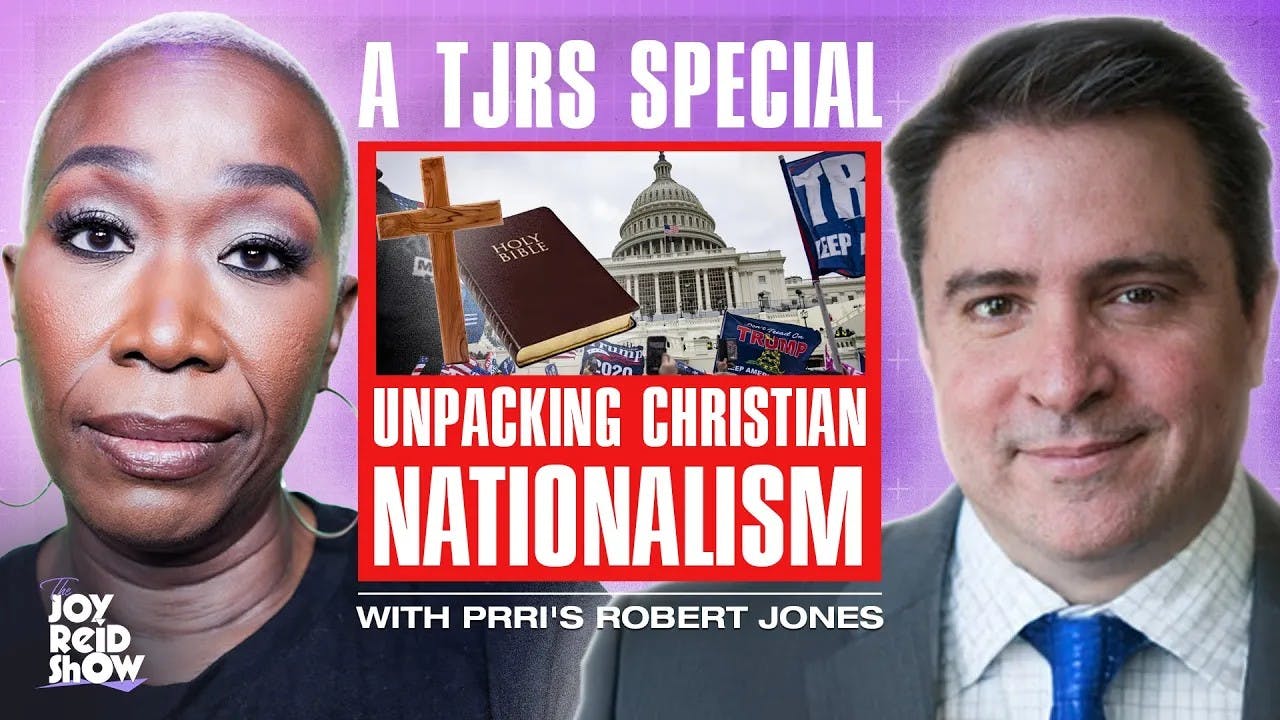
The Joy Reid Show
Unpacking Christian Nationalism ft. Dr. Robert P. Jones | The Joy Reid Show
01:08:36
Loading summary
Transcript248 lines
- [00:00]
Joy Reid
We all love a legendary comeback. And Degree Original Cool Rush is back and better than ever. Cool Rush isn't just a scent. It's a movement, a fan favorite that delivers bold, fresh vibes and all day sweat protection. Whether you have a man that spends hours in the gym, heads into the office early, or is just trying to stay fresh on a long day, Cool Rush has their back. Head to your local Walmart or Target and grab Degree Cool Rush, the fan favorite scent from the world's number one antiperspirant brand.
- [00:35]
Dr. Robert P. Jones
Okay.
- [00:41]
Joy Reid
Welcome to this special episode of the Joy Reid Show. Now, if you haven't hit like and subscribe, this would be a great time to do so. And thank you to everyone who's enjoying the show on YouTube and substack or Spotify or wherever you get your podcasts. Now I think we can all agree and see what's happening in America. Project 2025 is being implemented by the Trump regime at a rapid pace and at base what Project 2025 and its architects, like Russell Vogt, Trump's director of the Office of Management and Budget, are, are white Christian nationalists, something CNN warned about in this blockbuster investigative report that aired before the 2024 election.
- [01:25]
Russell Vought
In an ideal world, I mean, I think we, we, we could save the country in a sense of.
- [01:32]
Dr. Robert P. Jones
You know.
- [01:33]
Russell Vought
The largest deportation in history. And once you, once that starts, there's.
- [01:38]
Joy Reid
Going to be, you're going to be.
- [01:39]
Russell Vought
Winning a debate along the way about what that looks like. Right. And so that's going to cause us get to get us off of multiculturalism just to be able to sustain and defend the deportation.
- [01:49]
Joy Reid
Right.
- [01:49]
Russell Vought
If we're going to have legal immigration, can we get people that actually believe in, in Christianity?
- [01:54]
Dr. Robert P. Jones
Is that something?
- [01:55]
Russell Vought
Or do we have to have, you know, are we not allowed to have asked questions about Sharia law? So I want to make sure that we can say we are a Christian nation. And my viewpoint is mostly that I would probably be Christian nationism. That's pretty close to Christian nationalism because I also believe in nationalism.
- [02:15]
Joy Reid
Behind closed doors. Vote tells us not to take Trump's disavowal seriously.
- [02:20]
Russell Vought
I expect you hear 10 more times from the rally, the president, you know, distancing himself from the left Boogeyman at Project 2025.
- [02:30]
Joy Reid
And you're not worried about that?
- [02:31]
Russell Vought
I'm not worried about it.
- [02:32]
Joy Reid
Okay.
- [02:32]
Russell Vought
He's running against the brand. He is not running against any people. He is not running against any institutions.
- [02:40]
Joy Reid
It's interesting.
- [02:41]
Russell Vought
He's in fact not even opposing himself to a particular policy. He's been at our organization, he's raised money for our organization. He's blessed it from the, you know, I remember walking into our last day in office and told him what I.
- [02:53]
Joy Reid
Was going to do.
- [02:54]
Russell Vought
So he's very supportive of what we do.
- [02:59]
Joy Reid
Our Investigation into Project 2025 began two weeks before the meeting with vote at a conference for religious nationalists in D.C. the truth is Christian nationalism is not a threat to American democracy. Christian nationalism founded American democracy. Today, white Christian nationalists are on a tear, openly bragging about how they've warped Christianity and and even the teachings of Jesus to be not about caring for the poor and the immigrant, but rather about persecuting them. Join ICE today and and make Jesus smile as you with a gun pack foreigners into the back of a van to be kicked out of the country. That is a godly glorious endeavor. You'll get to go to Portland or Chicago and also get to throw libs to the ground too. That was Joel Webbin, a Trump supporting white Christian nationalist pastor who also said on that same Right Response Ministries podcast that shooting and even killing migrants is the more merciful option and that, quote, biblical justice means punishing a few while the rest stand in fear. Webbin, the president and founder of Texas based Right Response Ministries and who is also the senior pastor at Covenant Bible Church in Georgetown, Texas, has previously said that women should not have the right to vote and that Christian parents are failing in their duties to protect and provide for their children if they live in blue states like California. And he and Russell Vote are just two examples of the kind of men who are currently running our country through Donald Trump. Looking for expertise in these matters, the Joy Reed show turned to our friend Dr. Robert Jones, the founder and president of the Public Religion Research institute in Washington, D.C. here is that interview. Hello everyone, and welcome to the Joy Reid Show. We are, as I think you know, in a critical moment in our history when we are facing a political and social schism unlike anything that we've seen in decades. So I decided that we needed to take a step back and take a look at the data behind what we're facing and talk to an expert that might help us to unpack it. And so I am very excited to be joined by my friend Dr. Robert Jones of the Public Religion Research Institute. He is the president and founder and one of the best demographers, particularly of the white Christian cohort in our country. He's the author of the End of White Christian America, a very interesting title and of course the book white too long. Dr. Robert Jones I get to call him Robbie Jones. How are you, Robbie?
- [05:48]
Dr. Robert P. Jones
Great. I'm happy to be here.
- [05:49]
Joy Reid
Thank you so much for being here. I just want to start before I even get to all of the things that you know and all of the things that you've studied and all the research that you've done. I want to talk about you just for a minute. Okay, so look, this is where the Oprah style interrogation begins. Talk to me a little bit about growing up in Mississippi.
- [06:08]
Dr. Robert P. Jones
Well, I grew up as a Southern Baptist in Mississippi, and I was that kid who was at church five days a week. So I was there, you know, and that was normal. So I wasn't like some superintendent. That was kind of what was expected in that, in that, that world. I went to, I did go to public school, which was actually kind of a great gift and giving me a little bit of critical distance from that insular world because it was, I should say, being integrated when I grew up. Right. And I'm 57, so that tells you how long Mississippi drug its feet after Brown v. Board of Education. It wasn't until 1976 that we got our first black teachers, our first African American classmates. I was in third grade, so I remember that.
- [06:52]
Joy Reid
And how mixed was the class? Like, how more time.
- [06:54]
Dr. Robert P. Jones
I think it actually ended up being about 60% white, 40% black. So, I mean, it actually was, you know, I would say, like, I was the one generation that experienced actually integration working in Mississippi. Like, it actually worked. Like we had a fully integrated teacher staff. We had a fully integrated student body, you know, and there was a lot of racial tension. It wasn't a big, huge thing. It just kind of was what it was.
- [07:21]
Joy Reid
Yeah.
- [07:21]
Dr. Robert P. Jones
But there was also a great conspiracy in my white circles about not talking about, talking about why this sudden change had to be made.
- [07:29]
Joy Reid
Right.
- [07:30]
Dr. Robert P. Jones
So that was kind of all back there. But then, you know, but then I, I, I went to Southern Baptist College. I went to Mississippi College. I went to a Southern Baptist seminary on the other side of that. So I've drunk deeply at this.
- [07:42]
Joy Reid
Well, yeah.
- [07:43]
Dr. Robert P. Jones
Of the kind of evangelical world in the south. And then kind of going back to. My people, as we say right down south, are actually all from Georgia. So I was, you know, grew up in Mississippi, but my people six generations back are from, in and around Macon, Georgia. So that's Twiggs County, Bibb County. In fact, my brother, sister and I are the first generation in 200 years not to live in either Bibb county or Twiggs County, Georgia.
- [08:09]
Joy Reid
And so growing up did You. I mean, were you curious about issues of race as a young person? Because you are steeped in studying the, you know, the sort of demographics and sort of societal disconnect when it comes to race. Were you that kid?
- [08:25]
Dr. Robert P. Jones
You know, not exactly. I mean, it's so interesting that when you're in that world, like, it's so hermetically sealed, it's hard to kind of. I feel like I've spent most of my adult life trying to get some critical distance enough to kind of stand apart from it, to see it. Right. Because you're just in it. And I think that's part of the challenge, is that you were in that bubble. It really is hard to see. So when ruptures happen, like the first black kid showing up at school, like, then all of a sudden you go, oh, wait, like, why weren't they here before and. Or why wasn't I there before? And what's that about? Right? And then you start asking very uncomfortable questions that people try to shoe off.
- [09:03]
Joy Reid
Well, what did you, like, give me a sense of, like, sort of what you learned in school. Like, did you learn about Medgar Evers? Did you learn, like, what did you learn about, like, you know, did you learn about Emmett Till? Were those things taught in school? School?
- [09:12]
Dr. Robert P. Jones
Yeah. No, they were not. And, you know, so I said I went to public school, Jackson Public School District all the way through, and I was a good student, right? Graduated top of my class in high school. And so I would say, like, I learned everything. The state of Mississippi thought it was important for a high school student to learn like it was taught. I learned it. And if you had asked me at graduation from high school, tell me something about Emmett Till, who, by the way, was, you know, murdered in Mississippi up in the Delta, I think I would have known his name, but I would have struggled to give you even a sentence other than he was a young boy who was murdered. That's all I would have. But I couldn't tell you anything about the story. If you had asked me about Medgar Evers, who was gunned down in his driveway, which was nine miles from my driveway growing up, I. I would have not known who that was.
- [10:08]
Joy Reid
Interesting. And like, what were. How was slavery and Jim Crow, how was any of that or Reconstruction, how was that explained in school?
- [10:17]
Dr. Robert P. Jones
Well, you know, we didn't. So I had a Mississippi civics class. I had a Mississippi history class growing up. And, you know, we didn't get the full on War of Northern Aggression take, which I think the previous generation for me would have gotten. But we also got. It was that story of. Well, it was complex. It was complicated. Right. Yes. And there were many, many reasons that the Northern and Southern states split. And yes, slavery was one of them.
- [10:44]
Joy Reid
Right.
- [10:46]
Dr. Robert P. Jones
But we never got, like. We never read that speech by the vice president of the Confederacy who says, this is absolutely about. This is a white man's country, and this is what we're fighting the war about. That was not there. And the other overlay that was there was the lost cause. And so there was this glorification of. So in my elementary school days, we weren't celebrating Martin Luther King Day, but we were celebrating Robert E. Lee's birthday growing up.
- [11:14]
Joy Reid
And the black kids were expected to do that, too.
- [11:16]
Dr. Robert P. Jones
Oh, yeah. I mean, it was just. It was on the calendar, right.
- [11:19]
Joy Reid
Yeah.
- [11:19]
Dr. Robert P. Jones
Yeah.
- [11:20]
Joy Reid
And how much interaction did white and black kids have in these integrated schools? Yeah.
- [11:24]
Dr. Robert P. Jones
I mean, you know, what it looked like is a lot, actually. And it ended up being that, like, our sports, our teams were integrated. Right. And so for me, I played sports growing up, played soccer and baseball. But that was one area where I actually found that it did come to consciousness for me. So one quick example, integrated soccer team. We won the state championship. We're going to have this big party, the Moose Lodge in town.
- [11:49]
Joy Reid
Yeah.
- [11:49]
Dr. Robert P. Jones
Offers to give us the pool to have our party until they find out that we have some black kids on the team. And then they rescind because they have a policy that no black kids in the pool.
- [12:02]
Joy Reid
Right.
- [12:02]
Dr. Robert P. Jones
And we all know the old, old history of that.
- [12:05]
Joy Reid
Yeah.
- [12:05]
Dr. Robert P. Jones
But it was still lingering. This is in the 1980s.
- [12:07]
Joy Reid
Yeah.
- [12:08]
Dr. Robert P. Jones
Right. That this is still very much, very much around.
- [12:11]
Joy Reid
So where. So talk to me about, like, sort of where your consciousness flips, where you're like, this is something that I'm interested in and that I actually need to study it.
- [12:18]
Dr. Robert P. Jones
So I think it's there. And it's one of those things where I don't think there was, you know, kind of give the kind of New Testament. No, like, Road to Emmaus, like, epiphany moment where, like, at all the scales fell from my eyes and it all became clear. There wasn't anything like that. But I do think there were these important steps along the way. I credit my parents, I think, for setting some really strong boundaries against racial epithets and stuff that my grandparents would pretty regularly trade in and telling them, you cannot talk the way around. My kids. My parents said that, and I knew they had said that. Like, that was a kind of important boundary. I think these experiences around why can't we have the soccer party here? Right. My church freaking out one time because we had one African American kid come to a youth group event.
- [13:08]
Joy Reid
And.
- [13:09]
Dr. Robert P. Jones
And people freaked out because what happens if they want to join the church? It was like an emergency deacons meeting that got called, like, that kind of thing. And then like little other things. Like, I had a seminary professor actually at the Southern Baptist Seminary who finally told me. And I was like, what, 22. And I had never thought about what the word Southern meant in Southern Baptist. The denomination.
- [13:32]
Joy Reid
Right.
- [13:32]
Dr. Robert P. Jones
So the Baptist. The denomination is the Southern Baptist Convention.
- [13:35]
Joy Reid
Right.
- [13:36]
Dr. Robert P. Jones
And I just thought, well, we're Southern because we're down here and the Northerners are up there. Right. And that is a compass point. And of course, he finally said, actually, right. This is about. So we split in 1845, as the Methodists did, too. The Baptist and the Methodist both split in 1845 over slavery. Very clear what that split was about. And so what that meant was, okay, like, this was about aligning Christianity with a pro slavery movement. That actually serves as the dress rehearsal for the political secession. Right. So the Christians were the dress rehearsal for the political secession.
- [14:16]
Joy Reid
Right.
- [14:16]
Dr. Robert P. Jones
We split first before the country did. So I think it was like moments like that where I was like, okay, like this is the world then that, like, I've got to wrap my head around. I've kind of come up into something that is something more than it seems to be.
- [14:33]
Joy Reid
Yeah. And you. I mean, you. You. You've written a lot of books. I want to talk about the books, but I do want to talk about the Public Religion Research Institute because it is my favorite source of data. You and the Pew Research Institute are the. They're the two places I go first to try to get information. You founded it when and why.
- [14:47]
Dr. Robert P. Jones
Yeah, so we were founded. So Public Religion Research Institute. You'll see it. P, R, R, I. It's hard to say, but you'll see it in print. P, R, R. I've got the gutturals now between the Rs, but we founded in 2009. And so my PhD training was in sociology of religion. I was a math major as an undergrad. So I have always had this kind of quantitative interest in the study of religion and politics. And it was kind of a way. I was at the university, taught for a while at Missouri State University. But I always felt like I wanted to put the work on the ground a little more. This was a way of taking the pulse of American public opinion, tracking demographics in real time and then being Able to put things out quickly. Right. So I think it was about pace and it was also about public influence. And really our mission from the beginning was to help journalists write better stories and to be able to kind of situate an anecdote or on the ground reporting with a broader picture of data. And that's really been our mission. We've expanded a bit since then to support other scholars. So we have a public fellows program now that supports mid career scholars doing work in religion and politics. So we're kind of religion communications and convening now. But still our bread and butter is taking the pulse of what Americans think about politics and religion and tracking demographics and particularly what do religious people think about any policy you want to think about.
- [16:15]
Joy Reid
Okay, what's the most alarming thing that you discovered in all of your years of doing this work about what religious people think?
- [16:24]
Dr. Robert P. Jones
There's a. I'll give you two. There's a recent. Recent one and one, one far back. The, the one far back I think you and I have actually talked about on the show before was when I saw white evangelicals flipping. You know, they used to go by values voters, right? We were, ivotevalues.com was their big website. We vote values. And we had a question that asked about candidate's character and it said, how important is a candidate's character to your vote? And it literally asked about that. And we had at the time like 7 in 10 white evangelicals saying that a candidate who committed an immoral act in their private life could not possibly perform their public duties. Well, that's what you'd expect for somebody who claims to be a values voter. And as soon as Donald Trump would get in the top of the ticket, it flipped. And suddenly only 30% of white evangelicals thought that again. So that one was really disturbing because how quickly a principle can fall away and a whole political ethic could get shifted from a political ethic of principle to one of expediency and utilitarian ends justify the means. And I knew we were in deep trouble when I saw that. I mean, there were of course, other signs. We were in deep trouble already. But that was just like, oh wait, the other one's more recent. It is that we now are showing multiple surveys, not just one. And we've asked this question multiple ways that we are now showing white evangelical Christians supporting concentration camps in this country. And I think if so, I've been working on a new book. The first line of the book is, sometimes numbers can break your heart. It was really an emotional Experience. You're looking at these kind of cross tabs, and there's patterns and columns of numbers. I remember scanning down the line to look for. All right, here's the question. Here's the break for white evangelicals and looking to see that majority support for the erection of concentration camps. And even we add things like without due process, without being able to. It doesn't matter. And it hit me that I'm like, I don't know that it's possible to write a question that is too cruel or too violent with regard to immigrants in this environment, that the people who love to talk about themselves as evangelical.
- [18:59]
Joy Reid
God, the people of Jesus that loved.
- [19:01]
Dr. Robert P. Jones
Immigrants, would not support.
- [19:03]
Joy Reid
Yeah. You know, when I first came to. When the. When prri.org, the public religion Research Institute, first came into my attention was, you said it was founded in 2009. That is perfectly. It's perfect because it was around the Tea Party movement.
- [19:19]
Dr. Robert P. Jones
Yeah.
- [19:20]
Joy Reid
And you guys did some of the scariest data regarding the Tea Party movement. Because I think as a journalist, I felt like my profession was getting the Tea Party movement wrong. They were saying it was economic and anxiety, but it was clear that it was racial anxiety. If you were covering it. Talk about the ways in which Barack Obama impacted white evangelicals and how they view the world.
- [19:41]
Dr. Robert P. Jones
Yeah, yeah. Well, I mean, I think a couple things happened is that we had so just context. First, Barack Obama gets elected in 2008, of course, and at that time, white Christians have been experiencing a decline. I mean, this is kind of what I was writing about in the end of white Christian America. But they were still a majority of the country. So if you just added up all people who are white, non, Hispanic and Christian, 54%, they were still a majority of the country. By the time he gets out of office, eight years later, that number's dropped to 47. So we've got this kind of like, coincidental demographic shift at the time. We've got the black man and the White House, And I think 40. For many Christians. I would say for many white Christians, there are two events that I think were nuclear events for them that had to do with dislodging their perceived place at the top of the pyramid in American culture and politics. One was Brown v. Board of Education. I think that was an absolutely nuclear event. And the other one was the election of Barack Obama. And actually, I would say it's not just the election of Barack Obama, but the reelection.
- [20:52]
Joy Reid
That's right.
- [20:53]
Dr. Robert P. Jones
Of Barack Obama.
- [20:53]
Joy Reid
That it wasn't an accident.
- [20:54]
Dr. Robert P. Jones
It wasn't a fluke. It wasn't an accident. It was like, oh, something's shifted.
- [21:00]
Joy Reid
Well, and not just reelected and elected, but elected first of all, by 10 million votes the first time.
- [21:04]
Dr. Robert P. Jones
Decisively. Yeah.
- [21:05]
Joy Reid
Over the objections of only one group, white Americans, who voted 60, 40 the other way both times. And he still managed to win by 10 million votes the first time, by 5 million the second time by getting 80% of non white Americans. Like, the demographics were very stark. It was very clear that Barack Obama was gonna be president over the objections of most white people.
- [21:25]
Dr. Robert P. Jones
And I think that it's most white people and I should say it's most white Christians. And so we talk a lot about evangelicals, but the other kind of startling number that I think has just been so consistent is since 2000, really, that. So the whole 21st century, that it is majorities not only of white evangelicals, but white mainline Protestant Christians or the non evangelical Christians and white Catholics, all three of them. So, you know, it's typically like more than 8 in 10 white evangelicals, but it's about 6 in 10 white non evangelical Protestants and it's about 6 in 10 white Catholics. And that racial ethnic divide is. Yeah, it's what was behind the Tea Party movement is absolutely what's at the heart and the engine of the. Of the MAGA movement.
- [22:12]
Joy Reid
Right. Because you had a polling, a piece of data that to me was always the most telling. And you did this consistently over the years. Was America better during the 1950s when white men stood at the top of the social pyramid, or after the 1950s? And it was pretty consistent that those who were saying it was better off 1950s and earlier, those were the Tea Party people. And that was the thing that most showed you that they were gonna be both a tea Partier and a supporter of Donald Trump.
- [22:41]
Dr. Robert P. Jones
Yeah. And even we asked straight up questions like people who've said they identify with the Tea Party and asked them did they identify with the Christian. Right. Half of them were like, oh, yeah, yeah, that too. Right, absolutely.
- [22:51]
Joy Reid
Christian nationalists. They're very openly. So you identified the Southern Baptists as splitting over slavery. So the Southern Baptists were pro slavery. You identified Brown vs Board of Education, which was about integration and integrating schools. And then of course, you had the Tea Party, which was about racial anxiety over a black president and over losing control of the country. There's a theme here, right, Is that white Christians, you know, that call themselves Christians are very firmly standing in the anti black, on the anti black side of the line, or the anti integration side of the line. Because immigration, it isn't about white immigrants from Europe. It's about brown immigrants from. So talk about. Have you been able to sort of get to the bottom of where that anxiety comes from? Is it just fear of being a minority? Is it hatred of people who are of other races? What is it? What is it? What is the hate?
- [23:38]
Dr. Robert P. Jones
Yeah, well, I feel like. I mean, I feel like this is the thing I've been wrestling with, right? And I've been trying to understand it with some empathy, right? Because, I mean, again, I mean, I've. You know, my parents still live in Mississippi. My. My siblings still live in the South. So I got plenty of ties and friends down there. And so there is a way which I'm like, you know, like, what's happening? And, you know, it's the place from which I come. But I would say that, like, the thing that's so clear to me is that the reason it's so easy to string that little strand of pearls that you just strung up is because it is the central animating question we've been wrestling with since before the founding of the country. And then when you trace that, the cultural threads back, and that's kind of what I tried to do in the last book. The last book was the hidden roots of white supremacy and the path to a shared American future. I'd ask the question, okay, so what happens if we just keep going back? Where do we end up? And we actually end up, you know, the most proximate cause I identify there was we end up in the 16th century, and we end up with not 1492, the year of the Columbus, but 1493. And that's when the Church issues kind of the last of a set of documents called the Doctrine of Discovery. And they're all about, like, so what do European Christians, how do we deal with all these other lands that we've quote, unquote, discovered how we deal with the people who are there? How do we deal with people in Africa, Right? And the answer is straightforwardly, well, are they Christian? Was the first threshold question. And if they're not, then there's a whole set of things. They basically should be considered enemies of Christ. And then everything follows. You can take their goods, you can take their land, and it even says in the document, and you can submit them. The. They should be submitted to perpetual slavery. Right? That's from the Pope, from the head of the Western church. And so if you ask, like, what version of Christianity landed on these shores, that's where the moral compass was set. And so anything we have that's not. That has been a struggle, like, of people trying to build a different kind of Christianity that isn't committed to white supremacy, that isn't committed to Christian dominion. And so we've had this struggle literally since from before the beginning.
- [25:57]
Joy Reid
Well, and I love this. I almost think you should write a book called the 1493 Project to go along with the 1693 Project, because that is. Because this also coincides with the invention of whiteness itself. Like, whiteness actually doesn't exist. Before this doctrine of discovery, Europeans were French or German or Bavarian or they were all. And they all fought each other and they were all different tribes that hated each other's guts. Right. They were not all considered.
- [26:18]
Dr. Robert P. Jones
Jones. I'm Welsh.
- [26:19]
Joy Reid
Right. You know what I mean? And like, none of them got along and they didn't consider themselves the same group of people. But then you have this invention of this idea of whiteness, which I would argue is the most powerful invention ever created. More powerful than planes, AI or anything else, because it's a concept around which you can organize people who do not have the same interests. So if you are a very poor and you have no land or you're very rich and you're a billionaire, you create an interest that you have in common, which is that you're white. And so you can get the poor white man to go along with things that destroy him, that destroy his own farm, destroy his own family, destroy his religion, destroy his whole self concept, all of it, and make him do evil and go along with it. Because whiteness is more valuable than money. It's more valuable than a great job. Right. It's the most valuable thing in the world to white Americans particularly, and white Europeans. Can you just talk about whiteness itself and the power of it and what you found demographic? I mean, you know, when you look in the data.
- [27:14]
Dr. Robert P. Jones
Well, I'm gonna throw out a little shout out to our friend Eddie Glaud here because I think he was helpful for me in reading his book Democracy in Black. And you know, he's like, you know, you throw out the word white supremacy and it's almost. It's like one of those jargon words. And so people don't always unpack what it really means. Or we just picture, you know, this black and white photograph from the 1920s with some KKK people. And that's way back there. It's not really here in the room. And he's just like, look, we kind of get rid of all the bluster and the Jargon, it really is just about the idea that people who claim to be white, it's just a claim that our lives are more valuable than others and deserve or are entitled to more. And so that's just pretty indisputable, right. Even if you look back just in my own life, in my parents generation, where were the best public parks reserved for the public libraries? Right.
- [28:11]
Joy Reid
The pool.
- [28:12]
Dr. Robert P. Jones
The pool, right, that we were talking about, the beach. I mean, those are all straightforward, like, no, those are white people's things, right? People who can claim that term. And so I think that was super helpful to me. But there was a moment where I realized, like, I had heard, you know, oh, you know, race is a social construct. And like. But it's. Even after knowing that and like, believing. Believing that it took me a little while to not. This is gonna sound crazy, right? But this is the hold it has, I think, on people who grew up thinking of themselves as white. It took me a minute to think, oh, that's about whiteness too. Like, I was just thinking, oh, that's about Asian or that's about black, or that's about the other kinds of categories we have. And I was like, oh, wait a minute, wait, wait, that's about me. And, you know, and I've written in white too long, write a lot about James Baldwin. I mean, that phrase is a Baldwin quote. And there he makes this point. And it was so helpful to me to just like, think, oh, what this means, and I think Baldwin is so onto this, is that white people who still have this hold on us that we think of ourselves as being white, we literally don't know who we are, and that makes us dangerous. Right. If you don't know who you are and you're acting out of this false identity, right, that has this claim on you, and it has a claim on stuff that makes you not a great democratic citizen.
- [29:37]
Joy Reid
Yeah. I mean, and the thing is, it suppresses what normally were other tensions internally, right? The Irish versus the English. Like, that is an actual tension if you go to Ireland. But if you come here and you're Irish, you just subsume yourself in being white. And then you will side with an English person as long as it's not a black person. And it has created a coalition that is really powerful. But in a way, it's hard to believe that it even believes in its supremacy. Because if you feel that you're superior, you don't feel threatened that immigrants from the poorest part of Central America are going to, quote, replace you, or that Jews can Somehow get in a room and George Soros alone can replace all of you. Like, if you really say you will not replace us and that you have to march for that, you don't really feel superior. You're actually afraid of those other people. Right?
- [30:20]
Dr. Robert P. Jones
Yeah.
- [30:21]
Joy Reid
So it's like, it's not even supremacy. I don't know what the term for it is, because. But it is fear.
- [30:25]
Dr. Robert P. Jones
Yeah.
- [30:25]
Joy Reid
And I think when you say that you want to unpack it, even for your own family, it is, what are people afraid to lose? Right. I mean, black people used to have the power of life, and white people used to have the power of life and death over black people. Like any average white person, they didn't even have to have money, could just kill any black person they wanted. Up until like the 1960s, it was perfectly legal. So you had the power of life and death over other people and you basically owned the women in your lives. Right. The women had no rights. So it's like it is that, right? Is it? It's a fear of loss of power.
- [30:55]
Dr. Robert P. Jones
It's power. And I think the thing that may be a little bit deeper than that is that it's also connected to a sense of chosenness and entitlement, but like not just like a kind of thin asserted entitlement, but like a God given entitlement. Right. And there's something about being that special. Right. That I think is also deep, deep in people's like, oh, wait, but if we're not God's chosen ones, who are we?
- [31:24]
Joy Reid
You know, and it has to be sort of discomforting to say, wait a minute, so that guy, Barack Obama can also be the president.
- [31:31]
Dr. Robert P. Jones
Right.
- [31:31]
Joy Reid
Barack Hussein Obama is equal to George Washington, can have the same job. Right. And there's, you can even see it in Trump. Right. This rejection of the idea that, you know, anyone but somebody like him could be president. He comes from an immigrant German family. You know what I mean? The drumps were. They're new to the country in a way too. But he feels that he's entitled to it because he's white. Yeah. I want to talk about the part of it that's turned violent. We just recently had some really terrifying stories. We just had a Mormon church shot up. I mean, in spectacularly horrific fashion, burned this guy, rammed his car into this Mormon church, set it on fire, shot a bunch of people. You then had a guy in North Carolina, literally, boat up to the dock, starts shooting at a restaurant. We've just seen incident after incident. Even the Charlie Kirk shooting. We're seeing What I perceive just from the outside looking in as an epidemic of violence, specifically among white men. The FBI used to quantify this. They don't anymore. But the majority of mass shooters are white men between 29 and 49. When there's a mass shooting, FBI agents assume before, unless they're proven differently, that it's going to be a white guy.
- [32:42]
Dr. Robert P. Jones
Yeah.
- [32:43]
Joy Reid
Do you perceive, because you're looking at the data, is there an epidemic of violence and rage among white men?
- [32:49]
Dr. Robert P. Jones
Yeah. So you're absolutely right about this. I do want to say, as a sign of, like, where we are, the place, the only place you can find the Department of Justice's report on the most recent history of what these patterns of violence look like is on the Internet's Wayback Machine. Yeah, right. Because the DOJ deleted it.
- [33:10]
Joy Reid
They took it down.
- [33:11]
Dr. Robert P. Jones
Right. Because it didn't fit the narrative that they were wanting to kind of push about this. And the one, obviously is the assassination of the Minnesota lawmakers, Melissa Horton and her husband, and another attack there. That guy was a Christian national, a white Christian nationalist. Right. And that's been just scrubbed from completely. It doesn't show up anywhere.
- [33:37]
Joy Reid
Well, Cash Patel pretended he didn't know who Dylann Roof is, who was the white supremacist who went into Charles mother Emanuel and massacred to be false. So Dylann Roof, who followed white supremacist propaganda, murdered nine black parishioners in Charleston in 2015. Do you deny this?
- [33:58]
Dr. Robert P. Jones
I'm sorry, Dylan Ruth Roof.
- [34:01]
Joy Reid
Roof.
- [34:02]
Dr. Robert P. Jones
Can you give me some more information?
- [34:05]
Joy Reid
You head of the FBI, you probably know this. If you don't know, that's fine. I can. You can give me a reminder.
- [34:11]
Dr. Robert P. Jones
I've got a lot in front of me.
- [34:12]
Joy Reid
It was national news. Robert Bowers murdered 11 Jewish worshipers in Pittsburgh in 2018.
- [34:19]
Dr. Robert P. Jones
I do remember that.
- [34:20]
Joy Reid
And it was the deadliest anti Semitic attack. So do you admit that that happened? Yeah, I'm not saying the other thing didn't happen.
- [34:27]
Dr. Robert P. Jones
I'm just asking for a little people.
- [34:29]
Joy Reid
But you can go all the way back to Oklahoma, the Oklahoma City bombing. And you talked about again, you started PRI in 2009. At that time, the Department of Justice, the FBI commissioned a really detailed report about this that went all the way back to the Oklahoma City bombing and started to track this violent extremism that had white nationalist roots. That also. That we're sort of losing that chain of memory. But there's been this problem. It goes back really to the Clinton era.
- [34:58]
Dr. Robert P. Jones
Yeah, no, that's right. And so the question you asked. I think it's important to say that's what the data, what you describe is what the data shows. Right. It is typically white men that are young. I will say that these events, I don't know if epidemic is quite right just because they're still more than we want, but I'm not quite sure. We've kind of seen a full outbreak, but I think we have seen like a degradation and a setting of an environment. Right. That I think cues this up. And so I think that's what I'm worried about is even today that we were listening to President Trump address the military troops. Right? And even there, like, there's this kind of thuggish mentality. And, you know, he was like, yeah, if they spit, we hit. You know, and just this, the Daily Caller has an op ed out earlier a few days ago explicitly calling for violence against progressives. Right on there. And we're not seeing the DOJ investigating, you know, investigating that. So I do think there's an unraveling is what I would say that we're, that we're seeing. And I do think there's more. More to come, unfortunately.
- [36:08]
Joy Reid
And. Well, and you're also seeing, you know, and Donald Trump, who has been stoking violence since he started running for president, saying, you know, calling for protesters inside of his events to be beaten up, saying he'd pay the legal fees if somebody would hurt one of them, and then beginning much worse as he's getting older. And I would say more demented and probably suffering a little bit of mental decline. The idea that they need to erase any history of anyone who isn't a white man. No women, no gay people, no trans people. They are eliminated from the military. The indigenous troops who helped us in World War II, gone. The code talkers, Navajo code talkers, deleted. Medgar Evers, gone. You name it, they're gone. Harvey Milk cannot have a ship named after him. And this. What do you see as behind this desire to erase the history of anyone but white men that Pete Hegseth is leading in the military?
- [37:00]
Dr. Robert P. Jones
Well, I think we see an answer to that question and what's being put. Replaced. Right. So those things are getting erased, but then they're also restoring the names of Confederate yes folks. Right? So it's pretty clear.
- [37:13]
Joy Reid
Right. And those things went up, if people, to be clear, these things did not go up after the defeat of the south in the Civil War. They went up in the 1950s when they're trying to send a message on civil rights to black people. Hey, you're not gonna get these civil rights. We're gonna show you who's boss.
- [37:28]
Dr. Robert P. Jones
Yeah. I mean, I think this is really important. I mean, and again, I think a milestone for me and, like, reevaluating the whole lost cause and all the monuments, it was like actually seeing a graph, a chart of when all these monuments went up. And there's actually two spikes. One is in the 1920s. Right. What's going on?
- [37:45]
Joy Reid
The lynching era.
- [37:46]
Dr. Robert P. Jones
Lynchings. Right. All across the country. Right. And so in. In. And why is there? It's because African Americans are coming back from the war.
- [37:54]
Joy Reid
That's right.
- [37:55]
Dr. Robert P. Jones
And where they died and were wounded and risked their lives for this country, and then being told they got to go back to Jim Crow. Right. And they're like, yeah, no, we're not gonna do that. And so there was this moment of resistance, and that was the violent response to it. And so big bunch of Confederate monumentals. A lot of the ones on the courthouse steps go up during that period. And so what's that about? That's about saying, what kind of a justice are you going to get in this county courthouse if you've got a big Confederate monument standing right there on public. But then the other one is Brown v. Board. Right. Again, which we mentioned. That's when the other ones go up. Right. Say, no, this is us. Right.
- [38:30]
Joy Reid
Yeah.
- [38:31]
Dr. Robert P. Jones
And by the way, my high school, just to tie one more thread back, public high school integrated in the 1950s, changed its name to the Rebels. Right. Before that, it wasn't the Rebels, but in the 1950s, even though they weren't integrated yet, but the threat of integration was there, changes to the Rebels. And so even when I was there, our integrated high schools playing Dixie and flying the Confederate flag. Right?
- [38:57]
Joy Reid
Yeah. It's so interesting, though, because given that the south got whooped in that war, it's interesting. You're putting up generals who lost the war. I think the response should be that the Union side should just put up William Tecumseh Sherman's everywhere. Like, everywhere. You put one of those Lee's up, we're gonna put a Sherman or Ulysses S. Grant, and we're just gonna remind you who the winners were, because you're putting up statues of people who literally lost the war.
- [39:19]
Dr. Robert P. Jones
Yeah, they lost. And they were insurrectionist traitors.
- [39:22]
Joy Reid
Insurrectionist traitors. 100%. Robert E. Lee was a whole traitor. You go through West Point, they literally are putting him up in his rebel grave back up in West Point. That is an insult to every single graduate of West Point. To say, this loser who betrayed you is. Now you have to honor him. And there's a slave in the picture, in the portrait. What is that? I mean, have you been able to sort of unpack that? Is embracing the losing side. We don't have statues to Hirohito. Like, what are we doing?
- [39:49]
Dr. Robert P. Jones
Yeah. I mean, again, I think it's back to this thing of, like, no, no, no. We're the chosen ones. I think it really is back to that and back to this claim that even though we lost the war and this whole lost cause thing was. It's about shame, it's about defeat, but it's also about a reassertion. Like this whole. The south will rise again. Right. I mean, that. I can't take that and get whooped again.
- [40:13]
Joy Reid
And by the way, also got whooped by a bunch of black troops who signed up to carry arms and shoot the former slaveholders. It's like, y' all got whooped by your former enslaved people. Like, let's just be clear.
- [40:23]
Dr. Robert P. Jones
And it's deep, Right. Because, like, the verse to the Star Spangled Banner, we don't sit sing has some references and some very, like, degrading references to those black soldiers that were fighting.
- [40:36]
Joy Reid
That's right.
- [40:36]
Dr. Robert P. Jones
Yeah.
- [40:37]
Joy Reid
And that they were gonna go to hell. I think basically, essentially, that's the third stanza of the national anthem, which is why it's hard for a lot of black folks to sing the national anthem. It is a weird way to. A thing to embrace. You know, I've always thought that America the Beautiful should actually be the national anthem. Personally, I think it's a prettier song, easier to sing. But, yeah, I think for a lot of black folks, they hear that anthem, they're like, I'm offended. I don't know that I really want to embrace it. And yet people are. It's demanded that people embrace it. The same way you're seeing this demand that people sort of laud Charlie Kirk. What did you make of that? This sort of demand that even black people take the knee to Charlie Kirk, that they somehow say that he was a great man or vote to enshrine him in a congressional record. What was that about?
- [41:19]
Dr. Robert P. Jones
Yeah, I mean, it's just about fear. Invoking fear. Right. Because what's behind that? It's not just a demand, but there's an active threat.
- [41:27]
Joy Reid
Oh, absolutely. You'll be fired if you don't.
- [41:29]
Dr. Robert P. Jones
You could lose your job. And 150 some odd people have lost their jobs. Right. Because of this, because of speech. Right. Free speech. But the other thing is just last week, the last thing, one of the last things Trump did on his way out the door for the weekend was sign a memoir that tiptoes up to the line to saying, like, if you offer criticisms like this, we're gonna label you a domestic terrorist. Right. And then we're gonna put the full force of the Justice Department after you, your organization, and, you know, and you got Stephen Miller posing and saying, we're gonna take your money, we're gonna take your livelihood. You know, we're coming at you for speech.
- [42:06]
Joy Reid
Right.
- [42:06]
Dr. Robert P. Jones
And that's kind of. So I think it was a. It was a, like, for, you know, you've said it, I've said it. I mean, awful, right? Event that none of us could celebrate, should celebrate. I mean, it's awful, right? Everybody should be able to have. But to take an event, you know, that somebody was gunned down for free for speech and then flip it on its head and turn it into ending free speech.
- [42:30]
Joy Reid
Right.
- [42:30]
Dr. Robert P. Jones
It's like we're in a world upside down.
- [42:32]
Joy Reid
We are in a strange place. Let's talk about where we're going. Because one of the reasons I definitely wanted to have you on the show is to talk about scaring is caring, as we love to say, to talk about kind of where we're headed in terms of speech. It does feel like the federal government under Donald Trump is attempting to shut down any dissent, any dissent at all. They're gonna label it antifa. You guys, you do the data. My take is that antifa is not real, that there is no. There's no such thing. It's just anti fascism. But if you're saying anti fascism is a crime, doesn't that mean you're a fascist?
- [43:03]
Dr. Robert P. Jones
Well, that's the tortured logic, multiple point, tortured logic they're trying to set up here. That's right. That if you use the word fascism, that by itself is a call for violence. That's what they're claiming. Which of course it's not. No, and I really think it's. Because I'll just give you a couple of concrete examples. Donald Trump has used words that come straight from Mein Kampf, Right? So now I'm not gonna use the word fascist in some loose way, but, like, those are fascist words. And what he said is immigrants, right. Coming and brown immigrants coming to the country are poisoning the blood of the country. Like, that ought to send a chill up any American spine, Right? Because we. We hope we learned our lesson from the Holocaust and wear that kind of language. He's Talked about the left and others being vermin. They need to be rooted out and exterminated.
- [44:06]
Joy Reid
Right?
- [44:06]
Dr. Robert P. Jones
I mean, and you have to be able to say, like, look, that's not just, like, fascist, like, language. That's actually fascist language. Right? And we, as, like, Americans, who care about democracy, who care about freedom, who care about liberty, all of that for everyone, have got to be able to say, like, no, no, no, no, no. That's not us. That's not where we want to go.
- [44:30]
Joy Reid
Yeah. He's also himself called Kamala Harris a fascist and a communist, which are the two opposite things. So he thinks that people can be a Marxist and a fascist and a communist all at the same time, just so that he can use the word fascist against someone else. And apparently that's fine. But in terms of the amping up of the rhetoric, both on the ridiculous side, like, putting out this insane video that has Hakeem Jeffries in a mustache and a hat, and AI with Chuck Schumer saying insane things, like goofy and stupid things, saying there are med beds, which are not real, but on the other side, really sinister kinds of things. I just looked this morning on the Department of Housing and Urban Development's website in which they are violating the Hatch act by lying and claiming Democrats want to shut the government down, which is the opposite of true. We've lost the Department of Justice. I don't think there's a Supreme Court anymore. It's all in the service of this man. We've gone so far down the fascist authoritarian path. How bad is it?
- [45:32]
Dr. Robert P. Jones
It's bad. It is happening here, right? To that thing. We often think, yeah, it can't happen here, but it not only can, it is happening. I mean, I feel like everywhere I speak now, I'm trying to say, look, look, look, wake up. Like, it is happening here. The place my mind went to, I spent way too much time looking at the Department of Homeland Security's Twitter feed, and I should just invite everyone to do that, because I think there. What I'm worried about is that they just got a truckload of money. They can have more money than the.
- [46:11]
Joy Reid
Coast Guard and most militaries around the world.
- [46:15]
Dr. Robert P. Jones
Yeah, right. And it's going to be. I mean, it's going to be Trump's private militia, right? To be deployed all over the US and it's a Gestapo. They're just gearing up. But, I mean, the ads on there, too, are all shot through with all of this Christian nationalism motifs. These pie. You know, we're talking about, like, manifest destiny and this whole, like, America is a destined to be a white Christian promised land. That stuff is all running through our Department of Homeland Security. Right. And like, to the point where they're even putting up, like, things like this little pioneer couple. White, white pioneer couple. Right. I don't know if you saw this little image, this little white pioneer couple in a covered wagon on the prairie with a little baby, little white baby with a Bible on the little barrel inside the wagon. And, you know, and our government is posting defend your homeland above that photo. So, you know, I think this is, this is. I mean, yeah, it's. You have to laugh because it's absurd. But, like, they're serious.
- [47:21]
Joy Reid
Yeah, no, they're. So does this in your mind explain partly explain Donald Trump's zeal in favor of Israel? Because that narrative parallels what Israeli settlers, many of whom are coming from the United States, are doing and saying in the West Bank. Right. And they're saying, we're the pioneers who. This is our land, we own it. And if you're a Palestinian and you have a farm there, we can put a gun to your head and take it and we can do whatever we want to you. And we have the backing of the Israeli military and the police. And you have no rights. You have no rights that we need respect. I feel like that same sort of Jim Crow, you know, you know, colonizing mentality is happening. Do you think that is one of the reasons that Christians are the biggest supporters of this right wing government in Israel? There's far more than Jewish Americans.
- [48:12]
Dr. Robert P. Jones
Yeah. Oh, absolutely. There's no doubt about that. I mean, that ought to tell us something right there, that you do see this divide. Right. I will say this, that we are seeing the tide turning in public opinion on this.
- [48:23]
Joy Reid
Outside of Christian nationalists, it is completely gone the other way.
- [48:27]
Dr. Robert P. Jones
Yeah. So now we're seeing slightly more Americans saying they more have sympathy for the Palestinians than the Israelis. You know, about 31% saying both, but it's slightly more now. And that used to be the other way. Every age group now says that Israel should shut down their military even if they don't get the hostages back. Even you put that in. Still, majorities of every age group in the country say that. So the tide is turning. But I do think that white Christians in particular and white evangelicals have this biblical narrative that does have them kind of enmeshed in this as a cosmic spiritual war. Right.
- [49:01]
Joy Reid
Oh, and by the way, Bibi Netanyahu knows that.
- [49:03]
Dr. Robert P. Jones
Yeah.
- [49:03]
Joy Reid
And when he speaks, he's not speaking to Jewish Americans. He's speaking to white Christians.
- [49:08]
Dr. Robert P. Jones
Yeah. So the. A moment went early on back in 2023, he gave a speech and he cited the Amalekites.
- [49:16]
Joy Reid
Yes.
- [49:18]
Dr. Robert P. Jones
And now Amalek, he said, oh, yeah, yeah. So you don't. Most people are like, what is that? What's that about? Right.
- [49:25]
Joy Reid
Yeah.
- [49:25]
Dr. Robert P. Jones
But, you know, you go look it up. Right. It is, you know, back in Deuteronomy, it is a command for the Israelites to wipe the memory of a people off the planet, kill their oxen, kill their wives. It's one of the most violent passages in all of scripture.
- [49:44]
Joy Reid
Yeah.
- [49:45]
Dr. Robert P. Jones
And so just to throw that out. Right. Knew exactly where that was landing. And it did echo for me today, or in this, this week, this ominous language of Netanyahu saying, yeah, if you don't accept this unilateral deal we're about to just throw on the table, we're going to finish the job. And Trump, using the same language, you will have the full backing of the United States to finish the job. Now, to me, that's genocidal language. Finish the job. That's final solution. Like, what else can finish the job mean? Especially you've got a person citing this biblical passage of blotting their memory from the planet.
- [50:28]
Joy Reid
Right.
- [50:30]
Dr. Robert P. Jones
But I think that white evangelicals and Hegseth, I should say, like, he talks about this as a spiritual war.
- [50:36]
Joy Reid
Yeah.
- [50:37]
Dr. Robert P. Jones
So this is our Department of Defense, who loves to parade around calling himself the Department of War, which it's not, by the way.
- [50:43]
Joy Reid
It's still the Department of Defense.
- [50:44]
Dr. Robert P. Jones
Right. But there's a reason for that. Right. I mean, you know, he's. And he's got crusader tattoos all over him on his body.
- [50:51]
Joy Reid
Absolutely. And so when you transfer. I feel that what's happening in Israel and what's happening here are very much parallel because there is a desire, in my opinion, to do ethnic cleansing here as well. That there is this fear of becoming a minority and that this right wing. You know, it's interesting, Bishop William Barber says we should call them religionists, not Christianists.
- [51:10]
Dr. Robert P. Jones
Right.
- [51:10]
Joy Reid
Because there's nothing Christian about it. But, I mean, we are where we are. Their desire is to eliminate as many brown people, who, by the way, are also Christians, for the most part, to eliminate them from the country, to remove them, to physically remove them, wipe them out. And that is also a genocidal impulse, in my opinion. Is it in yours?
- [51:28]
Dr. Robert P. Jones
Well, I mean, look, this is not theoretical. Right. I mean, we often, I think, don't go far enough back. And that's kind of one of the things I did in the hidden roots of white supremacy. Like we carried out a campaign of genocide against Native Americans in this country. Right. So it's not like it's some theoretical thing that we don't have any experience.
- [51:46]
Joy Reid
With and wiped 90% of them off the face of the earth.
- [51:48]
Dr. Robert P. Jones
Yeah. I mean, we, you know, that's. That's what happened. And when you see all these, you know, things that were founded in the 1830s, like my Alma mater, Mississippi College, a good Baptist college, founded in the early 1830s. Why is that? Because we forcibly moved all the Choctaws off the land in 1830. Right. Following the Indian Removal Act. Right. So. And huge numbers of them die. Right. Because they're not provisioned, all that. So, like, yes, we have that impulses. And to that that thing about religionists versus Christians, like, this may be the sociologist in me, maybe it's the theologian in me. I want to insist that we call those people Christian. And the reason I want to do that is because that's what they call themselves. Maybe the sociologist in me, but maybe the theologian in me is like, I want Christianity to wrestle with that thread of Christian, because it's always been there.
- [52:38]
Joy Reid
Yeah.
- [52:39]
Dr. Robert P. Jones
Right. And the job, I think. Right. Of every generation is you want to bring forth the best in a religious tradition. Right. And the thing, I've been so, as a, you know, studying history that religions are malleable things, you know, and, like, if we want the tools of that religion to shape them into swords, it'll oblige. And if we want to turn it into plowshares, it will oblige. Right. But that's up to us, like, what we're going to do with that. So I kind of want to say no, no, those people are Christian, and we don't want to. If we, as other Christians don't want to be, like, associated with that, like, we got to do something. We got to create a movement. Right. That's going to create something else.
- [53:16]
Joy Reid
Well, I mean, and Christianity has been many things. It's done the Crusades, you know, 1066, they set off from Normandy or whatever, and they said they were going to just wipe out everything in the Middle East. They've done the Crusades, they've done the Inquisition.
- [53:27]
Dr. Robert P. Jones
That's all us. That's kind of what I want us to say. Yes, that is us.
- [53:30]
Joy Reid
It's all part of it. It's absolutely part of it. But it's also been an abolition movement. I mean, there have been parts of Christianity that are beautiful. Right.
- [53:35]
Dr. Robert P. Jones
That's us too.
- [53:35]
Joy Reid
And that's us too. And so that is where I want to make this is kind of solutions like what do we do? I mean, if you've got people that are so culturally steeped in it, and I do believe MAGA is its own religion, it is a sect of Christianity and it has got people in a chokehold. How is it even possible to reach those people? Or do we simply need to organize against them, overwhelm them and sort of lock them off from power?
- [54:03]
Dr. Robert P. Jones
I think it's a little bit of both. And I do think this is where I would say many progressive Christians who don't want that vision of the country have been a little naive. And so I think it comes from a good place. We want a big tent, we want to talk across the divides, we want to reach across. All of that comes from a good place. But I think we've got lessons from other places in the world and lessons from history that we admire. So, like the Confessing Church in Germany, Dietrich Bonhoeffer and others had to get to a point where they would say, you know what, if the right church is on the platform, we're not going to be on the platform with them. We're going to delegitimize that vision of Christianity. We're going to say we're doing something else. We're not going to pretend like they're just red and we're blue. Right? They're doing something that we think is evil. We're doing something over here and we're going to try to take a stand. So I do think we're going to have to draw some lines.
- [55:00]
Joy Reid
For instance, black pastors need to stop letting these right wing MAGA Republicans get on the pulpit. Because, you know, when we come around to King Day, they want to get online, you know, get on the pulpit and say that one line they remember from King, but then they go and they live right wing mega Christianity. So maybe they shouldn't be on their pulpit.
- [55:14]
Dr. Robert P. Jones
I think we're going to make some hard decisions. I do think that's right because like I, we're so tempted, I think on the left, like progressives are so tempted to make everything about, oh, it's polarization that's the problem, right? So if we can address polarization, we can get everybody back together. But like, that wouldn't have worked in the civil rights movement to say we were just, we're just divided, right?
- [55:34]
Joy Reid
We just disagree on whether black people should have human rights.
- [55:38]
Dr. Robert P. Jones
No, but, no, like there's a justice question here. There's a constitutional question. There's liberty and freedom and justice and principles that matter. Right. And we disagree over those things. And I think that's the thing we gotta figure out. You know, it's an art. I don't have the ten step plan, but I do think we gotta be willing to say like, yes, we want to build bridges, we want to build a big coalition as big as we can. But that old movie, Bridge on the River KWA is coming to my mind right now. But like, so just for everybody who doesn't know, that movie was about prisoners of war who were conscripted to build this bridge, but at night they were planning to blow it up. Right, right. And I feel like too often, like we want to just reach out to anybody and you know, we build going to kind of recruit people to build the bridge who are just going to go at night and strap dynamite to the piers. And we got to be wiser about that. I think if we really. Because I do think we're at a place where we got to figure out how to save the country. That's where we're at. And so we can't play at this. I mean, it's time to make some hard decisions, I think to make some people uncomfortable, some people angry. But we have to draw some lines. But those lines aren't drawn to demonize other people. Those lines are drawn to protect our deepest principles and the most vulnerable people among us.
- [56:55]
Joy Reid
And doesn't that require figuring out a way to de radicalize young white men? Because you know, I see the sort of replacement for the Charlie Kirk version of what I would consider right wing radicalism. Anti black, anti woman, anti gay, anti trans, just radicalism. But that was mainstreamed onto college campuses. But remember Campus Crusades for Christ? We're around the same age, but that used to be the way. And it was just like some nice evangelicals that just wanted you to read the Bible. And then it's Turning Point usa, which is a billionaire funded right wing movement to try to essentially radicalize young conservative white Christians. That radicalization has gone pretty far. Cause now we're at Nick Fuentes level where that's the most popular sort of strain of conservatism among young white men. Or at least it's one of the most popular. How do you de radicalize those young men?
- [57:42]
Dr. Robert P. Jones
I don't know. But what I do know is that there hasn't been like here's what I always think the far right has understood is that there is the work that they've done in the realm of culture has been huge. Right. I think far too often what you hear from the left is it's about kitchen table issues and we're going to kind of out economic policy. Right.
- [58:08]
Joy Reid
It never works.
- [58:09]
Dr. Robert P. Jones
Meanwhile, the hearts and minds are getting one over here on very different terrain.
- [58:13]
Joy Reid
And by the way, just not to cut you, but that is the power of whiteness. Whiteness overcomes economic. This whole idea of economic anxiety. People can be the most economically anxious. They will still vote their race.
- [58:24]
Dr. Robert P. Jones
Yeah.
- [58:24]
Joy Reid
They will still vote for whiteness over money, over having good job, having a home. They don't care. They just want the whiteness more than anything else.
- [58:33]
Dr. Robert P. Jones
Yeah.
- [58:33]
Joy Reid
Culture matters.
- [58:34]
Dr. Robert P. Jones
More power, self perception, all of that. Yeah, it is absolutely more powerful. I think we've got to figure that out. The thing I absolutely don't think is going to work is like, donate a Charlie Kirk on the left. Like, that's not the, you know, kind of cookie cutter. Like, take this and we're going to.
- [58:50]
Joy Reid
Do it over here. Yeah, that's Joe Rogan. That is the key.
- [58:54]
Dr. Robert P. Jones
No, that's not going to work. That's not going to work. Right. But something that's kind of authentic. But I think there just hasn't been investment in this space among progressives. Right. And so there's a lot of talented people out there with the right kind of investment that can be counterweights. Right.
- [59:09]
Joy Reid
Yeah.
- [59:09]
Dr. Robert P. Jones
To this. But they just. I think the investment hasn't been there on the left because I do think it was. We'll win the next election. That's all that matters.
- [59:15]
Joy Reid
Yeah.
- [59:15]
Dr. Robert P. Jones
We'll do some economic policy, register to vote.
- [59:18]
Joy Reid
That's the key. It's like, yeah, that isn't enough.
- [59:19]
Dr. Robert P. Jones
But the deep infrastructure that's going to build a movement over time. That investment just hasn't been.
- [59:25]
Joy Reid
So just to bookend what I asked you before, what's the scariest piece of data that pri.org has right now that sets you back?
- [59:34]
Dr. Robert P. Jones
Yeah. Well, we asked another question. When you're running a survey question, you try to put your finger in the wind. And which way is the wind blowing? What winds are blowing? And we decided to try to go straight at the question of Trump being a dictator. It's hard to do that directly. So we set up as a paired opposite question. Okay. So we're going to give you two statements. Which one do you agree with more? And so we want to give people both places to go. So one is like, Donald Trump is a strong leader, should be given the power he needs to make America great. Again, right straight out of the script. And the other one is Donald Trump is a dangerous dictator whose power should be limited before he ruins the country. Right. On that side, we do have right now a slim majority of Americans saying, Donald Trump is a dangerous dictator whose power should be limited. But it's like 52%. But on that thing. But who is on that other side? All the white Christian groups are on the. No, no. He should be given the power he needs to make America greater.
- [60:38]
Joy Reid
Including the Mormons, right?
- [60:39]
Dr. Robert P. Jones
Oh, yeah, the Latter Day Saints, white evangelicals, white mainline Protestants. It's the voting block, the white Christian voting block. I mean, the only post election, kind of postmortem piece I wrote was something for Time magazine and I just called it what White Christians have Wrought. All of them. Right, right.
- [60:57]
Joy Reid
Because if you look at white who are non aligned with a religion, who are less religious, Those are the 40% of white Americans.
- [61:03]
Dr. Robert P. Jones
The non Trumpers.
- [61:04]
Joy Reid
The non Trumpers. Yeah. Yeah. So that is. So we are in a moment when white Christian nationalism is here. It's radicalized an entire religion or all the different sort of facets of that religion. If we can't do anything about that, how do we end the passivity of the people on the other side who seem to be willing to watch Dancing with the Stars and just live with it?
- [61:24]
Dr. Robert P. Jones
That's the question. Right? Because if you go to a Holocaust museum, you kind of think about those educational programs. They kind of distinguish between the perpetrators, the worst of the worst, actually doing stuff. But then there's the sympathizers, people who are like, yeah, we're good with that. But then there's that big bystander group, and that's actually always the biggest. There's resistors over here, but the biggest group is always the comfortable, the oblivious bystanders that you're talking about. Like, yeah, watching reality tv. So I think the question is, like, how do we. Yeah, we wake those people up. And the thing is that we're actually not in a 50, 50 country. I should like, be clear about that. Right. So our weird electoral college and all that and the number of people that don't vote. So just to kind of give it, you know, Donald Trump did not get to 50% of even the people who voted. That's right. And we had more than 30% of the country, like, not vote. We had. We had, in fact, more people not voting than voted for either candidate.
- [62:21]
Joy Reid
He got 49% of 31%.
- [62:23]
Dr. Robert P. Jones
Yes, that's right. Right. So kind of remember that. So that we're not in a 51% MAGA country. And when you look at the other issues, like more than 6 in 10Americans believe in a path to citizenship for people who are undocumented in the country. That's what they really want in terms of policy. A humane, practical solution.
- [62:42]
Joy Reid
Not masked men tackling brown people in the street.
- [62:44]
Dr. Robert P. Jones
Right. Not deportation. Not even secondary. Like some kind of second class citizenship. We gave them that option too. But like 60% want a pass to citizenship. We ask about like you support this Christian nationalist thing. We have a very sophisticated scale. It's only three in 10Americans that really are on board with that vision. Six in 10Americans reject that vision. The great replacement theory. Two thirds reject. So like all up and down the line. This is not where the country actually is. But the problem is that enough of those people are willing to stand by and let it go that way. And I think that is the central challenge we're facing.
- [63:20]
Joy Reid
Anything I've missed that scares you, frightens you, or that you want to uplift in a positive way?
- [63:27]
Dr. Robert P. Jones
I will say we're seeing some signs of resistance. I want to give a shout out just. And they're in some ways with Congress sitting on their hands.
- [63:38]
Joy Reid
Yeah. Being useless.
- [63:39]
Dr. Robert P. Jones
Yeah. There's little other people can do. Right. But there are little moments and I think these all matter. So I'm just going to give you one. So back when. And this is also another cultural signal back when Donald Trump decided one of the most important groups to bring into the country were white Afrikaners. That's right, right. Who were being persecuted in South Africa. And in order to do that, he actually told people to stop resettling Afghanis who helped us.
- [64:13]
Joy Reid
That's right.
- [64:14]
Dr. Robert P. Jones
In the Middle East. Right. Stop doing that and do your resources to bring these Afrikaners here. And there were a lot of people who just caved because they get money from the government and they were telling them, you're not going to get any more government any more money if you don't do this. The Episcopal Church stood up and said, no, we're not going to do that. We're not going to play a two bit part in your white supremacist morality play. We're not going to do it. They end up shutting down their refugee that they'd had for three decades, but they just were not going to participate. I think that kind of non participation resistance in addition to public protests, but I think that kind of non participation across the board helps slow down the gears, you know, and that's going to be important. But that's going to have to happen everywhere.
- [65:02]
Joy Reid
Yeah. Okay, bonus question. I know I said this was my last question, but bonus question. The Supreme Court majority, the majority of them are white conservative Catholics. When you look at the data, are conservative white Catholics to the right of white evangelicals or are they just equally right wing?
- [65:20]
Dr. Robert P. Jones
No, it's a great, great question. No, in fact, I mean, so, you know, the difference is that like white evangelicals are like 85% all in for MAGA and Trump, but white Catholics are like 60, 40, like 60% in for MAGA and Trump. So. And on the key questions, like we've seen like, for example, this always like draws jaws drop whenever I say this in a big public setting. But if you ask white Catholics what do they think about abortion, most of them support the legality of abortion. If you ask white Catholic what they think about same sex marriage, most white Catholics actually support marriage equality. So they're not.
- [65:55]
Joy Reid
Catholics are generally pretty chill.
- [65:57]
Dr. Robert P. Jones
Yeah. They look like the country basically, almost.
- [66:00]
Joy Reid
I mean, their church services are an hour long. They're in and out in an hour. That just tells you that they're not radical because they're not in there.
- [66:06]
Dr. Robert P. Jones
Like the most of the culture war issues. They're basically where the country is, which is to say 60% in the land of the saints.
- [66:13]
Joy Reid
So those six that are on the court, they're just basically political radicals. They're not really religious radicals.
- [66:18]
Dr. Robert P. Jones
Well, I mean, again, I don't want to like let religion off the hook here. I mean, I think it actually mattered. That religious worldview is fueling it for them, definitely, Alito. But it is part of that kind of right, far right Christian nationalist world where it's a Christian nationalist country and white straight men should rule overall.
- [66:39]
Joy Reid
Yeah. And I think Clarence is just getting the vacation. I think he's just whatever. He's getting money. He's like, you're paying me to say it, I'm going to say it. I don't think he cares. Dr. Robert P. Jones. Robbie Jones, to me. Thank you very much. I appreciate you.
- [66:50]
Dr. Robert P. Jones
Thanks.
- [66:50]
Joy Reid
We're going to keep doing this because this is one of our goals, is try to unpack this stuff on a regular basis. I appreciate you agreeing in advance to come back and let's do this on a regular basis and we'll, you know what? If we can't fix it, at least we can talk about it and we'll cry together. How about that? We won't be crying alone.
- [67:05]
Dr. Robert P. Jones
Yeah.
- [67:06]
Joy Reid
Robbie Jones, thank you very much.
- [67:08]
Dr. Robert P. Jones
Thank you.
- [67:09]
Joy Reid
Thanks so much. To Robbie Jones and you can visit the Public Religion research institute@prri.org and see all of their great research. You'll also find Robbie Jones books in our store at shop.joyannread.com or shop.joyread.com and be sure to let us know if you love your print purchases by posting to your social media with the hashtag Wearing Joy or the hashtag Readers. Be sure to hit that like and subscribe button and share this episode and we will see you on the next Joy Reach Out Getting back to the basics Grassroot level Let me dig a little deeper with the shovel Plenty.
- [67:49]
Dr. Robert P. Jones
Can't tell the forest from the trees.
- [67:50]
Joy Reid
And I'm hard to detect Like a black hole in the dark Injustice anywhere.
- [67:55]
Dr. Robert P. Jones
It's a threat to justice everywhere Let.
- [67:57]
Joy Reid
Me make this clear I got a bone to pick and I'll never fear the threat Apart they don't want to talk about it they rap the party so I'm a real talk about it for sure.
- [68:07]
Dr. Robert P. Jones
This episode is brought to you by Lifelock. It's Cybersecurity Awareness Month and Lifelock has tips to protect your identity. Use strong passwords, set up Multi Factor authentication, report phishing and update the software on your devices. And for comprehensive identity protection, let LifeLock alert you to suspicious uses of your personal information. Lifelock also fixes identities theft, guaranteed or your money back. Stay smart, safe and protected with a 30 day free trial at lifelock. Com. Podcast terms apply.