
Podcast
The Kākā by Bernard Hickey
Hosted by Bernard Hickey · EN
101episodes
Episodes
Newest firstAll episodes
Unemployment worse than forecast & real wages fall
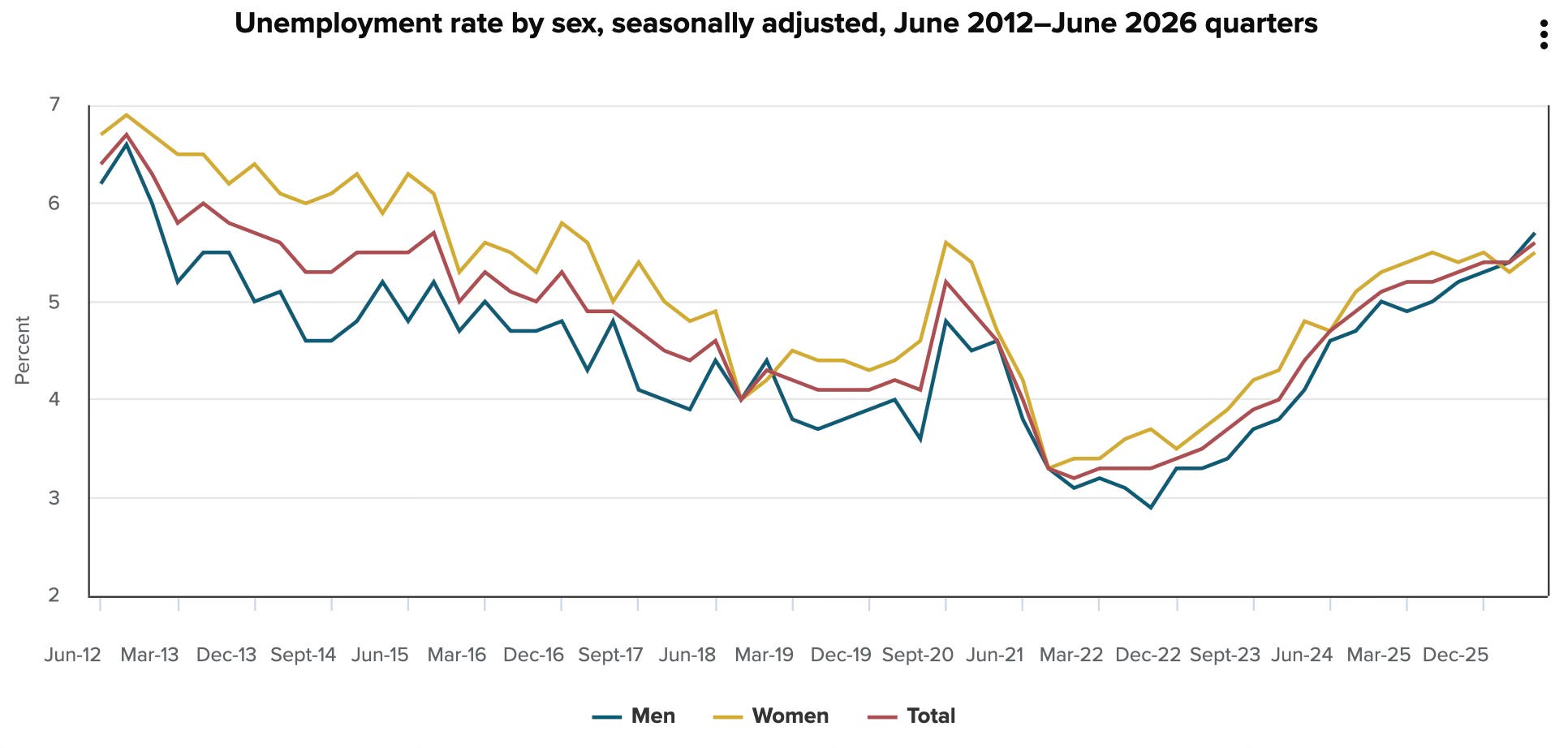
4d ago00:05:37Tap to summarizeIt couldn’t have been much worse. Unemployment rose and real wages fell. Unemployment rose more than expected to an 11-year high in the June quarter, while real wage deflation of 2.1% in the quarter added to the pain for home-owning households and voters now facing higher interest rates and lower housing wealth barely three months to go before the election.Yet this increase in the number of unemployed to 171,000 people, including 94,500 young people and 69,300 who have been unemployed for more than six months, happened during a year when 111,000 new temporary work visas were issued to workers from overseas. It has also happened just before the Reserve Bank decided the labour market was so tight it was creating an inflation problem that needed higher interest rates to create more unemployment to fix.Unemployment rose more than expected to an 11-year high of 5.6% in the June quarter, while the under-utilisation rate rose to a 13-year high of 13.8%. Economists had expected around 5.4%. That unemployment rate was up from 5.4% in the March quarter (revised up from 5.3%), while the under-utilisation rate was up from 12.9%. The unemployment rate for 15-24-year olds who were Not in Education, Employment or Training (NEET) rose to 13.8% from 12.9%, with the number rising by 7,300 to 94,500.The overall number of fully unemployed people rose 8,000 to 171,000, with 69,300 of those unemployed for more than six months. Meanwhile, the number of under-utilised people rose by 31,000 to 440,000. Of those, 255,700 were aged 15-34, up 33,000 from a year ago. The underutilisation rate for 15 to 24-year-olds rose from 33.6% to 37.0% percent over the year. The number of underutilised people in the 15-24 age group increased by 21,500 annually, with the largest increase in underutilisation coming from unemployment (up 12,200 over the year).This came after the number of people employed rose 13,000 in the June quarter from the March quarter to 2.905 million, but that wasn’t enough to keep up with the growth in the labour force of 21,000. That was driven by a 16,000 rise in the working age population and a rise of 5,000 because the participation rate rose to 70.7% from 70.5%.Wages fell 2.1% after adjusting for inflation; Retail wages at 26-year lowWage growth was also weak and below the Consumer Price Inflation rate. The Labour Cost Index measure of annual wage growth was 2.0% in the June quarter, which was below the CPI inflation rate of 4.1%, meaning real wage deflation was 2.1% in the June quarter. Real wage deflation was greatest in those jobs where discretionary consumer spending was weakest.Average total hourly earnings in the retail sector were unchanged from a year earlier at $33.66 per hour. That was the lowest retail wage inflation since the September quarter of 2000, when average retail wages fell 0.3% from the same quarter a year ago.A Government has never been re-elected during a period when real house prices and real wages are falling at the same time. The Labour Force data for the September quarter will be published on November 4, three days before the election.Many thanksBernard This is a public episode. If you'd like to discuss this with other subscribers or get access to bonus episodes, visit thekaka.substack.com/subscribe
Transcribe →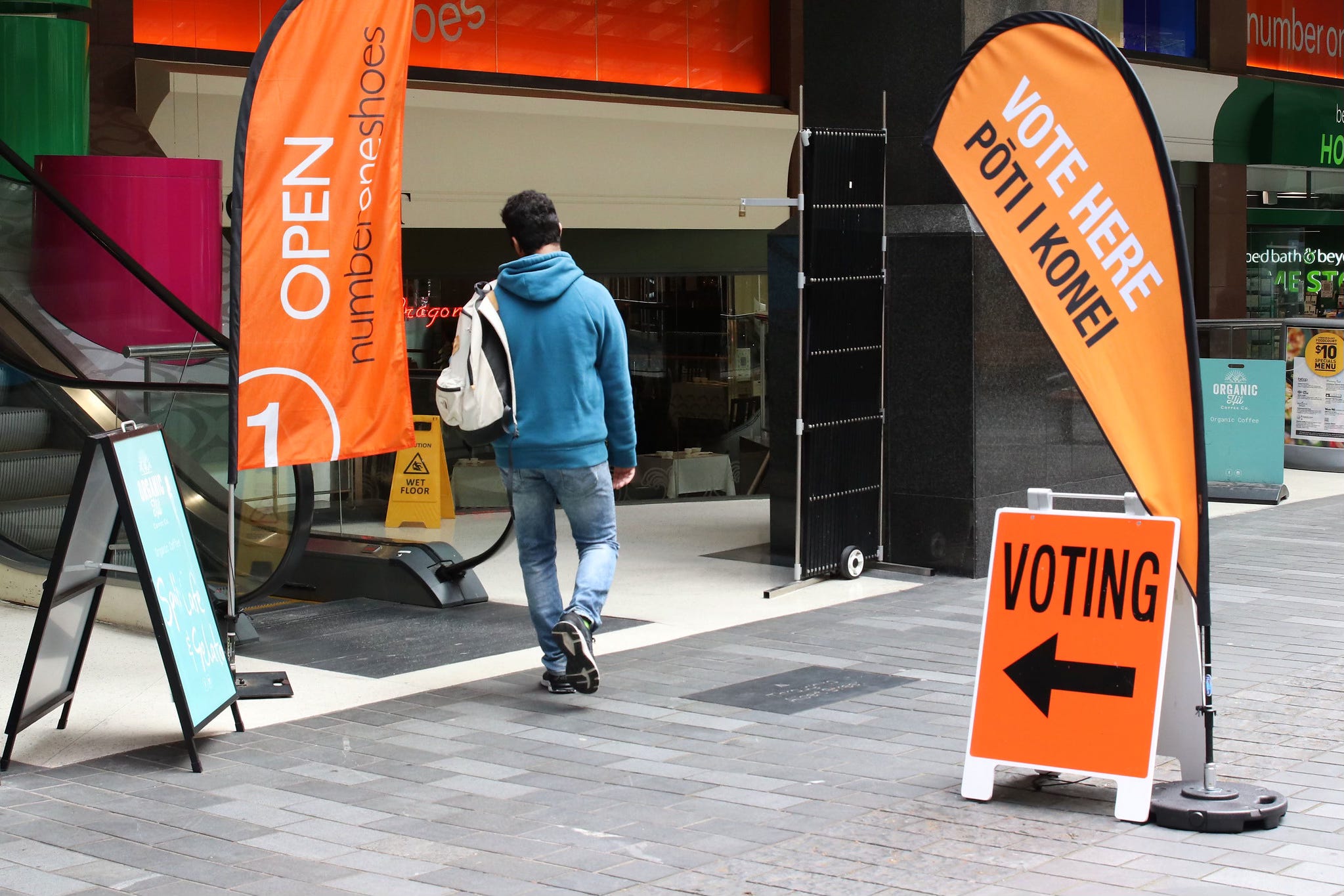
A generation being disenfranchised in plain sight
5d ago00:13:56Tap to summarizeAlmost half an entire generation of potential new voters are being disenfranchised in plain sight, with just 95 days to go until the General Election on November 7. More than 80% of new voters have already been disenfranchised in the election last year of ‘representatives’ in our largest, youngest and most ethnically diverse city: Auckland.The number of missing young voters is set to top a quarter of a million, which is more than voted in total for ACT and 50% more than voted in total for NZ First at the last election. It is almost 10 times the 1.08% margin over the 5% threshold that NZ First surpassed in 2023 when it got 6.08% of the vote and its eight seats in Parliament. The democratic deficit in this election is set to be worsened if, as the Electoral Commission projects, 55,000 people who try to enrol to vote on election day will be turned away under new election rules legislated by the Government. (See more analysis, charts and detail below, and in the video above.)Elsewhere in the news around Aotearoa’s political economy of housing, climate and poverty this morning:* PM Christopher Luxon apologised yesterday for his ‘parent-child’ comments about relations between the Government and small businesses to a business audience in Rotorua on Friday, saying at his weekly news conference last night: “I am sorry if my comments do not properly acknowledge the challenges that many small business owners are facing, and that I got that wrong.” * The Post-$ published an editorial this morning titled: ‘Luxon’s impotence makes him prime minister in name only,’ adding: ‘The prime minister’s failure to recommend to the Governor-General, Dame Cindy Kiro, that she dismiss his foreign minister demonstrates that Christopher Luxon now holds his job in a de jure sense only.’ Others commented on the apology too. See My Top Pick n’ Mix Six below* Almost a million notifications did not get sent to people eligible for cancer screening due to flaws in the national cervical cancer screening programme, RNZ reported last night from a Health NZ review released yesterday.* A senior figure in New Zealand First’s youth wing, Nicholas Newport (also known as Nicholas Wells), has been linked to a neo-Nazi group and online accounts that praised Adolf Hitler, Charlie Mitchell reported in a scoop yesterday for The Press-$. See Top Newspaper Article of the day below.* Dwelling consents fell 3.6% in seasonally adjusted terms in the month of June from May, after a 4.9% fall in the month of May from April, Stats NZ reported yesterday, as rising interest rates and the Government’s pullback from house building bear down on the sector. This follows a seasonally adjusted fall of 4.9% in May 2026. * Consents for non-residential construction fell 2.9% to $8.8 billion in the year to the end of June from the previous year. This is just above the sector’s 2020 Covid lockdown low and is the lowest in 11 years. It comes after the Government’s suspension of capital expenditure spending for hospital building, school building, roads and railways in early 2024. “This shrinking pipeline of work points towards further falls in work put in place during the second half of this year,” Infometrics Economist Gareth Kiernan noted. See Chart of the Day below.Join us as a paying subscriber to get my full daily selection of the news, analysis, commentary, links, charts, front pages and cartoons below, and to support this work I do sorting the signal from the noise in our political economy. Here’s 50% off for the first year.FYI to all paying and free subscribers, I have decided to open this up immediately. Thanks in advance to paying subscribers for their permission.A generation being disenfranchised in plain sightIt’s like watching a car crash in our political economy in slow motion, although it seems to have sped up this year.The collapse in enrolment among potential young voters in this election cycle is brutal, especially as previous research shows that voters that don’t vote at their first opportunity are much less likely to vote throughout their lives.The enrolment rate for voters aged 18-24 has fallen to 53% as of the end of June, sliding for a sixth consecutive election cycle from 70% at the end of June 2011, Lauren Crimp reported yesterday for RNZ from Electoral Commission data.Youth enrolment collapses to 53% from 70% in 2011Over 200k 18-24s missing from electoral roll as of July 31Over 70,000 young people missing from electoral roll in AucklandA preview of what that disenfranchisement looks like was evident in the turnout for the Auckland Council elections last year, and the resulting over-representation of older, white, locally-born men as councillors. Turnout overall fell to 29%, but was much worse for young voters and even worse than that for young Māori voters. It was most obvious in West Auckland and South Auckland, where the percentages of voters among young Māori voters fell under 15%.Turnout among young voters in Auckland election last year under 20%Auckland councillors more white, more NZ-born & older than populationDemocracy eroding in Parliament tooThe quality of any democracy is not just about the representation of the population, but the time and care taking in making (and unmaking) laws. The coalition Government has passed more bills in one term under urgency than any other Parliament since records were kept dating back to 2008, Irra Lee reported yesterday for RNZ from Parliamentary Library data.Govt uses urgency more aggressively than previous GovtsThis trend towards disenfranchising new generations of voters is consistent with a push from some activists to make it harder for younger, poorer and browner people to vote, and harder to count, through less comprehensive censuses.This is a live issue, with the Government shifting to an administrative census from a conventional household-by-household survey.My Top ‘Pick n’ Mix’ Six* Deep-dive by Kate Green for RNZ: Curing NZ’s health system: First halt the deterioration, primary care leader says* Explainer by Kate Newton for RNZ: Explainer: What is a data centre and why is everyone freaking out now?* Op-Ed by for Interest: Hyperscale data centres and flickering power ‘Earl Bardsley questions the appetite for ‘littering the landscape’ with windfarms and solar panels to maintain AI data centres established via contracts facing little public scrutiny.* The Post-$: Luxon’s impotence makes him prime minister in name only* Column for Newsroom: Anne Salmond: A tale of two leaders* Column for Newsroom: Gareth Morgan: What a waste of capital ‘The Baby Boomers of the big establishment parties know one economic path – housing investment and immigration. They need to make way for new generations.’Cartoon of the Day: Angry (& inaccurate) cupidTimeline-cleansing nature pic: GloriouscheersBernard This is a public episode. If you'd like to discuss this with other subscribers or get access to bonus episodes, visit thekaka.substack.com/subscribe
Transcribe →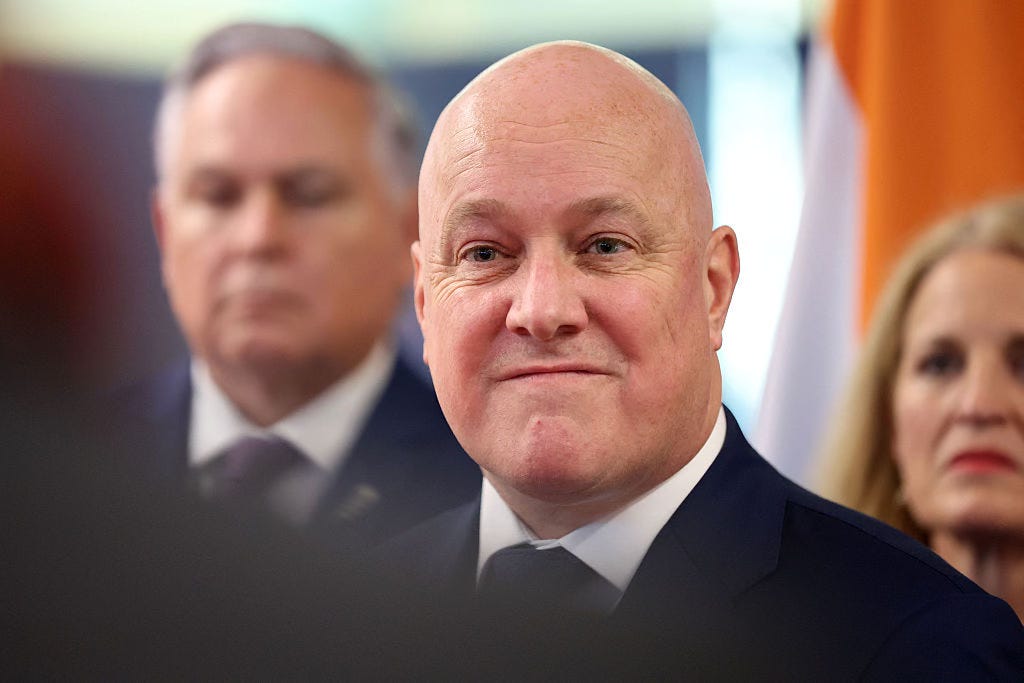
PM compares NZ businesses to whiny kids
6d ago00:09:40Tap to summarizePM Christopher Luxon told struggling small business leaders in Rotorua on Friday to take responsibility for their own businesses, saying it wasn’t his or the Government’s role to stimulate the economy. The comments comparing business leaders to whiny kids wanting handouts from the ‘adults’ in Government haven’t gone down well, prompting the Editor of The Post-$, Matthew Hooton, to describe Luxon’s comments as “corporate gibberish” and “inauthentic”, suggesting there was still time for National MPs change their leader. (See more analysis, charts and detail below, and in the video above.)Elsewhere in the news around Aotearoa’s political economy of housing, climate and poverty this morning:* New Zealand First has proposed the introduction of a ‘Kiwi Kids Grant’ of $5,000 per child per year for the first three years up to three children, in order to raise the birth rate above the replacement rate. It would cost $400 million in the first three years and be tax-free and not means-tested. Labour, ACT and National said such policies hadn’t worked overseas.* ACT has proposed giving teachers the legal power to remove ‘seriously or persistently disruptive students’ from the classroom. ACT candidate Paul Henry said when announcing the policy: “Let’s be honest, there are a lot of little s***s in classrooms, and we need to address that if we’re going to lift education standards. He added that New Zealand couldn’t invest extra in education as other rich countries such as Finland had, because “obviously, we are not a rich country. We’re a poor country at the moment, and so we need to address that.”Join us as a paying subscriber to get my full daily selection of the news, analysis, commentary, links, charts, front pages and cartoons below, and to support this work I do sorting the signal from the noise in our political economy. Here’s 50% off for the first year.FYI to all paying and free subscribers, I have decided to open this up immediately. Thanks in advance to paying subscribers for their permission.PM tells ‘children’ to stop asking for Govt helpIt was an innocuous enough and fair enough question to Christopher Luxon at a business breakfast event in Rotorua on Friday that has unleashed another round of accusations that the former CEO is out of touch for voters, and businesses in particular.Rotorua Business Chamber CEO Melanie Short told Luxon about the results of a survey of 82 business leaders in Rotorua in April and May that found a sharp fall in confidence since October linked to rising costs and a lack of demand. The survey also showed businesses wanted more public investment in infrastructure and business development.Short then asked: “We do not want to pass them on because we’re also getting less customers through the door. So, it’s a matter of time - how long can we hang on?”Luxon responded with these comments (bolding mine):“I think that’s a negative view, to be honest. Like we’re entrepreneurs and business people, and I get it. You know, if you’re not retooling and radically disrupting your business, you ain’t doing the job.“You know, you have to disrupt yourself aggressively before you get disrupted by global events, and if you keep thinking you want the same business model, the same customer mix, the same margin structure, you know you’ve got to be retooling and refinancing and rehoming, and that’s just the reality of business people all around the world.“So, my job is to make sure I’m setting up the conditions for you to be able to go create that growth. And I think some of the subtext and assumption in your question is that...I think in New Zealand I’ll be honest with you as a business person who was... I sat in Illinois for six years in Chicago, and the last person I wanted to ever talk to as a CEO was the government. I didn’t sit there in Chicago saying I wonder what the government thinks and I wonder what they’re doing to help me for my business? Can I get some grant money to do something? No, no, I’m a business person.“I’m building a kick-ass company that actually has commercially superior returns, great customer experience, and awesome internal culture. That is the job of what makes a great company, not a good one, a great one. And so that was my mentality.“Come home to New Zealand, and there’s a parent-child mentality. I have literally sat in boardrooms across New Zealand, and the conversation goes: ‘I wonder what the government’s going to do? I wonder what the government’s going to think?’“Who cares what the government thinks or does? Our job is to be adult, adult, adult. The business leaders, the political leaders, and the community leaders working together, doing things differently. I set up the operating system. You go out there and smack it and go create the road, and the community leaders see the pain, the hurt, the need, and the frustration, and the three actors do different things but complementary things to deal with the challenges and the opportunities.“So I still think there’s a little bit of.... okay, so in this chamber, how many of you are actually using Claude or Claude code? Okay great. How many sessions has the chamber run to help you understand that? Is that your number one focus right here, right now? Because that is going to disrupt your businesses, and it’s a huge opportunity for you to do exceptionally well off the back of it.“So how do we collectively lift our SME literacy on something like AI as a result? So I’m just pushing back to say my job is to set the conditions up. We’re getting spending under control. We’re getting inflation back into the band. We’re at 2.9 percent, strip out the fuel pieces. We’ve got growth coming in. And that creates opportunity.” Christopher Luxon talking to the Rotorua Business Chamber.‘Businesses don’t want an insulting lecture’Labour Finance Spokeswoman Barbara Edmonds said Luxon had insulted businesses with a patronising lecture.“Rotorua businesses told Christopher Luxon confidence is free-falling, customers are disappearing, and costs keep rising. They are telling him his Government’s choices aren’t working. His response was to call them negative and tell them to grow up.“Christopher Luxon promised to fix the economy and now he says, ‘who cares what the Government will think or do?’ New Zealand businesses care very much what the government thinks and does, because his government’s choices affect whether they keep their doors open.” Barbara EdmondsThe Post-$, which is edited by former National political staffer and lobbyist Matthew Hooton, also questioned the tone of Luxon’s comments and suggested it was not too late for National MPs to change their leader. The Post-$ also challenged Luxon’s characterisation of his own roles at Unilever and Air NZ.“For many, Mr Luxon’s analysis of New Zealand business culture will read more like the gibberish of corporate bureaucrats than the language of the entrepreneur and businessman he described himself to be.“Few companies are more at risk of being accused of being a child to the government parent than a national airline. Moreover, Mr Luxon did not just talk to the New Zealand government as chief executive, as he should have, but chaired Dame Jacinda Ardern’s Prime Minister’s Business Advisory Council.“Admittedly these are small points, but they suggest an inauthenticity about the Prime Minister that voters perhaps intuitively sense and reject.“A number of credible polls and important economic data are expected in the next fortnight. If, having considered that information, National MPs are certain Mr Luxon is the best of their number to beat Mr Hipkins, then their judgment must be respected. This month is their last chance to assure themselves of that again.” Editorial for The Post-$‘I did not plan to cause offence’Luxon told NewstalkZB’s Mike Hosking and RNZ Morning Report’s John Campbell in interviews this morning that he had not planned to cause offence and was he was disappointed with the reporting from The Rotorua Post-$ from the comments. The PM’s office yesterday issued a full transcript of his comments, saying the initial report mischaracterised his views.Asked by Hosking if his comments had been misreported or if he over-spoke, Luxon said it could have been “either or”, adding that “there was certainly no intent to cause offence”:“We’re trying to work with, enable and empower business. So, you know, that was my simple, you know, message in that room.“I said up front, I’m a great admirer of business people because they’ve led through difficult times, they’ve got a lot of people to lead. I’ve been in that situation as a business leader myself.”In my view, Luxon has again displayed his lack of understanding of how New Zealand’s economy currently works and how Government spending is often a crucial catalyst for household and business spending and investment.In previous recoveries from economic crises, the Government has pulled back on its own spending as a share of GDP, confident that households and businesses would be able and willing to step forward in place of the Government to borrow and invest. But that is not happening this time around because banks have done no net new lending to businesses since Covid, and rental property investors don’t want to inv...
Transcribe →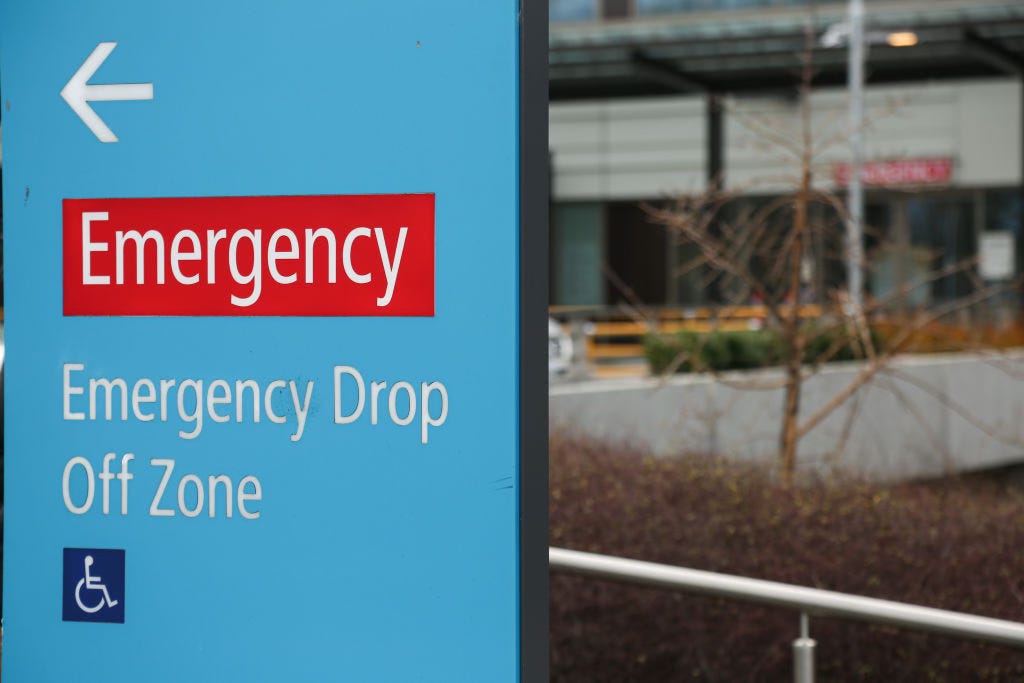
National sags again on economy in Ipsos poll
1w ago00:09:15Tap to summarizeNew Zealanders were more concerned than ever about the cost of living, health care, the economy, housing costs and unemployment in early July, according to the latest Ipsos Monitor survey of over 1,000 potential voters that was released this morning.The survey found more voters thought Labour would manage the economy, health care, the cost of living, housing costs and unemployment better than National. This is only the second time in the survey’s history since 2018 that Labour has beaten National on the economy, having briefly been ahead in October last year.The survey also found confidence in the Government (right track/wrong track) fell to its second lowest level ever in the survey’s eight0-year history, just above its record-low in October of last year. (See more analysis, charts and detail below, and in the video above.)Elsewhere in the news around Aotearoa’s political economy of housing, climate and poverty this morning:* Christchurch Hospital’s Emergency Department is in crisis this morning. An ED doctor said yesterday the hospital plans to pitch a tent outside as corridors fill up with patients in beds, with some already being angled in corridors in order to fit more in.* In my view, this case again highlights the dangers of ongoing under-investment and skimping on staff and maintenance to keep pressing the size of Government down under 30% of GDP in an aging, fast-growing and less healthy population. The population of Greater Christchurch has grown by 150,000 to 577,000 in the last decade, which was faster than projected or invested for. (See charts of the day below)* New Zealand First has revealed it plans to sell the retail arms of the Government-controlled gentailers, Meridian, Mercury and Genesis, to the private sector to fund extra generation by their wholesale arms, Tom Pullar-Strecker reports this morning for The Post-$.* ANZ’s Business Outlook survey through the month of July found an improvement in confidence about the economy and business’ own outlooks from June, but stagnant experienced activity, a contraction in hiring and a worsening outlook as the month went on and fuel prices rose ever higher.Join us as a paying subscriber to get my full daily selection of the news, analysis, commentary, links, charts, front pages and cartoons below, and to support this work I do sorting the signal from the noise in our political economy. Here’s 50% off for the first year.FYI to all paying and free subscribers, I have decided to open this up immediately. Thanks in advance to paying subscribers for their permission.National sags again on economy in Ipsos pollIt is turning into a long winter of discontent for the Government, across all the measures that drive voter support for the Coalition overall, and National in particular.Today’s Ipsos NZ poll results show voters even grumpier about the economy, the hospital system and unemployment than they were in October last year, when for the first time Labour was judged better on the economy than National.Here’s the key charts to tell the story:My Top Pick n’ Mix Six* Deep-dive by Amanda Gillies for RNZ/Newsroom’s The Detail: Deaths, delays and a health system under extraordinary pressure* Scoop by Sammy Carter for RNZ: Missed rent cases jump the Tenancy Tribunal queue - but is it favouring landlords?* Scoop by Nicholas Jones for Stuff: Top surgeon quit NZ for Australia after twice falling asleep at the wheel* Scoop by Glenn McConnell, Jenna Lynch & Emma Ricketts for Stuff: Revealed: Military choppers and bulletproof car on call to protect Seymour and Luxon on Waitangi Day; Stuff: The five times Luxon caught the air force express to the Beehive; Stuff: An Air Force chopper had to be flown up from Ohakea to take PM from Auckland to Hamilton* Interview with Quilae Wong by Mandy Te & Anna Whyte for Interest: Opportunity Party leader Qiulae Wong talks coalition dealbreakers & more* Explainer by Susan Edmunds for RNZ: How Consumer NZ wants to fix the electricity marketCharts of the day: Christchurch population above forecastsChristchurch city population and forecastSelwyn and Waimakariri districts population and forecastsFront Page of the Day: Labour beating NationalCartoon of the Day: A special water fountaincheers.BernardPS: I update this post online later in the morning for paying subscribers, including more detailed Picks n’ Mixes on housing, climate and poverty, a chart pack and more cartoons below the paywall fold. It is only available to paying subscribers, who are also enabled to comment and use The Kākā’s chat room. This is a public episode. If you'd like to discuss this with other subscribers or get access to bonus episodes, visit thekaka.substack.com/subscribe
Transcribe →
The Weekly Hoon: Helen Clark on why Winston Peters should be fired over his 'go home' comments, & on NZ's humiliation on a key UN vote
1w ago00:56:34Tap to summarizeThe podcast above of the weekly ‘Hoon’ webinar for paying subscribers on Thursday night featured co-hosts Bernard Hickey and Peter Bale talking with regular guest Cathrine Dyer about geopolitics, the economy, climate change and politics.This edition also included discussions with special guests:* Former PM Helen Clark on why PM Christopher Luxon should sack NZ First Leader and Foreign Minister Winston Peters over his ‘go home’ jibe in Parliament this week at Green MP Laurence Xu Nan.* Clark also described as humiliating New Zealand’s decision under Peters this week to join Belarus in abstaining on a vote to reappoint the UN’s Human Rights Commissioner, after the US pressured UN members to do so.* Janet H Anderson from the podcast Asymmetrical Haircuts, which covers international justice from The Hague. Janet, Helen and Peter discussed the UN vote and US pressure on the International Criminal Court.* Peter talked about the Helen Clark Foundation’s launch of a this book edited by Peter Davis: Facing Up To Our Future: Challenges and Choices for New Zealand: New Zealand’s traditional “she’ll be right” optimism is no longer adequate to the challenges facing the country. This major collection brings together 21 of New Zealand’s leading thinkers to examine the decades-long problems no single government can solve alone. * Bernard and Peter talked about local politics and the economy in the last 15 minutes of the show, including mentioning Opportunity Party Leader Qiulae Wong ’s appearance on The Hoon in November last year. She also did a mini-Hoon with Bernard last month when Opportunity got 6% in that month’s Roy Morgan poll.* Peter mentioned SurfDogChampions as this week’s skateboarding dog story.The Hoon’s podcast version above was recorded on Thursday night during a live webinar for over 200 paying subscribers and was produced and edited by Simon Josey. Regular guest Robert Patman will be back next week.The Hoon won the silver award for best current affairs podcast in last year’s New Zealand Podcast awards. (This is a sampler for all free subscribers and anyone else who stumbles on it. Thanks to the support of paying subscribers here, we’re able to spread my public interest journalism here about housing affordability, climate change and poverty reduction other public venues. Join the community supporting and contributing to this work with your ideas, feedback and comments, and by subscribing in full. Remember, all students and teachers who sign up for the free version with their .ac.nz and .school.nz email accounts are automatically upgraded to the paid version for free. Ngā mihi nui.Bernard This is a public episode. If you'd like to discuss this with other subscribers or get access to bonus episodes, visit thekaka.substack.com/subscribe
Transcribe →
How NZ punishes our stressed & jobless youth
1w ago00:11:37Tap to summarizeIt’s as if we’re trying to make them emigrate and we don’t want them to have our grand-kids. The Government has revealed it expects to take away the benefits of up to 4,700 teenagers without jobs, arguing their parents should look after them. This includes 2,733 who are too sick to work, of whom 69% are living with mental health challenges and some who are being treated for cancer.This comes as the National-led Coalition is cutting benefits in order to compress Government spending below 30% of GDP and bend public debt down towards 30% of GDP: the 30/30 rule both National and Labour have adhered to for decades, believing it keeps the economy healthy. It comes just after the Reserve Bank started hiking interest rates again, believing it has to make more young people unemployed to reduce inflation caused by a war in the Middle East and the Government itself.In effect, a generation of school leavers and graduates scarred by Covid and the worst jobs market in history for students, are being punished again by both the fiscal and monetary policies of the Government, which has collectively decided the sacrifices necessary for the greater good of the economy over the long term should be borne by those who were unlucky enough to emerge into the workforce in the last five years and are now unemployed and mentally ill. (See more analysis, charts and detail below, and in the video above.)Elsewhere in the news around Aotearoa’s political economy of housing, climate and poverty this morning:* PM Christopher Luxon is defending spending $20,000 on a helicopter ride from Auckland to Hamilton, Stuff reports this morning. * National Party donor Bayleys made $2.5 million in commissions from the sale of Kāinga Ora homes, Stuff’s Isaac Davison reports this morning.* Finance Minister Nicola Willis has denied NZ First Leader Winston Peters’ claim he wanted to keep the Reserve Bank’s dual employment and inflation mandate in coalition-forming talks in 2023, The Post-$’s Henry Cooke reports this morning.* Christchurch’s Emergency Department (ED) is often running at 300% capacity in ‘Code Red’ situations, with patients being treated in corridors, a doctor told Ben Tomsett in his report for NZ Herald; Meanwhile Amber Allott reports for The Press-$ this morning that the Nurses Union has lost an employment court fight to rule Health NZ is operating Christchurch’s hospitals with ‘unsafe staffing levels’.* Xero reports this morning its June quarter survey of small business customers found their strongest sales growth overall for nearly four years, but that jobs growth was weak, with an uneven recovery evident in strong rural sales and weak hospitality and retail sales. Jobs fell in Auckland, Northland, Bay of Plenty and Wellington, but rose in Canterbury, Xero reported. Meanwhile, Retail NZ’s June quarter survey found a slight improvement in retailers’ confidence.Join us as a paying subscriber to get my full daily selection of the news, analysis, commentary, links, charts, front pages and cartoons below, and to support this work I do sorting the signal from the noise in our political economy. Here’s 50% off for the first year.FYI to all paying and free subscribers, I have decided to open this up immediately. Thanks in advance to paying subscribers for their permission.How NZ punishes its stressed & jobless youthJust imagine you are in your late teens and have been unemployed for three years. Your benefit is not enough to live on after paying the rent and buying food and fuel that costs 30-70% more than when you first started looking for work. Perhaps the stress of not having enough money for food and not having a job or much social contact has worsened your mental health. Or you have cancer.And then the Reserve Bank puts up interest rates in a deliberate move to reduce employment and increase unemployment, in order to reduce inflation you had nothing to do with. It says curing this inflation is the most important thing and the resulting scarring of your employment life is unfortunate. And to top it off, the Minster of Social Development Louise Upston says she plans to take away your jobless benefit and force your parents to support you again. Even if you can’t work because you are too mentally unwell to work. Or have cancer.How would you feel?Would you feel the Government has got your back? Would you feel New Zealand is a great place to start your life and maybe even start a family?Maybe not.That’s the situation 4,700 teenagers on the jobless benefit face, including 2,733 who are on the jobseeker support (health condition, injury, or disability DCI) benefit, of whom 1,885 suffer from mental illness. Here’s the exchange in Parliamentary Question time yesterday where Upston was asked by Green MP Ricardo Menéndez March how many were subject to the new policy of removing their benefits.Ricardo Menéndez March: Does she expect that stripping people of their income support would likely improve or worsen someone’s mental health?Hon LOUISE UPSTON: Well, we’ve been very clear about our expectations that we want to see 18- or 19-year-olds in education, training, or preparing for work and that in the first instance, support should come from their families.Ricardo Menéndez March: Is she aware that people who are on jobseeker health condition, injury, or disability are, by definition, unable to work full time or have had to stop working full time because of that very same health condition, injury, or disability, and, if so, why is she making the assumption that they would be able to easily transition into study or employment?Hon LOUISE UPSTON: Well, the point of this is that 18- or 19-year-olds in some of the circumstances that the member suggests—we believe, on this side of the House, they should be the responsibility of their parents. If somebody is experiencing challenging health conditions, I would totally expect that their families are there to support them.Ricardo Menéndez March: What would she say to the cancer patients who are receiving jobseeker health and disability who are at risk of losing their benefits due to her reforms?Hon LOUISE UPSTON: Well, it doesn’t change the fundamental point. We believe that we don’t want 18- or 19-year-olds trapped on welfare, we don’t want them stuck on a benefit for another 20 years of their life; we want them to be supported by their family in the first instances and preferably in education, training, or in work.Ricardo Menéndez March: So is a cancer patient or someone with a psychiatric or psychological condition deemed to be trapped in welfare—according to her—if they simply need support to get better or access treatment?Hon LOUISE UPSTON: The policy that the member is referring to is specifically for 18- and 19-year-olds. Absolutely, if somebody is going through cancer treatment, that is an incredibly challenging time, but, actually, we do believe during that period of time, their parents, their families should be there to support them. I’d be really worried if they weren’t. We do have a parental assistance gap test for that very reason, but 18- and 19-year-olds should be supported by their family and when they are well enough, when they have capacity, they should be in training, education, or work.There are currently 108,600 15-24-year-olds Not in Education, Employment or Training (NEET) in the March quarter, representing 15.9% of the New Zealanders of that age and 14.4% of those available for work. That’s the highest youth unemployment rate since the December quarter of 2009: the depths of the Global Financial Crisis. This is happening at the same time as over 300,000 people with temporary work visas or student visas with work rights are in New Zealand.The scarring of a generationIt is even worse for students, as Student Job Search CEO Louise Saviker was reported as saying this week:“This is being driven by quite a significant convergence of issues that we don’t think has been seen in the history of student working over the last, say, 50 years. Certainly in our data.“The issues are relating to the economic environment, the employment market, the tertiary settings which are becoming more expensive every year for students to study. And then the cost of living for students as well.“Application rates are definitely the highest we’ve ever seen in Student Job Search’s data records over 40 years.“What that tells me is that students are really motivated, really committed and exceptionally committed. We hear from students every day who have applied for more than 50, sometimes even a hundred jobs.” Student Job Search CEO Louise Saviker quoted via RNZMy Top Pick n’ Mix Six* Investigation by Nicholas Jones for Stuff: Born at 25 weeks and clapped out of hospital 122 days later: Why Ada’s surgeon fears others may die* Deep-dive by Felix Walton & Ellen O’Dwyer ...
Transcribe →
'Kia ora! Welcome to your job. It'll cost you $60k'
2w ago00:09:43Tap to summarizeCases of the most egregious migrant exploitation are now emerging in dribs and drabs through decisions by the Employment Relations Authority, indicating a tip of iceberg that should shame the nation and endanger our exports to countries that monitor the use of slave labour. But it doesn’t, and hasn’t. Yet.This week, the ERA ruled the owner of Four Square Martina in Thames, Jaswinder Singh, had to pay $44,000 in penalties after he charged two workers from India $60,000 each for jobs at the supermarket in the Foodstuffs North Island Co-operative. The workers were repaid their $60,000 each after the Labour Inspectorate got involved. Each worker will receive $1,000 of the penalties. Foodstuffs has said Four Square Martina is no longer part of the Co-operative, but it’s not clear if it has been ‘de-bannered’ from using the Four Square signage because of the abuse. Singh is still running the store.This case is the latest showing the endemic abuse and the small fines and sanctions being applied. The fines fit into the ‘Business as Usual’ and as a ‘Cost of Doing Business’ category. (See more analysis, charts and detail below, and in the video above.)Elsewhere in the news around Aotearoa’s political economy of housing, climate and poverty this morning:* Immigration Minister Erica Stanford has announced unspecified changes to the Recognised Seasonal Employer (RSE) scheme for temporary fruit pickers from the Pacific that she said would ‘simplify’ the scheme. * HortNZ said yesterday it was confident of doubling annual exports to $20 billion as it welcomed the changes, which Immigration NZ announced would include an employer accreditation scheme that would allow accredited employers to not have to prove they had tried to find local workers.* Employment grew by 14,327 or 0.6% in June from a year ago, which was less than the 54,000 growth in the working age population over the last year. That means the unemployment rate is expected to rise to 5.5% in the June quarter from 5.3% in the March quarter. The data is due next week.* NZ First Leader Winston Peters said he had to accept the current Government’s removal of full employment from the Reserve Bank’s dual mandate as a ‘dead rat’ because both National and ACT wanted to return to the single inflation mandate. He told Henry Cooke at The Post-$ yesterday he wanted to bring the bring back the full employment mandate in any future governing arrangement and Labour has said it is already considering a return to a dual mandate.Join us as a paying subscriber to get my full daily selection of the news, analysis, commentary, links, charts, front pages and cartoons below, and to support this work I do sorting the signal from the noise in our political economy. Here’s 50% off for the first year.FYI to all paying and free subscribers, I have decided to open this up immediately. Thanks in advance to paying subscribers for their permission.‘Kia ora! Welcome to your job. It’ll cost you $60k’New Zealand believes it is squeaky clean when it comes to forced labour. So much so, that just last week, Trade Minster Todd McClay, was indignant in protesting against Donald Trump’s new 12.5% tariff aimed at countries that accepted imports from countries where forced labour was used. He said:“I strongly reject that there is any support at all in the New Zealand system for forced labour. We're not involved in it. It doesn't happen through our trade. It doesn't exist in New Zealand.” Trade Minister Todd McClay quoted by RNZ on July 24.It doesn’t exist in New Zealand? Minister McClay should have a look through the last couple of years of ERA rulings involving migrant workers and have a chat to the Government’s own Labour Inspectorate. Those rulings and the Inspectorate’s releases are a cavalcade of examples of unpaid wages, sick leave not granted, premiums charged for jobs, beatings, slum-like accommodation and routine ignorance of employment laws and rights.So how did we get here? And why are we kidding ourselves?One of the ‘bits tacked on’ to New Zealand’s low investment, low wage and resource-extractive economy over the last 20 years has been the endemic use and exploitation of migrants tied to their employers by temporary work visas and seasonal work visas. It has helped enable economic growth without investment or wage growth, and allowed businesses to use spare cash to buy and leverage land for tax-free capital gains — which is the real game. This temporary migrant industrial complex has also disguised relative declines in workers’ purchasing power because consumers found taxis, food delivery, convenience stores, services stations, shops, cafes and liquor stores were cheaper than they otherwise would otherwise have been the case. Entry level jobs in services jobs for young, locally educated workers have become harder to get, with lower real weekly wages and poorer work conditions. 300,000 work visas granted, while 108,600 young NZers unemployedThere were 108,600 15-24-year-olds Not in Education, Employment or Training (NEET) in the March quarter, representing 15.9% of the New Zealanders of that age. Yet, New Zealand also approved temporary work visas for 194,079 migrants in the year to the end of March, along with a further 85,575 visas with work rights for foreign students and 17,175 visas for RSE workers. There were 78,165 work visas granted last year for temporary workers aged 20-29, MBIE data shows.The way these temporary migrants are treated is appalling, and little is being done to fix it or question whether this system of temporary work visas tied to individual employers is a sustainable or even moral way to operate. New Zealanders and many overseas believe our business culture is honest, incorruptible and gives everyone a fair go. Buyers of our exports have not put us on the lists of ‘bad’ countries that use slave labour or operate exploitative factories. However, even a cursory glance at the ERA rulings shows how awfully we treat these temporary workers, many of whom are forced to leave after their three-year visa ends, especially if the Government becomes worried they may start costing our health system too much. The Four Square Marina case is just the latest, adding to the December 2025 case of Four Square Tauhara in Taupō, where two workers were charged $10,000 each for their jobs and were not paid for 710 hours work. Here’s the details of the Thames case, as relayed by the Labour Inspectorate:ERA Member Helen van Druten ordered the company, A Dharni Enterprises Ltd, trading as Four Square Martina, to pay a penalty of $32,000 and Jaswinder Singh, the sole director, a penalty of $12,000. The workers will each receive $1,000 of the penalty paid by the company.“Effectively, A Dharni Enterprises Ltd used the premiums to pay the employees’ own wages,” Ms van Druten said.She found the arrangement provided A Dharni Enterprises Ltd with a financial advantage, freeing up company money that would otherwise be used to pay those wages.Ms van Druten said the workers were particularly vulnerable because their visas were tied to their employer and they were new to New Zealand. The new Accredited Employer Work Visa scheme set up under Labour was the tool used in this case. Agents in India were involved too.The 2 workers, who each paid $60,000 to secure their jobs, had family ties to the business owner Mr Singh and entered New Zealand on Accredited Employer Work Visas (AEWV) in July and August 2023. The money was paid in India in 7 instalments.They only worked for the business briefly before leaving because Mr Singh felt they had misrepresented their English ability during the recruitment process.The Labour Inspectorate investigation was complex because inspectors needed to contact witnesses in India, where the premium payments were made, establish the role of intermediaries who facilitated the payments, and demonstrate a link between the payments and the workers’ employment.Earlier this month, the ERA and the Labour Inspectorate reported on the case of a kiwifruit picking contractor who systematically underpaid workers. The case involved a wage “banking” arrangement that resulted in workers not receiving all of their lawful entitlements, as well as failures to keep accurate employment records and correctly calculate leave entitlements. Workers with contracts guaranteeing them minimum hours were routinely required to work unpaid hours to offset time they had previously been paid for but not worked.The total amount of arrears owed to the four workers was $61,312, which the company agreed to pay prior to the ERA hearing.It’s clear New Zealand is debasing its reputation in exchange for cheaper stuff and avoiding investment in systems and training of local workers. The biggest issue is the use of temporary work visas, which are supported by NZ First as a way to allow to migration without admitting it’s migration, using the assumption that migrants that leave within three years don’t need to be counted as requiring the infrastructure in health, transport and housing for the extra resident population.The Greens have called for the visas to be disconnected from specific employers, removing a lot of the power currently wielded by such employers. Labour, National and NZ First have opposed this shift.My Top Pick n’ Mix Six* Interview with Claire Achmad by Lyric Waiwi...
Transcribe →
Why NZ should electrify everything ASAP
2w ago00:11:20Tap to summarizeTo emphasise both the risk and the opportunity for New Zealand’s political economy, the price of Brent crude hit US$100 a barrel again on Friday, which is likely to push petrol prices back towards $3.50/litre. But New Zealand’s uptake of EVs, home solar, home batteries and grid-scale solar and batteries is lagging far behind most other countries, who have incentives and national strategies to electrify fast.Aotearoa Inc has an opportunity to import panels and batteries cheaply from China’s massive factories, just as India, Pakistan, much of Africa and the likes of Australia and Uruguay have done. But the opportunity won’t last forever as the growing competitive and security tensions between the US and European-led trade blocs increasingly block imports from China, and pressures others to do the same. There’s also a risk China’s exports to New Zealand are restricted in the event of a wider conflict. The window may close quicker than many think. (See more analysis, charts and detail below and in the video above.)Elsewhere in the news around Aotearoa’s political economy of housing, climate and poverty this morning:* In election policies announced yesterday, National promised to extend paid parental leave to 30 weeks from 26 weeks, if re-elected, while ACT promised a higher share of health spending on Pharmac. The Greens called for a one year pause on consents for new AI data centres. * An Emergency Department doctor at Christchurch Hospital has told The Press-$’s Joanne Naish in a report published this morning that patients were regularly treated in corridors, waiting rooms and ambulance bays, with the situation deteriorating to the point of “substandard dangerous medicine.”* Another big employer of builders is about to go bust. John Anthony reports for BusinessDesk-$ this morning that IRD has applied to liquidate NZ Build Group, which has 250 staff.Join us as a paying subscriber to get my full daily selection of the news, analysis, commentary, links, charts, front pages and cartoons below, and to support this work I do sorting the signal from the noise in our political economy. Here’s an introductory offer of 50% off for the first year.FYI to all paying and free subscribers, I have decided to open this up immediately. Thanks in advance to paying subscribers for their permission.Why NZ should electrify everything ASAPNew Zealand’s cost of living, its inflation rate, mortgage rates, its trade deficit, its emissions profile and its prospects for deindustrialisation are now being held hostage by the whims of some unnamed people in the Iranian Revolutionary Guard Corp, and one very well known person in the White House.Last week the IRGC widened the conflict over the Strait of Hormuz to include the Red Sea by encouraging Houthis in Yemen to attack Saudi Arabian oil tankers trying to get oil out of the Red Sea. This came after the US attacked Iran for nine days straight, breaking a ceasefire that had dragged oil prices down below US$70 barrel by mid-July. Those prices jumped to US$102/barrel on Friday, although the US paused its strikes on Friday night and a fragile ceasefire resumed over the weekend. However, with the underlying conflict unresolved, oil prices remain near US$90/barrel today and increasing margins for refining fuel in Singapore are set to drive petrol prices here back towards their NZ$3.50/litre levels reached in March and April. By June, New Zealand’s monthly bill for fossil fuel imports hit $1.5 billion per month, double its level from a year earlier.But it doesn’t have to be that way.Other countries have pursued strategies for at least a decade to wean themselves off fossil fuel imports of oil, petrol, diesel and gas. Many have ramped that up since the spike in prices in 2022 when Russia invaded Ukraine and again when the latest conflict erupted around the Strait of Hormuz. Pakistan and India have launched war-style campaigns of solar panel and battery importation from China to reduce their reliance on oil and gas from the Middle East. Australia has subsidised solar panels for decades and has ramped that up with home battery subsidies in the last year, increasing the solar share of power production last year to 19.6%.Australian panels and batteries are now generating so much power in daylight hours that earlier this month the Government announced eligible households in New South Wales, South Australia and Southeast Queensland would get three hours of free power during the middle of the day every day, even if they don’t own solar. That battery installations have also transformed the market, allowing the solar-generated power to lower electricity prices in the early evenings by reducing the need to burn gas.Uruguay, population 3.5 million, is another less-well-known example of a country that took a strategic decision to wean itself off fossil fuels by shifting to EVs and ramping up renewable generation for electricity, including through solar. New Zealand, meanwhile, is a laggard in both EV adoption and the adoption of home solar panels and batteries, and grid-scale solar and batteries.This window of opportunity may start closingChina’s ability to manufacture EVs, panels and batteries at enormous scale and speed has rapidly reduced prices, but has also caused a backlash that has been amplified by the growing strategic and military competition between China, the United States and Europe. The United States has already slapped tariffs and sanctions on imports of Chinese panels and electrical equipment, aiming to boost its own industry and avoid reliance on China’s technology, which the US fears could be weaponised in a conflict.The European Union is also cracking down on China’s imports. This withdraw of US and European demand for China’s output will create extra downward pressure on costs, at least for a period. The danger for New Zealand is if either or both the US and European Union pressure New Zealand to also stop importing from China, or there is a conflict in the South China Sea which physically blocks imports. The beauty of a fast and large surge of electrification in New Zealand is that the panels and batteries are then permanently and repeatedly generating electricity here year after year, regardless of whether new equipment can be imported.But a slow electrification creates the risk of being locked out of the ability to keep electrifying.The Best of the RestMy Top Pick n’ Mix Six* Deep-dive by Mary Argue for RNZ: How will we live as storms get worse? One region’s story* Deep-dive by Emily Simpson for 1News: ‘I can see the appeal of leaving NZ, and I know exactly which way I’ll vote’ ‘In the latest in our State of the Nation series, a 30-something parent and operations manager shares her views about the current direction of Aotearoa.’* Deep-dive by Matthew Theunissen for RNZ: ‘There isn’t anything’: Students face harsh job market* Scoop by Kate Green for RNZ: Patient fell trying to kill cockroaches at Auckland Hospital, fleas hit wards* Column by Max Rashbrooke for The Post-$: The blindness and blame that make NZ a not-so-great country to raise children* Column by Simon Wilson for his Substack Hopetown : Housing, Fonterra, cement: the crisis of predatory delay ‘The tactic that holds back the progress we know we need’Front page of the Day: RNZCartoon of the Day: Ready. Fire. Aim.Timeline-cleansing nature pic: Morena.Anything I’ve missed?cheersBernardPS: I update this post online later in the morning, including more detailed Picks n’ Mixes on housing, climate and poverty, a chart pack and more cartoons. It is only available to paying subscribers, who are also enabled to comment and use The Kākā’s chat room. Check back in here later this morning to see the full lists and chart pack. This is a public episode. If you'd like to discuss this with other subscribers or get access to bonus episodes, visit thekaka.substack.com/subscribe
Transcribe →
The Weekly Hoon: Climate gaslighting; Construction turnover & hazardous Houthis
2w ago00:58:24Tap to summarizeThe podcast above of the weekly ‘Hoon’ webinar for paying subscribers on Thursday night featured co-hosts Bernard Hickey and Peter Bale talking with regular guests Robert Patman & Cathrine Dyer about geopolitics, the economy, climate change and politics.This edition also included discussions with special guest:* Simplicity Chief Economist Shamubeel Eaqub on his third annual construction industry report for the New Zealand Chinese Building Industry Association (NZCBIA).This week:* Bernard and Peter talked about Peter moderating a panel for the Helen Clark Foundation’s launch of a this book edited by Peter Davis: Facing Up To Our Future: Challenges and Choices for New Zealand: New Zealand’s traditional “she’ll be right” optimism is no longer adequate to the challenges facing the country. This major collection brings together 21 of New Zealand’s leading thinkers to examine the decades-long problems no single government can solve alone. * Bernard mentioned this substack post by Dr Andrew Dickson on NZ’s Number 8 wire mentality: The Productivity Gap is a National Fantasy. The number 8 wire legend and the productivity lament are two sides of the same coin. Why New Zealand’s economic architecture is built on lack.* Bernard, Peter and Cathrine then talked the Climate Commission’s warning in its annual emissions report this week that the Government needed to double its emissions reductions to comply with the law.* Bernard recommended listeners sample the videos now uploaded on the website for the Reality of Everything conference that Cathrine helped organize.* Then Bernard and Peter talked with Robert about China, the international rules based order, the Houthis and Saudi Arabia.* At the end, Bernard and Peter talked with Shamubeel about the NZCBIA report, Shamubeel’s LinkedIn post on inflation, and his T-shirt advertising the NZ Kiwi Hatchery near Rotorua.The Hoon’s podcast version above was recorded on Thursday night during a live webinar for over 200 paying subscribers and was produced and edited by Simon Josey. The Hoon won the silver award for best current affairs podcast in last year’s New Zealand Podcast awards. (This is a sampler for all free subscribers and anyone else who stumbles on it. Thanks to the support of paying subscribers here, we’re able to spread my public interest journalism here about housing affordability, climate change and poverty reduction other public venues. Join the community supporting and contributing to this work with your ideas, feedback and comments, and by subscribing in full. Remember, all students and teachers who sign up for the free version with their .ac.nz and .school.nz email accounts are automatically upgraded to the paid version for free. Ngā mihi nui.Bernard This is a public episode. If you'd like to discuss this with other subscribers or get access to bonus episodes, visit thekaka.substack.com/subscribe
Transcribe →
The only thing NZ has to fear is...fear of debt itself
2w ago00:10:30Tap to summarizeThe Government’s focus on deficit and public debt reduction isn’t working to grow the economy this time around because households are too indebted and businesses are too worried to step up and power that growth by investing and spending. The National-led coalition’s fear of public debt is misplaced and its strategy of repressing the size of Government and relying on the rest of the economy to grow can’t work without another housing boom, which no one is predicting or say they want. Instead, New Zealand’s economy is stuck in a self-reinforcing stagnation, frozen in a fog of fear of job losses, house price falls and shrinking public services. The only balance sheet strong enough and accessible enough to break the investment deadlock is the Government’s. The trouble is National’s fear of borrowing to invest in ramping up productivity is infecting the rest of the economy.US President Franklin Delano Roosevelt identified something axiomatic about how economies work when he said in his 1933 inaugural address at the pit of a depression that: “The only thing we have to fear is...fear itself — nameless, unreasoning, unjustified terror which paralyses needed efforts to convert retreat into advance.”In my view, the Government’s irrational fear of public debt has paralysed our political economy. I detail below and in the video/podcast above why that fear is unjustified and why public investment is needed this time around. That’s because in previous recoveries, households and businesses were much less indebted, were able to borrow from banks more easily, and there was much more confidence investment would pay off through another house price boom.Elsewhere in the news around Aotearoa’s political economy of housing, climate and poverty this morning:* The Climate Commission has warned the Government it would need to double Aotearoa’s rate of emissions reduction to meet its legislated targets. PM Christopher Luxon said he still thought New Zealand would achieve net zero by 2050, and may even do it a few years earlier;* New Zealand First is considering an election policy to help first home buyers by having the Government jointly buy their homes with a Crown guarantee to lower mortgage costs. Ella Somers reported for Interest yesterday from an interview with Shane Jones that: “Within defined areas, if you wanted to facilitate New Zealand families owning a home, then the Crown would own the home with you. And to lessen the burden of the full acquisition cost, qualifying households would become joint owners with the Crown, which over time would either sell down its equity or wait until the house was actually sold, and the Crown would take out the portion of the value of the property at the point of disposal.”;* In local economic and poverty news: Kiwibank published its third annual State of Savings Index survey by Talbot Mills this morning, showing 40% of New Zealanders had borrowed to cover living costs and 32% were not able to cope with an unexpected bill of $500;* In global economic news: Oil prices rose over US$95/barrel overnight after Iranian allies in Yemen forced four Saudi oil tankers to turn back from transiting out of the Red Sea through the Bab el Mandeb Strait, and Donald Trump threatened to bomb Iranian power plants;* In solutions news: the Public Health Communications Centre has proposed a nationwide universal vaccination programme to prevent RSV and free up room in hospitals; and,* In today’s scoops: Joanne Naish reports this morning for The Press-$ that Christchurch Hospital’s Emergency Department is bursting at the seams, while Michael Morrah reports for NZ Herald on the case of a patient who suffered a spinal fracture as nurses warn of unsafe staffing levels.Join us as a paying subscriber to get my full daily selection of the news, analysis, commentary, links, charts, front pages and cartoons below, and to support this work I do sorting the signal from the noise in our political economy. Here’s an introductory offer of 50% off for the first year.FYI to all paying and free subscribers, I have decided to open this up immediately. Thanks in advance to paying subscribers for their permission.The only thing NZ has to fear is the fear of (Govt) debt itselfFor a PM who professes confidence about the country’s future and is eager for ‘growth, growth, growth’, Christopher Luxon is remarkably fearful about using the tools at his disposal to generate that growth.The National-led Government’s entire strategy is focused on budget deficit and public debt reduction, which Luxon says will repair a ‘budget hole’ and reduce inflation and mortgage rates, in order to boost growth and jobs. But none of that is happening. Government debt is growing by $450 million a week, inflation is 4.1%, mortgage rates are rising, income per capita has fallen 2.7% in the last three years and unemployment is much higher than Treasury expected.In my view, the strategy isn’t working because the National-led Coalition’s ‘North Star’ of crunching down the size of Government to under 30% of GDP with a sinking lid on new spending can only work to grow the economy when households and businesses and farmers borrow more to invest and spend at the same time. They aren’t, and they can’t, because households already have too much debt and the Reserve Bank won’t let banks increase lending to them fast enough to offset a contracting Government. Also, those who could afford to borrow — landlords, farmers and businesses — aren’t confident enough to borrow and banks aren’t interested enough to lend to them because the housing market is depressed and so is consumer spending.New Zealand’s economy was never in the public debt spiral pointed to by Luxon and isn’t now. But it is now in a self-reinforcing confidence and spending stagnation, which has fed on itself for most of the last two years. It has been worsened by the latest energy price shock, but that’s not the main problem. Luxon believes all he needs to do is hold back the Government and businesses and households will step forward with higher export earnings, consumption and investment. He and Treasury think that because that worked in the past when Governments repressed spending after crisis responses in the early 1990s after Ruth Richardson’s budget cuts, the early 2000s after the Dotcom bubble burst, the late 2000s after the GFC, and then after the Christchurch quakes in the early 2010s. The trouble is those recoveries relied on house price and mortgage lending booms, influxes of foreign capital after the quakes, along with little bits of help from higher tourism and farming exports. Those rebounds happened without Reserve Bank lending restrictions, before households were full up with debt, were turbo-charged by housing booms, and happened at a time when banks lent to farmers and businesses. There has been no net new lending to (non property) businesses and farmers since Covid. Luxon believes we have a real economy that can export and invest its way to growth. Actually, we’re still a housing market with bits tacked on. Luxon, Treasury, and the rest of the economy are waking up to the truth our economy doesn’t work without housing booms. He may argue we just need more time and get luckier by avoiding more Trump-triggered trade and energy hiccups. But serious growth from exports simply isn’t enough in a mathematical sense. Our export sector is now worth just 25% of GDP, down from 35% of GDP 25 years ago. Growing our economy substantially through exports alone would require imports to be flat, which is not possible with higher fuel prices, and for the export growth to be multiple times higher than is possible or being seen. Our economy is based on domestic services and construction, all of which are either Government-run or depend on Government investment in infrastructure before growth begins. No, PM, we don’t have a public debt problem or a ‘fiscal hole’Luxon restated his Government’s strategy succinctly and pithily in an interview last week with the Financial Times, arguing against the ‘sugar rush economics’ of the Jacinda Ardern era and that the country’s finances were “in bad shape” when he was elected in 2023. “We’ve had to make the tough decision and say, look, we’re coming off the sugar-rush economics that’s caused so much pain and suffering,” he said, arguing that Labour had abandoned fiscal discipline during the pandemic. Luxon blamed higher spending under Ardern for driving up inflation, necessitating rapid interest rate rises that tipped the country into recession. Labour has argued that inflation — which rose as high as 7.3 per cent — was a reflection of global economic trends. “What we learnt through their Covid response was that actually just getting the cash bazooka out and firing cash around might have given a lot of short-term gain, but it created a lot of long-term pain.“It’s been a tough and challenging time as we’ve had to dig ourselves out of that hole and repair, but [New Zealanders] understand that the financial discipline and having the adults in the room running the show has been actually very good to set New Zealand up for the long term.”It’s worth challenging Luxon’s comments about fiscal holes. The OECD’s survey in May showed its measure of New Zealand Central Government net debt was 13.6% of GDP in 20...
Transcribe →