← The Law Entrepreneur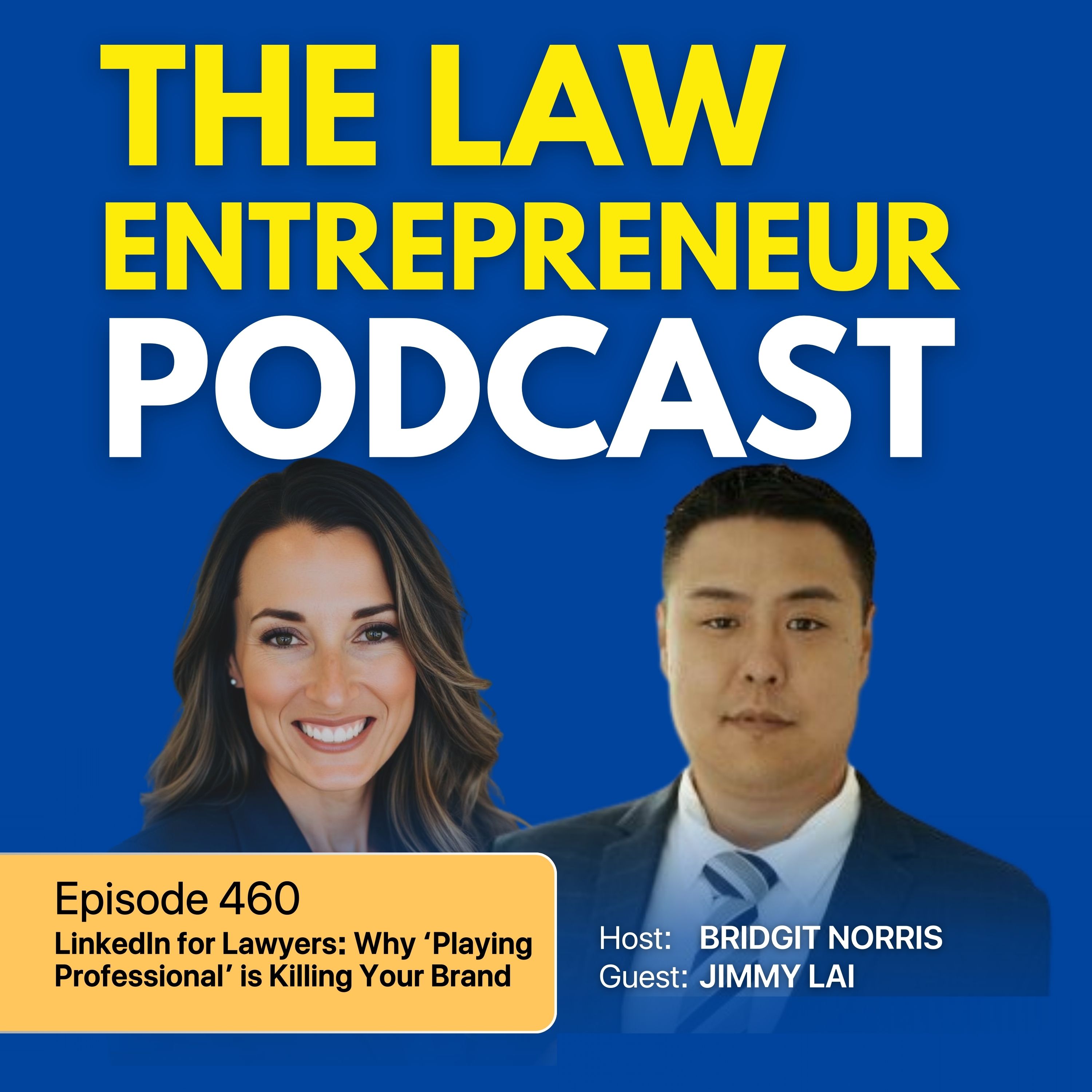
The Law Entrepreneur
460. LinkedIn for Lawyers: Why ‘Playing Professional’ is Killing Your Brand with Jimmy Lai
00:38:57
Loading summary
Transcript50 lines
- [00:03]
A
Sam Alai Here at the Law Entrepreneur, with our host, Bridget Norris, we focus on law firm strategies for law firm growth, practical plays to help scale firms for every shape, size and practice. It's time to talk about scaling. Let's have some fun.
- [00:24]
B
Welcome back to the Law Entrepreneur podcast, where we help lawyers scale, stop lending in and start building firms and lives they actually love. Today's episode is one I've been looking forward to because we're diving into the journey of someone who went from calling himself a boring lawyer to becoming a LinkedIn storytelling master and community builder. My guest is Jimmy Lai, CEO of Lai and Turner Law in Oklahoma, where he helps immigrants secure U.S. visas to start, scale and succeed in the U.S. but if you follow him online, you know him as the founder of the Unforgettable Professionals community, a place where so called boring professionals learn to tell stories that attract clients, build authority, and actually make them unforgettable. This conversation is about mindset, storytelling and strategy, and it might just change the way you think about LinkedIn forever. Let's jump in. All right. Welcome, Jimmy. I'm super excited for this conversation. So before we jump in, if you want to share a little bit about yourself and your practice so that everybody can get to know you a little bit first.
- [01:35]
C
Yeah. Well, first of all, thanks for having me here. My name is Jimmy Lai. I'm originally from Taiwan and I started my own law firm here in Oklahoma City three years ago. Basically being an international student, I struggle with finding jobs. So then I discovered what's called the E2 visa, which allows me to start my own firm and then to kind of continue living in and having a career in the U.S. and since then, it started as just myself and we've grown to a team of 23 team members, full time, part time, some VAs and myself. I practice immigration law. So I help others immigrate to the US with business or employment solutions. And my law firm, we practice Oklahoma Law for family estate planning, criminal defense, personal injury. So those are kind of our main practice areas right now.
- [02:29]
B
Wow, that's pretty expansive. I didn't expect you to tell me all those practice areas.
- [02:34]
C
Yeah, I struggle because the conventional business advice is niche down. Find your niche, figure out your niche. So in some sense, I only focus on immigration cases now, but it was kind of hard because when you start your own business with no prior experience being an attorney, no prior experience being a business owner, it's really hard to turn away business as long as we're competent. We took on the business and it's just hard to say no. And then eventually we figured out, okay, we do need to niche down. But in a sense, I'm trying to build a full service law firm still so that to service Oklahoma. And with pretty ambitious goals that I would like to achieve in the next 10 years.
- [03:13]
B
I love that. Well, Sam and he always says all the time he's definitely open to expanding. Once you scale one, then go to the next one. And then I think it's just, I think it's the concept of coming in and trying to scale everything all at once, which is so impossible. You have to know that pick one thing, get really good at it, then start to the next thing. So that sounds like that's what you did. It's great.
- [03:33]
C
Yeah. And I think that applies also to, to marketing because early on also I was just dabbling in various marketing, trying this, trying that, and now I'm trying to figure out, okay, doing my numbers and then figuring out if this is a profitable marketing channel and then doubling down on this before trying everything else. Because right now I'm like, I'm trying to do YouTube, I'm trying to do Instagram, LinkedIn. I got addicted to LinkedIn, which I will talk a little bit about. So I'm everywhere right now. So I just need to realize, okay, what's my most profitable or like what can generate the most return and then double down on that, then add on a different channel.
- [04:10]
B
We talk about that a lot too. With the marketing. Everybody always asks, so I want to do Facebook, I want to do TikTok, I want to do wait till you get something that works. And then exactly what you said. You double down on it. How much are you spending in marketing? Double it and then focus on expanding into other. But it's really hard for people, I'm going to be honest. It's hard to not want to do all things.
- [04:28]
C
Yeah. Even right now, even though I know the concepts and everything. But it's hard for me. I still want to do everything here and there. But now I'm trying to see how I can utilize my staff, like the attorneys and show off their expertise. Because if I'm on LinkedIn, I'm talking about immigration. I don't think I'm an expert in family law, so I wouldn't be able to share anything. The nuances of family law. So now, now the challenge is getting my, my team involved in marketing efforts.
- [04:54]
B
And are they open and excited to that or are they kind of.
- [04:59]
C
They're. They're excited about it, but then the challenge is Then they're like, oh, we don't have time. So now, because I, I'm still kind of wearing many hats now, you know, I was HR marketing operations. We just finally two weeks ago, hired on a HR specialist to really start doing the HR correctly. And then, you know, just hiring on fractional CFO is my next step to get our numbers better because we have, we're operating at a, at a smaller margin than we would like.
- [05:29]
B
So is your goal to expand to kind of be more the CEO visionary rainmaker and then only take on cases that you want to take on or you're still going to be focused on just immigration and.
- [05:41]
C
Yeah, so actually right now, I would say for about a year or so, I've only been spending maybe 10, 20% of my time doing the actual legal work. And I'm, you know, most of my time spent being the CEO, you know, doing the marketing, talking with vendors and trying to figure out how we can grow the business and networking. So I would say 80% of my time is pretty much spent on CEO like type activities. I'm not there yet, but yeah, that's kind of where there's like the business of law and the practice of law. And I openly joke with my friends and with clients that it's like, I may not be the smartest attorney, but my job is to find the best attorneys to service you. So that's kind of like what I see myself as. Like, I don't need to be the smartest, I don't need to be the best attorney in my law firm. I just need to be the, maybe the best known and get the clients coming in and then I'll be finding the best attorneys available to fulfill these clients.
- [06:37]
B
I love that. That brings me to the fun part of this conversation. The idea that you called yourself the boring lawyer, which is so funny because it totally projected a post of my own, a little series of my own with being the boring lawyer. So I would really love to kind of hear your story from going from that. And I know that being on LinkedIn and what the real moment for you was for realizing that part of it.
- [07:02]
C
Yeah. So I think what sparked the conversation of, you know, getting on LinkedIn was I attended one of those law firm conferences and one of the attorneys shared that he used LinkedIn as a referral strategy. And he said if he gets one client a month or even just one client from LinkedIn a year, it could be worth it. Still, I was, okay, let me try that out. So last September, I started at, I think I was at 1300 followers. And before that like 12 years of LinkedIn was just randomly sending out connection requests. And even though I don't know them, I just like sent out connection requests. So somehow I had 1300 followers. But that was back in September. And that was one of the reason was because I wanted to kind of figure out LinkedIn and referral strategy. The other was I was spending upwards of, and still am anywhere between 20 to 30,000amonth on ads. Google Ads, Facebook ads, agency fees, those tend to be a little bit higher. And because of my inability to, to put all eggs in one basket, I have probably like four different agencies there. So one's doing Google Ads for family. Well, one's doing family and immigration on Facebook. The other one's doing immigration on Facebook. And we have another one that does only DUI on Google. So eventually probably figuring out a way to consolidate that because the agency fee is taking up a bulk of that marketing spend. So with that in mind, I figured I need to start build up like a personal brand so that I don't need to rely on ads as much. Maybe I'll still use the ads to kind of scale and grow, but if there's ways for me to do that without having to spend too much money. So that's why I started on LinkedIn and since then growing on LinkedIn and made really great connections. I would say I only had, I would say like one client from LinkedIn. I signed up and then we have a couple referrals and now it's starting to get there. Where my goal on LinkedIn is just to be on top of mind. Like how all the big PI lawyers are using billboard strategy to be awareness top of mind. That's my strategy on LinkedIn. It's like flood, flood LinkedIn. Try to make my content fun and generate the awareness so that they know that, hey, there's this immigration lawyer on LinkedIn called Jimmy, and he also does, you know, legal work in Oklahoma. So that's kind of like my strategy for LinkedIn. And over time, even though I haven't signed up as many clients on LinkedIn yet, but we've hired three team members directly from LinkedIn without having to spend on ads. So I would say like that that's a win in my book is, you know, then I figured out that potentially it could be a recruiting strategy because another attorney came to us because they saw my post saying I'm looking for an attorney. And then they kind of went and asked my other associates because they were, they were friends and they're like, hey, is, is Lyon Turner a good law firm to go to? And so that's how we ended up hiring another attorney. So I see that as a recruiting strategy. And then how we got to the boring part was I got a lot of DMs and people asking me how did you grow? Like, and most commonly I would say the most common objection to people posting is that they think they have nothing to write about. They think they're boring, they think there's no interesting content. And that was what I thought I was because I thought my life was. I'm an introvert. I don't go out much, I don't party. I thought I was boring. And I blame suits, the TV show suits for making people think that lawyer life is exciting. But no, lawyer life is not exciting. It's, it's, it's quite boring. So I figured I'd market myself as like the borrowing lawyer who kind of discovered the storytelling and the story is what people resonate with. And kind of like that kind of framework has really helped me get more attention to my LinkedIn profile.
- [10:46]
B
I think that, that, that brings me to like another thing is, is thinking that and I see a lot of it still where lawyers want to post just about like legal updates or cases or. And I'm, I kind of liken it to. If you're trying to use this as a way to, to gain clients or to gain traction, I don't think that's something that they would be looking at. So how do you maintain the balance? Because there's obviously some of that that you want to post to maintain credibility and then some of it that needs to be posted to actually be able to attract people like regular humans.
- [11:19]
C
Yeah. So like on this thing journey I signed up to a lot of, you know, personal branding courses and LinkedIn course and it boils down to in the beginning is like finding out who you're. I guess like it's like marketing. What's your, who's your target audience? Who's your target client? So to like trying to figure out who you're trying to speak to and then building out your content pillars. So like it, it makes it easier. Okay. These five are my content pillars. So right now on my profile I think I have leadership as one law firm, growth as one attorney. Anything attorney life or attorney related, a little bit of AI stuff and marketing. I think that those are kind of like my main content. And one of them and the last one is the school community that I'm trying to build up right now. So like with those content pillars in mind and that's kind of, I have my content strategy laid out and on the weekend I use kind of more relaxed. There's no content pillar. It's just like whatever I find interesting is just experiment with it because there's not a lot of people on LinkedIn anyways on the weekends. So it's a, it's a time to shine and just kind of be yourself, be more yourself, authentic. So I don't know if you saw, but this past weekend it's just a random conversation with a friend saying, hey, Harry Potter donuts with Krispy Kreme. And then he said like you just broke news to me. So I just took a screenshot of that and just tagged Krispy Kreme and said, hey, you know, I broke news to a friend. I think Krispy King, how, how fun it would it be if Krispy Kreme responded to this? And then I sent DMs to 20 Krispy Kreme brand, brand managers, marketing people. One person finally responded and DM me his email. So we'll discuss if there's, if anything comes of it. And then on, on Tuesday morning when I went to go get donuts, well actually Monday I want to get donuts. And they said it sold out at 7 o'. Clock. So then they say you gotta go there early. So I Woke up at 5:30 and that, that turned into another content. Like okay, Lord wakes up at 5:30, not for court, but just to get donuts for his team. Because you know, one member of the team said they wanted Harry Potter donuts. So then that turned into another content and that one had like 10,000 impressions right now. So it's just, I guess my bar might be low on what I find interesting and that's what made it. People take themselves too seriously on LinkedIn sometimes.
- [13:33]
B
That's what I was going to say is, is that I'm wondering if all of the content that people feel so comfortable to post on like Instagram because they think that's the place for. Or you know, I'm posting in stories and that disappears so I can post it and it goes away. You know, is that translatable to someone who, I mean, it doesn't matter what type of law you practice. If you're trying to grow a brand and you're trying to, you know, lead or, or be a specific voice, I mean obviously the spaces are, can be crowded, like everything. Would you say that that would be a great transition to come off of? I mean, if they're already posting about their life, whatever it looks like in Instagram and that is that relatable and transferable to LinkedIn?
- [14:15]
C
Yeah, I think parts of it. Because LinkedIn, I think, is still in a way, heavily more on the educational value side of things. So, like the, the trick is try to figure out making content that's highly educational and highly shareable. That's the key factor. Like, if you can get people to repost your stuff, your stuff will go more viral. And so I say like, and just to make things more interesting, like, not to be the boring. Like, oh, this Supreme Court said this and this court decision is this. Maybe you add in maybe 20% of the content is still there just to build all your authority. But I think what gets people's attention is your lifestyle. What went on? For example, I posted last month about a conversation with a Gen Z staff. He texted me at, I think it was like 10:30 at night. So I made it into a content and that post blew up and had almost 600,000 impressions. Just like just by saying, hey, last week a Gen Z staff texted me at this time. So that was the hook. And then I thought he wanted to quit and something like that. And then that post just blew up. So anything really like what happens in your life, even if you're in like procurement or hr, I think you can blend in some of the things that you do on daily and you can turn that into a story and add some value to it. Those are some ways. And even in your role, I believe, like, you're helping tons of women CEOs running their businesses. And I think there's always conversations or there are some things that maybe you share to say, hey, maybe like, oh, so and so, or this person was struggling with marketing. And then we discussed these things and then, you know, these are some of the things that they didn't realize or hey, the company X said, I want to improve my marketing. But then we did a deep dive into the social media and found that there was 100 unread messages in which like 50 messages was asking about services. And so that like that could be a content in itself already. So, like, I think maybe because my bar is too low and I just find things interesting, like, whatever happens. And now like being active on LinkedIn so much that anything that happens in everyday occurs. I was like, okay, that's a LinkedIn content and I'll kind of put my notes down. Yeah.
- [16:31]
A
If your calendar is empty or chaotic, my Legal Academy Systems helps fill it with consults, streamline intake and make marketing easy and measurable. Start your firm's growth journey today. Book a call with us@schedule.my legalacademy.com Again, that's schedule.mylegalacademy.com so I have two things.
- [16:55]
B
I mean, one of them has always been an issue for like storytelling is like sometimes I think for some people it's hard. Like we're very pragmatic and it's like, and there's, it's very hard to get used to weaving in stories and get used to that. And so that's one thing. Like what would you say to somebody who maybe struggles with that? Like, you said you could take anything that happened in your day and create a post from it. But having that post be something somebody actually wants to read and respond to is the trick.
- [17:25]
C
Yeah, so I'm still learning like how to, how to tell better stories and I'm trying to learn how like different storytelling formats and then like kind of looking at all these big LinkedIn creators, how they write. But I think a big portion of it boils down to your hook. The first three lines. Like the first three lines just, it's like you're scrolling on TikTok and YouTube shorts. People's attention span are, it's already really low. So those three lines, you kind of want to. And my trick is basically try to spark curiosity because people are nosy and then so they're like, okay, they want to learn more. So like how do I get people to click to see more? So that's why I think like some stories, hooks, I think like the most recent one, like it's 5:30am and a lawyer waking up at 5:30 to go get donuts. Instead of getting. So that people are like, oh, wondering why are you like waking up at 5:30 but not for court. Oh, you're going to go get donuts. And that was interesting. And they're like, okay, why are you going to get donuts? So it's like the hook, the rehook and then the story and then you end. Some people add their, you know, get people to engage and say, hey, you know, what do you think the most common, I think the Most, the best CTAs are just getting the easy answers. Like yes and no answers or numbered, you know, like 1, 2, 3, 4, 5. Like if you have it open ended. Sometimes people are like, I don't know what to comment, I don't know what to say. But I feel like, do you agree? Yes. And then so like people just, yes, I agree or no, I Don't. And then they would just be more inclined to write more after they have the simple yes or no answer.
- [18:58]
B
So with AI and everybody being able to get. I'm seeing this a lot on lots of different platforms, but the fact that you can get any type of education, you can get any question answered, how do you think that that may play into, or is it already playing into the LinkedIn being super educational, where we are like, oh, we can all go find this information ourself. Why would we post it? Why would we post about it?
- [19:23]
C
That's a really good question. I don't really know the answer to that. I think people can tell when the content is AI. And I would say AI assists with my writing, but the content idea, I make those content ideas and run it through AI and then just making sure that people hate the EM dash for some reason. So I'll just use a hyphen instead of an EM dash just to change it up. But I think people know AI is so easy and they crave the real, real stories. So I think if you still keep it authentic, even the AI assisted, but if you have authentic story, authentic content, I think people will still want that. It's like we're in the information age. Information is readily available, whether you go seek it out yourself or it's fed to you on LinkedIn. And whether they like this particular person and want to follow them. So an example is like a recent referral and this person was really excited that he was able to refer me, someone, his own family member, because they, they were talking about immigration and they're like, oh, I just met Jimmy. I came across Jimmy a month ago, just a month ago. And then I really like his content on LinkedIn. And so he, he DM me and said, yeah, my family member needs immigration. And so, yeah, so, and we just set up, set a meeting and we'll be speaking soon.
- [20:37]
B
That's awesome. So I think when we talk about algorithms, which we can never ever know exactly what an algorithm is going to be and how it's not going to change today or tomorrow. But if you had like to give the top three or even two tactics that you could give to lawyers to say, this is what I would suggest you do if you're trying to engage with maybe lawyers to get referrals, or would they be different tactics if you were trying to engage to get clients, or is it the same?
- [21:06]
C
I think they're the same. But then just really understand what's your strategy, because in the practice area, LinkedIn is more B2B. So for immigration space, it was a little bit more challenging because you don't know who necessarily need immigration. And one thing would be like setting your profile up optimized. So you need your feature sections. You want to make sure that if you have a process for them to get in touch with you and book a time with you, maybe a page that opens up to your referral videos or whatever. So I think you want to optimize your banner, your feature sections. And in terms of signing up clients through LinkedIn for lawyers, I would say storytelling. I think lawyers are good writers already, so I think we can turn that into storytelling content. For example, I think I recently saw a PI attorney say, like this client of theirs fire the previous attorney and end up coming to them and the story and the journey. And they had a really strong hook. Like, okay, I think it was like, we settled this well, I mean we won this case for a million dollar, but where the other attorney encouraged my client to settle for 10,000. So that was like a big hook. I was like, okay, it makes you curious, like why? And then he talks about what they did to get to the million dollar judgment, things like that. So I think as attorneys you can always. There's probably plenty of stories that they can share to kind of show their authority, plus also increase your trust and the likeness. So I always think about, whenever I'm posting content now, I keep these things in mind, like, is it going to make them know me better? Is it going to make them like me more? And is it going to make them trust me more? So those are kind of like the three key things that I try to maximize whenever I post.
- [22:54]
B
Oh, that's awesome. So if there is one mistake that you see lawyers making that, that either just making generally on LinkedIn or making that killing any ability for them to get growth at all, what would that. What do you think that would be? Other than probably posting super generic boring. Nobody wants to read the Supreme Court ruling of whatever, whatever that they can read on their own.
- [23:18]
C
I think the mistake would be not paying attention to the hook. It may be like a case study or one of the cases. Exciting is great, but if they don't pay attention to the hook, no one's going to read the body of it. So I think that might be one of the mistake. And the other mistake would be trying to analyze too much. Trying to show, I guess, show off. I don't want to say show off, but try not to show off too much. Just show enough that that's. People know that you're an expert, you know, you're an attorney, you know what you're talking about. But I wouldn't go, I wouldn't start writing research papers or things like that on LinkedIn.
- [23:52]
B
Yeah, I think I've been told a few times by a few lawyers that lawyers are skimmers. They tend to skim things quickly. So would you say keep the content shorter when you're directing your content, you know, specifically the lawyers?
- [24:07]
C
Yeah. Yeah. So like, keep it short. There's like two thoughts on this. One is like, if you really want to build your authority a lot, then you can make it long, but you gotta make sure that every paragraph is exciting enough for them to keep on reading to the next. Or you gotta know that if it is early morning and they're just scrolling and trying to get ready for work, then you just want to make it easily skimmable and just like one sentence or two sentence, three sentences, and then make it, make it look nice and with enough white space. And so right now I'm like, when I write, I think I'm turning into like a LinkedIn writer. I had put space in between sentences.
- [24:43]
B
Now I know that's bad. That's like the marketing. You're just being a marketing writer. Like, and then I think, thinking about, like I always try to think about if I was going to read this, how would I read it and how would you keep getting me to read it? If you cram all the words together, I'm probably not going to read it. I'm going to maybe miss some important sentences in between there where they're all smashed together. So I, I try to do that as well, but I think sometimes we can over, definitely overthink it. So if you could only spend 30 minutes a week on LinkedIn, and I know that that is probably nowhere near what you're spending, but if the lawyer could only spend 30 minutes a week on LinkedIn, what, what should they focus on?
- [25:22]
C
I would just say like, if it's only 30 minutes, then, well, work, work through the beginning. Like your content pillars, all that stuff. Right. So assuming that's already done, I would say with the 30 minutes you have, batch write, just start writing and then batch write them and then just schedule them out. It's fine to schedule them out and then Maybe start with 2, 2 posts per week and then go from there and then. But LinkedIn doesn't like when you post and ghost. So preferably, even though if you schedule, let's say you schedule for 7am preferably, you still want to get on at like 10, 15 to 30 minutes beforehand or 15 minutes after just to, just to engage and comment on other people's posts to show that you're not posting and ghosting and so that, so 30 minutes is really not enough. I would say ideally you probably want to dedicate maybe, maybe two hours a week to LinkedIn at the bare minimum so you can have time to write plus engaging with other people's content and then replying to people commenting on your content.
- [26:23]
B
I think to me it feels like LinkedIn is obviously it's a long term game. It's not an instantaneous. You're not going to have a million followers overnight. So just like with YouTube, it's long term. You've got to be committed to it. Do you think that it's more going to play a role in the leadership aspect and the brand authority aspect versus, you know, obviously creating ads on Facebook that gets you clients specifically because I think LinkedIn ads are probably the same. They're, they're a little longer lead and you're not really sure if you're going to find the right clients. Whereas in Facebook and Instagram everybody lives there. So it doesn't matter what, what type it is. I feel like LinkedIn is more of a way to build brand authority and kind of be the authority in the space.
- [27:09]
C
Yeah, you're right. You absolutely nailed it. I believe, I believe that as well. And in a way I think LinkedIn is kind of like SEO, like website SEO, like you're building your own SEO into you. You don't, I, I don't think people ever search on LinkedIn really, but then somehow you know, LinkedIn feeds you the stuff that you consume. So in a way I kind of see it as, in terms like when I say SEO, it's like it's a long term game, like you're not going to get the dividends, you're not going to get a result immediately. When you see now 8,000 followers, that's almost a year of work putting into it. So it's a, it's not a fast growth but the connections you make on LinkedIn are, I think it's more, more deep. Like it's more impactful than a connection or a follower on Instagram or Facebook.
- [27:58]
B
Have you made a lot of connections maybe outside of the legal world and law practice that has also helped you grow?
- [28:07]
C
Yeah, yeah. So one of our Facebook marketing mender actually just DM me on LinkedIn. And so if anyone's seeing this, yeah, sure. Please continue to DM me That's fine. But I do get a lot of DMs. But he caught my attention with the DM. So that's another strategy. It's not just posting DM is another strategy to gain clients. And so he DM me on LinkedIn and he had a compelling offer and that caught my attention. I was okay, let's give it a go. And I met with him, discussed what he was doing and then we started working on Facebook ads. And the last three months we generated about 8x return on our investment. So that has worked out. And I would say there's like plenty of financial advisors that I'm coming across that can help me with my finances. And there's some legal bookkeepers as well that I've connected with on LinkedIn. So I think LinkedIn is a gold mine. There's plenty there and plenty of opportunities on LinkedIn.
- [29:02]
B
So maybe for especially lawyers who, who are working specifically with other businesses or maybe they trademarks or business law or corporate or something along those lines, I feel like that's a, this is a perfect platform for them to really build on because these are your ideal clients essentially. Especially if you don't have a very specific niche that you're working in. It's kind of, everyone's there, they're kind of, kind of open.
- [29:27]
C
Yeah. And so the, the one attorney type that does really well is employment attorneys. So like there's, I think there's one employment attorney that she has almost half a million followers I believe because, because she's post about the, the dark side of HR being an in house counsel and working for a corporation. So she shared like stories of that and that resonates because everyone on, almost a lot of people on LinkedIn are you know, employees. So that that type of content resonates. And she's gotten thousands of inquiries and leads actually from know just on LinkedIn. I also said even if it's family law and criminal defense, you can still get referrals that way if you're, if your audience are attorneys or just regular people in your area and they see you as the authority of, you know, speaking about family law and like issues like that, they might see you as an authority and then eventually they'll reach out.
- [30:18]
B
Yeah, I think it's the idea of like you said, it's being the authority, being recognized as the authority. And although everybody wants to scale their business via ads and be whatever, there's still something to be said for the lost art of building relationships and actually connecting with people and having a referral Network being able to say, okay, I can't help you because I'm not in California, but I certainly know a bunch of people I can refer you to. I think it's a big. I think we went from you can't just be all referrals to now people wanting to just be all ads. And I think with. We've gone from one extreme to the next without actually living in the middle.
- [30:57]
C
Right? Yeah, that. Yeah, yeah, that's like. I think that's what.
- [31:02]
B
Yeah, I think so. If, if lawyer wants to become the unboring lawyer or wants to. I don't label themselves as. I know we, we look at LinkedIn. I look at all some of the funny, the Yoda of this and I'm the Star Wars X of this and I'm the. It's kind of. But it's, it's definitely interesting and it definitely makes me read it. So you definitely want to do that. So if we had to leave them with. We know the brand pillars, we know that you should understand what you're talking about and who you're talking to. And generally if you're out there marketing in the world, you probably, probably have that established. After that, it's just starting to post. But what would be, what would you say is, is. Although it took a year, I mean, you did, you created another, what, 7,000 followers in a year. That's still pretty amazing if somebody wanted to even grow to that in one year. What is the commitment level? What is the, what is the number one thing that you would leave them with that they would need to do to make sure that, that they can accomplish that?
- [32:04]
C
Consistency. That's the number one thing is just show up every day. For me, in the beginning it was one to three posts a week. And then it turned into somehow I just got addicted to LinkedIn and I was, I'm posting it and I posted once a day and now it's two to four times a day. And then I actually schedule them out because like I, you know, for today I, I've been busy, but I was able to post a couple times already and so I just scheduled them out. And if I can be online to reply to comments, I will, and if not, I can't, I will say it's consistency and not giving up, staying saying the course and understand that people will come across your content and it compounds over time. And all you're looking for is just that 1% improvement. That's kind of what I learned from Laura Acosta. She's one of those thinking creators and she talked about just focus on the 1% improvement. And it just compounds over time. And so you don't have to. Even if you post to one follower on day one, it compounds and it slowly grows in the ads. And, and I would say joining different communities as well, it helps you being in a supportive environment and they can kind of help you with your writing, give you feedback. That's what I did in the beginning was I joined all these different communities to kind of learn how to write and getting support from the other community members.
- [33:22]
B
I think it's the idea behind you've got to want to grow, like, decide how it is you want to grow, decide what that looks like and go all in on it without expecting there to be an easy button. I find a lot of times people will even come to us and be like, oh, I thought I was just going to be able to press this easy button and everything was going to be magically done. And that's not the way it works.
- [33:43]
C
Yeah, yeah, that, that's, that's true. And I'll tell, you know, I'll say back to the attorneys, if they ever said, like, oh, I thought it was going to be over. Nice to say, like, well, how long did you go to law school for to be an attorney? Like, you didn't become a, you didn't become, you didn't become an attorney overnight. So good things will take time and you put in the work to become an attorney. You're also going to have to put in the work for be on LinkedIn. Just because, let's say, if you're the best attorney in the world, but if no one knows about you, how are they going to hire you? And why, why should they care? Why should people care on LinkedIn? You know, even if you're the best right now, but you don't, you don't share like what, what you've done for your clients and these, these stories and it doesn't connect with your audience, then it's still not going to do well. You can be the best attorney in the world, but if no one knows you, if they don't like you, they don't trust you, you're going to struggle with business.
- [34:32]
B
Yes. And be memorable. I think that if you don't take anything from this conversation is that LinkedIn does not have to be corporate speak on every single thing anymore. I think people are actually exhausted from it. I think people stopped going to LinkedIn because they were tired of that kind of same basic stuff. And now the deeper conversations even. And I don't even remember how, how I ended up finding one of your posts actually. But how that rolls out is now the people that off of your post that now have connected with me and I connect with. We're. We have great conversations and I have people reaching out saying, oh, this is what you do. I think I can help you. I think it all unexpected from just being willing to be active and not post things that, that are just so generally tiring soon.
- [35:20]
C
Fast. Yeah. And so just trying to make it fun. Like even my cheese rant, that was what a lot of people know me like, my cheese rant. I think it was like midnight or late at night. I said since it's like maybe I think it was like 9 or I think it was a 9pm I was like, since it's 9pm on LinkedIn and this is a free hook so you can say it's like late at night. And since it's late at night, no normal lawyers or no one's going to see this on LinkedIn, it's safe for me to say this. And so that's the hook. This is a free hook that it works a lot. And then I just went and went down the sec more. It's like, and I just said cheese is overrated. And then that, that blew up and had I think like 400 reactions and people commenting on it and they're like, no, why? And so I just started all this conversation. So I'm known as the person who, who hates cheese. But the thing is, I never said I hate cheese. I just said it's overrated. I didn't say I hate it because it's overrated, but. But then that's kind of what people know me by now. And I also want to give one more advice for anyone seeing this is you know how your LinkedIn name and then underneath your headline, don't say like immigration attorney or IP attorney or like a senior associate. Like, don't do that. Like, do like what you, what you like who is your ideal client that you help? So for example, like I, for mine I put like I help immigrants or I help families, individuals and businesses immigrate to the US via this. So like just letting people know what you do so it makes it easier for them to know, okay, this is what you do. So if you do ip, maybe you can make it a little bit more simple terms like, okay, I help businesses protect their brand or protect their assets or what you do. Exactly. Because until I met an IP attorney, I didn't really know when the IP attorney did the whole time. So I was like, okay, now I know, like they did again, they protect your, your brand, your assets, your copyright, your, your whatever and registering it trademarks. So that's, that's one. I think that's a really. When you asked me earlier and I just thought of that just now.
- [37:19]
B
So two things. So we're going to leave you with. You have go check your headline right now, make sure that it's not boring and that you're not just saying you're a personal injury lawyer or whatever other kind of lawyer. Number two, use the hook that he gave. We'll actually put that in the show notes too so that you can grab it. And then if you use that hook, find Jimmy on LinkedIn and let him know how it worked. Tag me as well. I'd be super curious how it worked. I haven't tried the. It's late at night yet, but I'm gonna have to try that one. And see, I'm like one of those night owls too, where I'm like, it's 10 o' clock at night and I'm still scrolling. So I definitely have the time to do that. So I'll have to try it. But all of your information is going to be in our show notes too. So if you're not following Jimmy, go follow him. I guarantee you you're going to not only learn stuff, you'll probably laugh a lot. And the connections of the people that follow you so far have been pretty amazing. So there is no loss in any of that. So reach out to him. He's amazing. He has a community as well. I'm inside it, the value inside there. If you're really wanting to learn LinkedIn without having to do what most of us do and buy 50 courses and 50 things and try to be in all of them, the community's great. Join it. There's a lot of information in there and I appreciate you, you coming on. This has been exactly what I thought it would be about LinkedIn. So I appreciate it.
- [38:40]
C
I appreciate it. Thanks for having me on.
- [38:42]
B
Thank you.
- [38:44]
A
That's the Law Entrepreneur for today. I'm Sam Malayi. I appreciate you listening. Subscribe to the Law Entrepreneur for more legal content and practical growth plays.