← The Law Entrepreneur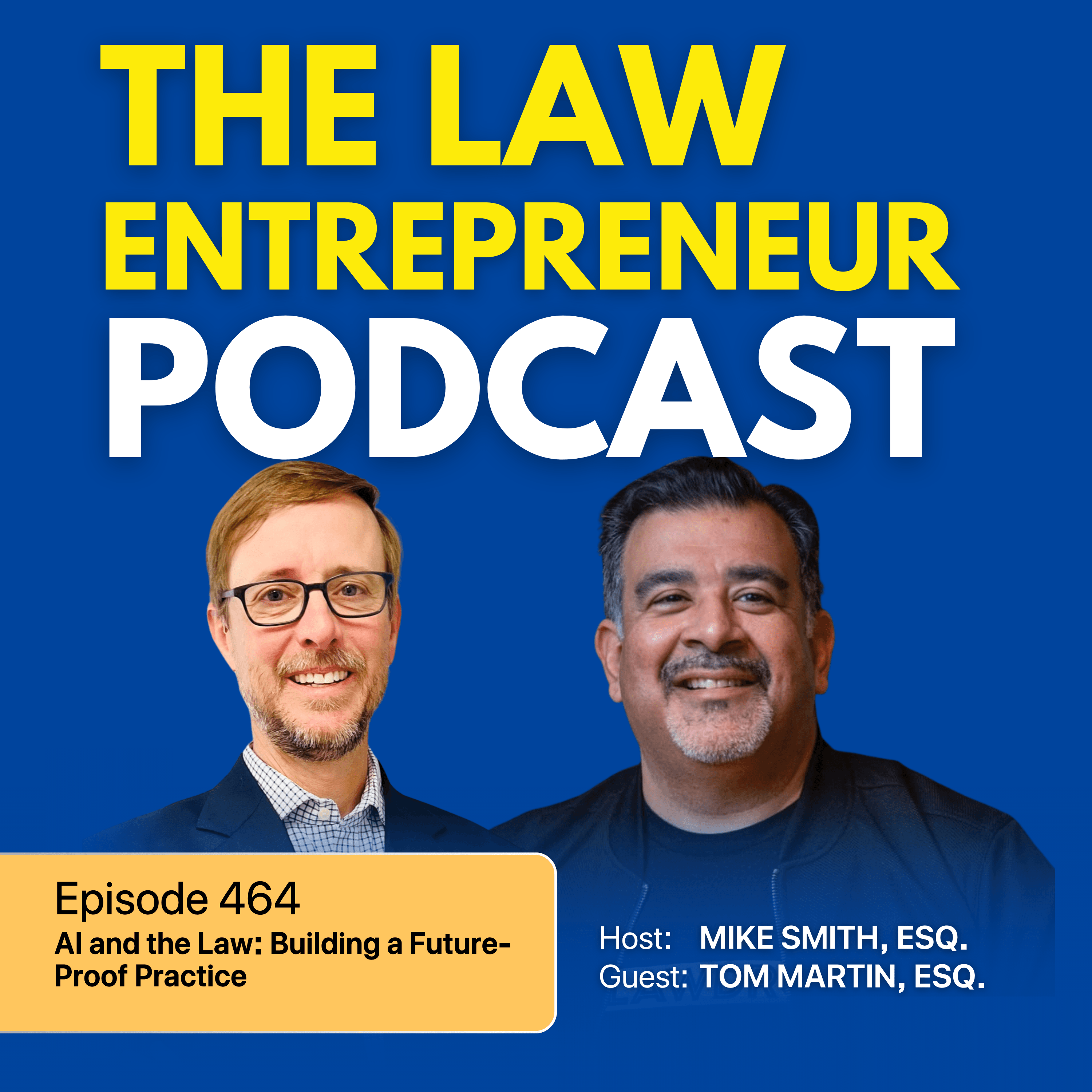
Loading summary
Transcript111 lines
- [00:02]
A
Hey, it's Sam Alai here, founder of my legal academy, where we help lawyers scale and automate their law firms so they could send up more clients and reclaim their precious time. If you're looking to grow your practice while working less, click the link in the show notes to book a free call to discover a radically different way to grow your law firm. Enjoy the episode.
- [00:23]
B
Welcome to the Law Entrepreneur, the podcast where legal innovation meets business strategy. I'm Mike Smith and I'm excited to be guest hosting today's episod. If you've been following the legal industry over the past couple of years, which I know you all have, you've probably noticed something remarkable happening. What we're witnessing is what many are calling the most significant transformation in legal practice since the invention of the law library. And at the center of that revolution is artificial intelligence. The CLIO Legal Trends Report that came out in 2024 said that there'd been a jump of AI adoption among lawyers from 19% to 79% in a single year. I mean, that is crazy. That's not the sort of typical slow adoption of technology that we usually see with lawyers. So a lot is changing out there, and today I'm speaking with Tom Martin, who is the founder and CEO of lawdroid, one of the pioneering companies in legal AI. He's been working on AI in the legal space for nine years, and so he was way ahead of like using ChatGPT to, you know, write a letter or whatever. And the interesting thing about Tom is he is actually a philosophy major who went to Yale, so he's very interesting to talk with. And he turned into a legal technologist and started applying technology in his law practice around 25 years ago. So he's got his own law practice in California in addition to running Law Droid and some other things. And he knows firsthand the kind of pain points that we face. We're going to talk some about, you know, opportunities in the legal practice for AI innovations that are happening, what's around the corner, some practical things that you can apply in your practice as well. Tom is also an adjunct professor at Suffolk Law School, where he's teaching a course on generative AI. And he co founded the American Legal Technology Awards, and he runs an annual AI conference that typically sells out every year. So, and on top of that, as I said, he's running his practice in California while he lives in Vancouver. So this guy's got everything going on at once, and he's keeping all these balls in the air. We're going to talk some about his company, about Law Droid. But we're going to tell you about just kind of what's going on out there in the world of AI and how it applies to your legal process or legal practice. So we're just going to dig into what it really means for lawyers. And I look forward to this conversation with Tom. So let's dive in. Welcome to the Law Entrepreneur. Are you really philosophy at Yale?
- [02:54]
C
Yeah. Undergrad? Yeah.
- [02:56]
B
Yeah. That's funny, I didn't realize that about you. I find it very interesting. I was a philosophy minor, not. Didn't get my degree in philosophy, but always really enjoyed the philosophical endeavor, I guess I would call it. So what we're going to talk about today is just kind of AI and the law and technology and the law and what you see in terms of where we're headed in the future. And I think somebody described you as you might have figured out how to clone yourself. Is that.
- [03:29]
C
Yeah, I've heard that.
- [03:31]
B
Use AI to clone yourself. So I know you are, you know, running Law Droid as a CEO. Are you still practicing actively?
- [03:39]
C
Yeah. I still have a law firm that provides probate services to Californians. Okay.
- [03:44]
B
Similar to me, I do a lot of probate work as well. And then you're teaching also at Suffolk Law School?
- [03:50]
C
Yeah, not this semester, but next semester.
- [03:52]
B
Gosh. And you host a bunch of conferences and things like that, too?
- [03:57]
C
Well, I host the AI conference for Law Droid, usually in the first quarter of the year, and then the American Legal Technology Awards in the last quarter of each year.
- [04:07]
B
Wow. So, like, balance and all that stuff. Have you, you know, found the AI helps you manage that better?
- [04:14]
C
Yeah, definitely. I mean, there's some of it that it helps a lot with that would have otherwise taken a ton of time. One small example is like, for American Legal Technology Awards, there's different communications you need to send out, you know, let's say to a journalist, hey, we got the finalist list, or to the finalists themselves or to the judges. And thankfully I have like, you know, past examples of things that I've sent by email. And I could just use those as a kind of like templates and then say, this is what's different this year. And it refreshes and provides something that I could use, tweak a little bit and send out. So, like the busy work.
- [04:53]
B
Yeah. Sort of tedious. Yeah. So you're able to provide that all as context for the AI to then generate the message about this year's event.
- [05:03]
C
Yeah, like a press release to our media Partners, you know. Yeah, just like, you know, maybe I provide like the quote for this year that I would have and it fills in the rest. And so it really saves a lot of time on that. If there's anything where I need to tweak it, I do before I send it off. But it really does save a lot of time.
- [05:23]
B
I'm curious, which I'm assuming you probably use a lot of different LLMs, different models. Which one do you find is best for tasks like that, like drafting pros? For emails and things.
- [05:37]
C
For emails and things like that, where it's just communications, I usually use Claude.
- [05:42]
B
Yeah. And I found the same thing. Yeah.
- [05:45]
C
And I'll use sonnet Claude sonnet 4.1. The opus is not really necessary for those kind of communications. And then for a number of different things, like I have to create cover art or images. And usually my go to is OpenAI. Like I'll use GPT5 and just say create image. And then I give like the description, the aspect ratio, the style, and it never does it first off, like you have to go through a few different iterations, tweak it a little bit, and then I'll grab that, put it into Canva, and then really dial it into what I want. So like, you know, when people think of AI, sometimes they think of it as just like a push button, like a one off where you just tell it what you want and then it either does it or it doesn't. And then, you know, it's pass fail based on that. But there's a lot of curation that we can bring to the table about different, like tweaks that we want. And then also like some manual work, you take it in Canva and then you like add little details and things like that to make it even better. But even with that extra work, it still saves a heck of a lot of time that it otherwise would.
- [06:55]
B
Yeah, I mean, I find that AI tools, the way I think of them is they're really a collaborator. And the same way that a really good paralegal is a collaborator. You know, back in the day I would have said to my paralegal like, hey, I need to draft a letter to Tom that says approximately this.
- [07:12]
C
Right.
- [07:13]
B
And he or she would have drafted it up and then I would have edited it from there. Well, AI is now filling that same role for me where, you know, I say to the AI like, hey, I need to draft a letter to Tom that says xyz and it gives me a first draft that I can then, you know, modify from There. So. Yeah, I mean, I. You're right. It's not just a push button thing. It's not just going to give you exactly what you want. You have to kind of work with it. This little push and pull kind of get the output that you want from it. So you started Law Droid, what was like 10 years ago? Is that or eight years ago?
- [07:46]
C
Nine years ago. Coming on 10.
- [07:48]
B
Okay. Okay, so we're getting close to 10. What. What sparked you to. To start a tech company?
- [07:54]
C
Well, it goes back a long way, but I've always loved technology. I've always loved computers. I was coding some, like, a simple program in basic when I was 11. So were a lot of my. Yeah, there were a lot of my friends. You know, they had Commodore 64s. I had an Atari. I was like, the only guy who had an Atari computer.
- [08:14]
B
Yeah, I remember those.
- [08:15]
C
And so, like, I had an interest early on, and then once I became a lawyer, I was just trying, you know, I was always looking at it from that angle, like, what could I do as you do in your practice? Like, how can you make it easier for yourself and the people who work with you? So, like, document automation or forms that trigger, like, actions and things like that. And this is like, early on, like 20 years ago, you know, like, I. My first startup actually was in 2000 when the DOT com bubble was going on. I actually created a site called immigrationfilings.com and it was so that somebody can go on there, fill out an immigration form, and have it populated for them programmatically.
- [08:57]
B
Nice.
- [08:59]
C
Yeah. And so that didn't go well with the bust after that. Yeah, but that was my first dabbling with a tech company. But this happened because constantly watching the news to see what developments are going on, and there was a news story about a young man named Joshua Browder, who at the time was about 17 years old, and he had created some chatbots nine, 10 years ago to help people in London fight parking tickets.
- [09:26]
B
Ah, I remember that. Yeah, yeah, yeah.
- [09:28]
C
And when I read that story, I've said this a few times, and it sounds corny every time I say it, but it did, like, make, you know, the hairs on my arm, like, kind of like it felt like, man, this is really interesting. This is different because at the time it was really different because I truly believe, you know, lawyers, they do documents, they provide advice, and there's court advocacy. Those are like three main pillars of what we do. LegalZoom had tackled documents, you know, court advocacy, not even close to being there yet. But that advice Information in the middle. That's what Joshua Browder had tackled. And I thought, wow, if you could combine that with the documents, like, that's huge. And so I jumped into it, I started experimenting with it, and really, Law Droid started as an experiment, and that's something I really encourage everyone to do, especially now when it's easier to do, is just get out there, experiment, find, you know, what makes you excited.
- [10:28]
B
Yeah, I mean, it's super easy now. I mean, with Vibe coding and things like that, you can. Well, no code tools like Zapier and Make and whatever your flavor of the month is. N8N. I mean, you can build so many, like, prototypes of, you know, workflows or whatever. It's just super easy to throw something together and sort of prototype it out, which is. It's fantastic. I'm so excited by all the opportunity that we have now. A lot different than in 1981 when we were writing basic programs. So you said at one point, we don't have the luxury of skepticism anymore when it comes to AI adoption and law. That that's a pretty strong statement. Can you kind of unpack that?
- [11:09]
C
I'm happy to. I mean, of course. I absolutely believe that that's true. That's a reality that I'm living in. And I think you are, too, from what you said. Like, Vibe coding. Right. And for those that are listening, you know, if you're not familiar with it, it's where you can basically tell an AI what kind of program, what kind of software you want to build, and it builds it. Again, not perfect. One off.
- [11:33]
B
Right.
- [11:34]
C
You have to go through it in kind of a feedback loop to get it to where you want it to be. So don't think that, hey, create a clone of LinkedIn for me. And, like, it doesn't do that on the first shot, that it's a failed project. That's not true. You just need to work on it. But now that that's possible, now that Vibe coding is possible, there really isn't much of a moat to software. So that same principle, I believe, holds true for lawyers, you know, because what we do as lawyers is knowledge work. Knowledge work is based on information and language and argumentation and all that. It is the heart and core of large language models. As the name implies, that they're expert at handling language. Is it identical to what we do as human beings? Does it perfectly, you know, handle everything like we do? No, it does not. Is it 9/10 of the way there? Yes, it is. It's getting better every Year. So the point being is that for a lawyer, I think at this point to kind of object to AI because it's not perfect. They're just missing the boat. You have to get on the boat and go with the flow to figure it out and make it work for you. And the last thing I'll say about that is that, you know, Bob Ambrosi, I want to give credit to him is that, you know, he pointed out like, the Venn diagram of like law and technology used to be, you know, never the twain shall meet. Yeah. And that, you know, personal computers came closer, email came closer, the Internet came closer, and then now large language models, these two circles completely overlap. So, you know, Bob Ambrose is also like, you know, recognizing this and I think y' all should too.
- [13:20]
B
Yeah, I mean, I think it's super important for attorneys who want to remain attorneys who want to be able to continue to practice. It's super important to understand on a basic level how AI works, how it can help you, and then also to understand what the drawbacks and flaws are. Because I was talking with a colleague yesterday and we've all heard these stories, but this is the first one I've heard that was somebody I know. And he was telling me about a brief that was submitted by another lawyer that we both know. And he said that when they reviewed the brief, they found six made up citations in the brief. Now, I mean, I just can't. I can't. I mean, how many stories have we heard about stuff like that from, you know, big law firm, small, everybody. But I mean, to me, it's no different than when you work with an associate and you say, hey, I need you to draft this brief for me. And they come back with, you know, something. And you're not going to just turn that into.
- [14:19]
C
At least.
- [14:20]
B
I'm not just going to turn that into the court. I'm going to review it, I'm going to double check their work, make sure it's right. And it's the same thing, you know, with AI. So I think in summing up kind of what we've been talking about, I think, you know, going forward it's going to be super important for attorneys to know how AI works, how to utilize it, and your clients are going to expect you to do that. Especially in practice areas where efficiency is important, where, you know, clients are paying by the billable hour and they want to pay as little as possible. It's going to be super important to know how to use AI to make yourself more efficient. So let's Talk a little bit about Law Droid Copilot. Now, that product, I think y' all came out in 24, is that right?
- [15:02]
C
No, copilot was actually 20. 23.
- [15:05]
B
Oh, 23. Okay. So it's a bit older than that. So tell me, you know, a little bit about what Copilot is and like, why is that different from just using ChatGPT?
- [15:15]
C
Yeah, so ChatGPT dropped November 2022. Copilot, the product we're talking about, I came out with that in January following that. So it was a quick turnaround because, you know, I recognized that it, you know, Chat GPT was what it has become. And we experimented with GPT3 prior to that, which was great, but it wasn't quite there yet for fluency. And, you know, having that experience, as we all did, of talking to Chat GBT and actually feeling like, wow, this is a fluent. I'm talking to a machine. Like, this is crazy. Crazy.
- [15:54]
B
I mean, yeah.
- [15:56]
C
And I think we all lose. Lose sight of that. But that was an amazing experience. And I thought, gotta, you know, gotta work this in somehow. How's it different, you know, all that stuff? Okay. The main thing is there's some lawyers like you and me and a lot of people that are listening to this. You're in Claude all the time. You're using Notebook, LM, Perplexity, OpenAI, mixing it all up. You're using different, like, image generation and stuff like that. It's not for you. Like the Copilot that I created, lodroid Copilot. Yes. It's confusing because the name is like Microsoft Copilot. By the way, we were first. I'm not going to get into the whole trademark thing. No, there isn't a trademark issue. Don't worry. But the point being is that for people that are really like, into AI deep, the Law Droid Copilot I created isn't meant for you. Who it's meant for is the vast majority of lawyers who are not knee deep in AI. They've heard about it, they think it could be helpful, but they don't feel so great about ChatGPT, you know, and they want it to be easy. They don't want to have to learn how to do prompt engineering or all this stuff. You know, I just want to make it work for me. And so the way Copilot tackles that is for all of us in the know. I've taken prompts, the full length, you know, crazy detailed prompts that we all use, and I basically put them behind a button. So the Lawyer using logic copilot. They'll just see a button that says, like, create a chronology. Right? They upload, let's say, a deposition transcript. They click a button that says create chronology. Behind that, I've curated that amazing prompt to pull everything out of the deposition transcript and create a properly formatted chronology. That makes a lot of sense. And for some of these, they could even like add a little flavor to it. It'll ask a follow up question saying like, what would you like the focus of this summary to be? So then they could say, oh, well, what I need to know is all references to the smoking gun. And it goes, got it. Then it creates a summary based on that. And so as you see, usually the way we would do it is we create this long prompt, we save it somewhere and then maybe we have to put more context in this thing. It's a button and then it asks follow up questions to expand the context for the AI. But for the regular lawyer who's using it, they don't have to think about all that. They just need to.
- [18:32]
B
Yeah, but, so it's a great kind of shortcut to, you know, getting into AI. Sort of an on ramp, if you will. That's. Yeah, that's great. And I can see like sometimes I, I love this stuff and I, I spend way too much time on tech. And sometimes I think to myself, like, you know, if I didn't play around with tech so much, I could probably make more money as a lawyer. So there's definitely something to, you know, focusing on your knitting will. So I think that's a great way for folks who don't either don't want to or don't have the time to dive deep into it, to, you know, be able to utilize AI in a really effective way.
- [19:09]
C
But, but Mike, I just want to say that I'm sure you've made a lot more money than you would have without the technology. Because you're into technology, you find ways of making it more efficient and being able to take on more clients, right?
- [19:21]
B
Oh yeah, absolutely. I mean, you know, and that's one of the things that I think sometimes I've heard, you know, expressions by lawyers kind of looking down their nose at volume or using technology to assist clients. And you know, my answer to that is like, you know, if I am the greatest, you know, whatever lawyer and whatever niche that ever walked the planet, but I can only serve, you know, one client a year, then, then, you know, at the end of my career, let's say I work 40 years, I've only helped 40 people. Whereas, you know, if I can leverage technology to bring my legal knowledge and experience to bear for a great number of people, I've had way more of an impact in the world than that. Sort of like guru mentality, I think. So that's my take on that. So Law Droid Co Pilot is one product that y' all have and then you also have Law Droid Builder, is that right?
- [20:21]
C
Yeah. So Builder Copilot leans towards the lawyers that are not really into AI, as Deep Builder is actually more for people that are into AI and they really want to get their hands dirty building stuff. Because I started creating Lawdroid Builder way before ChatGPT. It means that it has a foundation of good old fashioned AI, like conditional logic, like a tree organization of like you start here in the trunk and then you branch off, and then you branch off. So that branching logic. Now some people might hear that and they think, well, why do we need that old stuff?
- [20:56]
B
For sure we need it. Yeah.
- [20:58]
C
And the reason why is especially for legal, it gives you granular control. And so then we added over the layer of generative AI and with the platform you get the best of both worlds. Right? So like you could use generative AI where it makes sense. It's really good at making sense of unstructured information. So besides generating like, yes, we all know you could write a poem in the style of so such and such. And it writes a poem, but also like if you give it messy information, it could make sense of it. Right. It could structure it like you want to pull out certain high points and it could pull out those concepts from a messy document. And so my point is that you could use Builder to include all of these different steps, generative AI steps, classical AI steps, and then, you know, weave them together in a way where you can create basically like a virtualized legal service. If you want to create an interview, people answer questions and then it creates documents, like estate planning documents as a result of that. You can handle that whole thing within Law Droid Builder Documents automation. Yeah.
- [22:07]
B
So it's a way for you to create, you know, workflows essentially, you know, within your practice to ingest data from a client and then, you know, create a, I don't know, a legal product on the other end. Is that, Am I understanding that right?
- [22:25]
C
Yeah, that's one of many things it could do.
- [22:27]
B
Gotcha.
- [22:27]
C
It could create workflows that could be external facing where like a client's entering their own information and then it creates a document for them. Or it could deliver you the document in the background and it just says to them, thank you very much. But they don't know that you're getting your initial draft done for you so that it's 80% dialed in. So when you talk with them for the first time, you already have a draft that you're working off of. Another deployment is answering your phones for you. How are you doing? Take a message, transfer a call. We have an AI that could do that. And so there's, you know, there's different ways that you could apply it. Capturing leads.
- [23:09]
B
Now is there a test number we can give out for the, for the voice AI so everybody can bomb your server?
- [23:17]
C
No, no, please. Yeah, but you know, sometimes that actually happens. And actually one of the products that I have out there right now called Law AnswersAI LawAnswers AI I've actually seen that there's quite a number of questions coming in from lawyers. It's a great resource. It's meant to be for ordinary people that have legal questions and they get self help legal information, not advice information.
- [23:42]
B
Right.
- [23:43]
C
But I do see a number of lawyers on there asking those, you know, tricky questions and trying to trip it up.
- [23:49]
B
And so I'm curious, how do you. For that particular product or. Yeah, basically anything you're doing. You know, we all know one of the problems with AI is hallucinations. Well, how are you proofing the documents, if you will, or making sure those answers are vetted in some way before they're given to one of the visitors on the website.
- [24:12]
C
So there's two key aspects to that. The first is you're absolutely right, there is a probability involved because whenever generative AI is generating text, it's doing so based on its calculation, its prediction of next token. And so that's basically a probabilistic system, meaning that it's not deterministic. It's not going to be exactly the same every single time. Which interjects this potential for hallucinations. And hallucinations isn't always like it's dead wrong. It could be that it's interpreted it in a way where it's not exactly what the text says. It's a little different, but it's essentially correct still. You know, the hallucinations that we mostly talk about is where it gets a dead wrong. And so the ways, there's two ways. One is to minimize that. The way to minimize it is you tie it to reliable sources of information. You may stop it from searching the web potentially. So it only has like a sandbox of these documents. You're giving it. And then the third part is where you ask it to not rely on its training to only draw information from the documents. Actually, a fourth part of it is like, what model you use. People don't talk about that a lot, but each different model from different companies, they have slightly different personalities.
- [25:33]
B
Yeah, yeah.
- [25:34]
C
Some of them act like they want to show you they're the smartest guy in the room.
- [25:38]
B
Yeah.
- [25:39]
C
And so you got to pick the right model. And so that's half of it, is to try to control it as best you can. You know, the other half of it is just is really testing it and being transparent. My tack is just to be transparent about it. Look, this is AI. It's not going to be perfect. Here's the sources we're drawing it from, here's the citations to everything, disclosing the fact. Hey, it's not going to be perfect. We're doing the best that we can. And so I think the transparency plus all the safeguards I mentioned combined, that's the best that we can do right now.
- [26:10]
B
Yeah, yeah. I mean, that makes a lot of sense. I mean, and the reality is, like, even if you ask a lawyer, I mean, you're going to get 10 different opinions, you know, so. Yeah, some of them are probably wrong too, so. Well, you know, one of the things that jumped out in some of clio's data, you know, they do that survey every year.
- [26:30]
C
Is that Legal Trends Report.
- [26:32]
B
Yes, the Legal Trends Report. I'm sorry. So they, they noted that AI adoption and legal has jumped from 19% to 79%, which. That seems kind of mind blowing to me. What do you think is driving that adoption rate? Because, you know, I remember when we first started using email and there would be all these debates, I can remember going to cles, and there'd be, you know, all this debate about whether we could use email or not. Whether it was, you know, is that safeguarding, you know, clients information, we have we violating our duty of confidentiality reality. And now, I mean, it almost seems like the wild west in terms of the way that people are using AI.
- [27:15]
C
Yeah, I mean, what I think about that is first off, that statistic is actually from a year ago. So it might be. The adoption rate might even be higher at this point. The other thing was that that 79%, it had to, it didn't talk about the frequency of use. Right. The later Wolters Kluwer report that came out a few months after Clio's report actually talked about frequency using it once a week. And at that point it had gone up to something like 86, 86%, I think, for in house counsel. So, like, there's a representation of all this usage and people running to use it. I think that, you know, it's, it feels different for everyone, clearly, because we see this coming out in the news every single day. We know it's important. We've already become comfortable or like, used to tech with the cloud and with email and, you know, the Internet and all that. So, like, that makes it a little easier for adoption because we're, it's not like we had nothing and now we have AI and we're like, oh my God, what is. So we've kind of been acclimated. And so that's why I think the adoption curve is much higher. Also, the way they introduced it with the chat and it being publicly available made it so easy for everyone to experiment with it. So that's why I think the adoption curve is so high. However, I think it's slightly misleading about the adoption being that high because. What. How do you define adoption? And I think that a lot of lawyers define AI adoption as well. I use ChatGPT, and that's a good start. But what I want to emphasize to everyone listening is that AI is. And I don't want to sound like some futurist, you know, airy fairy person, but the way to use AI properly for what we do as lawyers is from the ground up. Like, you have to rethink how you're actually providing your services from the ground up using these tools. And so it's not just I use ChatGPT, it's about kind of reworking your whole business model, service delivery model to include these tools? Yeah.
- [29:22]
B
Well, I'm curious. You have an active, you know, probate practice in California. Have you been using AI in your practice? And how have you sort of reworked your practice from the ground up to, you know, provide more efficient services for your clients using AI?
- [29:38]
C
Yeah, there's lots of opportunities, and I have to admit that I haven't, I haven't implemented all of them all at once. But one that's an interesting one has to do with a recent change of legislation in California about probates. It used to be that pretty much anything over, I think it's $184,500 had to go through formal probate. Now they've actually created a carve out as of July of last year, I think, or it became effective at the beginning of this year. And what it says is if your primary residence is your Sole asset. And it's under. I forget exactly 700,000 or 600,000. If it's under that, you don't have to go through probate anymore.
- [30:24]
B
Nice.
- [30:25]
C
You can. Well, you do have to file a petition, but it's basically decided on that first petition.
- [30:31]
B
So it's like a small estate type.
- [30:33]
C
Yeah. Saves people a ton of time.
- [30:35]
B
Yeah.
- [30:36]
C
So it's a win, win. Like, I can bring on clients where we just do that and we can automate that. We could drive down prices. Win, win, win. You know, we get more volume, they get something that's more speedy and it doesn't cost as much.
- [30:53]
B
Yeah. So that's a great type of, you know, situation where you can apply that technology to, you know, really, you know, frankly increase people's access. Because, you know, in Georgia, we don't have a small state probate. So like every. It doesn't matter if you're a, you know, billionaire, you have, you know, nothing. A house with $50,000 worth of equity, and whatever it is, you have to probate it. And. Well, I mean, there's one exception. If you're. If you. All you have is a bank account that's under $15,000 and you have no will, then you. There is a banking affidavit that you can. You can use to access that account, that the family can use to access that account, but that's it. So, you know, basically everything has to be probated in Georgia. So, you know, we've really worked on. On trying to build tools where we can take data in from the client and then we can use AI. You talked about messy data. This is all, quote, structured, but, you know, we might have an address, but we don't have the county, you know, for the decedent. And we have to have the county to know where the jurisdiction or where venue is proper. And so the AI can, you know, take that address, you know, ingest that information. We don't have to, like, map fields and all that stuff. And we can just give it the whole blob of data and it can sort out, okay, well, this is the season's address. So that means their county was this. And, you know, it can even, you know, based on the information we're collecting from the clients, it can determine what type of petition we need to file, you know, based on, you know, what were they married? Did they have minor kids? They have, you know, all the different variables that can determine what petition needs to be filed and then ultimately draft a first draft of petition. So, yeah, it's the tools like that are really going to make it easy for us to produce, you know, things like the draft, and that should ultimately drive down prices over time.
- [32:59]
C
Yeah, it will. Like it necessarily will. So, you know, part of that too is like, also like, rethinking our relationship to clients and how we could add value because as business people, you know, running the firm. Yeah. You can increase volume and keep, try to keep gross revenue steady, but increasing the pie, too, is another way. And so, like, how do you increase the pie? Well, as we all know from like, estate planning, like, there's changes that happen every single year. Not all, not everyone catches those changes. And sometimes it leads to, you know, a really bad outcome. Yeah, because if you set up a trust for them, for example, and they forget or they refinance their house, they take it out of the trust, forget to put it back in. There's ways of creating, you know, let's call it legacy support plans where you sign them up, you do the estate plan, but rather than keeping it a one off, hey, there's, there's these critical things that are going to happen. You might, you know, do it wrong and then lose hundreds of thousands of dollars. Just sign up for this, you know, X amount per year and I can keep you updated. And then you have the tools to support you being able to support that price point.
- [34:11]
B
Yeah, well, I mean, the other thing that I find really interesting, and it makes me happy, I think it's an opportunity by using technology to do these sort of tedious things, we can focus more on the human aspect of it. So when, when we handle a probate case for somebody, I mean, somebody's died in their family and you don't want to ever get into a situation where you're treating that as a commodity, as a business transaction, etc. And by utilizing these tools that make that part of the job faster and easier, more efficient, I can spend more time, you know, talking to the family, making sure they understand everything, you know, helping them to think about their emotional needs instead of just kind of like, let's just get this done, like, shove them through kind of thing. So I think that's another, you know, huge opportunity. You talked about rebuilding your practice from the ground up. And so I would challenge people to start looking at the use of technology in your practice, both as a way to be more efficient, but also like, identifying, like, here's an area where we can increase the, the human interaction, the human piece of it. So one of the things we've done on our, in our estate planning Practice is we've implemented a weekly call to every client that we're, you know, actively working on their estate planning. So, yeah, I've got one person and she just, you know, she calls every client every week until we're done with their plan. Well, what that's done is it's really driven our. And we keep metrics on customer service, which. Or customer satisfaction, which I can get into that later, how we do it, if you're interested. But we've seen that increase our client satisfaction scores. You know, of course, I mean, that's the one thing clients complain about. Like, I never can get my lawyer on the phone. I can't talk to him. You know, so, yeah, so those are, you know, those are the kinds of things that I see as opportunities for us, you know, as lawyers trying to apply technology to the practice of law and making the human aspect of it more of the focus.
- [36:09]
C
I think that's a fantastic example. And I think for a lot of lawyers listening to this, they might think, well, heck, Mike, I can't do that. I don't have enough time in the day. We're just trying to keep up on our files. And proven Mike's point, like, that's the whole point, is that if you get. If you have AI and automation helping you with that, then you can spend more time on those things. And I can't tell you, like, how consequential that is for clients. It's the number one source of, at least in California, the number one source of bar complaints.
- [36:39]
B
Yes.
- [36:40]
C
Lack of communication. So if you do the opposite, more communication, that should be a good thing.
- [36:46]
B
Yeah. I mean, and I mean, not only, you know, the, you know, making a phone call and talking to the client, that's great, but you can also do things like you can send out an automated email when you reach certain phases in the case that says, hey, Tom, we just drafted your petition. You know, whatever. Whatever is going on in the case, you can automate that communication. And that's not necessarily AI, that's, you know, traditional automation type technology. But that those sorts of things, sending out emails, SMS messages, letting the client know what's going on with the matter in a way that doesn't involve anybody taking the time to type out an email. Those are huge efficiency gains that you can make in your practice.
- [37:26]
C
And I know you didn't ask me this, but for everyone listening, I think the way to make this happen is something that I've done in my practice. And I'm. Mike, I'm sure you've done this too is where you basically map out the user journey, the client journey. That sounds a little airy fairy, but what it is is you sit down with the people that actually handle the client and you think through step by step by step, what are, what is their interaction with us on signup, and then how many days after that do we then do the next thing? And you basically make a map of, from the client's point of view, how they're experiencing you at each step along the way. And so that's the critical way that all of these touches that you're talking, that you've done, that's how you all would be able to do that, is by going through that journey, you could identify all of these touch points that you can improve on.
- [38:21]
B
Yeah, it's funny, you and I are like on the same wavelength. I actually, I taught a course for my legal academy, and in that course I describe how to think about automation and then how to build automations. And you describe exactly my process. I start with the end. So like, if we. So for example, with estate planning, we say, okay, we want to deliver the documents in 30 days, and then where do, what's the start point? And then I build back from that 30 days, everything that needs to happen from there. And you also, you hit on something that's super important is getting all the stakeholders involved in that conversation. Because as the attorney, we think we know everything that's going on, but the reality is, like, you probably don't know every step that's going on. So getting everybody involved in that conversation is super important. So let's talk a little bit about some of the challenges with adopting AI in a law practice. I mean, the big thing that jumps out there is data security, the ethical considerations around that. So how do you address that at Law Droid? How do you address that in your practice?
- [39:26]
C
So for Law Droid, it's baked in, meaning that it's part of the default settings, is that we're, you know, number one, we're not training on your data. None of the AI vendors like OpenAI or Anthropic that we use will train on your data because the terms of service that we have agreed to and that they provided to us are that they don't train on the data. So there's that. Also privacy, like we have baked in, where you have SSL certificate encrypted, you know, information, all that good stuff to keep it safe, just like you have on the cloud, right. Already, if you're using Dropbox or box.com, you're already in the cloud so it's just as safe as it would be with them. But some practical advice for all of you. Using the consumer facing version of Claude or ChatGPT, if you're logging onto their website and using their AI, my advice to you is OpenAI. Go into your profile, there's a settings selection. You click on settings and then one of the sub settings is called data model or something like that. And one of the selections is improve the model for everyone. They're a little sneaky. The way that they've phrased that sounds so altruistic. Yeah. And that, oh, I'm a bad guy or gal if I don't improve the model for everyone. Well, you don't want to improve it for everyone, so you turn that off. Okay. And that will keep them from training on your inputs for claude. Same deal. And by the way, I used to be very pro anthropic which makes claude because they had it actually baked in by default that you didn't even have to think about it. It was just like they're not going to train in your data. And that was kind of like their principled stand. But they've changed that within the past two weeks. They, they changed that. So you got to turn it off.
- [41:18]
B
Yeah, I saw that. It's interesting. But I mean that was kind of their whole, you know, here's why we, you know, here's why we exist, here's what makes us different from OpenAI. But now it seems like they've gone the same direction. Well, let's talk a little bit about kind of like, you know, forward looking, like what do you see in terms of, you know, who's going to win this race, what do we do, how many models do we need to know about, you know, all that kind of stuff.
- [41:46]
C
So I mean, I get it that as, as a practicing lawyer, it's almost impossible to keep up with all, every single thing that's happening every single day with AI because it's one of my principal, you know, endeavors and it's hard for me to keep up. So the first thing is for all of you to just find, you know, sources of people that can keep ahead, inform you about what's going on. You just want to find somebody who's a good personality fit. You know, it could be Mike, it could be me, it could be, you know, any number of people that are out there talking about technology and then the practical ways that you can incorporate it. So number one, finding great sources of information for yourself, keeping up as much as you Can. The second part of that goes hand in hand, though. You want. You want to be experimenting with these things within your practice and finding ways that it'll work for you. You know, Mike's like, that workshop that he had sounds like the perfect opportunity for you all to go through and really think it through from the ground up so that it's not just, hey, I think this is kind of cool, and this would be a cool way to use AI, but how can it practically improve your business? Right? And you just need to have that opportunity to really think it through. But those are the two things I.
- [43:01]
B
Would recommend, I think, you know, to piggyback on the conversation we were having about, you know, building out your workflow. One of the things that I think is super important as you're doing that is to first build a good workflow. Don't start with the technology, start with the workflow. And, you know, even if right now your entire workflow happens in physical space, you can probably still find steps you can eliminate, steps you can improve. So improve that workflow and then once you have a good workflow, then start looking at, like, what are the points at which we could apply technology to improve this piece of it, to make it more efficient, and how can we use AI to do that? And I think then you'll have a really successful. You can build a really successful and efficient workflow, slash practice. So let me ask you about this. What do you think in terms of, you know, areas of the law that are kind of in danger from AI and then maybe areas that, you know, you don't see any problems coming for those lawyers at all?
- [44:04]
C
All. It's interesting, like, we're in this interesting time. A friend of mine actually called it, like the time between worlds. Because there's like, there's different, like, ways of different worldviews, right? Like, and we're moving out of one and we're moving into a new one. And so what does that look like? Well, I think, I think a lot of the stuff that's been somewhat cookie cutter is stuff that's going to be really easy for AI to uptake and already is, like, let's not kid ourselves. It's not in the future, it's now. And so that stuff is where we need to find the value add that we're providing as human beings, as counselors, experience having expertise and how we can add to that so that it's a whole layered package that they're getting. They're not just getting a document. Right. The second part of it has to do with, you know, specialization. So if you're a specialist, probably going as deep as possible is another way to, you know, to gain sustainability and viability going forward. So I think that specialization is a great moat to have because there's going to still be a need to have the ultra specialist, even with AI, because AI is going to subsume a lot of stuff. But the things around the corners, the real niches that go deep, having that human elements can be extremely important. So those are the two things that I think that will help.
- [45:31]
B
Yeah, I mean, you know, my. I guess I have a sort of narrow worldview as an estate planning attorney. That's what I do. So I kind of come back to that. But I think that there is, I don't want to say a danger. I think that basic foundational estate planning. So, you know, the person that needs a will and a power of attorney and an advanced directive and that's basically it. I think AI is going to totally do a better job of that than the divorce attorney who's now doing, you know, a $500,000 will for somebody. I think, you know, those are the kinds of legal services that I think are really susceptible to AI replacement. Anything transactional I think is, you know, in danger. But you know, if you're an estate planning attorney who only works with extremely high net worth individuals on, you know, things like nemcruts and you do tax plan, estate tax planning for, you know, extremely high net worth individuals, I don't see you as having any, you know, I think the AI can augment your practice, but I don't think you're going to be replaced in any way. I think you're going to be an important part of that equation. So to your point of specialization, you know, I think, yeah, that moving towards an area of higher specialization is going to build a moat around AI and anybody who can't or is unwilling to do that is, you know, I think you're in, you know, some danger in terms of your business model going forward. So tell me about what's up with lodroid. What's coming next?
- [47:06]
C
Well, there's a lot coming next because a lot more is possible and it's possible to create things rapidly now. So just in a small space of time, you know, lawdroid has gotten into kind of direct to consumer stuff a little more rapidly. So we had Depositron come out in New York State.
- [47:25]
B
We're going to be Depositron. What is that? I think I lost you. What's Depositron? Tell me about that.
- [47:33]
C
Yeah, so Depositron is an easy way for renters to get their security deposit back by just answering a few questions. It creates a demand letter to get the security deposit back. Nice. So that's New York State, but by the end of this month, we're rolling it out in California and Illinois.
- [47:49]
B
Nice. That's a great service.
- [47:51]
C
And then Law Answers is answering people's questions across all 50 states right now. And then for lawyers, we have a number of new products that are going to be coming out. You know, one that I already have out there is called sightcheck AI, which is to prevent the very hallucinations cases that you mentioned earlier. You just upload your motion, it automatically reads through your motion, cross references it against a database of actual case law and it flags for you every single thing that doesn't match up.
- [48:22]
B
And that's SiteCheck AI.
- [48:24]
C
SiteCheck AI. Okay. Prevent you from, you know, getting fined and, or getting flagged by the newspaper.
- [48:34]
B
Well, I know somebody I'm going to send that to.
- [48:37]
C
Yeah.
- [48:39]
B
So that sounds like really exciting stuff and I love that you are heading into that direct to consumer space because I think there's a lot of opportunity there for a company like lawdroid. So tell me if so you've got a newsletter, right? Law Droid Manifesto?
- [48:56]
C
I do. Law Droid Manifesto. I share my thoughts and ideas and also to host my podcast, Logroid Manifesto, where I interview innovators like yourself, Mike. And I'd like to have you on mine, by the way.
- [49:08]
B
Oh, that would be fun. I'd love to. How so? Listeners wanted to reach out to you. What's. I mean, you're pretty accessible, but what's an easy way for them to get ahold of you?
- [49:18]
C
Well, two ways really. One is like look me up on LinkedIn, you know, Tom Martin on LinkedIn, if you type in Tom Martin AI, it'll definitely come up. And then just, you know, please check out lawdroidmanifesto.com my substack. It's a great way to keep in touch. Sometimes when I send out a new article or something, I'll get a reply to the email from someone just saying, hey, I've been following you for a while and I love that I reply to every single one. Great to hear from everyone.
- [49:47]
B
Okay, and let me ask you this. Before we leave or before we finish up, you mentioned that folks should be following, perhaps following people out there who are kind of leaders in the space and would be able to curate what's going on in the AI world for you. So you're one person. Who else would you recommend that listeners follow to kind of keep the pulse of what's going on with AI?
- [50:17]
C
Absolutely. There's a few people. Number one, I'd recommend Nikki Shaver. Nikki, she has her legal tech hub consulting business where she works with legal AI companies. And so she's definitely on top of everything. She's extremely brainy, smart person. Nikki Shaver, others Damien Real, who works now at Velex. Now, Clio Damian is a real smart guy and keeps up on AI and has a great way of explaining it. And one other that I would recommend is Dazna Greenwood out of mit and he is quite all over this stuff, too. And one last one is on the west coast at Stanford. Dr. Megan Ma is another great leader.
- [51:07]
B
Okay, well, great. That's helpful information and you know listeners. Be sure to reach out to Tom, sign up for his new newsletter. And you know, I've really enjoyed our conversation today. Tom, thanks so much for being here with me, guest hosting on the Law Entrepreneur.
- [51:24]
C
Thank you so much for having me on Mike. I really appreciate it.
- [51:27]
B
Take care, Tom.
- [51:28]
C
Yeah.
- [51:28]
B
All right. We'll call that the end of it. Thanks so much for doing it, Tom. I really appreciate it.
- [51:34]
D
Thanks for listening to the Law Entrepreneur. If you found value in the show, please rate, review and subscribe on Apple, Spotify or wherever you're listening. And don't forget to share the episode with a friend. It could help transform their life. To get access to a treasure trove of exclusive free resources for Lawyers, go to joinlawyerclub.com Again, that's joinlawyerclub.com we'll see you on the next episode.