← The Leadership Dance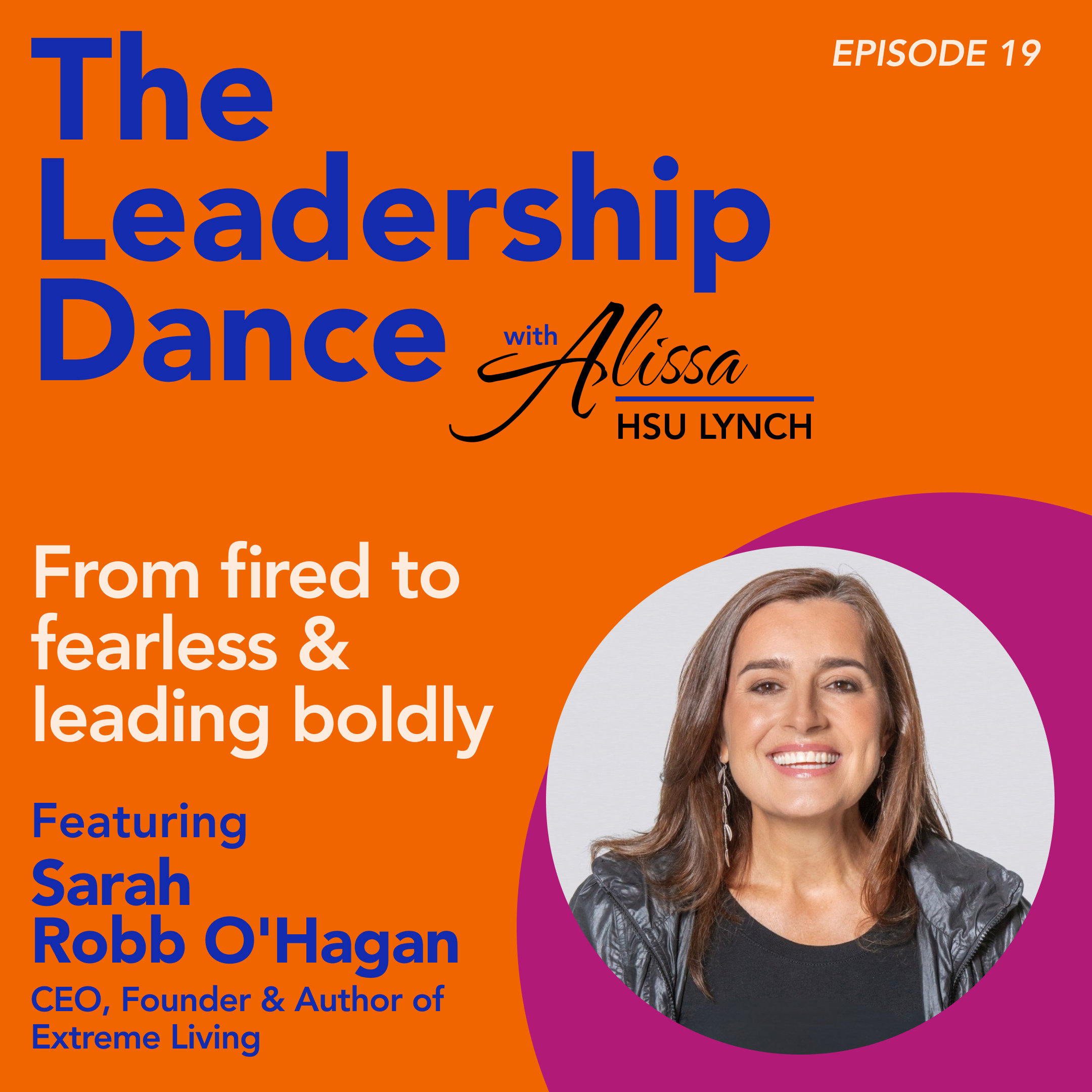
The Leadership Dance
Ep. 19: From fired to fearless & leading boldly, with Sarah Robb O'Hagan
00:27:47
In this energizing conversation, powerhouse leader Sarah Robb O’Hagan—former executive at Nike, Gatorade, and Equinox, and author of Extreme You—shares insights from her bold career journey. Sarah opens up about the tough lessons she learned...
Loading summary
Transcript46 lines
- [00:01]
Sarah Rob O'Hagan
The risk associated with Bold Moves is actually no more than the risk associated with playing it safer. You just have to reframe it in your head.
- [00:10]
Alisa Sue Lynch
That's great advice. And I also think a lot about, I call it reimagining success. Especially if you're coming off of a failure or not happy in your role. You kind of have to just reframe it for yourself.
- [00:22]
Sarah Rob O'Hagan
That's right. It's all in your head. At the end of the day, it's the narrative in your head. It's not what other people around you are thinking.
- [00:29]
Alisa Sue Lynch
Welcome back to the Leadership Dance. If you enjoy the show, make sure to share and subscribe so you never miss an episode. I'm Alisa sue lynch and today I'm thrilled to speak with Sarah Rob o' Hagan. Sarah has been described as Superwoman, Undercover and the Pied Piper of potential. A high energy combination of disruptive business leader, fitness fanatic, and cheerleading mom, she's been named among Fast Company's most creative people in business. She was most recently the CEO of Exos, the human performance coaching company where she transformed the business during the global pandemic and pioneered with her team a new approach to workplace culture that drives productivity and performance while avoiding burnout and employee disengagement. Prior to this, she led the turnaround and reinvention of Gatorade as its global president and has held leadership positions at Equinox, Nike and Virginia and currently serves on the board of JetBlue Airways and previously served on the board of Strava. She is the author of Extreme U, a book and content platform to unleash potential in ambitious young executives. Sarah is a sought after expert on business innovation and inspiring human performance. I'm so excited to have this conversation with you, Sarah.
- [01:46]
Sarah Rob O'Hagan
Oh, so am I, Elisa. Can't wait. It's been a long time coming. Yeah.
- [01:51]
Alisa Sue Lynch
So tell us what your childhood was like, where did you grow up and are there any experiences you remember from your childhood that helped shape you?
- [02:00]
Sarah Rob O'Hagan
As you can tell from my accent, I actually am a very proud American, but I'm a Kiwi, so I call myself an Amerakee Wee. I was born in New Zealand. Actually I spent my first 10 years in London, but then really my teenage years in New Zealand, which is probably the most formative time. And it's funny, like there's two things I think significantly shaped me. One is that I come from the first country in the world to give women the vote. Not many people know that and I do believe that really had a just a cultural Shaping on just never occurred to me that I couldn't do anything I wanted to do, you know, which is pretty awesome. But secondly, you know, I come from a fairly high achieving family. I'm the youngest of four. And yet all through my high school years, I just constantly tried and failed at things, whether it was making it in the field hockey team or I was desperate to get a speaking role in our high school production of Grease. I didn't even get to be in the chorus, you know, I was like, that bad. And I think every one of those failures really shaped me because I was so desperate to kind of prove myself and prove that I could be successful and kept coming up against this, like. But no, it's not working out. And somehow I think that gave me a grittiness to keep trying. Yeah.
- [03:18]
Alisa Sue Lynch
Did you play sports growing up?
- [03:20]
Sarah Rob O'Hagan
Yeah, I played a lot of sports, but like I said, I was certainly not world class. That's for sure. I was good, you know, decent, but I did everything from tennis and field hockey and swimming and skiing and sailing and water skiing, which was awesome also, which I think is related to your wonderful expertise here. I was also very musical. I was in orchestra and choir and all of these things. And in a funny. I think the combination of the sort of ambition of sports, the competitiveness of sports, with the creativity of the music world is a huge piece of what shaped who I am in the business world because, you know, I have become sort of known for innovation, and I think those two things are what shapes that.
- [04:05]
Alisa Sue Lynch
Let me pick up on that thread. So can you think about some lessons you have learned from both your creative background and competitive sports that have helped you in business?
- [04:16]
Sarah Rob O'Hagan
From the sports side, there's no question, like the teamwork, wanting to win but often losing. You know, how you are as a loser. Someone said to me the other week, do you prefer to win or prefer not to lose? Like, which one drives you more? And I think when you've played a lot of sports growing up, that is such an important part of what informs how you are at work. Because if you're a team and you're, you know, playing in the final of your high school regional championship and you lose, you have to pick yourself up and keep going and come back for the next season. And in business, you know, it doesn't matter who you are. There's gotta be amazing days of, you know, optimism and winning and lots of days when you don't and having that sort of ability to go, okay, I'm picking myself up and I'm Coming back for next week is super important. So I think that was a big lesson that translates. And then on the creative side, even though I wasn't obviously very good at it, I wanted to be in theater. I did a lot of performance. And it's funny, like, the business world that you and I grew up in was the first sort of era, I think, where being able to deliver a vision in front of a large group of people really mattered. And early in my career, when I was at Nike, I remember it was a real honor to get picked to deliver the vision to the sales team for the quarterly seasonal product launches. And I just think I was naturally quite good at giving these presentations because I'd learned to overcome the fear of public speaking. You know, when you've been a performer in your early years.
- [05:52]
Alisa Sue Lynch
Yeah, absolutely. I always think that one of the things that I learned from dance is being able to perform under pressure. And I remember I was doing an international assignment in Shanghai, China, leading the beauty business there. And we had our first national sales meeting. And you can imagine in China, there's hundreds of sales personnel, and most of them spoke Chinese. They didn't speak English. So management at jj, we spoke English in the office, but people in the field spoke their native language. And so I was determined to deliver a speech in Mandarin at the sales meeting. And so I practiced and practiced, and even just the tones and the pronunciation. And I did it and got a standing ovation just because that means a lot when you do that in another country. But, yeah, I wasn't nervous, but I had to practice and tap into that dance background of preparing for a performance.
- [06:44]
Sarah Rob O'Hagan
Not only just not being nervous, but I think when you've been a performer, you have to learn how to rebound quickly. Like, I can still remember playing the piano in front of 600 high school kids. In my school, for some reason, I was one of these people who I didn't sight read very well. I would memorize. And for some reason, my brain just stopped that day. My fan just stopped, and I froze. And I'm like, 600 people are staring at me right now. And somehow you figure out a way out of that into where you're going next. And I think I'm sure that must have happened as a dancer where maybe you miss a step or maybe you're in a different mark that you're supposed to be.
- [07:22]
Alisa Sue Lynch
Still happens when I'm on stage doing a talk.
- [07:25]
Sarah Rob O'Hagan
Yeah. Whoops. Where am I? Yeah.
- [07:27]
Alisa Sue Lynch
So, Sarah, people may not believe this about you, but you were fired from your job in your 20s?
- [07:33]
Sarah Rob O'Hagan
Yes.
- [07:33]
Alisa Sue Lynch
Not once, but twice.
- [07:34]
Sarah Rob O'Hagan
Twice.
- [07:35]
Alisa Sue Lynch
And in fact, I've heard you describe yourself as a complete disaster early in your career. Tell us more about that. How did those low points influence who you are today?
- [07:46]
Sarah Rob O'Hagan
It is exactly how I describe myself. So unlike many people in their 20s other than I was definitely the extremes of what can happen. And I had started off my career in the airline industry, and I was doing incredibly well, actually. I got relocated here to America. I ended up working for Virgin Atlantic Airways, which was a dream of mine. I ended up working literally alongside Sir Richard Branson on some pretty big marketing initiatives. I'm 26 years old, you know, at the Cannes Film Festival with Richard Branson, who does that. Amazing. And I'm like, there's no end to how awesome this is going to be. And then I end up actually getting asked if I would take a role at Virgin Mega Stores. I was so excited for this opportunity, other than the fact that I'm dating myself. But it was the year that Napster was invented. So we went from music retail being a place where we bought CDs, to suddenly music was being given away for free. It's like the original disruption story, if you think about it. And I come in with this, like, arrogance of, like, I know what I'm doing and I'm, you know, I'm everything I've been hanging out with. Richard, you should listen to me. And just completely misread the environment. I was in a company that, A, I didn't know anything about retail to start with, and B, this was going through an industry crisis, let alone the company I was working for. I was just using all the things I'm good at and applying it to this challenge. And I couldn't have been more off base. And I did end up, after a year, getting fired and not like, oh, we're having layoffs and you're one of them. One person got fired. That was me. And I. I still remember. I can still remember so clearly. In those days, we were in offices, you know, where you're in cubes, and literally everyone, as I'm walking out with the. The box, you know, the walk of shame as you're getting escorted out the door, and all these little people popping their heads up over their cubes like little prairie dogs. And I'm like, oh, this is really happening, and it's really mortifying. And then my next job I went on to, which was Atari, I actually got laid off, which I'll say is an improvement. But that, again, was just a situation where the Business was struggling and I didn't understand the consumer. I didn't understand all of the above and just couldn't be effective. And I think both of those stories, like, I. I share them because I was a complete disaster. And I remember mentally, emotionally, confidence, wise going, how do I ever come back from this? Like, I couldn't believe I ever would. Yet I go out of my way interviewing to get my job at Nike, which happened sort of nine months later. And I just think the huge dose of humility that you get from what I had just been through was so significant to helping me be quite successful in the end at Nike, because I just came in the door with, shut your mouth, open your ears, figure out how you can add value to the group that is here. Don't come in like you have all the answers. And it was just one of the greatest lessons that stood me, well, right up to today.
- [10:59]
Alisa Sue Lynch
That's such a critical lesson. I'm sure it was painful at the time to learn, but it's so critical because when we do move into new situations, you don't know everything. And to assume that you do, that arrogance, as you talked about, can set us up for another failure.
- [11:15]
Sarah Rob O'Hagan
And, you know, I have now come to look back with a bit more empathy and partly from sort of my own research. I think a lot of us fall into the trap of, you so badly want to prove yourself, that your instinct is to say, I've got the answers. You hired me for a reason. I've got to show you when in actual fact, most cultures first want to know that you understand them before you, like, start opining on them. And I think it's a human instinct to want to do that. And I often find when I'm mentoring young people, it's like, do everything you can to shut off that instinct. You're going to be okay.
- [11:54]
Alisa Sue Lynch
You're known as a turnaround artist and successfully revitalized the businesses you led at Nike and Gatorade. Can you talk about some of the leadership skills that you learned to accomplish those turnarounds?
- [12:07]
Sarah Rob O'Hagan
It's funny, looking back now, there's a lot of things I wish I would have been a lot better at. Like, I look back to Gatorade, I think I was 36, 37, that kind of age range. When I started at Gatorade, which is a $5 billion global business, you know, it was a huge mandate. And of course, I step into the beginning of the 20089 recession, and the business is free fall. And suddenly I'm going from what feels Like a fun new job to a really significant crisis. And it's funny, like, I think what comes naturally to me from where we started this conversation is the ability to use my creative instincts to see where to take a business. That was kind of quite a natural strength for me. The much harder piece was how you bring people along to that level of change. And when I look back on it now, I remember I had a mentor about a year and a half into that journey, and he looked at me and he said, individual heroics are not going to get this job done. Because I was that person that was just trying to hold everything together. And actually the greatest leaders, you have to have the vision, you have to have the confidence, you have to be pushing the team to a new place. But to the extent that you can sort of lead them from behind and really multiply your impact through really investing time and making sure others are pushing the agenda forward, you're going to be a lot more successful. So I would say now, yes, Gatorade was a massively successful story. It's a great business story. But I think now, if I did it again, I would do it in a way that didn't burn out the human candle in the way that it did in those days.
- [13:56]
Alisa Sue Lynch
So you've shared with me before talking about burnout, that you were burning the candle at both ends while you were working at Gatorade. Can you tell us more about what was going on in your life at that time? What made you realize that you had to change things?
- [14:10]
Sarah Rob O'Hagan
So I had just given birth to my third child six months into the journey at Gatorade. So not surprisingly, I attempted to go on maternity leave. And two weeks into it, this is when we had just launched all of the new changes we were making to Gatorade. And the business just went into free fall. And every rational piece of me was like, you've just had a baby, you're on maternity leave, you need to be on maternity leave. And every emotional piece of me was what we just talked about before. I haven't proven myself. This is in crisis. So I ended up, you know, two weeks in, I start doing calls that become more calls that become. And before long, 40, 50 hour weeks. And, you know, I didn't really have a maternity leave all. And I remember by the time, I don't know, three or four months in, I literally had a massive burnout moment where just exhaustion, a heap in the floor of the kitchen in the middle of the night, just going, I can't do this anymore. My husband really pushed to make me take a time out. And we took six weeks, went away, came back, and when I returned, I improved significantly in terms of putting some real boundaries in place on my own health and wellbeing. But I still look back now and go, I still was running a pretty relentless pace that everyone had to sign up for. And I think a lot of us fall into this trap in corporate America where you have so much pressure on you from your bosses, from the team, from whoever. Enough is never ever enough. I can remember several colleagues through that time. There's one particular woman in my head that she was taking a phone call on a Sunday morning from the bathroom and her in law's house so that people would know she was on a call, you know, and that was the kind of mentality I guess, that we all had. And now I look back and go, I have now become a student of human performance. It's like we did everything wrong to get the most productivity and creativity and clean decision making out of our team. So I don't run my teams that way anymore.
- [16:19]
Alisa Sue Lynch
Yeah, and when you think about it too, as the leaders, that's the behavior we're modeling for others big time. So it sets this expectation for our teams, for everyone around us that you also have to be always on.
- [16:32]
Sarah Rob O'Hagan
I'm so glad you brought that up because I think that has been my biggest learning. Fast forward 10, 15 years is the number of times I would do things like, hey everyone, it's fine, we're having no meeting Friday. And then guess who was setting up quiet meetings because, oh, it's urgent and investors need it. And you only have to do that once. And nothing that comes out of your mouth matters if you are not demonstrating what you were saying are appropriate cultural rules. And it's such a lesson to me. I try really hard now if I'm trying to stand for something, have to do it yourself.
- [17:08]
Alisa Sue Lynch
So after Gatorade, you then joined exos as CEO, which was another turnaround situation. Did you know going in that it was a turnaround situation? And how did you approach that role differently than Gatorade?
- [17:24]
Sarah Rob O'Hagan
Yes, I did not know it was a turnaround. So I joined exos, which is a private equity backed human performance coaching company. And the business when I joined it had two businesses. One was training elite athletes. The other was training what we call corporate athletes. So running gyms inside Google where you used to work, Citibank, all these great clients. So on the day I joined, we had 400 gyms around the world and it was two weeks before the World shut down. So the day I joined it was like, this is going to be awesome. And then the reason it became a turnaround was obviously the pandemic was just a mortal wound for the entire gym industry, but certainly our business this time around. I think I was much, much calmer and clear headed going into it, because I think whereas at Gatorade, I didn't even know what a turnaround was. I'd never been in a business that was in that much of a decline. And so every day I was just kind of fighting for survival. Whereas this time around I was like, there's no world where this isn't going to be multiple years until we get it back on its feet. We're running a marathon here. It's not a sprint. And therefore, I think my mentality was much more, we've got to start off the way we mean to go on. Now. There's a ton of things I didn't do right, but early on, myself and my team, we all were like, what are we going to do to help people not burn out through a very long and difficult journey ahead?
- [18:55]
Alisa Sue Lynch
Can you share some of those practices or tips that you and your team came up with to perform under constant pressure like that?
- [19:04]
Sarah Rob O'Hagan
You know, the first year of 2020, I would say, like almost everyone in our situation, we just were on, you know, drinking from a fire hose, exhausted, like everyone. And we did start to put in place things like no meeting Fridays. And I broke all the rules and it, it didn't really work. And then halfway through, I think it was halfway through 21 or 22, we actually partnered with Adam Grant and Marissa Shandell, who is also at the Wharton School with Adam on this huge experiment. We were like, what if we could completely rewire how we work with the express intent of maintaining productivity, but bringing down burnout and exhaustion? And we basically put it in place over a period of six months and they researched it beginning, middle and end. What happened, what we changed was, first of all, throughout the day, we had forced breaks between meetings. You were not allowed to be on a screen like this for longer than 50 minutes without a break. If it was like an hour and a half, two hour meeting, we would have breath work, you know, stretch breaks, et cetera, so that you were getting people up out of their chairs, getting them away from the screens. We put in rules, like any one on one meetings would not allow it to be like this. Instead you have to go, what we do, call, walk and talk. You know, where you're on your phone talking to your Colleagues, so you're getting fresh air, et cetera, lots of stuff around community building because we were aware that there was a lot of people feeling quite alone. And then we also introduced the four day work week, which we called UDU Friday. So literally on a Friday, nobody was allowed to email, text, no meetings, nothing. And you could either literally spend the whole day asleep or if you wanted to catch up on work, whatever worked for you. Which meant we had to restructure all of our calendars and meetings to get everything into four days. And we did that by being very intentional that Tuesdays and Thursdays were heavy meeting team days. Mondays and Wednesdays were more one on one days and Friday was udu. And the headline at the end is, we did prove out that we maintain productivity. We took burnout from 70% of people experiencing it before to 30 after. And that's in six months for me. I was like, now I've experienced this, I've seen the data and I personally lived it. There's no other way. Like, I would not ever go back to the old way now. And I'm very, very adamant that it's like being a performer. I would love to hear what a dancer does to prepare, to perform and to recover. That's what we have to do as executives, is really be intentional about preparation, performing and recovery.
- [21:53]
Alisa Sue Lynch
I really like that. And you're absolutely right. As a dancer or professional athlete, you have to recover. You have to invest in recovery just as much as you do in the preparation and the performance.
- [22:04]
Sarah Rob O'Hagan
Right on. And it's like when you think of it like that, none of us would ever expect a football player to play for five hours straight. None of us. And we would all go, thank goodness they're in the ice bath. Yet as executives, for some reason, we think 8 o' clock till midnight, with very little boundaries or breaks in between seems to be just fine, you know?
- [22:25]
Alisa Sue Lynch
Yeah, I love the intentionality that you put towards thinking about how to do that with your team. Because during the pandemic, for sure, I found for me, I would just be on calls or on my computer all day long. Like, people lost boundaries of having to go into the office and then going home and having that break of the commute, like, we just lost all of that and we're just always on.
- [22:48]
Sarah Rob O'Hagan
Yep, totally.
- [22:49]
Alisa Sue Lynch
So, Sarah, you have led some massive brands through transformation, but now you are guiding individual leaders to do the same in an immersive course you've created called the Breakout Leader. What is the course about? And can you talk about what is that Biggest inner shift that has to happen for someone to go from managing well to actually leading boldly.
- [23:12]
Sarah Rob O'Hagan
Yeah, I created the course, I guess, partly because I'm just super passionate about teaching. I love that, that role, but partly because I wanted to sort of capture these amazing lessons that I had learned from amazing mentors along the way and just distill it into something simple. And I would say the first thing the breakout leader is all about is what I like to say. Soft skills are the hard skills. Like, I think so many executives early in our careers, we are rewarded for functional expertise, technical expertise, and I even see a lot of, you know, I'm currently taking some AI courses myself. Like we all check the box on. I've learned the new latest thing that I need to know. But when it comes to leadership, how you engage with, interact with, bring people along is the only thing that matters. Yet early in our careers, it's not like anyone prepares us for that. You suddenly find yourself leading your first group and I think back to Gatorade. If only I had known back in those days some of these basic things to help, you know, the team I was working with come along. So the course is about that, like how you bring people along, how you get comfortable making bolder moves, like how you look into a marketplace and see something that can't exist. And then how do you bring others along to do it? And it's very immersive. Like I actually love teaching it because it's very sort of case study based and the students are spending a lot of time debating each other on how they would do certain things. So they're sort of learning in real time. And then of course, the end of the course, I do have a chapter or a module on human performance and recovery in the workplace and how you can manage not on your own energy, but the team you're working with.
- [25:03]
Alisa Sue Lynch
So our last question, Sarah, is if you could give advice to your younger self, what would it be? And you are a bold leader. So you are very clearly yourself and you bring yourself, but that's not true for everyone to have that level of confidence. So what advice would you give to others and if not to your younger self, about leading boldly?
- [25:22]
Sarah Rob O'Hagan
I am naturally a bold leader, but I don't really know that, you know, in a way you don't know yourself to be different to anyone else. I think the longer time goes on and the more time I spend mentoring others, I don't know how I got there initially other than sheer survival because I made so many mistakes. But I would say. Now, the number one thing to me about bold leadership is often we tend to think the safe option, that is don't make the bold move. Don't upset the apple cart. Don't leave your job and take a new one in an area you don't know. Don't be an entrepreneur. We tend to think all of those things are safer, but actually when you really peel back the onion, they aren't necessarily. Like, you may say, I'm making it up that you are some executive that's been in a job for 10 years and you get this opportunity over here. It seems too risky. I'm going to stay where I am. You don't know that. The where you are might suddenly get totally pulled apart by a pandemic and they have to lay people off and suddenly you've lost your job. And had you taken the bold move, at least you are in control of the move you're making even if it fails wildly. You are going to learn so much more from what you did by getting out of your comfort zone than by staying exactly where you were. So I tend to just try and reframe. For people, the risk associated with bold moves is actually no more than the risk associated with playing it safer. You just have to reframe it in your head.
- [26:55]
Alisa Sue Lynch
That's great advice. And I also think a lot about, I call it reimagining success. Especially if you're coming off of a failure or not happy in your role, you kind of have to just reframe it for yourself, as you said.
- [27:07]
Sarah Rob O'Hagan
Totally. That's right. It's all in your head. At the end of the day, it's how you are telling yourself the narrative in your head. It's not what other people around you are thinking.
- [27:17]
Alisa Sue Lynch
Sarah, you are awesome and I just love listening to you and learning from you. So thank you for joining the podcast and sharing your leadership dance with us.
- [27:27]
Sarah Rob O'Hagan
I have had a blast. Alisa, thank you for including me. I love this whole topic. Thank you.
- [27:33]
Alisa Sue Lynch
Like follow and share the Leadership Dance, where we explore how to choreograph the career of your dreams and chat with visionary leaders who are breaking barriers in the arts and business worlds. Until next time, keep dancing.