← The Leadership Dance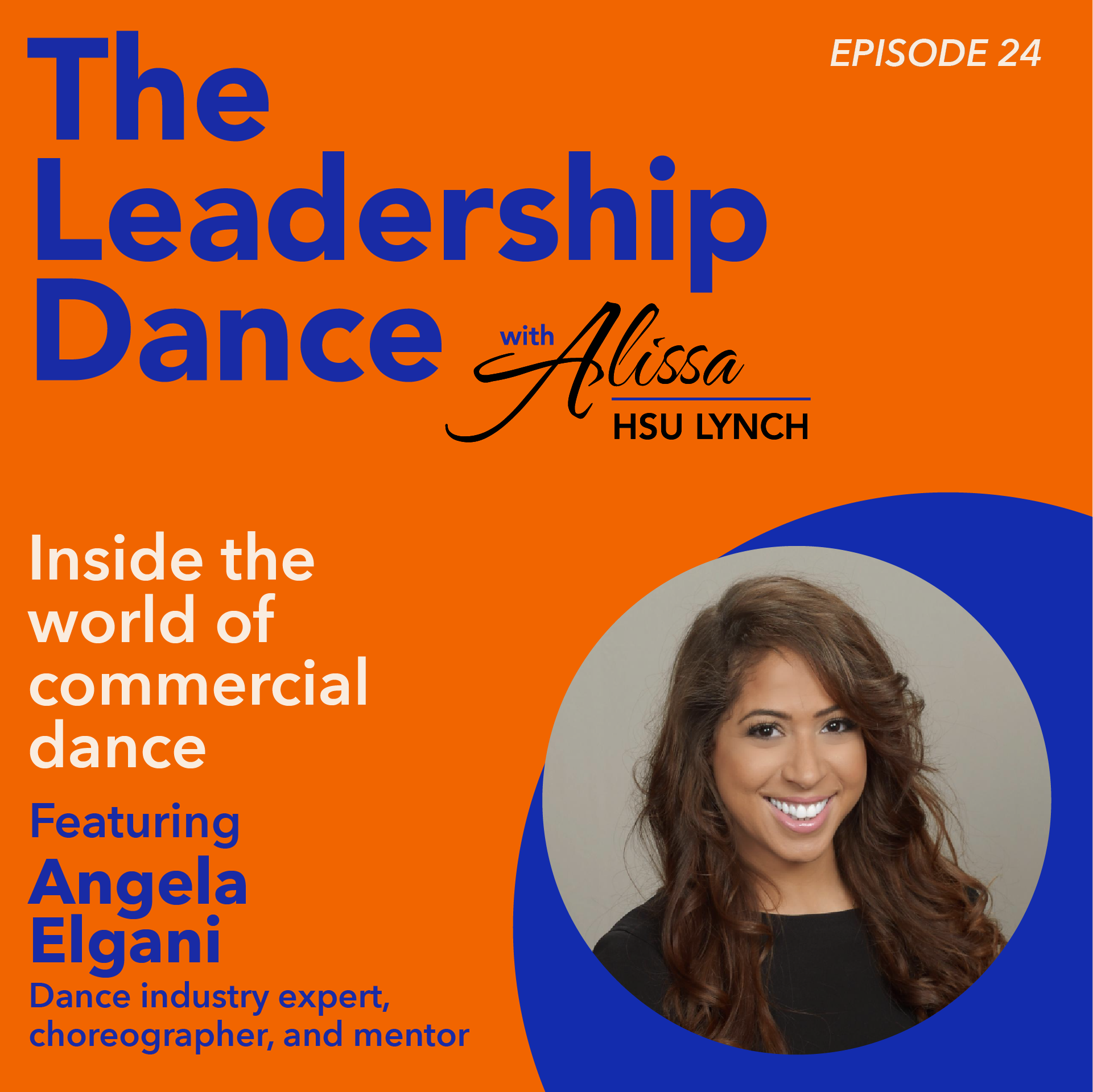
The Leadership Dance
Ep. 24: Inside the world of commercial dance, with Angela Elgani
00:34:10
Get a peek inside the commercial dance world from Angela Elgani, a renowned dancer, choreographer, and mentor whose two-decade career has taken her from world tours with Britney Spears, NSYNC, and the Backstreet Boys to blockbuster films like You Got...
Loading summary
Transcript58 lines
- [00:00]
A
I think sometimes with TikTok nowadays, you know, dancers actually do a lot of stuff in this realm, but on stage, on a tour, you kind of can't be this small. They don't see it, it doesn't read. The energy that you're giving to the audience has to protrude in a very big way. You want to project your dance, they need to see you up in the rafters. They need to feel that energy on the stage. Otherwise you will look very slightly. I had to learn to be confident. You got to stay focused because all of that can also be very distracting. I mean the audience, the energy, pyro and lightings and there's so many other things that are happening besides just my dance and then performing, it can be very overwhelming and I definitely realize how to get my focus.
- [00:50]
B
Hello and welcome to season three of the Leadership Dance where we explore the art of leadership with trailblazers in business and the arts. If you enjoy this show, please subscribe, share and leave a five star review. I'm your host, Elisa sue lynch and today I am excited to introduce Angela El Ghani. Angela is a seasoned dance industry expert and passionate mentor with over 20 years of experience. She has collaborated with music and film icons like Britney Spears, Backstreet Boys, NSync, Justin Timberlake, Christina Aguilera and Beyonce and has been instrumental in projects such as Step Up, Revolution and you'd got. Served with a focus on stage presence and technical precision, Angela crafts unforgettable performances that have captivated millions. She's committed to nurturing aspiring talent, helping dancers transform their dreams into thriving careers while navigating the challenges of the industry. I'm really looking forward to this conversation with you, Angela.
- [01:54]
A
Thank you so much for having me on.
- [01:56]
B
So Angela, you began dancing at just two and a half years old and built a two decade career on tour and in film. Tell me, what was your childhood like? Did you always know you wanted to be a dancer?
- [02:10]
A
Yes, I always knew. Or at least my mom tells me at that age because that's why I think she put me into dance because she said I was constantly running around the house putting on clothes, heels and performances. It just seemed like that was always meant to be. I guess I always wanted to be on the stage.
- [02:31]
B
So what type of dance did you start with?
- [02:34]
A
So I started with the classical, all three, jazz, tap and ballet. I did that for a very long time and then until I could advance each year progressively I tried to get into more advanced style point or higher tapping, like a hoofing or stronger jazz Skills.
- [02:55]
B
Sounds like you did it all. Wow. And then you enjoyed a successful professional career touring with icons like Britney Spears, Backstreet Boys, and appearing in movies like youe Got Served and Step Up Revolution. So we grew up with those. Those are iconic. Can you tell me more about how did your dance career develop? How did you become a professional?
- [03:17]
A
I just always had. I think after I got to my preteen teenage years, I started to see dance in mainstream media more obviously. We have the classics like Singing in the Rain and things like that. And of course, those were some iconic movies that inspired me in my dance journey. But as I was getting older, in my dance journey, I was seeing more, like, music videos and tours that were touring with dancers, and they were more mainstream in, like, what we call the pop mainstream lane. And I was just really excited by all of that. So MC Hammer with, like, Hammer Time, we're gonna talk about Paula Abdul, you know, and she had actually an album out. And she was a dancer.
- [04:07]
B
Yes, she was, yes.
- [04:08]
A
And then we're gonna talk about, like, In Living Color, where they actually had dancers on the TV show. So to see all of these things in mainstream really pushed my vision of, like, that is something I could see me doing. I would like to do, I want to do, I had the passion to do, and I just focused on that for a very long time. Now. How did I get into the professional realm? Well, step by step, I just kept. Never gave up. I mean, it was competitions, learning, and then competitions and then advancing and workshops, learning from any kind of scholars or higher ups I could find, you know, in my area or I could get myself to. That's kind of how I pushed my way up the ladder and I became a stronger dancer. Basically. I just tried to make myself a force that couldn't be reckoned with. Like, I just wanted to know that if I stepped on that dance floor against however many other people, that they would recognize me. Eventually it became they hired me.
- [05:12]
B
My younger son, who's in his 20s, is a hip hop dancer and he has an agent. So some jobs or auditions will come through the agent and others he finds out through his network. What was it like when you were coming up? How did you find out about auditions and actually get into those?
- [05:30]
A
Agents are very, very much a key part of that. Before I had an agent, I had to find out through knowing people, through, like, keeping your ear to the ground wherever I could get information, which at that time I was living in LA and I was going to a lot of the dance schools, like Edge, performing Arts Centers and Tremaine Dance. And they also, you know, bred a breeding of dancers, professional and non professional. So I could hear certain things that were going on. Then I heard about auditioning so I had to actually audition for my agent. I think they still do that, but they might do video submissions sometimes. Nowadays I feel like there's. That's the difference is that we can actually submit ourselves as a video or even as a package or like your online presence to where I just had to show up and just kind of give my all in that very moment. But yes, once I acquired an agent, the road became mainly through my agent. I really didn't like to take too many jobs outside. Not because of like, if a friend asked me, sure, that's great, I would love it. But it just depends on where it was coming from because I was in Los Angeles. And it is true, you do have to have a certain amount of caution because some people are not vetted and they could be trying to bring you in for the wrong reasons.
- [06:53]
B
And what was your very first tour? So who was that with?
- [06:58]
A
My very first world tour was with Backstreet Boys into the Millennium tour, which is what they're doing right now in Vegas. It's such a throwback. They're doing it at the Sphere in Vegas right now. The white outfits, all that great stuff. So yeah, that was my first tour.
- [07:14]
B
Can you share what it was like to dance professionally on tour? What did you learn about yourself, your dancing when you were performing at that level?
- [07:23]
A
Honestly speaking about the Backstreet Boys and that being my first tour, that was a huge learning curve step for, for me to take in. So as a professional dancer, I had studied style form, you know, advanced styles, advanced forms hip hop, which as I was growing up in dance school learning, honestly, hip hop wasn't even a class that was offered. I actually really had to go find like, I hate to say it like this, but like street people or you know what I mean, someone who was just more doing it as opposed to like, oh, I'm going to go take a hip hop class which is so readily available now, which was not available at all to me. So I had to like seek that type of style out and find it and learn from people who are not conventionally in teaching it in a class.
- [08:15]
B
Learning from the. The real deal, you know, the originals.
- [08:18]
A
Yeah, the originals. Because they weren't having classes, I just kind of almost had to be like. Or if they did, it was so small and random, like, come meet me at the Y at 5 and you only could hear about it. We weren't like posting on social media and it was like now a big blast and I didn't pay. They weren't even asking for money. It was just like a chance to be in their presence and watch and learn. And that's how I learned hip hop mainly. But back to the tour. So now we're on tour. I had learned all, all the best. I feel like that I could. But the parts on tour that came especially when I got onto that is learning how to perform for a very large crowd. I mean the crowd is like eighty thousand, a hundred thousand sometimes. I mean the sounds the size of the stadium, you just don't realize. And I think, I think sometimes with TikTok nowadays, you know, dancers actually do a lot of stuff in this realm on stage on a tour you kind of can't be this small. They don't see it, it doesn't read. The energy that you're giving to the audience has to protrude in a very big way. Just kind of like if you're speaking and they're saying like if you're speaking, they want you to speak to the back of the stage. It's almost like the same thing. You want to project your voice to the back of the stage, you want to project your dance. They need to see you up in the rafters. They need to feel that energy on the stage. Otherwise you will look very small. It's kind of hard to like understand unless you're there. And then the other part I had to understand because it was a pop tour like that, you know, there's not a lot of quote unquote backstage because you know, like if you go to a theater, there's like a stage and there's like curtains and then there's a backstage. Well, in these type of tours there is no like off. There's no off time unless I really dropped below the stage. So for example with the Backstreet Boys stage coming off stage wasn't until I was below the stage. So basically you're surrounded. You can never be off because you're, you're completely surrounded by the audience in so many different angles. It's like I literally have to like disappear and then that's when the stage is off. So I had to learn to be confident. I had to learn embracing large stages like that, which were also way larger than a lot of normal theater auditorium style stages, and also embracing an audience like that and the energy that they put off too. It all was like a very big learning curve in that, because all of that can also be very distracting. I mean, the audience, the energy, pyros and lightings and there's so many other things that are happening besides just my dance. And then performing, you realize so many pieces of the puzzle are working. It can be very overwhelming. And I definitely realized how to get my focus. That was a huge thing to be able to perform my best and do my job.
- [11:30]
B
Did you have anyone mentoring you or you just learn? You learn from each other, you learn on the job.
- [11:37]
A
A lot of you learn from each other, you learn on the job. But no, I didn't have a specific mentor. I wasn't really taken under the wing. I did learn a lot on the job. So I, I probably made mistakes. I just remember the first time doing my first dress rehearsal, the choreographer was like, come on, step it up. Like, it's time that, like, this is it. And that was a real wake up call because I was just doing it, I think how I do it in rehearsal, but it wasn't enough. And that's when I realized, okay, this, this has to be way more amped. And now that I teach dancers too, I do constantly try to get them to understand, like, first of all, you should always be dancing full out because it's like a habit. But then getting it on stage, it's going to read, you need to be more bigger. I think nowadays because of TikTok and just because a dancer wouldn't have that experience yet, they, they don't realize how actually pronounced, how big you need to kind of have your energy read. Not that you're making the moves extra big, it's the energy that you're putting behind it. Yes, it's the move. It's still the move, but it's energy that they can read from afar.
- [12:48]
B
And I think you also don't realize how much energy that actually takes.
- [12:52]
A
And those shows a lot of times go like two hours. That's another thing I try to teach dancers. I'm like, you gotta think this show is two hours of you dancing that high, that energetic the entire time.
- [13:06]
B
Is there a tour that you think of as the favorite time that you had on tour?
- [13:11]
A
It was the Brittney tour. It was the Slave tour. I mean, that was my favorite time. That really was a great tour. We were all like family together, friends and family. We worked with her. The whole tour was so specific around the dancers and her. It's like we were weaved into the story. It was really special.
- [13:36]
B
So you've talked now about tourings and live performance, but You've also done a number of films. Was working in movies different from dancing on tour, and how did those experiences influence your development as a performer?
- [13:51]
A
It is a lot different. Now you're taking your two hour show and it could possibly be days, weeks and days could be 20 hour days, 18 hour days, you know, of being able and ready to turn it on and be at that high, high level within the call of a dime. Now in response to like how I was saying, the energy has to reach the back of the room. On film, it is different. So that's why I think TikTok is different. Because when you're filming it is different, it reads different. So you can be a little bit more internal or smaller with your moves. So if we had a camera coming by and it's like, you know, you're catching the eye or you're acting in the scene you're supposed to be acting, which is what happens in those. When I did the movies, we were acting as a part of the scene with the dance. So it's very important to have your face on and your body and to understand how your body moves in a camera. So that's probably a positive for a lot of the dancers nowadays because they're probably mostly doing a lot of stuff on their TikToks and their YouTube channels, which gives them that, oh, I'm in front of a camera and how to, how do I move myself in front of the camera and how it can look as an advantage. But at that time I had no TikTok. We would watch videos of ourselves, like the Britney tour. They're always videoed because there's LED screens out and those videos are playing on the screen. So there's always cameras around. So they would all give us a copy of each night's show just so that we could review it and we would review how well we did, what mistakes we made and where our energy was lacking and stuff like that. We did that every night after every show. As far as movies, yeah, you have to have stamina because it can go like a long day, very long days. And sometimes you wait. And that's the part because it's like you might be high and then they're waiting. Then it's wait, wait for a while, wait for a while, wait for a while. Okay, back up. And when they come back up, it's not like you get a warmup. You don't really get a lot of leeway. They usually are pretty much like, let's get in maybe five minutes. But we need to get in get into our spacing and ready to go. And then sometimes you're doing that scene over and over again. Repeat, keep the energy. It's like stamina, stamina.
- [16:25]
B
And all of you have to be doing the same thing. So, I mean, otherwise they have to reshoot.
- [16:30]
A
Yeah. A mistake could cause reshooting. Yeah. I mean, a dancer making a mistake, even if they're not the lead, like actor or person, which kind of feels embarrassing sometimes because you know that you're not the lead. Right. And so the lead is kind of like, I have to do it again. So the pressure is on, you know, because you're like, whoops, I didn't mean to make a little mistake or have us do it again, but we gotta do it again.
- [16:58]
B
Now, you've shared a number of lessons learned from dance, at least as a performer. So gaining confidence, having focus, knowing how to use your energy. Can you share any leadership skills that you think you've learned from dance that translate into, now you're an entrepreneur and you're a mom. What are some of those leadership lessons learned?
- [17:19]
A
It is a lot of things that you can take from dance. Number one, I love the word, and I love to say it means so much in dance, but it means so much in life and entrepreneurship specifically, especially if you're trying to do a business, but also in life. Sometimes you have to pivot. And pivot in dance means like step and turn, like 180, right. So you're just like, totally flipping it around. And the easier, if you can do that at certain points in your life, I think the easier your life will be. I mean, this can be personal. And I have experience in a personal capacity and an entrepreneur capacity. In a personal capacity, you might be taking on a lot of grief. And I'm so upset. And all this emotion, and it's causing so much emotion in you and grief in you, where if you could just almost sort of kind of let it go and just pivot and keep going to the next part that you know that you need to go to, instead of going crying about what you couldn't go to or wherever it's at, however it should translate, you will probably have an easier life. Same thing goes in business. Some things just end up not working out. I mean, that is the trail for business. Right? They say it's not a straight line. It's not A to B. Especially being entrepreneur. It's more like a big jaggedy line that's going up and down and up and up and down. And so it makes it easier if you can see that something's not working. Pivot, turn. Don't continue down the path. Make that turn, make that change. Adjust and keep moving. I think for business, stamina, stamina, being able to focus in and keep going, keeping your energy into it. Like I was saying in the movie, the stamina, it's a long haul to get that movie done. In entrepreneurship in business, it's a long haul, usually to get your goal finish. It's not the quick one. It's the long haul. So you need to have the stamina, the brain power, the energy to stay as excited as you were about that idea as when you started it, you know, because sometimes, you know, you get an idea, you're like, I'm pumped. And you're pumped, and then maybe two, three months go down. You've had a few times you had to pivot, and then now suddenly your energy drops, right? Because it is exhausting or mentally taxing or even emotionally taxing, right? But if you can, try to figure out a way to keep drumming up, keep yourself motivated, keep it on a high level. That focus and that energy will push you through to finish and attain the goal of your entrepreneurship.
- [19:54]
B
You're a great example of that. But I know you have faced personal challenges. You lost your husband in 2013, only a few months before you had your daughter. Are you willing to share how that trauma changed your perspective and how it impacted your relationship to dance? Were you able to easily pivot?
- [20:16]
A
I have to say no. I was not able to easily pivot at first because that was so deeply connected to my heart. But as I kept getting myself on my feet, eventually it is what I had to do, because you have to understand, with that particular situation, for me, not only I lost my husband, but I ended up having to move out of my house. I had to sell a lot of my things, you know, so it was a big loss. It was a big ripping away. I had to move back to my home state, my hometown, which. My hometown. I'm from the middle of the country. I'm from St. Louis, Missouri. So when I left St. Louis, it was to venture to my dreams, right? And that's because more things happen, I think, in where I work. Entertainment industry, dance on the coast, whether it's east coast or west Coast, Okay. And I had to venture back to kind of an area where I knew my career wasn't going to be as thriving. Although it took me a minute to kind of pivot because of the emotional attachment I had to it. And eventually, in so many ways, I Kind of did have to pivot. It's like almost like losing your house in a fire. Can you imagine everything that would probably you would get out, but even if you got a box out, you just got that box out, right? Everything else in that house you probably still had an attachment to, like the pictures, picture frames, the furniture, maybe bases or something that was attached to you. Clothes. So many things, right, are in your house. And if it goes up in flames and you can only come out with a box, that's kind of how I felt about everything with that whole situation. It was almost like everything had just gone up into flames, and I could only get out with a box and my baby. And so it really was a whole testament to, like, almost like breaking me down to nothing. And this is what I'm doing now. It's like trying to rebuild myself back up to be the person that I know I. I can be. I am. So, yes, I had to pivot. Was it hard? Super extra hard. And eventually I had to realize that although those things meant a lot to me, those things, they were just things. The most important parts were the memories and the love I had in my heart for him. And now the gift I have of my daughter. And that was the most important thing. And I will have those with me forever, no matter what. Even if tomorrow everything changes or, God forbid, I do end up in an actual house fire again. I have my life, my heart, I have my memory, and I would have my daughter. That's the most important thing. So I know it sounds hard, it might sound rough, it could even sound cold. But it's not untrue that the most important things are what matters.
- [23:13]
B
Thank you for sharing that. Were you able to dance during that period, or did you take a break? What happened?
- [23:20]
A
I don't know why, but for some reason, I couldn't dance when that happened. I think a lot of people would think, oh, you could just dance and dance your feelings away or something. But there was a hurt so deep inside of me that it even hurt for me to think about going back into a dance studio. It hurt for me to think about doing what I know how to do. It hurt. And I don't know why that paralleled, except for the emotional attachment to both. And it's some kind of way mixed. But the trauma was real. And it took me quite a few years, probably like four years, to even step back into a dance studio. And I think I took like a Zumba class at the end of that Zumba class. But middle to end, I was like, Already in tears. I mean, I'm breaking down very hard. Like, just crumbled. So it took a while, and then it took me another couple months after that to even get back into, you know, so it was baby steps to finally feeling like, okay, I can get back to this thing I love.
- [24:27]
B
Well, and you also were a new mom and a single mom.
- [24:31]
A
Yeah. Really focused on her. I didn't want her to always see me as, like, a sad mom. So I tried my best to try to get healed as quickly as possible.
- [24:41]
B
So did you ever go back to performing, or is that when you made a pivot to become a coach?
- [24:48]
A
That was when I made the pivot, yeah. I haven't Performed. Performed the 7th socially at a party or something, which kind of get me going. People are like, oh, look at Angela. But no, I haven't performed. But it definitely made me pivot into being a coach and a dance teacher. I like to perform, though, with my students in class. Because I do try to transfer my energy over to them. And especially when I'm teaching aspiring dancers again, trying to show them how the energy for a stage, you needed to be higher. So a lot of times I try to instill that in them, to show them by actually showing them how it has to be.
- [25:28]
B
Well, I'm sure you're a really great example. I used to be a professional dancer. I think I mentioned to you in modern dance. And then I made a pivot and went into business. But people still ask me, like, oh, do you still dance? And I think once you've also danced at that level when physically we were at the top, at the peak now, you know, I'm like, no, I don't really dance anymore. Cause I can't dance the way that I used to dance. But I do dance, like in my kitchen. I dance at weddings, socially.
- [25:57]
A
Like he said, I'm definitely not at the same peak of dance as I probably was on touring and doing all those wonderful projects. But it's not lost. It's kind of a little bit like riding a bicycle. Definitely. The more I taught classes, brought some of it back up because I needed the energy to show them. And then I also developed Dance Good Vibes, which is my fitness version of the dance class. And I do that, you know, obviously to non dancers. It's not specific for dancers. This is for people who want to get in shape and have a fun way to do some cardio and workout. A lot of times I get a lot of non dancers, and they are very hesitant, saying, I'm not a Professional dancer. I'm always like, you know what? I promise you, if you get into my class and you come down this path with me, I can show you the moves and I can make it easy enough that you'll feel successful. You will be dancing well.
- [26:53]
B
You sound like an excellent teacher. I would love to take your class. You reminded me. I actually have stepped into a dance studio. I just moved to New York City and I joined a gym that offers dance for fitness. So I've taken a little jazz, which isn't my original style, and then hip hop, which has been really fun. And that's definitely not my style, but I enjoy it. So.
- [27:12]
A
Yeah, see, so same concept. Yes. And it's really fun. I enjoy getting people who think they can't dance to dance and feel so good about it. And I enjoy showing the aspiring dancer maybe never tried hip hop or is just really looking to raise their level and really kind of connecting with them enough to get them to that level. When people get there or when the student gets there, I'm very happy and proud and excited for them to, you know, know, achieve.
- [27:43]
B
I believe your coaching practice covers audition preparation, brand building, and performance mindset, which is amazing. Is there like one strategy or something that you see pretty consistently that you feel dancers overlook that can help make them more successful?
- [28:01]
A
Yes. I think we're all into it for the love of dance and sometimes competition. It feels competing, which is natural. But I think that you should always be willing to learn because you can't just say, like, I love hip hop, but what if you learned swing and you could do swing dancing really well and you got hired for a lot of swing dancing jobs? I mean, it could happen, right? If you're so dependent on like, I have to work for Beyonce or I have to work for Justin Bieber. You have to keep your options open and you have to think of yourself as a business, which is hard. Right. Because you're like, it's myself and you're passionate about dance. You have to think of it more as a product. And sometimes it's hard to separate yourself to the product that you're trying to sell and think of it as a business. I think they don't think of it as like, what am I going to do afterwards? Or what other things could I be interested in? I think a lot of times dancers are not thinking about financial, how much money they should be putting into themselves or savings, and how much should be into continuously learning. I think also dancers a lot of the time overlook things like contracts because we are handed A lot of contracts, and I know we have agents, and our agents are looking at the contracts. You really should try to understand contract language because it can be complicated, especially in Hollywood, if you are on that professional level, they are three throwing contracts at you quite often, a lot of times without your agent seeing it first. It would be smart to educate yourself on contracts, financials, other parts of the business. You know, how directors work, how actors work, music artists work, how they are signed. If you understand more parts, you can move fluidly through it easier.
- [29:56]
B
Did it take you a while to learn all of that? Because that sounds like a lot.
- [30:00]
A
Yes, which is why I'm doing mentorship and audition prep and mindset coaching, because I'm trying to help the dancers understand their mindset. I think now it's a lot more competition for dancers than when even I was coming up because dance has gotten so much attention. So you have a lot of dancers in the dance field, so you really are competing with every dancer, which is why I think they need a mindset and they need to try to learn. I was fortunate enough to be at a time where they allowed dancers to be with artists as, like the A group. See, you would even know what an A group means. That means, like, who's the A group? A group is usually the artists, the number one, the artist, or the actors, right? And then they usually move first or quickest or best, you know, and then B group would be everybody working, maybe under them, all the wardrobe people, security. Then C group could be everybody else in production. I don't think they put dancers anymore with a group, but I happened to work at a time when we were together, and I got to learn a lot because I befriended the artists, like the NSEEK members, the Backstreet Boy members. I just was around enough to learn what they were being requested of what they have to do. So when you start learning all of that, it makes you more easier to come into being a professional and a standout professional, a business person, because that's how you should look at yourself. Now, I'm a dancer. I'm not Angela a dancer. I'm Angela the dancer. And there's a brand behind me. And keep your eyes open. Learn as much as you can so that you can continuously work.
- [31:47]
B
So I'm sure after people hear this podcast, they're going to want to work with you. How can they find you? Are you taking on more clients?
- [31:54]
A
Yes, I am taking on more clients. So go ahead. You can go to the website, do the get in touch form, which is kind of like a form that you just put your name, your email and then I, I'm all involved with this myself, so I am directly calling you back. And I'm really personable. I take the personable approach. This isn't a cookie cutter box thing. I'm talking to that person and how they need to excel or progress in their, you know, what they want to do as far as being an aspiring dancer. So I'm going to be talking to them directly and what they need. That doesn't mean the next person does not need the same as that person. It's not a box thing that I'm just going to say this is the box. This is it. Connecting the dots from one person. It's almost like a patient to me. It's like, well, this is how we need to connect the dots for what you're, where you're at and what you want to do.
- [32:45]
B
And you do virtual coaching, it doesn't have to be in person.
- [32:48]
A
Yes, I do. Virtual coaching does not have to be in person.
- [32:51]
B
That's great. So Angela, last question. If you could go back to that two and a half year old little girl or maybe the dancer stepping on tour for the first time, what advice would you give to yourself?
- [33:04]
A
The same thing that I'm probably coaching. Keep your eyes open. Learn everything. Maybe everything that you learn could be an opportunity for you to take on another career or part another, another part of your career. Be passionate, but be patient and befriend everybody. Everybody can help you in some way or you can learn something from in some way.
- [33:31]
B
Wonderful advice and that is definitely applicable outside of dance as well.
- [33:36]
A
Yes, yes.
- [33:38]
B
It has been amazing to hear your story and how dance has been such a positive part of your life both on and off the stage. And I want to thank you for sharing your leadership dance with us and being on the podcast.
- [33:51]
A
Thank you. Thank you so much.
- [33:54]
B
Like follow and Share the Leadership Dance where we explore how to choreograph the career of your dreams and chat with visionary leaders who are breaking barriers in the arts and business worlds. Until next time, keep dancing.