← The Leadership Dance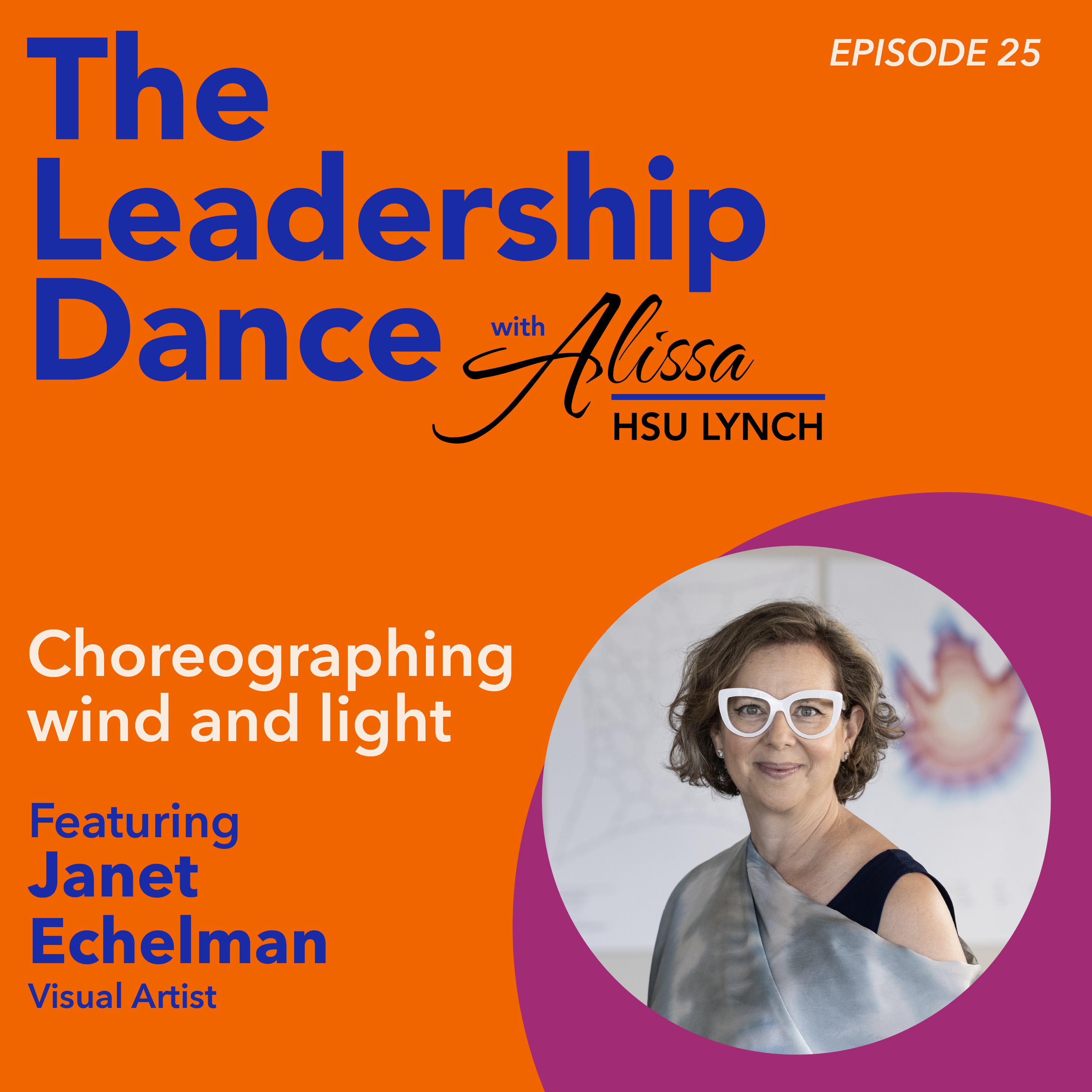
The Leadership Dance
Ep. 25: Choreographing wind and light, with Janet Echelman
00:38:26
Visionary artist Janet Echelman joins Alissa Hsu Lynch to pull back the curtain on her creative journey - one that’s anything but conventional. Oprah ranked her work #1 on her list of 50 Things That Make You Say Wow, and it’s easy to see why:...
Loading summary
Transcript44 lines
- [00:01]
A
I know a lot of people are afraid of AI. I'm not at all afraid of it, you know, replacing me because I use self as instrument. I was trained as a psychotherapist earlier in my career before I earned a living from art and my mentor would often say self as instrument, meaning the way that you emotionally are experiencing a situation or a person is actually you are like a thermometer, like that. You have to take your own responses as feedback. And that's what I do with the site. When I'm asked to come to a city and give it a signature identity artwork, I'm using myself as the instrument to feel. I talk to people, I interview people, I walk the spaces I see. Where do I feel open and expansive? Where do I feel constricted and claustrophobic? What does this need? Does it need my eyes to go up to the sky? So that's something that AI will not ever recreate. But AI will be so helpful if it can really generate based on the direction of the artist.
- [01:16]
B
Hello and welcome back to the Leadership Dance where we explore the art of leadership with trailblazers in business and the arts. If you enjoy the show, please please subscribe, share and leave a 5 star review I'm your host, Alisa sue lynch and I'm joined today by the amazing artist Janet Eckelman. Janet is an artist known for sculpting at the scale of buildings and city blocks, creating large scale fluid installations that merge art, architecture and engineering. Her work transforms with wind and light, inviting viewers into immersive experiences. Janet uses unexpected materials, blending traditional craft with advanced computational design. Her monumental works anchor public spaces across five continents in cities including New York, London, Sydney, Shanghai and Singapore. Permanent installations in locations such as San Francisco, Vancouver and Porto continually evolve with shifting light and air. Janet's unconventional path includes a degree from Harvard, five years living in a Balinese village, and graduate studies in both painting and psychology. Oprah ranked her work number one on her list of 50 things that make you say wow. And she received the Smithsonian American Ingenuity Award in Visual Arts, honoring the greatest innovators in America today. Recipient of the Guggenheim Fellowship, she has taught at mit, Harvard and Princeton. Her interdisciplinary approach challenges artistic boundaries and redefines urban space through experiential public art. I am so excited to have you on the podcast, Janet.
- [03:02]
A
Thank you, Elisa. I'm so excited to be here and become part of your community in the Leadership Dance.
- [03:09]
B
I wanted to start off by first, first of all, congratulating you on the launch of your book Radical Softness It's a visual compendium of your body of work, which is accompanied by a traveling museum retrospective. Tell us more about the book and your show.
- [03:25]
A
This is really a labor of love. It is written by 27 different authors from all around the world. Helsinki, Jeddah, Paris, Singapore, Mumbai, India, of course, New York, Los Angeles. And we are really excited to share the story of this journey. And really, the book comes from many different angles. There are four texts about engineering and science and computer science and computation. There are works about poetry by a US Poet laureate. There is a work about dance. So it really is bringing this multidimensional, multidisciplinary practice of the last 40 years together.
- [04:20]
B
It sounds incredible and I've already pre ordered my copy and I recommend everybody else order theirs. Now tell me a bit about the accompanying show or exhibition that's happening right now.
- [04:31]
A
Well, there are actually two exhibitions opening this fall. One is at the MIT Museum, which opens today, called Remembering the Future, which is a meditative piece that you can walk inside of and be a part of. Where we are standing at the moment of now, with the history of the earth's climate back to the last ice age on one side of you and to the other side, the multiple trajectories of the future that we shape and can shape. So that is opening today. And then in November, the museum retrospective traveling exhibit opens at its first destination, which is in Florida at the Sarasota Art Museum in mid November.
- [05:18]
B
Congratulations. So lots of opportunities to go see Janet's work. I want to dive into the work definitely in this podcast because it sounds fascinating and we want to understand your process. But I want to first go back to your childhood. You have had an unconventional journey in your life to get to where you are today. Go back to the beginning. What were you like as a child and what influenced you to become an artist?
- [05:44]
A
My childhood. I was the youngest and fourth child of many older brothers and I would often play in the front yard like, with like flowers or leaves and trees. I think there definitely was a nature spirit there. And early in my life I got involved in classical music. I played the piano. When I was 14 was my first invitation to be a soloist with the Florida Orchestra, where I grew up playing Grieg's piano concerto. And actually what I discovered is that I hate performing and that I'm really not cut out for it. I would get these like, terrible pains in my stomach before each and every performance and it didn't get better. And that really made it clear to me that I did not want to become a classical pianist. And so that closed one door, but at the same time, it opened the other door to education, because that was really my ticket into Harvard. But I am a slow reader, and I have always been. And I was really quite nervous coming from public schools in Florida and showing up at an Ivy League college next to all these kids who had been to prep school and clearly didn't have the kind of vision issues that I have with my eyes. The only reason I ended up in an art class in college, it was my freshman year, was that I was really intimidated by the reading lists of all the courses. They had so many books and so many papers, and I was like, I need at least one class that doesn't have papers. And that's how I ended up in my first art class. And lest you think I showed natural talent, I got a B minus. And that teacher was not enamored. It takes a long time to find one's voice.
- [07:44]
B
And what kind of art did you study in that class?
- [07:47]
A
I actually was incredibly moved by the class. And it is what made me decide that the life of an artist was the life I wanted, of posing the questions that I wanted to answer, of having my internal life and my external life be linked to. The most memorable part was that we had to pick one artist's life and follow the entire trajectory of it. And I picked Matisse because I just loved the color and beauty of his paintings. And what I discovered was that at the end of his life, in his 80s, he was confined to a wheelchair and his bed. And even there, he invented a whole new way of making art, the paper cutouts. So he couldn't paint, but he could cut. And I thought, that's the way I want to live. At every point of life, I'm being pushed to my edge, growing edge, and that there's no one else responsible for that but me.
- [08:48]
B
Wonderful discovery to have in college. Did you end up majoring in something creative or philosophy or what was your undergraduate major?
- [08:57]
A
First I was a history major, and then I became something called Visual and Environmental Studies, where I focused on documentary filmmaking. Never took a course in sculpture or engineering or architecture. All the things that really are so intimately linked to my work today, it's all been a discovery.
- [09:19]
B
You, after college, lived in Bali, Hong Kong and India. What called you to those places? Can you share what living there was like, and how did that influence your path?
- [09:33]
A
I was on a study program the junior year of my college experience, and that took me to nine different countries for a month each, where I lived With a family. And one of those places was Bali. I just felt like I had died and gone to heaven. It was this immersive culture where nature was everywhere, where each family had a musician in the neighborhood, gamelan orchestra as a duty, not a frivolous or extra. This was part of life and it was just a very special experience. So I knew that when I finished college, I really wanted to go and live there. And that's what I did. I had $300 total. And I walked through the rice fields looking for a home to rent. And I found a little place with a grass roof right on the rice fields. And that's where I began my work. I will note that after college, I thought the next step to becoming an artist was going to graduate school. And I applied to all the major art schools. I could think of seven of them. I was rejected by all seven of them. So that also was part of why I moved to Bali on my own. Because I realized if I wanted to be an artist, that meant just go and live the life of an artist. And I had to find my own teachers. And I decided that craft and craft traditions that had survived generation after generation were holders of wisdom. And that if I could apprentice myself to these craft and artisan masters, that they would become my teachers and that the methods themselves would impart that wisdom. And, you know, that's still the way that I approach my work today. I mean, craft is central to, to the work. Even though we're now using a great deal of computer science and material science to expand to these giant, monumental, building sized pieces, it's still the same approach to craft. Craft and method is at the center of my work.
- [11:57]
B
Yeah, I want to get into the computer science, but before we go there, can you talk a little bit about what is the specific craft that you learned in Bali or on your travels?
- [12:08]
A
Well, in Bali, they were textile traditions like dyeing fabric and batik and weaving. But it was later I applied to teach on a fulbright in India 10 years later. And that experience, I shipped all my paints off to create exhibits for the US embassies in three different cities around India. And the paints never arrived. And, you know, all of my very special custom tools, you know, nothing was there. And it was like, what am I going to do? I've promised. This is a big break for me, the big opportunity, and I've got nothing. And I just realized at a certain point time was running out. It was eight weeks until the show opened and I had nothing. That I was going to have to figure something out, you know, plan B had to appear, and I was in a fishing village and I started to work with fishermen. And that is the very first. They taught me how to tie the knots, and I began collaborating with them and also with tailors, using found fabrics, old saris, creating my first sculpture, which didn't stand on its feet, but it's suspended from above. And the rest, I guess, is history. I keep pushing the craft and asking questions to create things that I haven't yet been able to make. What can we do? So curiosity is my guide.
- [13:44]
B
So your art combines unconventional materials, from atomized water particles to fiber stronger than steel, and it blends. As you talked about ancient craft with computational design. I'd love to learn more about your innovative approach and how it's evolved over time.
- [14:04]
A
The first sculptures were made by hand in collaboration with artisans. First on the beach, with the fishermen and with tailors in a small village in South India. And then gradually, as my work has begun to scale up larger and larger, I needed to be able to create digital 3D models that I could share with an independent engineer who could analyze them and stamp construction drawings in order to get a permit to build them. My work has to meet the same standards that a skyscraper has to meet in terms of building code. If a building has to withstand 155 miles per hour of wind, my art has to withstand 155 miles per wind. And so I need to be able to speak the same language as architects and engineers. And that's what started this 15 year journey of developing our own technology. We have our own proprietary software that enables us to model the three dimensional forms and drape the nets and understand how gravity will form and shape the art. And I work intimately with structural engineers and aeronautical engineers who are, you know, who I basically worship. And I'm very privileged to work with such thoughtful. Not only brilliant, yes, brilliant, yes, expert, but also led by their own curiosity. SOM has been engineering many, many of my recent works. They're also the lead engineers of the world's tallest building, the Burj Khalifa. Same engineer who led that project as part of our team, Bill Baker, and along with Alessandro Baghini and Nicole Wang. I'm just so privileged because it's not. I have an idea and then I pass it to them and they engineer it. It's a much more intimate and integrated process where I'm asking them what's possible. They tell me, and then I generate ideas, then they explain, this works and this doesn't work. And then so it's this back and forth that each time, each iteration grows. So my collaborators, which also include architects, landscape architects, lighting designers, city officials for permits, clients, of course, are key. Enlightened clients are the sort of backbone of what creates good art. Without the enlightened point of view, the work just won't flourish. So it's a real collaboration.
- [16:51]
B
It's so interesting that you designed your own software, of course, with collaborators. What gave you the confidence to do that? It was driven by need, or were you inspired by somebody?
- [17:03]
A
It was driven by need. But in fact, it would never have occurred to me as an artist that I could commission or generate my own tools. Initially, I was just searching for tools. And I was married to a computer scientist, my late husband, David Feldman, who worked at Apple. We went to visit Frank Gehry, the architect. I had been introduced to him about this issue of what computer software would enable me to build these works. And I knew that Frank had innovated with his own computer software, which is now widely used, and his office licenses that software to many, many different designers and architects. And I said, frank, please tell me what software do you think would enable me to do what I want to do? And he was sketching, he was very excited about the work. He said, I've never seen anybody do anything like this. You should not adapt yourself to the tools that exist. You should develop them yourself because you need to be present at every decision making point so that you are shaping the way it develops. And that advice was really essential. And that's what we've done. You know, it's that I never give up whatever it is I want to do. It's just one step at a time, building the path to where I need to be.
- [18:33]
B
You have talked about working with architects, engineers, landscape design. So there's a lot of planning involved with your work. But how do you navigate the balance between planning and, say, improvisation? You know, how do you make it art? How do you manage that tension between the structure and freedom as an artist?
- [18:55]
A
Well, that's a really good question, Elisa. I was struggling with that issue, like, how do I keep the work alive? How do I keep growing and how do new ideas develop? When I was getting these permanent commissions from not just private clients, but public cities and entities where I was making a commitment to design permanent works, that was a lot of tension. And what I realized is that temporary projects I do, I sort of have two different buckets. I have these temporary projects where I take risks and I experiment and I sort of test them out. They may only need to last For a day or a month. And it enables me to try new kinds of ideas. Like I imagined that I could attach these things to skyscrapers and infrastructure. And that conceptually and practically a much more sustainable approach to bringing public art to cities. If we use the structure, we already have, the embedded carbon that's already there, and we use that in order to create these large scale cultural icons that bring us together. That was an idea, but I had to test it and I had to test that on temporary projects first. So the experimentation happens in the temporary installations or exhibitions and then the permanent works. I start with maintenance and work backwards. It's like, well, what is going to be easy to maintain? What is the nature of that long term commitment? And then we work backwards. So if I only worked on permanent commissions, I think as an artist I might shrivel up because I never want to take a risk on something where I feel a duty to my clients. Long term goals. And at the same time, you know, these temporary projects are where a lot of experimentation, new materials, new approaches, new tool development is all done. And then once we do these projects, then we test them. I do a LIDAR scan where a three dimensional scan is taken like a point cloud. And then we compare the digital model and the point cloud of what was actually built and make sure that they are close or the same. And when they're not, that gives us the information to keep refining and improving the tools. I never expected as an artist to have an R&D department. You know, the research and development is, we're doing it all.
- [21:39]
B
You have been talking about this process and it's been really fascinating to hear. There is so much applicability to business as well. The testing, the experimentation, the temporary nature, you know, doing MVPs and pilots, really proving out things before you do them at scale. But I loved hearing about the way that you bucket it into like temporary, where you just feel like you can just play. And then the permanent installations, where you definitely have to plan ahead and make sure that it's going to be there for years and years.
- [22:11]
A
I will add that these big public planning pieces that, you know, what you're calling a planning piece, that we cannot see them. So let's say the piece that unfurled in downtown Boston, you know, 600ft, it went up to the 28th story of a skyscraper, International place. We could never see the whole piece in the factory. So it is very much in our minds, in our document, as we build, you know, section at a time, roll it up in the factory, it goes into like one crate, you know, until it is unfurled in the city and then attached to the buildings. It is all about planning and precision and execution. It is not improv. That's all I'll say.
- [23:03]
B
Have there been any times where it didn't go as expected or there was something that you couldn't plan for that happened?
- [23:09]
A
Oh, there are so always things that don't go as planned, you know. In Munich, we were invited to install in the center of a very important historic the Odeonsplatz, with Mercedes Benz launching their electric car fleet. With my art and one of the columns, the location was on top of a hollow underground cavity under the street that no one knew, you know, and it required calling, you know, whatever. There's always something that goes wrong. There's always something that goes wrong. So at that point there is some improv. What do you do? How do you call? What do we do? Somehow it all happens.
- [23:53]
B
You make it work. So you've been talking about these large scale public sculptures and also the need to be very cross disciplinary in your approach. Can you talk a little bit more about collaboration and how do you manage a team of so many different perspectives and expertise?
- [24:12]
A
I would say my own style of leadership is to share my internal goal. Like, what is it we're after? I lack the expertise that say, my brilliant structural engineer has. So if I said I want a column here and here, that would limit the kind of input I would get. So if I say what I'm seeking is the lightest possible structure that will hold this up. And then suddenly my engineers will come up with three or four different, really different approaches. And then, you know, of those, then I'll say, well, let's go, let's explore this one. And then more sub iterations. I mean, we might have 80 or 90 iterations of a project before it gets to built form. So it's highly iterative. I don't know, you can see some of the drawings on the wall. You know, these are just works in progress as we, you know, evolve and grow. I try not to micromanage. Share the vision, trust, the talent and commitment and dedication of your team and then go there together.
- [25:24]
B
That's a wonderful approach that I strongly believe in as well. So, Janet, you have talked about weaving, art and technology. How do you see AI influencing the future of creative expression or even your work?
- [25:40]
A
Well, I'm excited about AI. We use it all the time in our research. I think of it as a useful tool that I hope gets better and better, quicker and quicker. We have Three computer scientists currently on retainer, constantly evolving and adding capabilities to the designing and color capabilities of our software. And I'm hoping AI will start to be helpful in that, to get our capabilities growing faster. Basically, I hope AI will generate options the same way that I described a conversation with my structural engineers. If we could include the AI tool as one of those collaborators generating 100 options for all of us to look at together. That's where I see the future of AI being really promising. I know a lot of people are afraid of AI. I'm not at all afraid of it, you know, replacing me because I use self as instrument. I was trained as a psychotherapist earlier in my career, before I earned a living from art and the training. My mentor would often say self as instrument, meaning the way that you emotionally are experiencing a situation or a person is actually. You are like a thermometer, like that. You have to take your own responses as feedback. And that's what I do with a site when I'm asked to come to a city and give it a signature identity artwork. I'm using myself as the instrument to feel. I talk to people, I interview people, I walk the spaces I see. Where do I feel open and expansive? Where do I feel constricted and quite claustrophobic? What does this need? Does it need my eyes to go up to the sky? So that's something that AI will not ever recreate, but AI will be so helpful if it can really generate based on the direction of the artist. I'm very excited about it. We did do a test. I'm collaborating with a professor at mit, Caitlin Mueller, and we're on zoom. And she said, oh, well, let's see what AI would do. And she said, design me three Eccleman sculptures for the Great Lawn in New York City, Central Park. And it generated these three images, and you could see how it was copying the style of many of my other works, but not a one of them could actually stand up there, you know, like, they're completely unbelievable. So I guess it's not here yet. The AI tool of my dreams, but, you know, hopefully soon.
- [28:31]
B
You recently created a work called no Lee to Marry with choreographer Rebecca Legere, who I have met at Princeton. What inspired you to incorporate dance into your artwork? What was that experience like for you? How did it impact your art?
- [28:47]
A
Well, the first dance collaboration was a cold call from Germany from the Stuttgart Ballet saying that they'd heard I worked with the choreography of Wind, which I do. Would I be interested to work with the choreography of Human dancers. And of course I was excited as I'd been making art for a while. I'm really excited to be a beginner again, to be a learner and a newcomer. Since I know nothing about dance. It's been really exciting to be designing sculptures that are themselves a dancer at a large scale and that dancers inhabit in science of them. And this is all an exploration of what it means to live in this physical world right now where we know humans are impacting the planet. We know the planet impacts humans all the time. It is a dance like your leadership dance, but it's not a dance of equals. And these dance collaborations, the current ones with Rebecca, is very much about that. Like, what does it mean to be mutually impacting one another as people and in this larger entity? So the sculpture has four people, you know, dressed in black behind stage, pulling ropes. That kind of dance the sculpture like a marionette. And the people inside as they shift their weight and they move and dance, that changes the shape of the sculpture as well. There's collaboration where, you know, a group of dancers, there are eight dancers in the work pull in one way and that enables this dancer to climb up anyway. It's very exciting for me to be creating forms for this new function, to be part of a dance performance. And it's traveling now in the United States. It premiered at in Princeton, New Jersey at the McCarter Theater in February. It's now beginning to travel the eastern seaboard. It will be at Lehigh University, at William Mary College, at North Carolina State. It's coming to Boston with Arts EMERSON to the 1,200 seat theater in January. It's very exciting to be sharing this work. We have classically trained dancers. We have performers from avant garde circus. There's an incredible amount of strength and artistry that is needed to navigate these nets on multiple levels. The jumping and it's really astonishing what the performers are capable of doing with this expressive goal. So I love being a learner. It's so exciting to know nothing and discover again, even in the mid part of one's career.
- [31:43]
B
I would love to see the show. So I'm going to follow up with you and see how I can make it to one of the upcoming performances.
- [31:52]
A
Great. And for your viewers on our website, they can see all the upcoming events, eckleman.com, just my last name and on Instagram, Janet Eckelman. All of these dance performances, the times and places, so that you can all join our community and become part. And please do introduce yourself to me if you are at one of these performances and tell me that you heard Elisa's podcast. I wanted to mention that we're celebrating the 10 year anniversary of a piece really important to me. It's in Seattle. It's called Impatient Optimist and it's installed at the Bill and Melinda Gates foundation in downtown Seattle. And we are looking for people to share any photos from their phone, any words or texts that they have experienced, what they thought or see in the work and what it means to them that would be very special to me. On this 10 year anniversary, you mentioned.
- [32:55]
B
Your husband, David Feldman, who was not only your life partner, but also a key collaborator in your work. How do you now honor his legacy and keep his spirit present in your life and work today?
- [33:08]
A
He's everywhere. He's in our thoughts every day. My colleagues and I were often what would David do? And it's now wwdd, what would David do? And he had a saying, you must be present to win. Which is really about showing up. And anytime I'm sort of on the fence, like, oh, they've invited me. I just went down to Brazil to give a keynote lecture. Oh, it's a long flight, I don't know if I need to go do that. And I thought, wwdd, you don't go down there, you don't know what you are missing. Right. And then of course I met some wonderful people and collaborators and have just been invited to do a new major commission down in Rio de Janeiro. And it's like, oh, you must be present to win. I guess the other thing, we made these little cards like the size of a business card with photos of David. And we have been sharing them and giving them to people and a lot of friends carry it in their wallet. You know, he loved making pizza. We have a wood fired oven, brick oven that he built. And anytime people like are eating delicious pizza, they'll shoot me a photo with the picture in it. And I think for other people who have experienced losses, I share this. I learned it from a friend. I know most people are worried, afraid of talking about a loved one who's missing, but the person who's grieving is thinking about them anyway. And if you talk about them, it's actually a gift to them because they're thinking about them anyway and it acknowledges that. And the thing about the photos with the photo is that you don't have to say anything. It's like just acknowledging that here we are in this fabulous place eating this food and we're thinking of a person who's not here. And it just the visual just shows you that they are still being thought of. And for me, that is what living on is, is when you are in people's thoughts and when your memory is a blessing. So he lives on. May we all be inspired by that energy and approach to life. You must be present to win.
- [35:22]
B
Thank you, David, for that advice and such a wonderful practice. I'm definitely going to keep that in my heart and share that with others.
- [35:30]
A
Thank you.
- [35:32]
B
What advice would you give to young artists who are starting out in their careers?
- [35:37]
A
Well, I guess I'd share what has kind of been a guiding principle for me, which is don't start with compromise. My TED talk is called Taking imagination Seriously. What does it mean to take your own ideas seriously? Or even to give yourself space to have those ideas, even if you're gonna censor them or delete them later? Give yourself a little breathing space to have the crazy idea. Give yourself time to say, okay, what are 10 outlandish ideas of products that you as a business person would like to offer, even if they're impossible to give yourself space to, like, assuming anything is possible. I do a lot of that. Then later you can, like, throw that one in the trash bin and that one's not buildable, and this is crazy, and that'll be too costly and blah, blah, blah. But at least have a chance to kind of not compromise. Dream big. And I would say for a young person, I realized that I was going to have the rest of my life to compromise. And if my dream was to be an artist making art all day, it wasn't about going to school or art school to do that. It was just like to live the life of an artist. I didn't need very much money to live. I mean, I was living on $250 a month, but I had all my time. And that's what was really important to enable me to grow as an artist. So don't start with compromise. Give yourself space to really imagine. Give your imagination the fullest range before letting the critical brain go in, which is important, too. Both sides are important, but what happens is that the critical brain kind of squishes your imagination before you really get to develop your ideas. So that's my advice.
- [37:41]
B
That is great advice, not only for young artists, but for all of us for sure. Janet, congratulations again on your new book and exhibition. And I encourage everyone to order their book today@eckelman.com and you can also follow Janet on Instagram anetechelman. It has been such an honor to speak with you and to have you share your Leadership Dance with listeners. Thank you so much for joining me on the podcast.
- [38:07]
A
Thanks, Lisa.
- [38:09]
B
Like follow and Share the Leadership Dance, where we explore how to choreograph the career of your dreams and chat with visionary leaders who are breaking barriers in the arts and business worlds. Until next time, keep dancing.