← The Leadership Dance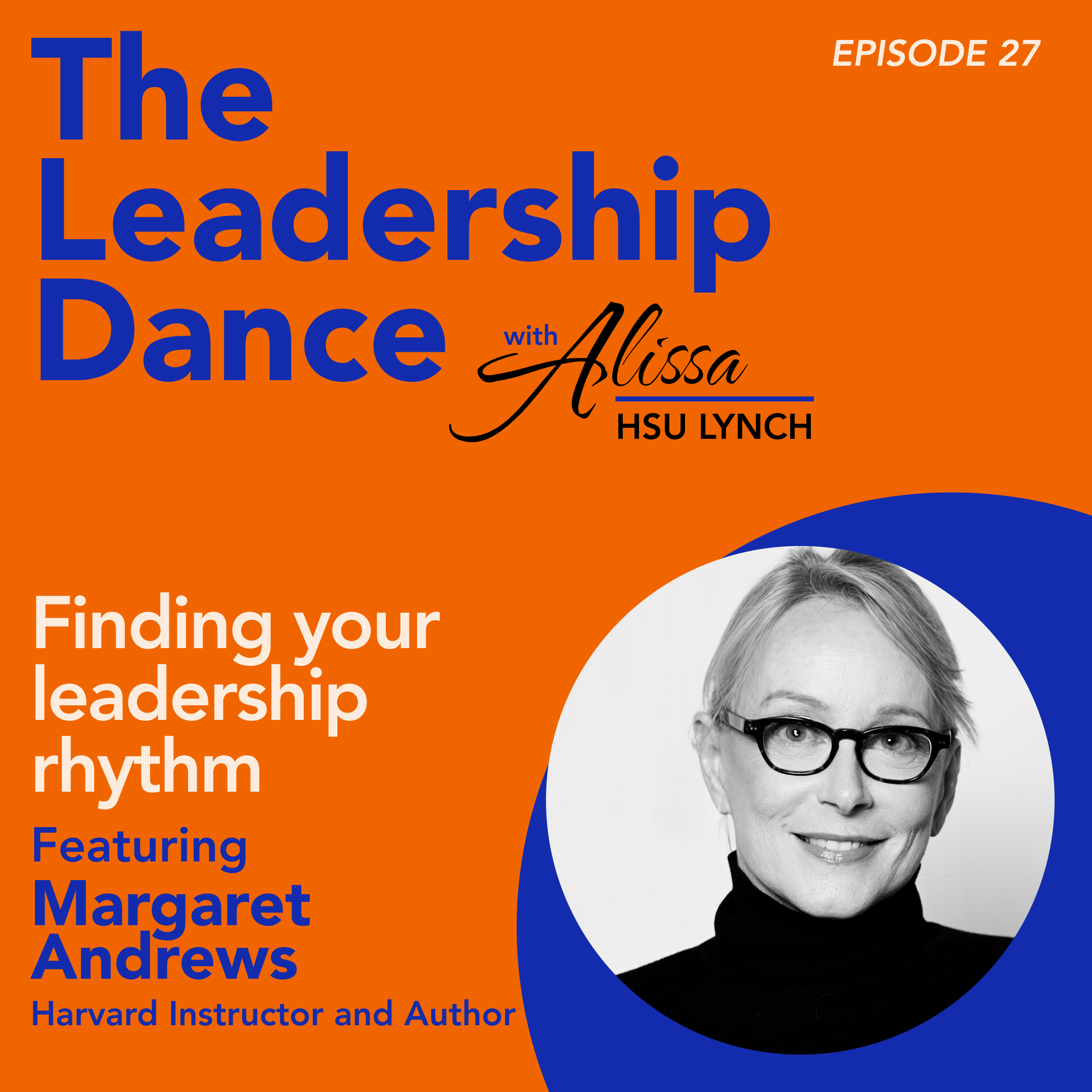
The Leadership Dance
Ep. 27: Finding your leadership rhythm, with Margaret Andrews
00:36:31
Harvard leadership instructor and author Margaret Andrews joins Alissa Hsu Lynch to trace her unconventional journey from accounting to academia, sharing how a series of “lucky accidents” and bold choices propelled her to the forefront of...
Loading summary
Transcript60 lines
- [00:01]
A
I just think in your career you kind of have to kiss a lot of frogs. That to me, I think one of the purposes of dating is to find out what you don't want in a partner, right? Oh, I think I want this. And then you date somebody like that, you're like, that's not what I want at all. And to me, jobs are like that too. If you're curious about it, try it. You know, maybe you take that job or maybe you do a side hustle in it, or maybe you do more reading or you interview people that are doing it. If you have curiosity, look into it, even just a little.
- [00:37]
B
Hi and welcome back to the Leadership Dance where we explore the art of leadership with trailblazers in business and the arts. If you enjoy the show, please subscribe, share and leave a five star review. I'm your host, Alisa sue lynch, and I'm really excited for today's conversation with Margaret Andrews. Margaret is a leadership expert who teaches the most popular professional development program at Harvard, Managing yourself and leading Others. She's helped leaders at Amazon, Wayfair, Walmart, and even the United Nations. And her new book, Manage Yourself to Lead Others just came out. In this new episode, we talk about how to deal with a bad boss, how to overcome setbacks in your career, and why self understanding is the key to becoming an effective leader. Welcome, Margaret. I'm so glad you're here.
- [01:29]
A
Thank you so much. It's very nice to be here.
- [01:32]
B
Let's start by learning a little bit about your childhood. What did you dream of becoming when you were younger and how did your upbringing influence how you navigated your career?
- [01:42]
A
When I was younger, the only thing that I can really remember wanting to be, and I'm sure it changed all the time, but the one thing I kind of remember was wanting to be a doctor. And I think the idea came from my parents and I don't remember when I changed it, but that is the one thing I can remember wanting to be.
- [02:00]
B
Are they doctors?
- [02:01]
A
No, they're not. So for some reason they just thought, oh, a doctor would be good. So that's where I got that idea.
- [02:08]
B
And then tell us a little bit about how your career developed. What got you to where you are today?
- [02:13]
A
I started off my career as a CPA in San Francisco. And so I worked with Deloitte and did. I was mostly on the tax side and I did that for about four years. And I realized that's probably just not the right job for me. It's probably not what I want to do for the rest of my life. So I did at the time what everybody did in that situation. And that is, I went back to business school. I went to school at MIT Sloan. And I decided at that point that I wanted to stay very. Because I'd been in tax, right? I'd been not just in accounting, but in tax, which is very narrow. I decided that I wanted to stay as broad as I could for as long as I could. And that's when I decided to go into strategy consulting, because I thought, hey, you're going to see all kinds of different problems in all kinds of industries. And so I did that for about five years, and it was. It did exactly what I wanted and I really enjoyed it. And. But the lifestyle left a little bit to be desired. So then I became a marketing executive and a few other things. And then through a series of very lucky accidents, I became the executive director at the MIT Sloan School of Management, where I ran the MBA program, including admissions, student affairs, career development and alumni relationship, and did that for about seven years and then really found my home in higher ed. So also worked at a couple of other places, including Harvard, and have stayed, you know, doing management development throughout that whole time. I feel like I have one foot in academia and one foot in the business world, which I think gives me a really interesting vantage point for this.
- [03:44]
B
So I think it would be really interesting for listeners to hear how did you kind of discover that this maybe was your passion or your calling? I mean, you said lucky accidents, but tell us a little bit more about what that looked like.
- [03:56]
A
Yeah, so it truly was a lucky accident in the sense that, you know, I was living in the Boston area and MIT Sloan was going through a curriculum redesign for the MBA program. And they did what I think was a great thing. They, they, besides having students and faculty involved, they said, you know, maybe we should have some alumni involved because they're out in the workplace. So they called me and said, would you be willing to. To help us with this? And I said, sure. So we were meeting every week at once a week at 7:30 in the morning, you know, before everybody got to work and things like that. And so after one of those sessions, I stopped by somebody's office who I, you know, knew when I was a student there and he wasn't there. So I left my card and about a week later he called me and we chatted and caught up and things like that. And then he said, so what can I do for you? And I said, well, nothing. I was just calling to say hi. And you know, hadn't seen you for a while. And he said, oh, I thought you were calling about the job. And I said, what job? Proceeded to tell me that they were, you know, hiring for this new job, et cetera. And I was silent on the other end of the phone because I was speechless. And I said, oh, my gosh, now I'm calling about the job. And I just. I knew that that job had my name written all over it, but they didn't know that. And so he said, but if you're interested, he said, you better hurry, because they hired a search firm. They had surfaced 10 candidates internationally, and they were meeting to do the interviews the following week. And so I pulled out every stop I could think of, calling and emailing anyone that I knew that might be able to help me with this. And so, long story short, I walked on as the 11th candidate on that list, and I walked out with the job. But had I never done that volunteering with them, I wouldn't have been there. And if I hadn't left my card for this guy to call me back and if he hadn't called me back. Right. So all of these, like, little things that went together, and somehow that's just the way it works sometimes.
- [06:02]
B
Yeah. That's an amazing story, and I'm sure you were very well qualified. But did you feel in the beginning that you knew what you were doing?
- [06:11]
A
Oddly, yes. And maybe that. Maybe there's a level of arrogance in that, but. So, as I said, you know, I knew that this was the job for me. I just felt it in my bones.
- [06:22]
B
Right.
- [06:23]
A
But they didn't know that, because here I was coming from business into academia, which is a different world. And also because I'd been a student there, and I'd been very involved in all kinds of things and had been involved as an alum, I knew it pretty well. And in fact, I knew MIT pretty well because both of my parents went to MIT as undergrads. They met there, they got married there. And even though I grew up in California, the culture of MIT was really the culture of my family. So the second I got on campus, I felt like I'd been there my whole life kind of thing.
- [06:57]
B
And you now are an instructor at Harvard. What brought you over to Harvard? To develop some programs for them.
- [07:03]
A
So after I worked at mit, I was doing a lot of consulting in higher ed, because what I found was I really liked this, and I liked figuring out how to turn things around and, you know, what you would need to do, which is what I did when I was at MIT multiple times, figured out, okay, what's wrong? What do we need to do? But then when I was at mit, I was not just consulting. I always said I had to eat my own cooking. Right. So as a consultant, you oftentimes say, oh, you should do this and you should do that, but when it's you, you have to do it yourself. So I did some consulting and then it was three people sent me the same job description over two days. And it was for this position at Harvard. And I thought, well, if that's not a sign, I don't know what is. And I ended up going to work for Harvard. I was an associate dean there for about six years. And while I was there, that's when I launched the class Managing Yourself and Leading Others, and then started the professional and executive development programs there. So boiled it down a 16 week class, down to two days kind of thing. And that's how that all started.
- [08:06]
B
So you went from teaching at Harvard to actually turning that course maybe into your new book, Manage Yourself to Lead Others. Congratulations.
- [08:14]
A
Thank you.
- [08:15]
B
What inspired you to write the book? Can you tell us? What is it about? Who is it for?
- [08:20]
A
Yeah, so what inspired me was that I created the class. I think it's 18 or 19 years ago, and a lot of people have, I don't know, a book, a class, a piece of art, whatever it is inside them and it has to come out. You know, I, I say if you've ever seen the movie Alien, you know, when the alien bursts from this person's chest, I think that's kind of what it's like. It has to come out. And I felt that way about the class, like that class had to be done. And so it started with that. And then when we were talking about doing some two day executive programs, this one seemed like a pretty good fit for that. And so that was one of the first ones that launched. And it's been, it's ended up being the most popular one of all. So after that, right. So I took it from a class so, you know, you have 30 to 40 people in there, to executive programs where you have 40 people or so per time. And then I did a speech, which you get wider audiences, and I thought, well, the next, the next iteration is a book. And so that was what it was. But I will say that writing a book and teaching a class were two totally different things. And so people have often said, oh, you've been teaching this for a long time, it must have been so easy. And I said, no, it wasn't. It wasn't easy at all.
- [09:40]
B
Let's get into some of the topics that you tackle in your book. What sets apart a good boss or a good leader from a great one?
- [09:47]
A
So I use an exercise for this, right? And so rather than listing the skills, et cetera, I ask people to think about the best boss that they've ever had and then to think of all the reasons, right? The big ones, the small ones, and all of that kind of thing. Long story short, I won't go into the whole exercise, but what it comes down to is that the reason, about 85% of the times that they give a reason are in the interpersonal skills. The relationship skills area, IQ and technical and functional skills are also important, but they're much lower down in terms of the importance of making somebody a great boss. And so that doesn't mean, by the way, that those are unimportant, that, you know, being intelligent and knowing whatever it is, the tax code or how to program an R or whatever it is are important. But that's not what makes you a great boss. Those things actually oftentimes got you promoted. But what makes you a great boss, A great leader has to do more with those relationship skills, the interpersonal skills. And when I ask people after we've gone through this exercise, I say, you know, would you work for this person again? Because very oftentimes it was like their first boss or something like that. And I said, would you work for them again? And everyone is like, yes, I would. So, you know, to me, that's the hallmark of a great leader, is if somebody would go back and do it again.
- [11:07]
B
Yes. So I think they create followership. And often great leaders bring their teams with them when they move to a new company. And that's also, I think, a sign of someone that you want to work for.
- [11:19]
A
Yes. The fact that you would actually go and do that. I agree with that.
- [11:23]
B
So I think we all have a little bit of trauma from working with a toxic boss. Why in your book do you say that the first step to dealing with a toxic boss is actually to look at yourself in the mirror?
- [11:35]
A
Because any relationship involves two people, so we're both involved with that. Or you could think of it a little bit like a dance. Right. One person moves forward, the other person moves back. So very oftentimes we may be doing things inadvertently that may be contributing to this. You know, whether it is people pleasing and not telling them when something is not quite right or working against them. Right. It could be all kinds of different things that we May be doing that, may be contributing to it. And it's not the idea of blame, of who's to blame. It's more looking at what's our contribution to it. Right. So you know what, what are we doing that may potentially be contributing to it? Because that's the first thing is, oh, if I'm contributing this, maybe I should stop doing that.
- [12:23]
B
But what if you're. You're in a situation where, okay, let's say you change some of those things that you recognize about yourself, but it's still a pretty bad situation. Is that when people often leave?
- [12:34]
A
Yeah, I think people leave. In fact, if you want to find in an organization where the difficult, not so great bosses are, look for turnover. Almost always a really bad boss, a bad manager, has higher turnover than other areas. But to your point, I think that we can't change anyone. It's hard enough to change ourselves. Right. And that's even if we want to. But you sure can't change somebody else. You can at best make them aware of it, of what's going on. Even then it's a little bit dangerous, because if you think about it, if you have a toxic boss, and if you think that if they knew how they were coming across that they would want to change, then maybe you would want to talk to them about it. But then you have to realize, yeah, but you know, what if they don't? What if I'm wrong? Right. Then there may be retaliation. You may be on the outs and those kinds of things. So it makes you really realize why people don't venture there. But I also think, too, that we can stay with a difficult boss sometimes for a while, as long as we're learning, especially when we're earlier in our career, that we are learning. And sometimes that's just uncomfortable. And it may have to do with the boss, and it may have to do that we're learning something that's hard to do, and sometimes it's hard to pull those apart. You know, I think of, you know, previous bosses that I've had or coaches in sports and things like that, that sometimes you don't like to hear what they have to hear. You know, whether it's hold the bat this way or move your arm that way, and you think, I'm doing just fine, thank you. And then you try it and you realize they were right. They were right. But maybe I didn't want to hear that. So, yeah, I think looking in the mirror is important because what might we be doing to contribute to it? But I also think too, that there are times when you just have to go, you know, if it's really impacting you, you know, if, if you have those Sunday scaries, right, where on Sunday you just, oh, having a bad day. Because you're anticipating the week ahead and it's starting to really mess with your mental health. You have to weigh those options. And I realize that that's not always an easy option, and sometimes you don't really have that option. But I say a couple things there, and one is, is to look around the organization and grasp onto anyone or anything that you can learn from, right. And network like crazy like your life depended on it. Because it might. Because you never know, there may be another job that opens up in the organization or a project or all of these kinds of things. And, you know, and just keep looking, keep your eyes open. Because sometimes the act of trying to, as, as I say, rescue yourself actually makes you focus less on the really difficult situation. And that sometimes is helpful too.
- [15:32]
B
Yeah, that's very good advice. I did an international assignment, my first international assignment with Johnson and Johnson in China, and was there for about two years and had an amazing experience and then came back to the United States and just felt like I wasn't appreciated. Things had changed. There was a somewhat toxic boss higher up in the organization. And I tried everything, you know, and I found myself, like you said, really dreading going to work. And I had always loved work. And I found myself complaining to other co workers around the water cooler. And I'm like, I don't like myself right now. So I think something needs to change. And that. That's when I ended up leaving JJ for the first time, unfortunately, which is a really big decision when you, when it's a company that you used to love. But sometimes you do need to remove yourself.
- [16:22]
A
Sometimes you do. And sometimes it's the best thing that you can do for yourself. But I love what you said too, about how you had this assignment and then you came back and they didn't recognize how different you were. Right. But internally you knew it. You were. You looked at everything differently. And I think that's a really common thing, whether it's that somebody has an overseas assignment or oftentimes they are going back to school part time while they're working, and they're accumulating all of this, either knowledge or experience. And so they feel completely different. And yet sometimes the organization doesn't recognize that. And very often they leave exactly what happened to you.
- [17:00]
B
So you talk about resilience and recovering from setbacks in Your book, which is just so timely given the state of the job market right now.
- [17:08]
A
Yeah.
- [17:08]
B
What would you say to someone who has recently faced a career challenge? Maybe they were laid off or they didn't get the promotion they wanted. What's some advice you can give?
- [17:17]
A
Yes, I would. I'll tell a very quick story where this term came from. My family and I used to go for a week in Maine up at. Around Moosehead Lake. And then the highlight of the week was when we would go whitewater rafting down the Kennebec River. So we would work with this outfit that would take us down and with the guides and things like that. And when they were doing the safety briefing, right, they tell you, you know, hold your paddle like this and not like that and all these different things. But one of the things that they talked about was they said, you know, there's a decent chance that you're going to be ejected from the raft and finding yourself, you know, swimming down the rapids yourself. And they said, you know, in that moment, just remember that you care about your safety more than anyone else and you should act according. And they called it aggressive self rescue. And I just loved that term because I thought that's exactly what it is, right? And they, of course, on the river, you do this and not that, you know, you swim on, on your back, feet forward, keep your feet above the water. You know, all of these kind of safety things that maybe aren't that obvious unless you know the river. But I think the same thing with resilience is that when you have a setback of any type of. You have to think about, okay, aggressive self rescue. The cavalry is not coming. I think I am the cavalry. You know, part of it is just, first of all, just setting. Setting yourself down and saying, what just happened, right? What just happened and what's. What has changed and what is the same, what have you lost? Or how have you been impacted or how have other people been impacted? And just being as honest with yourself as possible and not trying to make yourself the victim. And it's all them, they're just a bunch of jerks. And me, I'm perfect. And the other isn't the opposite of just saying, you know, I'm a terrible person, et cetera, so don't catastrophize. So that's the first part, because it helps you just sort of settle down and say, what really happened here? And then the second thing is to say, you know, what factors right now are under my control and what aren't? And I'm a huge believer in just taking out pen and pencil and writing it down. Because there is something about writing it down that slows you down enough to actually really think as you're doing it, as opposed to even typing it. And then, you know, as you do it, you can break it down. Sometimes these big things have, you know, five small things under them. And it also. The fact of engaging that part of your brain, that logical part of your brain, tampers down some of those really difficult emotions that you're feeling. Then once you have your list, just put something over the part that you have no control over. Just forget about them. Because if you can't do something about it, why worry about it? I remember somebody I knew was going through something really, really tough, and they told me, they said, a good day is when I take a shower. And I thought, that's good because that's under your control. Right. So it's something that you can do for yourself. So I think that's a big part of it is really not ruminating, which I say that as if it's easy. If you've ever had a setback, you know that that's not easy. But then, you know, the other things are to really keep up those social ties. Having a call with a good friend, somebody that knows you from way back when, perhaps. Because a lot of times they can either say something to you that will be helpful or remind you of something that will be helpful, and just really thinking about, okay, what have I learned here? I'm a big believer that something is not a failure if you actually learn something from it. Right. If you, for example, you did something that hurt somebody emotionally or something like that, you probably didn't intend to do that. But if you really think about it and think about what triggered me to do that, you know, how did they feel about it, how do I feel about it, et cetera. Just the process of kind of picking that apart helps us the next time that we're in a similar situation to choose differently. Sometimes those failures are those stepping stones to getting it right the next time. A painful way of doing that.
- [21:33]
B
That's really wonderful advice. I like the idea of writing it down because it does slow you down and maybe has that rational part of your brain kick in and then definitely focusing on what you can control, reaching out to your support system and learning. It's always a learning experience. That's what failure is. But it's not always your failure. Sometimes it's out of your control.
- [21:54]
A
That's right. Yeah. Sometimes, you know, I've known people that, you know. In fact, there's a woman that I interviewed for the book who was let go. She was the star performer in the group. She was also the highest paid and she was the first one to be let go. She's actually in there on resilience because, you know, she thought it was a horrible thing, right? This happened. And then so, you know, she had her own series of lucky accidents as she was, you know, figuring out what to do next. But it's not always your doing. Sometimes you are just in the wrong seat at the wrong time and things happen. The other thing I didn't say, but I think could be helpful too, is sometimes it can be helpful again, writing to just take out a blank sheet of paper and just write, write, write, write, write. Just whatever is coming out of your head, you know, about how unfairly you think you were treated or how this person was mean to you or whatever it is. And then because you're getting it out of your body, right? You're getting it out of your body so it's not bouncing around in your head so much, then you can go to, okay, what really happened, Right. Once you've gotten that out, you can do that. And I oftentimes will say to people, listen, you may never want somebody to read that piece of paper, right? Because you said some choice things there about other people. And I said, well, that's what paper shredders are for. So, you know, just take it when you're done and shred it right up.
- [23:13]
B
That's a great practical tip. So you've been transparent about your own personal experience with learning why self understanding is so important for managers. Can you talk a little bit more about how you were able to make the connection between self awareness and successful leadership? Yeah.
- [23:30]
A
So I think that when I talk about this best boss, this is actually how I help other people connect. It is, you know, the best boss that you had, the person that you would work for, again, was somebody that I asked people, do you think this person really understood themselves? And they say, yeah, I do. Do you think this person managed themselves well? Yes, they do. Do you think this person understood you well? Right. So they really, they exemplify all the things that we're talking about. So they are themselves best practices and they understood themselves. So that's not to say that there can't be successful people that don't understand themselves. Right. And I'm sure we've all seen them before, but very oftentimes they can be successful in a very narrow capacity and or For a period of time. And at some point, very oftentimes on their way up an organization, they kind of hit a wall and realize that old saying of what got you here won't get you there. And very oftentimes they've been relying on, you know, they can work really hard, they know how to do this type of work, et cetera. And they drive people very, very hard, oftentimes treating them not so well, which I, I think in general that most people that are not such great bosses don't intend to be that way. Right. And, and I, I think when I realized this, it gave me a lot more empathy for some of the people that had been my manager in the past where I might have thought, you know, oh gosh, they had it out for me. And then I realized, no, they were learning to lead and they were learning to lead on me and other people. And ultimately that's how they learned. Right. That's how we learn is that we do things and we, we think this is going to be the outcome and we realize the outcome is not always what we think. And one of the parts of that, I think is that the idea that we judge ourselves by our intentions. I intend to be a great boss, but other people judge us by our behaviors. And so they, and that's, as I say, what gave me a lot of compassion for my previous bosses. Because my guess is that they actually had very good intentions, but their behaviors just didn't match. So were they good bosses? No. But do I think that they were doing it on purpose? Not anymore. Although at the time I did.
- [25:59]
B
What do you advise? If you have a boss or you're managing someone, someone who isn't really self aware enough to change on their own, how do you help them along?
- [26:10]
A
Yeah, so I think part of it is to try to make them aware of that. A lot of times people especially, well, I'd say all throughout their career, I was going to say earlier in their career, but it happens all the way through, up until very, very senior management is to give them some feedback about how they come across to other people. Because a lot of times it's that intention and behavior mismatch that we talked about. They intend to be, you know, a great teammate or project manager or whatever it is. And yet they're really driving people crazy. So they are probably not aware of it. And if they are aware of it, they may not realize how problematic that is. And so I think the first thing is to try to make them aware of it. It can be a direct conversation, you can get at it through 360 degree feedback instruments and things like that. Because if you're not aware of something, you can't do anything about it. And I do think that most people do not mean to be like that. They just aren't aware and you can't manage something you're not aware of.
- [27:16]
B
Yeah, I've certainly had 360 degree feedback that shed light on something I wasn't aware of about myself early in my career. Just being a little bit too professional at work and people feeling like they didn't know me. And I got that through the, the 360 degree feedback. And at first, you know, it's a little difficult to hear or even to understand. But then as you internalize it and if you are wanting to be better and wanting to connect with the team that, you know, that encouraged me to change and to start talking more about my family life and the fact that I was a dancer before and bringing more of myself into work, which I think made me a better leader over time.
- [27:56]
A
I think it does. But I think a lot of times we're told not to bring that to work. Right. But it actually, when you think about the friends that you've made at work, at work, how did you make friends at work? Because you knew something about them. And I think that's, you know, we're all just. We're all just people. Yes.
- [28:13]
B
So on this podcast, we talk a little bit about the idea of choreographing your careers, which isn't mapping out your whole career in advance, but actually building in some improvisation and figuring out how your career might develop over time. And I know you also believe that it's important to embrace the fact that growth and learning aren't always linear or progressive. Can you talk a little bit more about why you think about that?
- [28:42]
A
Yeah. So I am a huge proponent of what you just said about, you know, kind of the improvisation in your career is that I don't know that it's the same anymore. But I think a long time ago, you know, my dad worked for the same company for most of his career. Nobody does that now. And in fact, that would be very unusual. So. But I think that. And the idea of, you know, follow your passion, I think has, you know, some good things and some not so good things because you don't know what you're passionate about until you try it. So I just think, you know, in your career you kind of have to kiss a lot of frogs. That to me, I think one of the purposes of dating is is to find out what you don't want in a partner. Right? Oh, I think I want this. And then you date somebody like that, you're like, that's not what I want at all. Right. And to me, jobs are like that too. Is that, you know, if you're curious about it, try it. You know, maybe you take that job or maybe you do a side hustle in it, or maybe you do more reading or you interview people that are doing it. But I'm. I'm a big believer in anything that sparks your interest, investigate it. Right. Even if it's just going online and looking at certain things. So I think, you know, part of your internal compass knows what direction, but, you know, it's not linear. It's kind of wobbles here and there. So, yeah, I totally agree with what you're saying. It's just kind of, if you have curiosity, look into it. Even just a little.
- [30:18]
B
Yeah, I like that advice. When I was somewhat of a lifer at Johnson and Johnson, I was there for 20 years, one of those people. Although I had a very varied career, you know, while I was at the company. But when I left, I didn't know what I wanted to do. And I did a lot of informational interviews. Cause I'm like, I just need to learn. And talking to people about what do you do in your job? Helped me narrow down where I wanted to focus next. So that's definitely. I love that curiosity.
- [30:45]
A
Yeah. And the thing is, is that they can help you understand what your transferable skills are. Right. Because you think, oh, I do this. And they say, oh, you know, that's just like this. So, you know, I always think of in higher ed, for example, people that do admissions oftentimes are very good at development too. Right. Because they're very good at getting to know people and oftentimes influencing them. So, yeah, totally transferable skills.
- [31:13]
B
I'm really interested to learn about a course that you taught on creativity and innovation. What concepts did you explore in that course?
- [31:22]
A
Oh, gosh, everything. So that one also came out because I was just curious about it. Right. You know, what is creativity and who's creative. And you know, I always grew up thinking that I wasn't very creative. I was always very good in math and, you know, science and things like that. I did like reading and I did like writing. But I will tell you, I don't know what grade it was. I think it was like second grade, third grade, something like that. In class we were doing these paper mache puppets and we were going to put on a paper mache puppet play afterwards. And so I made a paper mache puppet that was going to be a princess. And mine was chosen to be the wink of old witch because that's what it looked like. It did not look like a princess. And so I think that was one of those early experiences where I thought, well, you know, I'm no artist. And to me, I equated art being an artist with being creative. And it wasn't until much later that I realized, oh, these are different, right? Artistic creativity is one form of it that a lot of if you figure out a different way to approach or solve a problem, that's pretty creative. You know, so much creativity in science and experimentation and that kind of thing. So I was just very interested in it. And I think that there's one part of the creativity and innovation is about leading for creativity and innovation. And one of the things that comes out through the research is that a lot of times we don't have people that are comfortable with the creativity because, right. You've been in the arts and you know that what goes on stage at the end is not where it started. And you have to. Right? And you have to try things, even things you're like, this isn't going to work. And then. But part of it does, right? And now it's changed it. And when you have that sort of creative community where it's okay to just take a flyer, we'll just see how this goes. And also to just fall on your face and go, well, that one didn't work, right? That there. It's so freeing to work in an environment like that. But a lot of people aren't comfortable with falling flat or admitting that they made a mistake or it didn't work or, oh, it wasn't as great as an idea as I thought. And that's one reason why we don't have more of this in management, that we oftentimes think that sort of progress is this straight line. But if you've ever been in any, I mean, even a consulting assignment, right? You think, oh, hypothesis, we're going to, you know, get here. There's starts and stops and ups and downs and backtracking and things like that's just part of the process. And so if we realize that that's part of the process, I think we just all relax a little bit. That sometimes you just have to go a little more slowly to get there faster. Which I think is sort of a paradox for people. I always say, you're kind of emotionally naked together Right. Because you're just trying things. You don't know what's going to work. And it's scary at first, but it is so freeing as you go through the process and what you end up with is a hundred times better than you would have thought.
- [34:39]
B
Yes, yes. Very vulnerable. But then you get that aha, idea or moment when it all comes together and you're like, yes, this was worth it.
- [34:48]
A
Yes, it's, it's such an amazing experience. Absolutely.
- [34:52]
B
So, last question. What advice would you give to your younger self about navigating your career while staying true to yourself?
- [35:00]
A
Oh, wow. Well, first of all, I'm not sure she would have taken it.
- [35:05]
B
Right.
- [35:05]
A
So no matter what I tell her, I'm not sure she, I, I, I do feel that a lot of times we have best lessons are the hard ones, the ones that you really had to learn on your own, sometimes the hard way. But if I could, I would say, you know, don't take your work or yourself too seriously. Hold it loosely, you know, hold it more loosely. Because I think that when we hold it too tightly, it just stresses us out. It doesn't make anything better and oftentimes makes it worse. So to just have a little bit more distance from it, I guess.
- [35:44]
B
Perspective. That's great perspective.
- [35:46]
A
Yeah. But as I say, I doubt she would take it.
- [35:51]
B
So, Margaret, it's been wonderful to have you on the podcast to share your Leadership Dance and advice with listeners. Congratulations again on the launch of your new book, Manage Yourself to Lead Others. Everyone should pick up a copy and thank you so much for joining.
- [36:04]
A
Thank you so much. This has been a great conversation. I appreciate it.
- [36:08]
B
Like follow and Share the Leadership Dance, where we explore how to choreograph the career of your dreams and chat with visionary leaders who are breaking barriers in the arts and business worlds. Be sure to tune in for the next episode. Featuring Stella Abrera, former principal dancer with American Ballet Theatre. Until next time, keep dancing.