Loading summary
Transcript55 lines
- [00:00]
Lindsay Anderson
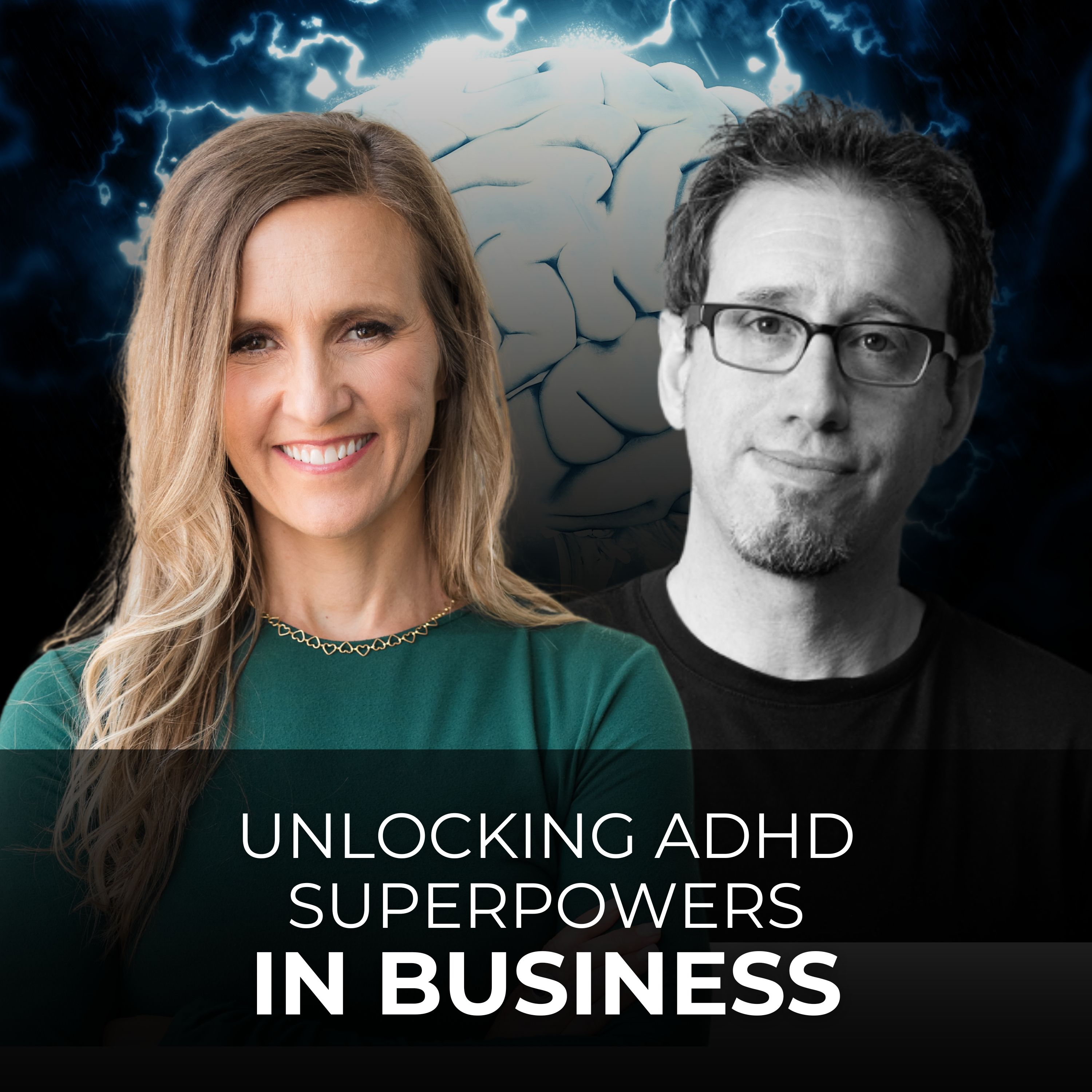
Hey everybody. Welcome to this episode of the Lindsay Anderson Show. I'm so excited for today's episode. Today's conversation is one I've been really looking forward to because so many entrepreneurs and small business owners really struggle with structure. They really like the shiny object syndrome, they really like being the visionary, but yet they struggle with one of the most important pieces of business, which is having a strategy set, sticking with a strategy, being iterative, tracking those numbers and some of those more mundane things that come with running a really successful business. And when you find out that a huge majority of entrepreneurs actually have ADHD and we can use that in our business to say, how does my brain work and how can I use that for my advantage? How can I be present here? How can I be conscious of how my brain works and use it for my advantage? Well, it really changes everything. And Steve knows all about entrepreneurship, he knows all about adhd and today we're talking about just that. And listen here. If you've never even been diagnosed or considered that you have adhd, the strategies that Steve shares with us on today's episode are next level, whether or not you are neurodivergent. Before we hop into that episode, I want to extend an invite. If you are serious about turning your social media into a sales machine and getting your systems in order, make sure that you take me up on my offer to apply for a free strategy session by heading to lindsay a.com apply. I have a handful of calendar dates available to talk with me and receive a social media strategy session where we will outline how to actually create a system that will help you generate more leads online. Now let's hop into my interview with with Mr. Steve August.
- [01:57]
Are you ready for next level growth in your business? Welcome to the Lindsay Anderson show where we pull back the curtain on the exact strategies, tools and mindsets that build million dollar empires. If you're hungry for more time, more freedom and a whole lot more impact, you've come to the right place. Buckle up because we're about to ignite your business journey. Now here's Lindsay.
- [02:31]
This episode is brought to you by the BAM Agency. Done for you. Social media that actually drives results, not just likes, but high ticket sales. If you're ready to turn your content into a client generating machine, grab a free strategy session call by heading over to Lindsay a.com apply.
- [02:55]
A guest today is Mr. Steve August. He is a wildly successful entrepreneur, founder of Steve August Coaching and the creator of the Focus Formula system for ADHD entrepreneurs. He's taken companies from idea to Multimillion dollar exits, raised over a hundred million for clients, and now helps other B2B founders get out of overwhelm and into unstoppable momentum. All by understanding how their brains really work. Steve, welcome to the show. Can you kick us off by sharing your story and what led you to create this work?
- [03:28]
Steve August
Yeah. Oh, thanks for having me, Lindsay. And thanks for that great introduction. Yeah, I got here through going through most of my life not actually knowing how my brain works. So I went through the journey of becoming an entrepreneur. I took my first startup from Idea to Exit and worked for the company that acquired US. Became CMO of $100 million private equity backed company. Started my own coaching practice after I left that and grew that to multiple six figures. And all the while was on the outside experiencing some pretty solid success, but on the inside was experiencing it very differently. Like constant overwhelm, constant panicking, constant. Just feeling like I wasn't. Like there was more I was leaving on the table and I couldn't seem to figure out why. I kept repeating some of these patterns. And then a couple of years ago, I got to this point at age 54, I just noticed that it wasn't that I couldn't even finish an email. I couldn't finish the first sentence of an email without my brain going over to YouTube. And I was like, okay, I think we're past just the normal distractibility of the age that we live in. So I went to the doctor and was diagnosed with adhd. And as I learned about what it really means in terms of how your brain works, because it's more than just chasing squirrels all the time, there's a lot of nuance in it and a lot of ways that it expresses itself. That suddenly the patterns in both my entrepreneurial life and life in general started to make sense. And so as I started to think about how this had impacted me, even though I had successes, I was like, man, I worked so much harder to get there. And I think I left a lot on the table. And I started to think, well, how can I help others who may be in this situation to avoid some of the things that happened to me?
- [05:17]
Lindsay Anderson
And I have found, and I believe I got this quote from you. Is this right, Steve? Is that entrepreneurs are 500% more likely to have ADHD? Is that accurate?
- [05:25]
Steve August
According to some set of studies that ADHD is around 4 or 5% of the population. They think it's a little underdiagnosed. But right now, a lot of studies show if you take entrepreneurs, just take them alone, it's more like 25 to 30%. So that's the delta between general pop and entrepreneur population.
- [05:45]
Lindsay Anderson
So what is it about entrepreneurship and small business ownership that draws ADHD individuals to wanting to do that?
- [05:53]
Steve August
Yeah, when you really understand what ADHD is and how it works, it makes all the sense in the world. So ADHD may be one of the worst names disorders ever because Attention deficit hyperactivity disorder. But the thing is, ADHD brains don't have a deficit of attention. We have a surplus of attention. We're paying attention to everything all the time. The challenge is where do we direct the attention and how can we direct it and stay focused on the right things. So the reason that ADHD brains seem to gravitate towards entrepreneurial pursuits is twofold. One, the routine of a cubicle or a corporate day to day is going to feel very stifling. And because we're interest driven and dopamine driven, it's really hard to stay engaged in that environment. On the other hand, in an entrepreneurship, especially in the startup phase, it's all about learning about a lot of stuff, connecting all these dots, creating new things, learning new things constantly. It's constant novelty, it's constant dopamine hits. And on that level it makes a lot of sense because that's what sparks innovation, it's what sparks new companies to come into existence.
- [06:59]
Lindsay Anderson
Yeah, and then I see it a lot over here is like the constant changing the new ideas. I love new ideas and I'm more fixed on this idea and once it becomes an old idea then I'm not as excited about it anymore. And I find that really holds people back from building their business, from generating sales, from sticking with a marketing campaign. Can you speak to that?
- [07:18]
Steve August
Absolutely. I mean, this was one of the biggest things that has held me back and ended up holding my startup back from having a better outcome. And that is, look, businesses get started with that spark of brilliance and that kind of like innovation out of the box kind of creative thinking. But where they grow and scale is this kind of iterative, methodical, very like almost repetitive, coming back to the same thing and doing it a little better, doing it a little better over time. And that starts to compound and all of a sudden now you've got that growth for both marketing and sales. It takes that you're going to put stuff out there, you're going to pitch. It might not work the first few times, but you have to keep coming back at it. Where an ADHD brain will be like, well, I got to throw out the whole thing and start with a new idea, because that's where my brain wants to go. And what you lose out on is that kind of compounding. And you also end up just constantly starting, and you don't get to the scale phase, because everything's just always a start.
- [08:17]
Lindsay Anderson
So. Well, we're going to talk about the solution, but it's impressive that without that diagnosis that you were able to have so much success. How were you able to have so much success if you didn't really understand what was happening for you?
- [08:29]
Steve August
I was able to leverage the brilliance and muddle through and work through. So what happens is, and this, I think, is something I probably don't have the energy at 50 that I did in my 30s and 40s is you just plow through, right? Yeah, you work harder, but you have that spare energy. It might not be efficient, but you get through it. But there's a cost to doing it energetically. There's a cost to doing it in terms of potential burnout. So it's a matter. If you can do it with that awareness, then you can create the strategy so that you can be ready for when things get less interesting, for instance. And that's actually where the growth happens. So that's one of my mottos, is make the important interesting, because.
- [09:14]
Lindsay Anderson
Make the important interesting. Can you give us a solid example on that?
- [09:18]
Steve August
Yeah. Right now I have a quiz called are you an ADHD entrepreneur Quiz? And it'll give you a sense of where you stand in terms of adult ADHD and in terms of what I term entrepreneurial, the entrepreneurial experience of adhd. And so I did my first version of that a few months ago, and I know it was version one. I know it was an mvp and coming back to it and iterating on it and looking at everything and saying, okay, where can this be better? What's the experience? What's the journey I want to take people through? There was a lot of resistance in my ADHD brain because it wasn't new anymore and it was done, but it's not where it needed to be. So what I ended up doing was saying, okay, let's figure out where we can add some novelty in here. Where can we find that spark? It's really important to do this a second time because I have leads coming in, but I know they could be converting better to the next step into the course that I offer. And so I build in. Okay, is there an opportunity to learn a new tool and apply it? So can use ChatGPT? I can use something that a New art tool or a new video tool. Is there another way I can make this more creative and more visual? And so instead of thinking about it as I just go back and rewrite these things, where's the opportunity to make it more interesting? If I make it interesting, I can make it interesting for other people as well.
- [10:41]
Lindsay Anderson
And call out to a good old chatgpt for helping us out on that a lot, you know.
- [10:47]
Steve August
Absolutely. It's become indispensable recently.
- [10:50]
Lindsay Anderson
If your content isn't generating sales, it's broken at the bamagency. We fix it. We build intentional systems that bring in consistent leads, convert DMs and grow your business, all without the overwhelm. Want to see how it would work for you and your business? Book your free strategy session now by heading over to Lindsay a.com apply.
- [11:20]
Okay, so yeah, but check can you give us I know you're not a doctor and warning everyone should go visit their doctor. All the things what is just like a quick checklist. If I haven't even considered, like I thought I was just an excited entrepreneur. What is just like a little checklist. I could go through that maybe I should start thinking about this ADHD thing so I can use it for my benefit instead of for my detriment in business.
- [11:42]
Steve August
Yeah, so that's a great question. And again, I'm not a medical professional, but here's where I've seen it show up. In the conversations I've had in my experiences with ADHD entrepreneurs. I hear things like, every day's a battle. Every day's a battle not to come up with the ideas, but just to initiate tasks and to start. Right. Just to get started. Decision paralysis is I hear things like by the time I've decided what I really should be doing, half the day's gone. Right. Because it's so hard. ADHD brings are really, it's a deficit of executive function. And executive function enables us to prioritize, organize, task, initiate, reduce impulses. And so if we have less executive function to work with, we're going to encounter some of these things. So another thing that I hear a lot is I get it to about 60 to 80% done and then it's dead to me. Like I can't get it that last bit. And I know that last bit is where I actually get to push, send or post or get the reward. And that's the one of the challenges with ADHD brains. All the reward is interest based. It's not necessarily outcome based. So whatever you're interested in right now is where the reward is and the long term outcome is less of a pull because it's just too far away. And so if you start seeing these patterns over and over again, then it might be something to think about because it's not just squirrel chasing and distractibility. There's certainly play into it. But it's that intensity of not being able to necessarily complete, start, complete, or decide. And so that's. What is that?
- [13:17]
Lindsay Anderson
Is that the strong definition here is being unable to start, complete or decide.
- [13:22]
Steve August
That's where I see it. Where I've said it's deciding. Yeah. In this realm it's not. You go through an assessment to really determine if you're in the ballpark of ADHD or if you're. And it's a spectrum disorder. So you can have everything really intensely or not as intensely, or you can have individual expressions of it. And so there's things like time blindness, rejection, sensitivity, the working memory deficit. So just the things that help us organize and do. And so what I've seen is, and the way I kind of organize my training is there's three components that really get in the way of sales and growth, and that is figuring out what the right thing is to do and deciding to do it, actually doing it, and then sustaining it over time.
- [14:07]
Lindsay Anderson
That's great. Yeah. Is that. And that's what you teach people. And that's how we can overcome what's happening in our brain.
- [14:13]
Steve August
Yep. Decide, do and sustain.
- [14:15]
Lindsay Anderson
Decide, do and sustain. Okay, so we've picked on, quote, unquote, the ADHD entrepreneurs a little bit today. I know that there are some really amazing things that ADHD can bring entrepreneurs. What are some of those benefits of actually being an ADHD entrepreneur?
- [14:31]
Steve August
Well, there's no problem you can't solve. Yeah, right. Because your brain's always paying attention to everything and gathering everything in. There's always something. There's always something that new you're learning and craving that you can then blend in. That's the brilliance of it. Right. You almost need that ability to look across lots of different things and be able to make connections. And that's what gives that superpower of ideating, thinking out of the box, creating. We get so wrapped up in our interests that we're able to evangelize to other people and make the vision real to other people. And so being able to bring people along, whether it's a customer on a sales call, whether it's a potential team member, that is a superpower.
- [15:13]
Lindsay Anderson
I love it. Now we just need to take that superpower and be able to actually use it for our benefit. So you have a formula called the Focus formula that you share with people. Can you walk us through that?
- [15:23]
Steve August
Yeah. So the Focus formula is a training course I have. It's the first thing when people start working with me. We go through that either if they're working with me one on one as a coach or in my ADHD entrepreneur accelerator program. So the focus formula basically breaks down and says, okay, here's how an ADHD brain works. Here's we talked about executive function issues. Here's where you're gonna get stuck. You're gonna get stuck deciding. You're gonna get stuck doing and starting, and you're gonna get stuck probably sustaining. Right. Because things get less. And so each section takes that on. So for deciding, one of the things we talked about is it's so important to have a magnetic north. What's your vision? What's your mission? And because without that, if we're not reconnecting with that every day due to our short working memory, things are hard to decide because we've lost touch with why we're doing it in the first place. And everything is cool, everything is interesting. So we have to.
- [16:15]
Lindsay Anderson
And so is that something like you write a statement and it is always in front of your face and it's like you're just reminding yourself. Is that how serious you're taking that?
- [16:23]
Steve August
Oh, yeah. Because out of sight, out of mind, that's what working memory deficit represents. So the more we can stay connected with. That's why I call it a magnetic north. It needs to be able to pull you because there are going to be lots of shiny objects and side quests and things that are going to be there to pull you off the track. And they all look good and they're all super interesting and they're all new. So we need something that can.
- [16:46]
Lindsay Anderson
And you're. And you're indestructible and can do anything. So I'm going to go ahead and do it.
- [16:50]
Steve August
Yeah, exactly. And you don't have a sense of time. Like, time blindness is a thing. So you've already underestimated by a factor of 10 what you've put on your plate. And so that's part of what we work on, is like ADHD brains get easily overwhelmed because it's always flooding in new ideas and options. And so in order to, like, parse out those options and to kind of manage that flood of ideas, we need to have things that we can anchor to. And that's what the magnetic north is.
- [17:19]
Lindsay Anderson
Can you give us one more example. I know you can't go over your whole focus formula here, but can you give us one more example of what we could do and implement today that would help us?
- [17:28]
Steve August
Yeah. So one of the other really powerful concepts in the focus formula is the two hour workday. So when we think about our days, we think a lot about how much can we get done. But with an ADHD brain, the better question is often how do I best manage and work with my brain? And I know like for me personally, I have like two really peak hours of executive function, right. And after that I may get stuff done. It may be a great day, it may not be as good day, but I know it's going to decline after that. So what I think is, and what I teach is like, okay, if we only have two hours to give our best shot at during the day, what gets that attention. And ideally it's the most impactful things that we can possibly do for our business. Right. So it's a way to prioritize and then also organize. So actually we have a little dashboard where people can actually organize. This is two hour workday stuff and then everything else. So it's not like super too structured because that demands too much cognitive energy.
- [18:28]
Lindsay Anderson
Right, Right.
- [18:29]
Steve August
So we're not doing really fine time blocking. We're just saying, okay, what goes in here in this two hour was so important that it deserves to be in there and what's everything else? And that has a huge impact on what you choose. And also it creates hard limits on what you can throw into your day and your week.
- [18:47]
Lindsay Anderson
That makes sense. Can you share with us an example of a client of yours that like maybe a little before and after peak here?
- [18:54]
Steve August
Yeah. I just got off a quarterly check in call with one of my accelerator members and I gave you two stories. This member started and he had a lot of ideas, but they weren't structured. So in the accelerator we help people with both the focus formula, the ADHD level stuff so they can get out of overwhelm, figure out their next blocks, figure out their magnetic north and go forward. And then we help them with the business stuff. Like what's their 10x customer? Who's their, who's our 10x? Who's the customer that's gonna, they're gonna build their business on what are the offers they need to be and how are they gonna get people to them. And so between when he started in December and where he is now, he's got a great pipeline. He had no pipeline. He had a hodgepodge of ideas. He didn't know who his target customer was. And now he's got a pipeline, he's got clients coming in and he said to me, I'm doing a newsletter and guess what, I'm gonna have it done ahead of time. And it was like mind blowing. And then just one of those along.
- [19:49]
Lindsay Anderson
Those lines, like they're gonna have a hard time niching down like you do the 10x client, they're gonna have a hard time picking one.
- [19:56]
Steve August
Exactly.
- [19:57]
Lindsay Anderson
Yeah. So watch out for that.
- [19:58]
Steve August
Yes. And that's what we work on. And then just recently we had somebody with a Focus formula take it us the online course and we also it comes with a co working community. So body doubling is where you show up with somebody else, tell em what you're gonna do and you guys just work in parallel. And it's magic for actually breaking through, just starting and getting out of procrastination. And this guy said within three days of taking the Focus formula and starting to do the coworking, he's like the experience totally. His experience totally changed. He felt like he could start counting on being able to start. He was getting stuff done. And one of the things that's challenging about ADHD is if you've been working with it for a long time, especially if you're late, diagnosed or undiagnosed, but you're experiencing it, you start to kind of lose trust in yourself because you know you can't count on yourself to get anything done until the deadline is really on you. And then it's going to be super stressful and you're not going to feel the wind, you're just going to feel relief right until the next cycle. And so being able to help folks get out of that cycle, to be able to trust themselves again, to be able to like, hey, I can count on me being able to even if it's only two hours a day, like I know I'm gonna get stuff done and I know I'm gonna be able to go into my weekend and be able to have a weekend and not feel like I've gotta make up for everything I didn't do. And to me those are the biggest wins.
- [21:23]
Lindsay Anderson
Huge, huge wins. I love that. Now we hinted on this before, AI is changing absolutely everything. I'm curious if you can shed some light on how AI and tools like ChatGPT are helping entrepreneurs, especially with ADHD.
- [21:38]
Steve August
Yeah, I was. It's been a godsend. So if you think about it through the lens, it's like I think of everything the lens machine now. So if I've got a deficit of executive function, there are certain things that are going to be really challenging for me. One is like, I'm going to look at a task and not be able to break it down. Like, I'll say, I'm going to redo my website this afternoon. That's actually a pretty big project. It's not going to happen in an afternoon. You might be able to plan it in the afternoon, but you're not gonna get there, maybe. And so asking ChatGPT or Goblin Tools MagicTodo to say, Here's a project, break it down, estimate it for me. And now all of a sudden, I've got, oh, wow, this is a much bigger project than I thought. And now I can have. At least I'm not gonna surprise myself and overwhelm myself by giving myself six of those projects in a week. Right. So that's one just kind of like helping that kind of planning and just. And kind of the time blindness and the kind of project blindness. And then the other parts that I think are really important is you think again about executive function. There's little places where executive function gets drawn down during the day that costs you a lot, but doesn't get you much. So it might be just a little email that you need to write to respond to somebody. And it's not a hard email, but for whatever reason, your brain can't get itself around it asking ChatGPT, here's what I want to get across in this sort of tone of voice. Can you take a crack at this? And it at least breaks through that barrier? And you say, okay, that's good. Close enough I can edit it or tweak it. And the other side for me is, as I do a lot of writing, is I'm really good at coming up with the ideas. I'm really crap at editing and proofreading. Ah. And so my cycle is I will write, I will blurt out stuff and get it this kind of interesting but messy and unconscise pile of language. And I will give it to ChatGPT and say, help me work with this. And over time, since I've used the same model, over time it's starting to really know me. And that's really where it's starting to get interesting, is like it starts on its own referrals.
- [23:43]
Lindsay Anderson
It's crazy.
- [23:44]
Steve August
Yeah. It refers to stuff that I had forgotten about that we had done four months ago or five months ago. Like, this is getting really, really interesting.
- [23:54]
Lindsay Anderson
Yes. Yeah, I agree. I agree. Well, Steve, it's been awesome. Thank you so much for sharing knowledge and your expertise here on the show. I'm curious for my final question here. What is a mindset shift that you would like to leave our listeners with, those who maybe are really resonating with your message and are struggling here? What's your final message here?
- [24:13]
Steve August
My biggest message is that the success as an ADHD entrepreneur comes down to working with your brain, understanding and working with your brain. And that's because anything as a founder or entrepreneur that you're experiencing gets expressed through your business, Right? And however you are, your business is going to be. And so if you're aware of how your brain works, if you're aware of and understand how to work with it and not against it, you're going to be able to take your business to the best possible heights.
- [24:46]
Lindsay Anderson
I agree. How you are is how your business is going to be. I think that is a great quote. I just had to double underline that. Okay, Steve, thank you for your time. I'm going to turn the time over to you. Let us know how to find you and anything else you want the audience to know.
- [24:58]
Steve August
Yeah, you bet. Well, you can find me at steveaugascoaching.com you can find me LinkedIn. I have a newsletter called ADHD Entrepreneurs. We just crossed 800 subscribers this week, which is pretty cool. And you can find me at my email@steveaugustcoaching.com awesome.
- [25:16]
Lindsay Anderson
Thank you, Steve, for coming on the show.
- [25:18]
Steve August
All right, great to be with you, Lindsay. Thanks for having me.
- [25:22]
Lindsay Anderson
There you have it, another awesome episode of the Lindsay Anderson Show. Thank you so much for joining me. Now, if your brain is buzzing right now in the best way, you are not alone. Steve reminded us that ADHD is not a flaw. It is actually something you can be aware of and use for your benefit. It's a different operating system than most people are operating with. And when you learn how to work with your brain instead of against it, you can unlock focus, clarity and momentum in your business like never before. And whether or not you're neurodivergent or not, the truth is you don't need to do more and chase the shiny objects. And you need better systems. You need support and you need a strategy that actually works for how you work. A big thank you to Steve for coming and sharing his expertise. Now, if you love this episode, make sure you subscribe and leave us a review. It helps us reach more visionary leaders just like you. And if you're ready for social media to actually start working for you. Create a system that actually works ADHD or not. If you're overwhelmed with social media, I invite you to apply for a free strategy session by heading to lindsay a.com apply. That will be a strategy session with me where we can look at what you're doing on social media and create a system how to actually generate more high quality clients from social media. Thank you so much to Steve for sharing your story, your focus, frameworks and your heart. Now. Thank you so much for joining me for the Lindsay Anderson Show. Cheers to you and your success.
- [27:03]
That's a wrap for today's episode of the Lindsay Anderson Show. If you loved this episode, don't forget to subscribe, leave a review and share how you're leveling up your business. Want more? Connect with Lindsay Anderson and get the tools you need to crush your goals@lindsaya.com until next time, keep pushing, keep growing and turn those business dreams into reality.
- [27:33]
Thank you for tuning in. If you got value from this episode, share it with a friend and hit subscribe. And if you're ready to stop posting and praying and actually generate revenue, let's talk. Book your free strategy session by going to Lindsaya.com apply.