← The Long Game with Jake Sullivan and Jon Finer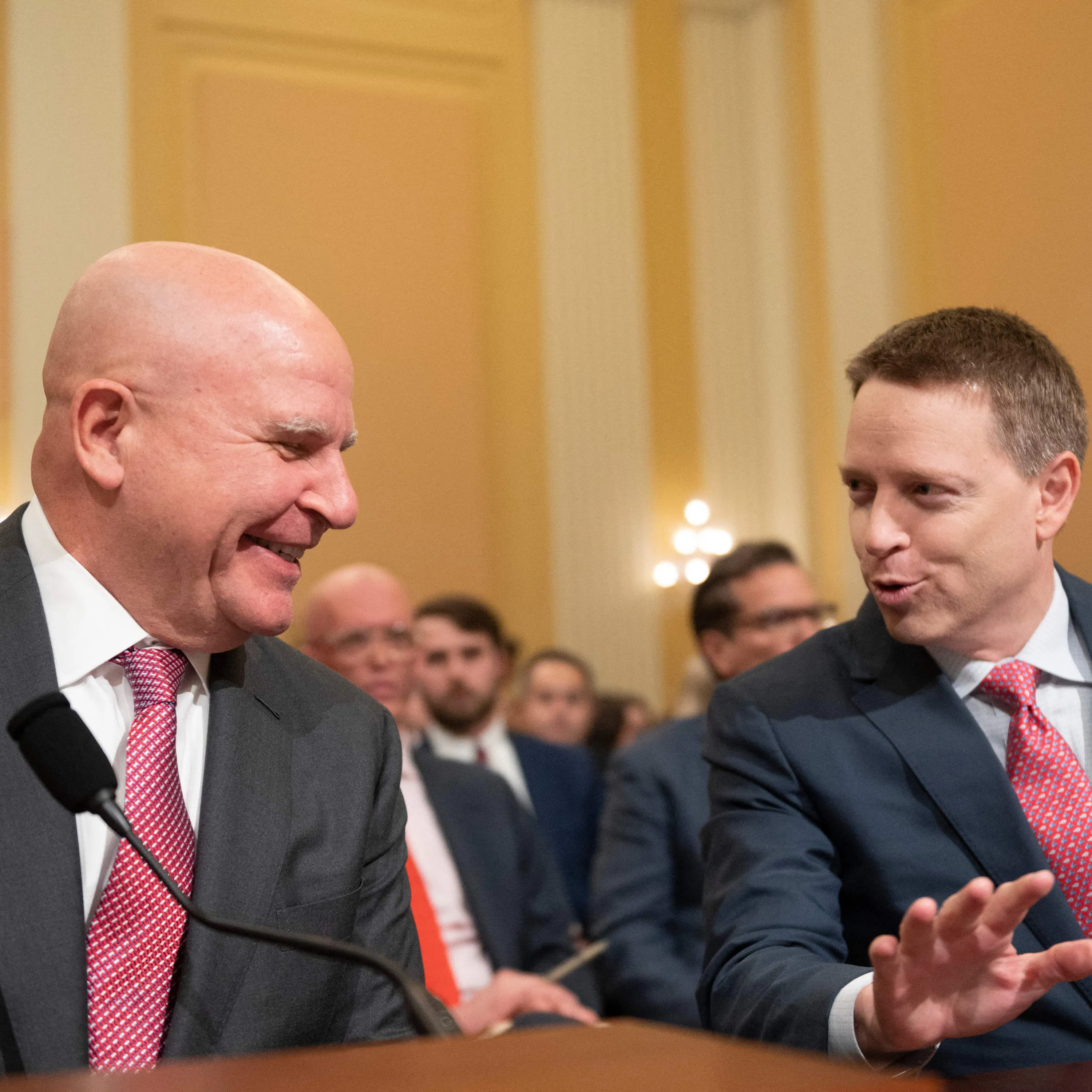
The Long Game with Jake Sullivan and Jon Finer
Debating the War in Iran and U.S. Strategy (w/H.R. McMaster and Matt Pottinger)
01:18:25
Loading summary
Transcript139 lines
- [00:02]
H.R. McMaster
Does anyone really know what goes on behind closed doors at the Supreme Court?
- [00:05]
Matt Pottinger
Four years ago, I got a tip about the court and I was not
- [00:09]
John Finer
in the market to cover it whatsoever.
- [00:12]
H.R. McMaster
But this tip was about a secret
- [00:14]
John Finer
influence campaign that had been carried out inside the court.
- [00:17]
Matt Pottinger
As you know, the very idea of that is outrageous.
- [00:20]
H.R. McMaster
I'm Preet Bharara, and this week New York Times investigative journalist Jodi Kantor joins me to discuss her expose on the court's shadow docket. The episode is out now. Search and follow. Stay tuned with Preet. Wherever you get your podcasts, we should pay particular attention to the emotions, the aspirations and the ideology that drive and constrain the other. In this case, if you consider the Iranian regime, I believe that what drives and constrains them is the emotion of fear. You know, fear of losing their grip on power.
- [00:53]
Matt Pottinger
It's ironic that President Trump, having really been the first who pioneered some of these strategies to keep advanced semiconductors out of China's hands, is now rethinking that. I hope that someone will explain to him besides industrialists who are trying to sell chips. I hope someone with a national security background will explain to him the consequences if he goes that route.
- [01:18]
Jake Sullivan
Welcome back to the Long Game. I'm Jake Sullivan.
- [01:21]
John Finer
And I'm John Finer. This is a special episode of the Long Game. We may say that every week, but this time we really mean it for a few reasons. For one thing, it's the first time we've had not just one guest, but two. But more importantly, we've been looking forward to this one because these are two guests who have walked a mile or more in our shoes. And we're grateful to be joined by HR McMaster and Matt Pottinger, who served under President Trump in his first term as his national security advisor and deputy national security Advisor, respectively. They therefore, as few others do, the incredible privilege and, truth be told, the irritations, indignities, and other more challenging aspects of the jobs that Jake and I held under President Biden. We want to stipulate upfront that while we've had our differences over various Trump administration policies, and obviously both HR And Matt have been strong critics of administrations we've worked in. Speaking for, Jake and me, these are two people whose service and professionalism we deeply respect, both in their most recent government jobs and long before. And so by way of introduction, former National Security Advisor H.R. mcMaster is a retired army lieutenant general with a decorated military career that includes combat tours in the first Gulf War and the wars in Afghanistan and Iraq, where I Actually got to spend three weeks with a unit he commanded in a city called talofer Back in 2005, when I was a journalist. He's the author of several acclaimed books, including Dereliction of Duty, about the failures of the Joint Staff during Vietnam, which was based on his doctoral dissertation. He's currently a senior fellow at Stanford's Hoover Institution. But perhaps most important and impressive of all of these achievements, he is a co host of not just one, but two podcasts. Former Deputy National Security Advisor Matt Pottinger is a fluent Mandarin speaker who began his career as an award winning reporter in China and throughout Asia for the Wall Street Journal, where we actually set about 10 desks apart way back when for a year in Hong Kong. Outraged by terrorist violence at the height of the Iraq War and by the PRC repression he covered as a journalist, Matt joined the Marines in 2005, Serv intelligence officer in Afghanistan, and he's now the CEO of Garno Global, an advisory firm. He also spends a lot of his time in Utah, which makes Jake and me jealous each ski season. HR Matt, welcome to the long game.
- [03:41]
H.R. McMaster
Hey, great to be with you, John and Jake and my old buddy Matt. I mean, it's a privilege to be with you guys.
- [03:46]
Matt Pottinger
Yeah, thanks for having us. Looking forward to it.
- [03:49]
Jake Sullivan
So I think we should get the most contentious question out of the way right off the bat so we can then move on to all the easier stuff. Which one of you two had the harder White House job?
- [04:00]
H.R. McMaster
Hey, Matt, for sure. Matt went for almost the whole duration. You know, I'm just one of the many. One of the many Trump national supervisors.
- [04:08]
Matt Pottinger
Well, I had the COVID year, which was, you know, that left a mark. You know, I've got scars from that year sitting in the west wing, you know. HR you were there for the first 15 months of the administration. I think that was the hardest period, in my view, just because everything was so unsettled. You had a lot of people competing for different, basically to assert different policies. I think you did an amazing job of presenting options to the President and carrying out his decisions when he made them, and also compiling strategies that ended up serving for the duration of the first Trump term. And even, at least with respect to some of the China campaign plans, I think some of that even carried over into early Biden years. So HR had the tougher job.
- [05:11]
H.R. McMaster
I mean, it's the people you're working with. And Matt, man, what a privilege to work with you, man. I mean, you did a fantastic job.
- [05:16]
Jake Sullivan
Well, you guys are much more friendly to each other than John and I are to each other. So maybe we could learn a thing or two from you. I don't know. We had a bit more of the hostile work environment thing going on. At least that was the reign of terror I tried to implement as national advisor.
- [05:30]
John Finer
The crucible. The crucible.
- [05:31]
Jake Sullivan
But you know, it's interesting. I'm on record, unfortunately, probably because John reminds me of it frequently as saying that I printed it out.
- [05:40]
John Finer
Yeah.
- [05:40]
Jake Sullivan
The Deputy National Security Advisor job, the PdnSA job is the hardest job in government. Having to really sit in the engine room of the Deputies Committee and wrangle these policies and then serve them up to principles and beyond. That was my experience. So, hr, I think you got, you and I, yeah, we had a lot on our shoulders, but nothing quite compared to these two guys when they were in those deputy roles.
- [06:06]
John Finer
I assume you guys probably felt, as we did, that NSC was a pretty special place in the US Government. Sort of an all star team from across the entire enterprise. We had people on our team who worked under you and your counterparts from Trump 1, just as you inherited some people from the Obama team. It seems to work less that way, candidly than it once did. And I'm wondering if you feel like something is lost in the process where there isn't as much of that carryover, particularly of the career officials from one administration to the next.
- [06:40]
H.R. McMaster
Well, as you guys know, the National Security Council staff is used in different ways by different presidents based on their preferences, based on their styles. There have been dramatic changes in the past, for example, between the Eisenhower and the Kennedy administrations, for example, with a more formal and then a less formal decision making process. And, you know, President Trump was unique in that. He just came, he's a real estate guy that came into office, you know, and so, you know, he received information differently. He had expected different, I think, things from the National Security Council staff. But I think what's most important, whether no matter what the administration is and how they use the National Security Advisor and the National Security Council staff, is to understand the importance of that staff, John, that you're, I think you're getting to, which is really, it's important because you're the body that can coordinate and integrate efforts across the departments and agencies to get the President best analysis. And then I think what every president deserves is multiple options for presidential decision making. Because, hey, you know, the President's the person who got elected, so the President should make that decision. You know, you were kind to mention my book Dereliction of Duty when I studied how and why Vietnam became an American war. I saw grave deficiencies in the way McGeorge Bundy ran the national security decision making process. They didn't take enough time thinking about the nature of the challenges that they were facing. The challenge of Vietnam in particular. They didn't set clear goals and objectives. They didn't identify the assumptions on which their planning was based. And they provided President Johnson with a shiny option that he preferred because Johnson really was prioritizing his domestic political priorities and saw Vietnam principally as a danger to those. So, hey, it's super important. And I'll ask, you know, Matt, turn over to Matt. But I do think President Trump, and Trump too, somebody convinced him that his, that his own staff was the deep state. And so he's taken kind of the cleaver, you know, to the National Security Council staff. And I think with some of the inconsistencies you see with the administration and its communications, for example, of its policies and decisions and objectives, I think that's a symptom of not having that staff and not having that coordination and integration function. Matt, what are your thoughts on that question?
- [08:57]
Matt Pottinger
Yeah, well, the NSC has two superpowers, right? One is that it's the only agency, if you want to call it that, it's the President's direct staff, but it's the only part of the government that has the mandate and the tradition and the President's authority to convene the whole government to make policy. Right. Other agencies have tried that. State Department every now and then tries to refashion itself as the new nsc, that it will convene all the departments and agencies. That's never worked out well. And it's always been transient, those periods. Just ask Al Haig. Right? So, but the other is proximity to the President. That's the other superpower. The National Security Advisor and his deputy are just down the hall from the Oval Office. They have their staff right across West Exec Avenue in the Old Executive Office Building, the Eisenhower Building. And so run properly, the NSC is the President's eyes and ears and also his peripheral vision on what the consequences of various policies will be. And so, yeah, right now the NSC is tiny, right? Where Jake and John, where did you guys max out with policy staff? Not including people running the situation Room and so forth. But what was your policy staff number?
- [10:25]
Jake Sullivan
We ended up getting pretty big. Close to 200, actually, by the time that we left.
- [10:30]
Matt Pottinger
Okay, so now it's three dozen. Okay, right.
- [10:34]
H.R. McMaster
We were down to like 110, I think, weren't we, Matt, or what were 85. 85 at one point, I think we got down to.
- [10:40]
Matt Pottinger
But by the time Robert o' Brien finished the first Trump term as National Security Advisor and I was his deputy, I think we were at 108 policy staff, which I actually thought was a very good number. I was nervous about shrinking to that level, but I actually thought it ran pretty well because you didn't have territorial disputes within the nsc. Everybody had more work, just a little more work than they could handle, but they were also empowered. We were able to delegate to those people, those senior directors who we trusted and who were doing good service for the president. When you've got 36 people, that basically means that things are not being surfaced to the President. Everything is led from the president down. Now, look, the president has a constitutional prerogative to make foreign policy. If that's how he wants to make policy, that's his decision. But what it means is he's gonna have less peripheral vision about some of the consequences. It also means it's harder to do some of the really technically difficult strategy. I thought that one of the things that. That you did extremely well in the Biden administration was the technological competition with Beijing and with other axis powers, making sure that the United States didn't just have a relative advantage, but had an absolute advantage that could increase over time in things like AI computing power and the like. That's impossible to do those kinds of policies straight from the Oval Office just because of the sheer complexity and just the amount of time. I mean, it took you guys a couple of years to get the first iteration of that policy done. So that's one of the costs of having such a small staff.
- [12:34]
Jake Sullivan
Hr, I was going to ask you. You made a comment in talking about dereliction of duty and the process of decision making leading into Vietnam, that stood out to me. You said that the national security adviser, McGeorge Bundy, and the people around him served up to the President a shiny option, I think was the phrase you used. We sometimes on this podcast do a segment called the Options Memo where we try to walk through what it's like sitting in the NSC to try to serve up to the president options, credible options that he or she could select from among. Can you talk for a minute about what you meant by shiny option in that case, and how you guys think about this idea of the Options Memo or the options presentation? What makes for a good delineation of options to a president? What are the risks and pitfalls of serving up options that kind of put the President down a bad course.
- [13:31]
H.R. McMaster
Well, you know, I do think, as we've been discussing, one of the functions of national security advisor, because you're the only person in the national security establishment who has the President as his or her only client, is to be the guardian of the President's independence of judgment. And so a way to do that is to insist on multiple options. But it begins, and it began with this process we put into place with problem framing, applying design thinking to the most significant challenges and opportunities we're facing internationally. So on that first day on the job, I took out a legal pad and just wrote down what I thought were the top 15 challenges to national security. And then what we did is we started with a principal small group framing session. That's a mouthful. But what it was meant to do is convene the principals around a framing paper, five pages only, that then outlined the nature of the challenge we're facing, the vital interests that are at stake. Hey, what's the. So what, the goal and objectives, the assumptions on which a planning effort would be based and then listing out the obstacles to progress that impede us from getting to those goals and objectives and maybe the opportunities, what we saw as opportunities. Then the memo ended and we convened the principals and the first part of our discussion in the situation room was, hey, you can't talk about what we're going to do. Do we have the framing right first? Do we have the framing right then? Then after that discussion we said, okay, hey, now what are your ideas about how we can, you know, integrate all elements of national power and efforts of like minded partners to overcome the obstacles, take advantage of the opportunities and then you get top down guidance instead of bottom up processes that I think are then prone to satisficing behavior, lowest common denominator, protection of institutional prerogatives, you know. And so this became the document that then drove the development of the options which, to get to your question, are differentiated by resource level, you know, by risk, you know, maybe. And they have to be distinguishable from one another, you know, so that the President can really, what the benefit is, is in the comparison of those options. If you have that framing done, you can say, oh, how effective do you think this strategy would be at achieving those objectives? What are the risks associated with it? You know, what are the resources that are available? And then the President can think about those trade offs and make hopefully the best available decision. Right. And as you know, there aren't that many, like really easy, great, great options. A lot of times you're looking at a kind of a least bad option, you know, and a situation that's relatively intractable, you know, or, or a long term problem that you have to kind of mitigate over time.
- [16:21]
Jake Sullivan
John and I joke sometimes that frequently the Pentagon's favored method of doing options was do nothing, do nuclear war, or do the thing we want to do and sending that over.
- [16:32]
H.R. McMaster
That's, that's what Kissinger said. Remember Kissinger said there are three options, you know, capitulation, nuclear war, and the option you want.
- [16:51]
Matt Pottinger
I'm Mitch, first two time IndigoCell champion,
- [16:54]
Jake Sullivan
championship MVP and forward for the US Women's National Team. Before I went pro, I graduated from Harvard with a degree in psychology, which comes in handy more than you think.
- [17:03]
Matt Pottinger
Any athlete pursuing greatness knows there's a
- [17:06]
Jake Sullivan
certain mentality you have to have.
- [17:08]
Matt Pottinger
What people don't know is what that costs. In my podcast, Confessions of an Elite Athlete, I sit down with the best
- [17:15]
Jake Sullivan
athletes in the world and explore the
- [17:17]
Matt Pottinger
psychology, mindset and unseen battles on the path to greatness. So take a seat and learn from
- [17:23]
Jake Sullivan
the Confessions of an elite athlete on YouTube or wherever you get your podcasts. So we are 250 years into this American experiment and I'd say it's going okay, I give us like a C plus. There is no perfect past, but there is also no exclusively negative past because
- [17:53]
Matt Pottinger
humans are gonna human.
- [17:55]
Jake Sullivan
That's what we do. I think the story of Americ is the struggle of people who have not been included in the promise of America to expand those principles to include more people. What's gonna determine the next 250 years of America?
- [18:10]
Matt Pottinger
And how do we write a new
- [18:11]
Jake Sullivan
social contract that can give us the democracy we deserve?
- [18:15]
Matt Pottinger
Okay, so I'm just gonna be a
- [18:16]
Jake Sullivan
jerk here because I'm a historian. So we have to have a prologue explaining, you know, we the people. Okay. You know, I do still remember it from Schoolhouse Rock.
- [18:26]
H.R. McMaster
We the people anointed the former perfect union, establish justice.
- [18:30]
Jake Sullivan
What is it? Ensure domestic tranquility.
- [18:33]
Matt Pottinger
So you're talking about a foundational document.
- [18:35]
Jake Sullivan
So I'm building a document that will protect American democracy.
- [18:40]
Matt Pottinger
That's this Week on America.
- [18:41]
Jake Sullivan
Actually,
- [18:49]
John Finer
If you guys are willing, we'd love to dive into some of the policy issues that are facing the country facing the administration could talk about this stuff related to process and the NSC all day. But maybe we should start with the biggest news story in the world right now, which is the war in Iran. In the perhaps unlikely event that you get a phone call summoning you Back to the Oval Office to talk to the president about what you are seeing. Maybe just starting with one big question. How is this war going from the perspective of somebody who is not sitting in the administration right now? And he wants your unvarnished take, what would you say to him at this point in the conflict?
- [19:27]
H.R. McMaster
Well, hey Matt, I'm gonna turn over to you quickly here, but I would say the same thing that we said to President Trump as we were framing his Iran strategy in 2017, a strategy that he announced in a speech that he gave in, I think September or October of 2017 in the diplomatic room, which is worth reading actually. And the fundamental assumption that underpinned that strategy was, was that there will not be peace in the Middle east, there will not be peace with Iran, There will not be security for the Iranian people or any of the peoples in the region who they have inflicted so much pain and suffering on, including us and our troops in the region, but also their Arab neighbors, Israel, Lebanon. I mean, until there is a fundamental change in the nature of the Iranian government such that it ceases its permanent hostility to the Great Satan us, the cancerous boils, they refer to Israel and their Arab neighbors in the west broadly. So that would be the main element of advice. And so associated with that would be, I think it's very important to sustain the pressure on the regime, whether this morphs into economic pressure more than military or whether it's military pressure again. But I don't think that we can really accomplish the objective we set out to accomplish. That was announced in the very beginning to prevent Iran from projecting power outside its borders until there is a change in the nature of that regime, and certainly a regime that's murdered 40,000 of its own people in a 48 hour period in January, there won't be security for the Iranian people until that as well. I mean, I'm thinking about the Churchill quotation about the Suez crisis. He said I would not have dared, but if I had dared, I would not have dared stop. And I think that's the danger at this moment, is that we'll stop.
- [21:13]
John Finer
You wrote earlier in this conflict. And Matt, then I'll love to hear your take on this as well, that the dictatorship in Tehran will not survive this campaign. I assume, although tell me if you disagree, that you don't think full regime change has occurred yet. The president sometimes suggests yes, sometimes suggests no. Do you still believe that that statement is true, that the regime will not survive this campaign? And if not, can this be a victory for the United States without that,
- [21:41]
H.R. McMaster
yeah, I think the regime has not changed fundamentally in terms of its hostility, as I mentioned, but it has changed in terms of the people. Right. There's been a great deal of upward mobility within the Iranian system. And I think that what is different is the cost that have been exacted on them in terms of their military capabilities, but also their ability to regenerate a lot of these weapons systems, whether it's petrochemical plants and missile manufacturing facilities and so forth. And what that does is open the door to a sustained campaign to prevent them from reconstituting some of these capabilities. And then the other question is, how can they survive economically? Who's gonna help rebuild Iran? Is China and Russia, Are they gonna invest in Iran? I mean, certainly we're not going to. So I think, you know, in the long term, the regime's done. They're finished. They murdered 40,000 of their own people. The Iranian people are ready for the change, in my view. So, of course, these regimes only have to be stronger than any organized opposition to survive. So this could be a lengthy transition, but I think they're finished.
- [22:43]
Matt Pottinger
John, President Trump is consistent with his predecessors in saying that Iran simply cannot be permitted to have a nuclear arsenal. That's number one. Number two, I think, tell me if you disagree with the premise that it's pretty clear that Iran has been pursuing a nuclear arsenal for decades now. Right. I mean, it's really been since 2006 that we've tried to achieve the dismantling of an enrichment capability that that has now produced highly enriched uranium that could be used to build a dozen bombs. Right. And I think it's also true that diplomacy on its own did not work. The JCPOA was ultimately a plan for delaying, but not forbidding Iran from having the tools that it would need to constitute a nuclear arsenal. So when President Trump went last summer during the so called 12 Day War, Operation Midnight Hammer bombing, the Fordo enrichment bunker, I think that that was exactly the right policy, especially having tried everything else over the course of various administrations. What we were really on course for, I think before Fordo, was a North Korea type outcome where we would give incentives, give relief to the North Koreans in the hope for delay, delay, delay, but ultimately we end up with a North Korean regime that has dozens of nuclear weapons. That approach didn't work. I think we were on course for a similar ultimate outcome. We were only delaying the inevitable. But the difference, and here's where I think President Trump has also been correct, is that Iran, in Iran armed with nuclear weapons would not be India or even Pakistan. This is a regime that has already shown what its ambitions are. It's been willing to wage warfare throughout the region against peaceful neighbors, conducted the attacks on Israel of October 7, 2023, or at least provided the support, help with the planning the hang gliders that Hamas used to fly in
- [25:36]
H.R. McMaster
the whole ring of fire, including Hezbollah and the proxy army of Syria. Right.
- [25:41]
Matt Pottinger
Look, October 7th was really a seven front war against Israel with Iran as the sort of head of the serpent running that war and enabling that war. As HR just mentioned a minute ago, they killed 40,000 of their own citizens. That was just in January this year. Right? I mean, they gunned down kids in the streets by the tens of thousands. You know, made Tiananmen Square look like a blip almost by comparison in terms of just the scale of the carnage. And so I think that an Iran armed with nuclear weapons would not be a stable force in the region or in the world. And I'd be interested if you disagree with that view. During the Obama administration, I remember that the Department of Defense made public for a time at the National Defense University some of the papers that were captured from Saddam Hussein. And I had the privilege of being able to read some of the notes from Saddam's NSC meetings, like his summaries of conclusion from his NSC meetings during the 70s and the 80s. And what I learned from that was that he was certainly intent on developing nuclear weapons, especially that period in the 1980s when he was really going for it. The Israelis did us the favor of bombing the Osirak reactor, which really foiled, derailed his plans. But why did Saddam want nuclear weapons? It wasn't because he wanted to go nuke the world. It was so that he would have a shield, a deterrent shield that would enable him to use terrorist proxies as well as conventional forces to invade and take over Jerusalem. It was in his notes he said, look, if I've got nukes, no one can do anything back to me. And that means that I can attack my neighbors with impunity. And I think that's very similar to the logic that the Islamic regime in Iran is operating under.
- [27:57]
Jake Sullivan
So I think we would agree, John and I, that preventing Iran from getting a nuclear weapon has to be a top priority of U.S. policy. We may have differences with you guys on obviously the Iran nuclear deal and on the relative merits of getting to that prevention through diplomacy rather than through war. But fundamentally, keeping Iran from getting a nuke is a really important element of US Strategy. What's Interesting to me about this idea of the deterrent shield, though, Matt, is Iran has kind of turned another theoretical deterrent shield into an actual one that is closing the Strait of Hormuz. And I think a lesson that it seems to have learned out of all of this is that this is an available option to it and that it can do so in a way that imposes costs on the United States and the rest of the world. And maybe it's even more usable than a nuke because the threshold for actually firing a nuke is really quite high. So how worried are you guys about Iran emerging from this conflict? With the experience of having shut down the Strait and with the notion that they could do so again in the future if they felt like they were under threat or attack from either the US Or Israel or someone else?
- [29:14]
Matt Pottinger
I thought it was obvious before the war that Iran would probably close the Strait of Hormuz in light of the fact that it was facing an existential attack. Right? I mean, the Ayatollah was taken out, that leadership was taken out. I won't miss them. But nonetheless, Iran is finding that even with conventional weapons and relatively new, cheap, asymmetric weapons, drones and coastal defense, cruise missiles and ballistic missiles and smart sea mines and things like this, that they're able to close the thing. But I think that by attacking all of their neighbors, neighbors who were not involved in the war at the outset, they're showing what is at stake. They're making your point for you in a sense, Jake, what are we left with if in fact this regime is permitted to basically close the Strait of Hormuz at will? And so I think that President Trump ultimately going for a counter blockade, even though this isn't gonna be fast, I do think that this was a pretty good option given a series of really unsavory options. Right? I mean, it's basically a way to say, okay, you want to play that game, that you're not going to benefit from the export of oil either. And in some ways, Iran, over time will feel that pinch even worse than some of the other states that might be able to begin exporting through the Red Sea and so forth. So I think that, to borrow again, HR's Churchill quotes like, we chose to press the matter now, so now we gotta see it through. I don't think that settling for Iranian control of the Strait is an acceptable outcome.
- [31:08]
H.R. McMaster
And Jake, as you know as well as anybody, I mean, I think it's really important to consider what I would call the latest phase in a 47 year long war, you know, with Iran, a war that they've waged against us through what they would describe as asymmetric means. Right. Really, their strategy was to expend every Arab life, you know, that they could or that they needed to, to accomplish their objectives of getting us out of the region as the first step in isolating and destroying Israel and killing all the Jews. I mean, that's really what they wanted to do. And of course, associated with that was fomenting these sectarian civil wars to keep the Arab world perpetually weakened and meshed in conflict so they could create that land bridge to the Mediterranean. I think, to connect what we've seen applied in the Strait of Hormuz and to your point, is the missile drone strike complex that we've seen employed that was essentially kind of a conventional shield behind which they were pursuing the most destructive weapons on Earth, including an icbm, because none of us believed that they had a space program. So I think that it was important to strike Iran at this time as they were trying to really deepen their arsenal by orders of magnitude. The missile drone arsenal and the strikes that we've seen them conduct, as Matt mentioned, as 14 countries in the region, is a pretty good ex post facto rationale for conducting this campaign. Now, the way it's been done, the way it's been communicated, the poor diplomatic effort around it, you know, in fact, the counterproductive, you know, gratuitous insults to the allies and then wondering, like, why they're not jumping in with. I mean, I mean, believe me, I have a lot of issues in the way it's been done. But. But I think, you know, the stakes are really high for seeing it through. It was not a surprise that they shut down the Strait. I mean, as you know, we have a military exercise every year, you know, on, on opening the Strait that often involves 30 different countries involved in it. So, hey, I think that now's the time to do it. And I do believe we have the military capability. Do we have the will to do it? But we have the capability to force the Strait back open if necessary and deny them that ability.
- [33:22]
John Finer
So the whole world is now wondering when and how this will end, and obviously a wide range of views as to the shoulds, but we're going to ask you to use your crystal ball. We've, we've done this a few times. I would say our batting average is well under a thousand in terms of where all this is, is headed. And maybe just one question for each of you on that. Matt, you've argued I think that Iran is unlikely to exceed to US Demands diplomatically that have not been kind of won on the battlefield. But there are a lot of those demands, at least according to what's been publicly reported. So do you think that there will be a diplomatic deal ultimately to resolve this and then HR for you. You've described this concept I think that we found very interesting, called strategic narcissism, where and if I butcher it, please feel free to correct it. But basically, it sounds to me like we're policymakers, see the world not necessarily as it is, but in some ways as they want it to be. And an antidote to that is what you call strategic empathy, which is basically a better understanding of an adversary's agency and motivations to inform strategy. And I wonder whether you see risk that the current administration is falling into this trap on Iran. So one question for each of you on kind of how this ends.
- [34:36]
Matt Pottinger
Yeah, I mean, all wars ultimately end with some kind of a diplomatic statement of some kind. Right. It's just that the negotiation is still taking place on the battlefield. And in fact, the Iranian, the guy who appears to be leading the negotiations with the US on the Iranian side said as much yesterday. He says we're bringing new capabilities to the battlefield. And his main point is you're not gonna take from us in negotiation things you couldn't take from us in battle. And that's why I think the war is gonna continue. I think it is continuing now just in a less kinetic form at the moment. But look, a blockade, which is what Iran is executing in the Strait of Hormuz, is an act of war. So even though they agreed to a two week ceasefire a couple weeks ago, Iran continued to wage war through blockade. Blockade is war. President Trump waited about a week or so and said, okay, I'll meet your blockade. I'll see you one. And now he's blocking Iranian oil from traveling out of the region and he's blocking, as we learned dramatically just in the last day, blocking Chinese shipments of weapons and military supplies that could be deemed dual use, but which are really quite useful in making rocket fuel and ballistic missiles and the like. So the US Is keeping that stuff out and is also keeping Iran hemmed in. So I don't think that the calculus has changed enough yet for a deal to be likely. I hope I'm proven wrong by that. By the way, I know that the sides are meeting apparently tonight in Pakistan, but if Iran's not bluffing and is saying, no, look, we're not going to give up enrichment we're not going to give up our stockpile of highly enriched uranium then. I think that that's one area where President Trump has actually been pretty consistent. Going all the way back to when he first announced that he was gonna run for president eight, nine years ago. He said that this is one thing that I'm not gonna permit is Iran having a pathway to a nuclear weapon. So I don't think President Trump's gonna back down on that. And I think Iran isn't ready to back down on its side either, which means negotiations are gonna continue in the form of blockades at a minimum.
- [37:09]
H.R. McMaster
And, John, I'll just say, hey, to kind of reinforce Matt's, I think, forecast here, strategic narcissism, in addition to what you described, I would describe it as the tendency to believe that what we do or choose not to do is decisive toward achieving a favorable outcome and also thereby neglecting the authorship over the future that others enjoy, including adversaries, rivals,
- [37:33]
John Finer
other side gets a vote.
- [37:35]
H.R. McMaster
Right, exactly. And so I think, you know, the antidote is obviously strategic empathy, as you alluded to. This is a term I borrowed from a great historian, Zachary Shore, in his book called A Sense of the Enemy. And he advises that we should pay particular attention to the emotions, the aspirations and the ideology that drive and constrain the other. In this case, if you consider the Iranian regime, I believe that what drives and constrains them is the emotion of fear. You know, fear of losing their grip on power. I mean, after murdering 40,000 of your own people in a 48 hour period, it's likely that the Iranian people will not be kind to them, you know, if they lose power. And then also the ideology of the revolution, which has as its prominent feature, you know, this permanent hostility, you know, to the old Great Satan, you know, and the cancerous boil and its Arab neighbors and so forth. So. So I think that's not going to change again. And so what you're likely to get is a pause rather than peace, if there is any kind of an agreement that comes out of tomorrow and there'll be a continuation of the war, as Matt said, in different ways, it'll ebb and flow in terms of military action. But as a historian, I tend to view this in the historical perspective. Hey, this has been going on since 79, 1979, and it will continue to go on, I believe, until there is that change in the nature of the regime. The other factor to consider in terms of strategic empathy are the Gulf states and Israel. And from the Gulf State perspective, their economic model is ruined, has been ruined by the Iranians. And so again, from their perspective, and you saw this with Yusuf Al Tayba's Abed, and what we've heard about the Saudis and Emiratis saying, hey, we've got to finish this job. They know they can't restore that economic model until there's a change in the nature of the regime. And from the perspective of Israel after October 7, 2023.
- [39:36]
John Finer
Right.
- [39:37]
H.R. McMaster
They're not going to watch idly as the Iranian regime tries to reconstitute their capabilities, as Golubov announced that they're trying to do right now. We've seen reports of them trying to reconstitute their missile and drone capabilities. You're starting to dig out some of these areas that have been buried to get access to more drones and missile launchers. So, hey, I think it's not going to be over. If there is anything that looks like an end of the war, it'll be just a pause, if that's right.
- [40:08]
Jake Sullivan
If you guys are both right that maybe there's a pause, maybe not. But in any event, the war will continue in one form or another. Do you think there will come a moment where President Trump authorizes putting US Boots on the ground, actually putting ground troops either on an island or in an operation against the nuclear program? Is that something you guys see as likely in the coming period?
- [40:31]
Matt Pottinger
I don't know. I saw President Trump quoted secondhand in a Wall Street Journal article over the weekend where he said our ground troops would be sitting ducks if he were to put ground troops in. I was telling HR Just the other day when I saw you out in California that the wars that HR And I fought in in Iraq and Afghanistan, in a lot of ways, the character of infantry warfare has changed. The nature of warfare is unchanging, but the character, which is to say how it is fought, is changing all the time. And I think it has changed dramatically in post2022 Europe, on the battlefields in Ukraine, where 90% of casualties are from drones, increasingly those are now drones that don't even have direct human control behind them. Infantry has to spread out to dramatic extents and dig in and hide. The Russians were losing 1,000 men a day, either wounded or killed 1,000 men a day back in December, according to the latest NATO statistics that I saw. And most of those were from drones. So the United States actually is not a capable power yet in that kind of infantry warfare. We don't have any experience with it. The Ukrainians and the Russians know a lot about it, actually. So do the North Koreans, who have a division of men. There are more Cuban soldiers who have experience with this kind of war than Americans do, and that's because there are thousands of Cuban mercenaries fighting against Ukraine on behalf of Russia right now. So I would counsel caution. Unless the Pentagon knows something that I don't, which they might, about new capabilities, layered defenses and the like. I would be very, very careful in advocating for ground.
- [42:40]
H.R. McMaster
Yeah, I'll just say that you can't have, like, I don't think a change in the regime just from the air. There has to be somebody on the ground. But that somebody could be the Iranian people. It could be, you know, it could be opposition groups in certain parts of the country that have a cascading effect. I mean, Jake, you were there in Washington, you and John, as the Assad regime collapsed, you know, in sort of that cascading offensive after kind of the IDF kicked the leg out from under the stool of Hezbollah that was helping to prop up the Assad regime. So I don't know what's in the works there. I'm glad we don't. But I think there probably are already elements in Iran who are prepared to assist the people if they rise up again like they did in January. So I think that that's one way it could end in terms of the regime changing. Another is kind of fragmentation. And I don't know enough about the situation within the Iranian security forces. Is there a splintering within the irgc? Is there really any difference between any of the leaders there who could turn against the existing regime and put into place some form of a transitional government? Are there those in the artes or the, you know, the conventional armed forces who could turn against the regime? These are all questions that, I mean, I can't answer. But to your point, I mean, there's not going to be regime change from the air. I could see a limited role for ground troops if they were to take, you know, critical terrain from which they could project power with, as Matt mentioned, you would need sort of an air defense bubble, you know, over that. Over that force, maybe to control key terrain associated with, you know, the bend in the Strait of Hormuz, for example, you know, the one island his name is escaping me, the. The large island that's largely. That's inhabited by a civilian population as well, but has all these caves, you know, that house a lot of these fast attack boats and so forth. So there could be a limited mission, I think, for. For ground forces, but certainly when you look at the scale, you know, of Iran. There's not going to be an offensive that imposes a new government. Hey, I'm Matt Buchel, comedian, writer, and floating head you may or may not
- [45:15]
Jake Sullivan
have seen on your fyp, and I'm starting a brand new podcast. Wait, Don't Swipe Away.
- [45:19]
H.R. McMaster
It's called that sounds Like a Lot. I'm going to start by breaking down
- [45:22]
Jake Sullivan
whatever insanity is happening in the world, and then I'll sit down with a
- [45:25]
H.R. McMaster
comedian or actor or writer or honestly, anyone who responds to my DMs.
- [45:29]
Jake Sullivan
This is not the place to get the news, but it is a place
- [45:32]
H.R. McMaster
to feel a little bit better about it. You can watch on YouTube or listen wherever you get your podcast.
- [45:36]
Jake Sullivan
That sounds like a lot Part of
- [45:37]
H.R. McMaster
the Vox Media Podcast Network,
- [45:44]
Jake Sullivan
Elon Musk spent most of this week sitting in a courtroom litigating some of the most important moments in the early history of the AI revolution.
- [45:53]
Matt Pottinger
He didn't do a great job, and
- [45:55]
Jake Sullivan
the ways in which he didn't do
- [45:56]
Matt Pottinger
a great job may come back to
- [45:58]
Jake Sullivan
haunt Elon Musk in a pretty big way. This week on the Vergecast, we're talking about what's going on in Musk vs OpenAI and how it might affect the
- [46:07]
Matt Pottinger
rest of the tech industry.
- [46:08]
Jake Sullivan
Plus the most exciting laptop we've seen in a while, and maybe the most exciting game controller we've seen in a while.
- [46:13]
Matt Pottinger
All that on the Vergecast.
- [46:14]
Jake Sullivan
Wherever you get podcasts.
- [46:24]
John Finer
Just to change gears here to another topic that's obviously of great consequence and that both of you have worked on. There's no issue that better epitomizes the name we've chosen for our podcast than China the Long Game. Our strategic competition with them is in some ways the ultimate long game, and they've been playing it a bit longer than we have. Unfortunately for the United States, we sometimes feel as if we're playing a bit from behind here. And part of that, I think, is during the wars in Iraq and Afghanistan where, as we've discussed, you both served, China saw and has described what they called a period of strategic opportunity to make advances, while in their view, we were distracted, and I wonder how much risk you see in the current moment that this happens again at a more consequential time. Given that China's power today is far greater than it was 20, 25 years ago, given concerns about the Taiwan military timeline or anything else, how much do you worry about this issue of strategic distraction by the United States?
- [47:23]
Matt Pottinger
The US Policy right now, and I would say in sort of the later part of the Biden administration. You can argue against this if you like, but I would describe the policy then and now as a detente, and that China is sort of also working within this detente framework. And the US now has even more reasons, I guess, to pursue a detente than it had when you were in office, because the president has chosen to sequence some very bold steps geopolitically raiding the capital of Venezuela and kidnapping the dictator there.
- [48:12]
H.R. McMaster
Arresting, Arresting, arresting.
- [48:14]
Matt Pottinger
No, look, no, I thought it was a great. An amazing move, both politically, geostrategically, as well as how it was militarily, how it was executed. So many things could have gone wrong. It was kind of amazing. But I'm very happy to see Maduro go. I think that this opens up all kinds of interesting opportunities now in our own hemisphere. But nonetheless, that was a big, bold move. This Iran thing is, to put it mildly, and we're not even near the end of this thing, potentially major move there. The president has Cuba in his sights, and so I think that he doesn't want to confront Beijing at a moment when he's confronting a whole lot of other people. Right. So detente historically has not worked out well for the United States. I would argue that America's Cold War strategy was calibrated confrontation, keeping the war cold. Cold wars are a lot better than hot wars, and that the detente decade of the 1970s was in many ways an aberration from Harry Truman all the way through Reagan and Bush and the end of the Cold War. And so I think that it's understandable why that's where we are now. But Beijing is going to use that time to try to expand, first of all, to try to catch up with us in AI. And I certainly hope we don't pursue policies that will help them in that regard. And I think we flirted with some pretty bad policy ideas, like selling China advanced AI chips. I mean, AI should be our third offset that allows us to maintain deterrence and a huge technological advantage over our adversaries. So it's ironic that President Trump, having really been the first who pioneered some of these strategies, some of these policies to keep advanced semiconductors out of China's hands, is now rethinking that. And I hope that someone will explain to him, besides industrialists who are trying to sell chips. I hope someone with a national security background will explain to him the consequences if he goes that route. But nonetheless, I think that right now he's in a. He wants to buy time to pursue these other bold gambles. He wants to buy time to get the United States out from under China's leverage on rare earths. Beijing is going to use the time just like the Soviets used the time to their advantage in the 1970s. Right. And I think Beijing will use that time to gather more military strength and ultimately to become more aggressive.
- [51:20]
H.R. McMaster
Yeah, John, I would just add to that that the competitions in other theaters and other geographic areas are very important to the competition with China. I mean, there are some who advocate for prioritizing China in a way that we play little kids soccer and all run to the Taiwan Strait or the South China Sea. But the commitments that we've had in sustaining, helping to sustain through the purchase of weapons by Europeans and provision those weapons to the Ukrainians, plus the resources that we're expending in the war against Iran have highlighted a lack of capacity in our armed forces and a lack of depth in our defense industrial base, as well as problems, as Matt alluded to, in terms of the resilience and reliability of critical supply chains, supply chains that are relevant to the production of weapons and munitions and so forth. This is why I think the President's budget proposal for the Department of War now is. Is important to get bipartisan support for that because we're facing a bow wave of deferred modernization, as Matt mentioned, the evolution of the character of warfare. We do have countermeasures to drones. We do have our own drone technological capabilities, but we have not fielded these at scale and integrated them into our joint force. And we see the degree to which our joint force is stretched in terms of just the size of. Of all of the services. So it's going to take, I think, sustained investment across many years to build up the hard power, which I think all of us would agree is super important to preventing this cold war with China from turning into a hot war. And so I see that as priorities. But think about what if. What if there is a change in the nature of the Iranian government such that it better reflects the attitudes and aspirations of its people. If that's the case, China's a huge loser because they've lost their platform in Venezuela, which, as you know, has been funding kind of the far left progressive movements that are anti American and the far left progressive dictatorships from Cuba to Nicaragua and so forth. And then also they've lost their client in the Middle east. And therefore, I think all of their influence in the Middle east because their influence in the Middle East, I think, and Jake and John, I'd love to hear what you think about this. Has really been based on portraying themselves as those who could constrain the Iranian regime. And once the Iranian regime shifts, and I don't think the Gulf states are going to have any patience for the Chinese anymore, given their support for Iran. And of course, we've already seen this happen with Russia after it's lost its influence in Syria, because what they do is they do a bait and switch, right? You had Russia, who's supporting Assad and thereby Iranian influence and ability to create this land bridge, and then what Putin would do is portray himself. Oh, listen, work with me, and I can constrain the Assad regime and the Iranians. So I think both Russia and China are big losers if there's a transition in the nature of the Iranian government, which, again, is why I think we have to see this campaign through H.R.
- [54:40]
Jake Sullivan
president Trump, it looks like, is gonna have a summit with Xi Jinping in less than a month. We'll see if it gets postponed again, but let's assume it happens. You are responsible for preparing him for meetings like that in the first term. When you were National Security Advisor, Matt, you also played a critical role in preparing him for meetings. We'd love to hear what that process was like and also what you expect to see at that next encounter. What do you think will happen there, and what do you think the opportunities are, and what are you worried about?
- [55:10]
H.R. McMaster
Well, I'll tell you, Matt had really played the foundational role in all of this in preparing the president for the summit, but also in laying the foundation, which was, I think, the most significant shift in U.S. foreign policy since the end of the Cold War, Jake, one that you continued on in terms of the shift from cooperation and engagement with China under this, what turns out to be a flawed assumption that China, having been welcomed into the international order, international economic order, would play by the rules. And as China prospered, it would liberalize its economy and liberalize its form of government. Okay? By 2017, it was pretty damn clear that wasn't going to happen. So Matt was really the architect of this shift to transparent competition with China. And so we put together, as I mentioned, this principal small group framing session around China in March of 2017, so that we would have at least a basis for our engagement with the Chinese delegation and for the president with Xi Jinping in Mar A Lago during the first week of April. That was his first summit. And the way we prepared him was by framing out that strategy and introducing a whole new set of assumptions. One of them was, hey, Chad is not going to play by the rules, they're not going to be a responsible stakeholder. They're going to try to tear down the existing rules of international discourse and replace them with a new set of rules that are sympathetic to their authoritarian form of governance and their status mercantilist economic model. So first we wanted President Trump to buy into that framing, which he did. It was already his inclination. If you'd seen what he had said on the campaign trail and everything in 2016. And then what we did is President Trump is reflexively contrarian. So the approach Matt and I took was like, hey, this is what Xi Jinping wants you to say, and this is how he's gonna use what you say against you. Matt, you wanna pick up on that in terms of new.
- [56:59]
Matt Pottinger
Well, just. Yeah, I mean, in terms of what's gonna come out of the meeting, the summit, it'll be like other detente era summits where the summit is the accomplishment.
- [57:10]
H.R. McMaster
Right.
- [57:10]
Matt Pottinger
And I don't think there's gonna be a lot of substance out of it. I think, I think the US wants to extend the nominal truce on rare earths, although I think Beijing is already subverting what was agreed in Busan because it's announced all of these licensing procedures and regimes for Japan and other countries, all that targets the United States ultimately. Right. If China says, look, any company on earth needs a license in order to sell dual use materials to Japan, even if they're not selling them from China, but they contain minute amounts of Chinese material in them, that's Beijing basically asserting control over global trade and they're sneaking their way toward that. So I think President Trump and his team are gonna try to mitigate that. I think Beijing wants to try to mitigate a return of export controls on things like AI Chips, and to try to mitigate against a return of the full. Some of the incremental tariffs that have come on during the first Trump term and then during the Biden administration, which put 100% tariffs on Chinese EVs. Good move, by the way. That was the right call. I hope President Trump sustains that. He has so far. So I don't think a whole lot's gonna come out of that. But I wanna ask you guys, cuz sometimes. I give credit in areas where I think you guys did a good job. But I wonder, knowing what you know now, looking at President Trump's first year, set aside the current Iran war for a second, but Venezuela, you guys were struggling to try to figure out a way to allow or pave the way for a Fair election in 2024 Maduro, I think predictably stole the election. In light of what happened with the raid, arresting Maduro and assuming that the US Helps push through a new election so that there's a real democratic transfer, which it would be a huge mistake not to do that. Were you a little envious of the early 2026 raid and the change that now makes possible in Venezuela?
- [59:47]
Jake Sullivan
Well, first I'd say, and you mentioned this earlier, we were just amazed by the professionalism and the skill of the special operators who pulled off that raid. I mean, just really remarkable. But a, I think John and I are both dubious that there will be a democratic transition in Venezuela. And the object of the current administration's policy seems to actually to be to reinforce the new dictator, Delsey Rodriguez, as she cracks down on any opposition in the country. And they've kind of shunted aside the Nobel Prize winning opposition leader, Maria Karina Machado. So I'm skeptical that will happen. But more importantly, actually, John and I wrote an op ed in the New York Times after that where we said our biggest concern about what happened there is that President Trump's appetite would grow with the eating, that he would see a raid that achieved the operational objective, grabbing Maduro in the face of real risk and think, hey, I can use the US Military when and where I want with little consequence. And that was a big reason for why he launched this war in Iran without really preparing for what Iran would do in response. I think in his mind, hey, Iran won't really respond. We can do this relatively consequence free. And so in the end, I think the pattern of the 12 day war followed by Maduro kind of set the stage for what's unfolded. And I've been struck over the course of this conversation, especially HR your view, your confidence that there will be regime change in Iran. My own view is that it's unlikely that this IRGC hardened regime with a new hominy as the Supreme Leader is likely to stick around for quite a while and that we're going to have to be dealing with it with additional capabilities that it didn't really have as fully brought into focus before, namely what it can do with missiles and drones to hold the Strait of Hormuz and hold its neighbors at risk. So I don't see good outcomes in the Iran case. And I think part of the reason we're in this mess, frankly, is because of what happened in Venezuela.
- [61:59]
Matt Pottinger
What about July last year when, I mean it was during your administration when Iran just went forward with more enrichment. You guys were trying to get a diplomatic deal going. The Iranians were not having it. They were emboldened to wage war against Israel. If you were facing the situation last July that president faced and President Biden were in the seat, would you have said, okay, they're within months of having a nuclear weapon. They're enriching now to 60%. It's just another twirl of the centrifuge to get to bomb grade. Would you have advised bombing?
- [62:46]
John Finer
Fordo Matt, you said something earlier in the conversation that I think you asked whether we to say something if we disagreed. And I don't think either of us did, but I think we probably do, which is that Iran is pursuing, and I think you called it, an arsenal of nuclear weapons and has been for some time. I think our view, I think the US Intelligence community's view is that Iran certainly uses its nuclear program as leverage and maybe on some level is buying the option to at some point pursue a nuclear weapon, but has not been pursuing a weapons program now for more than 20 years. And I think that that remains the case, although I think there have been a lot of questions raised now that having been bombed both last summer and obviously again extensively during the course of the current war, whether Iran's calculus is going to change on that question of pursuing a nuclear weapon and whether they're going to look somewhat enviously at a country like North Korea which has nuclear weapons and has never been attacked since it became a nuclear power. So I think that's one question, big strategic question that we would have been wrestling with when it comes to the decision to go after the nuclear program. But I think even maybe more to the point, the problem that the Trump administration, in my view faces now, the need for some sort of diplomatic outcome if they want to decisively, definitively deal with the £1,000 of highly enriched uranium that remains inside Iran despite two now separate conflicts in part aimed at dealing with that problem is the same problem they faced before they went to war. The first time they were in negotiations before the 12 Day War, they interrupted those negotiations. They and Israel with military action. They were again in negotiations before the current conflict, interrupted those negotiations with military action. And the bar for actually a diplomatic outcome that is, I think, in our view, the only way to definitively, durably, over the long term deal with this nuclear program has gone way up and has gotten more challenging because we have revealed ourselves to be a somewhat, if not very unreliable negotiating partner, having pulled out of the deal we made and then twice interrupted negotiations with, with, with going to war with them. So I think that would be our. Our concern. And again, maybe just the last point, this all went much better operationally the first time around than I think any of the war games we ever did on war with Iran ever suggested it would. Fewer casualties on our side, operational success from a military perspective, which cannot be denied. But there was never any guarantee that if we went back at it as we have this time, that operational success would lead to the sorts of strategic outcomes that I think you and we both want. And right now, that sort of hangs in the balance, I think, in our view.
- [65:29]
Matt Pottinger
So you guys really thought that Iran was enriching to close to fissile material just for leverage, but without the intention of ever having nukes?
- [65:40]
Jake Sullivan
I think John's point, that they were also buying the option, right? They were creating a capability that they could, if they chose to in the future, go for it. Go for it. And that's why it's so important to get a deal in place that doesn't allow that to happen. And that's, I think, what President Trump is now actually trying to do. After two rounds of military action, he's going back to the notion that actually we have to do a deal to get this highly enriched uranium because we don't have another way to get it other than through diplomacy. But yeah, Matt, both the US And Israeli intelligence community said they were not actively going for a bomb. They were enriching both to create a capability to have leverage against us and a threat against us, and to have a put option if they chose to pursue it. And that, I think, essentially has been the case since 03, when the Supreme Leader sort of turned off the active nuclear weapons program. So don't get us wrong. We're not saying the Iran nuclear program is not a threat because of this option issue, just that they weren't racing for a bomb over the course of the past 20 years. They were rather dialing things based on how they thought they could generate leverage against us and how they could create a capability that if in the future they wanted to pursue a bomb, they would. Now, I believe that they are probably going to come out of all of this more determined to get a bomb than they were a year or two ago on a faster timeline, because they will want additional deterrence following two rounds of military action against them. But they're also going to look at the Strait of Hormuz and say that too presents for us a real card we can play in terms of deterrence on a going forward basis because of the costs that it imposes on everyone else.
- [67:24]
Matt Pottinger
So we'll definitely agree to disagree on the aims of the regime.
- [67:30]
H.R. McMaster
Hey, so Jon, the counterpoint that I would make would be what good have negotiations with the Iranians, you know, done, you know, since, since 1979 when Brzezinski went to meet, you know, the new Islamic Republic foreign minister in Algeria, like, and then they took the hostage. I mean, really nothing. So I really think that negotiations with the Iranians without the prospect for the use of force or the use of force really don't accomplish anything because they are determined, I think, to continue this, you know, this, this, you know, 47 year long war against, you know, the Great Satan. So I do think that this campaign was necessary. It's hard obviously to prove a negative, but they were pursuing this orders of magnitude larger missile drone strike complex and I think if we had let that continue, it would have given them that conventional shield behind which they could race to a nuclear weapon. So, I mean, I think we could. I mean, I think both points of view are valid and should be considered, but what I would say is that the cost of not initiating this new phase of the long war against Iran in the long run would have been much higher. You know, inconsistent with the name of this podcast, the Long Game. In the long game, the cost would have been higher. The cost of inaction would have been higher.
- [68:57]
Jake Sullivan
Okay, we're gonna get you guys out of here on this question. Hr and it's a two part question for each of you. One, is your percentage odds that, let's say two years from today the Iranian regime is still in place, necessitating some form of diplomacy with respect to its nuclear program, as the Trump administration is pursuing right now. One and two, your percentage odds that one month from now there's some deal, whether the deal sticks or not, there's some deal between the Trump administration and Iran. What would you say to each of those two things?
- [69:32]
H.R. McMaster
Yeah, I'll just say quickly, 25% chance that in two years the Islamic Republic is still in place.
- [69:39]
Jake Sullivan
So you think 75% chance it's gone in two years.
- [69:42]
H.R. McMaster
75% chance it's gone. And then the chance of this being more than a pause and really being peace in terms of the negotiations, that's like a 2% chance.
- [69:52]
Matt Pottinger
I agree with HR that long term this regime is in trouble, but I'd give it a lot lower odds that that happens in two years. But I hope I'm wrong. I really hope I'm wrong about that.
- [70:09]
Jake Sullivan
And do you think that there'll Be at least taking HR's point that I liked his phrase pause, not peace, because I think there's a lot of in that. But do you think they come out and announce a framework that at least is starting to get implemented even in a ragged way within the next month, or do you think it's unlikely?
- [70:28]
Matt Pottinger
Maybe. But then it'd probably be sort of like after the first Gulf War, 1991, the US negotiated a pause and the end of that war. And then two years later we were bombing them again. And then it was sort of like every two years we would have
- [70:49]
H.R. McMaster
a
- [70:49]
Matt Pottinger
kinetic campaign, at least short term, as well as the no fly zones over the north and south. So I think we're in for any pause will be a pause. Right. You could argue we've been at war with them since 1979. The Iranians would say that's true. At a minimum, I would say that the current war is a continuation from really the October 7, 2023 raids on Israel, which was, you know, where Iran said, okay, this is our big chance, we're going for it. We're going to let Hezbollah loose, we're going to have these various militia, we're going to have the Houthi rebels in Yemen shut down the Red Sea and shipping through the Red Sea. So that was. They went for it. Right. And this is a consequence that both, both the Midnight hammer raid, the 12 Day War last year, the current war, are really consequences of Iran's decision to gamble big, to roll the dice of war in late 2023. And I think that the short periods of intermittent peace are pauses and we're going to see a continuation of that pattern until this regime turns into something very different.
- [72:08]
John Finer
All right. We've abused your time, but we've really enjoyed the conversation and I think we've learned something from it. Hopefully others will as well. And good to show that you can have a lot of disagreements, a civil discussion about it and hopefully bring some clarity to some of these really hard issues. So grateful to both you.
- [72:28]
Jake Sullivan
And there's a lot of other issues, Russia, Ukraine, which HR you mentioned that we didn't get to. So, you know, we're going to be banging down your door to come back on at some point so we can go through some of these.
- [72:38]
John Finer
We'll give you a decent interval.
- [72:39]
Jake Sullivan
Yeah, exactly. So thank you guys, really appreciate it.
- [72:42]
Matt Pottinger
Thanks for having us.
- [72:43]
H.R. McMaster
No real pleasure. Great to be with you guys.
- [72:45]
Jake Sullivan
Take care, guys. So, John, this is the part where we get to talk about our guests after they're gone, which is Always fun.
- [72:54]
John Finer
It's like you don't leave the party early, you know?
- [72:56]
Jake Sullivan
Yeah, exactly. Exactly. Now, I thought that was a fascinating conversation which really illuminated some different fundamental assumptions about these issue areas, including both Iran and China. And frankly, I think your question about strategic narcissism and strategic empathy was kind of a meta question in a way, because this episode is a lot about strategic empathy, hearing from Trump administration officials, how they view the world, how they think about things. And I think it's really important for our listeners, who may not agree with everything they heard today, to hear that out in full. And to me, there were really two assumptions put forward, one explicit and one implicit. That, to me, are the dividing lines in the analysis between how you and I see a lot of things and how those guys do. The first was that that this regime's on its last legs. We're going to push it over, maybe with the help of the Iranian people, maybe just with boots on the ground, and that's going to solve our problem with Iran. And really, that's the only solution. And HR said 75% chance he thinks that will happen. If you think that your whole approach here is quite different than what you and I, I think, believe that was the explicit assumption, the implicit assumption. Matt kept referring to detente, and I hope we get to have them back on to talk that through more fully. What he's kind of saying there implicitly is you guys weren't for winning. You were for managing the competition, not for winning it. And we have to go win it. And that means changing China. China has to look fundamentally different in the future. And I think you and I both don't think this China is going anywhere. And so we do have to learn to live alongside one another as major powers, even as we compete vigorously. So to me, that was the biggest takeaway, was not so much about a particular policy point. It was about these underlying fundamental assumptions that drive the policy points that emerge. The other side of that, and hearing HR puzzle through how he did policy planning as national security advisor only reinforced that.
- [75:04]
John Finer
Yeah, agree with all that. And I think one of the things that's amazing about a conversation like that is we spent an hour with them and got through, I don't know, a fraction of, I think, the material we would have liked to cover. You mentioned Russia, Ukraine. We've got this giant conflict where I suspect, to be honest, they probably, although I can't describe views to them, have some differences of opinion with the current administration about how they're handling it. Would have liked to tease that out a bit, get their sense of where they think that is going. Certainly on China, there was a lot more to dig into, even though we did cover that topic a bit. What I liked about the conversation is, is that I think we on our side of kind of the political spectrum sometimes treat the Trump administration or its defenders as a kind of a caricature. And there are, by the way, some people who basically represent caricatures of MAGA and Trumpism who you can play clips from. You could even have on and have a very different sort of discussion. But these are really two of the most thoughtful, knowledgeable, kind of experienced practitioners who don't defend everything that Trump has done, but largely still are members of his camp. And I think to hear from them is good for us, I hope good for our listeners, because you should be contending, I think, with the strongest version of your people who disagree with you
- [76:24]
Jake Sullivan
and patriotic people, too, very much, people who care about the national interest of the United States and have selflessly served this country really put themselves on the line. No, it's totally true. And your point about them having a difference on Russia, Ukraine, the most explicit criticism of President Trump's policy was H.R. mcMaster saying he screwed things up with our allies in Europe right over the Iran.
- [76:47]
John Finer
Offhandedly.
- [76:47]
H.R. McMaster
Yes.
- [76:48]
Jake Sullivan
But that was the one time where he's like, I don't agree with that. It's sort of all the other stuff, which goes to show you that there is a real fault line between guys who kind of occupy both the traditional Republican and the MAGA foreign policy camp that, like, this is an issue. The transatlantic relations, NATO, Russia, Ukraine, that is a real dividing line. It's too bad we didn't get a chance to do that today, but I think we should make a pact to, you know, a few months down the road, have them come back. We'll see where things are in Iran so we can reflect on this conversation and then we can take up some of those other issues as well. Well, that's all for today. We'll be back next week with a new episode of the Long Game.
- [77:29]
John Finer
We'd love to hear from you. Send us your questions and comments at Long gameox and subscribe to our feed
- [77:36]
Jake Sullivan
so you never miss an episode.
- [77:44]
John Finer
That's it for this episode of the Long Game.
- [77:46]
Jake Sullivan
If you like the show, please follow, share with friends and leave a review. It really helps listeners find us for
- [77:53]
John Finer
updates and more analysis in your inbox, join the community@staytuned substack.com the Longest Game
- [77:59]
Jake Sullivan
is a Vox Media podcast Network Production
- [78:02]
John Finer
executive producer Tamara Sepper Lead editorial producer Jennifer Indig deputy editor Celine Rohr senior producer Matthew Billy Video producers Nat Weiner
- [78:13]
Jake Sullivan
and Adam Harris Supervising producer Jake Kaplan
- [78:16]
John Finer
associate producer Claudia Hernandez marketing manager Leanna Greenway Music is by Nat Weiner. We're your hosts, John Finer Path and Jake Sullivan.
- [78:26]
Jake Sullivan
Thanks for listening.