
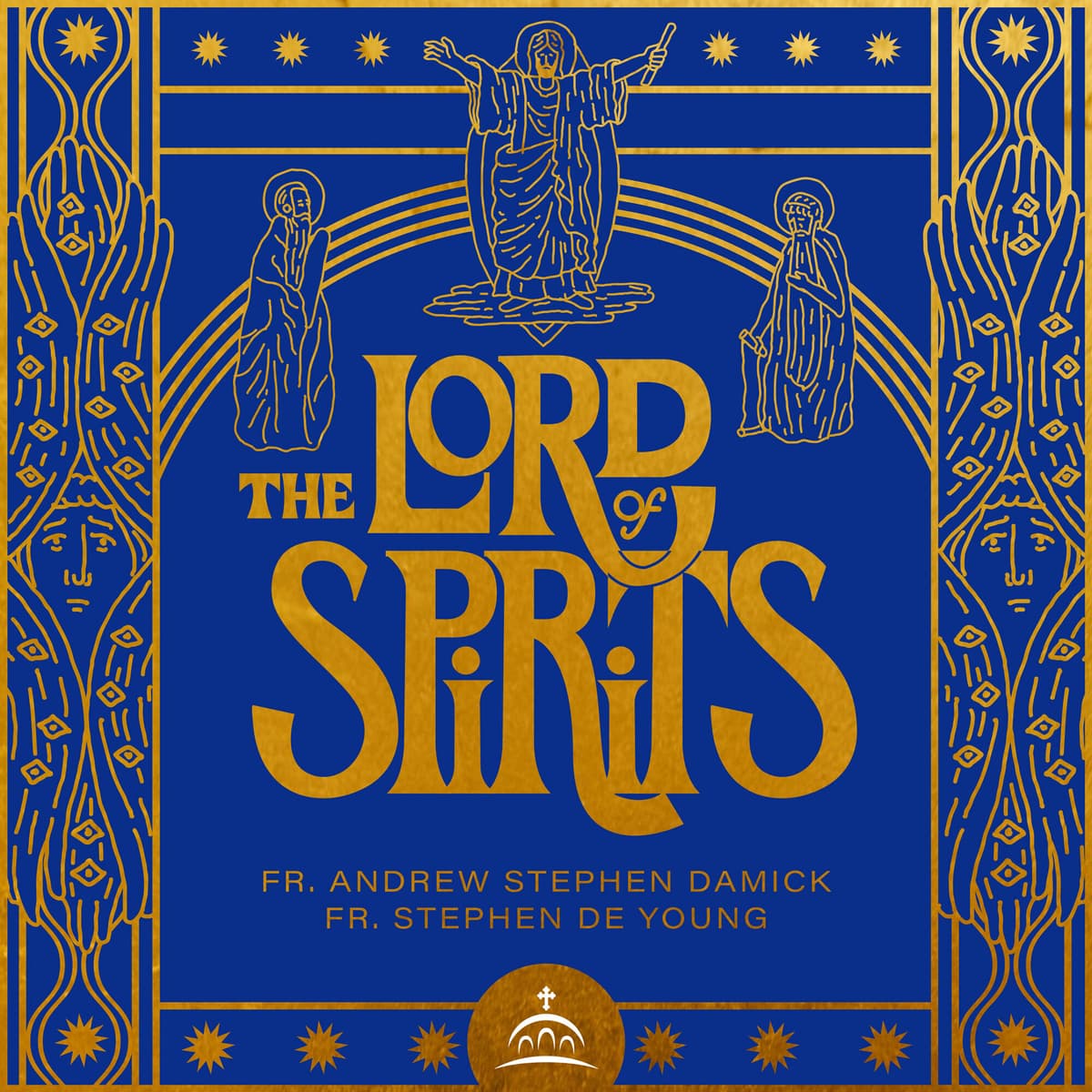

The Lord of Spirits – “The Mountain of God and the Boat of Theseus”
March 26, 2021
Podcast Hosts: Fr. Andrew Stephen Damick & Fr. Stephen De Young
Presented by: Ancient Faith Ministries
Overview:
This episode explores the theme of sacred geography in Orthodox Christian tradition. The hosts examine how the concepts of being, identity, place, and creation differ in an enchanted, Orthodox worldview compared to modern materialist thought. Through metaphysical discussion, biblical exegesis, philosophy, and relatable cultural references, Fr. Andrew and Fr. Stephen guide listeners through how the “seen and unseen” worlds intersect—culminating in the church’s vision of reality as a creation suffused with divine presence, culminating in the mystery of the “Mountain of God.”
Main Topics & Key Insights
1. What Does It Mean to “Be”? (Starts ~04:00)
The Materialist Dilemma
-
Modern western culture assumes something exists if it has “material reality”:
“We think of what it means to exist for us … something exists if it has material reality.” – Fr. Stephen (06:24)
-
The hosts unpack how English and Latin languages “reify” (make into a thing) concepts like ‘nothing.’
Biblical & Ancient Worldview
-
Existence isn’t opposed to ‘nothing,’ but to ‘chaos’.
“Being is opposed to chaos… In Genesis 1… you start out with primordial chaos… then creation is setting things in order. So, to be means to be ordered, as opposed to chaos.” – Fr. Stephen (09:07)
-
Creation “ex nihilo” (out of nothing) in Christian doctrine doesn’t mean God made things out of some ‘void’ that preexisted.
“The important element of creation ex nihilo is … there is no thing which is co-eternal with God … matter, energy, or anything else.” – Fr. Stephen (12:04)
Order, Relationship, and Identity
-
Existence means being ordered and embedded in a web of relationships.
“To exist means to be not only set in order internally as a thing, but to also be connected by this web of relationship to other things.” – Fr. Stephen (14:17)
-
Analogy: A tower that crumbles is no longer a tower—what something is “being” is not merely the sum of its materials.
“Same matter, now being a pile of rubble… being is a verb… It will be being a table or wall.” – Fr. Stephen (15:21)
Human Consciousness & Perception
-
How we order and name reality is creative and constitutive:
“What we call ‘the world’ is the product of human consciousness. It doesn't exist outside of human consciousness.” – Fr. Stephen (23:59)
-
Language, art, music, ritual—all ways “humans place reality in order.”
2. The Mind-Bending: Ship of Theseus & Teleology (Starts ~36:00)
-
Greek philosophy: What makes a thing itself if all its parts change?
- Ship of Theseus: If every piece is replaced, is it still the same ship?
-
The Orthodox/Scriptural view: Yes—the identity is in purpose, order, and relationship, not just material continuity.
“To exist, and to exist as a thing means to be placed in order and placed in that web of relationships.” – Fr. Stephen (43:31)
-
Classic quote:
“If you reify them, you turn them into things… congratulations, you’re a Nestorian.” – Fr. Stephen (46:44)
3. Saints, Salvation, and Being (Starts ~47:28)
-
Sainthood isn’t a static identity, but a calling and a becoming.
“You are a saint, and you need to become a saint…to become what you are.” – Fr. Andrew (49:39)
-
The Orthodox vision involves both the “already” and the “not yet”:
“Your identity is your telos, your end, your purpose, your goal. … Both of those can coexist at the same time.” – Fr. Stephen (51:09)
-
“Being” in Orthodoxy is dynamic—not a fixed state, but realized through communion, participation, and continual orientation toward God.
Memorable Reflection:
“These habits of thought … can introduce a lot of distortions in our understanding. And even though we can't necessarily radically change them, we can at least enter into criticism of them and correct ourselves.” – Fr. Andrew (52:53)
4. Place, Sacred Space, and God's Presence (56:09)
Sacred Place Is Relational
-
God is present everywhere, but especially present at certain times/places (e.g., the Tabernacle, Mount Zion).
“There's like spatial-temporal coordinates… when we say Christ is in our midst, we don’t mean when liturgy is over he departs… This is not opposed to absence.” – Fr. Stephen (58:59)
Ritual Makes Present
-
Spiritual/reality events are revealed at a particular time/place, not “created” then or confined there.
-
Through ritual, past archetypal events become present:
“Ritual makes the current time and place that time and place. … That’s why when we sing, we sing ‘Today….’” – Fr. Stephen (62:57)
-
Passover Example:
“Ritually, that original archetypal day has been made that day.” – Fr. Stephen (66:09)
- Judaism and Christianity differ on which event is archetypal: Exodus or Christ’s Pascha.
Thin Places
-
Question from Laura: What about “thin places”?
-
Some sites (from pre-Christian times too) are understood as “spiritually porous”—because sacred events are realized again ritually, or because of human interaction and memory.
“This place is now a different place than this place was previously.” – Fr. Stephen (80:54)
5. Sacred Directions & Geography (Starts ~81:44)
-
Cardinal Directions have symbolic associations in the ancient worldview:
- East: Where paradise is, where God dwells (“God planted a garden in the east,” Genesis 2).
“If you're going to face toward God, you face east because that's where paradise is and where he dwells.” – Fr. Stephen (84:10)
- North: The abode of evil (“Baal Zephon” and sinister side).
- West: The sea, chaos.
- South: The “origin” of civilization, the ancient past.
- East: Where paradise is, where God dwells (“God planted a garden in the east,” Genesis 2).
-
Relational orientation matters more than physical location (e.g., Orthodox Christians always face east, regardless of geography).
“Facing east is a matter of facing east. … It’s relational, it’s volitional, it’s orientation.” – Fr. Andrew (84:14)
6. The Mountain of God (Starts ~96:08)
The Mountain as Paradise
-
The “Mountain of God” is wherever God chooses to dwell with His divine council.
-
Eden = the first mountain of God (Ezekiel 28 refers to Eden as a mountain).
-
Historic sacred mountains: Sinai, Zion (Jerusalem), eventually, the Church (through Christ and the Theotokos).
“Mountains that are in the world and that you could go visit become the mountain of God for certain periods of time—temporal spatial coordinates.” – Fr. Stephen (103:55)
-
The tabernacle and later the temple are cosmic mountaintop gardens—microcosms of paradise.
-
Christ as the new temple/mountain:
“Christ is Ezekiel’s temple.… The Johannine literature—Christ says, ‘Destroy this temple and I will rebuild it’… He was speaking of the temple which is his body…” – Fr. Stephen (108:16)
Extension to the Faithful
-
Through the Spirit, we become the Mountain of God, temples of the Holy Spirit.
-
The Church, the Theotokos, the saints, even our own hearts, are called to “become paradise.”
“Your body becomes the temple of the Holy Spirit.” – Fr. Stephen (112:48)
-
The mountain of God, wherever it appears (including within us), faces spiritual siege from the powers opposed to God.
“What this means is that wherever God’s paradise is … that place is going to be under siege by the enemies of God, by the spiritual enemies of God. That includes within us.” – Fr. Stephen (116:28)
Memorable Quotes & Moments
-
Frank Sinatra’s philosophical legacy:
“To do is to be. To be is to do. Or as the great Frank Sinatra sang—do be doobie doobie do.” – Fr. Stephen (03:45)
-
On “thin places”:
“Why do we go to the saints? Because the saints have become paradise. We go there because we meet with God there and we connect with God there … it reverberates beautifully.” – Fr. Andrew (123:46)
-
Advice from a beloved priest:
“Make the place you’re in into paradise.” – Fr. Alexander Atty, quoted by Fr. Andrew (118:28)
Notable Caller Question
Austin’s Question (~69:20): Will the afterlife (heaven/hell) be experienced the same, or is there a gradient?
-
The hosts respond that—just as our orientation toward God shapes our present experience of Him—this will also be true in the age to come. There is an “infinite progress” for the saints in glory, and one’s experience of God’s presence is proportional to their capacity for communion.
“We have a continually deepening experience of God… It’s not just a static state…” – Fr. Stephen (73:17)
“The world as we know it is essentially a product of human consciousness. … Your orientation towards participating in God or in the works of the demons … is the key thing in terms of your experience.” – Fr. Andrew (71:02)
Practical, Spiritual Application
-
The spiritual life is making oneself and one’s world “paradisaical”—a place of God’s presence.
“If the kingdom of God is within you… if Christ is the temple of God… then it’s within you. So if you’ve done that, you are the paradise of God. But you also are not yet, because we’re still on the journey… That means that spiritual life is about making yourself paradisaical.” – Fr. Andrew (119:18)
-
“Being” is not simply existing materially, but acting in harmony with one’s purpose and relationships:
“These are verbs. Being, nature… That figures into this very, very deeply. … How am I being? Am I fundamentally oriented towards God and going to that mountain of assembly to meet with Him?” – Fr. Andrew (122:29)
-
Salvation/theosis occurs not in isolation but in and for the web of relationships—the Church, humanity, all Creation:
“Being set in order, having things be right, isn't just internal—it’s being set in a web of relationships… You can’t love God and hate your neighbor… That’s what’s going to cause all those things within us that are out of joint and out of place to slide back into place… We all find salvation and restoration and paradise together.” – Fr. Stephen (126:20, 129:35)
Key Timestamps
- [04:00] - What does it mean “to be” in ancient/biblical thought?
- [14:17] - Existence as order and relationship
- [36:00] - Ship of Theseus/philosophy of identity
- [47:28] - Sainthood: already and not yet, being by participation
- [56:00] - Sacred place, God’s presence & ritual
- [66:33] - Passover, typology, ritual time
- [74:00] - The Holy Spirit recreates, puts in order
- [81:44] - Sacred cardinal directions (east, west, etc.)
- [96:08] - The “Mountain of God” in Eden, Sinai, Zion
- [104:16] - The temple, Theotokos, and Christ as “mountain of God”
- [116:28] - Siege of the mountain: spiritual warfare
- [122:29] - Being “paradisaical” and practical conclusion
- [126:20] - Paradise, the web of relationships, and the communal nature of salvation
Tone and Style
The hosts maintain an energetic, conversational, and occasionally humorous style, using pop culture references, jokes, and asides (e.g., Star Trek, Batman, neverending debates about “grammar Nazis,” and Monty Python). Deep theological points are made accessibly and often with wit:
“I like that you phrased it as Picard and the Gang, so sort of TNG by way of Scooby-Doo.” – Fr. Stephen (20:15)
Summary Takeaway
This episode sets up the Lord of Spirits’ vision of Christian “enchantment”—where reality is a dynamic interplay of order, relationship, and presence. Places, people, and events are not static: they become what they are through divine ordering, ritual, and purposeful participation. The “mountain of God” is not mere metaphor nor mere matter, but a pattern of existence—made manifest in Eden, Sinai, the Temple, Christ, the Church, and the human heart. Orthodox Christianity calls us to “be paradise”—not just alone, but in and for the whole Creation.
Next up: The Mountain of God is surrounded by foes… Next episode—Into the Underworld!