← The Magnificent Others with Billy Corgan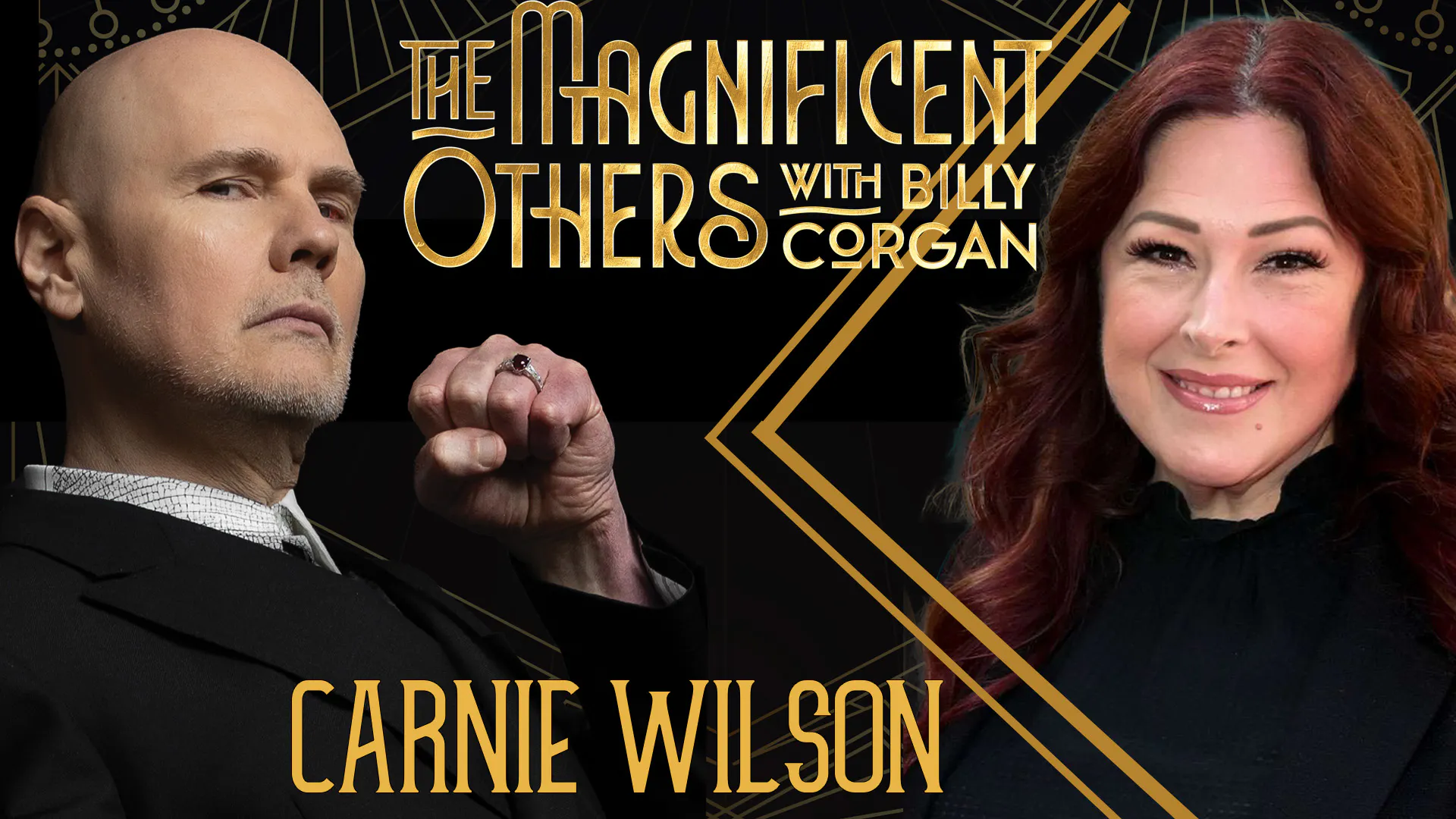
The Magnificent Others with Billy Corgan
Carnie Wilson | The Magnificent Others with Billy Corgan
01:42:23
Loading summary
Transcript797 lines
- [00:01]
Carney Wilson
See, right. That's one of my guilty pleasure songs.
- [00:06]
Unknown Interviewer
Oh, God, I love it. This is getting really deep. But this is where songwriting.
- [00:10]
Carney Wilson
It's what we're here to do. Because. No, because there is a connect. You understand where I'm going?
- [00:13]
Unknown Interviewer
Yeah. He's like, you need to call your band Pretzels with Mustard. And we're like, okay. You're a. You're clearly wasted and have the micro.
- [00:22]
Carney Wilson
Are you stone, too, though?
- [00:23]
Unknown Interviewer
Who knows? I just remember it was the most creative, magical thing I've ever felt.
- [00:30]
Carney Wilson
Artist and entrepreneur Carney Wilson is my guest to discuss. Growing up a scion of the Beach Boys, massive pop success with Wilson Phillips and the insatiable maw of the American culture. I'm curious, because you grew up in a musical world. Like, when do you first remember hearing music? Do you have, like, that first memory?
- [00:50]
Unknown Interviewer
Yeah, I don't know if I have, like a first memory, but I have memories of being in our living room. My parents had a really great stereo system that we could blast super loud. And we used to test it. Like, how loud can we really go? There were these huge black speakers, and they were on the ground, actually. And it was just. We would just totally play with fire. Just like blast it as loud as we could to. The windows would shake and. I mean, how destructive can that be when. That's the Carpenters, right? Cause that's what we would blast would be the Carpenters. So, you know, tucking to myself and feeling hot, you know.
- [01:36]
Carney Wilson
But anything loud has a kind of a. Yeah.
- [01:40]
Unknown Interviewer
I don't know what it is about volume of music. I really love listening to my music very loudly when I'm in my car. It's kind of dangerous the way I listen to it, but I don't know if it's. Cause my hearing is right now. I don't know, but it's kind of always been that way.
- [01:57]
Carney Wilson
Really.
- [01:57]
Unknown Interviewer
Yeah. So I remember the first memories would be, like, just in the living room, mom and dad stereo. And then it was Captain Fantastic. It was.
- [02:08]
Carney Wilson
That would have been about 73, right?
- [02:10]
Unknown Interviewer
Yeah. So I was born in 68, so like five or two or something.
- [02:14]
Carney Wilson
I'm just a little older than you see, but how much? I'm 67.
- [02:18]
Unknown Interviewer
You look great. God. Jesus. No, I'm 56. Thank you. Yeah. Yeah. So I just remember loving. Just loving it from young, young age.
- [02:32]
Carney Wilson
Because I grew up in a musical household, too.
- [02:34]
Unknown Interviewer
Yeah.
- [02:35]
Carney Wilson
So I feel like kids who grew up with musician parents, you know, we grew up in that atmosphere. There's always the atmosphere Weird people hanging around.
- [02:44]
Unknown Interviewer
Right.
- [02:45]
Carney Wilson
And music.
- [02:46]
Unknown Interviewer
And it is an atmosphere.
- [02:49]
Carney Wilson
Yeah. So I was curious for your own personal connection, because, you know, as, you know, when you grow up with a famous parent, people kind of put their own version of that on you. But your musical life indicates to me that you had your own experience with music and your own trajectory.
- [03:06]
Unknown Interviewer
Absolutely, you're right about that. People love to talk about that lineage, and it is a powerful thing and something I'm so proud of. But, yeah, it's like, I really did have my own experience with it, and it went in phases, you know, discovering different music at different ages. But.
- [03:24]
Carney Wilson
So tell me some of the people that you were listening to, like, when you first were like, okay, this is my music. I want to listen to this record.
- [03:31]
Unknown Interviewer
Yeah, well, that was. I mean, I am total 70s horror for music. Love anything in the 70s. I'm completely, like, blown away by.
- [03:42]
Carney Wilson
Gimme some Guilty Pleasures.
- [03:43]
Unknown Interviewer
Okay. Like Pablo Cruz, you know, like, you.
- [03:46]
Carney Wilson
Know, he's a music supervisor now. Did you know that?
- [03:48]
Unknown Interviewer
Is he.
- [03:49]
Carney Wilson
He's from when somebody told me he's the number one music supervisor guy in town here in la.
- [03:56]
Unknown Interviewer
Oh, my God.
- [03:56]
Carney Wilson
His, like, if you need a scene with, like, some kind of music, you go to Pablo Cruz. He's your guy.
- [04:01]
Unknown Interviewer
Oh, my God. Well, like Ambrosia.
- [04:04]
Carney Wilson
Remember Jay Ferguson?
- [04:05]
Unknown Interviewer
Of course. Yes.
- [04:07]
Carney Wilson
Thunder island. Was it.
- [04:09]
Unknown Interviewer
Yes. Love a song.
- [04:10]
Carney Wilson
See, right. That's one of my guilty pleasure songs.
- [04:15]
Unknown Interviewer
Oh, God, I love it. I love a groove. Like, that's the thing that got me was like, that's why I love, like, Michael Jackson's music. Cause it just. He just. He had these, like, rhythm, like these groove things. And I think all his songwriting, like, started with that. With some kind of groove in his mind.
- [04:30]
Carney Wilson
Yeah, you always think, like, he's always very rhythmic in his writing.
- [04:33]
Unknown Interviewer
Yeah, rhythmic. Yeah. So I was drawn to that. But definitely, definitely, you know, Fleetwood Mac. I think my first love was Elton John. That definitely was. I was five or six. That's when I. He's the one. He is the one that started it all. Not really the Beach Boys or anything. I mean, I remember growing up with all their music, and I loved it. But it wasn't until later till I gained a lot of respect. 13 and 14.
- [05:00]
Carney Wilson
Yeah. But again, I'm.
- [05:01]
Unknown Interviewer
Yeah.
- [05:02]
Carney Wilson
All due respect to your family, but I'm curious for your musical journey, because again, when I listen to the music that you ended up doing in your own life, in your songwriting too, you know, there's not. It's not. You're like, you don't sound like the daughter of the Beach Boys. You know what I mean? You have your own musical identity.
- [05:20]
Unknown Interviewer
Definitely. Thank you for saying that. I mean, it was a collaboration, you know? I mean, I still have never written a song by myself, and I really. Yeah. Never have.
- [05:29]
Carney Wilson
Okay, I gotta stop you there. Why? I mean, your father is one of the greatest songwriters ever. I mean, he's up there with the Tin Pan Alley writers. Right. I mean, he's one of the great melodicists, if that's even a word.
- [05:41]
Unknown Interviewer
I agree. Right.
- [05:42]
Carney Wilson
So I love the idea of genetic lines. You know what I mean?
- [05:46]
Unknown Interviewer
Me too.
- [05:46]
Carney Wilson
Okay. So I would think there would be some gift in there involved with writing. So the fact that you've never tested it on your own is surprising to me.
- [05:55]
Unknown Interviewer
I think I'm just terrified to tap into it.
- [05:56]
Carney Wilson
Why?
- [05:57]
Unknown Interviewer
I don't know. Maybe. Wouldn't that be funny if I wrote my first song at 56? Like, my full computer?
- [06:02]
Carney Wilson
I'm come over and we're going to. I'm going to stand there.
- [06:06]
Unknown Interviewer
You're so sweet.
- [06:07]
Carney Wilson
I would.
- [06:07]
Unknown Interviewer
Wouldn't that be great?
- [06:09]
Carney Wilson
I'd be really curious.
- [06:10]
Unknown Interviewer
Yeah. I like to noodle around at the piano and everything. And I'm just. I think I just have such, like, severe ADD that I can't focus. I can't focus.
- [06:22]
Carney Wilson
Okay, but are you a fan of Courtney Love at all?
- [06:26]
Unknown Interviewer
Yeah.
- [06:26]
Carney Wilson
Whole. Yeah. Are you a fan of that?
- [06:28]
Unknown Interviewer
I mean, not, like, dialogue.
- [06:29]
Carney Wilson
But I'm saying the reason I bring it up is not to put you on the spot, is when Courtney had come out of rehab in, like, 96, 97, I was having a lot of issues, personal issues. She asked me to help her on an album which became this album called Celebrity Skin. And Courtney's very add.
- [06:46]
Unknown Interviewer
Yeah.
- [06:47]
Carney Wilson
So I've written with ADD writer and writers. The thing with ADD writers is it's a little bit like things flying by in a stream. You gotta try to know which ones to grab.
- [06:58]
Unknown Interviewer
I know, I know. And that's why I love collaborating.
- [07:02]
Carney Wilson
Cause you got somebody to kinda.
- [07:03]
Unknown Interviewer
Yeah. And then, like, I start something, they finish it, or I have, like. It's so fragmented. That's the way my music is in.
- [07:12]
Carney Wilson
But why do you think it's fragmented? Is it just the way your brain works?
- [07:16]
Unknown Interviewer
Yeah.
- [07:16]
Carney Wilson
Okay.
- [07:17]
Unknown Interviewer
I really think it's the way my brain works because I love, like, riding bridges. I love, like, going off into the other land of the bridge.
- [07:25]
Carney Wilson
So you like reacting off of something that's there.
- [07:27]
Unknown Interviewer
Yeah.
- [07:28]
Carney Wilson
Okay, I get that.
- [07:28]
Unknown Interviewer
Yes. Yes. So, like, when China stands Do you.
- [07:31]
Carney Wilson
Not like the pressure, though, of being on the spot?
- [07:34]
Unknown Interviewer
No, it doesn't bug me.
- [07:35]
Carney Wilson
Okay.
- [07:35]
Unknown Interviewer
I mean, I don't have any shame or any. There's no shame about it.
- [07:39]
Carney Wilson
You've been in Playboy.
- [07:41]
Unknown Interviewer
I've spread my legs for Playboy, so is there anything you could be more like? You know, But I don't have a shame with that. But I think it's more frustration.
- [07:50]
Carney Wilson
Okay.
- [07:51]
Unknown Interviewer
And wanting to get to that next place and then, I mean. Cause shame is not the same as insecurity, I don't think.
- [07:58]
Carney Wilson
Okay.
- [07:59]
Unknown Interviewer
Shame is more like embarrassed kind of, you know, or like, feeling smaller or, like, not good enough, whatever. Embarrassed is more like, I think, to me, vulnerable and being exposed. So I don't know. I think I'm just hard on myself. I think ultimately I'm just hard on me. And it's hard to, like, think of all the music that has.
- [08:23]
Carney Wilson
Is that something you feel you were born with or that became something you used as an adoptive strategy to get through life?
- [08:32]
Unknown Interviewer
I think because I grew up in a house where everything was so, like, chaotic and hectic that I was a protector of my sister. Of, like. We had, like, crazy things happen when she was young. Like, she almost drowned when she was, like, three. And she was. She fell into this well. We had this big well in the center of our upper backyard. And she was. All I could see was her hand. She was drowning.
- [08:55]
Carney Wilson
Oh, my God.
- [08:55]
Unknown Interviewer
And I ran, you know, to get mom and dad. They were still married and everything. And they came running down the hall and dad pulled her out. And so I've always had this protective feeling over Wendy. And so I think that that started my. I have to be strong and great and be the one to have, like, the answers and the protector. And, you know. And then inside, I think there was panic.
- [09:18]
Carney Wilson
Okay.
- [09:19]
Unknown Interviewer
So, I mean, this is getting really deep. But this is where songwriting.
- [09:23]
Carney Wilson
That's what we're here to do. Because. No, because there is a connective tissue. You understand where I'm going?
- [09:27]
Unknown Interviewer
Yeah, Yeah, I know.
- [09:28]
Carney Wilson
Yeah. Cause you do have to open up into an unfamiliar space.
- [09:32]
Unknown Interviewer
Yeah. Well, it's a vessel, you know, and it's in there. And I think the feelings are familiar, but the. But I don't know how to say it. Like, getting it on, getting in a melody or in a lyric. Lyrics I'm not great with. I get, like, ideas. Like, I wanna write a song about a train. You know, that was my thing last month. I'm like, I know I've gotta write a song about a train. Like, we get on the train, it's moving, and we get off at different stops. And you know. And it was, you know, what inspired me was John Mayer's song called Stop this Train, which is my favorite John Mayer song. I love John Mayer. I'm slightly obsessed. Him in particular. Cause he's hot as hell. But his music and his voice and his songwriting, I love it. And Stop this Train blew my mind. And so I'm like, I want to write a song about a train as well.
- [10:24]
Carney Wilson
Well, your father famously worked with other lyricists too.
- [10:27]
Unknown Interviewer
He did, yes.
- [10:28]
Carney Wilson
So for playing the game of the genetic line, maybe you inherited the gift of melody, but not necessarily the gift of lyrics, Right?
- [10:35]
Unknown Interviewer
I absolutely think you're right. I mean, it's always about vocals and melody and harmonies and arrangements and that. Yeah, it's never been lyrics. But that's why I think co writing with my sister in China was good, because we all kind of contributed something that was right. But it's been so long since we've written together.
- [10:56]
Carney Wilson
Why do you think that is? Ego, the destroyer of all bands of all. Right. It's not money really. It's ultimately about money. So I wanted to ask you this too, because you're born in 68.
- [11:12]
Unknown Interviewer
Yeah.
- [11:12]
Carney Wilson
So Sunflower, the Beach Boys album, came out in 70. Surf's up was 71 and Holland was 73. And then you guys moved to Holland or something. Do I have that story right?
- [11:23]
Unknown Interviewer
We moved to Holland while they were recording it.
- [11:25]
Carney Wilson
So is that your first memory of that camp and working and. I mean, obviously it's your family. Yeah, that's worth pointing out. Cause you know, most bands, everybody goes different directions when the tour's over.
- [11:35]
Unknown Interviewer
Yes.
- [11:35]
Carney Wilson
But in your guys case, like, it's the family.
- [11:38]
Unknown Interviewer
It's the family. And dad went through his like, ups and downs of like, using drugs, not using drugs, having help from outside sources and programs and things that he got involved with. And then. And then it was like, is he gonna be involved with this album or is he not? And Holland we were. I was young.
- [11:57]
Carney Wilson
I mean, you'd have been five.
- [11:59]
Unknown Interviewer
Five. And so I was in kindergarten and we moved. And I remember going to school in Holland and feeding the horses apples and. And then, of course, another.
- [12:08]
Carney Wilson
Was this a temporary thing, like, we're gonna make this album over here. It wasn't like, we're all moving to Holland, right?
- [12:13]
Unknown Interviewer
Well, we moved to Holland while he was recording.
- [12:16]
Carney Wilson
But it wasn't like you guys were. Cause I saw some quote from one of your relatives saying something like, I think because they didn't. Something to do with. They weren't happy with America and how America was treating them.
- [12:26]
Unknown Interviewer
No, it wasn't that at all.
- [12:27]
Carney Wilson
Okay.
- [12:27]
Unknown Interviewer
It was. They were recording, and we moved there, and they did vocals there and recorded, you know, the album. I don't really know all the details, but I know that we were temporarily. Again, six months.
- [12:39]
Carney Wilson
I'm more interested in your memory, that's all.
- [12:41]
Unknown Interviewer
Yeah, well, it was actually a really hard time. Cause my dad was drinking a lot at that time. At that time. And he actually got in a car accident, wrapped his Lincoln around a tree and walked away from the accident. He was fine. But there was a lot of crazy. And my mom was young, you know, she was 20, 25, you know, and so, I mean, my daughter's gonna be 20. So I'm just thinking, like, wow, five years after she turns 20, this is what she was dealing with. It was a lot. But Holland was a very intense album and kind of scary. It's kind of a scary album. There was some weird on there, like that Jack the Ripper thing when Jack Riley and weird, you know, like the Pied Piper. I remember I couldn't believe how scary that was.
- [13:29]
Carney Wilson
I kind of like dark Beach Boys, but I didn't live it, you know.
- [13:32]
Unknown Interviewer
Oh, I love it. But as a kid, it was, like, really different. And, you know, I'm curious, you know.
- [13:42]
Carney Wilson
Your mom had done music, and that's how your parents met. But, like, was that something that she set aside? She wasn't that serious about, like, what's your impression of that? Cause I'm curious.
- [13:52]
Unknown Interviewer
Well, she was very young, 14 when she met him, or 14 and a half. And he was just, like, just getting into the first record and stardom, like, right in the beginning.
- [14:02]
Carney Wilson
Yeah.
- [14:02]
Unknown Interviewer
So this would have been, I don't know, 63.
- [14:05]
Carney Wilson
60.
- [14:06]
Unknown Interviewer
Yeah. And so she went to a concert, and she was in the front row, and she had some hot chocolate. And my dad said, can I have a sip? He was on stage, and he took a sip. And then he, like, spilled it all over her. And then he, like. That started.
- [14:22]
Carney Wilson
That's a way to meet.
- [14:23]
Unknown Interviewer
Right? That started it. And then he proposed to her while he was in Germany over the phone. He asked her to marry him. He was in Germany, touring.
- [14:30]
Carney Wilson
Very rock star.
- [14:31]
Unknown Interviewer
Very rock star.
- [14:32]
Carney Wilson
Yeah.
- [14:32]
Unknown Interviewer
And mom was 16. And my grandparents. My grandfather was this man who looked exactly like Einstein. Like a clone of Einstein. German and big, thick accent. An incredible man. Escaped, like, World War II on foot. Just, like, went to Chicago, met my grandma and My parents adored my dad. Sorry. My grandparents adored my dad. Like, beyond. And he loved them. She was this short little Jewish woman, and she was a great cook. God damn it. And he loved her matzo ball soup. So he would go. And they had a little piano, and they just fell in love with him. And they trusted him. So they trusted him. And, you know, back then, it was. People were getting married and hooking up so young.
- [15:23]
Carney Wilson
Right.
- [15:24]
Unknown Interviewer
But it was like they knew that he was the one.
- [15:26]
Carney Wilson
Well, just to not skip past the question, was music something? Your mom. I'm not saying she abandoned it, but it seemed like she had a moment and then it just didn't happen.
- [15:36]
Unknown Interviewer
I don't think it started until him.
- [15:39]
Carney Wilson
Cause my impression was she was doing something before she met your father.
- [15:43]
Unknown Interviewer
No, I don't think so. I think.
- [15:44]
Carney Wilson
Oh, okay. Maybe I got the story reversed.
- [15:46]
Unknown Interviewer
You know, I don't know the answer to that, and I don't know why. Maybe it's all the pot I smoked. I forgot. But, like. But I just remember she and Auntie Dee Dee and Ginger, they had the Honeys, and Dad, you know, produced them. And they were great.
- [16:00]
Carney Wilson
Yeah. Cause I've read something, but again, it's the Internet. Who knows? But it was something about. She was doing something on local television and that's how they met or something.
- [16:09]
Unknown Interviewer
I don't know.
- [16:10]
Carney Wilson
It's not important. It's more just the idea.
- [16:12]
Unknown Interviewer
Yes.
- [16:13]
Carney Wilson
Was there a musical ambition from your mother's side of the equation, too?
- [16:16]
Unknown Interviewer
I think there was. I think she was very interested in.
- [16:18]
Carney Wilson
Did she ever really return back to music at any point?
- [16:20]
Unknown Interviewer
The Honeys reunited in, like, the 80s, and they made. Or late 70s, and they made a record. And it was really good, actually. I remember them recording Temptation Eyes. My mom sang it great. But my favorite music was my mom and my Auntie Dede. They did an album called Spring. They were a group called Spring. And it's. Have you heard it before?
- [16:43]
Carney Wilson
No.
- [16:43]
Unknown Interviewer
Oh, my God. I mean, there's a song called this Whole World and Tennessee Waltz and Awake and all these songs. My mom's. But Mom's version of what's the Superstar?
- [16:58]
Carney Wilson
Oh. By the Carpenters.
- [16:59]
Unknown Interviewer
Jesus Christ. My mother's version and my dad's. Like, I say, who's your favorite singer in the world? Your mother. He loves my mom's voice. I said, who's a better singer, Barbra Stressenow or my mom? Your mother. It's so him to do that.
- [17:15]
Carney Wilson
So your mom. Born in Chicago, so we share that.
- [17:18]
Unknown Interviewer
Oh, nice. Yeah, yeah, yeah. And they came. They were very, very poor. One pair of shoes. My grandfather was a vacuum salesman and. Yeah. And then all of a sudden, here comes dad. Just changed everything.
- [17:32]
Carney Wilson
Yeah.
- [17:33]
Unknown Interviewer
You know.
- [17:34]
Carney Wilson
Well, it's easy now. We look back and we see, you know, like your father and the Beatles at these young ages creating this music which we're all still listening to. And they have no idea what's coming. That's right. None. It's easy for us to sit back and say, oh, so and so should have done this and made a left here at this street.
- [17:50]
Unknown Interviewer
Yeah, yeah.
- [17:50]
Carney Wilson
They had no idea what was coming. None.
- [17:52]
Unknown Interviewer
I think they were in. Just in their creative space. And it was so authentic and pure and just inside of them and so cool that they weren't influenced by other. Like we are today. You know what I mean? It was the absolute most purest.
- [18:10]
Carney Wilson
Well, back then you were rewarded for creating your own world.
- [18:13]
Unknown Interviewer
Yeah.
- [18:14]
Carney Wilson
You like, you truly. Now we live in this homogeny where everyone's trying to sound like each other, which is so weird to me.
- [18:18]
Unknown Interviewer
It's so weird to me. It's so odd. Like, I can't. How many girls can sound like Billie Eilish? I don't.
- [18:24]
Carney Wilson
Well, apparently a thousand more.
- [18:26]
Unknown Interviewer
Yeah. I actually love Billie. I actually love it.
- [18:30]
Carney Wilson
Well, here's my issue with pop music. If you take the top artists, they're really good. I mean, there's no mistaking, it's the 999 behind them. I know that you're like, oh, my God, like, what are you doing? How is that happiness? I don't get that.
- [18:45]
Unknown Interviewer
I. I just think that fame is more important than the artistry.
- [18:49]
Carney Wilson
Well, that's the new. That's the new economy we live in.
- [18:52]
Unknown Interviewer
Yeah. Yeah. It's frightening.
- [18:54]
Carney Wilson
But I mean, you think about it just started to opine. But, you know, I mean, your father basically created the album template that inspired the Beatles. Right. And inspired countless nerds like me to try to create our own worlds. Right. That's such a beautiful, aspirational thing that I can create this world with my gift of music. And it's all been reduced into this thing of like one song, three minutes. God forbid it's anything too different than anybody else is doing. It's very strange, right?
- [19:23]
Unknown Interviewer
It is strange. But then that's why when girls, young girls, and they say, do you have any advice, you know, for me? Because I want to be a singer or a songwriter. And I always say the same thing. I just say, do what's inside of your soul and your heart, and it's about expression and not necessarily the reaction. It's about expression.
- [19:45]
Carney Wilson
It's very hard for them to understand. Cause they live in a clique economy.
- [19:48]
Unknown Interviewer
I know.
- [19:49]
Carney Wilson
So if somebody's not clicking, it must be bad.
- [19:51]
Unknown Interviewer
And also, like, how do you make a living, you know?
- [19:54]
Carney Wilson
Well, you don't.
- [19:54]
Unknown Interviewer
You don't. And like, I was 18 years old when we started Wilson Phillips. I mean, I knew that I was gonna go into the entertainment industry the minute I thought I was gonna be an actress. That's where I started Y On the stage at school. And that's where I found my comfort, my home. I loved it. Music always, Always a thread. Musicals. I remember dad coming to see me in a musical called Carnival. He saw me really belt and sing for the first time. He loved it. But I. I don't know. I. I think it's just changed so much, right, the industry.
- [20:23]
Carney Wilson
You brought Wilson Phillips, so that's not probably a good place to go. There was the. Was the idea of you guys recording an organic thing and then you went and got a deal, or did somebody kind of think. You know what I'm saying? Like, how did that happen? Because I'm so cynical from being in this town too many years. I don't live here, but, I mean, I've been here enough.
- [20:42]
Unknown Interviewer
Yeah.
- [20:42]
Carney Wilson
You know, when we were kids and you guys were suddenly on mtv, it just seemed like somebody put the whole thing together because it just felt like that. But that's not. I'm not saying that's what happened.
- [20:51]
Unknown Interviewer
Well, I'm sure there's many different perceptions of it.
- [20:55]
Carney Wilson
No, but you tell me. I'm saying you were there.
- [20:56]
Unknown Interviewer
You know, I mean, it was. It was extremely organic. And it was actually a mission of mine. Wilson Phillips wasn't the mission, but my mission was sing in harmony with people. In the eighth grade, I became obsessed with getting anybody that would have a half an ear.
- [21:15]
Carney Wilson
That's the family business, though. Isn't that fantastic?
- [21:17]
Unknown Interviewer
So great.
- [21:18]
Carney Wilson
Cause I'm not a good harmony person. Musically, yes, but I don't hear it that way.
- [21:24]
Unknown Interviewer
I love singing harmony with anyone. Like a bum. I would sing with a bum. I just want to sing. I can't get over harmony.
- [21:33]
Carney Wilson
But that's the family business. But it's so beautiful.
- [21:35]
Unknown Interviewer
It is so beautiful. And I remember getting, like, during lunch periods and anytime I had the ability. I mean, I sang Kodachrome with my principal. It's just, like, so funny.
- [21:46]
Carney Wilson
Kodachrome.
- [21:47]
Unknown Interviewer
Kodachrome.
- [21:48]
Carney Wilson
Paul Simon.
- [21:49]
Unknown Interviewer
Paul Simon.
- [21:50]
Carney Wilson
Not a bad song, though.
- [21:51]
Unknown Interviewer
I know, I know. So, like, I went to this school called Oakwood. And I met my best friend, like Jackson Brown, was teaching a songwriting class in the third grade, Summer of third grade. And that's where I met my best friend.
- [22:04]
Carney Wilson
Who's your best friend?
- [22:05]
Unknown Interviewer
Tiffany.
- [22:06]
Carney Wilson
Tiffany.
- [22:07]
Unknown Interviewer
Tiffany Miller. She used to work.
- [22:09]
Carney Wilson
You still friends?
- [22:10]
Unknown Interviewer
Oh, God, yes. The best of friends forever. But we met, like, Jackson. That was the kind of school we went to. It was Oakwood School. All the kids, parents were in the industry. And Jackson Brown was teaching a songwriting class. But, you know, I. They were very. They were understanding of kids and their different talents. Everybody went to college in my grade except for me. I was the only one. And I went straight into Wilson Phillips. It was. That was the summer. But I could not. I could not. Not do it. And so, believe it or not, Mama Cass's daughter Owen. And Owen asked Chyna to sing to get kids of 60s rock stars. Kids. Did I say that right?
- [22:56]
Carney Wilson
Yeah.
- [22:57]
Unknown Interviewer
Together for a charity record. Like one song. Record one song and give all the money to charity.
- [23:03]
Carney Wilson
So it started as a sort of egalitarian.
- [23:06]
Unknown Interviewer
It did. And it was like. It was Donovan's kids, Jerry Garcia's kids, Zappas. The Zappas, the Wilsons, the Phillips. And nobody wanted to do it.
- [23:22]
Carney Wilson
What do you mean no one wanted to do it?
- [23:23]
Unknown Interviewer
Everybody passed, said, nope, not into it. And there was a Rolling Stone article, and it was Annie Leibovitz did the COVID And we were in it. It was a horrible picture, but it was like the first thing I had in it magazine. And it was Wendy and I. And other. Other kids were featured. And I think that's what sparked the idea for Owen. But nobody wanted to do it except Owen, Chyna, Wendy and I. So it was the Wilson. It was the Wilson girls, and then the Phillips family and Cass Elliott. Yeah, Mamas and Papas, Beach Boys kids that came together. And we, of course. And I was like, this is when I was big stoner. So it was always about waking up and just getting ripped to the. Just always smoking.
- [24:05]
Carney Wilson
Did your parents know you were smoking?
- [24:06]
Unknown Interviewer
Oh, yeah. And mom and I actually forced her to take a bong hit. And she was trying to put her whole mouth on her.
- [24:12]
Carney Wilson
But she never been stoned or she.
- [24:14]
Unknown Interviewer
No, I think she got stoned. But at one point she just, like, let us do it because I never got in trouble. But she knew that I was. That I was. We were potheads.
- [24:24]
Carney Wilson
Okay.
- [24:24]
Unknown Interviewer
And I know that sounds crazy, but.
- [24:26]
Carney Wilson
No, I've known a lot of parents like that.
- [24:28]
Unknown Interviewer
She trusted us. So we all. We wanted to do was just get stoned and listen to music. And the CD had just come out, so I couldn't get over how crispy and clean and lovely it sounded. So, like, the first CD I bought was Genesis abacab, which I love.
- [24:42]
Carney Wilson
I had that album too.
- [24:43]
Unknown Interviewer
Oh, my God.
- [24:44]
Carney Wilson
So we're basically the same age. So we've had the same. We've been damaged by the same music.
- [24:49]
Unknown Interviewer
Oh, I love it. There's nothing like the drums on abacab. So abacab.
- [24:53]
Carney Wilson
My dad saw that tour, actually.
- [24:54]
Unknown Interviewer
Oh, how lucky. Oh, my God. He's the most underrated artist ever, in my opinion. But so it was abacab.
- [25:01]
Carney Wilson
Just talk about Phil Collins.
- [25:02]
Unknown Interviewer
Phil Collins. Oh, God. And then Wild Heart, Stevie Nicks album, and a few more. But, God, everybody. Oh, Heart. And we started singing Dog and Butterfly, and it was like, okay, let's hear what it sounds like when Wendy, Chyna, and I harmonize. And it was like a. It was like a tidal wave, you know? It was just. It just like the sound enveloped us and just. It was the most warm sound ever. And Owen sounded good too, but her voice stuck out too much.
- [25:38]
Carney Wilson
Yeah.
- [25:38]
Unknown Interviewer
It didn't work with our blend.
- [25:39]
Carney Wilson
Yeah.
- [25:40]
Unknown Interviewer
And it was very sad. We, we, we. So then we were singing, singing, and it was like, oh, come over again, and let's just sing again. Let's just get on the floor and just harmonize. So it just started with the love of that. And then my mom came down from upstairs, and she said, what are you doing? And we said, we're singing harmony. And she goes, I hear you through the ceiling, through the floor.
- [26:04]
Carney Wilson
That's the harmonics that cut through. Yeah.
- [26:06]
Unknown Interviewer
She was like, you sound so good together. Do you know that? We said, yeah, we can't. We love it, like, but we don't know what to do, you know? And then Chyna goes, I think we should call my mom and ask her, because she knows a lot of producers. So we called Michelle.
- [26:23]
Carney Wilson
Yeah.
- [26:24]
Unknown Interviewer
And she's like, I know Richard Perry's a great friend of mine, and he's produced the Pornist Sisters and Barbra Streisand and Carly Simon. And I would be Carly Simon, like, fanatic. And Barbra Streisand, my favorite singer of all time, you know, and Karen Carpenter. But Barbra Streisand was another love. Elton and Barbara. Whew. But so we were like, okay, we're gonna call Richard Perry. And he goes, well, why don't you rehearse something and then come over to my house? Another fellow Stoner you know, so he was a big stoner. So we sang. All we could do was prepare five words from a Stevie Nicks song called Wild Heart.
- [27:02]
Carney Wilson
I saw you. That was your idea.
- [27:04]
Unknown Interviewer
That was it. It was just Dare my wild heart and we went in.
- [27:07]
Carney Wilson
You still remember your part?
- [27:10]
Unknown Interviewer
Oh, I don't know.
- [27:11]
Carney Wilson
Sorry.
- [27:11]
Unknown Interviewer
Always the low harmony. I'm always the low.
- [27:14]
Carney Wilson
We got a nice chest voice.
- [27:17]
Unknown Interviewer
Thank you. But, like, Chyna never knew how to sing harmony, so we had to teach her. And she still really doesn't know how. She does, but that's why she's better on melody. She just can't. Wendy naturally goes to the high. I naturally go low. And it's always that stacked of, like. And I don't know technically the term, but it's like Chynes middle, I'm low, and Wendy's above. So that's where we're comfortable in. So, like, it was. You know, we just went in and Owen was with us, so it was the four of us.
- [27:43]
Carney Wilson
Sure.
- [27:44]
Unknown Interviewer
We went to his house and we sang Dare My Wild Heart. And he went, that's it. First of all, he was rolling a joint, smoking his joint.
- [27:51]
Carney Wilson
He's like, okay, so you're with this famous producer.
- [27:53]
Unknown Interviewer
Famous producer.
- [27:54]
Carney Wilson
And you're only singing a line.
- [27:56]
Unknown Interviewer
Basically five words, one line of a chorus. And he's getting older. You're how old at this point?
- [28:01]
Carney Wilson
You're 18.
- [28:01]
Unknown Interviewer
We're 18. Fresh out of high school. And he went, that's it. And we said, yeah. What do you think? Do you like our sound? You know? And he goes. And he was. He must have been high as a kite. He was like, I. And I know this is dramatic, but he's like, I see the Beatles. I see. He's like, you need to call your band Pretzels with Mustard. And we're like, okay, you're a. You're clearly wasted and have the munchies.
- [28:30]
Carney Wilson
Might be stone, too, though.
- [28:31]
Unknown Interviewer
Who knows? Probably. Probably. I don't remember smoking with him, but it was, like, part of the thing. Like, just like, you know, the producer's getting high. It was just so part of it all. But we were like, yeah, that's all we have. And he's like, oh, I know what to do. I'm getting you together with another producer who was a writer and. Or no, who's a producer who's worked with the porno Sisters. You guys have to get in the studio and get comfortable around a microphone. So we went in. It was good advice. Yeah. And we recorded our first song. We Ever recorded in the studio was Mama Said. Mama said there'll be days like this.
- [29:06]
Carney Wilson
Oh, that one I was confusing with the Lenny Kravitz. Mama said.
- [29:09]
Unknown Interviewer
Yeah, I know. Mama said.
- [29:11]
Carney Wilson
Oh, I know that song.
- [29:11]
Unknown Interviewer
Yeah, yeah.
- [29:12]
Carney Wilson
Mama said that'd be a day song.
- [29:13]
Unknown Interviewer
And Mama said, Mama said. So I had the high part, which was the most. It was. I can't even get. It was so high. I don't know why he had me singing that, but I had the high part. And so it was.
- [29:26]
Carney Wilson
Do you think he was. Because, you know, your father famously would sing very high. Do you think he was trying to test you up there to see if you had that same falsetto?
- [29:34]
Unknown Interviewer
Maybe, maybe. But he just. He didn't know us. He didn't know our.
- [29:39]
Carney Wilson
Who was the person who was Richard Perry. Oh, but. So Richard Perry takes you in the studio.
- [29:43]
Unknown Interviewer
Richard Perry produced us for that song, but Jim Tract was the one who got us comfortable. I was just trying to understand the associate. He was the executive producer, you know.
- [29:52]
Carney Wilson
I get you.
- [29:53]
Unknown Interviewer
Richard was the executive producer, so. But he was a strange producer. He actually said, can you. This is so Politically Incorrect today. He was like. He goes, can you sing it a little more like retarded? But he didn't say it right, though. He meant like retard. Like, slow it down or something. So I heard it as retard.
- [30:11]
Carney Wilson
That's the way I heard was really weird.
- [30:13]
Unknown Interviewer
But yeah. So anyway, so then he said, you know, the only way you guys are gonna get any respect in this business is to write your own music. You have to write your music.
- [30:23]
Carney Wilson
Beautiful advice.
- [30:24]
Unknown Interviewer
Thank God. So he goes, I know the guy, and it's Glenn Ballard. So everything changed the moment we met Glenn. It was the greatest thing that ever happened to us ever, ever, ever, ever. Just the only thing I can think of is just magical, golden sparks of love. That was really weird. But yeah. Yeah, that's it. It was just beyond living in a casino in that little garage. And I have the best memories ever.
- [30:56]
Carney Wilson
Okay, so give us a snapshot.
- [30:59]
Unknown Interviewer
Just go in. And like, he was telling us that he came from music publishing. He worked his way up. He worked for Elton John, mca. He wrote a song called man in the Mirror for Michael Jackson.
- [31:11]
Carney Wilson
And so he had you there, right?
- [31:13]
Unknown Interviewer
And we were like, what? And with Sayedi Garrett. And then we.
- [31:19]
Carney Wilson
Okay, was it called Wilson Phillips? Is that your guys?
- [31:22]
Unknown Interviewer
Okay, so we had no name. We knew that we had to write songs and get some kind of demo together so that we could shop a record deal. And the Guy that was kind of our. I don't know, the guy that took us to the record companies. He was an A and R guy. His name was Artie Mogul, and he discovered Kenny Rogers, Crystal Gale, and.
- [31:46]
Carney Wilson
Well, they must have spelled money on you guys.
- [31:49]
Unknown Interviewer
They knew. I think the sound was the driving force. So nobody really gave a. What we sang. They just knew that.
- [31:58]
Carney Wilson
That sounds so perfect for this town.
- [31:59]
Unknown Interviewer
But it's true. But it's true.
- [32:01]
Carney Wilson
Yeah.
- [32:01]
Unknown Interviewer
And we were like, well, that's fine, but we have to write, right? Music. We have to express what's in us, and we know we've got something in. There was young love. We were 18, 19. I mean, I was like. With breaking up, getting together. Chyna had a terrible relationship. Wendy, too, was all over the place, and we wanted to write about it. And Glenn was the person that made us feel really comfortable. He loved our sound. That was a given, but it was more about, like, what do you want to say, girls? And we would be like, well, we're just. We're breaking up. We're getting back together, you know, whatever it is. And Glenn always had this angle. He was able to sort of tap into the more youthful, but bring his. He is a very kind, loving soul, and so his almost fatherly figure with us. We felt safe to write with him.
- [32:52]
Carney Wilson
That's amazing.
- [32:53]
Unknown Interviewer
It was amazing, and it was an amazing collaboration. So when we wrote youe In Love, we were great collaborators together. We all could just. It was. Cause four people writing together can be hard. But it was like he would start some kind of melody on the piano, and then Chyna would go, oh, how about, you know, this? And then I would go, well, wait, let's move to the left and try this. You know, it was just really. And then Wendy would have a great lyrical idea, lyric idea, and it was really wonderful, that whole process. It was so long ago that. I mean, I'm 56, so that was 38 years ago. So, like, I don't. I just remember. It was the most creative, magical thing I've ever felt. And it was very purposeful. It was like there was this goal. And when we. When we had. So he would. We would make these. We would start with a track, and then Glenn would record the music. And then he would say, take these tapes home and see if you can come up with some melodies and lyrics. And we did a lot of writing like that.
- [33:58]
Carney Wilson
Okay.
- [33:59]
Unknown Interviewer
So we would have writing sessions separately and with him, but with Release Me, that was the song that we wrote by ourselves. The first song, the Only song we wrote by ourselves, that song. But hold on was clearly just by the grace of God, and it was annoying. What happened. He had an idea for music, and he said, I only have time to make one tape, so I'm gonna let you guys take this. Chyna took it home, and we were like, okay, we'll get together and write. But it happened so fast, and thank God it did, because it was something that she was going through with sobriety. And it was like this. One day at a time, one day at a time. And if I could just hold on for one day and get through to the next day, then everything will be okay. And that's where hold on came. And I kind of came in and wrote a little bit at the end and, you know, sort of added some stuff arrangement wise, too. But it was really her expression, and it was. And when she presented it to us was on a yellow pad of paper. And I was annoyed because I thought, well, I didn't get a chance to contribute to this. Wendy was like, we didn't get a chance. But it was so good. And it was nearly finished. It wasn't quite all finished, but it was nearly finished. We said, oh, God, that driving. You know, someday somebody's going to be. What a great, like, driving chorus. And. And then, like, when the harmonies would come in, it was just. We knew it was something really big.
- [35:30]
Carney Wilson
Well, what? 10, 10.
- [35:32]
Unknown Interviewer
10 million records.
- [35:33]
Carney Wilson
10 million records. Wait, let me look at my little stats here.
- [35:36]
Unknown Interviewer
Yeah. Uhhuh.
- [35:37]
Carney Wilson
125 weeks on the charts. Grammy nominations for album and song of the year.
- [35:43]
Unknown Interviewer
Yeah. Best New Artist.
- [35:46]
Carney Wilson
So that's pretty heady stuff. Like 18 years old. I mean, yes, you grew up around it, but now it's your time.
- [35:54]
Unknown Interviewer
So we were 22 when we finally. We spent four years in the studio writing songs.
- [35:58]
Carney Wilson
Okay, I didn't know that part. Yeah.
- [35:59]
Unknown Interviewer
So it was 18. So I was 22 when the first album came out. And we spent a long time writing and trying to figure out, you know, just getting a stack of songs together. And then. So Artie brought us to Charles Koppelman and SBK Records, and he was. I remember Valentine's Day. We had met with every record company there was.
- [36:23]
Carney Wilson
And what was the general vibe?
- [36:24]
Unknown Interviewer
The general vibe was, we love this sound.
- [36:28]
Carney Wilson
What?
- [36:30]
Unknown Interviewer
But there were people that were very, very negative. You're just riding on the coattails of your parents. You know, is this real? And what does that even mean? Yeah, I don't know. It was like.
- [36:42]
Carney Wilson
But then again, on down, my brain would go to. If you were trying to sound like the Beach Boys or Mambas and the Papas, that. Which you weren't.
- [36:51]
Unknown Interviewer
We weren't. But it was because I think we were harmony based that it was like.
- [36:56]
Carney Wilson
That'S what happens when non musicians make decisions about music.
- [37:00]
Unknown Interviewer
Right.
- [37:02]
Carney Wilson
Because there's only so many different ways to do music.
- [37:04]
Unknown Interviewer
I know, and it was frustrating, but there was just a few people that got it.
- [37:12]
Carney Wilson
Yeah.
- [37:12]
Unknown Interviewer
And one of them was a guy from mca. I forgot his name. He ran MCA for a while. And I woke up on Valentine's Day and I had roses delivered by like 10, seven record companies. And I remember the card from MCA, it said, roses are red, violets are blue, MCA is the home for you.
- [37:30]
Carney Wilson
Somebody took a long time to work.
- [37:31]
Unknown Interviewer
On that, to work on that. So it was like, oh. So we literally got to pick the record company that wanted to sign us.
- [37:38]
Carney Wilson
Wow.
- [37:39]
Unknown Interviewer
Unbelievable position to be in. But we were confident, we were not around, we were serious.
- [37:49]
Carney Wilson
And how were your parents? Because, you know, I don't know, I have kids and my instinct would be I would want to swoop in and make sure my kids aren't about to get jipped by the business. Because I've been jipped by the business.
- [38:03]
Unknown Interviewer
Right.
- [38:03]
Carney Wilson
Did your dad or mom get protective?
- [38:05]
Unknown Interviewer
Yes. Yeah. Dad said one thing. Watch out for the Sharks. That was it.
- [38:12]
Carney Wilson
Is that your imitation of your father?
- [38:13]
Unknown Interviewer
Yeah, it is. And it's really good, actually. He's very funny. He's so funny. That's all he said, was, watch out for the Sharks. And there was very, very limited time with him because he was with Dr. Landy at that time, so. Oh, that whole thing, that was awful. And we wrote some songs about that and it was incredibly painful. And that was the source of a lot of pain and good material to write about. But we chose Charles Koppelman because he believed in us. And he said to me, you know, I'm a music man. And that's what you guys are. This is real. You have a lot to say. So we love that he wasn't looking at us like this money making thing, which we made them a lot of money. Millions and millions. But yeah.
- [39:04]
Carney Wilson
Cause let me hit pause. Cause you know, the beauty of the MTV era, which were not where, I mean, it exists, but it's not like it was, but was, you know, there I am in my, you know, my goth apartment, you know, whenever this is. And you know, there was no escaping you guys. But the cool thing was is I have very clear memories of hearing those songs, watching the videos yes. Kind of coming up with my own kind of conclusions, fair or not. But the cynical part of me assumed it was some sort of construction. So it's cool to hear that it was organically driven. And I didn't realize until I did the research to interview with you is that Glenn was involved. I know Glenn a little bit. And it makes sense to me that he was so instrumental in that.
- [39:51]
Unknown Interviewer
He had this magical way of letting each, all three of us express ourselves. And strong personalities. Wendy. Wendy has a strong personality, but it's more of a. She's a strong woman. She's a survivor. But she's not vocal. She's not very vocal. And I'm horrifically vocal and controlling.
- [40:12]
Carney Wilson
Hadn't noticed, but very controlling.
- [40:16]
Unknown Interviewer
And it was.
- [40:17]
Carney Wilson
Am I doing okay so far? You're so funny.
- [40:20]
Unknown Interviewer
You're amazing. You make it easy. You're easy to talk to. Well, you're easy for me to open up.
- [40:26]
Carney Wilson
The sneaky advantage I have is that I'm a musician, you see.
- [40:30]
Unknown Interviewer
Absolutely.
- [40:31]
Carney Wilson
I know the way we collectively, we think.
- [40:34]
Unknown Interviewer
We think.
- [40:35]
Carney Wilson
And most people who interview us don't understand the way we actually think. They have a Hollywood movie version of the way that we think, but they don't really understand. So when you're talking about Glenn, the demoing, all the hours that you would put in, the feeling that, like, I can do something on my own that's super important.
- [40:53]
Unknown Interviewer
Super important. And that's the creation, you know, it's the creation of it. And there are so many just man made, you know, it's kind of like me. It's kind of like deciding right now, like, do I get quartzite countertops or quartz. One is a natural stone and one is a man made. And my heart wants quartzite, you know, so it's like. I don't know.
- [41:17]
Carney Wilson
I didn't follow you on that.
- [41:18]
Unknown Interviewer
Well, it's kind of like this fabrication thing, you know, Is it real or is it fake? Is it.
- [41:23]
Carney Wilson
See, that's. That's one thing that impresses me, going back and listening to your music. Of course, I heard it all at the time. But what really strikes me now at my youthful age of 57, is that you guys weren't trying to sound like your parents bands. No, it didn't strike me then at the time because I just thought I was like, well, what is this? Right? You know, we knew because of course, all the marketing was about. You're the children of.
- [41:46]
Unknown Interviewer
Right, of course. Well, that's how. Like, really. Oh, that's kind of cool. I wonder what they sound like it.
- [41:50]
Carney Wilson
Is what it is, but I'm saying is, you know, I'm in some apartment in Chicago. All I know is you guys are on TV every five seconds.
- [41:56]
Unknown Interviewer
Every five seconds. And the videos were annoying, and it was. And we were. Was.
- [42:00]
Carney Wilson
The one on the beach was something on the beach.
- [42:02]
Unknown Interviewer
Yeah. Hold on. Yeah, well, okay, so. Okay, so the creative process and the recording and the music was, hands down the best part of it. And touring was minimal, and we did that, and it was fun, but it was. Our favorite thing to do, was be in the studio, and that's what we loved. Everything else was a pain in the ass. And so they used us to get SBK on the map, and we were traveling, like, five cities a day, and.
- [42:28]
Carney Wilson
We were just exhausted, meeting radio programmers and.
- [42:32]
Unknown Interviewer
Yes. And you know how it used to be. You had to go to the stations.
- [42:36]
Carney Wilson
You had to go to the stations. No zooming back then.
- [42:38]
Unknown Interviewer
No zooming.
- [42:39]
Carney Wilson
You.
- [42:39]
Unknown Interviewer
You go to the stations and kiss ass to the program director. And, you know, I was particularly good at that. So we would, like, be, you know, chummy, whatever, going to dinner.
- [42:49]
Carney Wilson
But what people don't see is the 15 pictures you take with the staffers, and then the weird guy asking the Pet Sounds question when you're in the middle of your day and you just want to go get some lunch and he wants to talk about Van Dyke Parks or something.
- [43:02]
Unknown Interviewer
Right? And then all that put together would get us the ad to get on the radio station, to get airplay, then to get requests, and then to move up the charts the more ads we got, you know, so it was so insane, but it was also thrilling. And here we are just growing up and, you know, experiencing this, and then it was like. And then we're in the, you know, in the van, going from city to city and then saying, you're selling 150,000 records a week. And it was. We couldn't believe it. But we. When we were in the studio making the first record, I looked at everyone and I said, we're going to sell 10 million records. And they were like, you're crazy. And I said, no, yeah, we are. Yeah, we are. Yeah, we are.
- [43:51]
Carney Wilson
Okay. So did you know the second one was only. Only going to sell two?
- [43:55]
Unknown Interviewer
I think it sold three.
- [43:56]
Carney Wilson
Okay.
- [43:56]
Unknown Interviewer
But anyway, we were told we were a failure after the second record came out.
- [43:59]
Carney Wilson
I've been there. I know that feeling.
- [44:01]
Unknown Interviewer
Yeah.
- [44:02]
Carney Wilson
You only went platinum.
- [44:03]
Unknown Interviewer
That's right. Only platinum. And I'll never forget the conversation.
- [44:06]
Carney Wilson
I had the exact same thing happen to me.
- [44:08]
Unknown Interviewer
It's the worst.
- [44:09]
Carney Wilson
This record only went platinum. Now. They would kill. Kill their children for a platinum record.
- [44:15]
Unknown Interviewer
Kill for a platinum record?
- [44:16]
Carney Wilson
Yeah.
- [44:16]
Unknown Interviewer
I mean, a million records. Who sells a million records?
- [44:18]
Carney Wilson
I mean, maybe Ariana Grande only, you know who, Billy?
- [44:23]
Unknown Interviewer
Adele. Right. You know, I don't want to be, like, negative about the business.
- [44:28]
Carney Wilson
Please be negative about the business.
- [44:29]
Unknown Interviewer
I mean, I don't want to be negative about the business, because I don't. I tend to not give things that I don't give a. About anytime.
- [44:38]
Carney Wilson
Okay.
- [44:38]
Unknown Interviewer
You know, like, I could go crazy about politics. I could go crazy about that. And yes, it does make a difference, and my children are on this planet. But I'm very good at sweeping things under the carpet too. I'm an alcoholic, you know, recovering alcoholic. I'm so used to numbing this out.
- [44:56]
Carney Wilson
Okay, so take me into that. Because obviously there would have been a lot of energy going into the second record.
- [45:02]
Unknown Interviewer
Yes.
- [45:03]
Carney Wilson
Was it the musical atmosphere of the time? Obviously, Nirvana had all kicked in there. You got grunge. You guys were about as far away from grunge as you could be.
- [45:10]
Unknown Interviewer
Although, don't let me forget, okay? I know I'm derailing. This is important. Later on, something happened with a guy who co wrote Impulsive, and we wrote with him. And this has to do with you. So. Okay.
- [45:22]
Carney Wilson
Okay, so you're saying we'll hold that. Okay, so what do you think were the circumstances that led it to only selling 3 million records? Which, again, sounds crazy because that's still a very successful record.
- [45:37]
Unknown Interviewer
We had new managers come in. They were Janet Jackson's management, HK management, and they were on this kick that sex was gonna sell and that we were two ordinary two girls next door and we needed to change our image.
- [45:52]
Carney Wilson
Oh, jeez.
- [45:53]
Unknown Interviewer
And that image was everything. So on the first. For the first record, it was like we were cool. We had cool coats on and jeans and white T shirts, and hold on was a lovely video and Pulsive was fun, and, you know, it was really cool. And then all of a sudden, it was like, for the second record, everything became very serious. The fighting started between the group, the pressure to make another album that was gonna be as successful as possible.
- [46:17]
Carney Wilson
Is that why musically, it feels a little bit more.
- [46:19]
Unknown Interviewer
No, that was personal. We were grieving our parents. I shouldn't say it like that. All of our. We didn't get a chance to feel all the emotions growing up with songwriting and being able to get it on paper until the second record. And it was like our life was on pause from 18 to 22. And then at 23, we had to make the other record. And what were we gonna write about? Well, we were all in therapy. We were all, you know, growing up and facing inner demons. And that was the basis of the second record.
- [47:00]
Carney Wilson
Okay. Cause I was. I don't remember the second record.
- [47:04]
Unknown Interviewer
Yeah.
- [47:04]
Carney Wilson
Shadows and Light, I'm saying at the time, I don't remember. I was in my own thing. So, you know what I'm saying? I have very distinct memories of the first one. The second one, I don't remember. I found myself struggling. So when I went and listened to it, knowing I was going to talk to you, I was surprised by the difference in the tone.
- [47:21]
Unknown Interviewer
So different.
- [47:22]
Carney Wilson
I actually, musically, it's very rich.
- [47:25]
Unknown Interviewer
It is.
- [47:26]
Carney Wilson
It's a good record. So it's not like. It's not like I listen to it, think, oh, man, right? Like, you know, it's a WTF moment where you're like, oh my God, what did they do? I was actually like, oh, there's something here.
- [47:36]
Unknown Interviewer
Yeah, it was different. It was like we. I mean, I think it wasn't as organic as the first one. I don't know if that's the right word.
- [47:47]
Carney Wilson
But to be fair to you, everybody says the same thing about a second record. Because if you're lucky enough to have success on the first record, you just don't have the same time and everything becomes a bit self observational.
- [47:59]
Unknown Interviewer
It does. And you try to capture. Capturing that.
- [48:03]
Carney Wilson
My favorite is now everybody has an opinion about what you should do when they didn't give a. The year before. Now everybody's your. You know you should.
- [48:11]
Unknown Interviewer
Yeah, yeah. It's so annoying.
- [48:12]
Carney Wilson
Yeah.
- [48:13]
Unknown Interviewer
Worry about yourself. I love Shadows in the Land. I love our second record. But it was the fighting with all of us and it was always like, okay, why the.
- [48:24]
Carney Wilson
What's the fighting?
- [48:25]
Unknown Interviewer
Because I think that Chyna had some difficulty being in a group. I think she wanted to express herself individually and she just said, I'm leaving.
- [48:38]
Carney Wilson
But that was at the end of the process. Or.
- [48:39]
Unknown Interviewer
No, that was at the end when Shadows and Light was considered the failure. And we did like a mini tour and everything just changed. It all became kind of dark.
- [48:51]
Carney Wilson
Very fast too, right?
- [48:52]
Unknown Interviewer
Fast. You know, it's a strange thing.
- [48:55]
Carney Wilson
Cause first record's 90, right? And I mean. Yeah, but you know, the Mamas and Papas didn't last that long either.
- [49:01]
Unknown Interviewer
I know, it was very short. It was like three years or so. Three years.
- [49:05]
Carney Wilson
24 charting singles in three years. They didn't tour. All they did was Record. But it was the same thing, right?
- [49:12]
Unknown Interviewer
Yes. Shorts.
- [49:13]
Carney Wilson
So in a weird way, like, again, who knows? It's just speculation.
- [49:16]
Unknown Interviewer
I never. I actually didn't put that together. Like, almost repeating history.
- [49:21]
Carney Wilson
Little odd, don't you think?
- [49:22]
Unknown Interviewer
It is.
- [49:23]
Carney Wilson
It's definitely father.
- [49:24]
Unknown Interviewer
Yeah.
- [49:25]
Carney Wilson
And the mother in this huge band that lasts for three years and then implodes or explodes. And she's in this huge group three years. It's like.
- [49:33]
Unknown Interviewer
It's kind of odd, I know, but I think the struggle was inside of her.
- [49:38]
Carney Wilson
Right.
- [49:40]
Unknown Interviewer
And it was just difficult not to.
- [49:42]
Carney Wilson
Jump too far in the timeline. I know she's very into her faith, and I was watching some videos of her kind of proselytizing, walking around her neighborhood, talking about Jesus and stuff, which is fine. I'm a Christian, so it's all good. But what I'm saying is, do you think that was an early form of her own spiritual struggle, too? Does it make sense?
- [50:01]
Unknown Interviewer
I think the struggle is in many areas for her and for me and for Wendy. And I think that the three of us have been friends since birth.
- [50:09]
Carney Wilson
Did the pressure sort of bring out the issues? Yes. Okay. So that's what I was trying to.
- [50:13]
Unknown Interviewer
Get at, the pressure. We couldn't. We couldn't come together with the pressure. Musically, we could come together, but spiritually and individually, inside of us, it was the egos. It became competitive.
- [50:31]
Carney Wilson
Oh, that's strange.
- [50:31]
Unknown Interviewer
Yeah, it became competitive. It was like.
- [50:33]
Carney Wilson
Is that strange to you now, looking back?
- [50:35]
Unknown Interviewer
No, because it was so. I was so worried that Wendy and I were. You know, this is something that I don't think I've ever said publicly. When we first got together with Richard Perry, the cassette tape that we made, there was a. There was an. It said the China Phillips group. And that really me off.
- [51:01]
Carney Wilson
Yeah. And that's one of those things you store in the back of your brain. Right.
- [51:04]
Unknown Interviewer
And I thought to myself, well, wait a minute here. There would be no group if I had not gotten us together and had that love of harmony and said, get. Get in here and sing. And there wouldn't be a group if Owen hadn't said, let's record together.
- [51:17]
Carney Wilson
Yeah.
- [51:17]
Unknown Interviewer
You know, I mean, there were five years we didn't see Chyna. She was doing. We had different lives. And she actually. When we opened the door, she didn't recognize Wendy. She introduced herself. Hi, I'm Chyna. And Wendy was like, it's me, Wendy. You know, Wendy had blonde hair and blue contacts in, and Chyna didn't recognize her. But, like. So, yeah, I felt like we got off on the wrong foot. And I've always been the person. I love an ensemble. I love collective thinking, collective love, collective energy. I feel like that's the best way to get the most out of it. You wanna be a solo artist, great go. But when it's the three of us, it's the three of us. And clearly that's the proof is in the pudding.
- [52:05]
Carney Wilson
Yeah.
- [52:05]
Unknown Interviewer
You know, that's what made the group is the three. So when there was kind of like this, I wanna stick out, I wanna go solo, it upset me and I had to accept it. And I remember crying on the phone to Glenn, saying, how could somebody walk away from something so successful? No matter how many records Shadows and Lights sold, how could somebody walk away? I don't understand.
- [52:28]
Carney Wilson
Yeah, it is odd in hindsight, that it's a story that really doesn't have a middle or an ending. It's just the beginning. And then it just kind of. I mean, I know you guys have done other stuff.
- [52:39]
Unknown Interviewer
Yeah.
- [52:39]
Carney Wilson
But that's different.
- [52:40]
Unknown Interviewer
Hasn't ended. Right.
- [52:42]
Carney Wilson
But, you know, what I'm saying is it'd be like if my band only put out two records, you know, and it was, you know, it's the kind of like the what if.
- [52:50]
Unknown Interviewer
The what if.
- [52:51]
Carney Wilson
Because you're only in your sort of youthful prime for so many years.
- [52:54]
Unknown Interviewer
Right.
- [52:55]
Carney Wilson
And we know from music history that's when a lot of the best music tends to get made, because the passion is there, the. Even the insanity, you know, like the whole. There's a fervor that happens with youth. You know, it's sex, drugs and rock and roll. Right. It all kind of feeds into something. So that's the shame of it is there's really no middle or end to that story for that time. That's what I was trying to say, artfully.
- [53:18]
Unknown Interviewer
Yes, yes. No, I agree. I just couldn't get over. I couldn't get past the shock.
- [53:24]
Carney Wilson
So not to add to the weirdness of it all, but the other memory I have from those times is, is people really being horrific with you about your appearance, you know, bullying, Like, I call it bullying. It's straight up bullying.
- [53:38]
Unknown Interviewer
Straight up bullying.
- [53:40]
Carney Wilson
That must have been really funky because.
- [53:43]
Unknown Interviewer
It was so hard.
- [53:45]
Carney Wilson
Yeah, I don't, I, I, I don't know. It's hard to be empathic in this scenario. We're just talking.
- [53:50]
Unknown Interviewer
It is. But it's like, as you can tell, I'm. I'm so open about talking about this.
- [53:56]
Carney Wilson
Well, that's part of, you know, what if it wasn't part of your story in the sense that you made it part of your story. I probably wouldn't even bring it up. Of course, since you did, I'm struck by, you know, you were. In this moment in time, you have all this success, and as somebody who was publicly bullied, too, I remember having these really conflicting feelings where it's like I would step outside my door to go play some massive concert, and then I would get that feeling in the pit of my stomach, like, yeah, but you're going to pay. Do you know what I'm talking about? Like, the good thing is a bad thing. And at some point, it becomes melded together where you can't have the good thing without the bad thing. Did you feel that?
- [54:35]
Unknown Interviewer
So I had to accept that people were going to be dicks.
- [54:41]
Carney Wilson
Can you say that more?
- [54:43]
Unknown Interviewer
So it's.
- [54:44]
Carney Wilson
No, I love it.
- [54:45]
Unknown Interviewer
Everything started off kind of. We had this executive guy, Arma Andan, who wound up becoming a good friend of mine, actually.
- [54:55]
Carney Wilson
Was he just the messenger or something?
- [54:56]
Unknown Interviewer
He was VP of SBK Records, and he came from Columbia Records, and he worked with Charles, and he was also our co manager. It was so incestuous and so wrong. We had a lawyer. Our lawyer was our co manager. The record company was. It was all total conflict of interest. We got. We didn't know it. We were desperate. We just wanted to have somebody believe in us. And we knew that Charles and the company was. But we didn't know how we were getting until later. But I remember when they came to one of our recording sessions very early on, maybe we had recorded half the album. And Arma came in and he said to me, what are we going to do about this weight problem of yours? Verbatim.
- [55:42]
Carney Wilson
Wow.
- [55:42]
Unknown Interviewer
And I remember running into the bathroom and just sobbing, oh, my God. And feeling so, like, this isn't right. Like, we're making a record and this is. This is art. And you're talking.
- [55:54]
Carney Wilson
It's also sacred space.
- [55:55]
Unknown Interviewer
It's sacred space. And he came in there like an. And I really. I mean, he wound up really apologizing for it. Cause I said, unacceptable. Like how you hurt me so badly when you did that. And he said, I just can't believe I said that. I am so sorry. And it took years. And I just said, you know, I really. You're so funny and so great. And then you were an. For saying that to me. Why did you do that? You know, it's like you lost control and you just, like, you really chose the wrong words. And were you really afraid that my fat was gonna make us not successful.
- [56:31]
Carney Wilson
Well, see, if you'd been skinny, you would have sold 11 million these mother so. But that's how they think.
- [56:39]
Unknown Interviewer
That's how they think. And it was always this like Hyde Carney in the videos. My light. I had to stay in this light.
- [56:48]
Carney Wilson
Oh my gosh.
- [56:49]
Unknown Interviewer
It was so humiliating for my chin. It was. Wasn't good. But the man who made the videos was such and is such a dear friend. And he always just said to me, give me the eyes and you have that spark. And he had to follow direction from the record company. He had to. But we always had this understanding that I was beautiful too. But it was. I sort of embraced my role. I kind of liked it. It was kind of like a power thing, I have to admit.
- [57:21]
Carney Wilson
Can you explain that a little bit?
- [57:23]
Unknown Interviewer
I was different. I was different. And you weren't gonna with me. Cause I had that. And that's part of my. The armor I've had.
- [57:31]
Carney Wilson
So what strikes me, and I was thinking about this this morning. If Wilson Phillips came out today, you know what I'm saying? You would have been embraced in such a different way.
- [57:42]
Unknown Interviewer
Absolutely.
- [57:43]
Carney Wilson
Now you've had something to do with that body positivity stuff. But who you are and what makes you who you are, people would be so different. It must strike you as slightly ironic.
- [57:54]
Unknown Interviewer
It's ironic, but I never tapped into that negativity. I don't like negativity. I feel like everybody that made fun of me was just unhappy and it was an easy thing to do.
- [58:08]
Carney Wilson
But that generation too was so mean.
- [58:11]
Unknown Interviewer
So mean. But there still are very mean people.
- [58:14]
Carney Wilson
Oh no, that hasn't ended. But you know, we're Gen X and so every generation has its version of. Of D cks. Right?
- [58:22]
Unknown Interviewer
And we're not. We're not accepting it.
- [58:23]
Carney Wilson
For some reason, our generation was very comfortable with bullying and it.
- [58:27]
Unknown Interviewer
And it. And it's sad because I. I love to lift people up so my. My whole insides. I could not understand why somebody would just make fun of me. Like focus on the music. What. Who cares if I'm heavier than the other two? You know? But when the new management came around and we had to. And we wanted to do like sex sells and they wanted to get us in corsets for our first video. You wanna see me cry? It was the worst experience ever. I was.
- [59:02]
Carney Wilson
Take me through it a little bit. We don't have to go too deep in.
- [59:05]
Unknown Interviewer
I just had to wear these corsets that were sucking me in and trying to make Me look as skinny as possible. I spent, like, I don't know, something like $50,000 on corsets. It was insane. And I was. I had pinched, I was bleeding. I had, you know, sores on my waist from cinching and trying to look skinny, and it was just awful and.
- [59:27]
Carney Wilson
Sound like some kind of weird nightmare.
- [59:29]
Unknown Interviewer
I pulled Jeff aside. We were doing this, you know, shooting the video, and it was like we were in this lingerie, and, you know, I, like, our body parts were coming out of our leotards. It was just. And I pulled Jeff aside, you know, the producer of the video, and I said, we're not shooting a Playboy video here. Like, what happened to the girls next door? Like, you really think this is the way we should be doing this?
- [59:52]
Carney Wilson
Yeah. I mean, in a movie, this is where I would turn to the camera and sort of say, like, you realize how strange this is. You have three young women in their physical prime. They've just sold 10 million albums, and within the space of about a thousand something days, you're trying to completely change who they are, what they are, and why the public is attracted to them.
- [60:14]
Unknown Interviewer
I know, and it rubbed me the wrong way, I bet. But I loved the music, so I was like, at some point, did you.
- [60:22]
Carney Wilson
Sort of rationalize it?
- [60:23]
Unknown Interviewer
I did. I did. I also was like, oh, okay. We're still, you know, the puppets. We still have a record deal. We have. We're contractually obligated to make the video and perform and do what they say.
- [60:37]
Carney Wilson
Well, you didn't know. I was across town telling everybody to off and said, no.
- [60:41]
Unknown Interviewer
I love it.
- [60:42]
Carney Wilson
I said no to everybody.
- [60:43]
Unknown Interviewer
Did you?
- [60:43]
Carney Wilson
Oh, yeah.
- [60:44]
Unknown Interviewer
Oh, my God, I wish I had the balls to do that. I, I Today I would.
- [60:48]
Carney Wilson
I look back and I can't believe how crazy I am because I said no to these people. I just looked at them in the eye and said, no.
- [60:53]
Unknown Interviewer
Oh, my God, that's awesome.
- [60:55]
Carney Wilson
And they would threaten me and threaten us, drop us. And I'd say, go ahead. And they just didn't because there was too much money to be made.
- [61:02]
Unknown Interviewer
It's so sick.
- [61:03]
Carney Wilson
It's a sick, sick business.
- [61:05]
Unknown Interviewer
It's so sick.
- [61:06]
Carney Wilson
Do you ever see Day of the Locusts?
- [61:08]
Unknown Interviewer
No.
- [61:09]
Carney Wilson
It's a famous book from the 30s, but it was made into a movie from the early 70s. Nathaniel west was the author. But it's about early Hollywood and the dark side of exploiting people and the characters. There's like a fake Shirley Temple with the stage mom and the wannabe hottie who just is willing to stand in the back just to stay. She's in the movies. Yes, but he wrote this book in 1939 or something.
- [61:32]
Unknown Interviewer
Wow.
- [61:33]
Carney Wilson
But it really gets at the dark underbelly of this town. So what I'm trying to illustrate, and again, turning to the camera, is here's a perfect example of you're from famous families, you have a very successful record, and somebody in an office decides, nope, not good enough.
- [61:50]
Unknown Interviewer
Right. And that's the thing.
- [61:52]
Carney Wilson
Not that this is the price of admission to get in the business. This is the price of admission to stay in the business.
- [61:57]
Unknown Interviewer
To stay. And it was. We were told. We were. I mean, our record company president said, you're a failure. And when those were his words, you failed.
- [62:06]
Carney Wilson
This is Koppelman.
- [62:07]
Unknown Interviewer
Koppelman. I remember sitting outside of my house, sitting outside on my lawn chair, and he said, you're a failure. And then he said, well, China, you're gonna do a record. You and Wendy alone. Then.
- [62:19]
Carney Wilson
Is this the Christmas record?
- [62:21]
Unknown Interviewer
So this was before the Christmas record. We tried to do some stuff, recorded some demos, and it was good, but. But then the Christmas record, he said it, let's just do a Christmas record then.
- [62:32]
Carney Wilson
Oh, they speak.
- [62:33]
Unknown Interviewer
I know. But then Wendy and I made a Christmas record that we are very proud of. I love our album.
- [62:39]
Carney Wilson
I'm not yet in the Christmas spirit, so I haven't listened to it, I admit, but.
- [62:42]
Unknown Interviewer
Oh, it's so good. The harmonies are so good. I remember recording it. And we wrote hey, Santa, and they still play it. It's so much fun. We'll be in concert now, and it'll be like, July, and they're like, hey, Santa.
- [62:57]
Carney Wilson
Gosh, that's so intense. I can't even. It's hard for me to form my thought on it because I just. I just feel the ick of the whole thing.
- [63:03]
Unknown Interviewer
Well, it's just.
- [63:04]
Carney Wilson
So how do you. Okay, so how do you pick yourself up off the ground?
- [63:07]
Unknown Interviewer
Well, get a talk show and move to Connecticut. Right.
- [63:10]
Carney Wilson
Okay, wait, this is my. You got my cue here.
- [63:14]
Unknown Interviewer
What?
- [63:14]
Carney Wilson
Just bear with me.
- [63:15]
Unknown Interviewer
Okay.
- [63:17]
Carney Wilson
This is your. I think it's incomplete, but this is your life in television.
- [63:22]
Unknown Interviewer
Oh, right.
- [63:23]
Carney Wilson
So acting.
- [63:25]
Unknown Interviewer
Yes.
- [63:25]
Carney Wilson
60S show. 70s show, Spring of the Teenage Witch, American Dad, Bridesmaids, Glee Talk Shows, Carny, the Newlywed Game. Carney Wilson.
- [63:37]
Unknown Interviewer
Emmy nominated.
- [63:38]
Carney Wilson
Emmy nominated for Best God Bless Karaoke Battle. Celebrity Wife Swap. Wilson Phillips. Still holding on a reality show about the band's reunion. I mean, I don't need to read them all.
- [63:52]
Unknown Interviewer
That's a quarter of it. It's Been years, right. So many things.
- [63:59]
Carney Wilson
Was it the survivor in you that was like, I'm just gonna keep working.
- [64:03]
Unknown Interviewer
I went on Howard Stern and a woman said, anybody that can stand up to Howard Stern needs a talk show. And about 22 new talk shows came out that year. I was just one of many.
- [64:15]
Carney Wilson
Did they try to turn you into like the gossipy Ricki Lake kind of thing?
- [64:19]
Unknown Interviewer
They kept saying to me, we love you because you have an opinion. So don't ever be afraid to show, you know, to give your opinion. Well, when the wife beaters came on the show and I said, you're a cocksucker, they were very upset. So, you know, I mean, I, you know, I couldn't hold back.
- [64:36]
Carney Wilson
Too much opinion.
- [64:37]
Unknown Interviewer
Yeah, too much. And then also I had the other nightmare where they said to me, you're gaining weight. We see it.
- [64:42]
Carney Wilson
Oh my God.
- [64:43]
Unknown Interviewer
Second time that happened. So it happened in the music business and it happened in the TV business.
- [64:46]
Carney Wilson
Oh, my God.
- [64:47]
Unknown Interviewer
And I just, you know, and I mean, you know. And his name was Jim Peritori. He died actually. So he was riding a bike and had a heart attack in France. I think he died. But he gave me a job which was very nice. It was telepictures and it was syndicated all over. You know, I was on after Regis and Kathie Lee, so that was fun. I did it for 155 episodes and I loved it. And it was the Survivor, but it was also like fun. It was an adventure.
- [65:17]
Carney Wilson
Okay. But the reason I read that list obviously includes the present day. But is it like my music career's over or I need to find other stuff to do? I'm trying to understand that moment of pivot.
- [65:33]
Unknown Interviewer
It's many interests. It's just the, this. Yeah. Music is on hold and we're not touring. I spent.
- [65:40]
Carney Wilson
But was that painful to you?
- [65:41]
Unknown Interviewer
Yeah, it was. Because I, every year I would ask China and Wendy, are we going to get back together? And the answer was no. So I had to make a living. I, I, I was excited. I mean, I was excited for different opportunities. And one thing would lead.
- [65:53]
Carney Wilson
Well, why didn't she. Okay, couple questions.
- [65:55]
Unknown Interviewer
Yeah.
- [65:56]
Carney Wilson
And understand the context of the question. It's not an, it's not a, there's no accusation. It's like, okay, okay, so let's just go simply. Why didn't you go solo?
- [66:07]
Unknown Interviewer
Why did she.
- [66:08]
Carney Wilson
No, why didn't you go solo? Or just do, or just decide to do Wilson Sisters? Well, we, but I mean, all in meaning, not.
- [66:17]
Unknown Interviewer
Well, we were still under contract with the record company, we had to deliver more records.
- [66:20]
Carney Wilson
Okay.
- [66:21]
Unknown Interviewer
So we started.
- [66:22]
Carney Wilson
But my sense of it is the energy went out of it. Is that fair?
- [66:25]
Unknown Interviewer
The energy went out of it. But. But before I got into the television, which was really. That's. It was kind of like, I tend to be OCD with things I get fixated on. Yeah.
- [66:40]
Carney Wilson
So you were all in on tv.
- [66:41]
Unknown Interviewer
I was all in on tv, but I had no goal. I had nothing really in mind. I just kind of went with the flow.
- [66:47]
Carney Wilson
Okay.
- [66:48]
Unknown Interviewer
So one thing would lead to another. Okay. But also, right before I really got into television, I reunited with our dad.
- [66:59]
Carney Wilson
Okay.
- [67:00]
Unknown Interviewer
So that came through music.
- [67:02]
Carney Wilson
Was this because of estrangement and Landy and all that stuff?
- [67:04]
Unknown Interviewer
Yes.
- [67:04]
Carney Wilson
Okay.
- [67:04]
Unknown Interviewer
So he was done with Landy. We got him away from Landy and he recorded a song with Rob Wasserman, the bass player who passed away. And he had done collaborations with different artists. And so it was two artists and him, Rob. And so he asked me if I would record a song with my dad. And so we did a song called Bells of Madness, Fantasies, Reality. And it was the first time I was in the studio with him as an adult. And he cried the whole time. He walked back and forth and cried the whole time. And I remember singing. And he loved it and it was great. And that was the beginning of the healing of our relationship. And it was through music. And this doesn't surprise me. And then we sang on a song called do it Again that Dom was. Was producing.
- [67:47]
Carney Wilson
But is this the. Is it like a remake of the Dune?
- [67:50]
Unknown Interviewer
Yeah, it was like a remake. But we. But the Wilsons got signed. Wendy and I got signed to Polydor, whatever it was called. Polygram or whatever.
- [68:00]
Carney Wilson
Polygram.
- [68:00]
Unknown Interviewer
Yeah, polygram. And we knew that we wanted to. So this is where you come in.
- [68:06]
Carney Wilson
Okay.
- [68:07]
Unknown Interviewer
This is so cool. All right.
- [68:10]
Carney Wilson
I try not to be nervous.
- [68:12]
Unknown Interviewer
So cool. You're so cute. Okay, wait, so the co writer of Impaulsive Cliff Magnus.
- [68:21]
Carney Wilson
Okay.
- [68:22]
Unknown Interviewer
Loves you, loves Smashing Pumpkins. And he. So he was like, wendy. And I said, we have to collaborate with different writers. And we made that Christmas record and now we were going to go for the pop record.
- [68:37]
Carney Wilson
Okay.
- [68:38]
Unknown Interviewer
And they were very excited and very behind it. We met with a lot of writers, wrote a lot of songs, and we started compiling these songs and we get with Cliff and he says, I think you guys need to really bust out of this, like, good girl image you've got to bring. Now he's a guitar. He's a guitar man.
- [68:58]
Carney Wilson
Yeah.
- [68:58]
Unknown Interviewer
So he was playing today in 1979.
- [69:03]
Carney Wilson
Yeah.
- [69:04]
Unknown Interviewer
And he played it for us. And he was like, just listen to the way he sings and how the guitars are heavy, but they're not too loud, but they're crunchy and delicious. But listen to how. Listen to the way the effects on his vocals and the way he sings and the melodies. Just listen to this. And we. We would play it and then go right into the writing session.
- [69:32]
Carney Wilson
That's so funny.
- [69:33]
Unknown Interviewer
So we see.
- [69:34]
Carney Wilson
I'm now getting shy.
- [69:35]
Unknown Interviewer
No, you're so cute. But so the result of that, there were two songs. One song was called I Hate youe Face.
- [69:44]
Carney Wilson
Perfect.
- [69:45]
Unknown Interviewer
No, I Hate youe Face. We were like, we don't care what anybody thinks. We're gonna go for this. And Cliff was such. He's a great guitar player, and he loves guitar. We were like, we are gonna go for it. This record came out, and it was a collaboration with our father.
- [70:02]
Carney Wilson
Oh, okay.
- [70:02]
Unknown Interviewer
And so we did some songs with Dave Stewart from the Eurythmics and wrote a song with him. Two songs with him. And our dad was a part of it. So it was like this. It was called the Wilsons. And it was really Wendy and I. But it was also our father. But we did four songs with Cliff. I think it was four, maybe five. And. And I Hate youe Face was really cool. And I am so proud of this record. And it never saw the light of day. And the ring.
- [70:30]
Carney Wilson
It never came out.
- [70:31]
Unknown Interviewer
It came out, but it just. It just.
- [70:33]
Carney Wilson
Oh, one of those.
- [70:34]
Unknown Interviewer
Yeah, one of those. We went on stage and did this song. I was determined to, like, show people that we could, like, rock out a little bit. And so I was literally like, you know, we would be like, you're in love. And then I'd be like, I hate your face.
- [70:48]
Carney Wilson
That's a cool idea. See, when you say the title, I didn't expect that, but it's cool.
- [70:51]
Unknown Interviewer
So it's about past lives. Like, I hate your face. Cause I love your face. And I've been here before with you. But anyway, we were very influenced by you with these songs, with three or four of these songs on the record. But it never saw the light. And it's some of my favorite stuff we've ever done.
- [71:09]
Carney Wilson
Yeah, it was interesting times, right, that you could have music like that be popular.
- [71:15]
Unknown Interviewer
Yeah, I know.
- [71:15]
Carney Wilson
It's very rare. I know when we had actually Going back to your world, when we had success in the 90s and people were sort of shocked by it because, you know, we were all these weirdos that had climbed up out of sewers, you know. I said, well, it's just the 60s all over again.
- [71:32]
Unknown Interviewer
Oh, interesting.
- [71:33]
Carney Wilson
You know, I mean, music gets so stale that kids are just like, show me something. And then all of a sudden, you've got all these artists that are just like, get out of the way. We're so sick of your, you know, whatever. Whatever, your snoozy, prepackaged pop, you know. We need something that feels more like what we're experiencing.
- [71:53]
Unknown Interviewer
I think you're in, like, a category of your own, to be honest. There's.
- [71:57]
Carney Wilson
Well, I was very inspired by the 60s bands. That was always my thing. I looked at that. Like, I would look at your family's world and the Beatles world and Zeppelin on. And say, love Zeppelin. Why can't we just be that? Why can't we just do our own thing? Just. Why can't we just make our own world? Like, why do we have to be like anybody else?
- [72:16]
Unknown Interviewer
No, I know, but your voice also has a sound. It has a certain sound to it.
- [72:20]
Carney Wilson
Yeah.
- [72:21]
Unknown Interviewer
It's your own unique sound. It's you.
- [72:22]
Carney Wilson
That's a. That's a whole. That's a different podcast, you see.
- [72:25]
Unknown Interviewer
That's okay. I'm allowed to say that. You can take it.
- [72:27]
Carney Wilson
You can say whatever you like. Thank you. I'm curious because we haven't talked about, you know, obviously we talked a bit about your dad, but, like, how were your, you know, your. Your uncles and stuff with your success and how were they supportive and.
- [72:42]
Unknown Interviewer
Yeah, they really were. But not Dennis, because Dennis died before. Dennis died when I was 15. So he was always like this mysterious, sexy man, and he was my uncle, but, like, I get butterflies around him. He was very handsome and obviously a sensitive guy, too. You know, he's very sensitive.
- [73:01]
Carney Wilson
That one. That one record, is it Pacific?
- [73:04]
Unknown Interviewer
Pacific Blue? Ocean Blue. Pacific Ocean Blue.
- [73:06]
Carney Wilson
What a beautiful, beautiful album.
- [73:07]
Unknown Interviewer
God damn it.
- [73:08]
Carney Wilson
There's so much in your family, it's kind of frightening.
- [73:11]
Unknown Interviewer
Well, thank you. But yes. And they all three had big, big talent. Carl was an amazing writer, amazing singer. I have God only nose on my God only nose.
- [73:22]
Carney Wilson
And that vocal.
- [73:23]
Unknown Interviewer
Oh, God, it's just.
- [73:24]
Carney Wilson
That's one of the greatest vocals of all time.
- [73:26]
Unknown Interviewer
I agree with you.
- [73:26]
Carney Wilson
You listen to that vocal, and it's just like, where does that come from?
- [73:30]
Unknown Interviewer
Stunning. He really had such a great sound.
- [73:33]
Carney Wilson
Some people have a purity in their voice.
- [73:35]
Unknown Interviewer
Yes.
- [73:36]
Carney Wilson
I don't mean a moral purity.
- [73:38]
Unknown Interviewer
Right.
- [73:38]
Carney Wilson
There's a certain.
- [73:39]
Unknown Interviewer
Yes.
- [73:40]
Carney Wilson
Straight. But it's so effective.
- [73:43]
Unknown Interviewer
That was him.
- [73:43]
Carney Wilson
Yeah.
- [73:46]
Unknown Interviewer
And, yeah, he was protective. Carl Was more protective. Dad just wasn't. We just weren't spending time with him. So he. Oh. But then when he said to us, I followed you on the charts every week. So he was watching us behind his door. But Carl was like, you guys just have to keep going. And Wendy, you need to do country record. He was convinced that Wendy needed to do country because she had, like, a twang in her voice.
- [74:16]
Carney Wilson
But if you look at where country is now, he wasn't that far off.
- [74:20]
Unknown Interviewer
Right.
- [74:20]
Carney Wilson
Country's never been bigger back then. It wasn't like it is now.
- [74:25]
Unknown Interviewer
Well, we asked Carl to sing on. Well, we asked dad to sing on hey Santa. And he said no. So that was probably just. Cause he was. You know, someone told him, no, you can't do it. But Carl came and sang backgrounds. And I remember him singing on it. And he sounded great. But I miss him very much. I think about him all the time. And I have pictures around my house, and I feel his spirit a lot. And my dad really misses his brothers, like, a lot.
- [74:55]
Carney Wilson
Yeah, it's intense. Cause if you look at rock history, like the Davies brothers, or there's an intensity when they're in the same group that I think it's hard for, I didn't have that. So, you know, I tried to beg my brother to be into music. He wasn't.
- [75:09]
Unknown Interviewer
He wasn't into it.
- [75:09]
Carney Wilson
I'll tell you a quick funny story. So my, you know, like, you were talking. My voice has this quality, right.
- [75:15]
Unknown Interviewer
Sound.
- [75:16]
Carney Wilson
And we got it. My father actually sang higher than me, but didn't have the cut in the voice that came from my mother, but my mother didn't sing. So my brother had no interest in music, didn't want to play. He's more of a take stuff apart type of guy. And now he's an artist. And I was driving in the car with him one day, and he was listening to a song, and he forgot I was in the car, and he started singing along. And it was that voice. And I never in a million years thought, interesting, because he's got the same genetics, Duh. So it was the only time. And I begged my brother, I was like, please sing on a record with me. And he was like, no.
- [75:54]
Unknown Interviewer
Oh.
- [75:55]
Carney Wilson
And he's got the same weird. Whatever that voice is. But I heard it outside my body for the first time in my life.
- [76:01]
Unknown Interviewer
I was like, what a trip.
- [76:03]
Carney Wilson
And it was, you know, as, you know, like. Cause the siblings, it's the same, but kind of different.
- [76:07]
Unknown Interviewer
Yeah, yeah, yeah, yeah, yeah. The tones.
- [76:09]
Carney Wilson
Tone.
- [76:10]
Unknown Interviewer
So I Was like, totally.
- [76:11]
Carney Wilson
I mean, I begged him, please just sing on record. I'll make it easy for you to sing one note.
- [76:16]
Unknown Interviewer
But that's like my daughter Lucy. Lola's totally into music, and Lucy is too, but she won't do it. She's not a performer. They don't want to perform. They're too embarrassed or something.
- [76:26]
Carney Wilson
Yeah, yeah. He doesn't have that.
- [76:28]
Unknown Interviewer
Or they don't.
- [76:28]
Carney Wilson
He doesn't have that narcissistic need for constant attention.
- [76:32]
Unknown Interviewer
There's definitely that. I just really believe that is. Of course.
- [76:37]
Carney Wilson
Just look at me, please. More. So I cannot find your 2003 soul album, which was called for the first Time.
- [76:48]
Unknown Interviewer
It never came out.
- [76:49]
Carney Wilson
Oh, okay.
- [76:49]
Unknown Interviewer
That's why.
- [76:50]
Carney Wilson
Okay. I'm like, you know, I'm googling away and I'm like, where's this record?
- [76:55]
Unknown Interviewer
Had a baby. And then.
- [76:57]
Carney Wilson
So it's just sitting there unreleased.
- [76:59]
Unknown Interviewer
There is no. There was never a full recorded album. I recorded a couple Diane Warren songs, and then we just stopped the project.
- [77:05]
Carney Wilson
Oh, okay. So that's why. That's the problem with the Internet is, like, you can't get to the bottom of certain news.
- [77:10]
Unknown Interviewer
But I recorded a Lullaby album that I heard. Yeah, that is a beautiful record. And I sang you are so beautiful with my dad, and that's one of the prettiest recordings we've ever done.
- [77:19]
Carney Wilson
So I'm not trying to belabor the point about body stuff, but, you know, being in the public eye and having this relationship and then even kind of being very public about your struggles with it, and I read somewhere about. Cause you did say about being alcoholic. Sobriety. And can you kind of just. And I guess what I'm asking is a very general question, but you tackle it how you want. Husband, family, sobriety, self acceptance, self love. Can you kind of walk me through that? Yes, because. Sorry, here's the real context. Anybody who struggles with life, which is pretty much every person. Right. But once you're in the public side of the equation, it adds this other dynamic that makes that even more complicated. So I'm kind of curious how you navigated that.
- [78:07]
Unknown Interviewer
First of all, no matter what I've been through, no matter what phase or what. What was happening, I've always let the public in because I. I feel, like, scared to hide things.
- [78:19]
Carney Wilson
And that's interesting.
- [78:20]
Unknown Interviewer
I don't know why. I. I think it's. I think it's ultimately that I. I have to connect with people. It's really important for me to feel.
- [78:29]
Carney Wilson
Like, even though, you know, there's sort of A vulnerability in that.
- [78:32]
Unknown Interviewer
Yes. I. I think vulnerability is the most courageous thing we can ever feel or do. I mean, to me, vulnerability is courage because you are open, exposed, and, like, that takes courage to just be like, I feel weak or I feel sad, or I feel. You know, And I've always had kind of a low, chronic depression, and I've never hidden that.
- [78:58]
Carney Wilson
But do you think that's genetic or is that environmental?
- [79:01]
Unknown Interviewer
Both.
- [79:02]
Carney Wilson
Okay.
- [79:02]
Unknown Interviewer
I think it's both.
- [79:03]
Carney Wilson
What's the environmental trigger in your mind?
- [79:06]
Unknown Interviewer
Probably just, like, what do people think of me? And then ultimately going, well, really, Do I give a. What someone thinks of me? Like, you think I'm.
- [79:17]
Carney Wilson
But that's a yes and no question answer. Right? That's always that weird thing.
- [79:20]
Unknown Interviewer
It is. But I was always a pothead. And then I stopped smoking, and I met my husband when I was at my heaviest weight, and I was becoming. I was gonna die for sure. I mean, I was really, really. I got Bell's palsy. I had my first acting role in a, you know, a television series called the 60s. And I played Mama Earth, a real character that was, like, in the Haight Ashbury, you know, and it was really fun. And then I got Bell's palsy when the premiere came out, and I walked on the red carpet, like, one eye open, you know, and I remember that. But I was at. I believe that I got Bell's Palsy. And it really stopped me in my tracks and said, like, literally, freeze. Like, half my face froze. And I was like, God, going, freeze, Carney. Take this snapshot here. You're going. You're going to die. So you have to do something from being overweight. And I had sleep apnea, and I couldn't breathe at night, and my blood pressure was up, and I was.
- [80:18]
Carney Wilson
Was it. Was it. You know, whatever. It's not that important. But was it overeating or. I'm saying, where were you?
- [80:26]
Unknown Interviewer
What was your response? Always overeating.
- [80:28]
Carney Wilson
Okay.
- [80:28]
Unknown Interviewer
Oh, yeah. Just completely broken up with the boyfriend. Like, you know, I was working at a needlepoint store. I was. I didn't know what I was gonna do about money. I was very depressed. I had gotten Bell's palsy. I had one acting role, you know, and I. And then Beach Boy Al Jardine asked if we would go do some shows with him with his sons and Matthew and Adam, and we had this great sound together. And then we started performing, and I met Rob on the road. When I was with Al, it was at a thing called Vet Rock in Pennsylvania at a Naval Base. And I see this guy walk across the tent, the food tent, you know, and he's, like, really cute. And then his friend that brought him was interviewing Rob after he was writing a book, and he said, this is my friend Rob. And Rob goes, hi. It's nice to meet you. And I used to watch your talk show, and I really enjoyed watching you. And I said, thank you. You know, but I remember that day. I was very. I was 310 pounds, but I was like, I'm going on stage, and I don't care how I look. I'm just gonna go and have a really good time. And I put little butterfly clips in my hair, and I put extra perfume on. Don't ask me why. And I met Rob that day. And then I have pictures of him. Someone took pictures of him in the front row watching me on stage. And there were these amazing pictures. Mouth is open. He was like, you know, couldn't believe it. And I. And he just dug the vibe. And then I got home, and it was before we had any kind. It was just message boards. You know, the Internet just started happening. And I got Rob Bonfiglio, Wilson Phillips, message board, rob Bonfiglio says hi to you. And I was like, who is this guy? He's like, I met you backstage, and you were so sweet, and I loved your butterfly clips, and you smelled really good. And I wrote him back. I'm like, are you single? And that was it.
- [82:23]
Carney Wilson
He just got right to the point.
- [82:25]
Unknown Interviewer
Right to the point. I'm like, are you single? He said, yeah. And he wasn't actually. He lied to me, which was. Cause he was, like, in a major. He was gonna move to Madrid. Cause he had a love, you know. And then she called his house. When I was there. He was in the shower. They were gonna get engaged. And we had just gotten engaged. And I said, guess what? Don't ever call back again because he's mine. Bye. Her name was Virginia. I call her Vagina. I was mad at her.
- [82:52]
Carney Wilson
But anyway, this was not on my dad's side.
- [82:54]
Unknown Interviewer
I know, I know. I really, like, went crazy. But anyway, Rob, Rob, like, we connected right away. And he was in a band called Wanderlust. And he's great guitar player, great songwriter. Just connected right off the bat. Like soulmate, hands down. Like two magnets. Absolutely.
- [83:12]
Carney Wilson
And you've been together how long?
- [83:13]
Unknown Interviewer
Never wanted to be apart, 25 years. And we fight all the time and we get on each other's nerves, but, you know, we are there for each other and we trust each other. And we have two wonderful children.
- [83:25]
Carney Wilson
So healing, as you know, is not a. You figure out one thing and then you're healed. I always say it's a three dimensional process. You fix one thing and then you have to repair this other relationship. Of course, like whack a wall, it's always, yeah, yeah. So kind of, where are you at in that arc now?
- [83:41]
Unknown Interviewer
I would say that, you know, when. When I did. When we did get together, it was five years had passed and I had, like, lost a couple jobs. You know, I did some talk show hosting and. And I was very. Just behind with taxes and money was not good. And I started drinking. And after I lost a bunch of weight, I had the gastric bypass surgery. I said to Rob, I'm going to get this surgery. It was right when I met him. And he goes, well, is it safe? And I said, yeah, it is. And he goes, we'll do it. I'll be there for you. And I became another person. And I wasn't used to being skinny. I got down to like, size four and I went from like a size 28 to a four. And I was. I didn't recognize myself at all.
- [84:26]
Carney Wilson
How'd you feel when you were there? Did you feel better? Worse.
- [84:29]
Unknown Interviewer
I physically felt so much better and I could do so many things, and it was great and wonderful, but it was absolutely terrifying. And I remember just like crying on his chest and I going, I don't know who I am. I don't know who I am. I don't. When I look in the mirror, I don't understand who I'm seeing. It was really trippy. And I just. I had a little therapy with the therapist. He said, you gotta. You have to literally grieve the old body. And I tried.
- [84:55]
Carney Wilson
That's interesting.
- [84:56]
Unknown Interviewer
Yeah. He said, you have to say goodbye to the old body.
- [84:59]
Carney Wilson
Is this. I mean, I'm asking you a psychological question, but is it an attachment to something?
- [85:05]
Unknown Interviewer
Yes, it's an attachment to my identity. Who's my identity?
- [85:09]
Carney Wilson
Okay.
- [85:10]
Unknown Interviewer
So, like, I couldn't because there are.
- [85:13]
Carney Wilson
Some schools of thought and I've only read these things. It's not an opinion that sometimes people who put on a lot of weight, they almost want this physical distance. Yeah, sure.
- [85:23]
Unknown Interviewer
Oh, yeah.
- [85:25]
Carney Wilson
I don't. I can't say I understand it, but.
- [85:27]
Unknown Interviewer
You know, I always looked at it like strength. I know that sounds weird, but, like, I'm not gonna get raped because a guy's not gonna find a fat girl attractive or I'm not gonna. No one's gonna hurt me. Or come close to me. I didn't want attention from guys. I was scared to get attention from guys.
- [85:46]
Carney Wilson
So kids, marriage, life.
- [85:50]
Unknown Interviewer
Didn't know if I wanted to have children. I was just really drinking a lot. And I said to Rob, I want a baby. I want. I mean, I'm 37, 36. He goes, you're not in any shape to have kids. And that really hurt me. And I felt.
- [86:06]
Carney Wilson
But was. Cause it was true.
- [86:07]
Unknown Interviewer
Cause it was true.
- [86:07]
Carney Wilson
Okay. Yeah.
- [86:08]
Unknown Interviewer
And I spent a year asking everybody if they thought I was an alcoholic. So they were like, well, we don't see you drink that much. Well, because I was hanging out in my closet.
- [86:16]
Carney Wilson
Yeah.
- [86:17]
Unknown Interviewer
You know. So anyway, I got sober 12 step, and I'm still in it. And it's the greatest thing that ever happened to me. And Rob was there. He's been there through everything. And then I got pregnant two weeks after I got sober. And, you know, Lola was our first gift. And, you know, just moved. We've moved a few times. We've moved like four times since Lola was born. And it's hard. Cause we've just, like, in and out of, like, making money, not making money. Enough money and not enough money. So I lost my home, and then we were renting, and now we just bought another house. But, like, it was just 20 years of no drinking. I've really grown up. Sobriety has taught me how to settle into my own skin. And just being a woman and knowing what I want, what I don't want, and what brings me peace, and I live for my children. You know, we've been sharing music together since they were born, so that's a whole other thing that's been happening. Being able to sing with my kids is. I thought it was great singing with Wendy in China. Oh, my God, we have the best sound.
- [87:29]
Carney Wilson
Do you harmonize?
- [87:30]
Unknown Interviewer
Yes. I was like a. Like a trainer, like a Navy SEAL sergeant. Like a drill sergeant. You're flat. Don't do it again. But let me tell you.
- [87:41]
Carney Wilson
So I think this is a good way to finish. So I've known different people. Because, you know, when your father was living outside of Chicago.
- [87:50]
Unknown Interviewer
Yeah.
- [87:51]
Carney Wilson
I knew Joe Thomas a little bit, who helped kind of get your father going again musically, and then some other people from Chicago I knew. And so, you know, as you do in this business, you know, when you meet different people, you're like, you know, I was less interested in, you know, let's call it the constant chatter about your father's mental health, which is obviously. I'm not making light of it, I'm saying is. Yeah, that's been the number one topic of conversation with your father. I'm ultimately more interested in your father's musical ability.
- [88:22]
Unknown Interviewer
Me, too.
- [88:24]
Carney Wilson
And, you know, I've seen him play live in those years with the Wonderments and that whole thing where they were doing Pet Sounds. And I saw one, even one beautiful night, whether it was like UCLA or something.
- [88:38]
Unknown Interviewer
Yeah, yeah, I remember that.
- [88:39]
Carney Wilson
I was there. And Al Jerdine came on play. It's just beautiful to hear that music live.
- [88:43]
Unknown Interviewer
Yeah. Yeah.
- [88:44]
Carney Wilson
And of course, your father. Varying degrees of participation, but whatever. He wrote it and he. Of course, who cares if he's in the front row? He's there, and it's a beautiful night. But I think the cool thing that I remember hearing. And I gotta tell you one little story, the one time I met your father. So I said to somebody, like, you know, kind of like, let's call it the how with it was your dad in this scenario? And they said, well, we, you know, we would rehearse up all this material with all those complex harmonies. And, you know, you'd see him, he'd be kind of staring off into space and thinking, oh, he's just not really here. And then somebody would hit a bum note and he would go like.
- [89:29]
Unknown Interviewer
Oh, yeah.
- [89:30]
Carney Wilson
And he'd go, no. It goes like, da dee da boo ba poo da. And they're like, what the holy.
- [89:37]
Unknown Interviewer
Yeah.
- [89:38]
Carney Wilson
They said his understanding of polyphony is frightening. And until you're in it with him and you see it in action, you're like, holy cow.
- [89:47]
Unknown Interviewer
It is so remarkable. And as his daughter, I trip out a lot. And I'm so, like, proud of him for being the survivor he is and the contribution to music. I don't want to cry. But, like, his contribution is so beautiful. And the layers of all his music is just so beautiful. And the thing that I want people to understand is that he is so grateful. He is so grateful to the people that love his music and the lives that he's touched. And he's aware of all of it. And he's also more aware of everything. And people don't realize that. Yeah, he's run by fear. Hands down, 100%. And 100% of the time, too. He is run by fear. And it's so funny. Cause so am I. So I see a lot of similarities with us, and that's why we relate to each other so well.
- [90:47]
Carney Wilson
This is why you need to write your own songs.
- [90:49]
Unknown Interviewer
I know.
- [90:50]
Carney Wilson
I'm telling you, I'm Coming over.
- [90:51]
Unknown Interviewer
I need to tap into this.
- [90:52]
Carney Wilson
I'm sit there and I'm just gonna be quiet and listen.
- [90:54]
Unknown Interviewer
And just listen. Well, the good news is, you know, I see him around three times a month, and we love to talk about music. So I'll just, like, play him a random song, you know, I'm like, baby, come back.
- [91:09]
Carney Wilson
And he's listening, player.
- [91:10]
Unknown Interviewer
He's. Player, player. He's like, I like that one. You know, and then we'll listen to Chicago, or we'll listen to, you know. But I was singing your song, which is my favorite Elton John song, and he really likes that song. But the good news is, you know, I can say that today. It's like, it doesn't matter what has happened in the past. I am so into. Where are your feet right now? Where are you right now? And if I keep thinking about that past stuff. Cause he's haunted by his past. But it's so strange because.
- [91:48]
Carney Wilson
Can you define that at least a little bit? I'm not looking for gossip. I'm just.
- [91:51]
Unknown Interviewer
I've never known anybody that can live in the past and be. Be in the present like my dad. It is the weirdest thing I've ever seen. He is a remarkable person. He's got so much that he wishes he could take back. And I know that he has regrets, but I think that his childlike quality and his love for just food, and I know he loves his children and his grandchildren, but he has a problem expressing love. It's hard for him. It scares him. It scares him to show that love. I don't know if he's scared to be vulnerable like that, but I have been able to connect and tap into love with him over these years. And it's been the most healing, best thing ever. But the amount of acceptance that I've had to have around what I'm going to be able to receive from him is my biggest life's lesson.
- [93:00]
Carney Wilson
I get that. Yeah. It strikes me every person has a mythology, and to me, this is my version. I didn't live it, but it's like he's the Promethean myth. He tapped in so early to such huge elemental forces. I mean, he didn't just tap into the zeitgeist of, like, surf and where music was going, the 60s. He literally tapped into the American songbook, the wider American story. And even he went for these crazy things, you know, the West. I can never think of the name of that song where it's kind of.
- [93:36]
Unknown Interviewer
A Western Rio Grande.
- [93:37]
Carney Wilson
No, it's after Pet Sounds. It's got like barrel house piano and something he wrote with Van Dykes. But it's like, oh, Orange Crater heroes. Or.
- [93:48]
Unknown Interviewer
Oh, Heroes and Villains.
- [93:49]
Carney Wilson
Yeah.
- [93:49]
Unknown Interviewer
Yes.
- [93:49]
Carney Wilson
You know, it's like he's like, trying to do John Wayne movies.
- [93:53]
Unknown Interviewer
So cool.
- [93:53]
Carney Wilson
It's like. So, like, what is happening?
- [93:55]
Unknown Interviewer
It's so cool.
- [93:56]
Carney Wilson
So, again, this is my projection. But when you tap into those elemental forces and you in your own way have tapped into them, when they invert and they invert at some point on everybody. Frank Sinatra on Down Elvis. But those same forces run you over.
- [94:13]
Unknown Interviewer
Yeah, for sure.
- [94:14]
Carney Wilson
You know what I mean?
- [94:15]
Unknown Interviewer
Well, people don't know how to deal with it.
- [94:16]
Carney Wilson
Well, by the way, there's no manual. There's no. There's no website.
- [94:20]
Unknown Interviewer
No.
- [94:20]
Carney Wilson
Here's what you do when your career goes the wrong way.
- [94:22]
Unknown Interviewer
Right. I think my dad is afraid of his own. He doesn't know where it came from. Cause I asked him one time, how did you write God Only Knows? Or how did you write these melodies? Or how did you write this song? He said, I didn't write it, God did. So he's extremely spiritual. And I don't know what God it is, but it's his own God. And, you know, I feel like there is a weird, like. And I don't know how to say it right. With artists, there's just something that we can try to touch, but we can't touch because it's so individual, you know, it's like it came from inside someone. And. You know what I mean?
- [95:09]
Carney Wilson
But I subscribe.
- [95:10]
Unknown Interviewer
What am I trying to say?
- [95:11]
Carney Wilson
Well, I subscribe to the idea that artists are like prisms. I'm a spiritual person, so I believe that it does come from another place. And we just become the. The light refracted.
- [95:24]
Unknown Interviewer
That's it.
- [95:25]
Carney Wilson
And if it truly came from within us, then why can't we do it again and again and again? You know what I'm saying?
- [95:32]
Unknown Interviewer
We can. It's our own.
- [95:34]
Carney Wilson
Right. But what I'm saying is there's a celestial component to certain mythological narratives. You know what I mean? Because, you know, in your father's case, why was there just concentrated energy between 1962 and 1973 and all this music, you know what I mean? And the elemental forces that sort of seem to push him towards certain chasms that are, you know, obviously he had a hard time with. But again, I wasn't there. You know, I've only read the books, you know.
- [96:09]
Unknown Interviewer
Right. I mean, my mom is someone that was there, you know, she.
- [96:14]
Carney Wilson
Yeah, you Know what? I'm glad you brought that up, because I had written a note about your mother. Because, you know, there's that story behind every great man is a great woman, which doesn't really work in modern vernacular, but the idea is that there must have been something about your mother in that dynamic that was very powerful.
- [96:30]
Unknown Interviewer
He still loves her so much, and she loves him so much. And at the new. The Beach Boys, new movie on Disney, the premiere, he was in his wheelchair. Cause he's had two really back surgeries. And my mom said, please take me to him. I want to say hi. And so, I mean, it was so cute. She walked up to him, and she couldn't say anything else. She just said, I love you, Brian. Mary. I love you. I love you. They just said, I love you. So cool. You know? And that was really great for me to see.
- [97:02]
Carney Wilson
See, when you listen to a love song, he was singing about her. You see?
- [97:07]
Unknown Interviewer
No question.
- [97:07]
Carney Wilson
Okay, so we owe her that, too.
- [97:10]
Unknown Interviewer
Oh, yeah, we do. Oh, we owe her. Oh, he would not be here if it wasn't for her.
- [97:15]
Carney Wilson
Because I feel that sitting with you. Right. That level of light.
- [97:18]
Unknown Interviewer
Yeah, I know. That's humbling, this gratitude.
- [97:21]
Carney Wilson
See, when you write God Only Knows, I mean.
- [97:23]
Unknown Interviewer
Yeah.
- [97:24]
Carney Wilson
Who's he singing about?
- [97:25]
Unknown Interviewer
Who's he singing about? And your mommy. My mother. Yes. And, you know, there's this thing with, like, the new wife, the old wife, you know, and this, you know, and.
- [97:34]
Carney Wilson
It'S like, I heard all the stories, especially in Chicago.
- [97:37]
Unknown Interviewer
Right. But Melinda did help him get back out there and in his life. And I'll always be in debt to her for that. But it's like my mother was the one that kept them alive.
- [97:49]
Carney Wilson
Yeah.
- [97:49]
Unknown Interviewer
You know, so it's interesting. He will always be grateful to her, and she will be grateful, and she'll always love him. I mean, it's her first love.
- [97:59]
Carney Wilson
Yeah.
- [97:59]
Unknown Interviewer
And that's a comforting thing, you know, because they're divorced.
- [98:02]
Carney Wilson
Who wants to think that their parents didn't love each other?
- [98:04]
Unknown Interviewer
Right. And, you know, I mean, I'm very fortunate that that's the case, but. Yeah, he's a complex man, but we all are in our own way. But I'm just grateful that I get to. Yeah. To be with him again.
- [98:19]
Carney Wilson
So my last little story. So I went to see your father play in Chicago one night, and, God, it would have been like 20 something years ago.
- [98:26]
Unknown Interviewer
Did he start coughing in the middle of a song?
- [98:28]
Carney Wilson
No, I don't remember that. I just remember I went to the show, and then maybe because of Joe Thomas or something. Somebody said, you know, if you come backstage, I can probably introduce you or something. And I just got the feeling like maybe it's not a good thing, you know? And they're like, no, no, come on. Come. Come in. Come, let me introduce you. So the guy brings me in, and your dad was sitting on a couch. He looked up and he said, you know, somebody said, oh, this is Billy. But he looks at me, goes, what do you do?
- [98:55]
Unknown Interviewer
God in heaven.
- [98:57]
Carney Wilson
And I didn't know what to say.
- [98:58]
Unknown Interviewer
Oh.
- [98:59]
Carney Wilson
Because I thought, well, if I tell him I'm a musician, right? He's just going to think, yeah, so is everybody a musician? I wanted him to kind of know who I was, but I didn't make a big display of it. So I think. I don't know what I said. I said something very simple. And he was nice, and we took a picture together, and he later signed it for me and all that. So it was all good. But what is weird, the reason it's a bad memory is because I came out of the room and there was a Time magazine reporter for some reason was around, and he identified himself and he said, can. He said, can I quote that exchange? And I said, no, because that's a private moment between me and Brian.
- [99:39]
Unknown Interviewer
That's right.
- [99:40]
Carney Wilson
And I said, plus, it was awkward because I didn't know how to answer the question. And I told the guy, look, whatever I said, I said I wasn't trying to be egoistic. It's somebody I really respect. And I was trying to find the right words.
- [99:58]
Unknown Interviewer
Yes.
- [99:59]
Carney Wilson
And he put it in the magazine and made me look really bad. Like, I was offended that your dad didn't know who I was and how.
- [100:08]
Unknown Interviewer
Ugh. Just horrible. Oh, they're the worst. Reporters are the worst. Mother is right. Wait, really fast. I know. We're wrapping up one of the funniest things.
- [100:21]
Carney Wilson
You're controlling my interview.
- [100:22]
Unknown Interviewer
I'm sorry. Wait, I have Taser right now. No, I'm not getting ready. This is gonna make you laugh. Cause it reminded me of this. Only my dad would do this. Don Henley released his book, Walden Woods. Whatever. And my dad had a book. I don't forgot what it was called. Wouldn't it Be Nice or whatever. One of the books that he didn't write, he was releasing it, and there was like a release party or an autograph signing. Autograph signing. And Don said, I really wanna meet Brian. So he went up, brought a picture. Oh, no. Brought a book and said, brian, would you sign this for me? This is Don Henley. And so he said, sure, Don. So he wrote to Don, the Eagles are a great group. Love Brian Wilson. And so Don said, thank you. Brian walked away, you know, and he goes, don, come back here, come back here. Let me have that. Let me have what I have that book. Crossed out the word great and wrote good. And then he said to him, oh. And Don said, why did you do that, Brian? He said, because the Beatles are great, the Eagles are good. Poor Don and I. And the funny part is that I know I'm gonna get killed for saying this. I love the Eagles more than the Beatles. That's just me.
- [101:39]
Carney Wilson
But you're safe here in Southern California. I'm safe in south, but outside the.
- [101:43]
Unknown Interviewer
I'll be literally killed.
- [101:44]
Carney Wilson
You're gonna have a hard time.
- [101:46]
Unknown Interviewer
But how funny is he that he did that crossed upgrade?
- [101:50]
Carney Wilson
Well, he did. He did propose in a sandbox. And I know, I know, we know all the stories, but.
- [101:57]
Unknown Interviewer
Yeah, my mother opened the door and they said, we have your two tons of sand. And she went, what? She said, three days, Brian, that's it. So she let them bring all the sand in. She said there were so many bugs, she said, get it out of my house.
- [102:09]
Carney Wilson
So it was only three days.
- [102:10]
Unknown Interviewer
It was only three days.
- [102:11]
Carney Wilson
See, that's a story that never ends, though.
- [102:13]
Unknown Interviewer
Uh huh.
- [102:14]
Carney Wilson
Thank you.
- [102:16]
Unknown Interviewer
Thank you.
- [102:17]
Carney Wilson
Fun.
- [102:17]
Unknown Interviewer
Oh, yeah, I love it. Oh, I can talk to you for like five hours.
- [102:20]
Carney Wilson
Thank you.