Loading summary
Transcript57 lines
- [00:02]
Suzanne Rico
Wondery plus subscribers can binge all episodes of the man who Calculated Death early and ad free right now. Join Wondery plus in the Wondery app, Apple Podcasts or Spotify.
- [00:16]
Jon Cryer
Rakuten is the smartest way to save money when you shop, because you earn cash back at over 3,500 stores. Fashion, beauty, electronics, home essentials, travel, dining, concert tickets and more. Your favorite stores like Lowe's, Levi's and Nike pay Rakuten to send them shoppers and Rakuten then passes on a part of that payment to its members as cash back. You're already shopping at your favorite stores. Why not save while you're doing it? It's a no brainer. Membership is free and easy to sign up. Get the Rakuten app now and join the 17 million members who are already saving. Cashback rates change daily. See rakuten.com for details. The that's R A K U T E N. Your cash back really adds up.
- [00:58]
Suzanne Rico
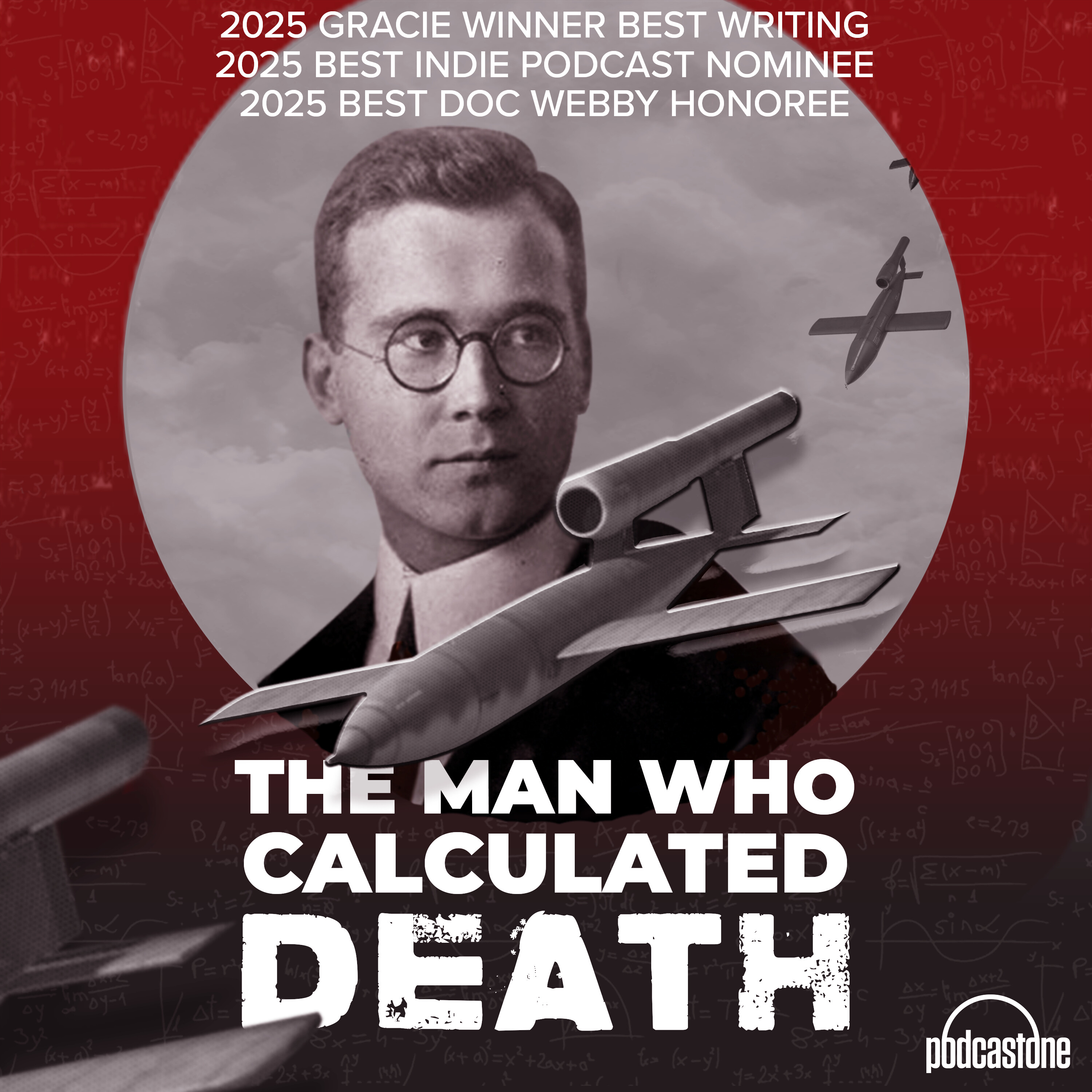
Hey everyone, it's Suzanne. And for bonus episode three, we go behind the scenes of the man who Calculated Death with Jon Cryer, the podcast's executive producer. Hope you enjoy some of the backstory to how my family ancestry got told and what's to come in season two.
- [01:15]
Unknown Host
So, Suzanne Rico, Yes, I am Joan Crier. Yes, you are the producer of your podcast. Yes, you are the man who Calculated Death. So you've had obviously your family story your whole life. What made you think that you could make this into a podcast?
- [01:31]
Suzanne Rico
Well, it all started when my mom died and she had left a partly written memoir that her dying wish was that my sisters and I finish it. So that kicked off this quest to know more, not just about her, but about World War II, Germany and my grandfather's role in World War II, which was a big role that I never knew anything about. I mean, my mom, when we were little, she would say, oh, if we asked, oh, your grandfather was a genius. And that's it. Boom. End of story. She didn't want to talk about it. So that's how the ball got rolling and then it rolled for many, many years.
- [02:06]
Unknown Host
Yes, yes, this has been a podcast many years in the making. Suzanne got months and months of GoPro footage and audio and it ended up consuming your life for a while.
- [02:23]
Suzanne Rico
Yeah, it really has. In fact, talking about it, I can feel like the hair on my arms and my neck stand up because it feels like when I talked about my mom, it feels so emotionally connective to her and to my family. And I think that once we get a little bit Older, we start to realize how important our family stories are and how important it is to know where we came from so that we can pass that down to the next generation. Right. I mean, if I don't do it, my kids are going to have nothing from my mother, from my father, from my grandparents. And then, and then that's really, I think when you. When you lose someone for good, right. There's a. There's a saying that I love that, that we all die three deaths. And the first one is when your heart stops beating. The second one is when they consecrate your body to the grave. And the third one is when nobody remembers to say your name. And I don't want to forget. I don't want to forget. Especially my mom.
- [03:16]
Unknown Host
And how much did you know about your grandfather? I mean, you, You. He eventually came to the United States, but you don't have any actual memories of.
- [03:27]
Suzanne Rico
No. He died in 1969. So I was a little toddler. And all I knew, I knew that he had created some sort of weapon. I knew that he was an engineer, but I didn't know anything more than that. So when I kind of went back into time and found out that he created this secret superweapon for Adolf Hitler, it pretty much blew my mind. And then the revelations that came after that he was caught up in this. In this crazy war crimes trial where the Nazis actually brought war crimes against.
- [04:04]
Unknown Host
Him, which seems like it makes no sense whatsoever.
- [04:06]
Suzanne Rico
It seems like it makes no sense. And my mom didn't even know that. Right. These were things that I found out going through so many files and paperwork and interviewing experts. And so that. That was a part of it. And then there was. There was my grandmother's death. And she died under very mysterious, very violent circumstances. And the legend in my family had always been that my grandfather's work was responsible for her death. And so I went deep into that. In fact, that alone. Oh, here comes the goosebumps again.
- [04:34]
Unknown Host
Yes.
- [04:36]
Suzanne Rico
The work that I did, just uncovering that part of the story took me probably two years.
- [04:43]
Unknown Host
Amazing. And when you listen to the podcast the man of Calculated Death, it's an incredibly epic story of a family. I mean, just the story of your mother's survival in war torn Germany at the end of World War II is harrowing and amazing to hear.
- [05:03]
Suzanne Rico
Yeah. And that's part of what has brought me so close to her in death, is that now I understand what happened to her. And when she told us bits and pieces of her story as we were growing up, she Told it in, like, fairy tale fashion, right? So she would say, like, and then the bombs fell, and then the city was on fire, and she would say these things, and we thought that it was like a Grimm's Fairy tale, right? We would be like, oh, my gosh, mom, tell it again. Tell it again. So we never connected that to her personally. Like, this happened to you. So we actually went and we found the building that she was hiding in in the cellar as the city of Kassel burned above her. 90% of the inner city was destroyed in a firebombing, and she was hiding in the cellar as her home burned above her. And then they finally got out at the last second, and she had to watch her. Her. Her. Her home burn. So that kind of trauma. She was six years old, and then she was there when her mother died, and she witnessed that. So my mom had a lot of PTSD, and that was like, you know, the 70s and 80s. We didn't even know what PTSD was.
- [06:10]
Unknown Host
Back then, because now we see all these things that we. Oh, yes, absolutely. That's a story.
- [06:15]
Suzanne Rico
She would have ptsd, Right. But do we just thought she was weird? You know, we thought we had a weird mom who would, like, run out of the store, like, trying to breathe, and we'd be like, oh, mom's freaking out again. But now we understand why there. Would we. I grew up in Cupertino, where Moffett Field is, and they used to have the old bombers flying over the Silicon Valley. And she would, like, panic.
- [06:36]
Unknown Host
I'm sure if you've ever experienced the sound of those bombers, it's terrifying. And it was, I suspect, meant to be terrifying. But I can certainly understand. And it's fascinating to me because listening to the podcast has totally transformed how I perceive that war, how I perceive people who went through it. Obviously, when we were young, the. You. You would hear war stories from veterans. And now I realize, oh, my God, I hope I was not re. Traumatizing these people.
- [07:04]
Suzanne Rico
You know, that's true. The people. The people don't like to talk about it.
- [07:07]
Unknown Host
No. And understandably. Absolutely understandably, yeah. Did your sister go through a lot of the same things you went through.
- [07:13]
Suzanne Rico
As you made the program? My sister was absolutely amazing. Both my sisters, I have two sisters, so my younger sister, Simone, she did the. The piano music, the classical piano pieces. She performed those in the podcast. I'm so grateful to her. And. And she read my mother's memoir, so she is the person who really brings that memoir to life in the podcast. And then my older Sister Stephanie is the one who. She rode shotgun with me. Right. I mean, she was there every step of the way. We went and we slept in the farmhouse where my grandmother died. They rebuilt it after the bombing and we spent the night in the room where she died. We went to an abandoned military base in the north of Germany and we got behind the locked gates to see where our grandfather tested these super weapons. We went to my Uncle Hans house, who went to the basement and got a box of his father's stuff out, which I sometimes call the box of dishonor. You know, it had his Knight's Cross in it and it had his Nazi medals and things like that. So she was there every step of the way. And not only does she speak fluent German, which was super helpful, but she also was just moral support. Yeah.
- [08:24]
Unknown Host
I have to say, I also, I admire, just as a listener, your willingness to go into some of the darkest parts of the history of Nazi Germany and how your father played a part in some of that. Grandfather, your grandfather, rather.
- [08:36]
Suzanne Rico
My dad was in California. Yes. So I'll tell you a quick story pertaining to that is I never identified myself. I mean, I identify as German for sure, but I never identified myself as a descendant of, of, of a Nazi ever, ever, ever. Who would ever want to do that? And so in the podcast I connect with this 94 year old Holocaust survivor who at the age of 14 was forced to build my grandfather's bombs in an underground concentration camp. So it was a conversation. Here come the goosebumps. It was a conversation between me, the granddaughter of the man who was the chief designer of those bombs, and the 14 year old who was forced to, to make them. And on that stage, in front of 300 people, standing room only, they introduced me as Suzanne Rico, descendant of a Nazi engineer. And I damn near crawled under the table. I mean, I was. My face went pale, I had this like autonomic reaction. I was sweating. And then I thought to myself, there's no way out. You just got to own it. Like, you've come this far, you have to own that. Because if we don't own that part of our histories, we don't learn the lessons. We don't pay it forward, we don't pass it on. And so Oscar and I have. That's my Holocaust survivor. We've formed this really close friendship and he always tells me, we need more people like you. We need more people like you to tell the truth. Because a lot of the bystanders from World War II, the German bystanders, they didn't have anything to do with it. Right. They don't really want to have anything to do with it, and I get it. But they did. And so I have completely embraced. Not in a good way. I don't know if that's the right word, but I own that history and that lineage and that heritage and that bloodline. It's part of who I am.
- [10:35]
Unknown Host
Well, I was very brave to investigate.
- [10:37]
Suzanne Rico
Thank you.
- [10:39]
Unknown Host
And it's really interesting to see the sort of. The interview that you got with Oscar Jacob, who worked at the camps, is an astonishing piece of audio. And, you know, it's incredibly moving and incredibly powerful, and it's a part of a narrative of. Of a lot of people coming to terms with the past, and it comes full circle. And I don't want to give away the ending of the podcast, but I think you're in a position to be in contact with the descendants of people who caused your family an enormous amount of pain. And when your opportunity is given to bring that full circle, you grasp it with two hands, and it's absolutely, absolutely beautiful.
- [11:36]
Suzanne Rico
Yeah, I really. I've come to love Oscar, and it's astonishing to me, every time I think about it, that somehow, because we have formed this really deep friendship is that I have become the steward of his story. Right.
- [11:49]
Unknown Host
Yeah.
- [11:50]
Suzanne Rico
Like, I am telling his story now, and that. That is deeply meaningful to me. It's. It comes with a tremendous amount of responsibility. And, you know, he does look to me to make the world not forget what happened to him. He was in three concentration camps. He lost 40 of his family members at Auschwitz. And so I take that very, very seriously. I'll tear up talking about it because you'll. You'll hear in the episode with Oscar, which I don't pat myself on the back often, as you know, but I think it's probably the best interview I've ever done. But in the. In the story, Oscar gives me a piece of grace that I just call a lesson in humanity. I feel like that's what it is.
- [12:34]
Unknown Host
That's absolutely what it is. It's amazing to listen to. Absolutely. And. And I should say that there's so much more to your family story after what happened in the.
- [12:45]
Suzanne Rico
In the.
- [12:45]
Unknown Host
In the first. And I will call it the first season of the man who Calculated Death, because, again, it's an incredibly epic family story. And that second chapter is also astonishing. And I can't wait till you take a swing at it.
- [13:02]
Suzanne Rico
I hope so. You know, it goes from. Really, my grandfather was born in 1899. So it goes from the turn of the 20th century, and it goes all the way through his death in 1970, and even farther, if you want to include my mother and my sisters and I. But a little bit about my grandfather. You know, he had an incredible life.
- [13:20]
Unknown Host
Oh, my gosh.
- [13:21]
Suzanne Rico
He was a race flyer when planes were like, there's one. I've seen one a year.
- [13:27]
Unknown Host
Yeah, exactly. He was Charles Lindbergh. He was, you know, Amelia Earhart. I mean, he was, you know, he was. He was a celebrity.
- [13:34]
Suzanne Rico
He was. He was a star.
- [13:36]
Unknown Host
And I just want to say it's a riveting account of a family slowly being sort of pulled into the Nazism that's engulfing the whole country at the time.
- [13:45]
Suzanne Rico
That's right. That's right. My grandfather was an aeronautical engineer. All he wanted to do was design and fly airplanes. That's all he wanted to do. And in the 20s, that's all he did do. And then he got into the 30s, and the Reich was getting started, and Hitler was on his rise to power. And the next thing he knew, the company he was working for was like, oh, you're not going to make sport and touring planes. You're going to make war planes. He had three kids by then. He was like, okay, I need a salary, right? And part of the investigation, and I'm not even going to tell you what I found, because you'll hear it in the podcast, but part of the investigation and the most important aspect for me of the podcast was asking the hard question of, was my grandfather a real believer, an ideological Hitlerite? And I think I answer that question, although it's impossible to get into the mind of a dead man. But there are lots of pieces that I uncover about that. And, you know, it's so weird, John, because obviously I never met him, but I feel like I know him.
- [14:49]
Unknown Host
And that's a beautiful thing. And it's interesting because the portrait that emerges is very complex. And you understand how, you know, we tend to like looking at World War II because we feel like good guys, bad guys. You know, everything's clear, very black and white. It's literally black and white. But when you get into understanding the human beings who went through it and why they did what they did, not to justify it, but. But to understand it and look back at yourself and reflect upon, you know, what are the choices I've made?
- [15:18]
Suzanne Rico
You know, what are the choices I made. That's exactly right. And I have to put myself not just into his shoes in the 2020s, but you have to put yourself in his shoes in the 1920s and 30s as this in Germany. Right. Which is kind of a fool's errand because you can't armchair quarterback from here. You can't look back and go, oh, well, here's what I would have done. I would have been Schindler. I would have, you know, helped everybody. And that's, that is the, the trap that I found myself getting into is like, oh, I would have done this, I would have done that. And then I go, well, wait, if my kids were at risk and my livelihood was at risk and I couldn't leave the country. Yeah, maybe not.
- [15:59]
Unknown Host
And we also have a. We have an assumption of perfect knowledge that every. That everybody going through a particular age and time is aware of everything that's happening at once. And you're not. You're. You're limited to the, to the knowledge that you have.
- [16:12]
Suzanne Rico
Right. And I think a lot of Germans did think that the storm of Adolf Hitler was going to blow over, that there was no way. And, you know, it's one thing that I love about this podcast is it introduced me to so many pieces of history I didn't know, that I didn't learn in 8th grade or 10th grade or 12th grade or college. And one of those was that Hitler was actually arrested in 1925 and convicted of treason and given like a five or six year prison sentence. And then the forward, right judiciary let him out after nine months, and then he off was off to the races.
- [16:48]
Unknown Host
Yes, he wrote Mein Kampf.
- [16:50]
Suzanne Rico
That's right. He wrote Mein Kampf. That's exactly right. So there were all these little pieces of history that maybe I knew and forgot, but, you know, I was like, okay, they had a chance. And that's the, like the, the hinge that history turns on all the time. And that's how his life. His life hinged to, unfortunately, what was happening to Hitler.
- [17:11]
Unknown Host
But he has a. He has a fascinating redemption arc that, again, we'll get to in the next. But you start it. You start it at the end.
- [17:20]
Suzanne Rico
I do. And what's super cool about that is that the second part happens in the United States. And what happens to my family after the war, that's actually when it started getting really hard for them. Right? I mean, during the war, he was a German engineer. He had a paycheck. He had, they. They made sure that he was well taken care of because he was making these wonder weapons. But after the war was over, after my grandmother was killed, and he found himself unemployed, widowed, and on the run.
- [17:52]
Unknown Host
And how many kids?
- [17:53]
Suzanne Rico
And five kids.
- [17:54]
Unknown Host
Five kids. Yes.
- [17:55]
Suzanne Rico
That's when the shit hit the fan for my family.
- [17:59]
Unknown Host
Yes. Because people forget that after the war, Nazis were reviled by the populace because they had gotten them into the war.
- [18:08]
Suzanne Rico
And nobody really wanted to help. Right. I mean, the United States did send some help, but not until the Marshall Plan did they send significant help. Right. So. So Germans were starving and the. And the. The infant mortality rate was skyrocketing, and my family was. I mean, they were starving and. And you can say something like, oh, well, he deserved it. Okay, let's just not even put that on the table. We can say it or not, but. But the kids didn't. Those kids did not deserve what happened to them. And so then the whole thing pivots over to the United States and, oh, my gosh, we go to Alabama and Ventura and the Jet Propulsion Lab and all these cool places. So I'm excited to bring that one, too.
- [18:53]
Unknown Host
Yep. It's an amazing story.
- [18:54]
Suzanne Rico
Yeah.
- [18:55]
Unknown Host
Amazing story.
- [18:56]
Suzanne Rico
Okay. The man who Calculated Death. Follow the man who Calculated Death in the Wondery app. You can binge the entire series early and ad free right now by joining Wondery plus in the Wondery App, Apple Podcasts or Spotify.