← The Marketing Millennials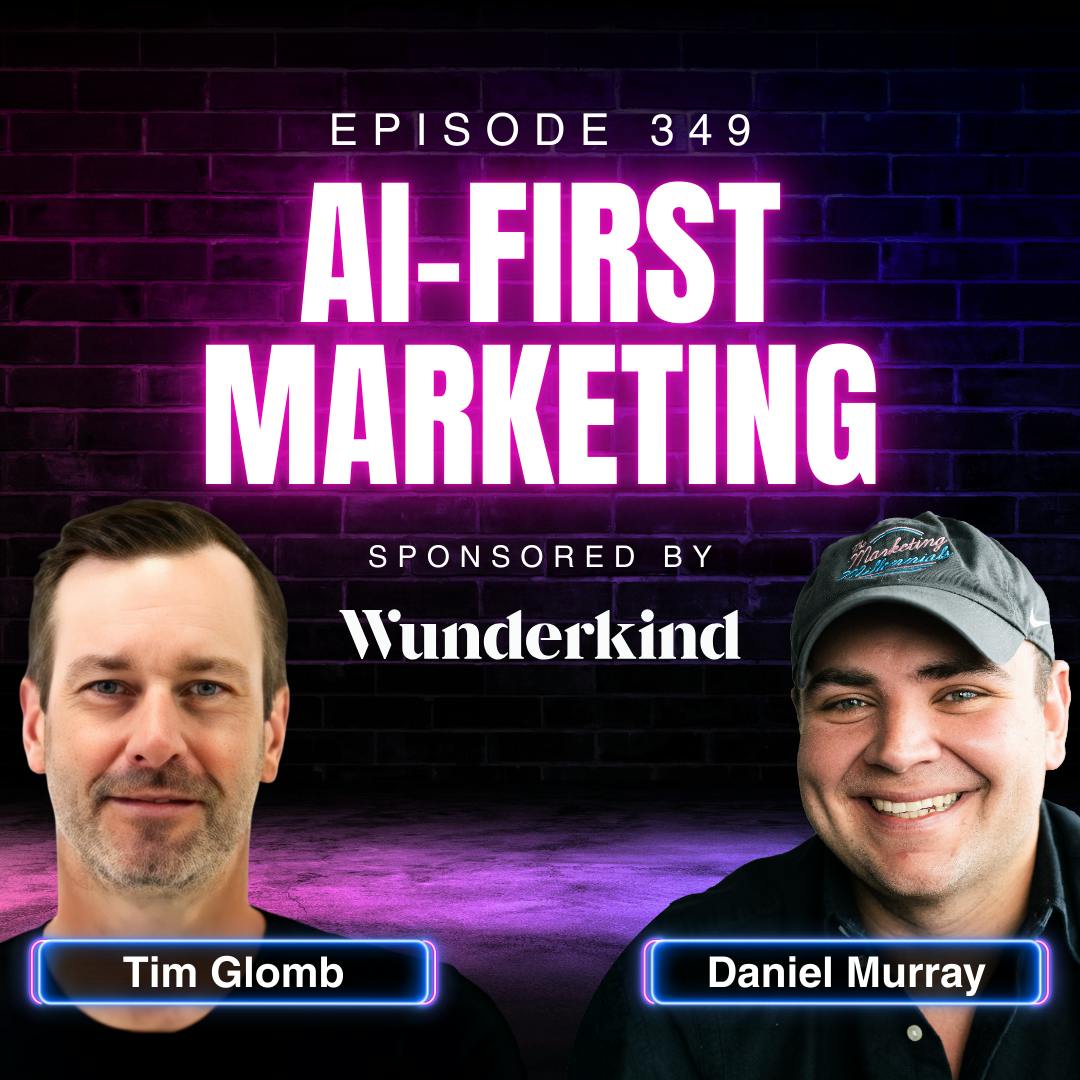
The Marketing Millennials
Building an AI-First Marketing Mindset with Tim Glomb, VP of Digital, Content, and AI at Wunderkind | Ep. 349
00:48:31
Loading summary
Transcript43 lines
- [00:01]
A
Marketers spend millions driving traffic to their site, but 95% of visitors leave without buying. Wunderkin helps brands turn those anonymous browsers into real customers with smart flows across email and sms. Visit Wunderkin Co to see how much revenue you could recover. Welcome to the Marketing Millennials, the no BS Marketing podcast. I'm Daniel Murra and join me for unfiltered conversations with the brains behind marketing's coolest companies. The one request I tell our guest stories or it didn't happen. Get ready to turn the up. What is up? Welcome back to another episode of the Marketing Millennials. Today I have Tim, the VP of digital content and AI at Wunderkin. Excited to chat. But I'll let Tim go into a little bit of what Wkin does and who he is, and we'll get into a fun conversation about Black Friday Cyber Monday.
- [01:10]
B
Let's do it, man. Yeah. So thanks again for having us. I'm Tim Glam, as you said, head of digital content and AI here. So I oversee all the operational AI. How are we actually using AI tools to run our business across everything from finance, HR, operations, marketing, etc. But Wonderkin won. What is Wkin? Wkin really is one of the world's largest identity graphs for consumer devices, right? All the things that consumers use to shop online, laptops, iPads, phones, etc. That identity graph has about 9 billion consumer devices tracked in it, which means we can oversee about 2 trillion digital click, browse and purchase behaviors each year across thousands of websites. And really at the end of the day, what we do is use all of that data along with our clients most brands, their first party data to trigger the best, most optimized Messages across email, SMS, social advertising on your website, etc. All in the spirit of finding the best personalized experience at the individual level. That's us in a nutshell.
- [02:13]
A
I'll ask you this question because we can kind of frame it in the sense of e commerce brands. Brands are going to are starting to deal with Black Friday Cyber Monday now because have to get ahead of it beforehand. So what is something like Wonder can do and why should you start making sure you have some a platform like this before Black Friday Cyber Monday?
- [02:37]
B
Yeah, good question. And look, Black Black Friday Cyber Monday is the super bowl for many brands. Some of our clients will see 50% of their revenue generated in that period, you know, or at least from the start of Black Friday all the way through into the holiday. But what they don't realize sometimes and what they miss is maybe their ESP you know, their email service provider has a pop up and that's helping people opt in for marketing.
- [03:01]
A
Right?
- [03:02]
B
You are going to get a flood of people looking for the best deals ever through the BFCM period, which means you're getting people coming to your website that typically don't come there all year long. Now they're in shopping mode, the moms, the whomever looking for those perfect gifts. That is a huge, huge, huge, huge opportunity to acquire net new people in a more sophisticated way so that you can market to them all year round right beyond Black Friday Cyber Monday and even into next one. And I think there's some great stats of like, you know, 70% of your customers come to your website within the three months of black Friday Cyber Monday right around then. So what can you do during that period to harness people? And with Wunderkin's identity Network, we know so much about a given consumer that's on your website that you don't even know. So let's say John Doe, Jane Doe has never been to your site, never purchased before. There's a good, good chance that their device is in the Waterkin identity network and we've seen them make purchases prior so we understand what makes them tick, what gets them to conversion. And then we can apply that technology even to the point of helping you offer the best value exchange to get them to opt in. So that's number one, number two, number 90% or more of your traffic during BFCM is gonna be anonymous to you. They might be returning customers, maybe they're not logged in, maybe you don't have a login or a loyalty program. So you know, is your cookie or your ESP's first party cookie, has it been erased, has it been ditched, has their cache been cleared? We can help you identify your own existing both consumers, people that have interacted with you before and your customers, people that are in your database that have purchased and we can unlock that the moment they come to your site. So now again, if Tim comes on a new iPad or iPhone or I cleared my cookies and you can't recognize me, you can't personalize to me, you can't send me an email, if I leave after, I don't convert and that's where Wunderkin comes in and closes those gaps. So you should be thinking about how much traffic can you identify whether they're net new and can you create the best offer to get them opt in. No longer are the days of everyone getting 10% off to join your mailing list. There's Table stakes. That's old school. Can you actually optimize and personalize for people and continue to create a breadcrumb trail? Everything they do on your site before they become opted in or before you can recognize them, Wunderton will track all of that. And the moment they opt in or the moment they're identified, all that intelligence is unlocked. So you can create complete personalization on your website while they're in session or have the ultimate triggered message after they leave.
- [05:34]
A
2025 has been a kind of a crazy year for E commerce. What is a the biggest change you're seeing in consumer behavior from 2024 to 2025? Because I mean we are setting up for a lot of E commerce markers, DTC markers, setting up a bscm, but they might not know what's happening with how consumer behavior is changing this year. So what are some things you're seeing in the back end?
- [05:59]
B
Yeah, great question. I could talk for days about the tariffs. You know we, we should probably talk about tariffs. So let me talk about non tariff things because the tariffs have impacting everybody. We been doing research every month since the tariffs came out starting in April, every month. In fact we have a new one that just landed on my desk today and how that's really impacting purchase decision planning, budgets, et cetera. But Outside of that, AI really is stepped up 2025 it has shown up and consumers look, we can't fight it. 700 million weekly active users on ChatGPT. That means a giant pile of people that had no idea what AI was 12 months ago are now using it for search. They're using it to find their best outfit, to find their best next vacation, whatever it is. So AI is changing that entire consumer journey and if your brand isn't tied into that some way in that discovery process, you're probably slipping. But also can you create more personalized experiences using AI? Right. Everybody, every marketer out there, including myself in my B2C days have done the whole like oh, I got to send an email Friday to everybody who looked at my sweatshirts. That's a horrible batch and blast campaign. In the age of AI, can you truly create a bespoke experience for Daniel and for Tim based on what you know of them? I never buy during the day. I buy on my phone or my iPad at 10pm at night after my day is done. If you have the intelligence and that data, can AI serve a better message at the right time with the right message in the right channel? That's where I think AI is coming and A lot of brands haven't really figured that out yet in my opinion.
- [07:40]
A
I want to ask a little bit deeper on that because I, I read one of your blogs and they it said pretty much that if you use MM like MMS versus sms, you see an increase and now that it's even harder to stand out because everybody has text message now and everybody has email now. So using something like multimedia messaging services like GIFs and having images actually helps you stand out in the text message box. So what are some things that are that brands could do to personalize the experience but also stand out during this period of time with that personalization journey?
- [08:19]
B
Yeah, good question. And look, the answer varies by vertical very, very clearly. Fashion brands, if they send MMS of actually showing accessories and things, conversion goes through the roof compared to just a traditional text. Like hey, get back to our site, click here. Like that's just a, that's just a message to get you to take an action. Whereas MMS is that visual. Right? And we know that people love videos, we know that they love testimonials, we know that they love reviews from other peers. So that visual in MMS works really well in those verticals. Financial services, not so much, you know, so it really depends on your industry when it comes to mms. The other thing is visual cues as a triggered sms. Mms. And what I mean by that is think about cart abandonment or even category abandonment or product abandonment. Somebody came to your site, they looked at a certain, let's say shoes, then they looked at ties, then they looked at belts, then they left. Well, that MMS will be an incredible visual reminder of the belt or the shoes they looked at or they spent the most amount of time on. So can you harness that consumer behavior time on site, the things that they actually did and looked at with a little bit of historical, like wunderkind understands what people have purchased on other sites. How do we bring that together to create the best bespoke MMS with the best creative. Right. Should we show the shoes or the belt? Where did they spend more time? What did they buy previously? So you know, MMS I think is great. We're all visual creatures, especially as you get younger in the audience that you're targeting. But it is a psychological visual reminder and it's a great tool to use especially if you know when and what to put in it. And you know when to put it, you know when to deliver it to that particular customer.
- [10:05]
A
Oh yeah. Now with AI you can like start separating lists better, you can start personalizing lists but also something you said earlier, which I think a lot of people are competing during this time period. So having a platform that can identify those users now you can start creating, building offer lists, promo lists, launch lists, start launching things throughout the year so you stay top of mind. So when BFCM comes, people are ready for it. Instead of having to capture that tensions when someone's like I'm shopping for this, this, this, this, this. Which is a much harder time to. I mean you see uptick because people are shopping. But the uptick could be exponential if you have a list built up or know who those people are and could deliver those personalized information. But I want to go into what you said earlier. I mean the thing that is affecting all brands right now, all over, is that the terrorists and inflation happening. So how is that affecting B2C? What DTC? And how, how could brands get over this hump or do things to make sure that they ease the consumer's fear ness over delivering products and stuff like that?
- [11:26]
B
Absolutely. Look, like I said, we've been polling hundreds of consumers each month as the tariffs started in April. A couple of things are absolute considerates. Number one, over 58% of the US consumers are either worried, pessimistic or outright panicked about their financial economic state in America. So think about that. Less than 40% of people are like okay with where we are economically. And that just by default is going to make people cagey about their money. Right. They're going to spend less. Women are far more worried about the economic impact of tariffs and the economic future in the next 12 months of America than men. Men are a little more bullish on spending, but not by. The other thing is 40% of Americans are regularly visiting websites that they've never visited before. So remember what we talked about a few minutes ago. You know, in bfcm you get a deluge of traffic because people are looking for deals. You know, they don't think about you. Like, I love Patagonia, but at the end of the day, if I've got to go buy outdoor gear as gifts for my kids, I'm gonna, I'm gonna cruise around and see who has the best deal. Cause they all have great products. So I'm deal shopping. So Patagonia loyalty kind of goes out the window in BFCM for me because I'm deal hunting. That's happening all year right now. So it's basically the BFCM panic attack. Everybody's looking for a deal from groceries to home goods to everything. So that's a great opportunity for every Small challenger brand because you're probably seeing a little more traffic right now than you normally do. And that's because people are deal hunting. So tariffs are bringing that on. The other thing is people are getting savvy to the tactics that marketers use. For example, cart abandonment. Almost everybody under the age of 35 understands what cart abandonment is. You put something in your shopping cart at a brand, you leave and you wait for that offer. Now two things are going to happen and this is really important for brands to understand your esp. If that's your cart abandonment trigger mechanism, right, let's say I'm going to name names. Klaviyo, mailchimp. I don't care what it is. If you're solely relying on your ESP to identify who put something in a cart and so that you can send them a message, a discount, a reminder, whatever it is, which consumers are now doing because they know brands are sending discounts to get you back to buy and so they do it intentionally. Cart abandoned. Well, your esp, like companies like Wunderkin, there's others beyond us. But Identity resolution partners can sometimes 10x identify the amount of opportunities to send off emails or sms. So as those people are browsing your site and abandoning your carts or abandoning your categories, do you have the Identity resolution in there? So that's one big thing. The last thing is be clear with your pricing. People have made it very, very clear they're willing to stick with you if they're loyal to your brand or they like your brand. If you're incredibly clear about why and when and how you're upping your prices. Over 50% of Americans do not believe that tariffs are protecting human job or American jobs. That's very clear. In fact, it's close to 60% in some demographics. So they, they also believe, I think 60% believe that US consumers are paying for these tariffs. So that means you as a brand actually can have a real transparent conversation. Say, we're sorry we had to raise our prices for 10% because of the tariffs. You know, we're getting dinged. So we're sorry we have to, you know, pass that on to you, the consumer. But the consumer understands that they have empathy for you. So don't try and hide it. Don't just raise prices and expect everything to be hunky dory. You'll get called out for it. Be clear, say, hey, we're sorry. In fact, I'm seeing a lot of brands just send emails to their entire list saying, look, if you're shopping this year, for us, prices are going up. We're sorry, it's out of our control, but we're trying to be transparent. So those, those are just a couple of things that we're seeing as trends that you could do as a brand to, you know, connect with your consumers during troublesome economic times.
- [15:32]
A
I actually like that because, for example, I just had a kid a few weeks ago and we buy the baby formula that and ships from Europe and like a brand was like, if you buy like, you should probably buy like more right now just in case it gets stuck in customs or something. And I was more as a parent, I'm like, thank you for telling me that I will spend more money to buy it now and then, then wait and have a risk that my baby doesn't get its food, then do it now. So I was really respectful of a brand telling me, hey, we only have 20 in stock right now. Yes, and it will go up because we don't have the shipment that's in that will get here in time. So if you want to buy more, more right now, just do it right now. I was more happy that the brand said do that instead of buying five coming back to the store in two weeks. And they say I raised my price. They didn't tell me that they were going to ra their price identity like give a, give a bigger heads up to the consumer. And I think that's a, a great point. And then what you said about.
- [16:41]
B
Being.
- [16:41]
A
Able to personalize that, that journey and actually understand who's on your side, what, what they like, what their, what are their preferred ways of communicating is, I think, I think it's just like a lot of the, the old method of either what you said, sending that Friday email to everybody who looked at that product and say buy again or just sending a generic, hey, you left something in your cart is way over. Yeah, it is.
- [17:19]
B
And you know, I want to mention something you said earlier on the last question when you said, you know, building these lists of people who have looked at shoes and this and that and having them ready for bfcm. I mean, I'm going to call that caveman marketing right now because we do live in the age and Wunderkin has unlocked this and there's other companies doing similar things. You literally can let, if you give all of your data and an AI decisioning engine access to it, right? All your first party data in your historical. Let's just take me as an example, Tim Glom. When did I last buy? What did I look at? How many times do I Come to the site. How many times do I open an app, whatever it might be? If you take that plus Wunderkin knowing that Tim has gone to all these other websites, looked at similar products and then you take the historical of when Tim does, when does he activate? If you have intelligence on when does he convert most, on what device does he convert most? Like I said, I get in bed at 10pm almost every night and that's when I browse for 30 minutes. That's when I'll buy on Amazon or direct from a brand. When you have that kind of individual data and history on every consumer, the need for lists almost goes out the window. The batch and blast almost dies or becomes very, very less important because AI can say Tim is ripe for this deal. At this point you just dropped stock or you just got this in inventory, this is back in stock or you just did a price drop. These are all indicators that could be matched to Tim. So literally the hardest thing for marketers to understand is we're used to a B testing. Hey, send email A and then email B to this list and see what it does. In an age of AI, every single person can get a truly bespoke, unique email. You can't track A, B, C, D, E, F variations. But what AI can do is prove that it can make a better decision on when and what and how to send a message to a person than any human could ever scale. That's scary for a lot of marketers to get to, but that's what Wunderkin is doing in our autonomous marketing platform. Seeing amazing results for like cruise lines, like increasing revenue and decision making and upselling, you know, suites on their ships, like exponentially over what they've been able to do through human orchestration. So I just want that to bake in marketers minds that AI decisioning is here. And if you're not playing with it, you know, 2026 is your year to explore that.
- [19:38]
A
I feel like so many marketers are just doing like the touch surface AI stuff, like I need to write an email with it or I need to. And then there's the, the next level of it. As I insert data in it, they give me like research answered which would have taken hours to do, like putting customer reviews and qualitative data in and saying what are the key pain points? What are this? Which will, will help for like website and maybe strategies for copywriting on those text messages and stuff. But what you said of mapping the next level is mapping letting AI say okay, Tim gets a message on his iPad at 10pm and it's going to offer him a new pair of shoes because he recently looked at a new pair of shoes on all these other websites but he couldn't find the right one and now he's in the buying mentality. So offer him a piece of shoe. That's like the next level where AI is actually kind of like the, not the campaign manager, but more of like the decision maker of like shooting out messages when audience needs it.
- [20:52]
B
Exactly. So now the marketers, the human marketers should set up business guidelines, right? So let's say for that pair of shoes, we're willing to discount between 0 and 18% discount, right. To win a sale. And if I can look at Tim and his history, you know, I make good money. So discounts don't really drive me hard. It's loyalty points and other value adds that drive my decision making. And if AI knows that we can send Tim a 5% discount but tell him he's getting free shipping and he's going to double his loyalty points. Whereas, you know, Jane Doe might need that maximum 18% discount because she's a thrifty shopper. And when AI makes those decisions in the moment at the individual level now humans just put the guardrails in place. This creative. We're willing to give these offers, we're willing to do these discounts. And to your point, it's AI decisioning. It's not the campaign manager, but it is the decision maker on when and where to sell. And when you see the results of the machines making decisions, it's huge. And look, just a couple years ago, all of us marketers applauded send time optimization. Every email platform has send time optimization. That's just machine learning and deciding to put people into certain cohorts and send it certain messages. That's close. But that's not personalization. It's still segmentation with groups of people getting messages at these different times. You know, when you do it at the individual level, it's crazy hyper personalized. So I'm really excited about that.
- [22:18]
A
Yeah. And I mean if you technically have a brand, even those hyper personalization sometimes doesn't like, doesn't even work because as someone with a name recognition, even if they send it any time will out beat someone who just sends a, a random time. So it's like yeah, people avoid, say use that as a strategy instead of building brand at the same time as well. So those are like little things that people do. I want to go into a question of, I know a lot of marketers during this time, like you said, are like setting up lists. They're, they're over relying on paid media. They are doing last minute scrambles of offer landing pages and complete offers. But what are some ways that brands can avoid making costly mistakes? Now before bfcm and also I would still ask the question like during bfcm, how could they make sure they gathering the right things this BFCM to set up for a successful 2026 BFM BFCM.
- [23:26]
B
Yeah, absolutely. So, so number one, the acquisition, right? We start to see around Halloween in America a lot of people are signing up for deals. So that's the acquisition play. Make sure you have the most optimized acquisition tools out there. And I challenge you, go talk to someone like Wunderkin who has identity and we'll show you how we're going to greatly increase over your ESPS acquisition tool. That's number one. Number two, urgency always wins. So you know, collect the data that you need, but when your promotions are going out, use urgency. You'd be blown away. And I did a webinar on this last year in our BFCM insights, you know, we generated billions and billions of clicks and like $5 billion in BFCM period. People, whenever you sent a message that said, hey, this is gonna end at, you know, 11:59 or midnight tonight, you'd be blown away in the last 10 minutes how many people actually activate, especially as you get closer to shipping deadlines for holidays. But BFCM all start. So in your campaigns, think about putting urgency in there. You know, make sure that's top of mind. When you talk about collecting data, this is a great time again to look at and measure how much traffic did you have come in through the period? You pick the period, whether that's Halloween or just a week of BFCM or whatever you want. How much traffic could I not identify? It came and it left. And to your point, I reached into my checkbook and I wrote a check to alpha, Alphabet and meta and I retargeted these people with third party pixels. I don't know who they were, but I paid to get them back. Think about that anonymous pile. What if you could shrink that anonymous pile in half and identify that other half so that you could use email and SMS to reach them for, you know, pennies on the dollar. Instead of paying this paid media funnel and you know, tornado of insanity, I would collect all that data and then get through BFCM and talk to an identity resolution partner in December, January and say, here's my metrics. I'm very frustrated. I had Good traffic, but I couldn't identify. I was only able to send 10% of that traffic a message to get them back and only 10% converted. How can I lift this next year? Collect that data this year, give it to someone like Wunderkin and challenge us to say how can you guarantee revenue is going to lift next year if I, you know, bring an identity resolution? That would be my advice.
- [25:49]
A
I think the crazy thing that you said right there is how many people don't realize that they're marketing to the same person and they're getting the same cac cost for someone that they already have over and over and over through like Facebook and Ometa and, and Google just because they don't understand who they are. It's we. I used to work at a company called Ciao now but our messaging for Ciao now was that like DoorDash, you're like basically if someone repeats order on DoorDash, it's a marketing tool so you basically keep, keep on paying for the same order and marketing over and over and over when they're ordering. So it's the same thing as Meta and Face a meta and Google when you're doing that. And one thing I wanted to add too is my wife. She's queen of D2C so she knows all about this but she talks a lot about like people needing to set up a mobile first experience for this time and a lot of people still not doing that especially for like Cyber Monday and Black Friday Cyber and they do things like put widgets on their phone that block, they block like offer like offer pod pops that block CTA's call to actions. They block copy, they block. So what are some things that people should be thinking about for mobile first experience? Even though we've been talking about mobile first for years, I think still brands aren't realizing how many people in BFCM are shopping mobile first these days.
- [27:28]
B
Yeah, I mean especially that younger generation generation. You know, I think there's huge, huge power and being able to personalize an actual experience in the moment. What I mean by that is if you're lucky enough to get somebody to come to your digital property, let's call it your website, whether they're coming on mobile or in your app. Especially if you have an app and you're lucky enough to get them to download and we'll leave that to the side because most people that have consumers logging into their app, they're pretty connected and they know everything that's going on because it's a logged in state. So let's talk about people mobile shopping, but on your website, if you could personalize that to your point, if you got all these pop ups in technology that's being blocked by, you know, millennials who don't want that stuff on their phone, you're missing a huge opportunity. But with lightweight SDKs from say, like an identity partner, you could literally understand who's there and personalize that experience without having third party pop ups and all these restricted and ad blockers and whatnot. But your experience on that website can change dynamically based on who it is and the information we have on them. So that's one thing that's probably a stretch to implement for this year's bfcm, but you should absolutely, to your point, at the least, maximize the viability and the readability and the speed of your website for a mobile experience. Because we all know, man, two seconds, I'm out. There's another website waiting for my attention behind yours if it's not optimized and people will ditch very, very quickly.
- [28:56]
A
Here's a tough stat. 95% of website traffic is anonymous and leaves without buying. Unidentified visitors means lost revenue. That's where Wunderkin comes in. They can identify those browsers and deliver personalized outreach that turns them into customers across email and text. The best part, you don't have to rip out your current tools. Wunderkin plugs the data right into your stack. Unlock your incremental revenue at Wunderkin Co. Today I want to ask you, since, I mean, you do have AI in your role and we know we talked about AI, how to use it in personalization and what it does, but what are some other things you thinking about? It doesn't have to be like personalization, but what are some things that marketers should be using with AI right now, Whether it's internally in their tech stack or it's marketing to their end, like the audience with AI.
- [30:02]
B
Yeah, the number one thing I think from an internal perspective is the insights that AI can pop up that a human would, it would take hours if not days to go find and understand. And what I mean by that is when you have all this data, all your click throughs, all your web traffic, all your identification, if you have all your data available to an enterprise level or an umbrella AI engine that says, hold on a second, we're missing an opportunity here, or these are the people that are perfect for that product that you just got back in stock or just loaded up the inventory on. You know, humans can have been doing this for, for years, right? Matching the opportunity through business rules and looking at data. But AI happens instantly. So for example, at Wunderkin, we have what's called AI audiences. So a brand marketer can go in and give a little guidance through natural language and say, I need to move these shoes. We've got a lot of these shoes. They're collecting dust. The price point is X, Y and Z. I'm willing to discount to X level. What are the opportunities within my existing audience right now that I could create today to approve and go off and have triggered messaging happen over the next month to sell those shoes? And the AI audiences will look at all of your data. Everybody who's been there, everyone who's clicked again, Wunderkin might be bringing enhanced and enriched data. Tim was looking for shoes on another website. We can't tell you which one. But yes, he's in the market. He should be in this cohort of audiences. So I think marketers need to understand that AI can go find these opportunities without you having to say, let me build a rigid rule. If somebody bought shoes in the last six months, suppress them, because they're probably not in the shoe market. And if they've looked at these things in the last six months, then put them on this list. It's very human, it's very rigid, it's very orchestrated. But I literally will find the needle in the haystack every day for any segment, for any product, for any channel. And a lot of marketers don't understand that because they haven't been introduced to it or presented it because their current solution, their esp, their cdp, whatever they're using, doesn't have it. So, you know, one thing I learned as a marketer, I've been doing this, you know, I'm 50 something, so I'm still young in spirit. But I've learned that if you're not kicking the tires on your technology and your technology partners constantly and keeping them up to par, you might be lagging and you might just be stuck in your technology and not even know what's possible. So that's the one thing I would, I would tell marketers to do, is go kick the tires. Go look at what technology can do today with AI, because it's unbelievable the opportunities it will create for you.
- [32:39]
A
I think one of the worst problems in marketing today is the guardrails. Or what's about the limits that their current solutions have on their creativity and what they could do as marketers just because they don't want to go implement a new solution or this, the old solution I think sometimes I know migrating sucks and it could be hard, but if your partner is not continuously investing and upping their technology every month or putting on new features is probably something wrong. And you don't want to be stifled. You rather be stifled by your budget than your, your technology. So, yes, I don't think, like, it's just crazy to me how people are saying, I don't, I, I'm not going to send more, more text messages because, like my text messages don't do this or I'm not going to send emails at this time because my tech or, or what you said. I'm not. I can't use AI in my, in my personalization. So I'm just going to keep sending batch emails. And then you're losing to your competitors. Who has the solution fully and what.
- [33:57]
B
I love about this, and you know, I've been through the cycles, right? CMOs just in the last few years said, consolidation. We want to consolidate. We don't want 10 vendors. We want one partner who's going to be able to do everything for us. Well, that's great idea and it's a great way to like slim your vendor list. But at the end of the day, is that vendor really into R and D? Are they really advancing their product like you just said? Are they, you know, rolling things out? What I think in the age of AI right now, and the way Wunderkind looks at this and the way we've stayed, we are a decisioning engine with data intelligence. If you love your espn, you love your CDP and you love your text platform and you love the creative over there and you love the way they operate, great. Don't change that. You can add a Wunderkin type layer. We have things called Build. It's a framework of APIs that will now make intelligent decisions, but you can still do all your creative in your ESP and it fires through your ESP or through your text platform. So I think a lot of brands have an opportunity to say, I love this esp, I love this text platform, whatever it is. Is there a smarter data layer or intelligence AI layer I could attach on the side of it or have live underneath of it so that we at Wunderkind decide. Tim needs a text message today, so we're going to send this through a tentive, for example, but tomorrow he needs an email on this topic, so we're going to send that through Klaviyo so marketers don't feel stifled by your own esp. Look at some of these data layer intelligence things that could bolt on very economically, cost effectively very quickly, and still keep your creative and keep your existing tech in place. You know, most CMOs who want consolidation don't like to hear that. But the reality of it is go find the vendor that's very, very good at that part of the process that cog in the machine and plug them in where you need them. I think there's a huge opportunity, especially with all these AI companies popping up like us.
- [35:51]
A
Yeah, I think that sometimes becomes a little problem when you have a solution that does it all. They're not like the best at the one thing that you need to. So having a solution that can integrate to your current solutions. And that's a question that people should be asking if they are looking like, who are the integration partners? Can they integrate? Is there an open API? Can I connect to all these other tools? I think people need to ask those questions before that they, before they buy a solution.
- [36:29]
B
Absolutely. Right now, more important than Anything is an OpenAI framework or, sorry, an open API framework. So with APIs you can do anything very quickly. So if you're, if you're dealing with a vendor, I don't care what it is in your marketing stack, if they're very rigid and they can't take open APIs in a two way, that should be a blocker right there. You should really, really question how important is that vendor? Because APIs and connecting all these. Look, there's solutions that are being built right now that we don't even know about. You and I have never heard of. And in January it's going to be the next big thing. So taking that API framework, you're able to plug in the right tool, the right data, the right experience at the right time. So that's a good call.
- [37:10]
A
Lastly, I have, and I asked everybody on this podcast, but what is a marketing hill you would die on?
- [37:17]
B
0 party data. I don't think enough brands ask consumers what they actually care about. I think we all think we're the smartest people in the room. We're marketers, we know what our consumers need. We built this product. It's a perfect fit for xyz. We're going to jam it down their throat, even to the point where, look, we build websites that are one way, they're billboards. We talk at the consumer. This is my product description. This is what it does. This is the cost, These are the colors. I think there is a complete lack of conversation and data mining those conversations. It's as simple as surveys. Like I've seen Brands do incredibly well. Large brands. Coca Cola was an old client of mine, Starbucks, et cetera. Go out and run sweepstakes surveys or just ask your audience what they care about, put that information in their individual profile. Jane and John Doe level. I think zero party data is the rocket fuel for personalization because you and I could. 10 of us could be on this podcast right now and Apple could be trying to sell on us their next product. But each one of us cares about something different. One of us might care about how long does the battery last. One of us might care about how cost effective it is. I care about the camera. Well, when you know that and when you know what your consumers actually care about, you can talk about and present your product in the perfect light. And you know you no longer have this one big launch mantra for your flagship product, that it does X, it now does XYZ 1, 2, 3. Because you can map what it does to what people care about. So I think zero party data, that psychographic stuff that consumers give directly to a brand, is rocket fuel. And I'm bummed that more, more brands don't take that more seriously.
- [39:01]
A
I mean, also like you said, in the age of AI, right, that is probably the biggest differentiator you have with data with other brands because everybody has email, everybody can get a title, everybody can get a name, everybody can get where you live. But if you're not collecting conversations or even going out in public and recording conversations you have with people now with AI, you just could put it into your whatever AI partner you have and it could digest the multiple conversations and tell you these are the five things your consumer cares about. And then if you go on to go deeper, you can map it back to the individual. But yeah, it's just what you said, like zero party data now is what's going to separate you when everybody is collecting, everybody has access to collecting all this other information that you were saying before.
- [39:56]
B
It's a total differentiator. You're playing on a completely different field. You're not even playing at the same rules because you're right. Everyone has a checkbook and can run ads. Everybody has a website and can track it. Everybody has a product that does X, Y and Z. It's that rocket fuel. And you know, I'm going to name one. Hills Pet Food was a client of mine years ago and they literally asked you so much about you and your pet and all that went into their record. I think they had, on average, well, they had about 200 data points. They could ask you over A customer lifetime. But they had on average over 50 unique data points. They knew exactly when, where, how, and what to present to you from a. From a pet experience. And people love their pets that have pets. So that was a great company that personalized everything, like down to the end mile. So it's a company that's going up against giant pet food companies and they had to be a challenger brand. And zero party data is helping them cut through with like the ultimate personalization, which builds the ultimate loyalty package. Those people who buy from Hills continue to buy from Hills because they understand them as an individual and that goes along.
- [41:03]
A
And what you said, I mean, you could. That could be done with like 10 data points. Like, if you figure out the dog's age and you just map it to like, what dog usually happens to that dog's age? What type of dog they have? Do they have allergies or not? Do they eat, like, do they eat regular food or hydrolyzed food? Like, you ask like four questions and now you can personalize that this is what people at this dog's age have. This is what this dog type, like seed. Here are five, like trusted brands for that type of pet. Who needs that? Those types of things. And you could personalize it by saying your pet, Jimmy the. The cat that loves X, Y and Z would love these five things without saying those five data points that I just said.
- [41:51]
B
And it goes even beyond that. Like, yeah, they go deep. They're even like, does your pet like to play with toys? Does it fetch, like, these small, simple questions that don't seem to have big meaning, but they paint a picture of what happens in your house, under your roof, with you and your pet. And all of that data is completely personalized into the copy. You know, you talked about AI for copy and subject line. Well, Hill's Pet, I'm assuming right now, because they have great copy, is using AI to say, this is everything we know about Tim and Skippy, his pet. Like, right. You know, we know we're promoting this product, but write it in the tone that Tim and Skippy are going to understand, you know, and they can say things like, hey, you know, next time you're out fetching that ball or that rabbit or that bunny. Right? Because they'll even ask you, your dog likes to fetch. Cool. What does it fetch? Here's a list. Bunny, stuffed animals, balls, like, whatever. All that stuff matters, man. It's a psychological connection. When you see that in the email that you get from that brand, it's.
- [42:47]
A
It's a huge you just add those, those points and merge tags in the email and then it's. And then you could. And use your copy, like how you write copy usually as a brand and you merge those two. So you personalizing on the brand side and personalizing on the consumer side.
- [43:05]
B
It's so simple. But a lot of brands just aren't putting those tools together. They're not stitching it together. So again, what hill I die on? I think zero party data. Personalized information about an individual is always going to be the most important fuel to your marketing campaign.
- [43:21]
A
Lastly, where could people find what you're doing? Wunderkind's doing all that good stuff.
- [43:26]
B
Yeah, I mean, look, we're a content company. I'm head of global content here. As I mentioned, we do tariff reports, we do BFCM reports, we do tons and tons of content. You can always go to Wunderkin Co. It's not comm. It's in our resources section. Whether you're a client, you know, whether you never want to do business with or not, I don't care. I spend a lot of our money on research and development. So again, I'm researching consumers, I'm researching what other marketers are doing. We make all of that data available to you. In fact, we're an AI first content company in that. Yeah, we can give you a PDF you can download for the tariff reports for the month of September. Cool. But we also have beautiful, what we call mascots. They're AI engines completely trained on that. So if you just want to go and ask questions, say, I'm a footwear brand and I only sell to men 18 to 34. What should I be doing based on tariffs? You can do that. It's our own little ChatGPT experience on all of our content. So please visit Wunderkin Co. Look at our resources, go through those gates, give us your email address. But on the other side, I promise you, you're gonna have AI tools to make you the smartest marketer. They're going to be available to you 24 7. And if your boss comes to you and goes, we need something new for bfcm, what are we going to do? Go use our bots? Like go use all of our research and have it give you 20 ideas, just ask it like you would chatgpt.
- [44:48]
A
Yeah, I read the reports. I mean, I mentioned a couple and they're here. I think having a company who's actually collecting these data will make it easier for you to do that. It's not hard to just put in an email to Just go get. This is one time where I say you can put in an email to get something because I think a lot of reports are actually BS that I read. But if you, when you have a library of stuff to go and AI to be able to search it, I think it's a match.
- [45:19]
B
I'll give you a good example. So last week I was looking at metrics for our August tariff reports and there was somebody from a footwear company, that's why I mentioned that. And they said, hey, what do I need to know? I sell to these people. And our AI bot gave them direct feedback and percentages and it kept querying, kept querying, chatting. And then it said, write me a blog that I can prepare for my leadership to tell them the suggested changes in our marketing parameters that I need them to buy into. So our agent literally wrote the entire blog with bullet points and data. So I'm assuming that person copied that answer from our AI mascot and took it to leadership and said customer research that came out last week says this, this is why we need to do X, Y and Z. So please use our tools like be the smartest marketer in your, in your organization. Maybe even be the smartest AI, you know, person in your organization.
- [46:12]
A
And we all know leadership love data, so we know they love it. They love a data point to refer back to. And that's whoever, whatever marketers did that. I give props of their, they're using it smartly.
- [46:26]
B
You wouldn't believe some of the things we see in the query. I can see all the queries. It's great. I don't know who it is, but to be sure, like if you're using our tools, you're anonymous in our AI widgets. But people are really, I mean we live in the age of ChatGPT. This is what marketers need now. They no longer need a report that they have to read for 30 pages, retain maybe 10% and go make decisions. They just need a smart AI based assistant that has all the right information, you know, in its knowledge base. That's the world we live in today. So please, we've, we've adopted this, we're paying for it. Even if you don't do business with us, use our tools, be a smarter marketer.
- [47:02]
A
Well, thank you so much for coming on and I really appreciate you appreciate having me. Thanks so much for listening. Keep tuning in to hear more great insights from the coolest marketers from around the world. If you haven't already, make sure, sure to subscribe and follow the marketing millennials podcast on Apple Podcasts, Spotify, YouTube or wherever you get your podcast. And if you like what you hear, I would greatly appreciate you giving us a five star rating. It helps bring more marketers into our community.