← The Marketing Millennials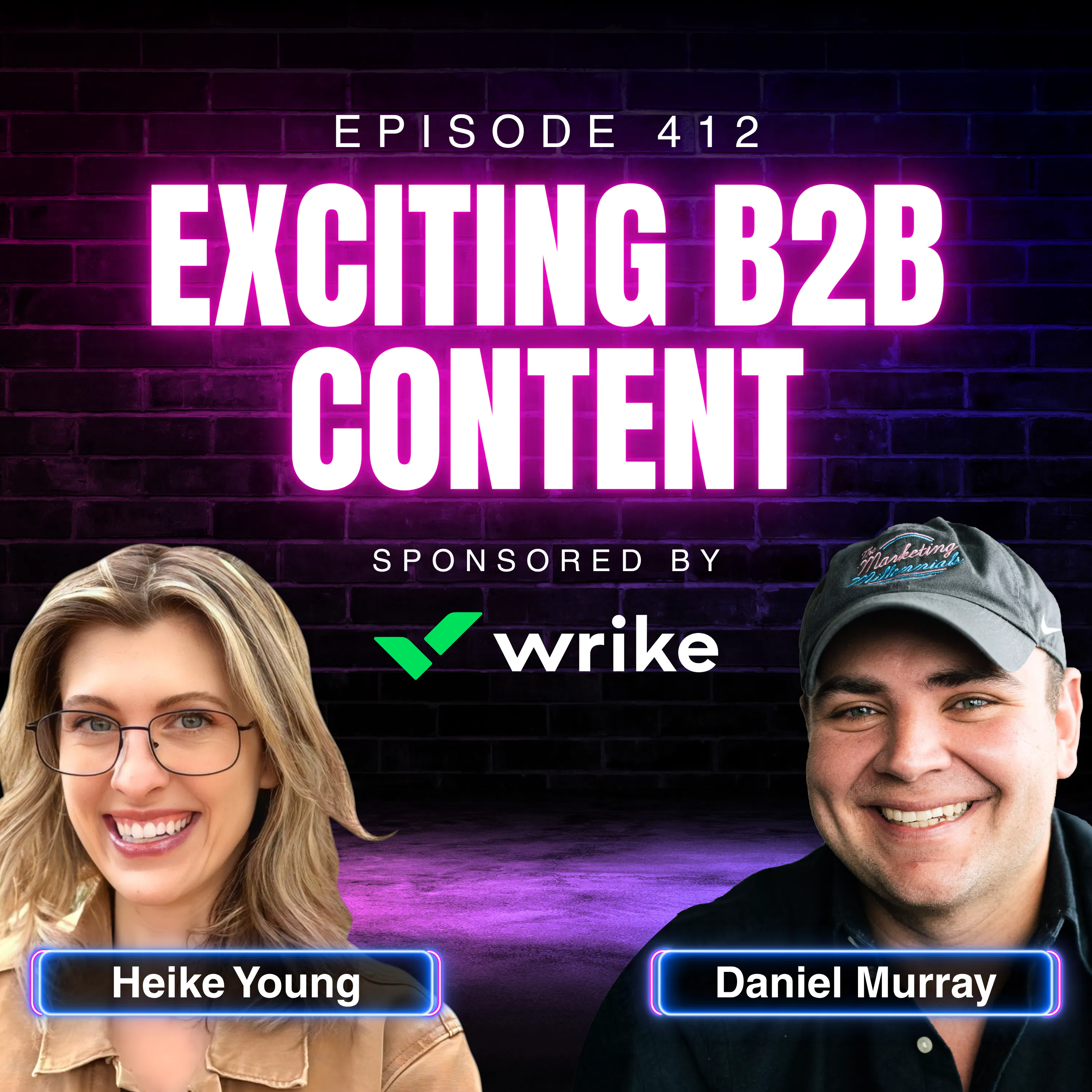
The Marketing Millennials
How to Make B2B Content Actually Exciting with Heike Young, Former Head of Content, Social, and Integrated Marketing at Microsoft | Ep. 412
00:46:47
Loading summary
Transcript29 lines
- [00:01]
A
Ever think about how much time you spend doing admin versus real work? Wrike fixes it. Smart task management AI that flags risks and one source of truth for your whole team. For real. Check it out@wrike.com TMM that's W R I K-E.com TMM welcome to the Marketing Millennials, the no BS marketing podcast. I'm Daniel Murray and join me for unfiltered conversations with the brains behind marketing's coolest companies. The one request I tell our guests stories or it didn't happen. Get ready to turn the up. We have someone who's LinkedIn famous on the podcast today. Super excited to talk to her. Heike, thank you for joining. I'll let you give you a little background of what you do and who you are, but I just needed the people to know that we have a link LinkedIn star here.
- [01:11]
B
Thank you so much. And for everybody listening who doesn't know the full backstory of this podcast episode, this is like our third time trying to record it and I think it's finally working. I think we got everybody's technology is working. My roof isn't being actively worked on. Fun fact, the last thing that you want to have going on in your house when you're recording a podcast is for roofers to be working in your neighborhood. So finally we can actually have this conversation. So thank you Danielle for having me on the Marketing Millennials. I'm Heike. Heike like Micah, if anybody listening to this has ever been staring at my name on LinkedIn and didn't know how to pronounce it. I work at Microsoft currently. I come from kind of the enterprise B2B content and social media space space. I was at Salesforce for 11 years. Before this I really got my start in book editing and book publishing. I used to edit the For Dummies books, if any Marketing Millennials are old enough to remember those. And I also managed social media at an agency for a little while. But aside from all of that, I kind of have this other, this whole other life where I publish content on LinkedIn and this has been a big priority of mine, I guess since maybe January 2024 is when I really started to publish a lot more content on LinkedIn, especially LinkedIn videos. I was really at sort of a low point in my second maternity leave, really lacking creative outlets, feeling kind of down and just seeing all my co workers doing cool things on LinkedIn and just wanted to add something to that mix while also learning some video editing skills that I really didn't have at the time. And so yeah, I guess it was kind of January 2024 that that I began to publish more content on LinkedIn. I had about 2,000 followers and in a year, primarily through creating humorous short form vertical videos on LinkedIn, I grew my account to 20,000 followers. I think I might have, I don't know, I have to go back and look exactly, maybe over 35,000 followers now. I've just really continued to prioritize content that fills my cup, the kind of things that make me laugh and that I would want to see in my feed. So yeah, that's been something I've really focused on and just like a big creative passion of mine for the past year and a half or so and excited to, yeah, get into this conversation with you about all things marketing and millennials and whatever tangled web of conversational topics that we get into today.
- [03:40]
A
Yeah, I'm super excited that we have a third take of this podcast. And I do, I, I if you not following Heike, you should go follow her on LinkedIn. She does put out great short form video content. But I, I want to go into that because LinkedIn, I mean, has evolved a lot over the last, even like the last two years. It never, it didn't have short form video before. They've been testing a lot of features for a long time. People did static, people did imagery. And what made you pursue like comedic style content? And why do you think it resonates with like a B2B audience so much?
- [04:20]
B
Yeah, it's a great question. I think for me, as I was scrolling LinkedIn a year and a half ago when I started this project of uploading weekly, if not more vertical videos to LinkedIn. Often humorous as you, as you said, at least I hope they're humorous. If you don't think they're funny, no, that's fine. That's neither here or there. To me, at least I tested something and learned in the process, right? Content creation, content strategy, testing. But I think for me at the time I was spending a lot of my wee hours with my newborn baby scrolling TikTok. To be honest, I was consuming a lot of content on TikTok and it was just so engaging. And so I was like, this person could look like they just rolled out of bed, the production value could be on the floor. But if somebody had a really good joke, if they had something to say, that video could get a million views overnight. And I was so inspired by the way that content, just like having a good resident idea was spreading through this Short form format on TikTok in particular. And so then I would go over to LinkedIn and I was scrolling to feed and I'm seeing all this content from people who I know are really smart, I know are really funny. They're people maybe that I've worked with in the past and I know that they're a genius. But for whatever reason, you know, a lot of the content that I would see there would be this sort of text based, you know, post. It's not a lot of, maybe not a lot of humor in it. It's like super stunned serious. And I guess for me it was just marrying these two things together. Like this isn't the TV show separates. We are the same person when we come to work that we are at night. We're the same person who binges Love island or watches SNL or listens to Bo Burnham stand up or whatever it might be, right? Whatever your audience might be into, whatever you might be into, you are that same human being at the end of the day. And so I think just wanting to approach B2B content with more of a holistic mindset of like, this is the same person with the same taste in entertainment any hour of the day, like that really motivated me to create something different on LinkedIn. And certainly there were other creators that did inspire me and continue to inspire me to this day. But I do, I feel like I was trying to create, I was trying to fill a niche and I was trying to create something that I would want to see in my feed and something that I didn't see as much of in my feedback as I would have liked. And so that was definitely a big inspiration to me for creating this type of stuff on LinkedIn.
- [06:55]
A
Yeah, it's funny how consuming content can inspire you to create certain forms of content and also seeing content on other platforms that are relatable to everybody and just bringing that touch to B2B. I think like you said before, we're the same human that comes to work and then goes to take care of the kid after work and then goes to hang out with their friends, goes to go like that. We're the same and we're scrolling the feed just the same way. And we're not sometimes like the best ideas just come from another industry or another format or another. And especially on like a platform with LinkedIn, which I've seen for a long time is being better, does not always work on LinkedIn, like creating better content, because that's subjective. But like being distinctive on LinkedIn works. Like having A format having a style showing up differently. So I want to go into like for someone who is starting today, like, what is your like 1, 2, 3 steps to get started on LinkedIn.
- [08:07]
B
I love what you said and want to go back to one thing you said for a second and then I'll give some more practical tips. One thing you just said that really stood out to me was being quote unquote better or I think what you mean is like more high quality in your content production does not equal high performance. I completely agree with this. A bigger budget does not mean bigger performance full stop when it comes to video content. And I see this all the time, not only in my personal LinkedIn account that I run for myself, but also in brand accounts that I manage. Often the most low fidelity content with the least amount of production budget put into it can often pop up pop off the most on social media. It all kind of comes down to the message and what you have to say. And sometimes in B2B I actually think that all the fancy bells and whistles, the big production value, it can actually make your content read more like an ad when you want it to read like organic content that somebody would just be scrolling social media and wanting to enjoy. So I would think about that. I would think about, you know, who are the if you're a marketer, you're trying to uplift the voices of people in your business or if even if you're just trying to create content or for yourself as a creator, as an influence, as somebody who's just trying to even build your personal brand a little bit, you're not trying to become a huge big name creator influencer but you want to be known in your industry, you want to be asked to speak at conferences and things like that. I wouldn't worry as much about the polish as I would about the substance.
- [09:47]
A
I two points I want to make on that is one that like social media for the longest time in B2B has been like an announcement channel and and like a checkbox channel versus like a attention channel and a a way to get like build actual value for the person on the other side. It's like oh, we have an event check mark. I got to put it on social media just because it's a checkbox. Oh, I have a, we have a someone new joining the company. Let's checkbox and tell everybody that's but instead like that's evolved. But I also just piggyback on that you like low fidelity content. I've worked with some and I've Been around with some big names like Microsoft, light companies who have such strict brand guidelines, brand formats, they want this high production. So how do you internally force the issue? We actually don't need these high production things. How we actually don't need. We could do different things on social to actually win.
- [10:54]
B
I'm still figuring out the answer to that question, Daniel, but I have a few ideas of things that I think could work. Number one is really leading with examples. So when you're just starting out in this journey, you might not have data from your own profile to show, hey, look what happens when we do a more low fidelity approach. But what you can show is other examples in your industry. And I'm telling you, it doesn't matter if you're the biggest enterprise company in the world, if you're a small startup where you fall on that spectrum, there are examples of companies in your industry with founders and marketers and employees who are out there telling the stories of that company in a really compelling but low budget way. So I would look for examples. And this has definitely been something that I've personally done when I've been in house to show my leadership. Hey, did you guys know that XYZ competitor over here just did this really cool YouTube short series or they just started a TikTok and like look what they're doing. And that type of social pressure can really help, especially convincing readers who may not be on board with this type of thing yet. But then I would say data is going to be your best friend. And I think it's not only data about performance. I think a lot of people, when they hear the word data, they probably think, I mean performance data. So like, oh look, we did this high production video and it did X many views and then we did a low production and it was that many views. That is one tool in your toolkit. But I also want you to think about two other really big data points that are key to convincing your leadership to do anything in today's environment. One is budget and one is speed to market, moving with speed and urgency, right? So in terms of budget, if you can actually say, hey, for this type of content, we can get this many impressions for this many dollars and maybe the only dollars that you're spending are a tiny microphone and that's almost the only a free video editing app and that's all you need. And this is how much content we can create at that budget, right? And like that's incredible versus the budget over here. So that's another data point. So performance data, budget data, but the last one is speed to market data. And it's really, really important today. I think for any brand that wants to be more active on social, moving quickly in today's environment, you have to be able to flip on a dime and create content that is relevant and timely and seasonal. Not something that just was dumped on your YouTube channel or your LinkedIn and looks like it was filmed, you know, three years ago. Because it's not timely at all. Right? Like that's not the tea, that's not what's working. So if you can also have a data point and go back to your leadership and say, yeah, when we do videos the old way, it takes us a month and a half and there's a this long process and there's a million people that need to get involved and then there's all these approvals. If you work with us on this new process, on the flip side, we can ideate and have an idea filmed in the afternoon that we created that morning. And that video has the potential to really do numbers. And so I think if you combine those data points together, together you wrap them up into a really compelling story, you are going to be able to change some minds at your company and do it really effectively. And the other thing I would just say too is working with creators is an, is an additional option available to you if your company is a little bit skeptical. So maybe you have some budget and clearly maybe they do have budget because they've been filming these really high production value videos and take a portion of your budget and work with some creators, work with some individual influencers who have relevance with your target audience. They are going to be able to reach that audience really fast as well. And that can be something that's hard for companies to do. I know for me personally, I do offer some brand partnerships now on my account, which I never set out actually to try to do. Back in January 2024, if somebody would have told me, you know, I would be doing brand partnerships on my LinkedIn account, I would have been like, I think you're wrong. LinkedIn is for me to apply to jobs, not get jobs on LinkedIn. Like, I would have been so confused about what that even looked like. And since this past January, it is something that I've been offering. But a lot of the brands that, you know, come to me and are looking to work with creators or influencers are really struck by the speed that influencers can work with. And so they're like, well, this is amazing. We can kind of go back and forth On a few ideas for a video. I can script it in a few hours and have something filmed and edited in just a couple days. Like that type of speed is really what's needed in today's cultural context. But it's often, you know, it's not possible in a lot of the traditional production environments that brands were brought up in.
- [15:47]
A
I mean, I think those are all good points. I think one, like showing what other people are doing. Like brands always want to like naturally keep up with the Joneses. If you. It's like a natural instinct of keeping up with the Joneses. And I think the, the results, like obviously that's like showing that like short, like these low production videos are getting these numbers versus these high production are not getting these numbers. And then I like the how the point of like what you said is like, there's so many other ways that you can go out of like the creative realm without like having to post yet, which are like working with influencers or using comments as a way to not like a commenting strategy, which you can be a little bit more unhinged in the comments than you are in on your social account. So there's so many ways that you can start standing out. But that gets me back to that question I was going to ask you is like, let's go down the two paths. We could go down two paths. I think one is an individual. What are the 1, 2, 3 and 1 is like, I want one to convince my boss to start posting on LinkedIn for like a brand account. What are those three steps? Are they the same? They're different. Going down those two paths.
- [17:11]
B
If you are an individual looking to create more video on LinkedIn for whatever reason, right, you want to be positioned in your industry to get speaking opportunities, you want to get a new job. The possibilities are endless, right? And I think sometimes there's been this misconception when somebody starts posting on LinkedIn, they must need a new job. That is not the case, right? In today's world, marketers especially, you know, people that really need to put their name out there for a variety of career growth opportunities, LinkedIn is the best place to do that. So let's just normalize posting on LinkedIn for a variety of growth opportunities. And it might not even be a promotion or whatever else. It might simply be getting outside perspectives on things, meeting new people. There's a million reasons why somebody would want to post more on LinkedIn that have nothing to do with, you know, they hate their job. So first and foremost, like, let's normalize that if you are an individual who is looking to Post more on LinkedIn, you see the potential of video in particular. There are a couple of things that I want you to do. The first one is to lean into the cringe of watching and listening to yourself. And I hear this complaint from folks a lot, which is I want to do more videos, but like, I don't like watching myself. And so I think people have a couple, they have a couple responses to that. One is that they just avoid video altogether, which is probably not the best response. Right? We all know that video is one of the primary ways that all of us engage with our phones. Like this is a really helpful way to get in front of other people. So just ignoring it, I, I don't think is your best option. Another thing that people do sometimes though is they actually do start to film content and create, but then they like don't watch it back. They film something, they never watch it again. They clip it out and they just like upload it to YouTube Shorts or LinkedIn or wherever else and they never watch it. I highly, highly suggest you avoid doing that. You are going to learn so much about yourself by leaning into the cringe, by watching the video, listening to yourself back. You're going to discover so many things, little tweaks about your delivery that are going to make a huge difference. I will tell you from personal experience, when I started doing this, my first several videos that I edited, it was miserable for me to go back and watch it. I noticed a bunch of little quirks about my delivery style that drove me nuts. But the only way that I ever noticed them was through watching myself do it. I did this thing where I would blink really hard whenever I made a big point. Super annoying. I, I personally was annoyed watching myself do it. I never would have noticed that if I hadn't taken the time to go back and watch the videos. I also was doing this tongue clicking thing. This is totally a vulnerable moment, by the way, for me to share this with you guys. But I was doing this tongue clicking thing where I would be about to make a point and I would go and then I would go on with my point. And I still probably do it to a certain extent, but I've dramatically reduced my reliance on some of those quirks. And so number one, I would say you've got to lean into it. You know, you've got to just kind of take, take that first step and leap into creating the video content. But the second thing that I would say is it's really more of like a spiritual thing. And I would say content creation, for me, it has become a very integrated part of how I live in the world and how I live in my body, how I view things. And I know this sounds a little bit woo woo. And you're like, where is she going with this? I really believe that content creation is a gift that some people, it's like a spiritual gift that some people need to be who they are in the world. And if you're listening to this, this, and you're like, I have ideas for videos I want to create, I have podcasts I want to create. I want to be the Shonda Rhimes of my industry and have a media empire. That is not normal. Not every person has that feeling. A few people have a spiritual gift of communicating and creating content and really putting their voice out in the world and really unique ways. And that's, that's a gift. You owe it to the world to let us see that part of you. And so do the work, do the internal thinking that you need to do to get to a place where you feel confident in the ideas that you're going to put out into the world and then give us the privilege of hearing your voice. So those are a couple of things that I would say for an individual who is looking to get started.
- [21:43]
A
Yeah, I really like that I would just double down on a couple of things is I always like to refer to sports because like I played sports and when I, when you come to posting, it's kind of the same thing. You get confidence from consistency, like putting things out there. Like, you get confidence from doing the, like practicing. And that's why people do practice. Like they practice. Some of the days are bad, some of these are good, but you get confidence from just putting things out there. 2. What you said about videos and watching videos and you think it's cringe, but the best athletes out there, they watch their game film to figure out, oh,
- [22:24]
B
such a good point.
- [22:26]
A
Yeah, they watch a game film to like look at. Okay, the hook didn't pace as well or I, I had a clicking, like I say like a lot. And so I tried to, I tried to consciously, I'm not good at it yet, but I try consciously not say like in all my videos, but just watching yourself back helps you understand where you can improve, where your weak spots are, where your strong parts are. You could double down on the strong parts, you could double down on the angles. You can also see comparative to how it's performing in the market. If I do this, it does that. So watching game film and then the last part where you said about people needed and I, I always urge people is that there's content for everybody out there. And even if people don't, the people who don't like your content and that's not who it's for, there's some people that need to hear that message at that time. And I've had it all the time where I posted something very simple about marketing and I got a ton of people dming me like thank you for the reminder. But then I had these high level marketers make fun of that and say that's so simple. Like why are you saying that? Why would you ever put out content in that realm? So some, some content's not for everybody and you have to just some messages are meant to be heard by other people. I just want to double down on what you said and then you could go to the brand side of things question. Is your team slow or is your processes broken? If every campaign feels like it takes twice as long as it should, take a look at Wrike. Wrike is an intelligent work management platform that connects briefs, approvals and timelines in one place. Wrike also learns your workflows and automates repetitive stuff and makes smart suggestions to keep getting more efficient this evening, even a workload management so you can make sure nobody's buried and nobody's bored. With total visibility from brainstorm to launch handoffs, stop turning into hiccups. Go to Wrike.com TMM to stop chasing status updates and start doing the work.
- [24:49]
B
I think you made a great point, especially about just the content isn't for everyone every single time. There are some posts that big name influencers do on TikTok where you know most of their posts these days are going to be a 10 out of 10 from a reach and engagement standpoint. They've spent years building up an audience of thousands, millions of people and you know, almost every video they post, it's, it's racking up hundreds of thousands of views. That's probably not your goal. If you are in marketing, your goal is probably to influence an icp. People in your industry that you're looking to get career opportunities from the sky is the limit. Your goal is not to go viral every time. And I actually think this feeds into my answer to what you were asking about. You know, for brands, I actually have a hot take that if every single piece of content you post is a huge hit, you're not taking enough risks in your content. You should be testing new things you should occasionally be posting, yes, a flop because you are finding the boundaries of your content strategy. You're finding, okay, if I post about this, like that's really landing. If I post about that, not landing as much, I need to explore this more deeply. I need to find a different hook, I need to find a different wrapper or packaging for this idea so that it reaches the most possible number of people. And so I would say this for brands too. And if you are somebody trying to post more videos on LinkedIn, et cetera, and you know you're doing this on behalf of, of a brand, yes, use the data. I spoke a little bit to that a moment ago. Not only your performance data, but also your budget and your timing data to tell a holistic picture of your content, your production and performance, but also just keeping in mind and telling your leadership, telling the people that you work with, like, hey, some of our content is to test and learn and that's okay. And that also brings me back to a really great point that Jack Appleby has made and he's a great social media mind. On LinkedIn, if you don't follow a Jack and you're listening to this and you're interested in social media trends, Jack always says, you know, if you're in social media, you probably get a lot of requests from people to post random pieces of content that you don't agree with, rather than just trying to shut down every piece of content that you don't agree with and just saying, no, no, you know, we can't do that on our account. What if instead you said, hey, I wouldn't recommend that, but I'm happy to post it if you like. And then you use that performance data to strengthen your viewpoint. Right. I would look at opportunities to, yes, post all of the content that you really believe in. But also it actually doesn't hurt sometimes to post some of the stuff that you know and this might be a hot take that isn't your best, your best, most strategic content because it helps to tell that story of, of what is really performing on the channel. And so, you know, those are a few things that I would say and then getting really practical here. I have spent a lot of time over the past year and a half posting a video almost every single week. Actually, some weeks I probably posted more than one and I spent a lot of time thinking about what on LinkedIn makes a high performing piece of content. And I, I think I've learned a few things about it. You know, in a year I grew my account from 2,000 to 20,000 followers, primarily from posting short form vertical videos. And what I really learned that there's four things your content needs very tactically to perform well on LinkedIn. So LinkedIn is different than any other video platform. It's not like YouTube where we get a title and a description and all of this real estate. It's the video is showing up in the feed next to text posts, next to video posts and next to image posts. And it has to really fight for its place in that feed. And so I also think a lot of people on LinkedIn, maybe they're browsing LinkedIn at work. They're, they don't want to always watch a long video. Their, their video, the tab is open in their browser with a million other work related tats. They might not be watching it with the sound on. And so I always tell people, you know, there's kind of four things to look at, a title for the video. So I would superimpose a text box on top of the video, say what it is. Captions, you need to have captions that actually explain, you know, so show something about what this video is going to be about. You don't want those first few captions to just be, my name is Heike and I work at Microsoft. They can see that from my LinkedIn profile. They don't need me to regurgitate that. Right. So captions that really get into the meat of the content. A visual hook. So some type of visual, a person smiling, maybe you're holding an interesting prop, you have a cool background behind you to visually compel people to watch. And then finally, the last thing that you need is a part of the text post that is really gripping and hooky as well. And because every video post on LinkedIn, it doesn't just stand alone. There's a bit of text that goes in the text post and that can be long or short. People do all of the above. But you need these elements to work in concert together for your video to in my experience, reach the broadest possible audience. And so I would think about, especially if you're working on a brand account, but these same tips apply to a personal account. I would think about how you can communicate the value that you're going to provide in this video through all of those elements that I just mentioned. And hopefully with all of those things combined, you will be able to get that view and earn that view and that, that trust and credibility over time. And after a year and a half of doing this, I believe that now when I put out a Video because I put out a lot of valuable videos in the past just from people seeing it, like, oh, okay, it's from Hikea. She posts a lot of videos that I find valuable. That trust and that credibility is already there and I've earned it. And I have to keep earning it with every video that I put out. And I want them all to be valuable. But the more that you put yourself out there, the more you create your content and show people how useful and inspirational and entertaining even that it is, you're gonna earn more of those views over the long term. So don't get discouraged if the first few times you're like, all right, this didn't quite hit the mark of what I was looking for. You keep going. Because that reach and that resonance with people, it's, it's gonna come the more that you continue to be consistent in, in your content.
- [31:32]
A
Yeah, I mean, showing up inconsistency builds trust. That's the ultimate trust builder is like if you show up day in, day out, people will start recognizing you. And that's why, I mean, it's just marketing. You're just doing marketing where you're, if you stay top of mind long enough, like, people will start recognizing you for that thing that you keep on putting out there to the world. And I do, I think it's also important for people what you said about how to, how you broke down a video. I think it's important that format, like there is formats that work. It doesn't have to be how you say things, but like having a hook, having text overlay, having captions, having, making sure that you do things in three second interviews. Because that's how people's attention spans going. So it's like things like that, where you can work on those elements of your video will help you because I know a lot, there's a lot of people who put a great content, but it doesn't hit because they aren't doing the format or the, the correct way of putting out a video. And that's just, it's hard to say. But at the same time, you have to do what works on the platform to keep, to keep people watching and keep people's attention spans. Because there's a lot of people putting out content on LinkedIn, which is actually kind of actually go back and say there's not actually enough people putting out content, but you're still competing against the attention of the people who are putting out content on LinkedIn.
- [33:19]
B
Yeah, agree with that. And I think that if you, it's. We're still in the very early days of LinkedIn being used as a video platform and I've heard a lot of discourse. I'm chronically on LinkedIn. I spend a lot of time on there for work and personal reasons. So I'm, I'm on LinkedIn a lot. I see a lot of discourse in the community of like, oh, the short form videos are, you know, they're ruining LinkedIn and we want to go back to the text based posts and look, I get it. Sometimes I'm just looking to skim a couple inspirational text based posts too and then get back to work. I don't always have time to watch a video, but I have also found incredible value in short and long form videos that I've watched on LinkedIn. And I don't believe that there's anything inherently less rich or emotionally deep or resonant about a short video versus a long video. In fact, there's that famous Mark Twain quote, right? That's like, I I sorry for the long letter, I didn't have time to write you a short one. I think that sometimes a really compelling idea delivered in just a few seconds, a few moments that can linger with people. It's clarity, the succinctness of it like that can linger with people for a long, long, long time. Where sometimes if you're watching a 20 minute TED talk, whatever it might be, your mind is wandering. You know, maybe not every single day second is as punchy as it could be. There's nothing inherently better about a long versus a short video. It's all in how you use it, right? And so what I try to encourage people to do in my work is to treat people like a whole person. Right? It's got to be culturally relevant, timely, move with the culture and the context that we're in, treat them like a whole person. We're not in severance. It's the same person who's watching your video on LinkedIn in the morning as they are, you know, when they're surfing the web for personal reasons at night. Like it's always the same person. Treat them with that same respect, entertain and like, don't be afraid of a little bit of humor, you know, a little bit of that fun. It's actually a great thing to stand out with that type of an approach and really just leaning into LinkedIn and its evolution and kind of like working with it and the direction where it's headed. Because I believe that we're in the very early days of LinkedIn as an inspirational, you know, video platform.
- [35:45]
A
I, I love that. I also always say is if, if a platform is doubling down on a feature, that means you should probably double down your content on that feature because they're going to push more impressions to prove out that feature. It's just how platforms are. If they're gonna, if you put, they putting a videos more and more videos out there, they want that feature to be working so they can encourage people by giving them impressions and views on that platform. This is how platforms go like have worked whenever they launch something. That's exactly like when Instagram launched Reels. Reels now has like more views and a lot of static posts and have more potential to go viral because you they were pushing that feature and that's where people's attentions are. So yeah, so YouTube shorts, if you
- [36:39]
B
were posting YouTube shorts right when they started putting those out, yeah, you got some crazy reach and it's normalized a little bit. But these platforms, they're looking at the data of where people engage, where they see the biggest opportunity. LinkedIn has some incredible stats actually about the engagement of videos on their platform. And so I think they have a lot of reasons why they're pushing content in this direction. And I think it just depends on the message. You know, the media is the message as true today in 2025 as it was 30, 40, 50 years ago. Like the media that you're putting out be strategic in what is the message that you're trying to say, what is the best platform for this? And sometimes joke. I'm trying to lean a thing. I'm trying to say sometimes it's not a video. I had a post earlier today where I was thinking about making it a video and then I was like, there's not really a visual gag. There's nothing I need to say about this that's like it could only be conveyed by a video. A text post is perfectly fine for this. There's other things I want to say where I do want to include some type of visual. Okay, well does it need to be clicked through like a carousel? Is it something better talked through like a video, all of these things. You're not creating a video for video's sake. You are, you're creating it to land a specific message. And so thinking through that stuff is so important. And if you are interested in this, if this is like a topic that piques your interest, I would love for you to come over to my LinkedIn profile and one of my pinned links is my video hooks guide. I spent a lot of time over the past Year and a half distilling a bunch of these tips and ideas into a guide that I just like, I'd never seen anybody kind of put it all into one place before. I know I really could have used a piece of content like this when I was starting my journey and I kind of fumbled around figuring it out myself. So if you go to my profile and you click on my link, my link there, that is on gumroad, and it is A guide to LinkedIn, video hooks and like the placement and some of these tactical elements. That is where I have nerded out about a bunch of this stuff. So if you're listening, you know, curious to get your thoughts, if you want to come, come take a look. And I've had some people reach out to me and just, you know, let me know that it's changed how they thought about placing their content on LinkedIn. And I would love for that to be the case for you too, if you're, if you are a fellow nerd about any of this stuff.
- [39:18]
A
What last thing I want to ask you, because I ask everybody in this podcast, what is a marketing hill you would die on?
- [39:25]
B
So many hills that I would die on. I'm just like living in a land of hills, but all by myself, hopefully. Oh, man, Hopefully I can pick just one. For the purposes of this conversation, I would say one hill. I would die. And I'm going based off of the definition of like you like me having this opinion, I feel like the weirdo or I feel like the outlier. Like, nobody else agrees with me on this. And so this is the opinion that I'll share across multiple jobs. I have seen this across multiple types of industries I've worked in, whether that was agency or in house. I have seen this, this pervasive belief over the years that the person with the highest job title is going to be the best spokesperson for your content and for your company. And here's what that looks like in real life. It's like pitching the SVP to always speak at the conference, pitching the SVP plus to be in every webinar, having that same person host your podcast, having that same person host all of your webinars, featuring that person on your blog posts all the time. I have a different opinion, which is that you should always go with the person that's going to be the most engaging. And people don't care the title of the person that's speaking. They care how interesting, engaging and fun and enjoyable the content is to read or watch or listen to. And so I Feel like I'm sort of an outlier in this because I've had to push back on this so many times in my career. But I truly believe. Go with the person who. They also have a YouTube channel, and so they're going to be great at delivering a webinar. Go with the person who. They have a small business that they're very passionate about where, you know, they're constantly, they're constantly up on stage delivering talks for that small business. And they've never done it before for your company. But, like, now could be the opportunity. I would always go with that person who maybe doesn't have a fanciest job title but is going to make the content the most engaging.
- [41:30]
A
I. I love that. I think. I mean, that's how I. When I look for speakers, for events, I always look for people who have done it before or. Or are great at speaking. And I always test them out on webinars and podcasts before, just to tell. But I don't look at titles. I look at like, do they have an interesting point of view or a good topic that would resonate with my audience? And that's like, what you should go for is like, can they deliver that point of view in a way that keeps people engaged? It's going to be interesting. So I think. And also, most of the time, the people that aren't SVPs are the ones who are actually doing the thing. So they actually have like, real.
- [42:12]
B
Absolutely, yeah.
- [42:15]
A
Like, I'm just doubling down. What you said is like, go like, the point of content is to get people to be engaged or why keep all people there? So go with the best person you have to. Who could do that? Lastly is where can people find you, what you're doing, follow you, all those good things.
- [42:35]
B
The main place to find me is on LinkedIn. My name is H E I K E. If you were listening to this and you're like, heike, how would I even spell that? Is how you would spell it. And then young is my last name. LinkedIn is the primary place where I'm posting my content. But a fun little Easter egg is that I am testing more and more content on TikTok. I do a different type of content on Tik. It's just my name on TikTok, you'll find me. But I do some different topics on TikTok. I actually do a little bit more like mom content, like corporate mom with the demanding job type of content. If that sounds like you, millennial mom with little kids type of content. So if any of that sounds like it could be your jam. Come hang out on TikTok. It's definitely not something that I am doing that I have, like, I think on TikTok, I have like 190 followers. So it's definitely something where I'm still testing and figuring out what works. But I think as a content creator, like, that's where you have a lot of fun playing and trying new things. Like, there's no pressure. And so that's what I really like about it.
- [43:51]
A
Yeah, it's good to test and also, like, it's good that you're trying it on a different channel to see if there's an audience for it. And obviously there is an audience for it because there are so many moms with jobs that are demanding that need some tips and advice of how to deal with that, so.
- [44:14]
B
Oh, my gosh, yes. And I find like, on LinkedIn, it's interesting, like, I posted a little bit of content on LinkedIn before about, like, more parenting advice, and I found that just for me personally, I know there's probably other people who have a lot of success. I find that it hasn't done as well on LinkedIn. And I think people are really, for me, my audience, people are really looking for more of those, like, career growth, you know, career challenges. I feel seen type of content when it comes to their careers. And so just like having it be a little bit more tailored toward parenting topics. Topics for me, it just hasn't resonated as much on. On LinkedIn and on TikTok. I definitely posted a few videos like that where I saw some really strong indicators that there could be more of a community and more of a conversation happening there. So definitely continuing to do both. I have aspirations and dreams of, you know, starting a YouTube channel, but I have to get back to that dreamism. I actually started the YouTube channel a few years ago and the channel was so I'm super into spicy food and the channel was me eating spicy food and like doing different challenges or just like taste testing different hot sauces and stuff. And I. It was really, really fun, but I stopped when I had kids. And so I would love to go back and find a way of resurrecting it at some point, but I definitely need more hours in the day going back to moms with demanding jobs topics.
- [45:43]
A
I love it. Well, thank you so much for coming on the podcast and that was a great conversation.
- [45:48]
B
Yeah, thanks so much for having me.
- [45:51]
A
Thanks so much for listening. Keep tuning in to hear more great insights from the coolest marketers. From around the world. If you haven't already, make sure to subscribe and follow the Marketing Millennials podcast on Apple Podcasts, Spotify, YouTube or wherever you get your podcast. And if you like what you hear, I would greatly appreciate you giving giving us a five star rating. It helps bring more marketers into our community.