← The Marketing Millennials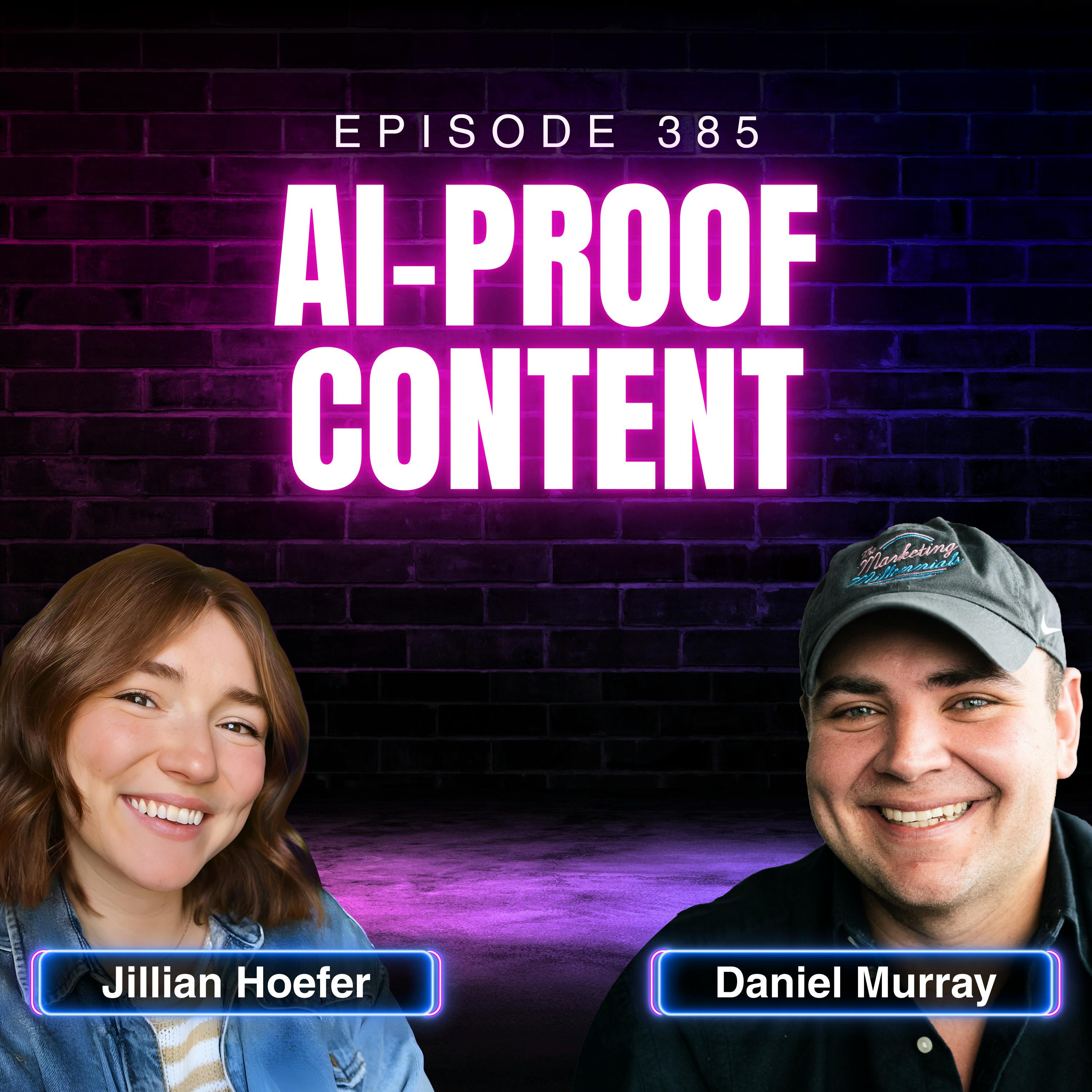
The Marketing Millennials
How to Make Content Stand Out in the AI Age with Jillian Hoefer, Director of Content Marketing at UserEvidence | Ep. 385
00:37:55
Loading summary
Transcript53 lines
- [00:00]
A
Welcome back to another episode of the Marketing Millennials. Today, I got Jillian Hofer on the podcast. We recorded this last year and honestly, it hits different. Now everyone out there is pumping out AI content. Jillian's doing the opposite. Original research with actual humans. I know this is a wild concept, but here's the thing. She surveyed 600 people, put in six months of work, and now that's one report that fuels 80% of her content. In this episode, we break down the whole process. How to actually do this where most people screw it up, and how to use AI without sounding like a robot. And my favorite part of the episode, she shows me live how fast she can pull a stat from her custom GPT. It's ridiculous. Look, this isn't easy. It's not a hack. But. But while everybody else out there is publishing the same recycled stuff, this is how you build something that people actually trust. So let's dive into the episode. Welcome to the Marketing Millennials, the no BS Marketing podcast. I'm Daniel Murray, and join me for unfiltered conversations with the brains behind marketing's coolest companies. The one request I tell our guests stories or it didn't happen. Get ready to turn the off. What is up? Today I have Jillian on the podcast. Thank you so much for joining.
- [01:39]
B
Hey, thanks for having me, Daniel. Excited to be here.
- [01:41]
A
I want you to give a little background about how you got into the content space before we talk about your thoughts on content and how it's evolving with this AI trend coming.
- [01:52]
B
Yeah, for sure. So I stumbled into it like, I think most millennial kids didn't grow up saying, I want to be a content marketer for a tech company when I grow up. But I studied broadcast journalism in my undergrad. Totally was in deep with thinking I was going to be a reporter. I wanted to be a news anchor. I wanted to end up in one of the big markets. I went to a school, actually Ball State University, which David Letterman went to. So we got all the David Letterman big bucks to provide with some really great programs and equipment and state of the art stuff for video and radio and multimedia. And I was in college at the time that really multimedia journalism was just starting to become a thing. Like my degree technically was a dual degree because multimedia journalism wasn't exactly a thing yet. But I was a double major in journalism and telecommunications because that was kind of the closest thing they could cobble together at the time. And I loved telling stories in a bunch of different formats. I loved specifically, I had a heart for video and audio. I Just thought those were really fun and cool mediums for storytelling. And then I kind of had an aha moment when it, when it all became real. When I was looking for internships in my upperclassmen years where I was like, oh, I don't actually want to move to a little Podunk 6th Market Town and work the 1am news shift for five years and earn my stripes. I'd rather make a little money. So I took a corporate internship that was an internal communications marketing internship and kind of just kept niching down and niching down until I realized like, oh, wow, I can use a lot of these multimedia storytelling skills in a corporate environment and get paid a lot more and work nice hours, which was a great plus to all the things I wanted to check off. So kind of ended up stumbling into it and then really, really enjoying working for startup teams just because the, the speed of it was kind of my style. I was used to working on deadline, used to working quickly in, in. So that's kind of how I ended up where I am today.
- [03:54]
A
And one thing you're really passionate about right now, and I think AI is here. It's not going away. But you talk about a lot about a lot about how original research is becoming more value built today than any other time. So could you explain like what is original research? How can marketers start doing this and why is it important?
- [04:18]
B
Yeah, for sure. So I kind of first came to know about the concept of original research, which is essentially like we all did it in school. It just is gathering new data and analyzing it to answer a specific research question. We all did that in all of our undergrad and graduate years. But the first way I kind of started to hear about it in the more B2B and content marketing space is through state of reports. So you see a lot of annual state of reports being put out by brands and all that's based on original research. So this job that I'm at currently at User Evidence, I run content marketing here at User Evidence. This was the first job that I kind of went, okay, my team's really bought in on this. They had just released our first original research report right before I joined the team. So I kind of got to experience the fruits of the labor of what an original research report did for us. Ours was called the Evidence Gap. It was essentially kind of a state of report, but we just branded it to be a little bit more of a piece of content ip. I don't know if that term is familiar. Brendan Hufford, I think was the first one to use it. But it really just solidified our POV in the market. Kind of helped us go, okay, we now have this language. Based on this research that we did, we surveyed over 600 B2B marketers, buyers and sellers to figure out there was this evidence gap in the way that they thought about providing customer evidence for their buyers in the buying process. There's this big gap in like what marketers expect, what sellers need and what buyers are actually using to buy. So having that data and that big report to work off of has been such a huge game changer for me. And I think as a content marketer right now it's the really the biggest way that we can continue to create really impactful proprietary content that's going to stand out. While a lot of lesser content marketers are going, I'm just going to crank out AI fluff pieces all day long.
- [06:15]
A
I mean, that is happening right now. And I get why people are doing it, but also to stand out, you have to do the harder things usually. But I want to break down, how does this get started? How do I, like if I was running a content team right now, I want to make original content piece. Where do I start? How do I start doing interviews? What does that process look like?
- [06:43]
B
Yeah, so you've got to start with your research capture essentially. And most of the kind of state of reports or the reports that people are putting out that are original research are based off of a survey. So that to me is definitely the easiest way to start with the broadest set of data. I think you're going to learn the most from a survey, a wide survey of your ICP or your audience or just an audience that you want to get the attention of. You're going to learn a lot if you do a survey. I think supplementing that with some key interviews, maybe with people who are in the space or are experts or are, you know, just kind of the type of Persona that you're trying to go after and appeal to. Having that as kind of a secondary layer is great, but I really think a survey is a great place to start. So if you are hoping to start with original research, you've got to start with a survey. There is so much that goes with that though, Daniel, that is like, honestly, it's just hard. It's a big undertaking. When I just finished up my first start to finish original research project at User Evidence, we released a customer marketing landscape report that came out a few months ago. I came into it with rose colored glasses being like, I can do this in three months. Like, I think this is a one quarter project. It was like a six plus plus month project. And we did have a lot of external support, a lot of internal support. It's just, it's massive. So you have to start with really great survey design. You have to make sure you're sending the survey and distributing it to the right audiences. So you've got to have partners there. You've got to make sure that your hypothesis is going to land or the data that you're gathering from the survey is going to support the hypothesis. So there's a lot that needs to even happen before you send that survey out. But that's definitely the first place I think you got to start.
- [08:29]
A
And then once you, so you get the survey, you get the partners, you get the data. Like, what does that look like? So now you have 600 responses. What do I do? Like, what is the next step of that?
- [08:42]
B
Daniel? This. And this is where I went wrong. This is where so many people go wrong. You have to have some sort of data analyst that you're working with. If you have one on your team, if you have someone who like is phenomenal at digging into the numbers and the raw data and pulling out the stories, that's great. You should get them in early and often on this project. But if you don't, you've got to go out and find someone who's going to be able to do this in either a freelance or a contracted capacity. There are a lot of companies and firms out there that do it. There are a lot of individual freelancers and contractors that do it. But I think that was a huge learning for me. Is our CEO is a data guy, like, and I had to pull him in big time. I had to go, okay, I tried to dig through this data, I tried to find a story. I pride myself on being a storyteller. But there is something really different about having, you know, imagine 600 responses to a 12 question survey. I am not great at math, but that's thousands and thousands of data points that you're sorting through. Some of them are right in kind of testimonial answers. So you're pulling all this data. It's, it is something that's so important and it's a step that a lot of people skip. Um, but in order to make sure that you're telling the right story with the data, you've gotta make sure you have someone that you can partner with to pull the right pieces so that you're telling the right stories that are gonna actually Impact your brand and the outcomes in the way that you want to.
- [10:07]
A
Now I'm gonna go into like the content marketer side of this. So the data analyst gets you. 76% of people are doing X, Y and Z. Like, this is the most common response I see of this. As a content marketer, how are you thinking? I know, because I know you also thinking about, okay, we need to make this, this piece. But that's only half the battle of like a content marketer is like, you also have to market the content and make sure people see the content. So what is after you do that, how does the creation process look like? And are you thinking about, hey, we need to make social posts out of this? Are we going to make this? Are you just thinking about the piece first and then the distribution?
- [10:50]
B
Yeah, so. So I'll answer this kind of in two parts, Daniel, because I do think they're kind of two different processes. One, I'm going to take us actually back to pre survey. I talk to a lot of teams that do original research at User Evidence. One of our offerings, our service offerings, is to help people out with the surveying part of the original research and then the calling through the data. The thing that is so interesting to me is that teams can approach it two very, very different ways with very, very successful results on both sides. Number one, which is how we approach the evidence gap. We came in with a really strong hypothesis. So that's where we started. Before we even crafted the survey and sent it out, we said, what message do we want to get out to market? What point of view do we want to get out to market? And what do we need? What data do we need to back up that point of view? And that's how we crafted the whole survey. That's how we figured out who to survey. It's how we figured out how to analyze the data and pull the points we wanted to other teams to equal success, go in completely agnostic and just say, we genuinely have a question, we don't have an answer to it. We are going to put it out there and see what the result is and be willing to be wrong on a hypothesis. So you kind of have to decide at the beginning, like, okay, what is the goal of this piece? Is the goal of this piece the goal of this research project is the goal to prove a point that we've already determined, or is the goal to gather new information and maybe potentially disprove a point that we thought was a truth? Again, neither of them are wrong, but it's a really, really Important distinction when you're going into the project for the evidence gap. Since we kind of already had a hypothesis, Daniel skipping ahead to after we started to analyze that data, we kind of then could work. Once we'd been given the points and the results, it was much easier for us to kind of map. If you, I think of like that meme, the like Pepe Silvia meme of like mapping the points on the big thing of like, okay, if we know this is the big hypothesis, we can pull these data points in to then tell the story. And that's where you start to build these really, really strong points of view that are data backed, that then support the story that your brand is already trying to tell. Whether it's around selling your product or just trying to get a problem story out to the market, you now have data to back up those things, which is really important. Does that mean some of that data gets left on the cutting room floor a little bit strategically? Yeah, sometimes it does. But for the most part, I think you're able to kind of pull the points that you want, just like any good storyteller would do with any sort of input.
- [13:17]
A
This is why it takes six months to do. I mean, but I, I do think the way you thought, thought thinking about like the scientific process of have a hypothesis, gather data to prove or disprove the hypothesis, then tell the story of like, based on the data, what happened? I think that is. And it's good to start at the point where you just said knowing something because then you can go tell that data analyst, hey, like, we're trying to prove X, Y and Z. Does this data support or not support this hypothesis that we're coming up 100%.
- [13:55]
B
Yeah, I just actually spoke to. We're hosting a webinar in a few weeks here where we're featuring a couple of our customers that we worked with on original research projects. And I literally just spoke to them a half an hour ago, and both of them approached it in completely different ways. One of them had the hypothesis going in. One of them went in to kind of just say, let's open this up and see where we're wrong. And one of them shared the example of we got this data back from who we thought was our ICP telling us, hey, we don't actually think this is a problem. And then they went, wow, okay, this actually is bigger than just this piece of content that we're creating. This now is a whole go to market change for us. This is changing who we're targeting. This is changing who we're messaging. And then they still got great content out of it. They still created an amazing state of report, but it informed so much more than just that. Which is why I think it's really cool that, like, as a content marketer, if this is a project that you can own, this gets you a seat at the bigger table at the company. Like, you're the owner of this incredible goldmine of data now that not only is producing a great output, which is a piece of content, and then the waterfall of all the millions of pieces of content that you can build off that data, but you also are the holder of all this really great information that typically is about your icp.
- [15:09]
A
Yeah. I mean, so many things you could do with that. You could talk to product, you could change messaging on your website, you can inform social, like, this is what people care about. So many different things could just come from this deep research you're doing with your customer. And also, it's hard for a marketer to, like, I'm going to talk to 25 customers, you're talking to 600 people. Like, I mean, at scale, which is surveys. But you still. 600 people are giving you information, some your customers, some you're not your customers. And you're trying to put all this into. But there's some things that you might not use in your research that you will use for something else, which is cool as well.
- [15:52]
B
Yeah. And Daniel, I just did that. So I was telling you about the customer marketing tech landscape report that we just put out. There was a huge finding that we found from that survey. So we had surveyed over 200 customer marketers about how they build their tech stacks, what vendors they're currently using, what their feedback is on those vendors. But then we also had a whole separate part of the survey that was just kind of like, hey, generally, like, what do you hope these vendors in this space know about you and your role right now? And we learned so much about the state of the customer marketer role, which is still a fairly new and nebulous role. And they happen to be our main ICP and our buyer Persona. And we learned so much about what they care about and what, where they're heading, where that role is heading, that we didn't even put that in the report because we're like, this is separate. This is too big. Like, we need this to go somewhere else. So we did a whole separate deep dive article on our blog. We with those findings and with some of the key interviews that we did with customer marketers in this space, because we were like this, this is too big of a finding to just like stick in a little subhead of a report.
- [16:57]
A
Also, I think one thing that is super valuable about this is when you talking in your content, you could state like, based on re research, based on this, based on 600 customers, which is so valuable than just saying something that's just in the world. And I bet you're doing that all the time. But like so many, so many companies can't do that. That's like take original research and say, we talked to 600 people, 56% said this, 10% said this. And you're actually using data which has built so much more trust with your audience. Instead of just saying a number and just guessing or guesstimating or coming out from old research, which a lot of research is like, if you go look, it's like from 2022 or 2023, it's like brand new fresh information in your content that you go after.
- [17:53]
B
And thing. The thing that you know, my. Our VP of marketing, Mark Huber, who originated the evidence gap, that was originally his project before I joined the team, he reminds me all the time that he's like, the reason marketers specifically love original research is because we're nosy. We want to hear from our peers. We want to see what other people in the industry, if there's a report that seems relevant to me as a content marketer or as a startup marketer or any sort of niche that I then go, oh, I just kind of want to see the baseline. I'm always going to be more compelled to download that, even if it is behind a gated form.
- [18:29]
A
Yeah. And I think marketers are more inclined to see you as a thought leader or see you as like someone giving value information, which like most great content marketing in the B2B space, is helping a marketer become better in their job, whether make better decisions, better, do something actionable, but it's making them be better. And if you have data from people who are like them, who they want to hear from, and they don't have the time to talk to 600 people, it's so valuable for you being seen as that facilitator, as the company to give that to them.
- [19:09]
B
It also helps our go to market team, specifically our sales team, so much to have data points to back up the points that they're presenting to prospects and to prospective buyers. It's so much more powerful for someone like, I mean, I think SDRs have the hardest job on the face of the planet. Like if I Tried to do a cold call, I would break out and do a cold sweat that would never end. Like, I just don't know how they do it. But it is so much more powerful to go, hey, we surveyed 600, you know, people like you, 75 of them said, 75% of them said, this is a problem. Is this a problem for you too? Like, that just breaks that barrier of entry so much quicker in that conversation and gives so much credibility upfront. So this is, this is far beyond a content play for us especially. Our whole go to market motion is using the data that we've gotten from this survey.
- [20:04]
A
I know this is like an AI disruptor because you're not, you're competing against fluff pieces. But I want to know, like, what are you doing with AI to help you create this piece of content? Because like five years ago you, you as a content marketer couldn't put something in like an AI like model and say, give me 10 responses that say something like this now. So how are you using AI to help you in content marketing?
- [20:34]
B
AI is only as good as its inputs, especially in content. That's what I've learned as I've been like deeply, deeply experimenting over the past year. You have to have solid proprietary inputs in order for it to output anything worth posting on behalf of yourself or your brand. If you have, you know, 6,000 plus data points from a 600 person 10 question survey that you then can put into an AI bot and say, hey, you are an expert on this information now help me create this email that has this goal or help me surface a point that's going to support this blog post that I'm writing that all of a sudden gives it an incredible proprietary input for you to use as a support mechanism. So that's literally what I have done, is that I will, every time we do an original research project, I will go and I will put the raw survey data into a bot in chat GPT or in Claude. I've been experimenting with a couple of them. But I'll go start a project and I'll say, hey, you are now the expert. Like you're my research partner in this specific set of data. I don't want you pulling from other places. This is what you know. And then I'm going to come in and I'm going to say, hey, I'm working on a podcast episode. Our host is going to chat with this person. I would love a stat that supports this question that he can then use from the report. What do you have for me? And it serves up five things I can choose from. I said, hey, I worked at this blog post. I'm going to copy and paste the blog post in here. Tell me three places that I could insert stats or data from the report. Data or a quote that we got from one of the survey respondents that I could put in this article and it would make sense. And how would I cite it? So I literally have the spot that I will reference every single day when I'm creating new content that helps me feed the data from these proprietary surveys into the stuff we're doing. It's not just about making one report and repurposing that into little bite sized pieces for social. It's about literally having an entirely new proprietary data set that no one else owns that you now can use and pull from for content for the next nine to 12 months. It's, it's been a game changer for me.
- [22:44]
A
Yeah, I think that, I mean original data, zero party data is where marketers are going to win now because there's so much chat, gbt, scraping anything that's public right now and Claude is scraping anything that's public. So you win if you can have something different. And that's, that's what I feel deeply about like video and podcast content. Because you can put in 300 transcripts of like podcasts and say like give me the ten best content marketing quotes from my guests and pull it up and then write a newsletter on that, write a blog post on that, like talk, say in a podcast. Hey, you know, Jillian said that like this is the best way to do content marketing. Do you agree or disagree? Like just what you said, like video is also a way to get hours of content without having to like write and go deep in writing as well. So I think that's another thing that I've seen as well with content marketers.
- [23:50]
B
100%. And it can be a really powerful combo effort too. Right? Like for example, with this most recent report that we did, the customer marketing tech landscape report, the two main kind of data pieces that we were working with for this original research project was that survey 200+ customer marketers. But then we also had these 12 interviews with who we consider just like top of the line customer marketers and customer marketing influencers right now to get more in depth analysis on how they were building their tech stacks and how they were buying and what they were seeing in the industry, we combined the transcript transcripts from those video interviews with the data that we were seeing and we now have this gold mine of just like this spider web of. We have quotes from these people who are wonderful faces and voices in the industry that can also be backed up by this data now. So, yeah, like, like you said, Daniel, I mean, our team is a huge user and proponent of AI. It is not going anywhere. Any content marketer that is resistant to it is probably going to fail, unfortunately right now in this space. But you have, it's a tool. You have to use it in the right way. And I think the right way for content marketers right now is going to be investing in the ways that you can give it the best inputs possible. And for me, it's data.
- [25:08]
A
I know you talked about a little bit, you've gave a little bit. If you can give some detail on when you've like, come up with this report. What does a, a marketing plan look like to make sure, like, the right people see it? Like, the eyeballs are on this report because it's something you spend six months on. Like, I know, like the distribution plan is just important as all that work you did for six months. So what is, what does that look like?
- [25:37]
B
100%. So the evidence gap, to give you some concept, the first Evidence Gap report, which we're working on, the second edition of it right now, because we want it to be an annual piece that kind of builds on each other. But the first Evidence Gap report came out last September. I would, I would be very honest in saying that 80% of our content that has come out since then, whether it's a podcast episode, a video interview that our founder did, a blog post, a whatever, a thought leadership post for one of our thought leaders, 80% of that content has somehow referenced back to the research we did in the evidence gap, which also means that it pushed people back to that gated report. We're still getting a handful to a dozen downloads of this report nine months later because we have used it to fuel every single piece of content. And it doesn't mean that we're just repeating the same things over and over and over again. It means that we're repeating the data points and the quotes that we got from the research. So it really is like I was telling you, Daniel, building that kind of AI ChatGPT bot that helps me surface those relevant stats and quotes from the research and insert it into 80% of what we're doing. That's the distribution plan. I mean, that is how we continually get eyes on this report. And also, good data just draws people in. Like, like you said, I think we did a lot of experimentation and I'VE been shocked to see how much better anything performed when you're able to pull that number out to go, Hey, 600 marketers sounded off on this and here's what they said. Like, that is a hook of any piece of content is going to win attention every single time and win trust and credibility, which has been huge for us as a younger brand.
- [27:24]
A
One thing that I also see people doing very well is, and a good setup for a user original research piece is they do the survey and then some leader on their company goes on a conference tour where they're talking about the findings of this report. And that I see as a great way to get eyeballs and get more people. It's a perfect way to write a talk. You have all this evidence, you come up with the evidence, you come up with the tactics based on original research. And it's a great way to get in front of people when you have a report that you made internally as a company.
- [28:10]
B
100%. I think I love that idea so much because I think of now so many of the talk tracks of the earlier 2010s at those keynote conferences were based on these kind of like kitschy frameworks. Like, oh, you pick a word and then every letter stands for something. And then it's just these kind of frameworks that were kind of these fluffy marketing frameworks. I think we've all been very disillusioned about those because now we're like, okay, cool, but show me the proof that those things work. Like, it's cute that you made up a little, you know, thing that like is. Is catchy, but show me the proof that it works. Show me the data that it works. And I think marketers are getting smarter. Like, we see through that now and in a way that we want someone to present us with the proof and the data. And so the more that we can base our keynotes and our talk tracks and our thought leadership posts off of data, like, the more credibility you're going to build automatically instead of just getting an eye roll from someone. I think one of the most creative ways that we have used the data from the Evidence Gap report is that not too long after the report came out, we did sit down interviews. So our VP of marketing, Mark Huber, was at two big marketing events last year and we were the sponsor. And along with our sponsorship package, we said, hey, can we get a, you know, can we sponsor like the podcast or the video studio or whatever? We brought our film crew with us. We scheduled, you know, at each of these events seven to 10 interviews with, like, big thought leaders that were there, whether they were the keynotes or just friends or just, like, big names from companies that we wanted to talk to and get in front of. And then to kick off every conversation, Mark had a printout of the report in front of him, and he had picked a stat or a quote from the report that he used to kick off the conversation to just get their raw reaction to. And a lot of the time, you know, you'd get a reaction from one of these thought leaders of like, whoa, that's surprising data. Tell me more. Like, it was a really cool way for us to have this again, like, multimedia. I'm the video girl. I love starting with video. I love using that to repurpose. It was a really cool way of pulling these stats in this report into a medium that was really repurposable and really cool to, like, tie in other thought leaders and almost tie these names and faces to this research and show that, like, they were genuinely surprised and intrigued by it. And so thus other marketers should be, too.
- [30:34]
A
Yeah, I think that's a great way of getting content, is like, you sponsor events, you go to the events with attention that I am going to interview 10 markers to get even more content. Now you have content, even more content. Fueling that engine that with original. I would say interviews are one form of, like, original, because you're talking to people. I mean, they might be saying the same thing in five other podcasts, but if you can back it up with some original questions that aren't asked in the podcast, then you have original answers that are out there in the wild, too.
- [31:11]
B
Oh, 100. Like I said, I think, like, honestly. And that's why our brand invests in a podcast, too, because I think when you have that original capture of, like, a conversation like this, if you can pull that and no one else owns that, you didn't grab that stat from a Forbes article from 2013. Like, if you can own those quotes and that conversation and those voice and then pair it with data, it's a lethal combination for content marketers in the best way.
- [31:36]
A
I'm going to ask you this because I want to see how fast could you get a quick stat that you have from the report that right now, with your GPT, if I asked you right now, like, get me a stat from your report.
- [31:49]
B
Easy, easy. Do you want me just pull any of it? Should I just prompt it in any way, or do you have something specific?
- [31:55]
A
No, just I don't know what. I don't know exactly what's in the new report. So I want to see how quick you can get it. Just so marketer could see she's doing this on the call. I did not tell her to do this. She's doing it right now.
- [32:07]
B
I'm gonna say this is gonna be cool. Hey, can you pull up a set about what kind of customer evidence buyers want to see most? And then it's coming back and it's thinking and it says 67% of buyers prioritize compelling, statistically backed business cases for ROI. This underscores the importance of presenting clear, quantifiable outcomes to demonstrate value.
- [32:31]
A
This is why you got to do it, everybody. I just right on the call, just ask straight up. I think that's super cool. And that's a lot of people. 67%.
- [32:42]
B
Yeah, I know. And that was something that it was really interesting to us to figure out kind of what kind of customer proof buyers cared about most in the buying process. And like, you know, we right now, a lot of customer marketers think like, okay, I have to just do a bunch of case studies over and over again. But really aggregate ROI stats are the biggest thing that they care about, which is pretty cool to just kind of see and be like, oh, okay, that's what we should be prioritizing.
- [33:07]
A
Because a lot of the time those case studies are only relatable to a couple people because it's like five people. If I was doing it on this SaaS company that only serves this audience, maybe 10 companies would relate to that. But a stat that all these marketers are doing, it is way different than a specific brand that's doing it.
- [33:34]
B
Totally.
- [33:35]
A
Last question I have for you, and I ask everybody on this podcast, is what's a marketing hill you would die on?
- [33:42]
B
Other. Other than I'll go outside of original research because we just talked about that the whole time, so that feels like it's cheating. The other hill that I will die on right now is that content marketing should be in charge of internal thought leadership programs. And that doesn't mean you just do founder led content. It means you train your whole team on how to be their own thought leaders for your brand and for themselves. It will pay off in spades.
- [34:04]
A
I love that. And also, I think having what you just said, having original research, makes it way easier for those people.
- [34:11]
B
A million times easier.
- [34:13]
A
Yeah. Because you can surface them like, hey, here are 20 stats. Write about something that one of these stats that is that how that you think is most important to you or your audience or whoever you're going to talk to. So I think helping those internal people have content is why people don't do the internal advocacy. But I think if you give them something to use like a report, it's way easier for them.
- [34:42]
B
Oh yeah. And I was doing content marketing back in the days of like the early days of social advocacy, where it was literally like, hey, we invested in this big platform like Bamboo, and I, as the content marketer, put three different posts in there that you can choose from that really just tells people to read this blog post in three different ways. But that, like, to me, nowadays that's not impactful at all, especially on LinkedIn, which is where the majority of our audience is. To me, it's so much more about, like you said, how do we enable the people at our company to be comfortable enough with the problems that our solution is attacking and selling to, that they can just become experts on the problem and start talking about the problem in creative and fun ways. Data is a huge part. It gives a lot of confidence if you could throw a credible recent stat out there, a lot of that fear of barrier of entry that people feel around like, well, what if I don't say the right thing? Or what if I like, you can't deny a stat. Like 600 people said it. You can write a post about it and no one's going to argue.
- [35:43]
A
Yeah, I mean, not a lot of people are going to deny, like, data. I mean, Gong did this really well in the, back in the day. Like, not many people are going to deny, like, heavy research data that a company comes from. People are going to question if there's no backing to what you said you're claiming on, on the Internet. So.
- [36:07]
B
Oh, I think Gong with Gong Labs, they were one of the first really big, like B2B adopters of original research. And the cool thing is that, like, it was so proprietary because it was all from their own platform. They didn't have to go out and gather it time after time. But I think it just showed the power because everyone in B2B marketing knows Gong Labs. They know Gong. They built an incredible content brand for themselves and an incredible brand.
- [36:32]
A
And last, where could people find you and what you're doing?
- [36:37]
B
Yeah, I'm on LinkedIn. I, I want to say unfortunately, but not I have fun on there. I think a lot of people are having fun on there. So you can find me on LinkedIn at Jillian Hofer. And that's where I'm hanging out a lot of the time.
- [36:47]
A
So if for some, it's unfortunate for others, it's like that's, that's my people, that's my place. There's a lot of crazy on LinkedIn, but there's a lot of crazy on every platform.
- [36:58]
B
So if I ever end up on LinkedIn lunatics, you can take me out back and take my passwords away. But for now I feel pretty confident that I'm just showing up as my original self. I don't think I'll be a lunatic anytime soon.
- [37:13]
A
Well, thank you so much. I really appreciate it and I appreciate you coming on the podcast.
- [37:17]
B
Awesome. Thanks for having me.
- [37:20]
A
Thanks so much for listening. Keep tuning in to hear more great insights from the coolest marketers from around the world. If you haven't already, make sure to subscribe and follow the Marketing Millennials podcast on Apple Podcasts, Spotify, YouTube or wherever you get your podcast. And if you like what you hear, I would greatly appreciate you giving us a five star rating. It helps bring more marketers into our community.